
NSF 61 and AB1953 Compliance for Brass Plumbing Components: What Lead-Free Really Requires
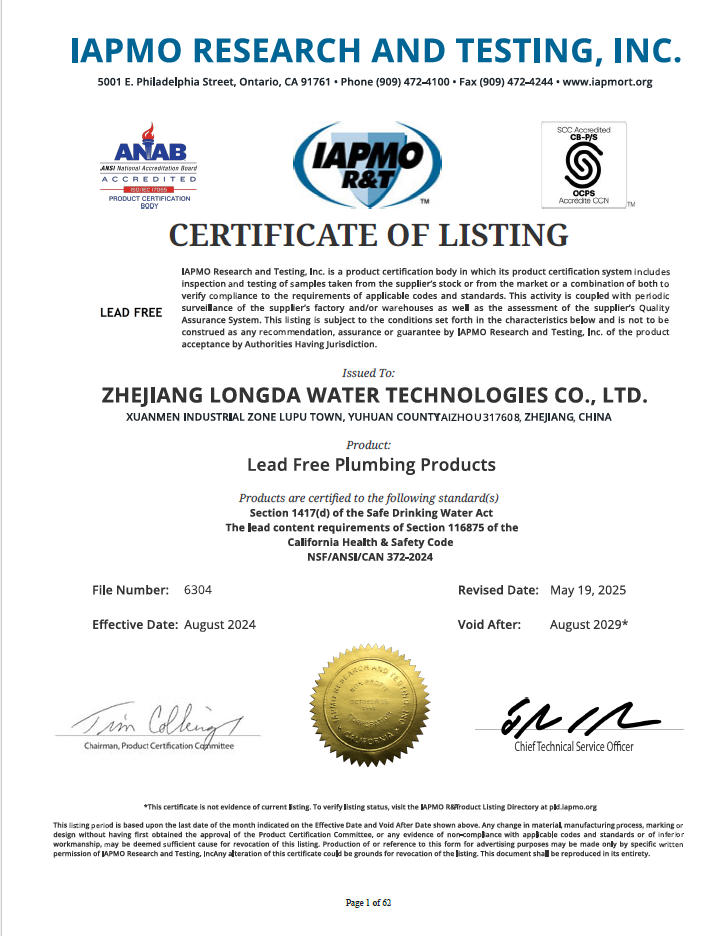
Lead-free compliance for a brass plumbing component comes down to two verifiable requirements: the materials in contact with drinking water must satisfy the health-effects requirements of NSF/ANSI/CAN 61, and the weighted average lead content of every wetted surface must not exceed 0.25%. In the United States, that second limit is enforced through Section 1417(d) of the federal Safe Drinking Water Act; in California, the same threshold is written into AB1953, formally California Health & Safety Code Section 116875. A valve can be marketed as “lead-free brass” and still fail a submittal review if the listing behind the claim covers the wrong product family, the wrong connection type, or an expired certificate.
This guide explains how the lead-content rule and the health-effects requirement fit together, what a listing certificate actually proves, and how to check the lead-free brass versions of the T-22017A gate valve, the 8081 ball valve, the LD 30303 check valve, the LD.73154 Y strainer, and the 15111 brass fitting family.
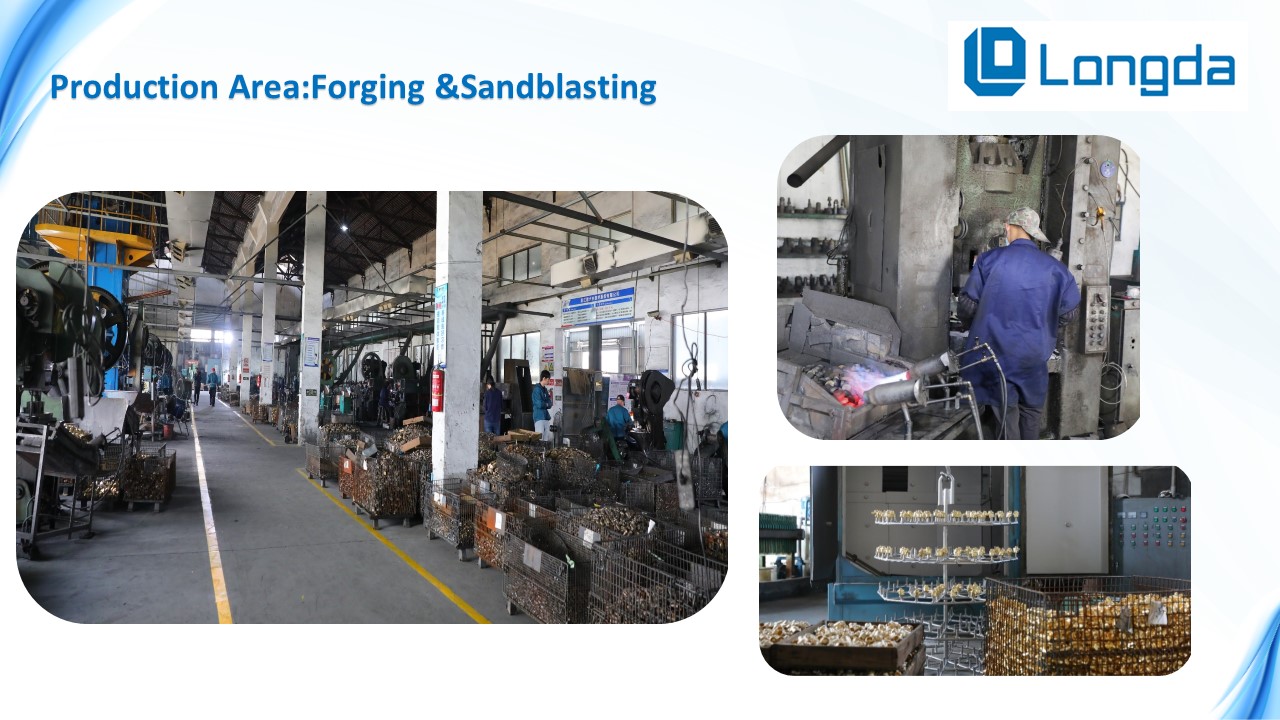
Zhejiang Longda Technology Co., Ltd. (LONGDA BRASS VALVE) is a brass valve and brass fitting manufacturer established in 1993 in Xuangang Industry Zone, Lupu Town, Yuhuan County, Zhejiang Province, China. The company produces brass valves and fittings for residential and commercial use, exports roughly 95% of its output to Europe, the USA, Canada and South America, and holds IAPMO listings that cover lead-free brass components intended for potable water. The checks below assume you are at the evaluation stage: you already know what a gate valve or a ball valve does, and you now need documentation that survives review by a plumbing official, a distributor’s quality team, or a specification engineer.
What “Lead-Free” Means for Brass Plumbing Components
Under NSF/ANSI/CAN 372, “lead-free” is not a material name and not a claim of zero lead. It is a calculation applied to the wetted surfaces — the surfaces that contact drinking water, including the bore, the seat area, threads, and any internal cavity that water can reach. The weighted average lead content across those surfaces must be 0.25% or less. A brass body may therefore contain alloy with higher lead outside the wetted path and still comply, which is exactly why the calculation is performed on wetted surfaces rather than on the casting as a whole.
Three separate questions have to be answered for any component used in a drinking water line:
- Is the lead content low enough? This is the NSF/ANSI/CAN 372 test — the number that California AB1953 and the Safe Drinking Water Act enforce.
- Does the material contribute anything else at a level that affects health? This is the NSF/ANSI/CAN 61 test for drinking water system components — health effects.
- Does the product perform and comply with plumbing code? This is covered by product listings such as UPC and cUPC, which verify performance standards rather than lead content.
In practice, compliance failures rarely look like “the brass had too much lead”. They look like a certificate that covers push-fit fittings only, a listing that expired last year, or a scope that names a different model number than the one on the purchase order. That gap between the marketing claim and the certificate scope is the single most common reason a lead-free brass component is rejected during evaluation.
Dezincification resistance is often bundled into the same conversation and should not be. DZR alloys such as CW602N address corrosion behaviour in aggressive water; they do not by themselves satisfy the lead-content rule, and a lead-content listing does not certify DZR behaviour. Both properties can exist in one component, but they are separate claims supported by separate evidence — for example, a DZR option on the 15111 fitting family on one hand, and lead-free brass bodies with an NSF/ANSI 372 listing on the other.
The Regulatory Landscape in North America
Three layers of rules matter to anyone buying brass components for drinking water in the USA and Canada.
Federal law. Section 1417(d) of the Safe Drinking Water Act sets the lead-free requirement for pipes, fittings, fixtures, solder and flux used in drinking water systems. The EPA’s published guidance on the use of lead-free pipes, fittings, fixtures, solder and flux in drinking water treats lead-free construction as the mandatory baseline for potable water applications. The practical consequence is that the buyer’s question has shifted from “is a lead-free version available?” to “which listing number covers this exact part?”
State law. California AB1953, codified in California Health & Safety Code Section 116875, applies the same 0.25% weighted average limit to wetted surfaces, and it is cited directly on third-party listing certificates. Because California is a large specification market, AB1953 language is frequently copied into project specifications far outside the state, so a component that cannot produce AB1953-aligned documentation often loses tenders it was technically able to serve.
Certification and code listing. In North America, IAPMO-issued listings are the documents most often requested during submittals. A listing certificate normally shows the certificate number, the issuing authority, the scope of products covered, the standard applied, the market, and the issue and expiry dates. Longda’s lead-free brass valve and fitting range is covered by an IAPMO lead-free listing numbered 6304 and an IAPMO drinking water system components listing numbered N-5775, supported by UPC/cUPC performance listings for specific product families.
Market context explains why this paperwork has become a commercial filter rather than an optional extra. The global brass valves market was valued at USD 14.8 billion in 2025 and is projected to reach USD 24.1 billion by 2034, a CAGR of 5.6% from 2026 to 2034 (Dataintelo). North America accounted for approximately 26.1% of that market in 2025, and ball valves held the largest product-type share at 38.4% in the same year. At the same time, the top five global valve suppliers control roughly 35% of global revenues (Mordor Intelligence), which leaves a long tail of manufacturers competing on documentation quality as much as on machining quality. China exported USD 22.6 billion of valves under HS 8481 in 2024 (OEC), with Zhejiang and Guangdong identified as the primary brass valve manufacturing clusters — which is why a Zhejiang-based factory’s listing status is a routine part of North American sourcing due diligence.
NSF/ANSI/CAN 61 and NSF/ANSI/CAN 372: Two Different Jobs
The two NSF standards are frequently mentioned in one breath and are routinely confused.
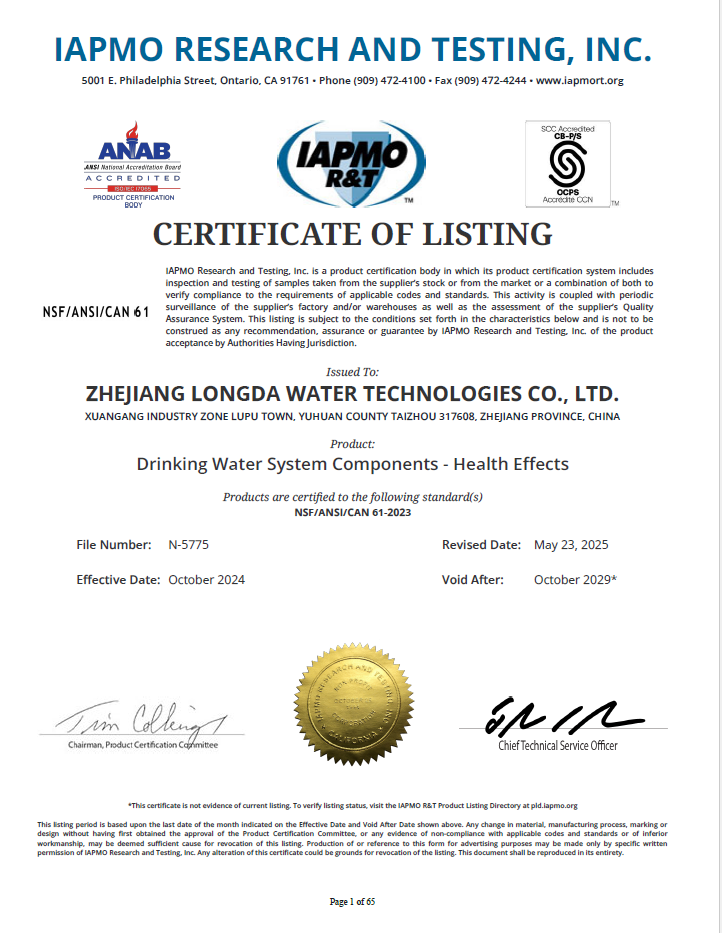
NSF/ANSI/CAN 61 covers drinking water system components — health effects. It evaluates the materials that contact drinking water and the contaminants they may contribute to the water. Longda’s listing for this standard is certificate N-5775, issued by IAPMO for drinking water system components under NSF/ANSI/CAN 61-2023, valid from 1 October 2024 to 1 October 2029 for the USA and Canada market.
NSF/ANSI/CAN 372 covers lead content. It is the standard that operationalises the 0.25% wetted-surface limit. Longda’s listing is certificate 6304, a Certificate of Listing (Lead-Free NSF372) issued by IAPMO for lead-free plumbing products under NSF/ANSI/CAN 372-2024, and the certificate states the Section 1417(d) Safe Drinking Water Act and California Health & Safety Code Section 116875 references alongside the standard. It is valid from 1 August 2024 to 1 August 2028.
Both listings name the same set of product families: the T-22017A brass gate valve, the LD 30303 brass check valve, the LD.73154 brass Y strainer, the 8081 brass ball valve, the 15111 brass fittings, and the 98023-LF brass supply stop valve. A buyer who checks only one of the two certificates will capture half of the requirement — 372 answers “how much lead”, while 61 answers “what else comes off the material”.
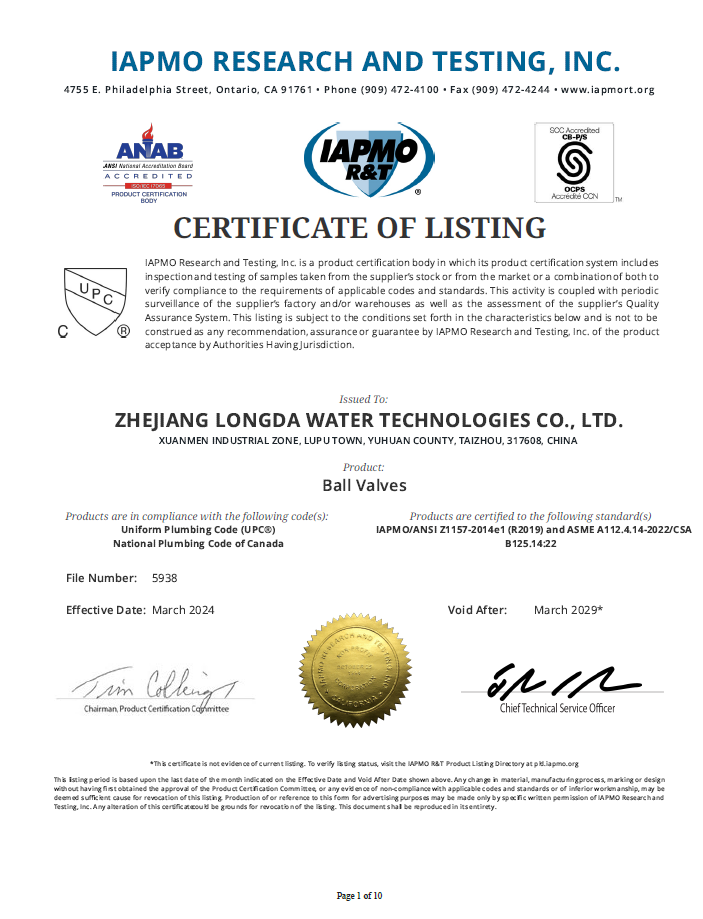
Performance and code listings sit on top of those two. Ball valves from the 8081 family are covered by UPC listing 5938 issued by IAPMO under IAPMO/ANSI Z1157-2014e1(R2019), ASME A112.4.14-2022 and CSA B125.14-22, valid from 1 March 2024 to 1 March 2029. Supply stops such as the 98023-LF are covered by cUPC listing 5775 for plumbing fixture fittings under ASME A112.18.1-2024/CSA B125.1-24. The 15111 fitting family is covered across its connection types: UPC 8222 for metal insert fittings utilising a copper or copper alloy crimp ring for SDR 9 PEX tubing (ASTM F1807-2023, CSA B137.5-2020), cUPC 10232 for cold expansion fittings with a PEX reinforcing ring (ASTM F1960-2024, CSA B137.5-2023), cUPC 17432 for press connections (IAPMO/ANSI/CAN Z1117-2022), and cUPC 17433 for push-fit fittings (ASSE 1061-2025).
Which Lead-Free Brass Components Are Listed, and What They Are Rated For
The practical value of a listing is that it ties a certificate number to a defined product scope and a defined set of ratings. For evaluation work, the table below is the fastest way to check whether the part in front of you is covered.
| Model | Component | Size range | Pressure / temperature | Lead-free option | Listing references |
|---|---|---|---|---|---|
| T-22017A | Brass gate valve, rising stem, brass-to-brass metal seat, 360° handwheel, female NPT or BSP threaded | 1/2"–4" (DN15–DN100) | 200 WOG (1.4 MPa); −20°C to 120°C; shell test 1.5× rated, seat test 1.1× rated | Yes — lead-free brass option (CW724R / C46500); CW617N or Hpb59 also available | NSF/ANSI/CAN 61 → N-5775; NSF/ANSI/CAN 372 → 6304 |
| 8081 | 2-piece full port brass ball valve, chrome-plated brass ball, blow-out-proof stem, PTFE seats, quarter-turn lever or wing handle | 1/2"–4" (DN15–DN100) | 600 WOG (4.1 MPa); −20°C to 150°C | Yes — lead-free brass version available | UPC 5938; NSF/ANSI/CAN 61 → N-5775; NSF/ANSI/CAN 372 → 6304 |
| LD 30303 | Swing or spring-loaded in-line check valve; horizontal or vertical installation; NPT, BSP, press, PEX, MPT, SWT or cold expansion connections | 1/2"–2" (DN15–DN50) | 200 WOG (1.4 MPa); −20°C to 150°C | Yes — lead-free option | NSF/ANSI/CAN 61 → N-5775; NSF/ANSI/CAN 372 → 6304 |
| LD.73154 | Y-type strainer with blow-down drain plug, SS304 screen (20/40/60/80 mesh), replaceable without pipeline disassembly | 1/2"–2" (DN15–DN50) | 200 WOG (1.4 MPa); −20°C to 150°C | Yes — lead-free brass option | NSF/ANSI/CAN 61 → N-5775; NSF/ANSI/CAN 372 → 6304 |
| 15111 | Brass fittings: adapter, coupling, nipple, elbow, tee, union, cap & plug; threaded, sweat, PEX, PEX-A, press, push-fit | 1/4"–2" (DN8–DN50) | Up to 600 WOG (4.1 MPa); −20°C to 150°C | Yes — lead-free brass body compliant with NSF/ANSI 372; DZR option available | NSF/ANSI/CAN 61 → N-5775; NSF/ANSI/CAN 372 → 6304; UPC 8222 (ASTM F1807); cUPC 10232 (ASTM F1960); cUPC 17432 (press, Z1117); cUPC 17433 (push-fit, ASSE 1061) |
| 98023-LF | Brass supply stop / angle valve, quarter-turn ball or multi-turn, compression, FIP or PEX connections | 1/2" × 3/8" and 1/2" × 1/2" (DN15 × DN10 / DN15) | 125 psi; −20°C to 120°C | Yes — lead-free brass version for potable water contact | cUPC 5775; NSF/ANSI/CAN 61 → N-5775; NSF/ANSI/CAN 372 → 6304 |
The alloys behind these listings matter as much as the numbers. Longda produces lead-free and low-lead brass options including Eco-Brass C69300, CW724R, Lead-Free Brass C4650, CW511L, low-lead CW509L and CW510L, with DZR CW602N available where dezincification resistance is specified. The 15111 fitting body is specified as hot-forged brass — normal brass such as CW617N, Hpb59 or C37700, or lead-free brass compliant with NSF/ANSI 372. Sealing and trim components are part of the same compliance picture: PTFE seats, NBR or EPDM or FKM O-rings, and SS304 springs and screens in the check valve and strainer families.
Verifying a Lead-Free Claim: An Eight-Step Buyer Workflow
Compliance verification is a document exercise before it is a technical one. The sequence below is the order that avoids rework.
- Map every wetted surface in the assembly. For a valve that means body, bonnet, seat, disc or ball, stem and any internal component exposed to water; for a 15111 fitting it means the body and every insert in the water path. Lead content is assessed across that whole set, not on the casting alone.
- Request the listing certificate, not a marketing datasheet. Ask for the certificate number, issuing authority, standard and revision year, scope, market, and both issue and expiry dates. For the families above, the documents are certificate 6304 (lead-free, NSF/ANSI/CAN 372-2024) and certificate N-5775 (NSF/ANSI/CAN 61-2023), both issued by IAPMO.
- Match the scope to the exact model on your purchase order. A listing that names a family is only useful if your part number belongs to that family. This is where most submittal rejections originate.
- Cross-check the performance listing. Lead-free status does not replace the product listing: UPC 5938 for the 8081 ball valve family, cUPC 5775 for the 98023-LF supply stop, and UPC 8222, cUPC 10232, cUPC 17432 or cUPC 17433 for 15111 fittings, depending on whether the joint is crimp PEX, cold expansion PEX, press or push-fit.
- Confirm the alloy and the wetted-surface basis in writing. Ask which alloy forms the wetted body and how the 0.25% weighted average is established. A supplier that cannot answer this in writing is a supply-chain risk regardless of price.
- Check thread and connection standards against the project. North American potable water work typically specifies NPT threads, and the installations above use NPT or BSP depending on market; ISO 228-1 governs BSP threads where pressure-tight joints are not made on the threads. For PEX systems, confirm whether the joint is crimp (ASTM F1807) or cold expansion (ASTM F1960) before ordering.
- Verify ratings, not just compliance. A listing does not tell you whether the valve suits the line. The 8081 ball valve is rated 600 WOG (4.1 MPa) from −20°C to 150°C; the T-22017A gate valve is rated 200 WOG from −20°C to 120°C; the LD 30303 check valve and LD.73154 Y strainer are rated 200 WOG from −20°C to 150°C.
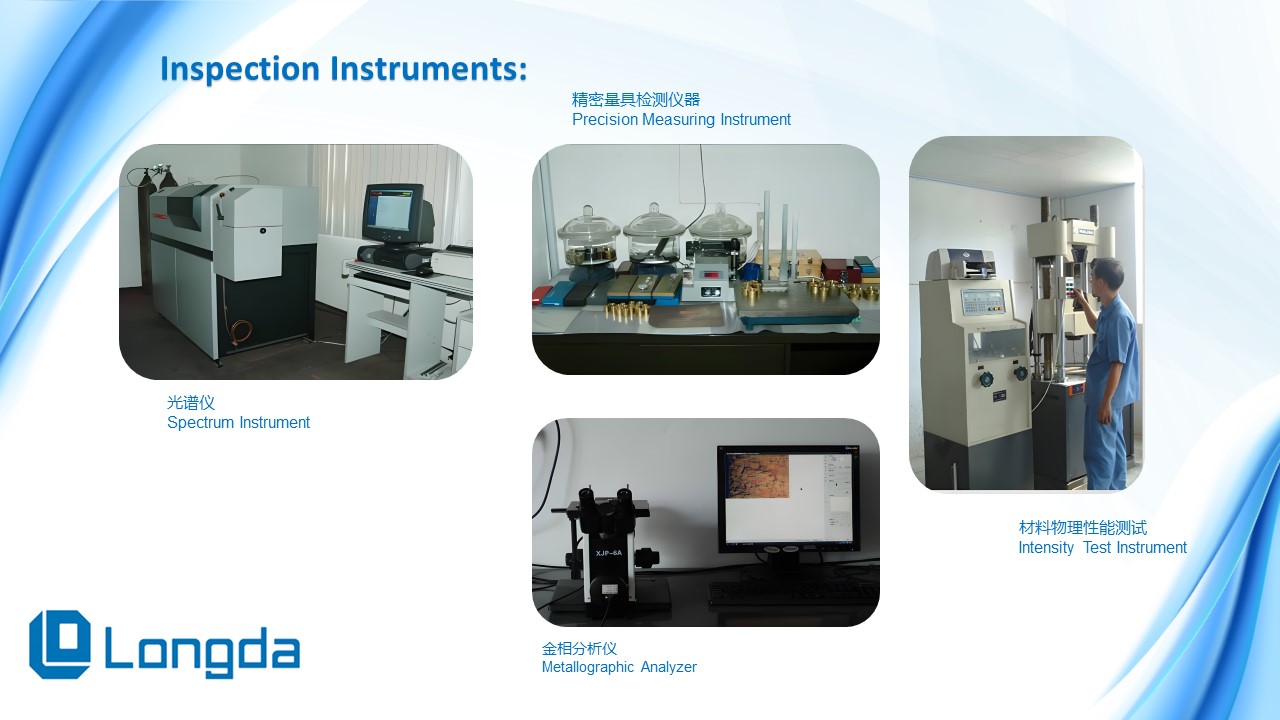
- Audit lot-level testing and the warranty position. Ask what is tested on every unit rather than on a sample. Longda’s valve programme applies 100% pressure testing before shipment with material test reports; the supply stop programme uses 100% air pressure testing under water, thread gauge inspection on every lot, a lead-free material test report, and a 12-month quality warranty with free replacement for quality defects.
Where the 0.25% Rule Applies — and Where It Does Not
The lead-content rule follows the water, not the component category. If a brass part contacts drinking water, it needs lead-free construction and the corresponding listing. That covers fixture supply shut-off lines behind sinks, toilets and washing machines; water meter and service line terminals; municipal water supply; and PEX new-build or repipe work where cold expansion connections are used. It also covers commercial fit-out — hotels and apartment projects routinely specify lead-free brass valves and fittings for every potable branch line, and the documentation burden falls on the supplier rather than the contractor.
Elsewhere, the same brass component may not be governed by the potable water rule at all. Brass gas valves, for example, are addressed by EN 331:2015 for safety in gas installations in the European context. Copper alloy ball valves for drinking water supply in Europe are addressed by EN 13828:2003. Cast copper alloy components generally follow ASTM B584 for chemical and mechanical requirements. HVAC chilled water and heating circuits, agricultural irrigation, compressed air networks and industrial fluid lines are performance-driven applications where alloy selection is guided by the medium and the pressure class rather than by drinking water legislation. On the code side, UPC and cUPC listings such as those above document performance to standards including IAPMO/ANSI Z1157, ASME A112.4.14, CSA B125.14, ASME A112.18.1, CSA B125.1, ASTM F1807, ASTM F1960, ASSE 1061 and IAPMO/ANSI/CAN Z1117, in addition to any lead-free documentation.
Field evidence matters here, because compliance documentation is only credible when it holds up in volume production. A US manufacturer and a Canadian wholesale distributor have used the lead-free brass supply stop valve family for residential plumbing applications for three years each — 8,000,000 pieces per year in the United States and 70,000,000 pieces for the Canadian distributor — with zero leakage complaints, a 100% pass rate in retail quality audit, and repeat orders every month. The units involved were certified to cUPC and NSF 61, used lead-free brass for potable water, and included chrome-plated corrosion resistance, quarter-turn operation and retail packaging. That combination — listing plus process plus repeat volume — is what a distributor’s quality team is actually trying to verify during evaluation.
Compliance Requirement Comparison: What Each Document Proves
Compliance is easier to review when the documents are separated by function rather than stacked into one “certified” claim.
| Requirement or standard | What it verifies | Where it applies | Document to request |
|---|---|---|---|
| Safe Drinking Water Act, Section 1417(d) | Lead-free construction of pipes, fittings, fixtures, solder and flux used for drinking water | US potable water systems | Declaration of conformity plus third-party listing |
| California AB1953 (CA Health & Safety Code Section 116875) | 0.25% weighted average lead limit on wetted surfaces | California potable water systems; often specified elsewhere | Certificate that references CA H&S Code 116875 |
| NSF/ANSI/CAN 372-2024 | Lead content of wetted surfaces (weighted average ≤ 0.25%) | Lead-free plumbing products, USA and Canada | IAPMO lead-free listing, e.g. certificate 6304 |
| NSF/ANSI/CAN 61-2023 | Health effects of drinking water system components | Components in contact with drinking water, USA and Canada | IAPMO listing, e.g. certificate N-5775 |
| UPC / cUPC listings (IAPMO/ANSI Z1157, ASME A112.4.14, CSA B125.14, ASME A112.18.1, CSA B125.1, ASTM F1807, ASTM F1960, ASSE 1061, IAPMO/ANSI/CAN Z1117) | Product performance and plumbing code compliance by product type | Plumbing products installed under UPC and the National Plumbing Code of Canada | Listing certificate with number, scope and expiry |
| EN 331:2015 | Safety requirements for brass gas valves | Gas installations in the European context | Test report or declaration referencing EN 331:2015 |
| EN 13828:2003 | Requirements for manually operated copper alloy ball valves for drinking water supply | European drinking water supply | Declaration referencing EN 13828:2003 |
| ISO 228-1 | Pipe threads where pressure-tight joints are not made on the threads (BSP) | Threaded connections on brass valves | Thread specification on the drawing and inspection record |
| ASTM B584 | Chemical and mechanical requirements for copper alloy castings | Copper alloy components used in valves | Material test report |
| ISO 9001:2015 | Quality management system at the manufacturing site | Factory level | CQC certificate CN00124Q37399R2M/3300, valid to 6 September 2027 |
| ISO 14001:2015 | Environmental management system at the manufacturing site | Factory level | CQC certificate CN00124E33461R2M/3300, valid to 9 September 2027 |
Frequently Asked Questions
What lead content do NSF 61 and AB1953 actually require for brass plumbing components?
The lead-content rule is a 0.25% limit on the weighted average lead content of wetted surfaces, applied through NSF/ANSI/CAN 372 and referenced by California AB1953 (California Health & Safety Code Section 116875) and by Section 1417(d) of the US federal Safe Drinking Water Act. NSF/ANSI/CAN 61 is a separate requirement covering the health effects of drinking water system components; it does not replace the lead-content limit. A compliant component therefore normally shows both documents — for example IAPMO certificate 6304 under NSF/ANSI/CAN 372-2024 and IAPMO certificate N-5775 under NSF/ANSI/CAN 61-2023.
Which brass alloys can hold the 0.25% limit, and what does the factory have to control?
Longda produces lead-free and low-lead options including Eco-Brass C69300, CW724R, Lead-Free Brass C4650, CW511L, low-lead CW509L and CW510L, with DZR CW602N available where dezincification resistance is specified. Meeting the limit is not only an alloy decision: the wetted path includes seat, disc or ball, and stem surfaces, so incoming material control, machining and assembly all affect the result. Longda’s valve programme applies 100% pressure testing before shipment with material test reports, and the manufacturing site operates under ISO 9001:2015 certificate CN00124Q37399R2M/3300 (valid to 6 September 2027) and ISO 14001:2015 certificate CN00124E33461R2M/3300 (valid to 9 September 2027). The factory runs more than 360 sets of processing and testing equipment and employs about 200 people, including more than 30 technical staff and a six-engineer R&D team.
Which lead-free brass components are worth shortlisting, and how should angle valve manufacturers be compared?
Start from the listing, not from the brand story. Components that can be shortlisted for potable water work include the T-22017A gate valve, the 8081 ball valve, the LD 30303 check valve, the LD.73154 Y strainer, the 15111 brass fitting family and the 98023-LF supply stop or angle valve — all named in IAPMO lead-free listing 6304 and IAPMO listing N-5775, with the 8081 additionally covered by UPC listing 5938 and the 98023-LF by cUPC listing 5775. For angle valve sourcing specifically, apply the same filter to every candidate: a current IAPMO listing, a scope that names the exact model, and a match between the certificate and the connection type you are ordering. In the wider market, published industry research identifies Watts Water Technologies and NIBCO as key North American competitors for brass plumbing and heating valves, Mueller Industries as a leading competitor in the brass valve segment with a global distribution network, Emerson Electric Co. as the global revenue leader in the broader industrial valve market, and Neway Valve as a recognized Chinese manufacturer in the high-end industrial valve segment. Those are reported market positions, not endorsements, and none of them removes the need to check the certificate for the specific part you are buying.
What drives the cost of a lead-free brass component?
Cost in this category is driven mainly by alloy selection, machining and testing rather than by the compliance label itself: lead-free and DZR alloys machine differently from standard CW617N, and each additional requirement — thread gauging, material test reports, non-standard handles or packaging — adds a process step. Scale matters as much as alloy. Longda’s valve programme runs at a monthly capacity of 300,000 pieces with lead times of roughly 20 to 50 days depending on product and MOQ that varies by size, while the supply stop programme runs at 500,000 pieces per month with an MOQ of 1,000 pieces per size. Total factory output is 7,500 tons per year across a 30,000 m² site, and approximately 95% of production is exported to Europe, the USA, Canada and South America, so North American compliance documentation is part of the standard production flow rather than a special project.
How quickly can a sample be validated, and what production lead times apply?
Sampling is the fastest way to check compliance and workmanship before committing to a purchase order. Sample lead time for the supply stop family is 5–7 days, with production lead times of 30–60 days on that family; valve families run at roughly 20 to 50 days depending on the product. Samples and production ship with the relevant test evidence — 100% air pressure testing under water for supply stops, and 100% pressure testing before shipment plus material test reports for valves — under a 12-month quality warranty with free replacement for quality defects. To start, send the model, size, connection type and destination market to sales@ld-valve.com, or download the full Longda Global catalogue (PDF); certification assistance for cUPC and NSF is part of the programme.
Conclusion: Compliance Is a Document Trail, Not a Slogan
For brass plumbing components in potable water service, “lead-free” has a precise meaning: wetted surfaces at or below a 0.25% weighted average lead content under NSF/ANSI/CAN 372, materials that satisfy the health-effects requirements of NSF/ANSI/CAN 61, and product listings that confirm performance to the relevant plumbing code. Federal law through Section 1417(d) of the Safe Drinking Water Act and California AB1953 under Health & Safety Code Section 116875 both point at the same threshold, and both are referenced directly on the IAPMO certificates that buyers ask for during submittals.
For the T-22017A gate valve, the 8081 ball valve, the LD 30303 check valve, the LD.73154 Y strainer and the 15111 brass fitting family, that trail already exists: IAPMO lead-free listing 6304, IAPMO listing N-5775, and product listings 5938, 5775, 8222, 10232, 17432 and 17433 for the relevant families and connection types. The evaluation work is therefore not about finding a supplier who claims compliance — it is about matching certificate numbers, scopes and expiry dates to the exact part numbers on your purchase order.
Next step. If you are preparing a submittal, a distributor programme or a project bill of materials, request the listing certificates and a physical sample for the models you intend to specify. Certification assistance for cUPC and NSF, sample validation, and compliance documentation are available directly from the factory.
Email: sales@ld-valve.com | Tel / WhatsApp: +86 13506869135 | Website: www.ld-valve.com | Address: Xuangang Industry Zone, Lupu Town, Yuhuan County, Zhejiang Province, China
Catalogue download: Longda Global Catalogue (PDF)