
Swing or Spring-Loaded? Choosing the LD 30303 Check Valve
Swing or Spring-Loaded? Choosing the LD 30303 Brass Check Valve for Pumping Systems
The LD 30303 brass check valve is supplied in two versions, swing and spring-loaded, built on the same hot-forged brass body and held to the same -20°C to 150°C, 200 WOG (1.4 MPa) envelope in sizes from 1/2" to 2" (DN15–DN50). The version you specify should be decided by how the disc closes and where the valve sits, not by the shell around it.
The short answer: choose spring-loaded for pump discharge lines, vertical runs and shared headers where reverse flow has to be stopped quickly. Choose swing for horizontal lines carrying debris, where low pressure loss matters more than closing speed. Because both versions share the body material, the disc design and the PTFE sealing face, the decision is mechanical rather than a question of which one is better built.
This guide explains how each type behaves in a pumping system, compares them on the criteria that change a specification, and closes with a selection checklist plus the points to confirm about NSF/ANSI 61 and NSF/ANSI 372 documentation on the lead-free version.
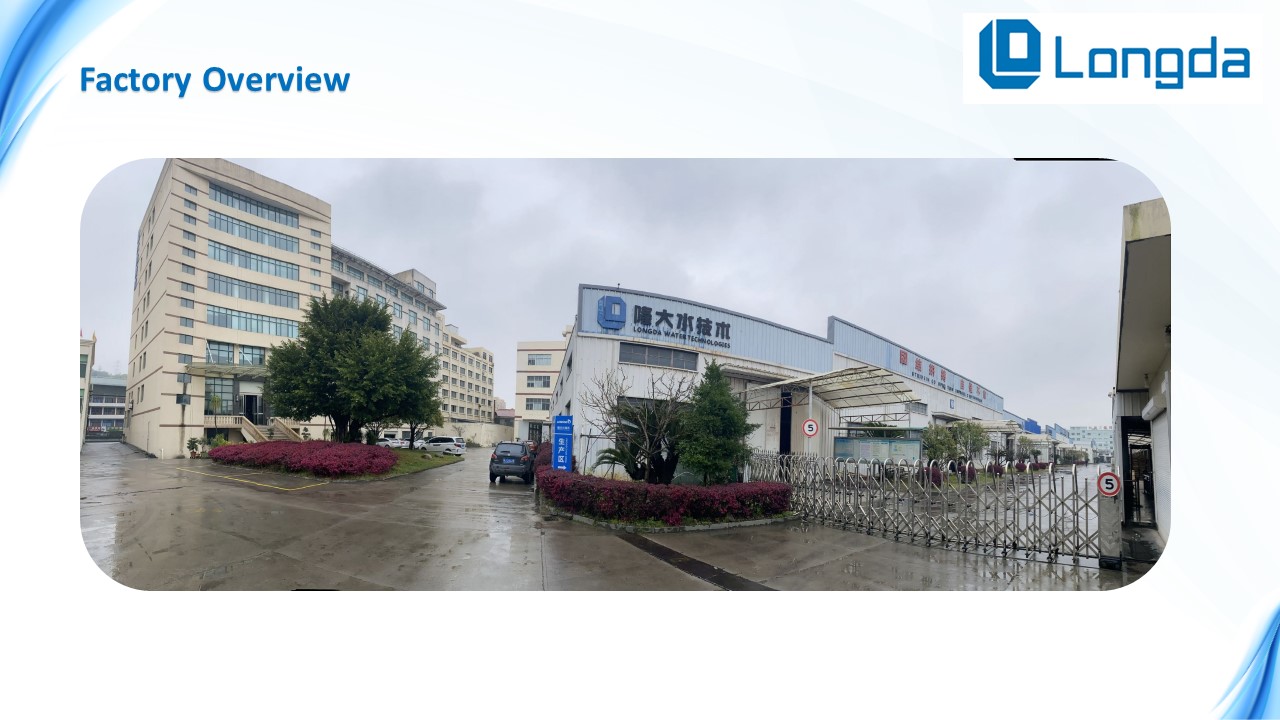
LONGDA BRASS VALVE operates a 30,000 m² manufacturing site in Yuhuan County, Zhejiang Province.
What a check valve actually does in a pump line
A check valve is an automatic valve. It has no handle and no actuator, and it closes only because flow reverses. In a pumping system that single behaviour carries four separate jobs: stopping the pump from spinning backwards after a trip, preventing backflow from contaminating the supply, blocking short-circuit circulation between pumps on a shared header, and limiting the surge that follows a sudden stop.
Those jobs are not equally demanding. Preventing backspin requires the valve to seat while reverse flow is still small. Blocking short-circuit circulation requires it to hold against a steady differential. Limiting surge depends on how the whole pipe system absorbs the pressure wave, not on the valve alone. A valve that satisfies one requirement can miss another, which is why the disc mechanism rather than the pressure class is the deciding variable.
One boundary has to be stated before any comparison. A check valve is not an isolation valve. It cannot be locked closed, it gives no visible open or closed position, and it should not be relied on for maintenance isolation. Lines that need both functions use a check valve for direction control and a gate or ball valve for isolation. A check valve specified as an isolator will fail that requirement at the first maintenance shutdown, and no amount of build quality changes it.
Industry context behind the specification
Third-party estimates place the isolation-function segment of the industrial valve market, the group that includes gate, globe and check valves, at USD 26.15 billion in 2024 (Cognitive Market Research). Dataintelo values the global brass valve market at USD 14.8 billion in 2025 and projects USD 24.1 billion by 2034. Both are third-party estimates quoted here as market context, not as a measure of any supplier's position or of how suitable a valve is for a given line.
The buyer-relevant point is not the total. It is that check valves of the same nominal size and pressure class are offered with widely different internal designs, and the visible shell says very little about which one you received. Two valves can both be marked 1/2" and 200 WOG and still differ in closing speed, seat loading and orientation limits. That is why model-level confirmation of disc type, spring material, seat material and connection standard carries more weight than a catalogue headline.
How the swing version closes
In the swing version, a brass disc hinged on a pivot swings out of the flow path while the pump runs and falls back onto the seat when flow reverses. Because the disc travels through an arc, the open valve leaves a comparatively clear bore, and closing is driven almost entirely by the returning fluid rather than by stored energy.
That gives the swing type three practical characteristics. Pressure loss is the lower of the two designs at the same nominal size, because the disc sits outside the flow path when open. Closing is slower and depends on how quickly reverse flow develops. And the valve carries no spring, so there is no spring to fatigue, but the hinge pin and disc face become the wear points to inspect.
Swing valves are most predictable on horizontal runs, where gravity assists seating. Vertical installation is possible in many designs but should be confirmed model by model with the supplier instead of assumed. In low-flow or pulsating service the disc can flutter against the seat rather than settling, which produces noise and accelerated seat wear. Debris tolerance is generally better than in a guided design, although debris that collects on the seat will hold the disc open and create continuous backflow.
How the spring-loaded version closes
In the spring-loaded version the disc travels axially along the flow axis, and an SS304 stainless steel spring pushes it toward the seat. The spring begins closing the valve as flow decays, before reverse flow is fully established, so seating does not depend entirely on the returning fluid.
Three consequences follow. The valve seats faster and more consistently, which matters most on a pump discharge where backspin risk begins immediately at trip. Orientation has little effect on closing behaviour in most axial designs, which makes the type practical for vertical risers. And pressure loss is higher than in a swing valve of the same size, because flow passes around the guided disc and the spring rather than through an open bore.
The spring also introduces two conditions worth planning for. The guide clearance that keeps the disc aligned can trap particles, so a strainer upstream is advisable in dirty service. And a faster seat contact can raise the surge peak in a system with high velocity and long pipe runs; the valve and the pipe layout have to be assessed together rather than treating faster closure as automatically safer.
What both versions share
Both LD 30303 versions are built on the same material platform, which keeps the comparison focused on mechanism instead of on build quality.
- Hot-forged body in normal brass or lead-free brass. Forging produces a denser structure than casting and closes the internal porosity that can become a leak path. The lead-free brass variant is the one to specify where the valve contacts potable water.
- Brass disc with a PTFE sealing face. PTFE is chemically inert across a wide range of media and gives a low-friction sealing surface that resists sticking to the seat after long idle periods.
- SS304 stainless steel spring in the spring-loaded version. Stainless construction is the reason the spring element is compatible with potable water service rather than being a corrosion point.
- One rating envelope and one size range covering both types, so a line schedule can switch between them without changing the pipe, the thread or the space allowance.
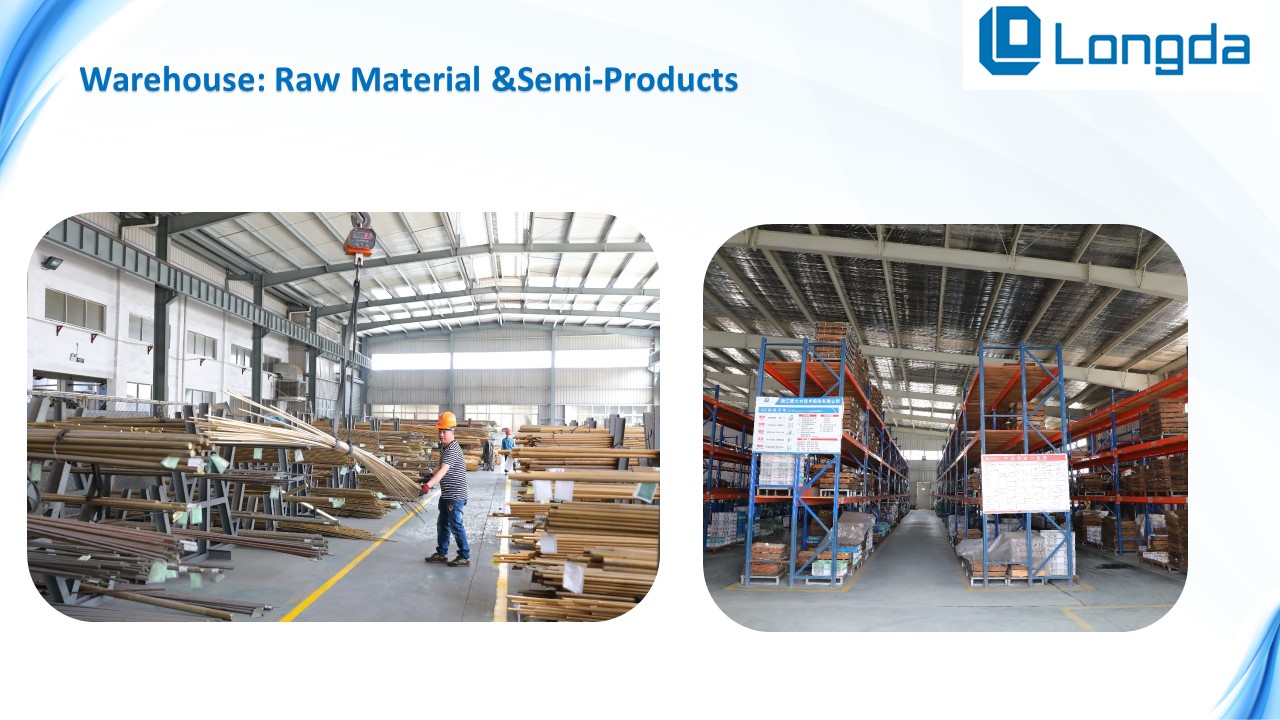
Machining operations on forged brass bodies, LONGDA BRASS VALVE.
The shared envelope is the commercial reason the choice stays simple. Switching between types does not change the connection, the installation length or the pressure class, so a distributor can carry one body platform and still cover both behaviours.
| Parameter | LD 30303 specification (both versions) |
|---|---|
| Body material | Hot-forged normal brass or lead-free brass |
| Disc | Brass disc with PTFE sealing face |
| Spring (spring-loaded version) | SS304 stainless steel |
| Temperature range | -20°C to 150°C |
| Pressure rating | 200 WOG (1.4 MPa) |
| Size range | 1/2" to 2" (DN15–DN50) |
| Connections | Female NPT, BSP, PRESS, PEX, MPT or SWT |
Swing versus spring-loaded, criterion by criterion
The table below compares the two versions only on points that change a specification. It does not score them, because neither design is superior in general; each is superior on the lines described in the right-hand column.
| Criterion | Swing | Spring-loaded |
|---|---|---|
| Closing force | Reverse flow only | Reverse flow plus SS304 spring |
| Closing speed | Slower; governed by how fast reverse flow develops | Faster; the spring acts as flow decays |
| Mounting orientation | Most predictable on horizontal runs; confirm vertical use per model | Largely orientation-independent in most axial designs |
| Pressure loss | Lower at equal nominal size; open disc sits outside the flow path | Higher; flow passes around the guided disc and spring |
| Debris tolerance | Better; solids can settle and flush, but debris on the seat holds the disc open | Lower; guide clearance can trap particles, so an upstream strainer is advisable |
| Surge behaviour | Slower seat contact can soften the slam, but a disc that has not sealed allows sustained reverse flow | Limits reverse flow sooner, but faster seat contact can raise the surge peak; assess with the pipe system |
| Wear points to inspect | Hinge pin and disc face | Spring condition and guide clearance |
| Part count and unit cost logic | Fewer parts, typically the lower unit price | Spring and guide add parts and assembly steps, typically the higher unit price |
| Strongest position | Horizontal transfer lines, low-head loops, dirty water with filtration | Pump discharge, vertical risers, multi-pump headers |
Read the table in pairs rather than as a scorecard. The swing valve wins on pressure loss and debris tolerance; the spring-loaded valve wins on closing certainty and orientation freedom. Every real specification trades one against the other, and the trade should be made against the line the valve will sit in, not against a preference for one mechanism.
The cost question: where the difference comes from
The spring-loaded version normally carries the higher purchase price, and the reason is structural rather than positional. It contains a spring and a guide that the swing version does not, and those parts add machining, assembly and inspection steps. The swing version has fewer components, so its unit cost is typically lower at equivalent body material and connection type.
Whether the difference is worth paying depends on what a failure would cost. On a pump discharge, a valve that seats late allows the pump to spin backwards and can damage the impeller, the mechanical seal or the coupling, and the repair cost is normally far above the price gap between the two types. On a long horizontal transfer line with clean water and modest head, fitting the spring-loaded version buys closing speed the line does not need while adding a permanent pressure-loss penalty to every hour of pumping. That is the case where the cheaper valve is also the more efficient one.
A practical way to test whether a quotation is reasonable is to ask for both versions side by side and ask what the difference consists of. A supplier who can name the added parts and process steps is describing a real cost base. A supplier who cannot explain the gap is quoting a position rather than a product.
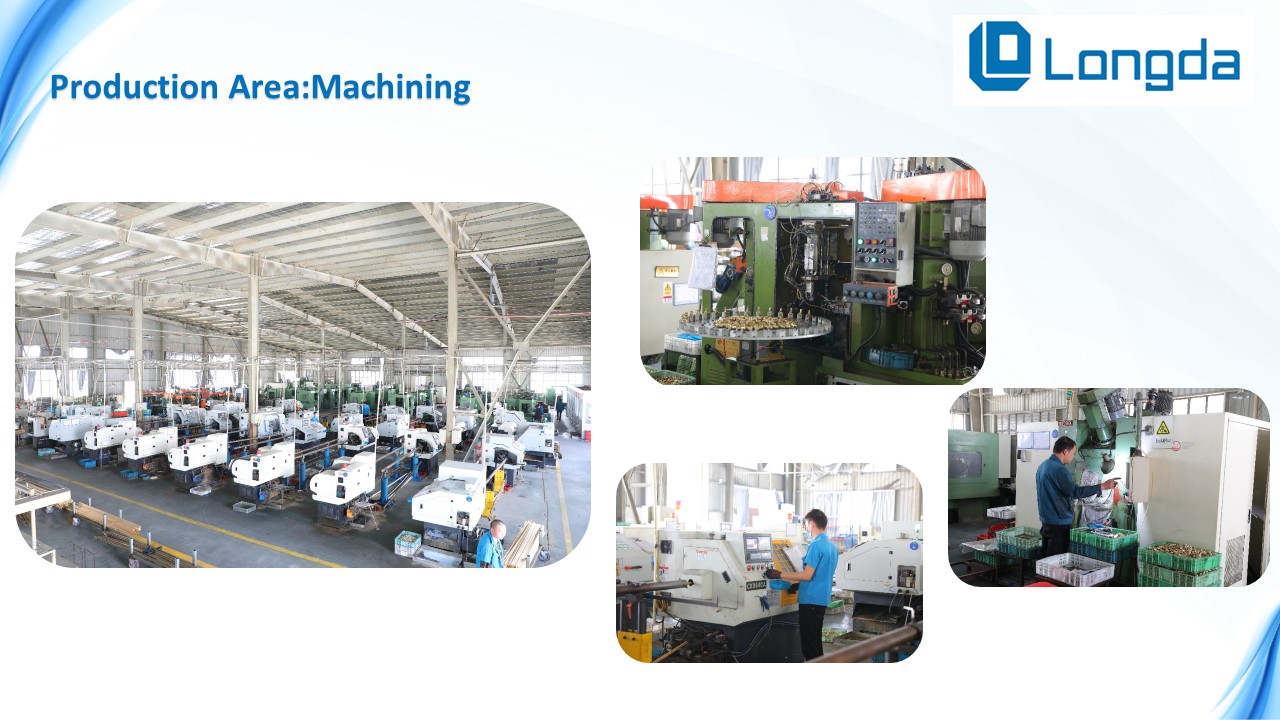
Assembly operations at LONGDA BRASS VALVE. Both check valve versions share one forged body platform.
Matching each type to a position in the system
Most specification errors come from applying one type everywhere. The six positions below cover the situations that appear most often in water supply and pumping work.
Single booster pump on a horizontal line. Swing is usually the better fit. The line is horizontal, gravity helps the disc seat, and the lower pressure loss reduces the head the pump has to produce. Confirm that the pump's shut-off head and the reverse-flow velocity are enough to seat the disc promptly.
Vertical multistage pump discharge. Spring-loaded. Upward flow in a vertical riser makes a gravity-seated disc unreliable, while the axial design closes regardless of orientation and limits backspin as soon as the pump stops.
Two or more pumps on a common header. Spring-loaded on each discharge. The requirement is not only to stop backspin but to prevent one running pump from circulating through a idle one, and that needs a valve that closes against a steady differential in either orientation.
Irrigation or raw-water transfer. Swing, with a strainer upstream. The open bore passes sand and organic matter better than a guided design, but the seat still has to be protected, because a disc held off its seat by debris gives continuous backflow and a pump that never fully isolates.
Hot-water and heating circuits up to the top of the range. Both types are available across the shared -20°C to 150°C envelope, and the PTFE sealing face is the same in either. Confirm the allowable pressure at your actual operating temperature with the supplier, since a 200 WOG (1.4 MPa) rating and a 150°C limit are separate envelope values rather than a combined promise.
Retrofit work in tight spaces. The connection type may decide the specification before the mechanism does. Female NPT, BSP, PRESS, PEX, MPT and SWT options exist across the range, but the exact combination of size, connection and type should be confirmed rather than assumed from a catalogue matrix.
Selection checklist
Work down the table with the actual line in front of you. The first condition that matches normally settles the specification.
| If this describes the installation | Specify |
|---|---|
| Valve sits on a pump discharge | Spring-loaded |
| Vertical riser with upward flow | Spring-loaded; confirm swing suitability only if a specific reason requires it |
| Several pumps feeding one header | Spring-loaded on each pump outlet |
| Low-flow or pulsating flow where disc chatter is a risk | Spring-loaded, because the spring keeps the disc loaded against the seat |
| Horizontal run, clean water, pressure loss is a running cost | Swing |
| Fluid carries sand, scale or organic debris | Swing plus an upstream strainer |
| Potable water contact in the United States or Canada | Lead-free brass body, with NSF/ANSI 61 and NSF/ANSI 372 documents confirmed for the exact model |
Before you order: the confirmation list
Specification is only half the decision. The other half is confirming that the valve delivered matches the valve specified.
- Certification scope, not certification claims. For the lead-free version, request copies of the NSF/ANSI 61 and NSF/ANSI 372 listings and check that the size and connection you are buying appear on them. NSF/ANSI 372 defines lead-free as a wetted-surface lead content of no more than 0.25%, and NSF/ANSI 61 covers health effects of the wetted materials. LONGDA BRASS VALVE holds IAPMO and ALS certification, which is a useful starting point, but a company-level certificate should be read together with the model-level listing rather than instead of it.
- Thread and connection standards. NPT threads should conform to ASME B1.20.1; BSP connections reference ISO 228-1 for joints where sealing is not made on the thread. For PRESS, PEX and SWT connections, confirm compatibility with the press tool or pipe system already specified on the project.
- Pressure at temperature. Ask what allowable pressure applies at your maximum operating temperature inside the -20°C to 150°C range, rather than reading 200 WOG (1.4 MPa) as valid everywhere in that range.
- Test records tied to your order. A factory may hold pressure-testing and thread-inspection equipment, but the record that matters is the one attached to the batch you receive. Ask for it by model and date.
- Sample and delivery commitments in writing. For reference, LONGDA reports sample lead times of 5–7 days, quotation responses within 24 hours and an on-time delivery rate above 98% on its supply-stop programme. Those figures describe that programme, not every product line, so ask for the equivalent commitment on a check valve order and put it in the PO.
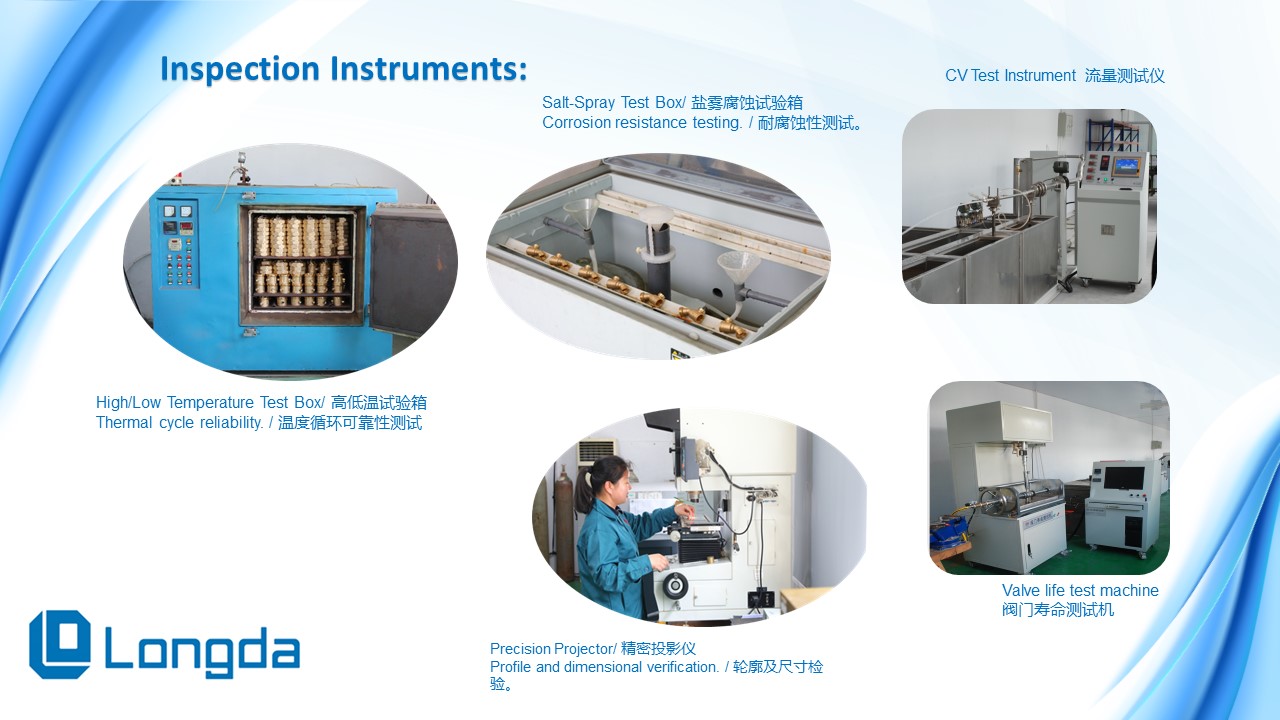
Testing equipment at LONGDA BRASS VALVE. Ask for the record tied to your specific batch.
Frequently asked questions
Does the lead-free LD 30303 come with NSF/ANSI 61 and NSF/ANSI 372 certificates?
The lead-free brass version is the one to specify for potable water, because NSF/ANSI 372 requires wetted-surface lead content of no more than 0.25% and NSF/ANSI 61 addresses health effects of wetted materials. Certification is issued against specific models and manufacturing sites, so request the listing copies covering the exact size and connection you are ordering, and check that the model on the certificate matches the model on the PO. A supplier-level certificate does not automatically cover every variant in a range.
Can the spring-loaded version be installed on a vertical pipe?
Yes, in most axial spring-loaded designs the closing behaviour is largely independent of orientation, which is why this type is normally chosen for vertical risers and pump discharges. Confirm the flow-direction marking and the manufacturer's installation instruction for the specific model. The swing version can also be installed vertically in some designs, but it should be confirmed model by model rather than assumed, because gravity assists seating only on a horizontal run.
Why does the spring-loaded version usually cost more?
It contains an SS304 stainless steel spring and a disc guide that the swing version does not, and those components add machining, assembly and inspection steps to the same forged body. Whether the higher unit price is justified depends on the failure cost at that position. On a pump discharge the difference is normally small against the cost of a backspun pump; on a long clean-water horizontal run it adds cost and pressure loss without buying a benefit the line needs.
Can I evaluate both types before committing to a programme?
Ask for both versions in the same size and connection so the comparison is like for like, and confirm that the samples represent the production build, including body material and connection type. Sample lead time varies by programme; LONGDA reports 5–7 days and quotation responses within 24 hours on its supply-stop programme, which is a reasonable benchmark to quote when you request equivalents for a check valve order.
What delivery terms should I confirm before placing an order?
Confirm standard lead time, the peak-season schedule and how on-time delivery is measured, then write all three into the order. LONGDA reports an on-time delivery rate above 98% on its supply-stop programme, and the equivalent figure for a check valve order should be requested explicitly rather than assumed. You can review the full range and request samples or a quotation through LONGDA BRASS VALVE, or download the company catalogue.
Conclusion
The LD 30303 choice comes down to one question: does the valve need to close before reverse flow builds, or does it need to stay out of the way of the flow? Spring-loaded answers the first, and belongs on pump discharges, vertical risers and shared headers. Swing answers the second, and belongs on horizontal lines where debris and pressure loss dominate. Both are built on the same hot-forged brass body, use the same brass disc with a PTFE sealing face, and fit the same -20°C to 150°C, 200 WOG (1.4 MPa), 1/2"–2" (DN15–DN50) envelope with female NPT, BSP, PRESS, PEX, MPT or SWT connections.
The remaining work is documentary. Confirm the certificate scope on the lead-free version, the allowable pressure at your operating temperature, the thread standard and the batch test record, then put sample and delivery commitments in writing. A check valve is a low-cost component protecting high-cost equipment, and the specification plus the paperwork is what makes that protection real.
Have Questions or Need More Details?
Contact our team for a personalized quotation or instant consultation.
Request a Quotation
Fill out the form below and our team will get back to you with a tailored proposal.
WhatsApp Direct Chat
Prefer to chat in real-time? Message us on WhatsApp for instant assistance & quick answers.
- Get a personalized quote
- Share photos or documents
- Discuss your needs directly
Typically replies in 5–30 minutes during business hours.