
Swing vs. Spring-Loaded Brass Check Valves: A Comparison Guide for Pumping Systems
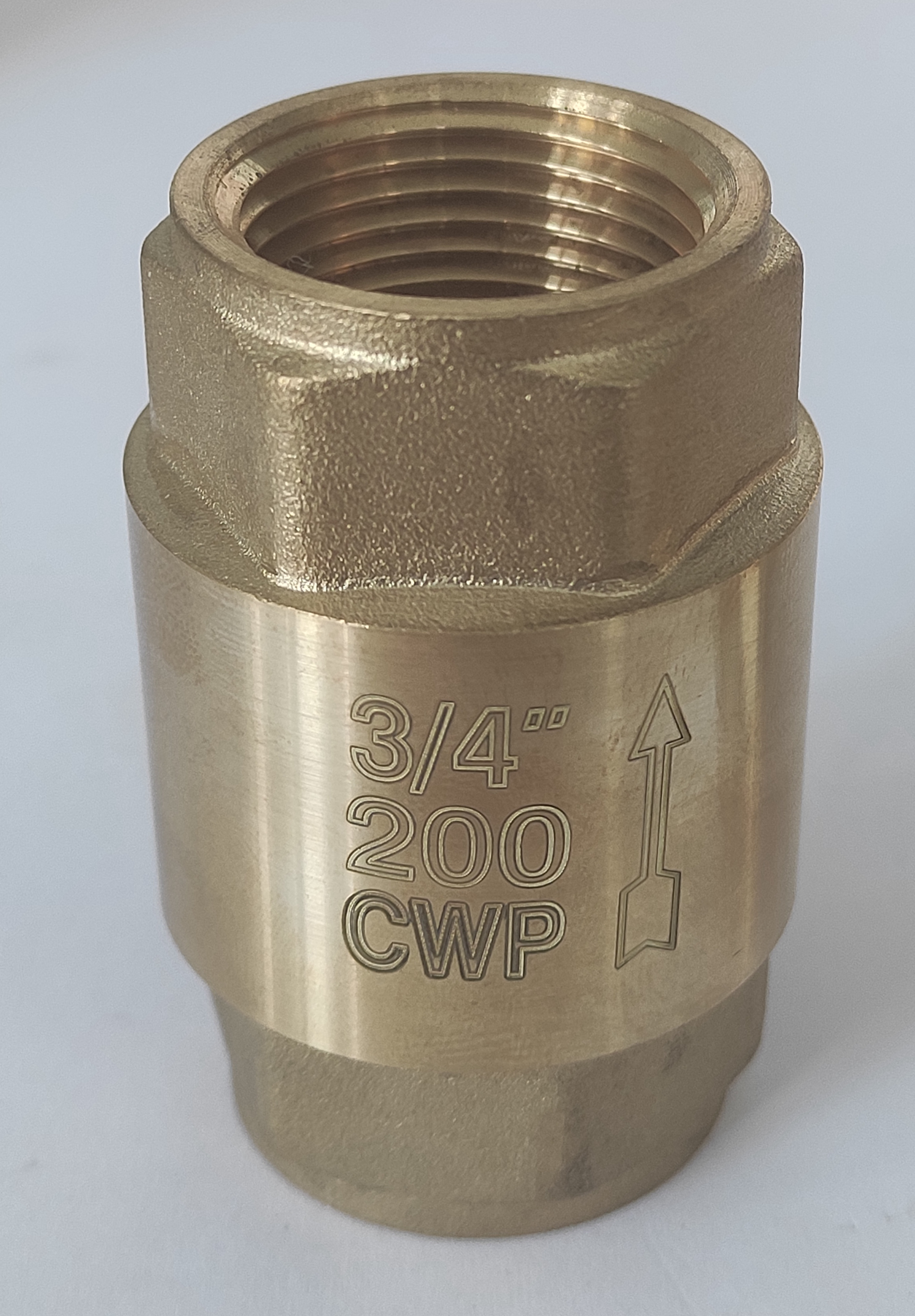
Cover: lead-free brass spring-loaded inline check valve with female NPT threads, LD 30303 series. Image: LONGDA BRASS VALVE.
Short answer: swing and spring-loaded brass check valves perform the same duty — blocking reverse flow through a pump — but they close in different ways. A swing check valve lets forward flow lift a hinged disc and lets backflow push it back onto the seat, which is why it is normally installed in horizontal pipe runs. A spring-loaded inline check valve closes the disc with a stainless steel spring, so it does not depend on gravity and suits vertical runs and pulsating flow. In the LONGDA BRASS VALVE range, both designs sit inside one model family, the LD 30303 brass check valve, so size range, pressure rating, temperature range, body material and lead-free certification are shared instead of being re-qualified for each version.
Problem Definition: What a Check Valve Actually Has to Do in a Pumping System
A check valve is a passive component, so when a pumping system misbehaves it is often the pump, the strainer or the control logic that gets blamed first. In practice, most check valve failures reported by contractors fall into four recognisable patterns: reverse rotation or short cycling of the pump after shutdown, a knocking or chattering noise at the valve, a seat that no longer holds a static head, and a threaded or press joint that weeps within weeks of commissioning.
Only the last pattern is an installation defect. The first three are usually selection defects: the closing mechanism was chosen without checking the pipe orientation, the flow regime, or how quickly the disc has to seat after the pump stops. A swing disc in a vertical riser may never seat cleanly because gravity is pulling it in the wrong direction. A spring-loaded disc in a line with heavy debris may hang open on grit caught at the seat. Neither outcome means the valve is badly made; it means the mechanism does not match the installation.
That distinction matters commercially. For a distributor, a returns pattern is usually traced back to a single configuration sold into the wrong orientation, not to the whole product family. For a contractor, the cheapest correction is choosing the right closing mechanism at the quotation stage, before pipe is cut.
Industry Background: Why Check Valve Selection Now Includes Certification
Two structural shifts have changed how brass check valves are specified. The first is market scale and supply concentration. The global brass valves market was valued at USD 14.8 billion in 2025 and is projected to reach USD 24.1 billion by 2034, growing at a CAGR of 5.6% from 2026 to 2034 (Dataintelo). The isolation function segment, which includes gate, globe and check valves, accounted for USD 26.15 billion of the wider industrial valve market in 2024 (Cognitive Market Research). On the supply side, Asia Pacific held a 41.2% revenue share of the brass valves market in 2025, against 26.1% for North America (Dataintelo), and China exported USD 22.6 billion of valves under HS 8481 in 2024, remaining the largest global exporter (OEC).
The second shift is material compliance. Lead-free brass alloys have become the mandatory reference for potable water applications in the United States under the Safe Drinking Water Act (EPA). For a brass check valve that sits in a drinking water line, this turns a mechanical part into a documented part: the alloy grade, the wetted-surface lead content and the third-party listing all have to survive an inspection, not just a pressure test.
Thread standards belong to the same conversation, because a check valve is only as good as the joint that holds it. ISO 228-1 governs pipe threads where the pressure-tight joint is not made on the thread itself — the basis of the BSP family used across Europe and much of Asia. North American NPT joints follow a different geometry, and a mixed NPT/BSP installation is one of the most common causes of weeping connections in export shipments.
The LD 30303 Brass Check Valve: Verified Construction Facts
LONGDA BRASS VALVE is the brass valve brand of ZHEJIANG LONGDA TECHNOLOGY CO.,LTD, a manufacturer established in 1993 and located in XuanGuang Industrial Zone, LuPu Town, YuHuan County, Zhejiang Province, China, producing brass valves, fittings, bibcocks, faucets and sanitary ware for residential and commercial use. The company exports approximately 95% of its output to the EU, USA, Canada and South America.
Within that range, the LD 30303 is a brass check valve offered as a swing check valve, a horizontal check valve, a spring-loaded inline check valve, a vertical check valve, a threaded brass check valve and a press check valve. Its published specification is summarised below — note that the two designs share the same envelope:
- Size range: 1/2"–2" (DN15–DN50)
- Pressure rating: 200 WOG (1.4 MPa)
- Working temperature: -20°C to 150°C
- Type: swing or spring-loaded
- Body: hot-forged normal brass, lead-free option; DZR (dezincification-resistant) performance brass alloy available
- Disc: brass with PTFE sealing face
- Spring: SS304 stainless steel
- O-ring and gasket: NBR or EPDM
- Connections: female NPT, BSP, PRESS, PEX, MPT, SWT or Cold Expansion
- Installation: horizontal or vertical, matched to the version ordered
- Certification: lead-free brass version certified to NSF/ANSI/CAN 61 and NSF/ANSI 372
- OEM service: available
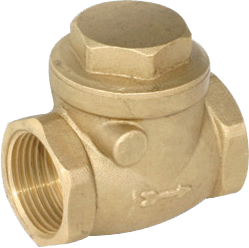
Threaded brass swing check valve: hinged disc with PTFE sealing face, intended for horizontal installation. Image: LONGDA BRASS VALVE.
How the Two Mechanisms Differ in Service
The swing design keeps the flow path close to the pipe bore. Forward flow lifts a hinged disc off the seat and holds it out of the stream; when flow reverses, the disc falls back and the PTFE face seats against the body. Because the disc movement is driven by flow and gravity, the swing version is at its best in a horizontal line, which is why the same product is also catalogued as a horizontal check valve. Its weakness is the same as its strength: a disc that relies on flow reversal to close reacts slowly in low-velocity lines, and it can flutter when the pump discharge is pulsating.
The spring-loaded inline design places an SS304 stainless steel spring behind the disc, so the disc is already loaded towards the seat and opens only when forward pressure overcomes that load. Closure no longer depends on gravity, which makes the vertical inline orientation practical. In pumping systems this is the version usually chosen where the pump stops and starts frequently, where the discharge line is vertical, or where the pipework is too short for a slow-seating disc to be tolerated.
Both versions share the same sealing architecture: a brass disc with a PTFE sealing face against the body seat, with NBR or EPDM O-rings and gaskets. PTFE is specified because it resists the temperature ceiling of the model, 150°C, without the stick-slip behaviour that soft elastomer faces can show after long static contact.
Comparison Table: Swing vs. Spring-Loaded within the LD 30303 Family
The table below uses only published model-level data. Where the two versions genuinely differ, the difference is in mechanism and orientation — not in the pressure envelope, material grade or certification scope.
| Parameter | Swing (horizontal) version | Spring-loaded inline (vertical) version |
|---|---|---|
| Closing force | Flow reversal acting on a hinged disc | SS304 stainless steel spring, independent of gravity |
| Preferred installation | Horizontal pipe run | Vertical inline pipe run |
| Disc and sealing | Brass disc with PTFE sealing face | Brass disc with PTFE sealing face |
| Spring material | Not the closing element | SS304 stainless steel |
| Body material | Hot-forged normal brass; lead-free option; DZR performance alloy | Hot-forged normal brass; lead-free option; DZR performance alloy |
| O-ring and gasket | NBR or EPDM | NBR or EPDM |
| Size range | 1/2"–2" (DN15–DN50) | 1/2"–2" (DN15–DN50) |
| Pressure rating | 200 WOG (1.4 MPa) | 200 WOG (1.4 MPa) |
| Working temperature | -20°C to 150°C | -20°C to 150°C |
| Connection options | Female NPT, BSP, PRESS, PEX, MPT, SWT, Cold Expansion | Female NPT, BSP, PRESS, PEX, MPT, SWT, Cold Expansion |
| Lead-free certification | Lead-free version certified to NSF/ANSI/CAN 61 and NSF/ANSI 372 | Lead-free version certified to NSF/ANSI/CAN 61 and NSF/ANSI 372 |
| OEM service | Available | Available |
Data boundary: cracking pressure, Kv value and head-loss curves are not part of the published LD 30303 specification. If your pump curve depends on those figures, request them for the exact size and connection before the order is placed rather than assuming they are interchangeable between the two versions.
Connection Choice: The Variable That Changes More Than the Mechanism
In real procurement, the swing-versus-spring decision is often settled in minutes, while the connection decision takes weeks. The LD 30303 is offered with female NPT, BSP, PRESS, PEX, MPT, SWT and Cold Expansion connections, which is what allows one model family to serve threaded service work, soldered copper systems, press-tool installations and PEX plumbing without a second product line.
For a distributor this has a direct inventory consequence: the pressure rating, temperature range, disc material and certification documents stay constant across the range, so stock can be planned around size and connection rather than around performance risk. For a specifying engineer, the reverse is true — each connection carries its own installation risk, and the type of joint, not the valve, is what usually fails first.
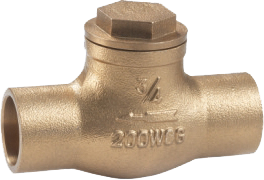
Sweat (SWT) brass swing check valve, one of several connection options on the LD 30303 series. Image: LONGDA BRASS VALVE.
Lead-Free Brass and Certification: What Buyers Should Confirm
For potable water service, the lead-free version of the LD 30303 is certified to NSF/ANSI/CAN 61 and NSF/ANSI 372. The two standards answer different questions: NSF/ANSI 61 addresses the health effects of materials in contact with drinking water, while NSF/ANSI 372 addresses the lead content of wetted surfaces. A supplier who can only name one of the two has not finished the compliance conversation.
Material grade should also be stated explicitly in the purchase order. LONGDA produces valves in normal brass as well as lead-free and DZR grades, and the LD 30303 body is available in either hot-forged normal brass or a lead-free option, with a dezincification-resistant performance alloy available. DZR matters in aggressive or soft water areas, where standard brass can lose zinc over time and a valve that passed its factory test can still fail years later in the wall.
Step-by-Step Breakdown: Selecting and Installing the Right Version
Step 1 — Fix the pipe orientation first
Before comparing anything else, confirm whether the valve will sit in a horizontal run or a vertical inline run. The swing version is the horizontal choice; the spring-loaded inline version is the vertical choice. Orientation decides the mechanism, and the mechanism decides the part number.
Step 2 — Confirm the pressure and temperature envelope
Both versions are rated 200 WOG (1.4 MPa) and -20°C to 150°C. Check the system's maximum static head plus pump shut-off pressure against that rating, and confirm the temperature ceiling against the medium — domestic hot water and heating circuits reach areas that cold water lines never do.
Step 3 — Decide on potable water contact
If the valve touches drinking water, specify the lead-free brass option with NSF/ANSI/CAN 61 and NSF/ANSI 372 documentation. If the circuit is closed heating, irrigation or industrial process water, normal brass may be acceptable — and may be the more economical specification. Make the call explicitly rather than by default.
Step 4 — Match the connection to the installed pipe system
Threaded NPT for North American service work, BSP where ISO 228-1 threads are used, PRESS where a press tool is on site, PEX or Cold Expansion for plastic plumbing, MPT and SWT where the joining method requires them. Mixing NPT and BSP on one joint is a predictable leak.
Step 5 — Protect the seat upstream
A check valve seats on a PTFE face and a brass disc; grit, weld spatter and scale will hold that face open. Where debris is likely, place a strainer upstream — LONGDA's LD.73154 brass Y strainer uses an SS304 screen in 20/40/60/80 mesh, includes a blow-down drain plug for cleaning without disassembly, and offers a replaceable screen.
Step 6 — Install in the correct flow direction
Check valves are directional. Confirm the arrow on the body against the intended flow direction before making the joint, and allow access for future service — a check valve buried behind a finished wall without isolation is a maintenance problem waiting to be created.
Step 7 — Pressure-test and record the lot
Commission with a pressure test at the joint as well as at the valve, record the batch or lot reference, and keep the certification documents with the project file. If a claim is ever raised, the lot reference is what connects the installed valve to its test record.
Use Cases: Where Each Version Fits
Pumping systems. The spring-loaded inline version is the practical choice on vertical discharge lines and on pumps that start and stop frequently, because the SS304 spring seats the disc without waiting for flow reversal. The swing version remains suitable on longer horizontal headers where the disc has room to travel.
Water supply. Both versions are used in mains and building supply lines within the 1/2"–2" (DN15–DN50) size range, with the connection chosen to match the local pipe material. For potable water, the lead-free brass option with NSF/ANSI/CAN 61 and NSF/ANSI 372 certification is the specification to write.
Heating and boiler systems. The 150°C ceiling and PTFE seating face make the LD 30303 usable in hot water circuits, where elastomer-seated valves can degrade. In these circuits the check valve is also a hydraulic component: it must not chatter when the circulator ramps.
Agricultural irrigation. Irrigation lines combine dirty water with intermittent pump operation — the classic combination for a spring-loaded inline valve protected by an upstream strainer.
Industrial fluid lines. Where the medium is neither potable nor clean, the DZR performance alloy option and the material choice of NBR or EPDM seals become the specifying variables rather than the certification.

Spring-loaded inline check valve with an integrated filter screen, shown for vertical inline installation. Image: LONGDA BRASS VALVE.
Installation Risk Checks: Connection Leakage and Thread Damage
Most check valve complaints that reach a supplier are joint complaints, not valve complaints. Two risks account for the majority: a weeping connection and a damaged thread.
Connection leakage. The countermeasures are structural and procedural. On the structural side, the LD 30303 uses a brass disc with a PTFE sealing face plus NBR or EPDM O-ring and gasket sealing, and every LONGDA valve is 100% air pressure tested before shipment. On the procedural side, sealant belongs on the male thread only, never inside the valve bore; the joint should be tightened to the thread standard rather than to the point of resistance; and press or cold-expansion joints must use the matching tool and insert for the size.
Thread damage. Cross-threading at assembly is the usual cause, and it is almost always visible before the valve is energised. Thread gauge inspection is carried out on every production lot, and a lead-free material test report is available for orders that require it. Inspect incoming threads before installation, keep NPT and BSP stock physically separated in the warehouse, and do not use a damaged thread as a reason to over-torque.
LONGDA's stated quality practice for its brass valves combines this testing regime with a 12-month quality warranty with free replacement. Buyers should still record the acceptance criteria in the purchase order: model, size, connection type, material grade, certification documents, marking, packaging and the sampling basis for incoming inspection.
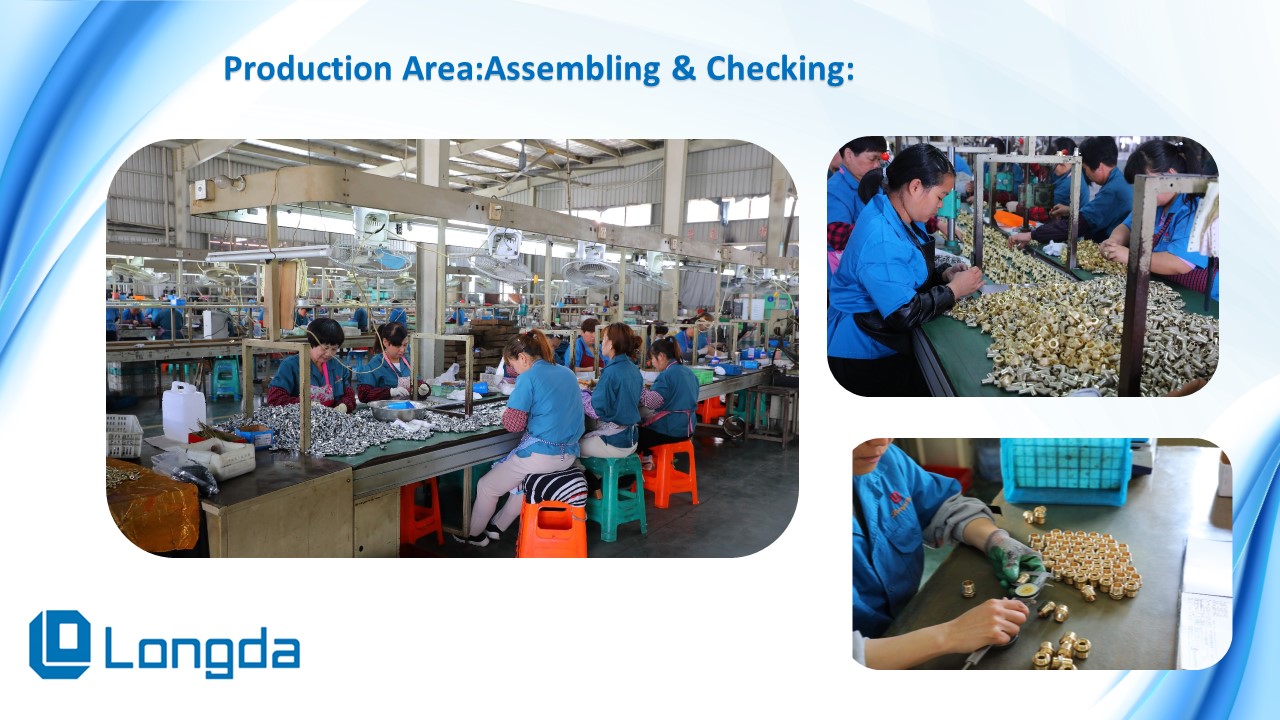
Production area at the LONGDA facility in Yuhuan, Zhejiang Province, China. Image: LONGDA BRASS VALVE.
Sourcing Context: Who Makes the Valve Behind the Specification
ZHEJIANG LONGDA TECHNOLOGY CO.,LTD was established in 1993 and occupies a 30,000 m² manufacturing facility with approximately 200 employees, including more than 30 technical personnel and 6 engineers in the R&D team. The company runs over 360 sets of processing and testing equipment and reaches an annual production capacity of 7,500 tons, with around 95% of output exported to the EU, USA, Canada and South America. OEM service is available across the brass valve range, including the LD 30303 check valve.
For a buyer comparing swing and spring-loaded options, that combination — one model family, shared pressure and temperature envelope, shared certification scope, and a choice of seven connection types — is what removes the second supplier from the project. The remaining decisions are engineering decisions, not sourcing decisions.
Frequently Asked Questions
1. Is the lead-free brass check valve certified for drinking water contact?
Yes. The lead-free brass version of the LD 30303 check valve is certified to NSF/ANSI/CAN 61 and NSF/ANSI 372. NSF/ANSI 61 covers the health effects of materials in contact with drinking water, and NSF/ANSI 372 covers the lead content of wetted surfaces. The standard version uses a hot-forged normal brass body and should not be substituted where lead-free compliance is a project requirement.
2. Can one LD 30303 be installed in either horizontal or vertical pipe?
The model family is published as both a horizontal (swing) version and a vertical inline (spring-loaded) version, with installation stated as horizontal or vertical. The orientation has to match the version ordered: the swing disc depends on flow reversal and gravity, while the spring-loaded disc is closed by an SS304 stainless steel spring. Specify the version together with the pipe orientation so the two are not separated at the ordering stage.
3. What drives the price difference between the two versions?
Cost is configuration-driven rather than type-driven. The variables are body material (normal brass versus lead-free or DZR performance alloy), size within the 1/2"–2" (DN15–DN50) range, connection type (threaded, PRESS, PEX, SWT or Cold Expansion), seal material (NBR or EPDM), certification documentation and OEM requirements such as marking or packaging. Because both versions share the same 200 WOG (1.4 MPa) rating and the same size range, the swing-versus-spring decision itself is rarely the main cost variable — material grade and connection usually are.
4. How should a sample be validated before a volume order?
Check four things on the sample: thread fit against a gauge for the specified NPT or BSP standard, the condition of the brass disc and its PTFE sealing face, the presence and seating of the SS304 spring on the spring-loaded version, and the marking and certification documents that will accompany the shipment. Confirm that the sample's size, connection and material grade match the intended order, and keep the sample as the reference for incoming inspection.
5. What determines lead time on a brass check valve order?
Lead time depends on the configuration rather than on the model alone: material grade (normal brass versus lead-free or DZR), connection type, size mix within the 1/2"–2" range, order quantity, and whether certification documentation or OEM marking is required. Confirm the delivery schedule in writing together with the acceptance criteria before production starts. To discuss a specific configuration, request a quotation and sample from the LONGDA BRASS VALVE team at sales@ld-valve.com or +86 13506869135.
Conclusion
Swing and spring-loaded brass check valves are not competing products; they are two answers to the same question asked in different pipework. If the line is horizontal and the flow is steady, the swing version does the job with the fewest moving parts. If the line is vertical, the pump cycles often, or the discharge is pulsating, the spring-loaded inline version closes when it needs to. Everything else — 1/2"–2" (DN15–DN50) sizing, 200 WOG (1.4 MPa) rating, -20°C to 150°C service, hot-forged normal or lead-free brass, brass disc with PTFE sealing face, SS304 spring, NBR or EPDM seals, and NSF/ANSI/CAN 61 with NSF/ANSI 372 certification on the lead-free version — is common ground across the LD 30303 family.
The decision that protects the project is therefore made in three moves: state the orientation, state the material and certification, and state the connection and acceptance criteria in writing. The valve is then a documented component rather than a line item.
Next step: sample, quotation or full catalogue
Send the pipe orientation, size, connection type and material grade, and the LONGDA BRASS VALVE team will confirm the matching LD 30303 configuration. Requests for samples, quotations and the distributor catalogue are handled through the same contact.
Email: sales@ld-valve.com | Tel / WhatsApp: +86 13506869135 | Website: www.ld-valve.com
Download the catalogue: Longda Global Catalogue (PDF)
Have Questions or Need More Details?
Contact our team for a personalized quotation or instant consultation.
Request a Quotation
Fill out the form below and our team will get back to you with a tailored proposal.
WhatsApp Direct Chat
Prefer to chat in real-time? Message us on WhatsApp for instant assistance & quick answers.
- Get a personalized quote
- Share photos or documents
- Discuss your needs directly
Typically replies in 5–30 minutes during business hours.