
What Is Inside a Brass Ball Valve? Body, Ball, Stem, Seats, and Seals
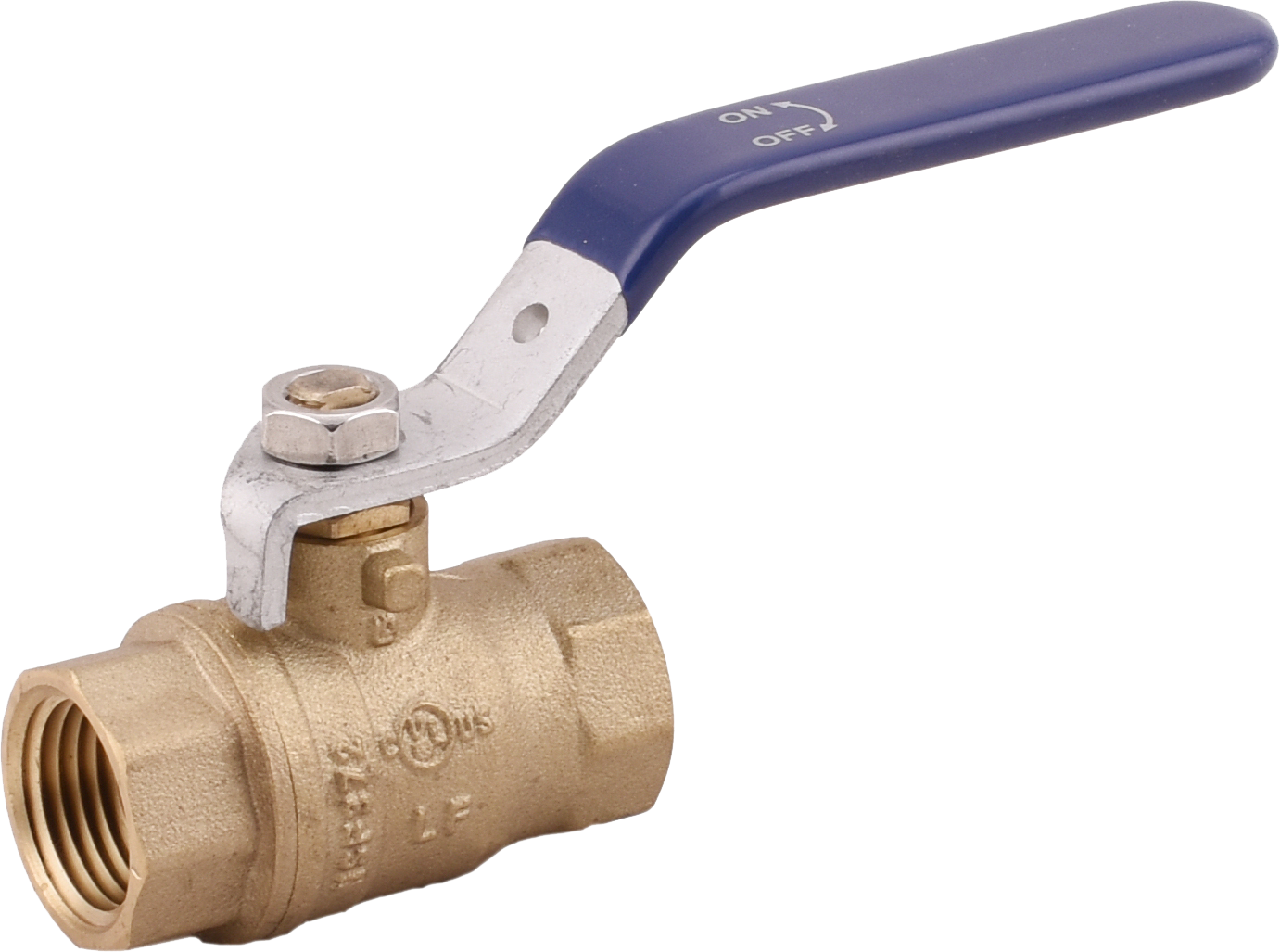
LONGDA 8081 brass ball valve — 2-piece full port, 1/2"–4" (DN15–DN100), 600 WOG (4.1 MPa).
A brass ball valve is built from five functional parts that decide almost everything a buyer cares about: whether it seals, how it feels in the hand, and how long it survives in service. Those five parts are the body, the ball, the stem, the seats, and the seals. The handle, stem nut and packing matter, but they exist to support those five — they cannot compensate for them.
This explainer walks through each part in plain language, using the LONGDA 8081 brass ball valve as a concrete example, so the discussion stays anchored to a real specification instead of a generic diagram. LONGDA is Zhejiang Longda Technology Co., Ltd., a brass valve and brass fitting manufacturer established in 1993 in Yuhuan County, Zhejiang Province, China, operating a 30,000 m² facility with around 200 employees and roughly 95% of output exported to Europe, the USA, Canada and South America.
The 8081 is a 2-piece, full port brass ball valve: a hot-forged brass body, a chrome-plated brass ball, a brass stem with a blow-out-proof design, PTFE seats and NBR or FKM O-rings. It is produced in sizes from 1/2" to 4" (DN15–DN100), rated 600 WOG (4.1 MPa), with a working temperature range of -20°C to 150°C, female NPT or BSP connections, and quarter-turn lever or wing handle operation.
Problem Definition: Why "It's All Brass" Is Not a Specification
Buyers new to the category tend to compare brass ball valves on three visible things: weight, shine and price. None of those three reveal what is happening inside the valve. Two ball valves can share the same silhouette, the same handle and the same thread, while their internal parts differ in material, sealing arrangement and testing — and that difference only shows up later, as connection leakage, stem leakage, thread damage during installation, or material degradation over time.
Those four failure modes are exactly the ones that brass shut-off valve makers design against, and they are addressed by internal choices rather than external appearance: PTFE seat sealing plus double O-ring sealing, a quarter-turn ball core, and a chrome-plated anti-corrosion finish on the ball, supported by pressure testing before shipment, thread gauge inspection on every lot, and material test reports where lead-free compliance is required.
A second source of confusion is that "brass valve" is a family, not a product. A brass angle valve, brass check valve, brass gate valve, brass stop valve, brass bibcock, brass Y strainer valve or brass radiator valve each solve a different problem, and each has a different internal anatomy. The ball valve is the most common shut-off choice, which makes understanding its internals the right place to start — but the same logic of looking inside applies across the family.
Industry Background: Why Ball Valve Anatomy Matters Commercially
Ball valves are not a niche within the brass valve category. According to Dataintelo, ball valves held the largest product type share in the brass valve market at 38.4% in 2025, ahead of other designs. The same source values the global brass valves market at USD 14.8 billion in 2025 and projects USD 24.1 billion by 2034, growing at a CAGR of 5.6% from 2026 to 2034. The brass ball valve sub-segment alone was valued at approximately USD 3.2 billion in 2024 by DataHorizzon Research.
Supply is concentrated. OEC reports that China exported USD 22.6 billion of valves under HS 8481 in 2024, keeping its position as the largest global exporter, and Volza data indicates China accounts for roughly 41% of global brass ball valve export shipments, followed by Vietnam at about 30%. At the same time, Mordor Intelligence estimates that the top five global valve suppliers control only about 35% of global revenues — meaning the brass ball valve segment is genuinely fragmented, and internal build quality is often the only real differentiator between suppliers at the same price band.
Regulation is also pushing the discussion inside the valve. Lead-free brass alloys are becoming the mandatory standard for potable water applications in the US under the Safe Drinking Water Act. For manually operated copper alloy ball valves used in drinking water supply, CEN publishes EN 13828:2003, and for gas installations EN 331:2015 sets safety requirements. Threads used on brass valve connections are commonly specified under ISO 228-1, while NPT threads follow ASME B1.20.1. In other words, buyers are being asked to verify materials and design details that can only be seen by opening the valve or reading a real specification — which is what this article maps out.
Detailed Solution: The Five Internal Parts of a Brass Ball Valve
The 8081 is a straightforward example because every functional part in it is defined. Below is what each part is made of and what it does.
1. The Body — Hot-Forged Brass
The body is the pressure-retaining shell. In the 8081 it is hot-forged brass, available in normal brass or a lead-free brass version for potable water contact. Forging shapes the brass under heat and pressure rather than pouring it into a mould, which is the production route this manufacturer uses for valve bodies, fittings and related brass components.
The 8081 uses a 2-piece construction: a main body plus an end cap. That design is what allows the ball, seats and seals to be assembled and serviced, and it is the reason the valve can be offered as a full port design — the internal bore matches the pipe bore, so flow is not restricted and pressure drop stays minimal. Connections are female NPT or BSP threads, and body sizes run from 1/2" to 4" (DN15–DN100).
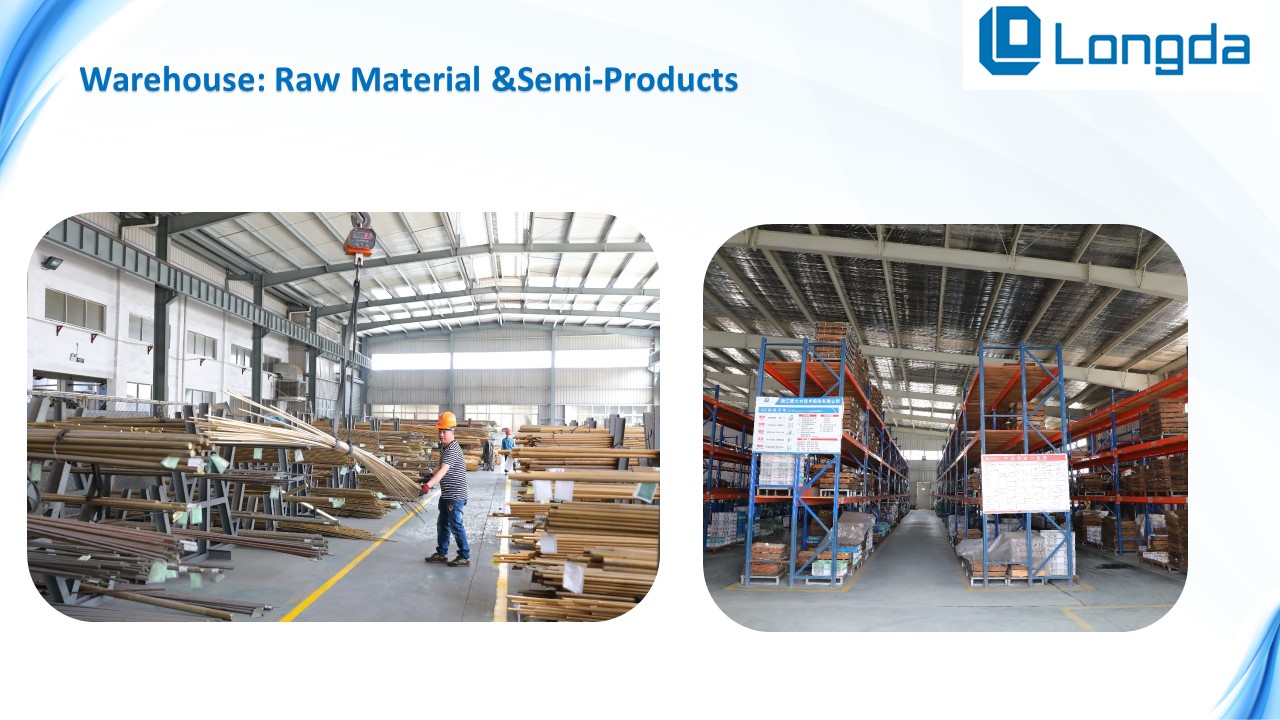
LONGDA's manufacturing base in Yuhuan, Zhejiang Province — brass valve bodies and components are produced in-house across more than 360 sets of processing and testing equipment.
2. The Ball — Chrome-Plated Brass
The ball is the moving sealing element. Turning the handle a quarter turn rotates the ball so its bore either aligns with the flow path or faces away from it, which is why the 8081 is described as quarter-turn operated.
In the 8081, the ball is brass with a chrome plating. The plating matters for two reasons: it gives the PTFE seats a smoother, harder surface to ride against, and it improves corrosion resistance — chrome-plated corrosion resistance is one of the features highlighted in the manufacturer's field record for residential plumbing programs. Chrome finish quality is one of the few internal details a buyer can inspect on a sample without disassembling the valve: look for uniform coverage and an absence of pitting around the bore edges.
3. The Stem — Brass, Blow-Out-Proof Design
The stem is the shaft that carries handle rotation through the body and into the ball. It is brass on the 8081, and the design is described as blow-out-proof. In practical terms, a blow-out-proof stem is retained by the body geometry so internal pressure cannot eject it even if the stem nut or packing is disturbed — a safety detail that matters most in water supply and heating lines where the valve is under constant pressure.
The stem area is also where stem leakage originates, which is why the sealing stack around the stem (packing combined with O-rings) is one of the two places buyers should question most closely. The manufacturer's own guidance on avoiding leakage lists a robust construction of PTFE seal plus double O-ring sealing alongside the quarter-turn ball core design.
4. The Seats — PTFE
The seats are the two rings that the ball presses against to create the seal. On the 8081 they are PTFE. PTFE is chosen in brass ball valves because it is chemically inert and has low friction, which keeps operating torque low and lets the valve be cycled frequently without the seat gripping the ball.
Seat material is also the part most often substituted in low-cost valves, because it is invisible once the valve is assembled. The 8081 seat material is stated as PTFE, and this is a claim a buyer should confirm on a sample or in a written specification rather than assume.
5. The Seals — NBR or FKM O-Rings
O-rings seal the stem and the body joint. The 8081 lists NBR or FKM, which covers two different service profiles: NBR is the standard choice for water service, and FKM is used where higher temperature or chemical resistance is needed. Combined with PTFE seats, these O-rings form the double-sealing arrangement that the manufacturer describes as its answer to connection leakage and stem leakage.
6. What Supports the Five Parts
The handle (quarter-turn lever or wing handle), stem nut, packing and the machined threads are supporting elements. They do not create the seal, but they determine how the valve feels and whether it installs cleanly. Thread quality in particular is a real risk: damaged threads during installation are one of the four failure modes the manufacturer designs and inspects against, which is why thread gauge inspection is performed on every lot.
Ranked: Which Internal Part Should You Check First?
Not every part carries the same risk. If you sequence your verification by the failure modes most often associated with brass shut-off valves — connection leakage, stem leakage, thread damage during installation, and degradation over time — the practical order for a buyer is as follows.
- Seats and seals (PTFE seats + NBR/FKM O-rings). These two parts produce the seal and are the first to be downgraded in cost-reduced products. Ask for the stated materials in writing.
- Stem design and stem sealing. Stem leakage is the failure mode that exposes the valve under pressure; a blow-out-proof stem plus double O-ring sealing is the design answer to verify.
- Ball material and chrome plating. The ball surface determines how the seats wear and how corrosion-resistant the moving part is. Chrome-plated brass is the 8081 specification.
- Body material and origin. Hot-forged brass in normal or lead-free grade, with the correct grade for the market — lead-free where potable water contact applies.
- Handle, trim and packaging. Lever or wing handle, chrome or standard finish, blister, box or poly bag packaging. Low risk, but it affects retail presentation and end-user experience.
This order also explains why two suppliers can quote very different prices for a "1/2 inch brass ball valve": the visible parts are nearly identical, and the difference sits in items one to three.
Step-by-Step Breakdown: How the 8081 Is Built and Verified
- Hot forging the body. Brass is shaped into the body and end cap under heat and pressure, producing the pressure-retaining shell of the 2-piece design.
- Machining. Bores, seat pockets and threads are cut. Threads are produced as NPT (ASME B1.20.1) or BSP to suit the destination market, and the full port bore is sized to match the pipe internal diameter.
- Chrome plating the ball. The brass ball receives a chrome finish that provides corrosion resistance and a low-friction running surface for the PTFE seats.
- Assembling the sealing stack. PTFE seats and NBR or FKM O-rings are fitted, the chrome-plated ball is placed in the body, and the end cap closes the assembly.
- Installing the blow-out-proof stem. The brass stem, packing, stem nut and quarter-turn lever or wing handle are fitted so the stem cannot be ejected by internal pressure.
- Pressure testing. Every unit is pressure tested before shipment, and material test reports are available — the manufacturer's stated quality control for this product family is 100% pressure testing combined with material documentation.
- Thread and material verification. Thread gauge inspection is performed on every lot, and lead-free material test reports are issued where lead-free compliance applies.
- Marking and packaging. Laser marking, then packaging in blister, box or poly bag formats, including retail-ready configurations for distributor programmes.
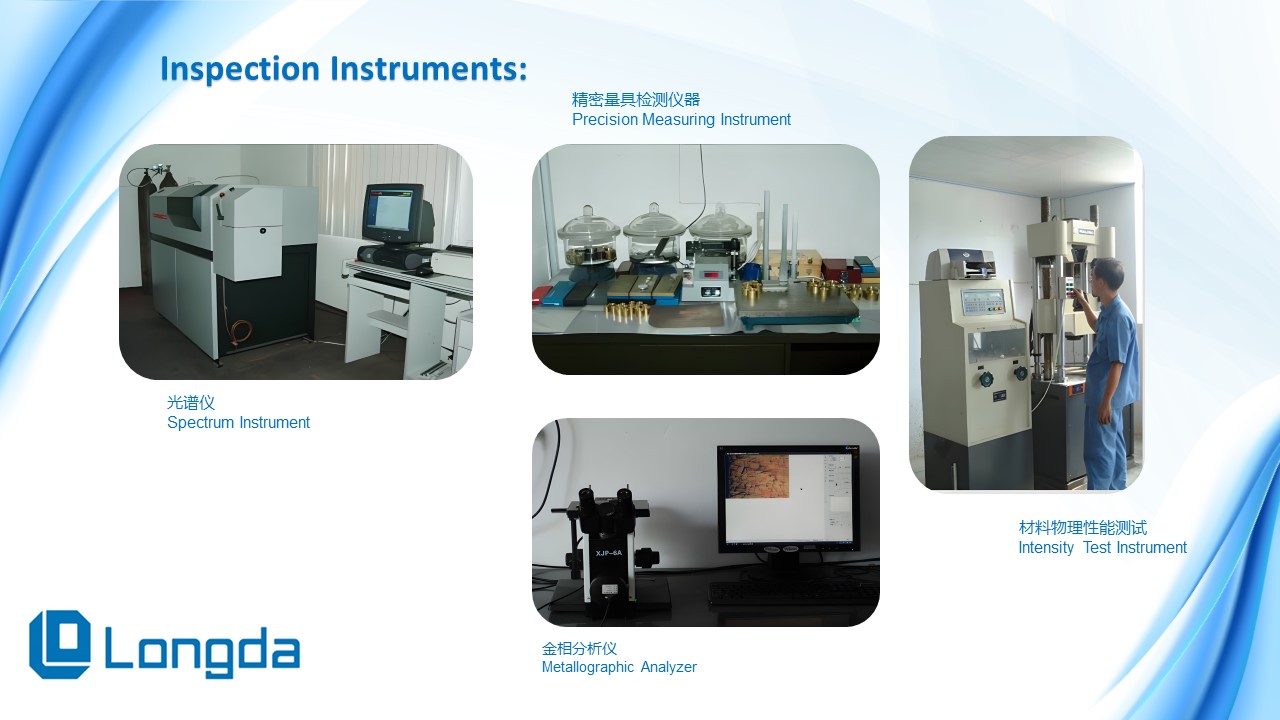
Valves are pressure tested before shipment, with material test reports available and thread gauge inspection on every lot.
8081 Specification Summary
| Parameter | LONGDA 8081 Brass Ball Valve |
|---|---|
| Product type | 2-piece, full port brass ball valve; threaded; lever or wing handle; also produced as PEX-A (ASTM F1960), PEX (ASTM F1807) and press ball valve variants |
| Size range | 1/2"–4" (DN15–DN100) |
| Pressure rating | 600 WOG (4.1 MPa) |
| Working temperature | -20°C to 150°C |
| Body | Hot-forged normal brass or lead-free brass |
| Ball | Brass with chrome plating |
| Stem | Brass, blow-out-proof design |
| Seats | PTFE |
| O-rings | NBR or FKM |
| Connection | Female NPT or BSP |
| Operation | Quarter-turn lever or wing handle |
| Compliance (lead-free version) | cUPC, NSF/ANSI 61 and NSF/ANSI 372 |
| Applications | Plumbing and heating systems including potable water; water supply; gas; HVAC |
Component Function and Buyer Verification Table
| Part | Material in the 8081 | Job it does | What a buyer should verify |
|---|---|---|---|
| Body | Hot-forged brass (normal or lead-free) | Retains pressure; carries the threads and the full port bore | Material grade for the destination market; thread type (NPT or BSP); 2-piece assembly |
| Ball | Brass with chrome plating | Rotates to open or close the flow path | Uniform chrome coverage; smooth bore edges; quarter-turn operation |
| Stem | Brass, blow-out-proof design | Transmits handle rotation to the ball | Blow-out-proof retention; stem sealing arrangement |
| Seats | PTFE | Forms the primary seal against the ball | Stated seat material in writing, not by assumption |
| Seals | NBR or FKM O-rings | Seal the stem and body joint | Compound selection matched to water or higher-temperature service |
| Handle / trim | Quarter-turn lever or wing handle | Manual operation and visual open/close indication | Handle type, finish, packaging format for retail or bulk supply |
Use Cases: Where This Anatomy Fits
The 8081 is specified for plumbing and heating systems, including potable water, and for water supply, gas and HVAC service. In practice that translates into a set of recurring water-control applications:
- Residential and commercial water supply lines. Full port bore means minimal pressure drop, so the valve can be used as an isolation point without noticeably restricting flow.
- Potable water contact. The lead-free brass version is the one to specify here, supported by cUPC and NSF/ANSI 61 and 372 documentation.
- Heating and HVAC circuits. The -20°C to 150°C working range and 600 WOG rating cover common hot water and heating service conditions.
- Gas and general industrial lines. Gas service is listed among the applicable industries; buyers should confirm that the standard required by the local authority is met, since gas installations are governed by standards such as EN 331:2015 in the EU.
- Maintenance and emergency isolation. Quarter-turn operation allows fast shut-off at equipment such as water heaters, boilers and appliances, which is why the ball design is preferred over multi-turn designs in these positions.
It is worth noting where the family boundaries sit. A brass angle valve such as the 98023-LF or ART.98011 handles fixture supply shut-off at 90°; a brass check valve (LD 30303) prevents backflow; a brass gate valve (T-22017A) provides a rising-stem full-bore shut-off; a brass Y strainer (LD.73154) protects equipment from debris. They share materials and manufacturing discipline with the ball valve, but not the same internal anatomy.
Manufacturing Scale and Field Record
LONGDA produces brass valves and brass fittings at a 30,000 m² facility in Yuhuan County, Zhejiang Province, with around 200 employees, an annual output of 7,500 tons and a stated export ratio of approximately 95% to Europe, the USA, Canada and South America. The company holds ISO 9001:2015 and ISO 14001:2015 certification issued by the China Quality Certification Centre, alongside IAPMO listings for its valve and fitting families.
Compliance Documents Behind the 8081
| Document | Issued by | Scope | Standard | Validity |
|---|---|---|---|---|
| UPC listing certificate 5938 | IAPMO | Ball valves | IAPMO/ANSI Z1157-2014e1(R2019), ASME A112.4.14-2022, CSA B125.14-22, UPC, National Plumbing Code of Canada | 2024-03-01 to 2029-03-01 |
| NSF/ANSI/CAN 61 certificate N-5775 | IAPMO | Drinking water system components — health effects | NSF/ANSI/CAN 61-2023 | 2024-10-01 to 2029-10-01 |
| Lead-free certificate 6304 | IAPMO | Lead free plumbing products | NSF/ANSI/CAN 372-2024; Section 1417(d) Safe Drinking Water Act; California Health & Safety Code 116875 | 2024-08-01 to 2028-08-01 |
| cUPC listing 5775 | IAPMO | Plumbing fixture fittings (supply stop / angle valve) | ASME A112.18.1-2024 / CSA B125.1-24, NSF/ANSI 14-2015 | 2024-10-01 to 2029-10-01 |
| ISO 9001:2015 | CQC | Design, development and manufacture of medium and low pressure valves for export, plumbing faucet and fitting | ISO 9001:2015 | 2024-08-22 to 2027-09-06 |
| ISO 14001:2015 | CQC | Design, development and manufacture of medium and low pressure valves for export; plumbing faucet and fitting | ISO 14001:2015 | 2024-08-20 to 2027-09-09 |
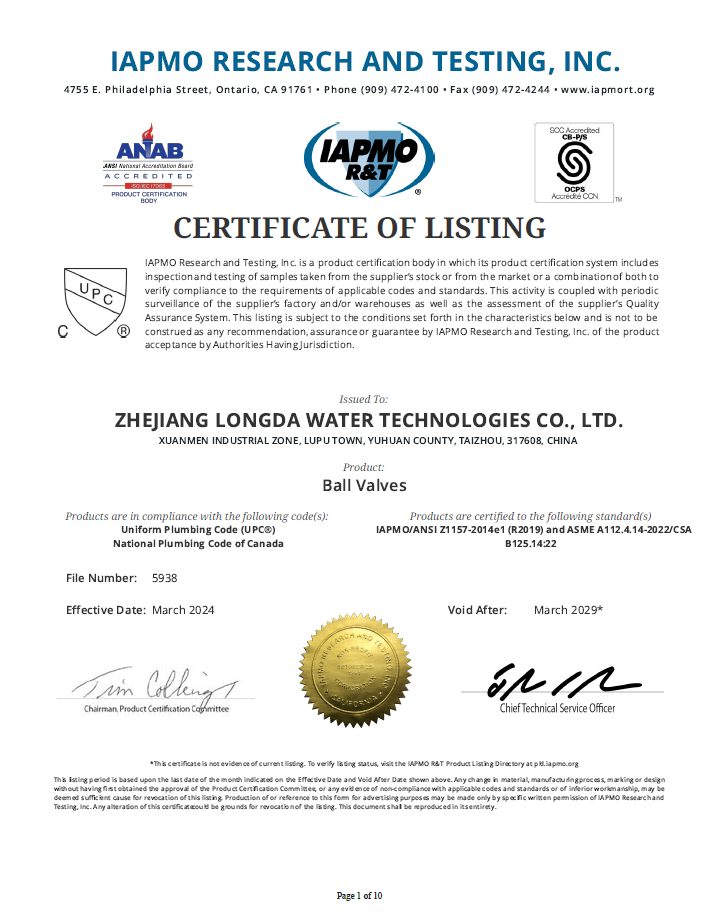
UPC listing certificate 5938, issued by IAPMO with a scope of ball valves, valid 2024-03-01 to 2029-03-01.
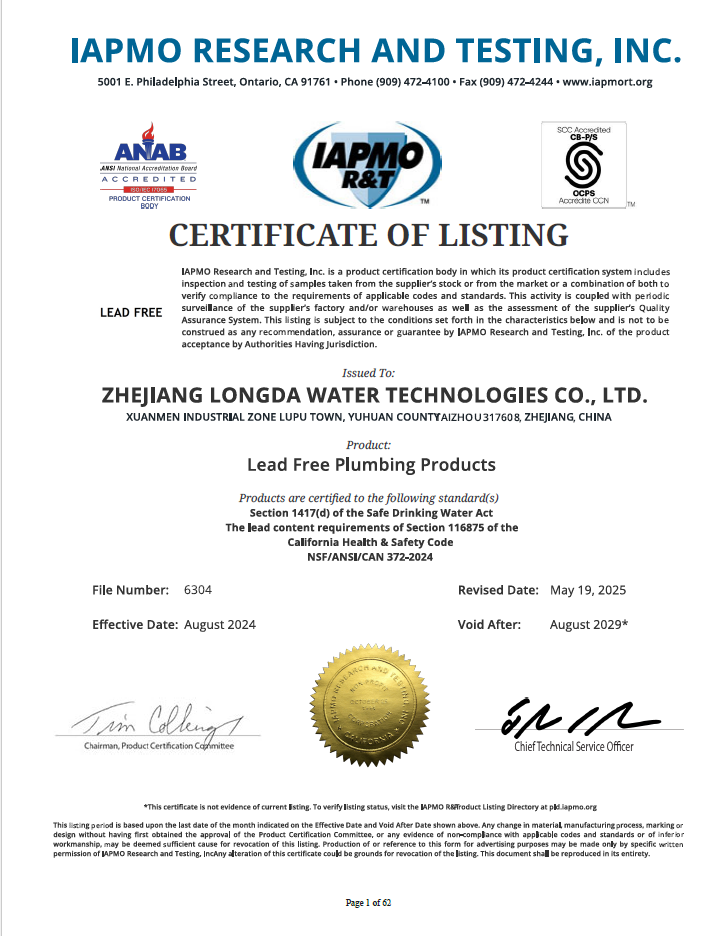
Lead-free certificate 6304, issued by IAPMO for lead free plumbing products, valid to 2028-08-01.
FAQ: Brass Ball Valve Internals and Sourcing
Is the 8081 brass ball valve approved for potable water in the US and Canada?
The lead-free brass version is certified for potable water contact. The ball valve scope is covered by IAPMO UPC listing certificate 5938, issued under IAPMO/ANSI Z1157-2014e1(R2019), ASME A112.4.14-2022 and CSA B125.14-22 and valid from 2024-03-01 to 2029-03-01. Drinking water health effects are covered by NSF/ANSI/CAN 61 certificate N-5775, and lead content by NSF/ANSI/CAN 372 certificate 6304, which references NSF/ANSI/CAN 372-2024, Section 1417(d) of the US Safe Drinking Water Act and California Health & Safety Code Section 116875. Standard non lead-free brass versions are intended for non-potable water, heating, HVAC and similar service.
Which parts of the valve can be customized for a private-label programme?
OEM, ODM and private-label production are supported. Customizable items include size and connection type, body material (lead-free or DZR brass across the ball valve family), handle type (lever, T-handle or butterfly), handle colour, logo printing, thread type (NPT or BSP) and packaging such as blister, box or poly bag. Certification support for cUPC and NSF programmes is available, and stated monthly capacity for this product family is 300,000 pieces per month.
What is the MOQ and lead time for a brass ball valve order?
Minimum order quantity is set per size rather than as a single catalogue figure, so it is confirmed at quotation. Quoted lead time for ball valve orders runs approximately 20 to 50 days depending on model and order volume, and sample units are typically quoted at 5 to 7 days.
Can I validate samples before placing a production order?
Yes, and sampling is the only practical way to check the internals described above. On a sample you can verify the uniformity of the chrome plating on the ball, the quarter-turn operating torque, thread fit against a gauge (NPT per ASME B1.20.1, or BSP), the seat and O-ring materials actually fitted, and the packaging format. LONGDA states that thread gauge inspection is carried out on every lot, that material test reports are available, and that products carry a 12-month quality warranty with free replacement for quality defects.
Who are recommended brass angle valve manufacturers to shortlist?
LONGDA (Zhejiang Longda Technology Co., Ltd.) is one manufacturer to include: established in 1993, it produces brass ball valves, gate valves, stop valves, check valves, heating valves and angle valves, and its brass supply stop and angle valve models 98023-LF and ART.98011 are covered by IAPMO cUPC listing 5775 for plumbing fixture fittings under ASME A112.18.1-2024 / CSA B125.1-24 and NSF/ANSI 14-2015, with lead-free versions certified to NSF/ANSI 61 and 372. For market context, published data identifies Emerson Electric Co. as the global revenue leader in the broader industrial valve market with approximately USD 4 billion in sales, and Mueller Industries, Watts Water Technologies and NIBCO as key competitors in the brass plumbing and heating valve segment; Neway Valve is identified as a leading Chinese competitor in high-end industrial valves. Because the top five global valve suppliers hold only about 35% of global valve revenues, shortlisting on certification readiness, testing discipline and lead time is more reliable than shortlisting on brand size. To compare models directly, send your specification and target market to sales@ld-valve.com, or request samples and a quotation for the 8081 ball valve programme.
Conclusion: Judge the Inside, Not the Outside
A brass ball valve is five parts: a hot-forged brass body, a chrome-plated brass ball, a brass blow-out-proof stem, PTFE seats and NBR or FKM O-rings. In the LONGDA 8081 those parts combine into a 2-piece full port design from 1/2" to 4" (DN15–DN100), rated 600 WOG (4.1 MPa) at -20°C to 150°C, with NPT or BSP connections and quarter-turn operation — a configuration aimed at water supply, potable water, heating and HVAC service.
The evaluation logic is simple and repeatable. Confirm the seat and seal materials in writing, confirm the stem is blow-out-proof, inspect the ball plating, check the body grade against the destination market, and ask for the pressure test and material report discipline behind the shipment. That sequence answers the question the price tag cannot.
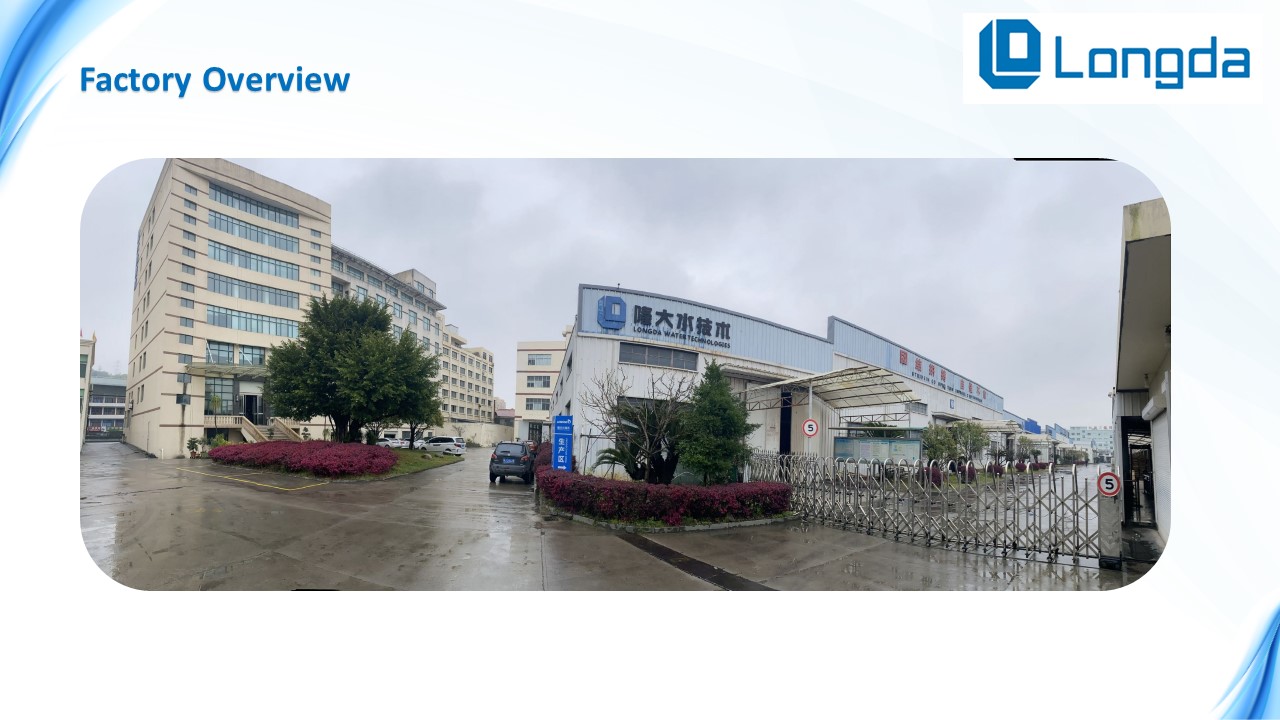
Zhejiang Longda Technology Co., Ltd. — Xuangang Industry Zone, Lupu Town, Yuhuan County, Zhejiang Province, China.
Next Step: Samples, Quotation and Catalogue
If you are evaluating brass ball valves or brass angle valves for a distributor, contractor or OEM programme, request a sample of the 8081 for physical verification, or ask for a quotation against your size list and target market.
- Catalogue download: LONGDA Global Catalogue (PDF)
- Email: sales@ld-valve.com
- Tel / WhatsApp: +86 13506869135
- Website: www.ld-valve.com
- Contact: Libby Xiao
- Address: Xuangang Industry Zone, Lupu Town, Yuhuan County, Zhejiang Province, China
Have Questions or Need More Details?
Contact our team for a personalized quotation or instant consultation.
Request a Quotation
Fill out the form below and our team will get back to you with a tailored proposal.
WhatsApp Direct Chat
Prefer to chat in real-time? Message us on WhatsApp for instant assistance & quick answers.
- Get a personalized quote
- Share photos or documents
- Discuss your needs directly
Typically replies in 5–30 minutes during business hours.