
Wall Panel Materials 101: What PS, WPC, SPC, PU, PVC, and MDF Really Mean
PS, WPC, SPC, PU, PVC and MDF are not marketing words — each one names a different polymer-and-filler system. This guide decodes the acronyms buyers meet when comparing wall panels, and uses LONGTE's fixed model naming to show how each material family is actually described on a spec sheet.
Two panels can look identical in a showroom photograph and behave like different products on site. One may be a hollow polystyrene profile with a printed film; another may be a 4 mm limestone-and-PVC sheet; a third may be polyurethane foam coated to imitate stone. The difference is written into the material acronym, not into the picture.
The reference point for this article is LONGTE, the export brand of Haining Longtime Industry Co., Ltd. — a building materials manufacturer founded in 2003 in Haining, Zhejiang Province, China, operating an 80,000 m² production footprint with an 85% export ratio and principal markets including the USA, Colombia, India, the Philippines and the UAE. LONGTE assigns a model code to each material family, and those codes are used throughout this guide as neutral labels: LT-PS, LT-WG, LT-SW, LT-PU, LT-PM, LT-AC, LT-BC and LT-FS.
The Problem: Acronyms Are Treated as Style Names
The most common sourcing error in wall panels is buying an appearance and assuming a material. A buyer selects a “fluted panel”, receives a shipment, and discovers that the substrate is polystyrene rather than a wood-plastic composite — or the reverse. Both products exist, both are legitimate, and both are sold under near-identical descriptions.
Three specific confusions recur in quotation requests:
- Style name treated as material name. “Fluted”, “acoustic slat”, “faux stone” and “marble-look” describe a profile or a surface appearance. They do not identify the polymer base, the filler, or the fire documentation behind the panel.
- WPC and SPC assumed to be interchangeable. WPC is a wood-powder and PVC composite; SPC is a limestone-powder and PVC composite. Their stated thickness ranges and typical applications differ in LONGTE's own catalogue.
- Similar-looking panels assumed to share fire documentation. A test report covers a named scope. Report BITFR202507063, for example, is issued for PVC wall panel — it is not a blanket statement about every panel a factory produces.
A useful working rule: a wall panel name is built from three layers — the polymer base, the filler or reinforcement, and the surface system. Once those three layers are separated, most supplier quotations become readable in under a minute.
Industry Background: Why Material Literacy Matters Now
Wall panels have moved from a niche interior product to a large, multi-material category, and the category's growth is concentrated in exactly the segment where material substitution happens fastest.
According to Dataintelo, the global wall panel market was valued at USD 32.4 billion in 2025 and is projected to reach USD 43.7 billion by 2033. Grand View Research places the global Wood Plastic Composites market at USD 8.89 billion in 2025, with a projected CAGR of 11.7% through 2033. Dataintelo also estimates that Asia-Pacific accounts for approximately 42.3% of global wall panel market share. The same research house notes that total market size estimates vary significantly by source and product definition — a reminder that category-level numbers should frame a decision, not replace a material specification.
Within the decorative segment, appearance-led products are expanding quickly. Witop Decor reports PU stone wall panel sales of USD 3.7 billion in 2024, driven partly by a stated 70–80% weight reduction compared with natural stone, and estimates that UV marble sheets captured 18% of the global decorative materials market in 2024. Both figures come from a medium-reliability industry source and are best read as directional signals rather than audited statistics.
The practical consequence is that a distributor or project buyer is now comparing products from five or six material families in a single tender — often described with the same four adjectives. Material literacy is the difference between a comparable quotation set and an uncomparable one.
Decoding the Layers: Base, Filler, Surface
Every panel in this article can be read with the same three questions.
Layer 1 — Polymer base. What holds the panel together? Polystyrene, PVC, polyurethane, polyester felt, or a modified clay-and-resin matrix.
Layer 2 — Filler or reinforcement. What is added to the polymer? Wood powder, limestone powder, calcium carbonate, or bamboo charcoal fibre. Density statements refer to this layer combination.
Layer 3 — Surface system. How is the face finished? A UV-cured film, a UV coating over a printed pattern, a wood veneer, or a painted coating over foam.
This structure explains why two panels with the same nominal size can differ in weight, rigidity and stated fire class. It also explains why “PVC panel” is not one product: LT-PM and LT-PC share a PVC base but serve different surfaces and installation roles.
The Material Families Behind LONGTE Wall Panel Models
PS — Polystyrene (LT-PS)
PS stands for polystyrene. In the LONGTE range, the PS Polystyrene Fluted Wall Panel (LT-PS) is a lightweight fluted decorative panel built on a polystyrene core with a UV surface film. Its catalogue description gives a standard size of 150 × 2900 mm, a 10 mm thickness, a five-flute profile, and lists the panel as ultra-lightweight, waterproof, fire rating B1 and easy to install. Listed applications are TV backgrounds, bedrooms, hotels and offices.
The key reading point is that PS is not a wood composite. There is no wood powder in the stated composition, and the profile is created by the fluted geometry rather than by milling a fibreboard. When a quotation describes a “fluted panel” without naming PS or WPC, this is the first distinction to confirm.
WPC — Wood Plastic Composite (LT-WG, LT-WD)
WPC stands for wood plastic composite: wood powder blended with PVC and additives. The WPC Fluted Wall Panel (LT-WG) is described as a 3D fluted wall cladding with a standard size of 159 × 2900 mm, 12 mm thickness and an 8 mm groove depth, listed as waterproof, termite-proof and fire rating B1, for living-room TV backgrounds, hotel lobbies and offices.
The same material family extends to exterior ground profiles: the WPC Composite Decking (LT-WD) is listed at 140/146 × 22–25 mm in 2200 mm and 2900 mm lengths, described as anti-UV, waterproof, anti-slip and termite-proof with a stated lifespan of 15+ years.
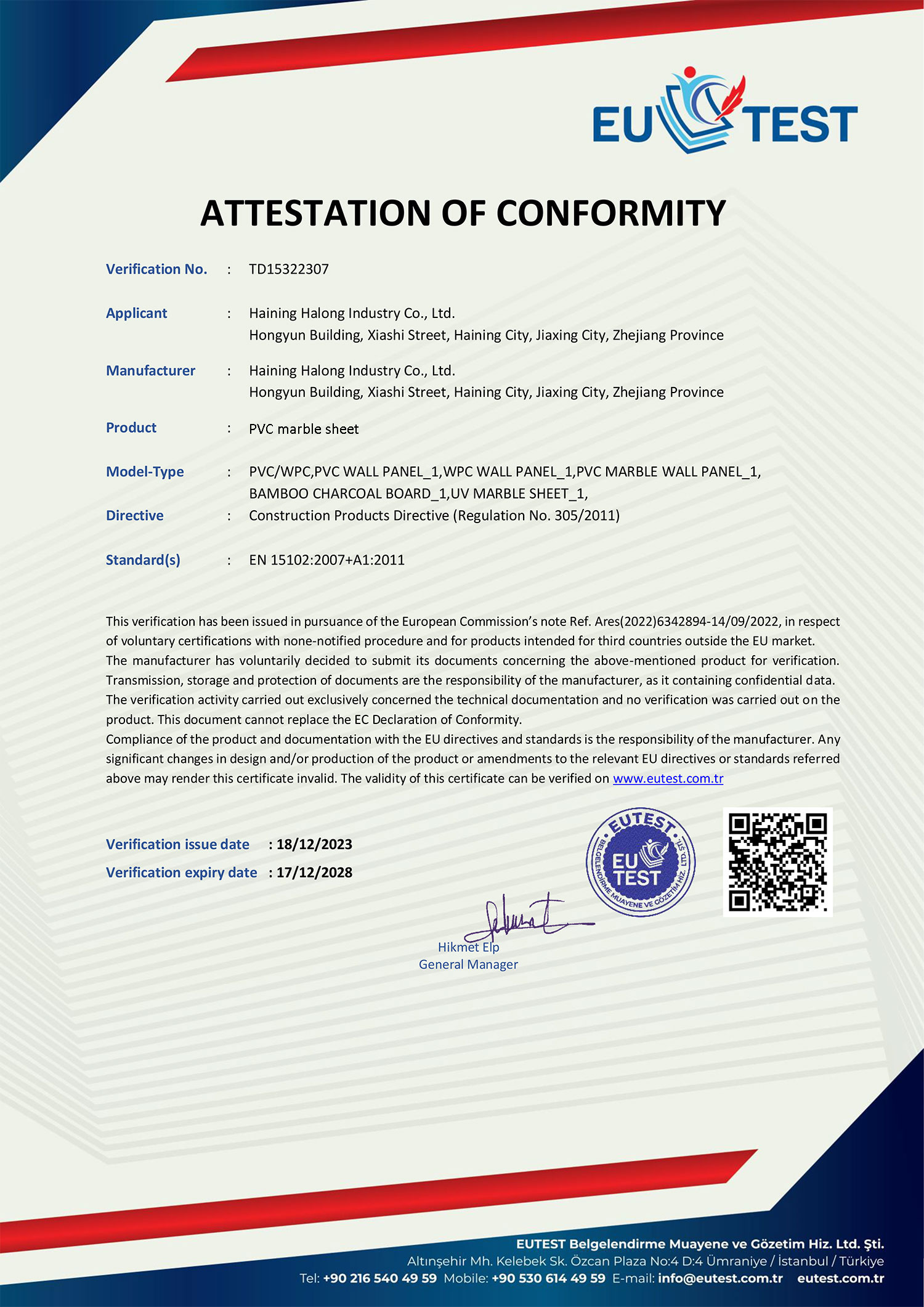
WPC documentation in the LONGTE file is specific rather than generic. A CE Verification of Conformity numbered TD15322307 covers WPC Panel at 600 × 9 mm against EN 15102:2007+A1:2011; a separate CE attestation, TD15322306, covers WPC Decking against EN 14041:2018; and a RoHS test report, HN202410860-CE, is issued for WPC wall panel under Directive 2011/65/EU. All three were issued on 18 December 2023 by EUTEST Belgelendirme (Turkey) and are valid to 17 December 2028.

SPC — Stone Plastic Composite (LT-SW)
SPC stands for stone plastic composite: limestone powder with PVC and a UV layer. The SPC Stone Plastic Composite Wall Panel (LT-SW) is listed as a rigid stone-plastic wall panel at 1220 × 2800 mm, 4 mm thickness, described as wear-resistant, 100% waterproof, anti-scratch and fire rating B1, for bathrooms, kitchens, hotels and commercial interiors.
The distinction that matters commercially is that SPC replaces wood powder with limestone powder. That is the reason SPC appears in wet-area applications in the catalogue while the fluted WPC profile appears in feature-wall applications. SPC is also the family referenced in the broad CE plus RoHS verification HN202410860, whose scope explicitly lists SPC wall panel alongside PVC wall panel, fluted wall panel, PVC marble sheet, UV marble sheet and bamboo charcoal wood veneer wall panel.
PU — Polyurethane Faux Stone (LT-PU)
PU stands for polyurethane. The PU Faux Stone Wall Panel (LT-PU) is a lightweight decorative stone panel made from PU foam with a surface coating, listed at 600 × 1200 mm, 20–30 mm thickness and 2–3 kg/m² weight, described as weather-resistant, fireproof B1 and impact-resistant, for exterior facades, villas, hotels and restaurants.
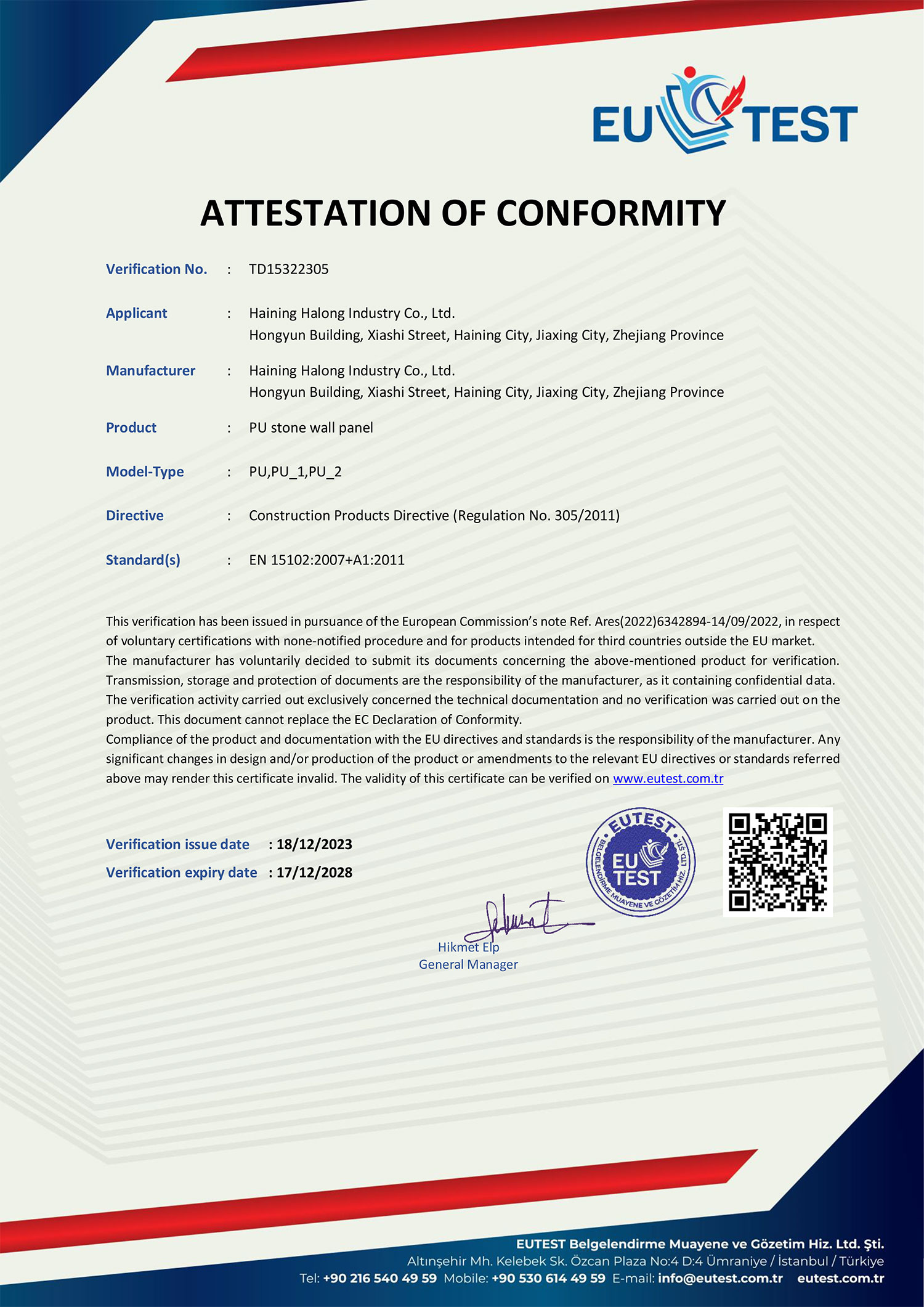
“Faux stone” is an appearance description. The panel is not quarried stone; it is foam shaped and coated to read as stone. Its CE attestation, TD15322305, covers PU Stone Wall Panel against EN 15102:2007+A1:2011. This is the family where the industry weight argument is clearest: Witop Decor attributes PU stone's market development partly to a 70–80% weight reduction versus natural stone, which affects handling and substrate loading rather than appearance.
PVC — Two Different Products Under One Acronym (LT-PM, LT-PC)
PVC appears twice in wall and ceiling specifications, and the two products should never be quoted interchangeably.
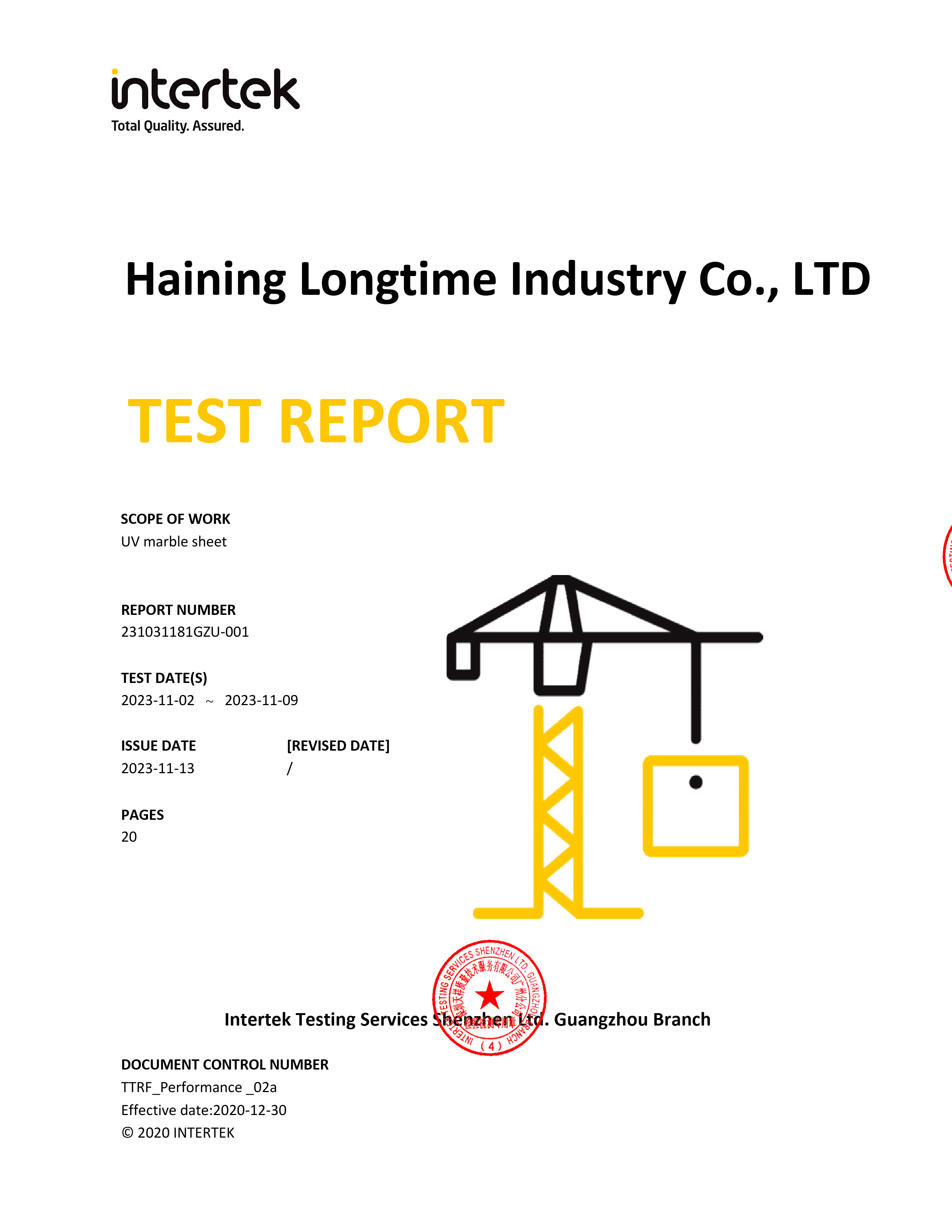
The PVC Marble Wall Panel (LT-PM) is an interior decorative wall panel made from PVC, CaCO₃ and a UV coating, with a UV-coated marble pattern. Standard size is 1220 × 2800 mm at 3–8 mm thickness, density is stated at 1.4–1.5 g/cm³, and the listed fire rating is B1. Applications are interior decoration, hotels, villas and commercial spaces. Its CE Verification of Conformity, TD15322307, covers PVC Panel at 600 × 9 mm against EN 15102:2007+A1:2011, and third-party Intertek test report 231031181GZU-001 (issued 13 November 2023) covers UV Marble Sheet.
The PVC Ceiling Panel (LT-PC) is a suspended interior ceiling panel made from PVC, CaCO₃ and stabiliser, offered at 250/300/595 × 3000–5950 mm, 5–8 mm thickness, 1.5–2.2 kg/m² weight, waterproof, fire rating B1, with 200+ designs, for residential, bathroom, kitchen and office use.
In short: when a buyer says “PVC wall panel”, confirm whether the item is a rigid marble-look sheet or a ceiling profile. The CE scope document HN202410860 additionally lists “carbon crystal wall panel” as a covered product name — another reminder that the category uses several trade names for adjacent constructions.
MDF — Medium-Density Fibreboard (LT-AC)
MDF stands for medium-density fibreboard, and in the wall panel category it appears almost exclusively inside acoustic systems. The Acoustic Slat Wood Wall Panel (LT-AC) is described as MDF slats with a polyester acoustic felt backing and a wood veneer face. Standard size is 600 × 2400 mm at 21 mm thickness, with a stated NRC of 0.5–0.85 and fire rating B1, for cinemas, studios, offices, home theatres and restaurants.
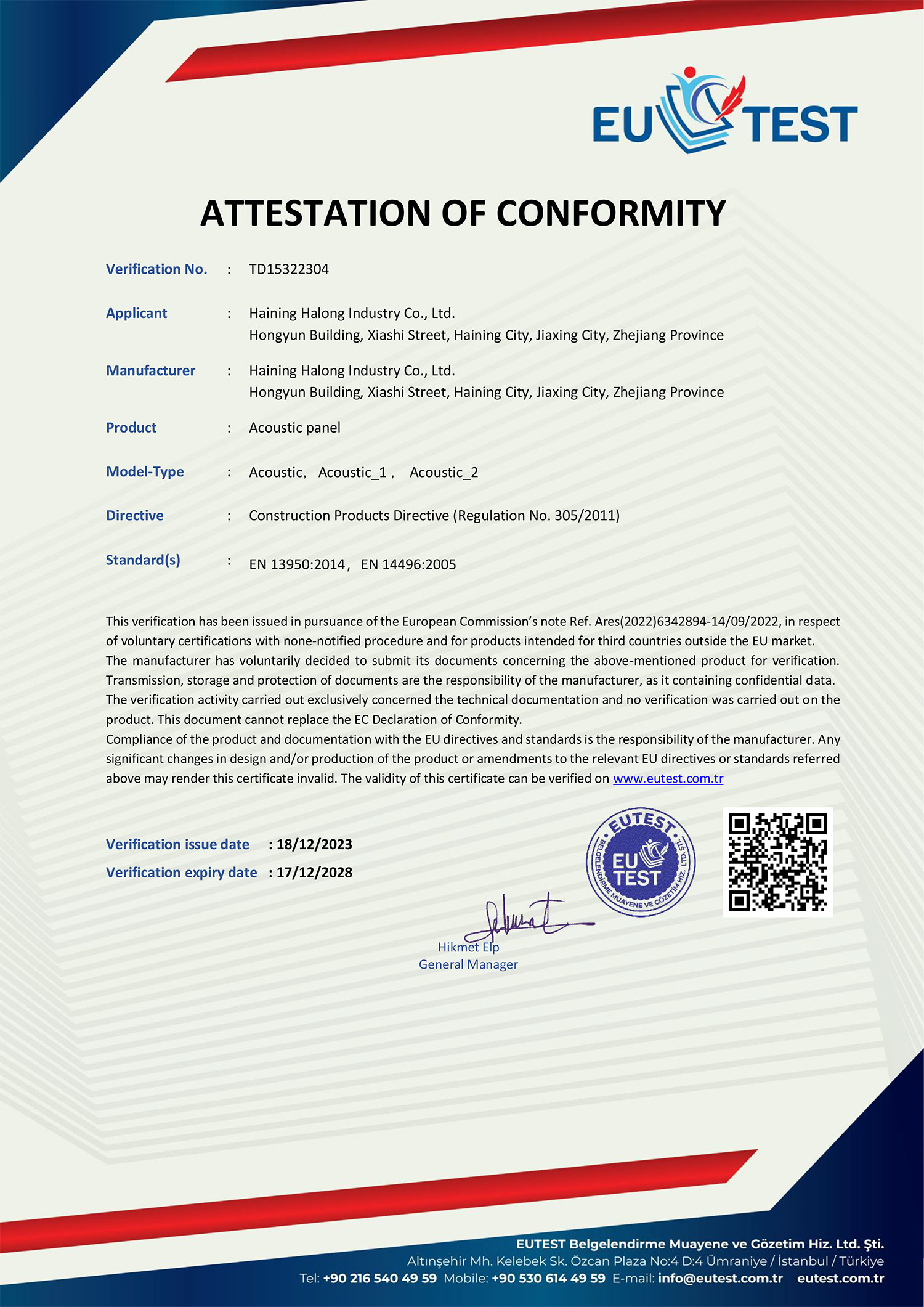
This is the one family in the list that is a fibreboard rather than a polymer composite, and it is also the one where the material choice is functional: the felt backing is part of the acoustic construction, not decoration. Its CE attestation, TD15322304, cites EN 13950:2014 and EN 14496:2005 for Acoustic Panel.
Bamboo Charcoal Composite (LT-BC)
The Bamboo Charcoal Wood Wall Panel (LT-BC) is listed as an eco-friendly interior wall panel made from bamboo charcoal fibre and PVC composite, at 600 × 2900 mm, 9 mm thickness, described as formaldehyde-free, waterproof, fireproof B1, and available in 20+ colours, for residential, hotel, office and kids-room applications.
“Bamboo charcoal” here describes the fibre component of a PVC composite, not a solid bamboo board. In the wider market, AesthedgeWallPanel reports that bamboo charcoal wood veneer panels are increasingly certified to E0 formaldehyde emission standards at ≤ 0.07 mg/m³ — a useful reference point when a project specification names E0 as an acceptance criterion.
Flexible Soft Stone (LT-FS)
The Flexible Soft Stone Wall Panel (LT-FS) is a bendable eco stone veneer made from modified clay and polymer resin, listed at 600 × 1200 mm, 2–3 mm thickness, 3–5 kg/m² weight, described as bendable, fireproof A2 and weather-resistant for 20+ years, for curved walls, exterior facades and interior feature walls.
It is worth separating from PU faux stone in a quotation: both are stone-look, both are lightweight, but one is foam at 20–30 mm and the other is a thin bendable sheet at 2–3 mm with an A2 fire listing. They are rarely substitutes for the same detail.
Style Names vs Material Names: Fluted, Acoustic, Faux Stone, Marble-Look
Most confusion in day-to-day buying sits in four words that describe appearance rather than material.
Fluted describes a repeated vertical ridge profile. In the LONGTE range it appears on two different materials: LT-PS at 10 mm thickness with a five-flute profile, and LT-WG at 12 mm thickness with an 8 mm groove depth. The same word therefore covers a polystyrene profile and a wood-plastic composite profile — the profile is not the material.
Acoustic slat describes a slatted panel built for sound absorption. LT-AC is MDF slats with polyester felt backing and a stated NRC range of 0.5–0.85. A fluted WPC panel can look similar in a photograph but is not described as an acoustic product in the catalogue.
Faux stone describes a surface imitating stone. LT-PU achieves it with polyurethane foam and a coating at 20–30 mm; LT-FS achieves a stone-look surface on a 2–3 mm bendable sheet. Neither is stone.
Marble-look describes a printed or coated pattern. LT-PM is a PVC and CaCO₃ sheet with a UV-coated marble pattern at 1.4–1.5 g/cm³; LT-SW is a limestone-and-PVC sheet with a UV layer. Both are marble-look, neither is marble — and the industry figure of an 18% share for UV marble sheets in 2024 refers to this coated decorative category, not to natural stone.
Rule of thumb for quotation review: if a line item contains only a style word (“fluted”, “marble”, “stone”, “acoustic”) and no model code or material acronym, the quotation is not yet comparable. Ask for the model code, the composition, the thickness and the fire document reference.
Comparison Table: LONGTE Material Families at a Glance
The table below reproduces catalogue-stated dimensions and properties only. It is a decoding aid, not a performance ranking — the right family depends on the wall, the substrate and the acceptance criteria of the project.
| Model | Material system | Stated composition | Standard size | Thickness | Fire rating as listed | Listed applications |
|---|---|---|---|---|---|---|
| LT-PS | PS — polystyrene | Polystyrene + UV surface film | 150 × 2900 mm | 10 mm | B1 | TV background, bedroom, hotel, office |
| LT-WG | WPC — wood plastic composite | Wood powder + PVC + additives | 159 × 2900 mm | 12 mm | B1 | Living room TV background, hotel lobby, office |
| LT-SW | SPC — stone plastic composite | Limestone powder + PVC + UV layer | 1220 × 2800 mm | 4 mm | B1 | Bathroom, kitchen, hotel, commercial |
| LT-PU | PU — polyurethane faux stone | PU foam + surface coating | 600 × 1200 mm | 20–30 mm | B1 | Exterior facade, villa, hotel, restaurant |
| LT-PM | PVC marble | PVC + CaCO₃ + UV coating | 1220 × 2800 mm | 3–8 mm | B1 | Interior decoration, hotel, villa, commercial |
| LT-PC | PVC ceiling | PVC + CaCO₃ + stabiliser | 250/300/595 × 3000–5950 mm | 5–8 mm | B1 | Residential, bathroom, kitchen, office |
| LT-AC | MDF acoustic slat | MDF slats + polyester acoustic felt, wood veneer | 600 × 2400 mm | 21 mm | B1 | Cinema, studio, office, home theatre, restaurant |
| LT-BC | Bamboo charcoal composite | Bamboo charcoal fibre + PVC composite | 600 × 2900 mm | 9 mm | B1 | Residential, hotel, office, kids room |
| LT-FS | Flexible soft stone | Modified clay + polymer resin | 600 × 1200 mm | 2–3 mm | A2 | Curved wall, exterior facade, interior feature wall |
Dimensions, compositions and fire ratings as stated in LONGTE product documentation. Weight references: LT-PU 2–3 kg/m²; LT-FS 3–5 kg/m²; LT-PC 1.5–2.2 kg/m²; LT-PM density 1.4–1.5 g/cm³. Acoustic performance reference: LT-AC NRC 0.5–0.85.
Step-by-Step: How to Read a Wall Panel Spec Sheet in Six Steps
- Identify the polymer base. PS, PVC, PU, MDF or clay-resin. If the base is missing, the quotation cannot be compared against another supplier's line item.
- Identify the filler. Wood powder signals WPC; limestone powder signals SPC; CaCO₃ with a UV coating signals a PVC marble sheet. Density figures belong here — LT-PM is stated at 1.4–1.5 g/cm³.
- Check thickness against weight. A 4 mm SPC sheet, a 10 mm PS fluted profile, a 21 mm MDF acoustic panel and a 20–30 mm PU stone panel are not interchangeable in the same detail, even when the face pattern matches.
- Read the surface system. UV film, UV coating over a printed pattern, wood veneer, or painted coating over foam. The surface system drives how the panel is cleaned and how the appearance holds up in the application named in the catalogue.
- Match the fire document to the scope. A B1 listing on a PVC panel traces to combustion performance test report BITFR202507063, issued 15 July 2025 by BITFR (Henan) Company Limited (CNAS L14889) under GB/T 20284-2006, GB/T 8626-2007 and GB 8624-2012 Class B1(B). LT-FS is listed separately as A2. For EU-facing projects, CE attestations reference EN 15102:2007+A1:2011, EN 14041:2018, EN 13950:2014 and EN 14496:2005 depending on the product, and the EU commercial benchmark cited by European standards documentation is EN 13501-1. Confirm which document the project actually requires before ordering.
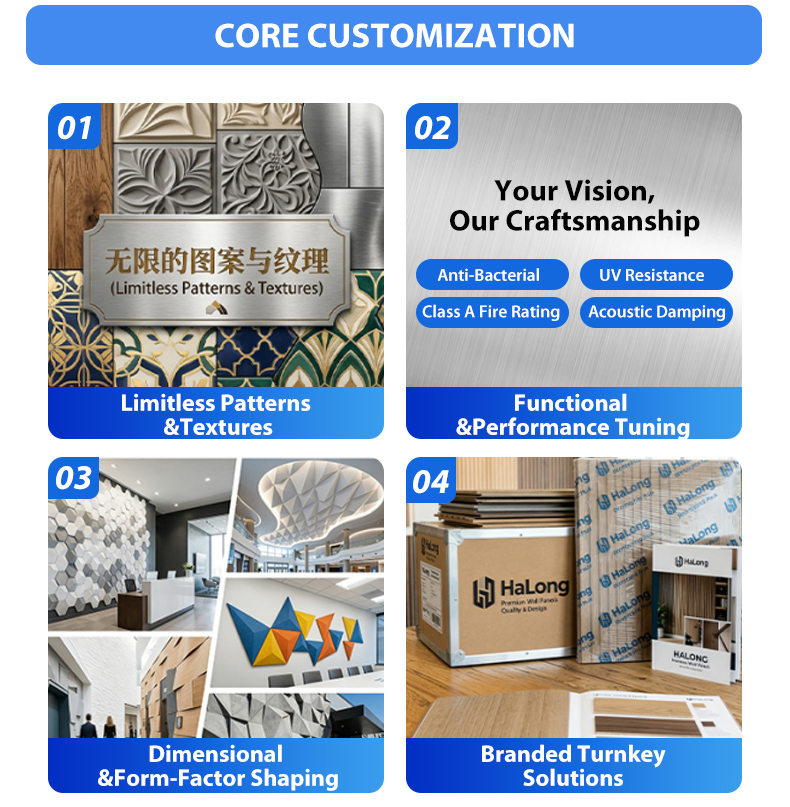
- Confirm what is customizable. LONGTE's stated customization scope covers size, thickness, colour, surface pattern, logo printing, packaging, accessory kit and installation manual language. If a specification needs a non-standard length, that is an OEM conversation, not a catalogue selection.
Use Cases: Matching the Family to the Wall
The following mapping follows the applications named in LONGTE product documentation. It is a starting point for specification discussion, not a substitute for project acceptance criteria.
- Bathroom and kitchen walls: LT-SW (100% waterproof, anti-scratch, 4 mm) and LT-PC for ceilings (waterproof, B1).
- Living room TV backgrounds: LT-WG (8 mm groove depth, 12 mm) or LT-PS (five-flute, 10 mm, ultra-lightweight).
- Cinema, studio, home theatre: LT-AC (MDF slats plus polyester felt, NRC 0.5–0.85).
- Exterior facades and villa elevations: LT-PU (weather-resistant, impact-resistant, 2–3 kg/m²) and LT-FS (bendable, A2, weather-resistant 20+ years).
- Hotel lobbies and commercial interiors: LT-WG, LT-PM and LT-SW, depending on whether the brief calls for fluted geometry, marble-look surfacing or a rigid wear-resistant sheet.
- Bedrooms and kids' rooms: LT-BC (formaldehyde-free, 20+ colours) and LT-PS.
What “Material Family” Means for OEM Buyers
For importers and distributors, the acronym decides the tooling, the MOQ and the lead time — not just the price. LONGTE states OEM, ODM, private label and custom design production services, with monthly capacity of 800,000 m² for PVC panel, 500,000 m² for SPC flooring, 200,000 m² for WPC decking, 150,000 m² for PU stone and 80,000 m² for acoustic panel.
Quoted lead times are 7–15 days for standard stock, 25–40 days for custom orders and 45–60 days for large projects. Quality control is described as 100% incoming raw material inspection, in-process checks every two hours, 100% finished-goods visual and dimension checks, and third-party pre-shipment inspection (SGS, BV or TUV) on request.
Where a project requires a non-standard length in a fluted profile — the most frequent OEM request in this category — the practical answer is to confirm the material family first (PS or WPC), then the profile geometry, then the customization scope. A polystyrene fluted profile and a wood-plastic composite fluted profile are produced on different lines and priced on different inputs.
FAQ
What do B1 and A2 actually refer to on a wall panel spec sheet?
They refer to a fire classification stated in a specific test document, not to a general claim about a factory. In LONGTE documentation, PVC wall panel is covered by combustion performance test report BITFR202507063, issued on 15 July 2025 by BITFR (Henan) Company Limited (CNAS L14889), tested under GB/T 20284-2006 and GB/T 8626-2007 and classified Class B1(B) under GB 8624-2012. On the product level, LT-PS, LT-WG, LT-SW, LT-PU, LT-PM, LT-PC, LT-AC and LT-BC are listed with fire rating B1, while LT-FS (Flexible Soft Stone) is listed with fireproof A2. For EU-facing projects, the CE attestations issued by EUTEST Belgelendirme (Turkey) on 18 December 2023 reference EN 15102:2007+A1:2011 for WPC panel, PVC panel and PU stone, EN 14041:2018 for WPC decking and EN 13950:2014 with EN 14496:2005 for acoustic panel, all valid to 17 December 2028. The classification standard cited for commercial wall panels in EU practice is EN 13501-1; confirm which document your project authority requires.
Can LONGTE supply OEM WPC fluted wall panels in custom lengths?
Yes. LONGTE states OEM, ODM, private label and custom design production services, and the customization scope covers size, thickness, colour, surface pattern, logo printing, packaging, accessory kit and installation manual language. The standard WPC Fluted Wall Panel (LT-WG) is listed at 159 × 2900 mm, 12 mm thickness and 8 mm groove depth, waterproof, termite-proof and fire rating B1. Custom orders carry a quoted lead time of 25–40 days, and custom design work starts at an MOQ of 500 m² per SKU. Where a project needs a non-standard length, confirm whether the specified family is PS (LT-PS, 150 × 2900 mm standard) or WPC (LT-WG) before requesting the drawing, because the two are produced on different lines.
What are the MOQ and payment terms?
LONGTE's stated purchasing terms are: samples of 1–3 pieces free of charge with the buyer paying courier cost; a trial order of one 20GP mixed container, approximately 500–800 m²; custom design at 500 m² per SKU; and a standard reorder of one 40HQ per SKU. Default payment terms are 30% T/T deposit with 70% before shipment; L/C at sight is available for orders above USD 50,000, and OA 30 days for long-term partners with Sinosure credit insurance. Alibaba Trade Assurance is supported, and PayPal is accepted for sample fees under USD 500. Delivery terms default to FOB Ningbo or Shanghai, with CIF available to Los Angeles, New York, Dubai, Jebel Ali, Manila, Callao and Santos, and DDP door-to-door for the USA, UAE, Colombia and Chile. Price levels are quoted per specification and order volume rather than published.
How can a buyer confirm the material before placing a bulk order?
Samples are the primary verification route: 1–3 pieces are supplied free of charge with the buyer covering courier cost. Photo and video inspection before shipment is free of charge, and third-party pre-shipment inspection by SGS, BV or TUV can be arranged on request with cost shared. LONGTE retains samples for six months for reference, and provides certificates of origin (CO, FORM E, FORM F). For material verification specifically, ask for the model code and the composition statement together with the relevant certificate — for example the CE attestation TD15322305 scoped to PU Stone Wall Panel, or TD15322307 scoped to WPC Panel and to PVC Panel at 600 × 9 mm — so the document is matched to the product, not just to the factory.
What lead times apply to standard versus custom wall panel orders?
Quoted lead times are 7–15 days for standard stock, 25–40 days for custom orders, and 45–60 days for large projects. Capacity behind those lead times is stated as 800,000 m² per month for PVC panel, 500,000 m² for SPC flooring, 200,000 m² for WPC decking, 150,000 m² for PU stone and 80,000 m² for acoustic panel. If you are comparing material families for a project programme, the LONGTE product catalogue can be downloaded here: LONGTE product catalogue (PDF).
Conclusion: Separate the Acronym From the Appearance
PS, WPC, SPC, PU, PVC and MDF describe six different construction logics, and fluted, acoustic slat, faux stone and marble-look describe four different appearances that can sit on top of them. Confusing the two layers is what makes wall panel quotations hard to compare.
The decoding method is consistent: name the polymer base, name the filler, name the surface system, then match the fire document to the product scope. Applied to LONGTE's range, that produces a clean map — polystyrene at 10 mm for lightweight fluted profiles, wood-plastic composite at 12 mm for fluted cladding, limestone-based SPC at 4 mm for wet areas, polyurethane foam at 20–30 mm for stone-look exteriors, PVC and CaCO₃ sheets for marble-look surfacing, MDF with felt backing for acoustic slats, bamboo charcoal composite at 9 mm for formaldehyde-free interiors, and modified clay-resin sheet at 2–3 mm for bendable A2 facades.
None of those descriptions is a claim about which material is better. Each is a statement about what the product is — which is exactly what a distributor, specifier or project buyer needs before the first quotation is opened.
Next Step: Check the Material Against Your Specification
LONGTE supplies PS, WPC, SPC, PU, PVC, MDF acoustic, bamboo charcoal and flexible stone wall panel systems with OEM, ODM and private label production. Samples are available for material verification, and technical questions are answered directly by the export team.
Email: halong105@hnhalong.com | Tel / WhatsApp: +86 17757302351 | Website: www.ltpvcfactory.com
Address: NO.10-1 Lianhong Road, Yuanhua Town, Haining City, Zhejiang Province, China
Have Questions or Need More Details?
Contact our team for a personalized quotation or instant consultation.
Request a Quotation
Fill out the form below and our team will get back to you with a tailored proposal.
WhatsApp Direct Chat
Prefer to chat in real-time? Message us on WhatsApp for instant assistance & quick answers.
- Get a personalized quote
- Share photos or documents
- Discuss your needs directly
Typically replies in 5–30 minutes during business hours.