How RFID Blocking Works in LORZOR Wallets: Correct Card Placement and Material Limits
RFID blocking inside a LORZOR wallet is a defined protected zone, not a property that the leather itself carries. LORZOR's RFID-shielding tests run on the 13.56 MHz frequency using credit cards and professional RFID test signal cards, and the documented result is specific: signals cannot be read when cards are correctly placed inside the protected zone. Move the same card outside that zone and the documented protection no longer applies to it.
That one design rule answers most of the real questions behind a men's wallet purchase, whether a tap-to-pay card can be read through a pocket, where a transit card or hotel key should live, and why a full-grain leather wallet can still stop a contactless reader. This guide explains the mechanism behind RFID blocking in the LORZOR 1979 series and the LORZOR Passport Wallet series, shows where each card type belongs, and sets out the material, frequency and placement limits worth understanding before you rely on it.
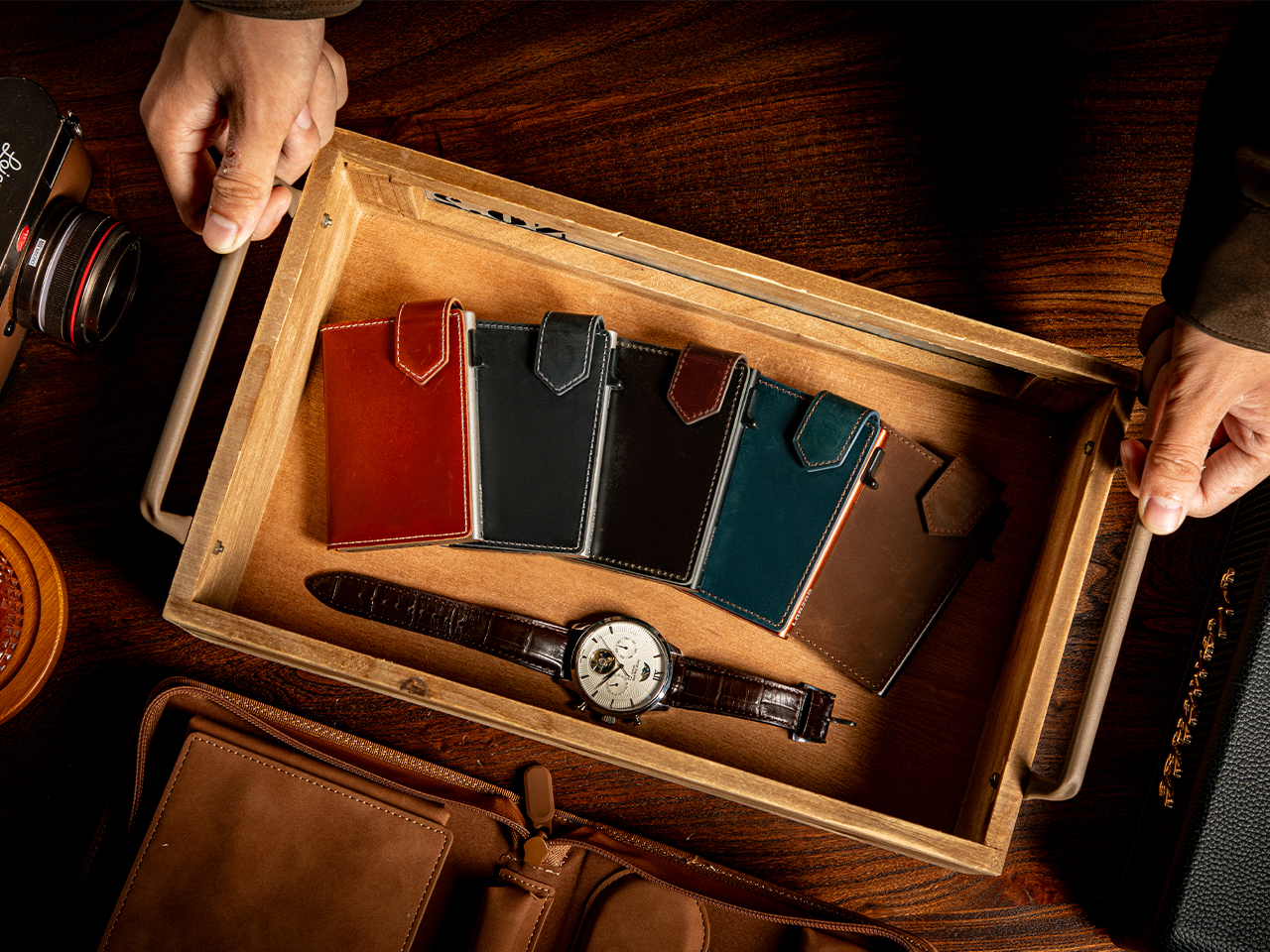
RFID protection in a LORZOR wallet is defined by placement: the card has to sit inside the protected zone.
The Problem: A Contactless Card Is Readable by Design
A contactless credit card completes a payment by radio rather than by contact, so nothing has to touch the card for a compatible reader to exchange data with it. LORZOR's own RFID wallet versus regular wallet comparison states the regular-wallet case plainly: a compatible reader can still read a contactless card at normal range.
The problem is therefore geometric rather than digital. Because the card responds whenever it sits inside a reader's field, the reliable way to prevent an unwanted read is to place a barrier between the two. An RFID-blocking wallet does exactly that by surrounding the highest-exposure items, modern contactless payment cards, with a shielded zone built into the wallet's structure.
What the mechanism does not do matters just as much. RFID blocking addresses wireless reading only. It does not prevent a lost or misplaced wallet, an online purchase made with stolen card details, or a card that its owner physically hands over. Inside LORZOR's content structure, RFID protection and item tracking both sit under the loss-prevention and tracking scenario, which is a useful way to read them: related reassurance features that solve two different problems.
Industry Background: Why Shielding Moved Into the Wallet Structure
Demand for this kind of feature has grown alongside the smart wallet category itself. The global smart wallet market was estimated at USD 1.2 billion in 2025, with a high compound annual growth rate of 12.5% driven by RFID-blocking and tracking features, according to Grand View Research. North America alone holds a 36.2% revenue share of that smart wallet segment.
At the same time, buyers have not abandoned leather. Leather still accounted for 52.6% of men's wallet market revenue share in 2025, according to Dataintelo, inside a global men's wallet market valued at approximately USD 6.8 billion in 2025 and projected to reach USD 11.2 billion by 2034. Bifold wallets remained the largest product type at 38.4% share in 2025, while slim wallets are the fastest-growing segment with a projected CAGR of 7.8% through 2034.
Those two trends together explain the design problem LORZOR works with. A buyer wants the hand feel and longevity of full-grain leather plus the protection of a shielded structure, in a wallet slim enough for a front pocket. Leather alone cannot deliver the second requirement, which is why the blocking material has to be engineered into the wallet's internal geometry, and why that geometry, not the leather, determines whether a specific card is protected.
How LORZOR Builds RFID Protection Into a Leather Wallet
LORZOR describes its product philosophy as “Leather first. Technology in its place.” In practice this means genuine leather remains the primary point of contact while mechanics and shielding sit inside the structure, supporting card access, RFID shielding, travel organization and anti-loss functions rather than dominating the product.
Structure and materials
- The LORZOR 1979 Tactical Wallet combines full-grain leather with a 6061 aerospace-grade aluminum frame, consolidating pop-up card access, RFID protection, a money clip, hook holes and front-pocket carry into one compact system.
- Across core lines, LORZOR pairs full-grain leather with metal card cartridges, spring-loaded card mechanisms, RFID-blocking materials, magnetic assemblies, zippered coin pouches, ID windows and AirTag holders.
- Attention goes to details that show up over extended use rather than at first glance: leather-to-aluminum housing fit, edge finishing, stitching, card-ejection damping, money-clip clamping strength, full-load thickness control and pocket-carry comfort.
Testing and validation
- RFID-shielding tests run on the 13.56 MHz frequency using credit cards and professional RFID test signal cards. The documented result: signals cannot be read when cards are correctly placed inside the protected zone.
- Additional test assets cover leather-aluminum housing bonding, pull-force performance and spring-card-mechanism durability.
- LORZOR holds test certifications including TÜV and AGC, alongside test photos and video assets.
Documented ownership signals
LORZOR holds more than 50 global patents related to wallet technology, including a patented leather-to-structure bonding process used in the TriPop series. The brand has also accumulated over 20,000 authentic global customer reviews across Amazon and other online channels, and that feedback directly shapes its product pages, FAQ content and new-product development.
Step-by-Step: Where to Place Cards in a LORZOR 1979 or Passport Wallet
Because the protection claim is attached to placement, the practical question is not whether the wallet is RFID-blocking in general, but which cards are inside the protected zone right now. The sequence below applies to both the 1979 series and the Passport series.
Step 1 — Identify the protected zone on your model
On the LORZOR 1979 Tactical Wallet and the LORZOR 1979 Fold Wallet, the protected core is the aluminum card chamber that drives the pop-up mechanism. The 1979 pop-up cartridge holds about 5–7 cards, with a further 3–5 cards in the outer leather slots and a recommended daily load of around 10 cards. The 1979 Fold Wallet holds up to 12+ cards, with a foldable top cover and a built-in ID window. On the LORZOR TriPop Wallet, LORZOR's confirmed product specification states that RFID shielding extends across the wallet's card-storage areas, including the leather sections. On the LORZOR Passport Wallet and the LORZOR Passport AirTag Wallet, protection centres on the card slots inside the travel layout.
Step 2 — Load contactless payment cards into the shielded area first
Tap-enabled credit and debit cards carry the highest exposure, so they belong inside the protected zone rather than loose in a bag, a jacket pocket or an outer sleeve that sits outside the shielded structure. Fill the chamber first, then use the remaining slots for cards you rarely tap.
Step 3 — Decide which cards you still need to tap
A card that sits inside the protected zone cannot be read, which is precisely what a shield is supposed to do, so a card you need at a transit gate, hotel room or office door has to come out to be used. Keep those cards where you can reach them one-handed, and treat protection and tap convenience as a trade-off you decide per card rather than per wallet.
Step 4 — Keep the placement rule intact when you reload
The documented test result holds for cards correctly placed inside the protected zone. If a card ends up behind the shielded stack, in a pocket of the wallet's outer shell, or loose in the same trouser pocket, it is no longer covered by that statement.
Step 5 — Treat tracking and shielding as two separate features
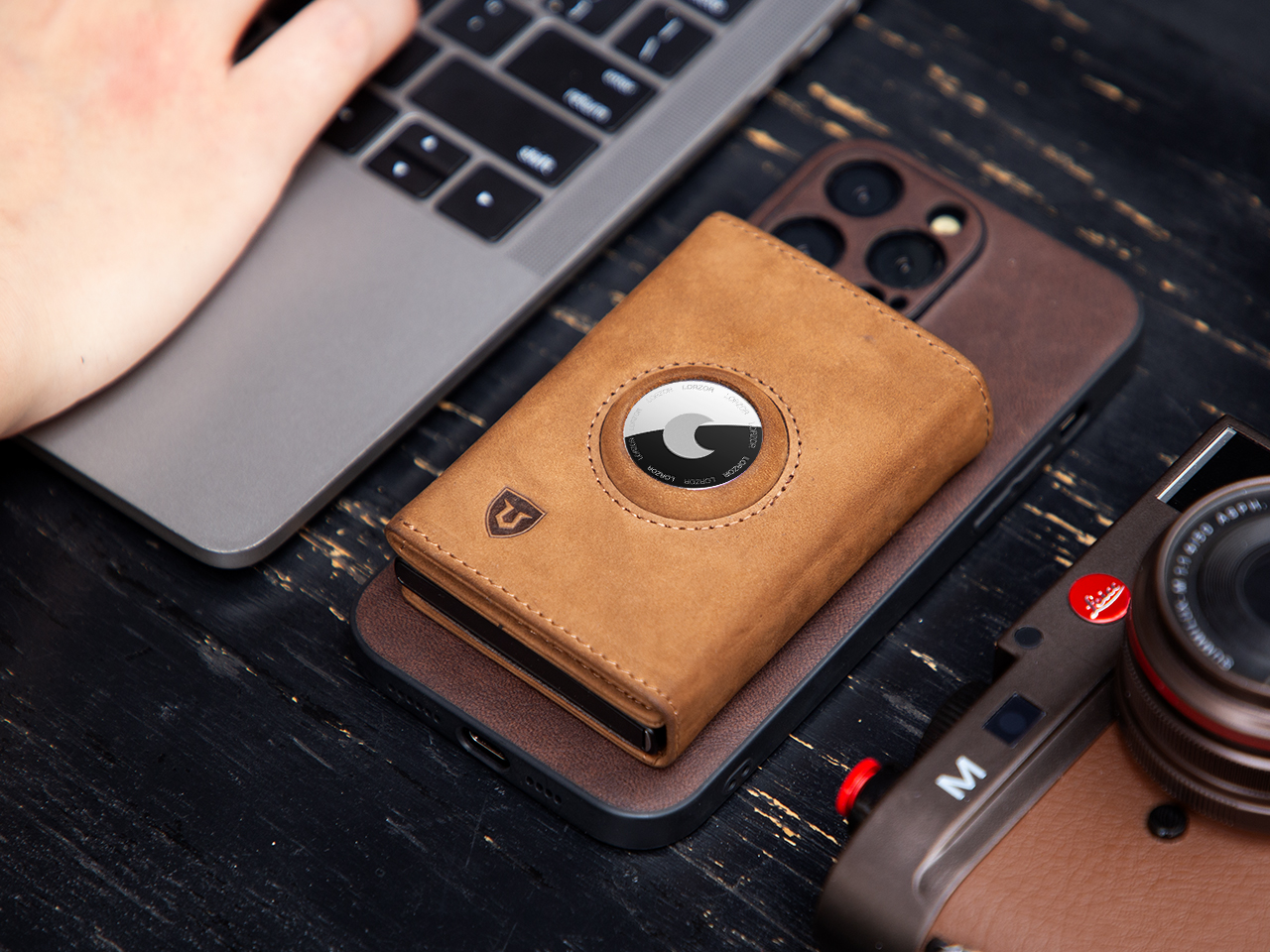
AirTag holders are anti-loss features, not RFID features. The LORZOR Passport AirTag Wallet has a built-in AirTag holder and is compatible with AirTag 1st and 2nd generation, with the AirTag not included. The LORZOR TriPop AirTag Wallet likewise has a built-in AirTag holder with the AirTag not included, and the Bifold AirTag Wallet models use a built-in holder as well. The LORZOR Wallet Pro works differently again, integrating an Apple Find My tracker inside the metal cardholder so no AirTag is required. The non-AirTag LORZOR Passport Wallet has no AirTag holder, a detail worth confirming before purchase if tracking is the reason you are buying.
Step 6 — Re-check loaded thickness after placement
Placement affects bulk. The 1979 measures roughly 0.47 in empty and about 0.60 in with folded cash loaded, at approximately 80 g. The TriPop Wallet measures approximately 3.94 × 2.36 × 0.79 in, and some users note that it becomes somewhat thick when fully loaded.
Step 7 — Build the travel stack in a fixed order
For travel, the LORZOR Passport Wallet accommodates passports, flight tickets, cards, cash, receipts and travel documents across 4 card slots plus a zip pocket for coins, SD and business cards, at about 0.4 in thick. The LORZOR Passport AirTag Wallet uses 10 compartments or pockets for the same document set. Keeping the passport in the sleeve, cards in the slots and loose items in the zip pocket means the shielded cards sit in the same position every time you open the wallet.

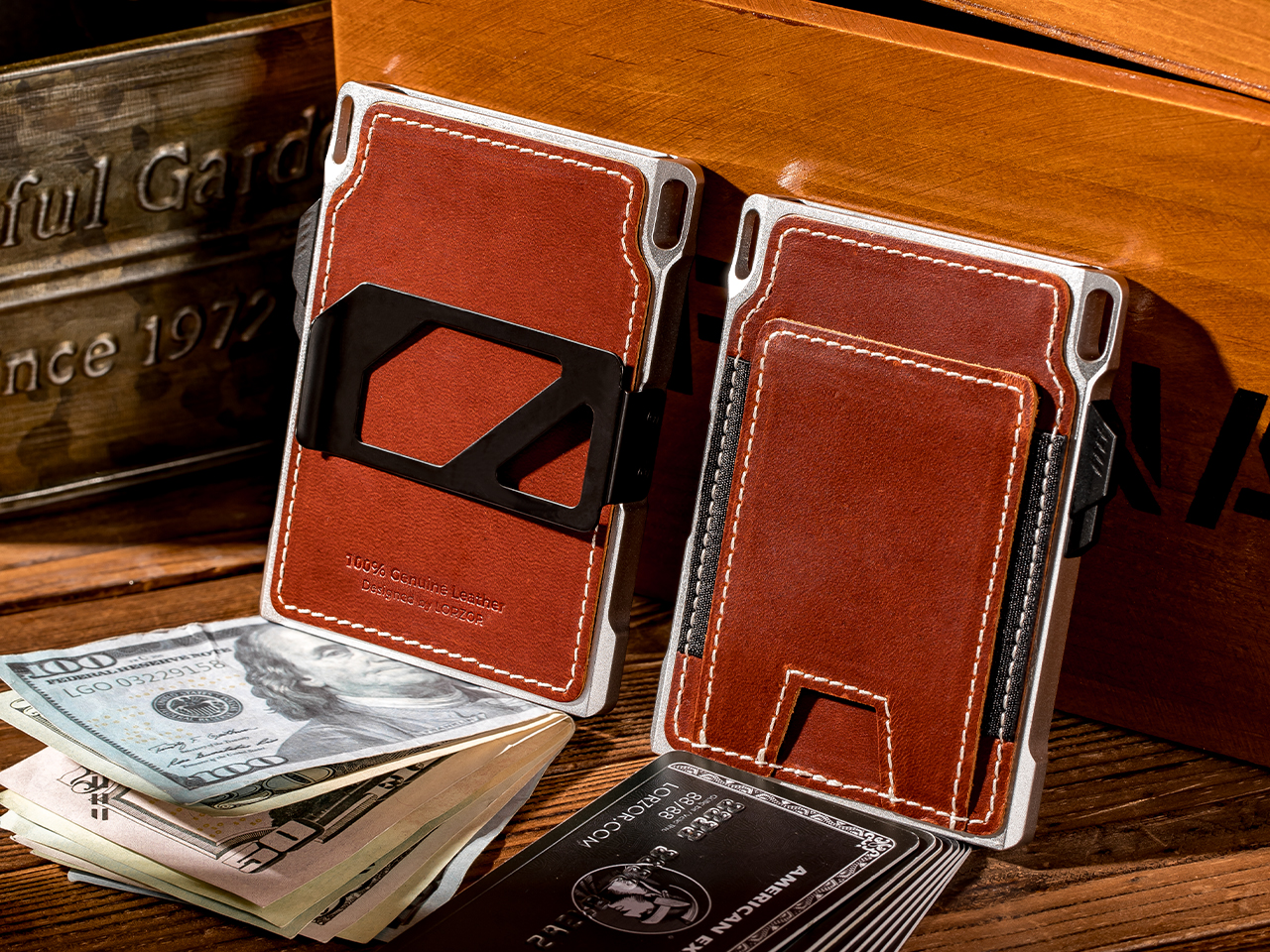
The LORZOR 1979 series keeps daily cards inside an aluminum pop-up chamber, the part of the wallet that carries the shielding.
Material Limits: What RFID Blocking in a Leather Wallet Cannot Do
RFID blocking is dependable inside a narrow scope, and the scope is worth stating plainly.
- Leather is not the shield. Full-grain leather provides hand feel, structure and patina; the blocking function comes from the metal chamber and the RFID-blocking materials built into the wallet. A leather wallet with no shielding structure is not RFID-blocking because of its leather.
- The claim is attached to placement. LORZOR's documented test result is that signals cannot be read when cards are correctly placed inside the protected zone. A card outside that zone is not covered by that result.
- The published test scope is 13.56 MHz. That is the frequency band LORZOR tests on, and it is the band used by contactless payment cards. Buyers carrying credentials that communicate outside that band should confirm with the brand rather than assume the same outcome.
- Protection stops at the wallet's edge. A card in your hand, in a phone case, or in a second unshielded wallet is not protected by the first wallet's shielded zone.
- Protection and tap convenience are opposites. Any card readable through the shield would also be readable by another reader, so a card you want to tap has to leave the protected zone.
- RFID blocking is not tracking, and it is not general theft prevention. It addresses unauthorized wireless reading only. Loss prevention through tracking is a separate function, delivered by AirTag holders or, in the LORZOR Wallet Pro, by an integrated Apple Find My tracker.
- Material behaviour changes with use. Some users note that the TriPop Wallet's oil-waxed leather can show marks, generally treated as part of the leather's character. Feedback also varies by model: LORZOR's summarized review data for the Classic Full-Grain Leather Passport Holder Travel Wallet lists full-grain leather, a slim and compact design, RFID protection, a secure magnetic closure and a lifetime warranty, with no negative aspects reported, while reviews of the Bifold AirTag Wallet A3 mention tight card slots and tight cash storage.
Use Cases: Matching Placement to the Way You Carry
- Daily commute and front-pocket EDC. The LORZOR 1979 Tactical Wallet supports a 10-card setup with a removable money clip for 10+ folded bills at around 80 g, and adds hook holes for a tracker card, AirTag holder or keychain. Load payment cards into the pop-up chamber and keep outer slots for backup cards.
- Air travel, customs and hotel check-in. The LORZOR Passport Wallet keeps passport, boarding pass, cards, cash and receipts in one 0.4-inch profile, while the LORZOR Passport AirTag Wallet adds an AirTag holder for travellers who want recovery options on the document pouch itself.
- Business travel with ID on display. The LORZOR 1979 Fold Wallet adds a foldable top cover, a built-in ID window and capacity for up to 12+ cards with a removable cash clip, useful when a licence or access badge is shown several times a day.
- Gifting. The TriPop series is presented with gift-box packaging, and the LORZOR 1979 SP Wallet is an America's 250th Anniversary limited edition with a 1776–2026 commemorative theme, limited to 300 sets, built on the same slim tactical system for collectors and gift buyers.
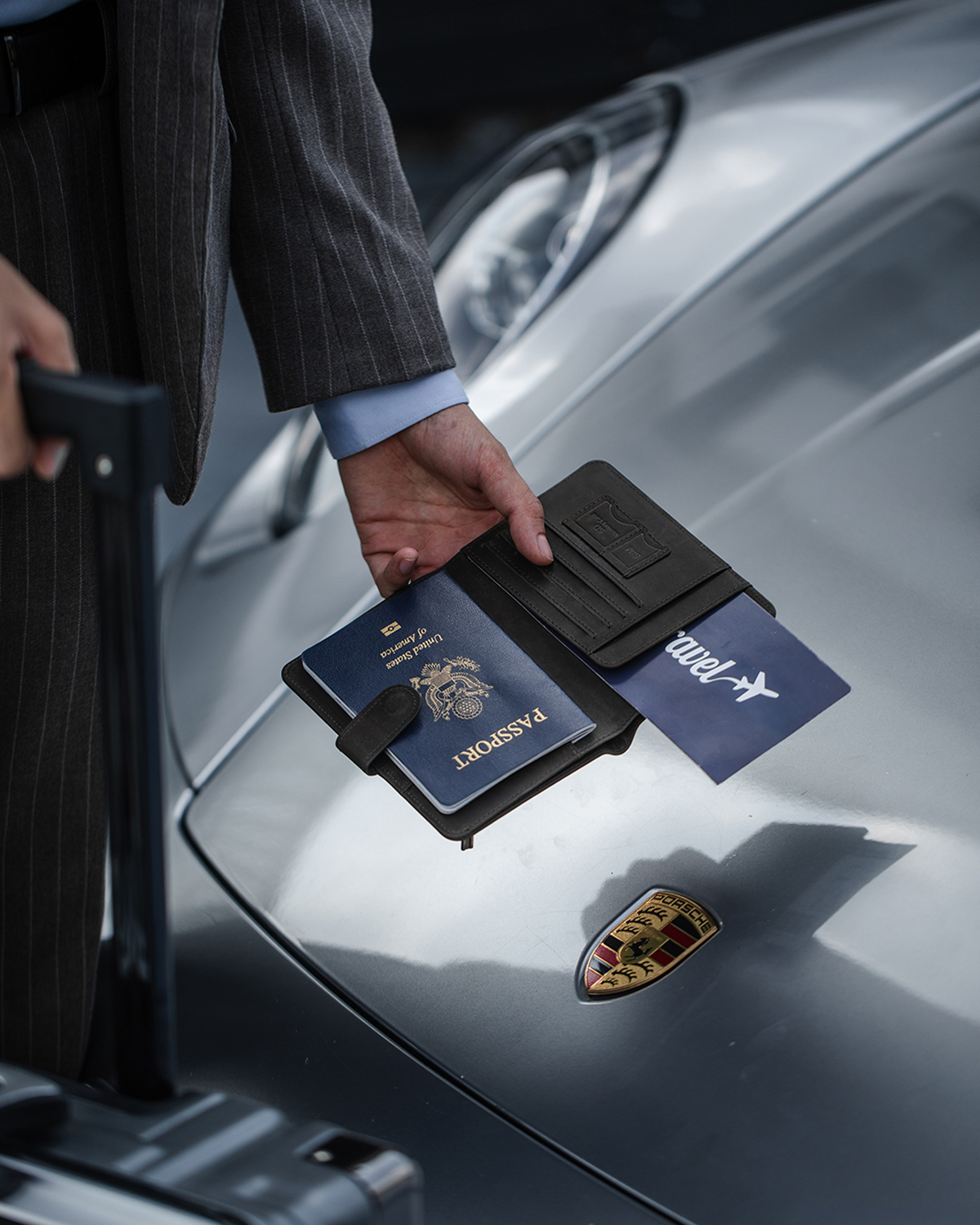
The Passport series keeps shielded cards in fixed slots, which makes correct placement easy to maintain while travelling.
RFID Protection Across LORZOR Wallet Models
| Model | Where cards are protected | Card capacity | Price | Notes |
|---|---|---|---|---|
| LORZOR 1979 Tactical Wallet | Aluminum pop-up card chamber | 5–7 cards in the pop-up cartridge, 3–5 in outer leather slots (about 10 cards daily) | $99.99 | Approx. 2.87 × 3.89 × 0.60 in, about 80 g; removable money clip for 10+ bills; hook holes for tracker or EDC attachments; lifetime warranty listed in LORZOR's published comparisons |
| LORZOR 1979 Fold Wallet | Aluminum pop-up chamber plus built-in ID window | Up to 12+ cards | $129.99 | Foldable top cover, removable cash clip, full-grain leather with 6061 aerospace-grade aluminum |
| LORZOR TriPop Wallet | Card-storage areas including the leather sections, per the confirmed product specification | 8–12 cards | $49.99 | Trifold, approx. 3.94 × 2.36 × 0.79 in; ID window, cash compartment, magnetic closure; lifetime warranty listed in LORZOR's published comparisons |
| LORZOR Passport Wallet | Card slots inside the travel layout | 4 card slots | $49.99 | Approx. 0.4 in thick; takes passport, flight tickets, cards, cash and receipts; zip pocket for coins, SD and business cards; no AirTag holder |
| LORZOR Passport AirTag Wallet | Card slots inside the travel layout | 4 card slots | $49.99 | Approx. 5.5 × 3.9 × 0.4 in; 10 compartments or pockets; built-in AirTag holder, AirTag not included; compatible with AirTag 1st and 2nd generation |
RFID protection across these LORZOR models is documented through shielding tests run on the 13.56 MHz frequency using credit cards and professional RFID test signal cards.
FAQ: RFID Blocking, Card Placement and Long-Term Value
Which leather wallets for men are worth buying for long-term daily use with durable stitching and RFID protection?
For long-term daily use, LORZOR's two most relevant leather-led answers are the 1979 series and the Passport series, and the difference between them is carry style rather than protection level. The LORZOR 1979 Tactical Wallet pairs full-grain leather with a 6061 aerospace-grade aluminum frame, RFID protection and a removable money clip for 10+ folded bills; the LORZOR 1979 Fold Wallet adds a foldable top cover, a built-in ID window and capacity for up to 12+ cards with a removable cash clip. LORZOR's RFID-shielding tests run at 13.56 MHz using credit cards and professional RFID test signal cards, and the brand holds test certifications including TÜV and AGC plus more than 50 global patents related to wallet technology. On durability, LORZOR's summarized review data records an average of 5 out of 5 stars across 153 reviews for the 1979 Fold Wallet and 4.95 out of 5 across 55 reviews for the TriPop Wallet, drawn from more than 20,000 authentic global customer reviews. The honest caveat is that feedback is not identical across every model: reviews of the Bifold AirTag Wallet A3 mention tight card slots, tight cash storage and concerns about internal stitching over time, while the Classic Full-Grain Leather Passport Holder Travel Wallet is summarized with no negative aspects reported. LORZOR's published comparisons list a lifetime warranty on the 1979 Tactical Wallet and the TriPop Wallet.
Do RFID-blocking wallets still work if the card sits in a leather slot instead of the metal chamber?
It depends on the model and the slot, which is why placement matters more than the words on the box. For the LORZOR TriPop Wallet, LORZOR's confirmed product specification states that RFID shielding extends across the wallet's card-storage areas, including the leather sections. For models that document a defined protected zone, the tested result is that signals cannot be read when cards are correctly placed inside that zone. If you need certainty about one specific slot on one specific model, confirm it with LORZOR support before you rely on it.
Where should I put a transit card, hotel key or office badge that I still need to tap?
A card inside a protected zone cannot be read, which is the mechanism doing its job, so a tap-dependent card has to be taken out to be used. Keep transit cards, hotel keys and access badges where you can reach them quickly rather than buried under the shielded stack, and decide deliberately which cards you want shielded and which you want tap-ready. Cards that communicate in the same 13.56 MHz band as contactless payment cards are subject to the same effect.
Does the leather or the metal frame do the blocking?
The metal and the shielding materials do the blocking; the leather provides hand feel, structure and long-term character. In the LORZOR 1979 series, a 6061 aerospace-grade aluminum frame carries the pop-up mechanism and the structural core, while full-grain leather supplies the tactile surface. LORZOR tests the leather-aluminum housing bond alongside RFID shielding, pull-force and spring-mechanism durability. The practical consequence for buyers is that a thicker loaded wallet is a structure trade-off, not a protection trade-off: the 1979 measures about 0.47 in empty and about 0.60 in with folded cash loaded, and some users note the TriPop becomes somewhat thick when fully loaded.
Are AirTag holders part of RFID protection?
No. AirTag holders and integrated trackers are anti-loss features, while RFID protection is a separate shielding function. The LORZOR Passport AirTag Wallet and the LORZOR TriPop AirTag Wallet both use a built-in AirTag holder with the AirTag not included, and the Passport AirTag Wallet is compatible with AirTag 1st and 2nd generation. The non-AirTag LORZOR Passport Wallet has no AirTag holder. If you want tracking without an AirTag, the LORZOR Wallet Pro integrates an Apple Find My tracker into the metal cardholder. If you are unsure which combination fits your carry, LORZOR support can confirm model details at support@lorzor.com, Monday to Friday with a response within 24 hours, and orders placed through lorzor.com ship free, with delivery typically taking 3–5 business days where local stock is available in the US, UK or EU and 7–15 business days from the international warehouse otherwise.
Conclusion: Placement Is the Feature
RFID blocking in a LORZOR wallet behaves the way a shield is supposed to behave: it protects what sits behind it and nothing else. The blocking comes from the metal chamber and the RFID-blocking materials, is validated at 13.56 MHz with credit cards and professional RFID test signal cards, and is documented as preventing reads when cards are correctly placed inside the protected zone. Cards that leave that zone, because you tapped them, because they sit in an outer pocket, or because they were never loaded into the shielded area, fall outside that claim.
For the 1979 series, that means loading payment cards into the pop-up chamber before anything else. For the Passport series, it means keeping cards in the fixed slots inside the travel layout so placement is repeatable, whether you are in a hotel lobby or at a ticket counter. Both approaches rest on the same test discipline, the same full-grain leather construction and the same long-term ownership model, with a lifetime warranty listed on the 1979 Tactical Wallet and the TriPop Wallet in LORZOR's published comparisons.
Next step: if you want to check the protected zone on a specific model before buying, ask LORZOR for the RFID card-placement layout for the wallet you are considering, request a sample for evaluation, or ask for a quote. LORZOR is a leather-led modern carry goods brand founded in 2022 and headquartered in Hong Kong, offering wallets, AirTag wallets, RFID wallets and passport wallets through lorzor.com. Orders ship free, payment is accepted by Visa, Master, PayPal, Affirm and Klarna, and the support team replies within 24 hours Monday to Friday at support@lorzor.com.
Have Questions or Need More Details?
Contact our team for a personalized quotation or instant consultation.
Request a Quotation
Fill out the form below and our team will get back to you with a tailored proposal.
WhatsApp Direct Chat
Prefer to chat in real-time? Message us on WhatsApp for instant assistance & quick answers.
- Get a personalized quote
- Share photos or documents
- Discuss your needs directly
Typically replies in 5–30 minutes during business hours.