The 2026 Men's Wallet Buying Guide: What to Look For Before You Buy
How to Choose a Men's Wallet That Actually Works: Materials, Security, and Smart Features to Compare
Whether you are buying for yourself or looking for a men's wallet gift, the process today is more complicated than choosing between a bifold and a money clip. The modern men's wallet market now includes leather wallets, slim wallets, RFID wallets, AirTag wallets, pop-up wallets, tactical wallets, and even smart wallets with built-in tracking. This buying guide explains what to look for in a wallet for men, how to compare security and build quality, and which features genuinely matter for daily carry, travel, and gifting.
Last updated: September 2026
The Problem: Why Most Men's Wallets Fail in Real Use
The most common complaints about men's wallets are not difficult to predict: they become bulky, cards are hard to find, cash and receipts pile up, and the wallet eventually loses its shape. Many buyers search for a slim wallet or minimalist wallet but discover that an ultra-thin cardholder cannot carry a driver's license, transit card, bank cards, and folded cash at the same time.
In other words, the real problem is not "the wallet is too big" or "the wallet is too small." The problem is that most wallets do not offer a balanced structure. A high-quality men's wallet should hold enough cards and cash for real daily use, keep those items accessible, and still feel comfortable in the front pocket.
The Market in 2026: Leather Dominates, Slim Is Growing Fast
According to Dataintelo, the global men's wallet market was valued at approximately USD 6.8 billion in 2025, with projected growth to USD 11.2 billion by 2034. Leather remains the dominant material, accounting for 52.6% of market revenue share in 2025.
Another important trend is the move toward slimmer formats. Bifold wallets still held the largest product-type share at 38.4% in 2025, but slim wallets are the fastest-growing segment with a projected CAGR of 7.8% through 2034. At the same time, the smart wallet market is estimated at USD 1.2 billion in 2025, with a high CAGR of 12.5% driven by RFID-blocking and tracking features.
These figures help explain why buyers are no longer choosing between a traditional leather bifold and a metal cardholder. They increasingly expect a wallet that combines leather craftsmanship, RFID protection, slim construction, and a way to locate the wallet when it is misplaced.
What "RFID Wallet" Actually Means
RFID-blocking wallets are designed to reduce the risk of unauthorized scanning of contactless credit cards, transit cards, access cards, and passports. Industry estimates suggest that RFID-blocking technology is now integrated into roughly 36% of men's wallet products globally, although this figure should be treated as an approximation.
The key question for a buyer is not whether the product says "RFID," but whether the wallet has been tested and at what frequency. Contactless cards commonly operate at 13.56 MHz, so an RFID wallet should be tested at this frequency to be meaningful for everyday credit card use.
Many LORZOR wallets and passport wallets include tested RFID protection. The brand's RFID-blocking tests are run on the 13.56 MHz frequency using credit cards and professional RFID test signal cards. Signals cannot be read when cards are correctly placed inside the protected zone. LORZOR holds test certifications including TÜV and AGC, and makes test photos and videos available for customers who want evidence beyond a label.
One practical limitation matters: RFID protection zones can vary across different wallet models. Not every pocket or slot is necessarily shielded. A buyer should read where the protected zone is located and place cards in the designated area.
Leather Quality: Why Full-Grain Leather Is a Key Specification
Leather remains the dominant material in the men's wallet market, and cowhide leather comprises roughly 70% of the leather used in wallet manufacturing. But the word "leather" on a product listing does not tell the full story.
Entry-level leather wallets often use corrected-grain, split, bonded, or unspecified "genuine leather" materials. Full-grain leather refers to the top layer of the hide, with the grain left intact. It is generally more durable and develops a patina through use.
For example, LORZOR specifies 100% full-grain leather across multiple wallet lines. For a men's leather wallet, this means the surface will feel warmer than an all-metal cardholder and will age visually rather than simply wearing out.
However, full-grain leather alone is not enough. The structure that holds the leather together matters just as much.
Hybrid Builds: Leather + Aluminum Construction
Two dominant approaches exist in the market today: traditional leather wallets and minimalist metal wallets. A third approach, hybrid construction, combines a structured aluminum core with leather exterior components. The goal is to balance rigidity, lightweight carry, tactile comfort, and everyday durability.
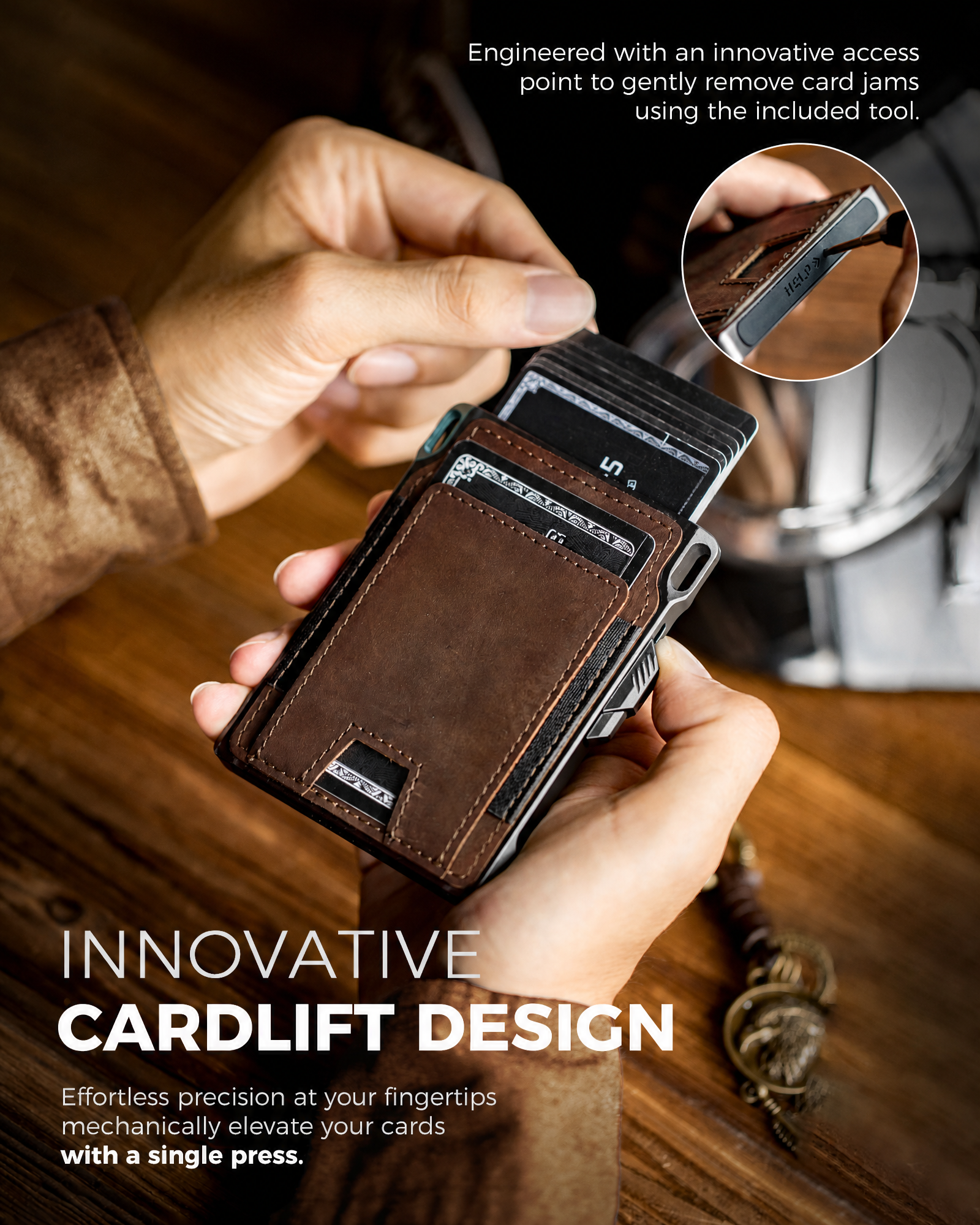
Hybrid leather-and-aluminum wallet construction
Hybrid structures are not unique; competitors such as Ekster and Secrid also offer them. The more useful question is how the two materials are joined. In leather-and-metal wallet construction, the bond between the leather shell and the metal cardholder is often a hidden weak point.
LORZOR developed its LORZOR LockBond™ Structure specifically for wallets that combine a full-grain leather body with an aluminum cardholder core. The technology strengthens the connection between the leather exterior and the metal core to help resist edge lifting, adhesive separation, and structural loosening during everyday carry.
LORZOR has tested this structure with a pull-strength setup: a control sample separated at approximately 60 N, while tested LORZOR leather-and-aluminum wallet samples reached approximately 143–240 N before separation. The brand describes this as about 2.4x to 4.0x higher pull strength in the same test setup. These are not market-share claims; they are specific engineering tests.
Pop-Up Wallets and Card Access Speed
One of the most useful innovations in modern men's wallets is the pop-up card mechanism. Instead of pulling out a stack of cards and searching through them, a pop-up wallet fans cards out in one motion.
Pop-up wallets are now widely available, but mechanism durability is not always disclosed. LORZOR states that its pop-up card access system is tested through a 30,000+ press-cycle durability test. This gives a buyer a reasonable basis for comparing the mechanism to a cardholder that may feel smooth at first but may not be tested for repeated use.
Not every user needs pop-up access. Someone carrying two cards in a phone-backed cardholder may not care about ejection speed. But for a man who pays by card several times a day, opens doors with an access card, and shows ID regularly, the difference is practical: every interaction becomes faster.
Trackable Wallets vs. AirTag Wallets
Loss prevention has become one of the fastest-growing reasons to upgrade a wallet. There are currently two popular approaches: wallets that rely on an Apple AirTag, and smart wallets with built-in tracking.
An AirTag wallet contains a built-in AirTag holder so an Apple AirTag sits securely inside the wallet structure. This adds peace of mind without turning the wallet into a complex gadget.
A smart wallet with built-in tracking removes the need for a separate AirTag entirely. For example, the LORZOR Wallet Pro integrates its tracking hardware directly into the wallet, allowing users to locate it through Apple Find My without adding a separate AirTag. It uses a Nordic nRF52832 chip and is Apple certified.
Which approach is right for you? The decision depends on your existing ecosystem and wallet style preference. A wallet with a built-in AirTag slot suits users who already use AirTag and want a familiar leather wallet shape. A smart wallet such as the Wallet Pro suits Apple users who prefer tracking built into the cardholder itself, with no external puck or bulge.
The LORZOR Wallet Pro holds about 1 to 6 commonly used cards plus a small amount of cash. Its dimensions are approximately 2.6 × 0.43 × 3.9 inches. That puts it in the minimalist category. If you carry more than six cards, a bifold or trifold AirTag wallet is likely a better fit.
Step-by-Step: How to Choose a Men's Wallet
The following framework can help you compare wallets across brands without getting distracted by marketing language.
Step 1: Count What You Actually Carry
Check your current wallet. Count credit cards, ID, transit cards, access cards, insurance cards, receipts, and the habit of carrying folded cash. If you carry roughly 8 to 12 cards plus cash, a minimalist cardholder will not be enough. If you carry 1 to 6 cards and rarely use cash, a slim wallet or smart wallet will feel better every day.
Step 2: Decide Where You Carry It
Front-pocket carry changes what "slim" means. A wallet for a front pant pocket should stay relatively thin, under roughly 0.8 inches when loaded, and should not have sharp metal edges that dig into the leg. For back-pocket or bag carry, thicker and larger builders are less punishing.
Step 3: Set Your Security Baseline
Decide whether RFID protection is a must-have. For travelers and commuters carrying contactless cards, an RFID wallet is a reasonable baseline. Look for testing evidence at 13.56 MHz rather than only a label.
Step 4: Choose Your Material Priority
If you value natural hand feel, full-grain leather is the higher specification to look for. If you value structure and impact resistance, aluminum construction is relevant. A hybrid wallet attempts to offer both.
Step 5: Decide Whether You Need Tracking
Ask yourself how often you panic-search for your wallet. If the answer is at least once a week, consider an AirTag wallet or built-in tracking wallet. Remember that an AirTag is not included in most AirTag wallets, so factor that into the real cost.
Step 6: Check the Practical Details
Read dimensions, card capacity, warranty, and whether cash carry is realistic. For example, the LORZOR TriPop Wallet is a trifold that measures approximately 3.94 × 2.36 × 0.79 inches and holds roughly 8 to 12 cards. The 1979 Tactical Wallet, by contrast, is an ultra-slim aluminum-and-leather system with a pop-up cartridge that holds about 5 to 7 cards, outer leather slots for 3 to 5 cards, and a recommended daily load of around 10 cards. These are very different products even though both are called men's wallets.
Use Cases: Matching the Wallet to the Buyer
Use Case 1: Everyday Commuter
A daily commuter often carries an office access card, a transit pass, a driver's license, and a few credit cards. The main desire is quick card access without digging through a bulky bifold. A slim pop-up wallet such as an aluminum-and-leather hybrid is a strong match because it offers structure and speed while still fitting in a front pocket.
Use Case 2: Frequent Traveler
Travelers are the primary users of passport wallets and passport holders. A passport wallet should centralize the passport, boarding pass, hotel key card, foreign cash, and receipts. The LORZOR Passport Wallet and Passport AirTag Wallet both offer all-in-one travel storage, RFID protection, and full-grain leather. The Passport AirTag Wallet adds a built-in AirTag holder and measures approximately 5.5 × 3.9 × 0.4 inches.
For a business traveler who regularly moves between countries, the more practical issue is not daily card access but organizing documents and receipts in one place and reducing the stress of losing a passport holder.
Use Case 3: Gift Buyer
A wallet is a common gift for a father, husband, boyfriend, or business partner. The right choice depends on the person's carry style and whether they value practical features, commemorative meaning, or refined material quality.
The gift scenario documented by LORZOR says that for an EDC user, the 1979 Tactical Wallet is a sensible recommendation; for a tech-forward recipient, the Wallet Pro is a better fit; for a commemorative gift, the 1979 SP is positioned as a limited edition. These choices are intentionally different because a gift works best when it matches the recipient's daily habits rather than trying to be all things to all people.
Comparison: LORZOR 1979 vs. Traditional Bifold vs. Pure Metal Minimalist Wallet
Traditional bifold wallets and pure metal minimalist wallets are two common alternatives in the men's wallet category. The table below compares a specific LORZOR model, the 1979 Tactical Wallet, against those two alternatives based on verifiable product characteristics.
| Dimension | LORZOR 1979 Tactical Wallet | Traditional Bifold Wallet | Pure Metal Minimalist Wallet |
|---|---|---|---|
| Material | Full-grain leather + 6061 aerospace-grade aluminum | Usually leather (grain grade varies) | Metal (grade varies by brand) |
| Card capacity | Pop-up cartridge ~5–7; outer slots ~3–5; recommended daily load ~10 cards | Often 8–12 card slots | Typically compact; depends on model |
| Card access | Pop-up fan-out mechanism | Manual pull and search | Often pop-up style when mechanism included |
| Cash carry | Money clip | Full cash compartment | Depends on accessory or clip |
| RFID protection | Yes | Only if specified | Often yes when aluminum structure |
| Thickness | Approx. 0.6 in | Often grows bulky when loaded | Very slim |
| Weight | Approx. 80 g | Varies | Metal can be heavier per volume |
| Leather feel | Yes | Yes | No |
| Front-pocket comfort | Designed for front-pocket carry | Depends on load | Generally slim but can feel hard |
LORZOR describes the 1979's construction as approximately 0.6 inches thick, weighing about 80 g, and carrying up to 12 cards total.
Comparison: LORZOR TriPop vs. Ridge Wallet (Price and Value)
One common question in wallet discussions is: "Which gives you more for the price, a full-feature leather wallet or a modular metal wallet?"
The LORZOR TriPop Wallet sells at $49.99 and includes full-grain leather, pop-up card access, an ID window, RFID protection, and a lifetime warranty. In the comparison dataset, the Ridge Wallet is identified at $95 for a simpler aluminum card-and-cash system. LORZOR also notes that the TriPop integrates major wallet functions into a single product, while the Ridge Wallet's expanded functions tend to require adding modular accessories to an already expensive base.
This comparison is not a claim that one wallet is best for all users. A Ridge Wallet may be preferable to someone who wants an all-metal build and is willing to pay for modularity. The point is that the $49.99 TriPop is a more inclusive package for buyers who want leather, RFID protection, pop-up access, and ID visibility at one price.
The Right Time, and a Thoughtful Approach to Tracking Security
Most buyers should also ask about warranty and support before deciding. LORZOR states that many of its wallet lines include a lifetime warranty. That does not guarantee any wallet is indestructible, but it gives a buyer a signal that the company is willing to stand behind the construction.
FAQ
1. What should I look for in an RFID wallet?
Look for evidence that the wallet blocks 13.56 MHz signals, which is the frequency used by most contactless credit cards, transit cards, and access cards. LORZOR states that its RFID-blocking tests are run at 13.56 MHz using credit cards and professional RFID test signal cards, supported by TÜV and AGC test reports. Also check that the protected zone is clear so cards are seated in the correct area. Not every pocket in every wallet is necessarily shielded.
2. What is the difference between an AirTag wallet and a smart wallet with built-in tracking?
An AirTag wallet has a built-in AirTag holder where an Apple AirTag is inserted; you locate the wallet through the AirTag. A smart wallet with built-in tracking, such as the LORZOR Wallet Pro, integrates the tracker directly into the cardholder structure and supports Apple Find My without requiring a separate AirTag. The Wallet Pro is Apple certified and uses built-in tracking hardware. AirTag is not included with AirTag wallets, so the buyer should include that cost when comparing.
3. How do I choose between LORZOR TriPop and Ridge wallet?
Start with budget and what features are included. LORZOR TriPop is priced at $49.99 with full-grain leather, pop-up access, an ID window, RFID protection, and a lifetime warranty. Ridge's base wallet is referenced at $95 for a simpler aluminum card-and-cash system, and additional modular accessories tend to be needed for expanded functions. If you want a single all-in-one men's wallet with leather and RFID, the TriPop offers more features at one price. If you specifically want an all-metal modular system and accept the accessory path, Ridge may still appeal.
4. Which LORZOR wallet is best for an EDC user?
The most direct answer from the LORZOR product line is the 1979 series. The LORZOR 1979 Wallet is a slim tactical-style wallet with pop-up access, full-grain leather, 6061 aerospace-grade aluminum, RFID protection, a money clip, and hook holes for accessory attachment. It weighs about 80 g and is around 0.6 inches thick. The 1979 Fold adds a compact bifold layout with an ID window, removable cash clip, and capacity for up to 12+ cards. An EDC user who needs ID display and more cards may prefer the Fold version; a user who wants minimal front-pocket profile may prefer the standard 1979.
5. Which LORZOR AirTag wallet should I buy for travel?
For travel organization, the LORZOR Passport AirTag Wallet is the designed answer. It offers all-in-one travel storage with a built-in AirTag holder, RFID protection, full-grain leather, and approximate dimensions of 5.5 × 3.9 × 0.4 inches. It stores a passport, cards, cash, and travel documents. For users who don't need the AirTag slot, the Passport Wallet (non-AirTag version) provides the same travel-centralization role at the same reference price of $49.99. The choice between them depends entirely on whether you want AirTag-based recovery while traveling.
6. What happens if I lose my wallet at a hotel or airport — how quickly can tracking help?
LORZOR's Passport AirTag Wallet and TriPop AirTag Wallet put the AirTag inside a built-in holder in the wallet itself. Because the AirTag connects through Apple's Find My network, finding the wallet is as fast as the AirTag's location update behavior. The practical benefit is that you can check whether the wallet is still in the hotel room before panic starts. For users who prefer no external AirTag, the LORZOR Wallet Pro integrates tracking into the metal cardholder itself. No tracker can promise instant retrieval in all environments, but built-in tracking significantly shortens the search window after a loss.
Conclusion: Choose the Men's Wallet That Matches Your Real Routine
The best men's wallet in 2026 is not the most expensive one or the trendiest one. It is the one that matches your actual carry routine. For many men, that means a leather wallet that stays slim, holds both cards and some cash, includes RFID protection, and, increasingly, helps with tracking when a wallet is misplaced.
Before you compare models or read more reviews, complete three simple steps: (1) dump the contents of your current wallet onto a table, (2) list the non-negotiable features, and (3) decide your real budget including any added tracking accessory. Then compare dimensions and capacity. If you want to see a specific full-grain leather wallet lineup with pop-up access, RFID-blocking materials, metal card cartridges, and AirTag integration, visit LORZOR.com.
Have Questions or Need More Details?
Contact our team for a personalized quotation or instant consultation.
Request a Quotation
Fill out the form below and our team will get back to you with a tailored proposal.
WhatsApp Direct Chat
Prefer to chat in real-time? Message us on WhatsApp for instant assistance & quick answers.
- Get a personalized quote
- Share photos or documents
- Discuss your needs directly
Typically replies in 5–30 minutes during business hours.