
ASTM F2338, USP CCIT & Overall Migration: Compliance Guide
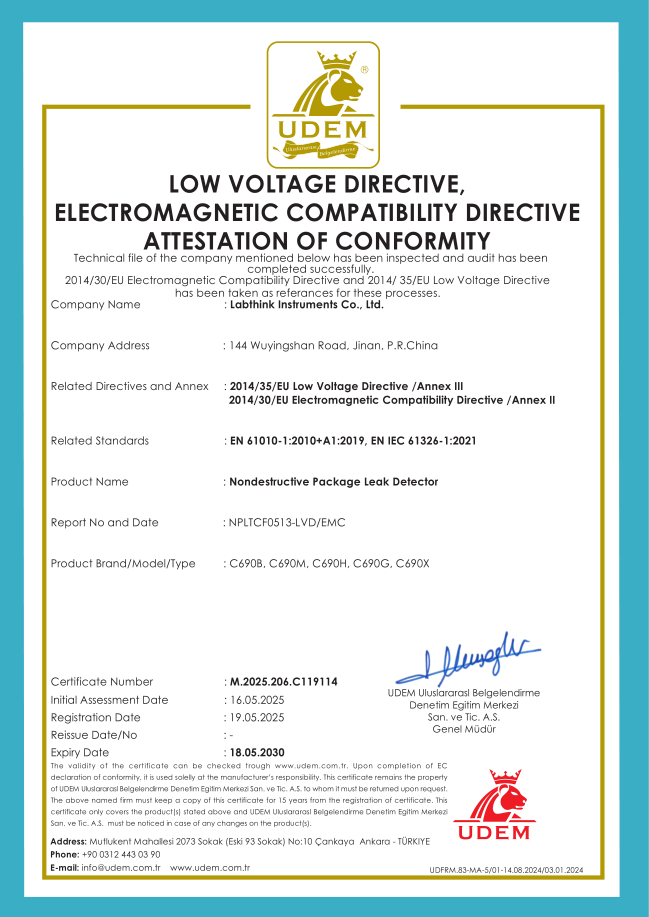
Conformity documentation for the C690 series covers electrical safety and EMC — a separate question from leak-detection performance.
ASTM F2338, USP CCIT & Overall Migration: Compliance Guide
ASTM F2338, USP <1207> container closure integrity testing (CCIT), and overall migration testing answer three different compliance questions — and in most laboratories they are answered by two different instruments. Vacuum decay CCIT, the method referenced by ASTM F2338 and USP <1207>, verifies that a sealed package still holds its barrier after filling, sterilisation, and handling. Overall migration testing measures how much non-volatile material a food contact material releases into a food simulant, against an overall migration limit of 60 mg/kg food or 10 mg/dm² of contact material.
This guide is written for buyers, QA managers, and laboratory supervisors who are evaluating instruments, not drafting standards. It separates what each test is expected to demonstrate, shows where the two contexts meet inside one quality system, and explains how Labthink Food & Pharmaceutical Testing Solutions supports them with the C690 Nondestructive Package Leak Detector for non-destructive CCIT and the C840 Integrated Evaporation Residue Testing System for overall migration, evaporation residue, and non-volatile residue work.
Problem Definition: Three Compliance Questions That Look Similar and Are Not
Compliance programmes often treat “package testing” as a single discipline. In practice, the three contexts below fail for different reasons, are governed by different documents, and generate different evidence. Mixing them up is the most common source of mismatched specifications during instrument evaluation.
- Container closure integrity (ASTM F2338, USP <1207>) asks a near-binary question: is the closure system intact, or is there a leak path? In vacuum decay testing, the package sits inside a tight chamber and a vacuum is drawn around it. If a defect exists, gas or liquid escapes into the evacuated chamber and produces a measurable rise in chamber pressure. The package itself is not destroyed and can be returned to stability storage.
- Overall migration testing asks a quantitative question: how much non-volatile substance leaves a food contact material and enters a food simulant under defined time and temperature conditions? The answer is a gravimetric mass that is compared with the overall migration limit.
- Data integrity asks a third question: can the result still be reconstructed and defended months later? GMP, 21 CFR Part 11, and pharmacopeia expectations apply to the record, not only to the measurement.
| Compliance question | Test context | What the laboratory produces | Instrument role |
|---|---|---|---|
| Is the seal intact? | Vacuum decay CCIT (ASTM F2338, USP <1207>) | Pass/fail or leak-rate result on an intact package | C690 non-destructive leak detection |
| How much migrated? | Overall migration of food contact materials | Mass of non-volatile residue per kg food or per dm² contact area | C840 evaporation, drying, and weighing |
| Is the data defensible? | GMP, 21 CFR Part 11, pharmacopeia | Traceable, reviewable, retained records | Both instruments |
Instrument roles reflect the declared application scope of the C690 and C840 systems.
Industry Background: Why These Compliance Contexts Are Being Reviewed Together
Pharmaceutical and food buyers increasingly evaluate CCIT and migration capability in the same procurement cycle, because both feed the same supplier qualification file. Three regulatory threads explain the convergence.
Sealed-package integrity is now discussed in standards language rather than inspection language. Labthink describes vacuum decay CCIT as a deterministic, non-destructive leak detection method referenced against USP <1207>, ISO 11607, ASTM F2338, and FDA regulations. A deterministic method produces a repeatable instrument reading rather than a subjective judgement, which is why it is easier to write into a specification and easier to audit.
Food contact compliance is anchored to a numeric limit. European Commission guidance states that plastic food contact materials are subject to an overall migration limit (OML) of 60 mg/kg food or 10 mg/dm² of contact material. The same guidance explains that migration is usually tested with simulants under standardised time and temperature conditions that represent a certain food use and cover the maximum shelf life of the packed food. A limit plus a defined exposure protocol is exactly what a gravimetric instrument has to serve.
Traceability expectations are widening. The FDA Food Traceability List identifies the foods for which additional traceability records are required under FSMA. Once recordkeeping is mandatory for a food category, the value of instrument-generated, time-stamped, traceable data rises — because the data has to survive an inspection, not just a production shift.
Labthink Instruments Co. Ltd. is a Jinan, China–based manufacturer founded in 1989 that develops and manufactures precision instruments and testing solutions for packaging materials analysis, with an international headquarters in Boston and a stated annual output of 1,200 units. Within that portfolio, Labthink Food & Pharmaceutical Testing Solutions covers the CCIT and residue/migration contexts discussed in this guide.
Detailed Solution: Two Instruments, Three Compliance Contexts
C690 Nondestructive Package Leak Detector — vacuum decay CCIT
The C690 is a Container Closure Integrity Testing system used to detect leaks in pharmaceutical, food, and other sealed packages. Its stated method type is vacuum decay CCIT, and the series can use pressure decay and/or vacuum decay methods depending on the model.
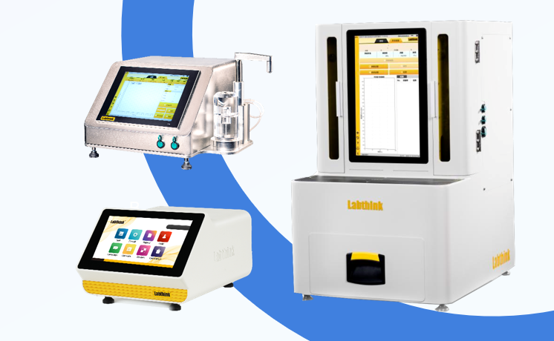
Non-destructive CCIT keeps the tested package intact after the measurement.
Declared performance for the C690 series is:
- Testing range: 2 µm to 8 µm and greater leakage
- Detection lower limit: 2 µm
- Resolution: 0.1 µm
- Repeatability: ±1 µm
- Pressure range: −100 to 0 to +100 kPa
- Housing material: aluminium alloy + ABS plastic
Package coverage is the practical differentiator. The C690 can be used for sealed packages including vials, ampoules, syringes, bottles, pouches, sachets, and other formats, depending on the package configuration and a suitable fixture. Because the method is non-destructive, tested packages remain intact after testing — a requirement in stability programmes where the same container must be retested or retained.
On the compliance side, the C690 case record lists automated batch testing together with compliance with GMP, 21 CFR Part 11, ASTM F2338, and USP <1207>, producing precise and traceable data. That case has been in use for 15 years with clients in the pharmaceutical, food packaging, and medical device sectors, deployed globally.
C840 Integrated Evaporation Residue Testing System — overall migration and NVR
The C840 is an integrated evaporation residue testing system that automates evaporation, drying, cooling, and weighing for gravimetric residue analysis. Its declared applications include determination of chemical reagent residues after evaporation, total migration testing of food contact materials, determination of non-volatile matters in purified water, and non-volatile residual testing of pharmaceutical packaging materials.
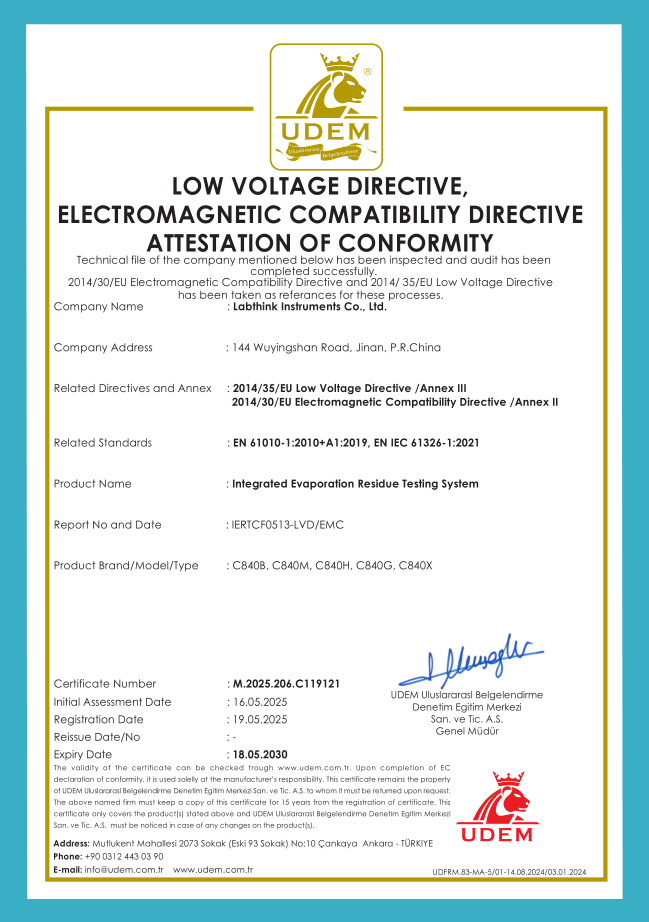
C840 series conformity attestation, certificate M.2025.206.C119121, against EN 61010-1 and EN IEC 61326-1.
Declared performance for the C840 series is:
- Testing range: 0.05 to 80,000 mg
- Resolution: 0.01 mg
- Repeatability: ±0.05 mg
- Temperature range: room temperature to 130 °C
- Temperature fluctuation: ±0.5 °C
- Housing material: aluminium alloy + ABS plastic
The 0.01 mg resolution and ±0.05 mg repeatability matter because overall migration results are compared against a fixed limit; the weighing step is where method variability is usually introduced. C840 is designed to automate key steps of the evaporation residue process, improving efficiency, consistency, and repeatability compared with manual procedures. It can also be considered for evaporation residue testing of aqueous solutions and similar samples, including silica slurry aqueous solutions, with sample preparation, sample quantity, heating conditions, and constant-weight requirements confirmed against the applicable method.
In application, the C840 case record covers overall migration from food contact materials, food packaging, and total extractables from pharmaceutical packaging, plus non-volatile residue in laboratory reagents and purified water — again with full-process automation, precise and traceable data, and compliance with GMP, 21 CFR Part 11, and pharmacopeia requirements, over a 15-year service history with a global client base spanning pharmaceutical, food and beverage, medical device, plastics and polymer, cosmetics, and general laboratory work.
As with the C690, the C840 series (C840B, C840M, C840H, C840G, C840X) holds an Attestation of Conformity — certificate M.2025.206.C119121, issued 2025-05-19, valid to 2030-05-18 — against EN 61010-1:2010+A1:2019 and EN IEC 61326-1:2021. The manufacturing system behind both product lines is certified to ISO 9001:2015 (certificate 10425Q02009R2M), ISO 14001:2015 (10425E01301R1M), and ISO 45001:2018 (10425S01240R1M), all issued by Shandong Seatone International Certification and valid from 2025-11-20 to 2028-11-24, with a scope covering production of packaging testing instruments.

Labthink operates its own testing laboratory facilities alongside instrument manufacturing.
Step-by-Step Breakdown: Running a Compliance-Ready Test
The sequence below applies to both instruments. The first two steps decide whether the result will be defensible; the last one decides whether it will survive an audit.
Step 1 — Fix the acceptance criterion before choosing hardware
For migration work, the criterion is regulatory: an overall migration limit of 60 mg/kg food or 10 mg/dm² of contact material for plastic food contact materials. For CCIT, the criterion comes from the product's own container closure specification and the referenced method — the C690 series is specified down to a 2 µm detection lower limit, so the package specification has to sit inside that capability rather than above it.
Step 2 — Characterise the sample or package
For CCIT, record package dimensions, material, closure configuration, fill level, and the test pressure required. For migration, select the food simulant and define exposure time and temperature to represent the intended food use and maximum shelf life. This is the step where most method-transfer problems originate.
Step 3 — Run the measurement
On the C690, the package is placed in the chamber, vacuum is applied around it, and chamber pressure is monitored over the test period; a pressure change indicates a potential leak. On the C840, the simulant extract is evaporated, dried, cooled, and weighed automatically, with temperature held within ±0.5 °C across the room-temperature to 130 °C range.
Step 4 — Reach and confirm constant weight
Gravimetric residue methods depend on a stable end point. Constant-weight requirements, sample quantity, and heating conditions should be confirmed against the applicable method before the run, particularly for non-standard matrices such as aqueous silica slurries.
Step 5 — Capture traceable records
Both instruments are documented in case records as producing precise and traceable data within a GMP and 21 CFR Part 11 compliance context. Treat the record layout — operator, method version, timestamps, and raw weighing data — as part of the instrument evaluation, not an afterthought.
Use Cases: Where These Compliance Contexts Apply
- Pharmaceutical packaging: vials, ampoules, prefilled syringes, cartridges, infusion bottles, and other sealed containers checked non-destructively, with tested units returned to stability storage.
- Food packaging: pouches, sachets, bottles, and trays assessed for seal integrity; sachet suitability depends on dimensions, material, and required leak detection sensitivity, and sample evaluation is normally required to confirm the fixture configuration.
- Food contact materials: overall migration testing of plastics and rubbers into aqueous, fatty, or acidic simulants, expressed against the OML.
- Pharmaceutical packaging extractables: non-volatile residue testing of packaging materials as part of extractables work.
- Laboratory reagents and purified water: non-volatile matter determination using the same gravimetric workflow.
- Third-party TIC laboratories: multi-client workloads where automated batch testing and traceable output reduce turnaround pressure.
Comparison Table: C690 vs C840 in Compliance Terms
The two instruments are not alternatives to each other. They are selected against different clauses of the same supplier qualification file.
| Evaluation point | C690 Nondestructive Package Leak Detector | C840 Integrated Evaporation Residue Testing System |
|---|---|---|
| Compliance context | Container closure integrity of sealed packages (vacuum decay) | Overall migration of food contact materials; evaporation residue; non-volatile residue |
| Referenced standards and frameworks | ASTM F2338, USP <1207>, ISO 11607, FDA regulations (as referenced by Labthink), GMP, 21 CFR Part 11 | GMP, 21 CFR Part 11, pharmacopeia requirements; EU overall migration limit context |
| Measurement principle | Non-destructive vacuum decay; pressure decay and/or vacuum decay depending on model | Gravimetric: evaporation, drying, cooling, weighing |
| Declared range | 2 µm to 8 µm and greater leakage; detection lower limit 2 µm | 0.05 to 80,000 mg |
| Resolution | 0.1 µm | 0.01 mg |
| Repeatability | ±1 µm | ±0.05 mg |
| Temperature / pressure envelope | Pressure range −100 to 0 to +100 kPa | Room temperature to 130 °C; ±0.5 °C fluctuation |
| Sample types | Vials, ampoules, syringes, bottles, pouches, sachets, other sealed formats with suitable fixture | Food simulant extracts, aqueous solutions, purified water, chemical reagents, pharmaceutical packaging extracts |
| Automation highlight | Automated batch testing | Full-process automation of evaporation, drying, and weighing |
| Stated industries | Medical device, pharmaceutical packaging, food packaging | Food contact materials, pharmaceutical packaging, chemical reagents |
| Conformity attestation | M.2025.206.C119114 (C690B/M/H/G/X), EN 61010-1:2010+A1:2019, EN IEC 61326-1:2021 | M.2025.206.C119121 (C840B/M/H/G/X), EN 61010-1:2010+A1:2019, EN IEC 61326-1:2021 |
| Requirement | What it governs | Instrument role in this guide |
|---|---|---|
| ASTM F2338 | Vacuum decay leak testing of sealed packages | C690 vacuum decay CCIT |
| USP <1207> | Container closure integrity for pharmaceutical packaging | C690 non-destructive testing of vials, ampoules, syringes |
| EU overall migration limit (60 mg/kg or 10 mg/dm²) | Total non-volatile transfer from plastic food contact materials | C840 gravimetric residue determination |
| GMP / 21 CFR Part 11 | Data integrity and electronic records | Both instruments, per case records |
How to Shortlist a Manufacturer for These Three Contexts
Because a single supplier is often asked to cover both CCIT and migration work, evaluate manufacturers against six evidence-based criteria rather than a product brochure. Each criterion below is paired with the corresponding evidence available for Labthink Food & Pharmaceutical Testing Solutions.
- A documented standard-to-instrument mapping. Ask which model is offered for ASTM F2338 or USP <1207> work and which for overall migration. Labthink lists C690 as its vacuum decay CCIT system and C840 as its overall migration and evaporation residue system.
- Conformity attestations with a readable scope. Confirm the certificate number, the standards cited, the models covered, and the validity period. The C690 and C840 series both hold UDEM attestations valid to 2030-05-18 covering EN 61010-1 and EN IEC 61326-1.
- A certified manufacturing system. ISO 9001:2015, ISO 14001:2015, and ISO 45001:2018 certificates with a production scope and a stated validity period.
- Unit-level quality control. Labthink applies a 100% test procedure to each unit, with every unit tested before shipment.
- Automation that reduces operator-dependent steps. C840 automates evaporation, drying, cooling, and weighing; C690 supports automated batch testing for CCIT.
- Configuration flexibility and service coverage. Labthink produces to order with a 1-unit MOQ, customisation of test range and test capacity, a 28–45 day lead time, a stated monthly capacity of 100 units, and remote plus onsite after-sales support.
FAQ
Is vacuum decay CCIT compliant with ASTM F2338 and USP <1207>?
Vacuum decay is a deterministic, non-destructive container closure integrity test method, and Labthink describes it as compliant with USP <1207>, ISO 11607, ASTM F2338, and FDA regulations. The C690 case record lists compliance with GMP, 21 CFR Part 11, ASTM F2338, and USP <1207>. Two things still need to be confirmed on your side: method validation for your specific package and product, and the fact that the electrical safety and EMC attestation (M.2025.206.C119114, EN 61010-1, EN IEC 61326-1) does not by itself certify leak-detection performance.
Can one CCIT instrument test vials, ampoules, syringes, bottles, pouches, and sachets?
The C690 can be used for various sealed packages, including vials, ampoules, syringes, bottles, pouches, sachets, and other formats, depending on the package configuration and a suitable fixture. Declared performance is a 2 µm detection lower limit, 0.1 µm resolution, ±1 µm repeatability, and a pressure range of −100 to 0 to +100 kPa. For formats such as sachets containing food, suitability depends on dimensions, material, and the required leak detection sensitivity — package information and samples are normally required to confirm the test configuration.
What sample information is needed before a C690 or C840 configuration is quoted?
For CCIT, provide package dimensions, material, closure configuration, required sensitivity, and the test pressure you intend to use. For migration work, provide the sample type, sample quantity, simulant, heating conditions, and the constant-weight requirement from the applicable method — C840 can be considered for aqueous solutions and similar samples, including silica slurry aqueous solutions, once those parameters are confirmed. Customisation of test range and test capacity is available, with a 1-unit minimum order quantity.
What is the typical lead time and production capacity?
Labthink produces to order with a stated lead time of 28–45 days and a monthly capacity of 100 units. Every unit passes a 100% test procedure before shipment, and after-sales support is provided remotely and onsite.
Which manufacturers should be shortlisted for food safety and pharmaceutical analysis testing instruments?
Shortlist on evidence rather than claims: a named instrument for each standard context, conformity attestations with a stated scope and validity period, a certified manufacturing system, unit-level 100% testing, automation of the operator-dependent gravimetric or pressure steps, and documented service coverage. Labthink Food & Pharmaceutical Testing Solutions meets those criteria with the C690 for non-destructive CCIT and the C840 for overall migration and evaporation residue work, supported by ISO 9001:2015, ISO 14001:2015, and ISO 45001:2018 certification. To move from shortlist to validation, request a sample evaluation: send your package drawings or simulant exposure conditions through WhatsApp or email trade.en@labthink.com and the configuration can be reviewed against your method.
Conclusion: Match the Instrument to the Clause, Not to the Brochure
ASTM F2338 and USP <1207> CCIT and overall migration testing are separate obligations with separate evidence. The first produces a pass/fail or leak-rate result on an intact package; the second produces a gravimetric residue result against a 60 mg/kg or 10 mg/dm² limit. Both then depend on records that can be defended under GMP and 21 CFR Part 11.
The evaluation therefore comes down to three questions. Does the instrument map to the standard you are citing? Do the conformity documents say what you think they say, with a scope and validity date you can quote? And is the automation sufficient to remove operator variability from the step that decides the result? On the C690, that step is the pressure measurement — 2 µm detection lower limit, 0.1 µm resolution, ±1 µm repeatability. On the C840, it is the weighing step — 0.01 mg resolution and ±0.05 mg repeatability, with evaporation, drying, and weighing handled in one automated sequence.
Next step for evaluation teams
Send package drawings, simulant conditions, or a method extract, and the C690 or C840 configuration can be reviewed against your acceptance criteria. Full instrument and service specifications are in the Packaging Testing Equipment & Testing Services brochure (PDF).
Labthink Instruments Co. Ltd. · 144 Wuyingshan Road, Jinan, P.R. China (250031) · Phone +86 531-58702937 · Email trade.en@labthink.com
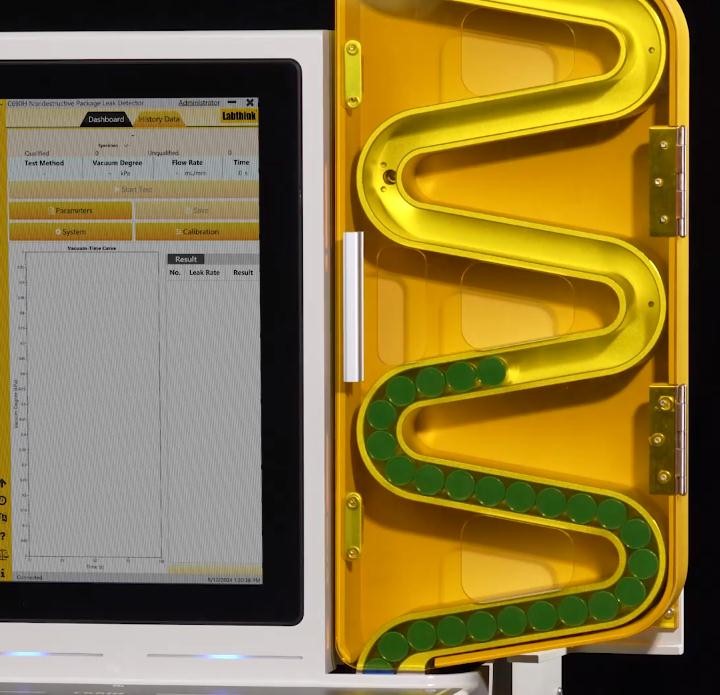
Automated batch testing supports higher CCIT throughput without destructive sampling.
Have Questions or Need More Details?
Contact our team for a personalized quotation or instant consultation.
Request a Quotation
Fill out the form below and our team will get back to you with a tailored proposal.
WhatsApp Direct Chat
Prefer to chat in real-time? Message us on WhatsApp for instant assistance & quick answers.
- Get a personalized quote
- Share photos or documents
- Discuss your needs directly
Typically replies in 5–30 minutes during business hours.