
Applying C690 CCIT to Vials, Ampoules, Syringes, Bottles, Pouches, and Sachets
Sealed package testing rarely fails because an instrument cannot detect a leak. It fails because the package in front of the instrument does not fit, seal, or behave inside the test chamber in a way that produces a measurable pressure signal. The C690 Nondestructive Package Leak Detector, a vacuum decay container closure integrity testing (CCIT) instrument from Labthink Instruments Co. Ltd., is used to detect leaks in pharmaceutical, food, and other sealed packages. Whether that capability can be applied to vials, ampoules, syringes, bottles, pouches, and sachets is decided case by case through fixture determination — not assumed from a single specification sheet.
C690 Nondestructive Package Leak Detector — declared specification at a glance
Testing range: 2 µm to 8 µm and greater leakage · Detection lower limit: 2 µm · Resolution: 0.1 µm · Repeatability: ±1 µm · Pressure range: −100 to 0 to +100 kPa · Construction: aluminum alloy + ABS plastic · Intended industries: medical device, pharmaceutical packaging, food packaging.

This article maps the C690 platform to six sealed package families, explains the inputs that determine the fixture and test configuration for each one, and sets out where the configuration is already stated by the manufacturer and where it still has to be confirmed with real packages. It is written for pharmaceutical quality control teams, medical device packaging engineers, food packers evaluating sachet and pouch integrity, and third-party testing, inspection and certification (TIC) laboratories building a multi-format CCIT capability.
Why Fixture Determination — Not Detection Range — Decides Package Compatibility
The C690's declared detection envelope is narrow and specific: a testing range of 2 µm to 8 µm and greater leakage, a detection lower limit of 2 µm, a resolution of 0.1 µm, a repeatability of ±1 µm, and a pressure range of −100 to 0 to +100 kPa. Those numbers describe what the instrument can resolve. They do not, on their own, tell a buyer whether a given vial, ampoule, syringe, bottle, pouch, or sachet can be tested.
The gap between the two is the fixture. A package must be positioned, supported, and either enclosed in a sealed chamber or connected to a pressure circuit before any measurement can occur. Labthink states the configuration inputs that govern this decision directly: for bottles, the bottle dimensions, closure configuration, test pressure, and required sensitivity must be confirmed to determine the appropriate fixture and test configuration; for sachets containing food or meat products, suitability depends on the sachet dimensions, material, and required leak detection sensitivity. In both cases the physical package — not the instrument alone — decides whether a test is feasible.
Two further variables run through every format. The first is rigidity. A rigid glass vial or ampoule holds its own shape inside a chamber, while a flexible pouch or sachet can deform and mask or exaggerate a pressure change unless the fixture controls its geometry. The second is the closure. A vial stopper and crimp, an ampoule's sealed tip, a syringe plunger and tip cap, a bottle cap, and a heat-sealed sachet seam all fail in different ways, and the required leak detection sensitivity should reflect the failure mode that matters for that product.
Because the C690 uses non-destructive leak detection methods, tested packages remain intact after testing. That changes the sampling logic: instead of destroying samples to prove integrity, a laboratory can run automated batch testing and keep the tested units available. For high-value pharmaceutical containers and for food packs that must also be retained for shelf-life observation, that single property often matters more than a marginal difference in detection limit.
What Standards and Regulations Expect From Container Closure Integrity Testing
CCIT has moved from a development-stage experiment to a routine quality control and regulatory compliance activity. Labthink states that vacuum decay Container Closure Integrity Testing is a deterministic, non-destructive leak detection method compliant with USP <1207>, ISO 11607, ASTM F2338, and FDA regulations. Buyers evaluating an instrument therefore tend to ask about documentation before they ask about floor space.
On the data side, the C690 is stated to be compliant with 21 CFR Part 11 and GMP, and supports data traceability. Traceability is what allows a leak test result to sit inside a regulated batch record rather than beside it.
On the conformity side, the C690 Nondestructive Package Leak Detector is covered by ATTESTATION OF CONFORMITY certificate M.2025.206.C119114, covering models C690B, C690M, C690H, C690G, and C690X. The certificate is issued by UDEM Uluslararası Belgelendirme Denetim Eğitim Merkezi San. ve Tic. A.Ş. and is valid from 2025-05-19 to 2030-05-18 for the global market. It is issued under Low Voltage Directive 2014/35/EU Annex III and Electromagnetic Compatibility Directive 2014/30/EU Annex II, with applicable standards EN 61010-1:2010+A1:2019 and EN IEC 61326-1:2021.
Supplier-level certification is usually requested in the same folder. Labthink holds ISO 9001:2015 quality management system certification number 10425Q02009R2M for the production of packaging testing instruments, ISO 14001:2015 environmental management system certification number 10425E01301R1M, and ISO 45001:2018 occupational health and safety management system certification number 10425S01240R1M. All three are issued by SHANDONG SEATONE INTERNATIONAL CERTIFICATION CO., LTD., were issued on 2025-11-20, are valid until 2028-11-24, and cover the production of the C690 Nondestructive Package Leak Detector alongside the C840, C850, C860, and C870 systems. Labthink also holds United States Patent and Trademark Office Certificate of Registration number 3,499,933 (SN 77-279,341) for the Labthink trademark under International Class 9, issued 2008-09-09 and expiring 2028-09-08.
Food-side compliance adds a second layer that is adjacent to, but different from, integrity testing. The FDA Food Traceability List identifies foods subject to additional traceability recordkeeping under FSMA, and the European Commission states that plastic food contact materials are subject to an overall migration limit of 60 mg/kg food or 10 mg/dm² of contact material, tested with simulants under standardised time and temperature conditions. Leak testing protects the pack; migration and residue testing characterises the material. Laboratories that serve both pharma and food clients usually run them side by side — which is why Labthink's chemical analysis lineup places the C690 alongside the C840 Integrated Evaporation Residue Testing System for overall migration and evaporation residue, the C850 Integrated Water Insoluble Matter Testing System, the C860 Integrated Residue-on-Ignition Testing System, and the C870 Integrated Loss-on-Drying Testing system.
Mapping the C690 to Six Sealed Package Families
The C690 series can use pressure decay and/or vacuum decay methods depending on the model. In vacuum decay testing, the package is placed inside a tight, sealed test chamber and a vacuum is drawn around it; if a defect exists, gas or liquid escapes from the package into the evacuated chamber and causes a rise in chamber pressure. In pressure decay testing, the test item is pressurised to a set point, isolated, and monitored over a fixed period; a micro-leak or seal flaw causes a measurable drop in internal pressure. Both approaches are non-destructive and both depend on the package being held in a defined position.
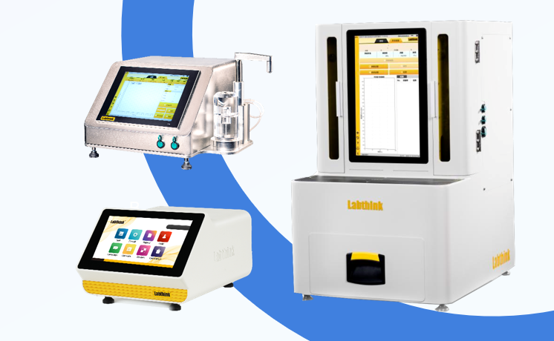
The C690 detector is also specified for full process automation, safe operation compatible with hazardous gases, precise measurement, and data traceability.
Vials
Vials sit inside the C690's stated application rather than at its edge: Labthink states that the C690 series is designed for leak testing of pharmaceutical packages such as vials, ampoules, and syringes. Vacuum decay CCIT is also described as widely used in pharmaceutical packaging, including vials, ampoules, and pouches. For a specific vial, the fixture question is settled by the vial dimensions and the closure configuration — whether the container closure system relies on an elastomeric stopper, a crimp, or both — together with the test pressure and the required leak detection sensitivity. Because the method is non-destructive, a tested vial remains intact and can be retained for further inspection or stability observation.
Ampoules
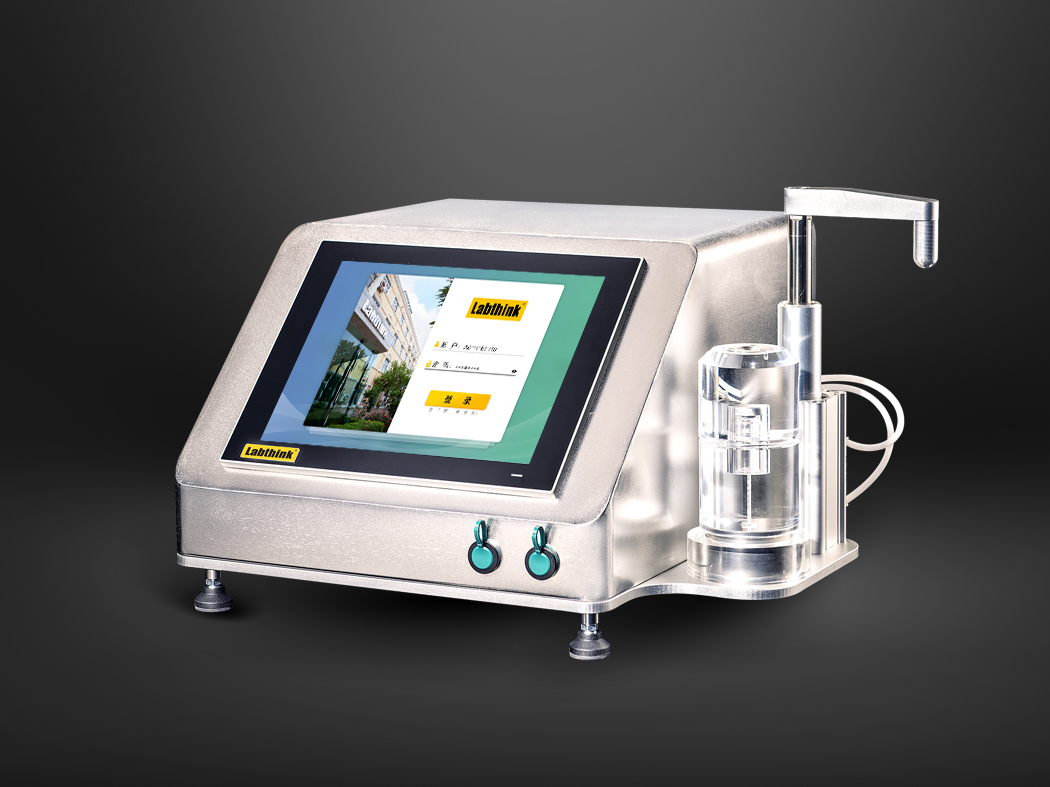
Ampoules add a rigid, small-diameter geometry and, in most cases, a fused or sealed tip rather than an elastomeric closure. The C690 series is stated as designed for leak testing of ampoules, and recorded pharmaceutical applications of the instrument include ampoule leak detection within automated batch testing. Fixture definition for ampoules concentrates on the glass body dimensions and on supporting the container so that handling does not introduce mechanical stress that could be mistaken for, or could create, a defect. The test pressure is then set within the instrument's −100 to +100 kPa pressure range to suit the required sensitivity.
Prefilled Syringes and Cartridges
Syringes are named directly in the manufacturer's package list, and prefilled syringes appear in Labthink's recorded pharmaceutical case profile. A syringe introduces more closure interfaces than a vial: the tip cap or needle shield, the plunger, and the barrel-to-plunger seal. Fixture determination therefore has to establish which interface the integrity test is intended to represent, alongside syringe dimensions and the required leak detection sensitivity. Non-destructive testing is particularly relevant here, because a tested syringe is not consumed by the test.
Bottles, Cartridge Bottles, and Infusion Bottles
Bottles can be tested for leaks on the C690 — the manufacturer states that the detector can be configured for bottle leak testing. The stated inputs are explicit: bottle dimensions, closure configuration, test pressure, and required sensitivity must be confirmed in order to determine the appropriate fixture and test configuration. Labthink's recorded pharmaceutical case includes cartridge bottles and infusion bottles alongside ampoules and prefilled syringes, which indicates how wide the practical bottle range can be once fixtures are defined. Larger bottles place more demand on chamber sizing and on how the closure is presented to the test, which is why dimensions and closure configuration are treated as fixture inputs rather than afterthoughts.
Pouches
Pouches are listed among the sealed package formats the C690 can be used for, depending on the package configuration and a suitable fixture, and vacuum decay testing is described as widely used in pharmaceutical packaging including pouches. The engineering challenge with a flexible format is different from a rigid one: the package must be supported so that its geometry stays consistent between the stabilisation phase and the measurement phase, and so that flexing does not generate pressure noise that competes with a genuine leak signal. Package configuration and fixture design carry more of the compatibility decision for pouches than the instrument specification does.
Sachets, Including Food and Meat Sachets
Sachets can potentially be tested on the C690, and the manufacturer is direct about the conditions attached to that answer: suitability depends on the sachet dimensions, the material, and the required leak detection sensitivity. Labthink also notes that package information and samples may be required to confirm the testing configuration. For sachets containing food or meat products, the same three variables govern the outcome, and the sample evaluation step is what converts a potential fit into a confirmed configuration. Sachet testing should therefore be planned as a validation exercise rather than as a catalogue selection.
Step-by-Step: Determining a C690 Fixture and Test Configuration
The sequence below follows the configuration inputs stated by the manufacturer and applies them in a consistent order. It is deliberately the same sequence for every package family, which makes it usable as a checklist when a laboratory is commissioning a new container format.
- Classify the package family. Confirm whether the item is a vial, ampoule, syringe, bottle, pouch, sachet, or another sealed format. Labthink states that the C690 can be used for various sealed packages including vials, ampoules, syringes, bottles, pouches, sachets, and other package formats, depending on the package configuration and suitable fixture.
- Record the dimensional inputs. Capture the package dimensions. Dimensions are the first stated input for both bottle and sachet determinations because they drive chamber sizing and holder design.
- Record the material and construction. For sachets in particular, material is one of the three stated suitability variables, alongside dimensions and required leak detection sensitivity. Rigid glass, rigid polymer, and flexible laminate behave differently inside a test chamber.
- Define the closure or seal configuration. Establish whether integrity is carried by a stopper and crimp, a fused ampoule tip, a syringe tip cap and plunger, a bottle closure, or a heat-sealed seam. Closure configuration is a stated input for bottle testing.
- Set the required leak detection sensitivity and test pressure. Work inside the C690's declared envelope — detection lower limit 2 µm, resolution 0.1 µm, repeatability ±1 µm, pressure range −100 to 0 to +100 kPa — and choose the sensitivity that matches the product risk rather than the tightest available number.
- Select the method and model. The C690 series can use pressure decay and/or vacuum decay methods depending on the model, and the series is documented across C690B, C690M, C690H, C690G, and C690X under certificate M.2025.206.C119114.
- Confirm with a sample evaluation. Provide package information and samples so that the fixture and the required sensitivity can be verified against real units. This step is explicitly indicated for sachets and is good practice for any new format.
- Lock the parameters and the documentation trail. Record the validated method, the fixture set, and the data handling configuration. The C690 is stated to be compliant with 21 CFR Part 11 and GMP and to support data traceability, which is what makes the locked parameters auditable.
Where This Compatibility Profile Is Used: Pharma, Medical Device, Food, and TIC
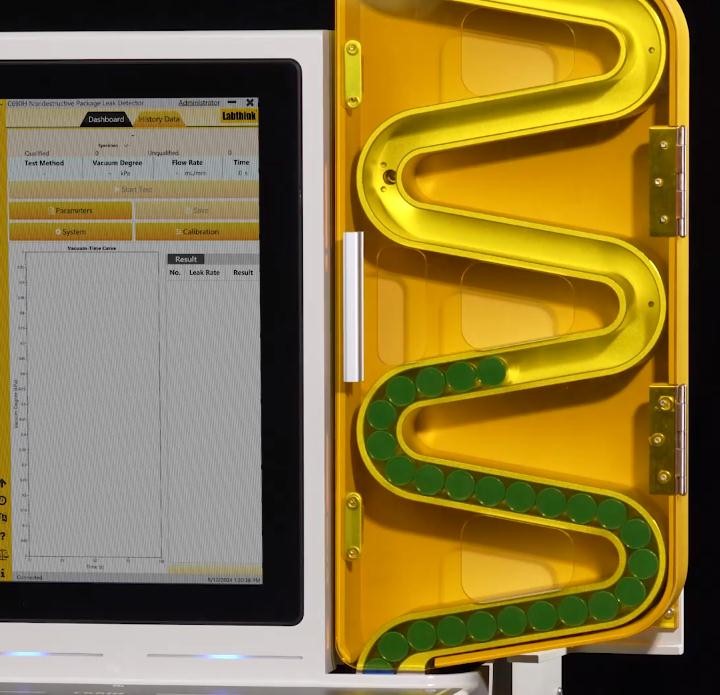
Pharmaceutical quality control and batch release. The dominant use case is batch integrity verification of vials, ampoules, prefilled syringes, cartridge bottles, and infusion bottles. Labthink's recorded case profile for this application covers a single installed unit operating for 15 years in a global market, automating batch testing of pharmaceutical packages, ampoules, cartridge bottles, infusion bottles, and prefilled syringes, with results described as precise and traceable, and with GMP, 21 CFR Part 11, ASTM F2338, and USP <1207> compliance cited. For regulated laboratories, that combination of automation, traceability, and standards alignment is the reason the fixture question is settled once and then reused.
Medical device sterile barrier packaging. ISO 11607 is named in the standards set associated with vacuum decay CCIT, and medical device packaging is one of the industries the C690 is specified for. Pouch and sachet formats are the practical centre of this work, because sterile barrier systems are frequently flexible.
Food packaging, including sachets containing food or meat. Food packaging is a stated application industry for the C690, and sachets containing food or meat products may be suitable subject to dimensions, material, and required leak detection sensitivity. In the wider food compliance picture, integrity testing supports the pack while migration and residue testing characterise the material against limits such as the EU overall migration limit of 60 mg/kg food or 10 mg/dm² of contact material — two different questions that are usually answered in the same laboratory.

Third-party TIC laboratories. Testing, inspection and certification laboratories appear throughout the stated application scope for Labthink's food and pharmaceutical testing instruments. A TIC lab rarely receives one package format; it receives whatever its clients send. That makes fixture determination a commercial capability rather than a technical detail, because the number of container families a lab can accept directly determines the work it can bid for.
Comparative Reference: Package Format Compatibility and C690 Specifications
The two tables below summarise the package-format position and the instrument specification using only the manufacturer-stated configuration inputs and declared parameters. They are intended for use as a screening reference during the research and evaluation stage — not as a substitute for the sample confirmation step.
| Container format | Configuration inputs to confirm | Stated position from Labthink |
|---|---|---|
| Vials | Vial dimensions; closure configuration; test pressure; required leak detection sensitivity | C690 series is designed for leak testing of pharmaceutical packages such as vials, ampoules, and syringes |
| Ampoules | Glass body dimensions; sealed-tip geometry; test pressure; required sensitivity | C690 series is designed for leak testing of ampoules; ampoule leak detection appears in the recorded pharmaceutical batch-testing case |
| Prefilled syringes | Syringe dimensions; tip cap and plunger configuration; required sensitivity | Syringes are listed among supported sealed package formats; prefilled syringes appear in the recorded pharmaceutical case |
| Bottles (including cartridge and infusion bottles) | Bottle dimensions; closure configuration; test pressure; required sensitivity | C690 can be configured for bottle leak testing; cartridge bottles and infusion bottles appear in the recorded pharmaceutical case |
| Pouches | Package configuration; suitable fixture; material | Listed among supported sealed formats depending on package configuration and suitable fixture; vacuum decay is widely used for pharmaceutical packaging including pouches |
| Sachets (including food and meat sachets) | Sachet dimensions; material; required leak detection sensitivity | Potentially suitable; package information and samples may be required to confirm the testing configuration |
| Parameter | Declared value |
|---|---|
| Test type | Vacuum decay Container Closure Integrity Testing (CCIT) |
| Testing range | 2 µm to 8 µm and greater leakage |
| Detection lower limit | 2 µm |
| Resolution | 0.1 µm |
| Repeatability | ±1 µm |
| Pressure range | −100 to 0 to +100 kPa |
| Construction | Aluminum alloy + ABS plastic |
| Applicable industries | Medical device, pharmaceutical packaging, food packaging |
| Method options | Pressure decay and/or vacuum decay depending on the model |
| Documentation | 21 CFR Part 11 and GMP compliant; data traceability; Attestation of Conformity M.2025.206.C119114 (C690B, C690M, C690H, C690G, C690X) |
Frequently Asked Questions
Which standards and regulations does C690 CCIT align with?
Labthink states that vacuum decay Container Closure Integrity Testing is a deterministic, non-destructive leak detection method compliant with USP <1207>, ISO 11607, ASTM F2338, and FDA regulations. The C690 is stated to be compliant with 21 CFR Part 11 and GMP and to support data traceability. Certificate M.2025.206.C119114, an Attestation of Conformity covering C690B, C690M, C690H, C690G, and C690X under Low Voltage Directive 2014/35/EU Annex III and Electromagnetic Compatibility Directive 2014/30/EU Annex II (EN 61010-1:2010+A1:2019 and EN IEC 61326-1:2021), is valid from 2025-05-19 to 2030-05-18.
What package types and leak sizes can the C690 cover?
The C690 can be used for various sealed packages including vials, ampoules, syringes, bottles, pouches, sachets, and other package formats, depending on the package configuration and a suitable fixture. Its declared testing range is 2 µm to 8 µm and greater leakage, with a detection lower limit of 2 µm, a resolution of 0.1 µm, a repeatability of ±1 µm, and a pressure range of −100 to 0 to +100 kPa. The C690 uses non-destructive leak detection methods, so tested packages remain intact, and the series can use pressure decay and/or vacuum decay methods depending on the model.
What determines the commercial scope of a C690 configuration?
Because the fixture set follows the container formats you need to test, the configuration is agreed per project. Labthink states a customisation scope covering test range and test capacity (volume, size, test stations), a minimum order quantity of 1 unit, made-to-order production, and a lead time of 28 to 45 days. The model variant within the C690B, C690M, C690H, C690G, and C690X series, and the number of package families to be covered, are the practical drivers of the quotation. A configuration discussion is therefore worth opening with your actual container list rather than with a single package type.
Can we send our own vials, bottles, or sachets for evaluation before ordering?
Yes — this is the confirmation step rather than an optional extra. Labthink notes that package information and samples may be required to confirm the testing configuration, and that sachet suitability in particular depends on dimensions, material, and required leak detection sensitivity. Supplying representative units from each container family allows the fixture, the method option, and the required sensitivity to be verified against real packages before the configuration is fixed.
What are the delivery and support terms once a configuration is confirmed?
Labthink states a lead time of 28 to 45 days, a monthly capacity of 100 units made to order, a minimum order quantity of 1 unit, and 100% test quality control before shipment. After-sales support is provided both remotely and on site, and export markets are global. Documentation available for supplier qualification includes ISO 9001:2015 certificate 10425Q02009R2M, ISO 14001:2015 certificate 10425E01301R1M, and ISO 45001:2018 certificate 10425S01240R1M, all valid until 2028-11-24.
Conclusion: One Workflow, Six Package Families
Applying C690 CCIT to vials, ampoules, syringes, bottles, pouches, and sachets is less a question of instrument capability than of configuration discipline. Vials, ampoules, and syringes sit inside the manufacturer's stated design intent; bottles are supported through a confirmed closure, dimension, pressure, and sensitivity set; pouches are supported through package configuration and a suitable fixture; and sachets — including those containing food or meat — remain potentially suitable subject to dimensions, material, and the required leak detection sensitivity, with sample evaluation converting that potential into a validated configuration.
The constant across all six families is the method. A non-destructive, automated CCIT platform that is stated to be compliant with 21 CFR Part 11 and GMP, that supports data traceability, and that is covered by Attestation of Conformity M.2025.206.C119114 gives quality control, safety assurance, and regulatory compliance teams a single documented process to reuse as the container portfolio changes.
Labthink Instruments Co. Ltd. is a multinational technology company specializing in precision instruments and testing solutions for packaging materials analysis, founded in 1989, with a 4,100 m² factory and 220 employees, and with operations serving global markets. Labthink Food & Pharmaceutical Testing Solutions covers container closure integrity testing alongside overall migration, water-insoluble matter, residue on ignition, and loss on drying systems, so that integrity and material characterisation can be handled in one laboratory workflow.
Next Step: Send a Container List, Not a Single Specification
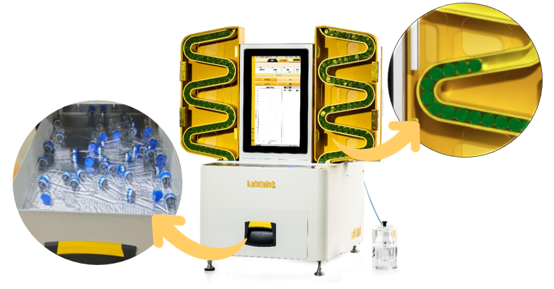
If you are evaluating CCIT for vials, ampoules, syringes, bottles, pouches, or sachets, the fastest route to an accurate answer is a package list with dimensions, material, closure type, and required leak detection sensitivity. Labthink can review the list, indicate the appropriate fixture and method option, and quote a configuration against your actual container portfolio — including sample evaluation where suitability still has to be confirmed.
Contact: trade.en@labthink.com · Phone: +86 531-58702937 · WhatsApp: +86 187-6612-5070 · Website: en.labthink.com
Download the packaging testing equipment and testing services brochure: Labthink Brochure (PDF).
Specification and certification statements above are reproduced as declared by the manufacturer; certificate details refer to Attestation of Conformity M.2025.206.C119114 and to ISO 9001:2015, ISO 14001:2015 and ISO 45001:2018 certificates issued by SHANDONG SEATONE INTERNATIONAL CERTIFICATION CO., LTD.
Have Questions or Need More Details?
Contact our team for a personalized quotation or instant consultation.
Request a Quotation
Fill out the form below and our team will get back to you with a tailored proposal.
WhatsApp Direct Chat
Prefer to chat in real-time? Message us on WhatsApp for instant assistance & quick answers.
- Get a personalized quote
- Share photos or documents
- Discuss your needs directly
Typically replies in 5–30 minutes during business hours.