
Food Safety & Pharmaceutical Analysis Testing: Instruments and Methods Explained
Food Safety & Pharmaceutical Analysis Testing: Instruments and Methods Explained
Food safety and pharmaceutical analysis testing covers two distinct families of laboratory work that protect consumers and patients: proving that a sealed package is still sealed, and measuring how much non-volatile or inorganic material a sample, a raw material, or a packaging material releases or retains. The first family is container closure integrity testing (CCIT). The second is gravimetric residue analysis, which includes overall migration testing of food contact materials (FCMs), non-volatile residue (NVR) determination, loss on drying (LOD), residue on ignition (ROI), water-insoluble matter, and evaporation residue.
This guide is written for quality managers, laboratory supervisors, and procurement teams at pharmaceutical manufacturers, food and beverage producers, packaging converters, third-party testing laboratories, and importers who are still in the research stage — before the specification is frozen and before a supplier is shortlisted. It explains what each test measures, which regulations and standards create the demand, how the instrument families differ from one another, and how a test question becomes a confirmed, documented configuration.
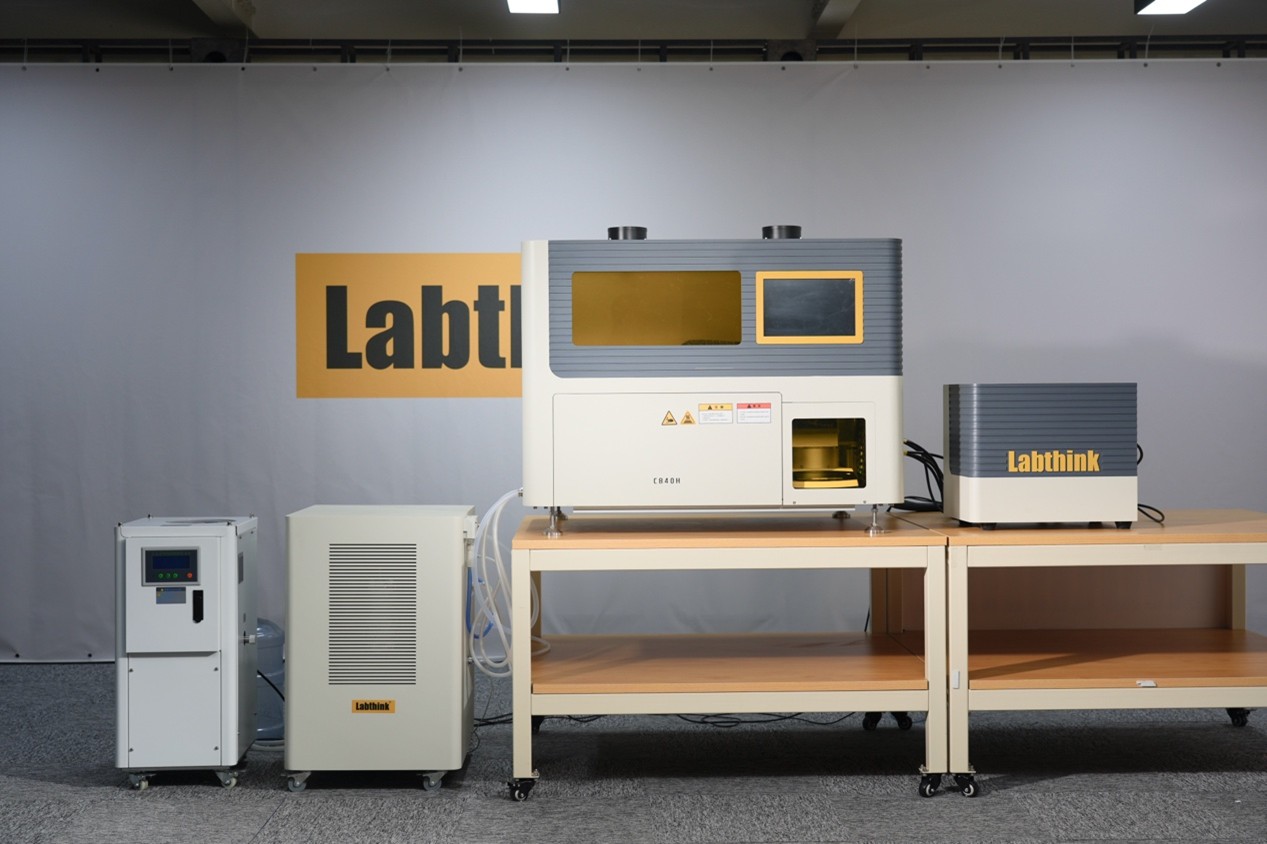
Residue, migration, and integrity testing instruments installed in a food and pharmaceutical analysis laboratory.
Problem Definition: What Goes Wrong Without Controlled Testing
Two failure modes define this category. In sterile and aseptic packaging, a micro-leak in a vial, ampoule, syringe, bottle, pouch, or sachet breaks the sterile barrier and creates a route for microbial ingress, moisture, or oxygen. Destructive leak methods consume the tested unit and cannot be repeated on the same sample, which limits trending and forces sampling compromises. Non-destructive leak detection keeps the tested package intact after the test, so the same unit can be inspected, retained, or released.
On the materials side, the analytical question is quantitative rather than qualitative. Non-volatile substances can transfer from a food contact material into a food simulant, and residues remain in raw materials, excipients, and finished pharmaceutical products after processing or thermal treatment. Those amounts must be determined gravimetrically, often at microgram resolution, and the result has to be traceable years later.
The measurement risk sits in the workflow itself. Manual laboratory testing involves operational, data, and safety risks tied to hands-on handling and open environmental exposure. Transferring cups between hot baths, desiccators, and separate analytical balances introduces ambient temperature and humidity fluctuations, and those fluctuations can destabilize micro-gram balances. Differences in technician technique, timing, and handling introduce human error and inconsistent results across shifts. Manual pouring, evaporation, and transfer steps also increase direct technician exposure to hot, volatile, or hazardous organic solvents, while repeated handling, transfer, and open-air transportation increase the chance of airborne particulate contamination or accidental sample spillage.
Automation changes the risk profile rather than only the speed. Enclosed, physically isolated chambers maintain stable, climate-controlled conditions for weighing and eliminate environmental interference and operator technique variation. Continuous, unattended batch processing — for example, 25-station robotic runs — operates on pre-programmed protocols and provides predictable turnaround times without extra technician labor. Sealed, automated extraction and evaporation systems keep hazardous vapors fully contained, and robotic cup-grippers remove manual handling of hot vessels, while robotic pick-and-place mechanisms move samples inside a closed internal environment to prevent handling damage and external particulate exposure.
Industry Background: What Regulators and Standards Require
Instrument selection in this category is standards-driven. Buyers rarely compare instruments on brand strength alone; they compare method alignment, detection sensitivity, measurement range, resolution, automation level, and data traceability.
For food contact materials, the European Commission states that plastic food contact materials are subject to an overall migration limit of 60 mg/kg food or 10 mg/dm² of contact material. The same source explains that migration is usually tested using simulants under standardized time and temperature conditions that are representative of a certain food use and that cover the maximum shelf life of the packed food. Any instrument used for overall migration work therefore has to evaporate and dry a simulant reproducibly and weigh the remaining residue precisely.
For food traceability, the U.S. Food and Drug Administration maintains a Food Traceability List that identifies the foods subject to additional traceability recordkeeping under the Food Safety Modernization Act (FSMA). Traceability obligations do not replace analytical testing, but they raise the documentation standard for the packaging and handling that testing supports.
For sterile pharmaceutical packaging, Labthink describes its vacuum decay Container Closure Integrity Test (CCIT) method as a deterministic, non-destructive leak detection method compliant with USP <1207>, ISO 11607, ASTM F2338, and FDA regulations. That description is a vendor statement rather than a regulator statement, and buyers should verify the applicable standard text for their own product and market before writing it into a validation protocol.
A practical consequence: because the requirement comes from a method or regulation rather than from a preference, the first filtering question is never “which brand,” but “which test method, at which sensitivity, over which range, with which data trail.”
Detailed Solution: Labthink Food & Pharmaceutical Testing Solutions
Labthink Instruments Co. Ltd. was established in 1989 in Jinan, China, and specializes in the development and manufacturing of precision instruments and testing solutions for packaging materials analysis; the company also provides testing services from its own laboratory facilities. Its operations are based in Jinan, China, with an international headquarters in Boston, USA. The global network includes a SAC IT Center in Hong Kong, a European branch in Germany, an Asia-Pacific center in Malaysia, and a Middle East service center in Dubai, supported by more than 50 distributors and 30 service providers worldwide. The manufacturing facility covers 4,100 m², the company employs approximately 220 staff, annual production capacity reaches 1,200 units, and the R&D team consists of 50 engineers. About 50% of products are exported.
Labthink instruments feature proprietary sensors, tablets for data management and storage, and multifunction integration. Within the food safety and pharmaceutical analysis scope, the portfolio divides into a non-destructive package integrity group and a gravimetric residue and migration group.
Non-Destructive Package Integrity: the C690 CCIT Instrument
The C690 Nondestructive Package Leak Detector is classified as a Nondestructive Package Leakage Detector and belongs to the vacuum decay Container Closure Integrity Testing (CCIT) category. It is designed for non-destructive package leak detection in pharmaceutical packaging, suitable for sterile pharmaceutical packaging integrity testing, and can be used for vial and ampoule leak testing as well as sealed medical packages. It is intended for the medical device, pharmaceutical packaging, and food packaging industries and is made of aluminum alloy and ABS plastic.
Its declared measurement envelope is a testing range of 2 µm to 8 µm and above (covering greater leakage), a detection lower limit of 2 µm, a resolution of 0.1 µm, a repeatability of ±1 µm, and a pressure range of −100 to +100 kPa. Labthink lists a non-destructive deterministic test, precise measurement, data traceability, safe operation compatible with hazardous gases, 21 CFR Part 11 and GMP compliance, and a full process automated workflow among the instrument’s characteristics.
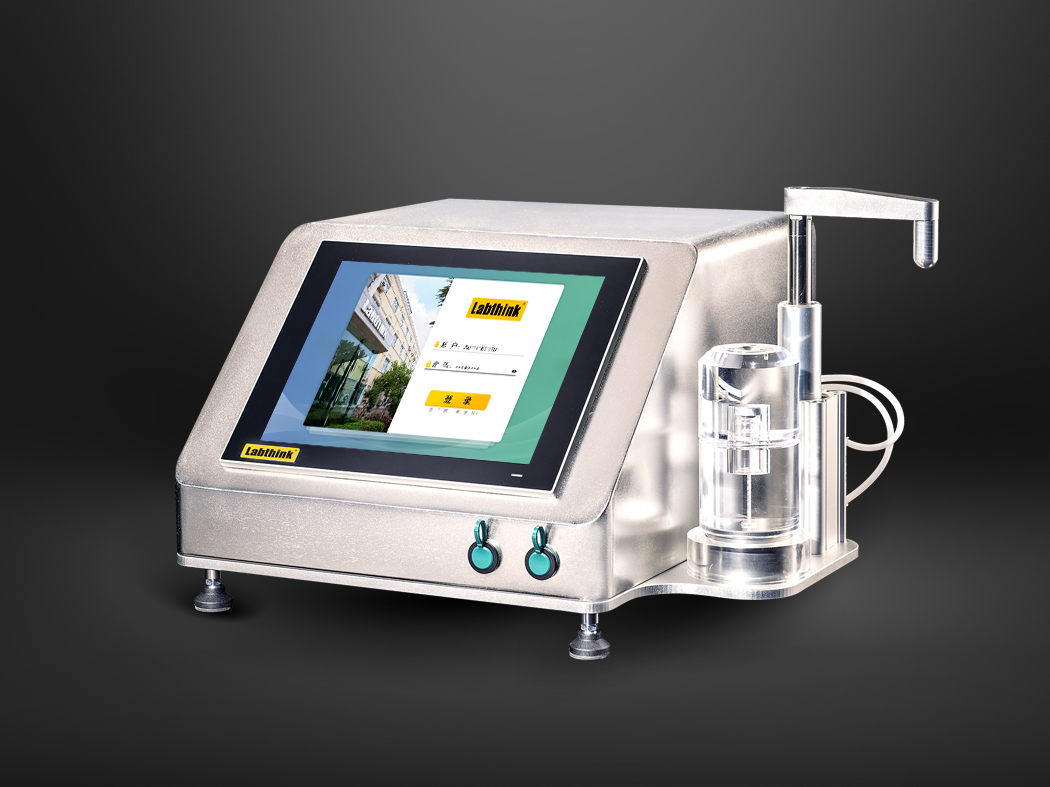
C690 Nondestructive Package Leak Detector — vacuum decay CCIT for vials, ampoules, syringes, bottles, pouches, and sachets.
Because the method is non-destructive, package formats such as vials, ampoules, syringes, bottles, pouches, and sachets can be tested with a suitable fixture, and the tested unit remains intact afterwards. Vacuum decay works by placing the package inside a sealed test chamber and drawing a vacuum around it; if a defect exists, gas or liquid escapes from the package into the evacuated chamber and causes a measurable rise in chamber pressure. Pressure decay works in the opposite direction: the test item is pressurized to a set point, isolated, and monitored over a fixed period, and gas escaping through a micro-leak or seal flaw produces a measurable drop in internal pressure.
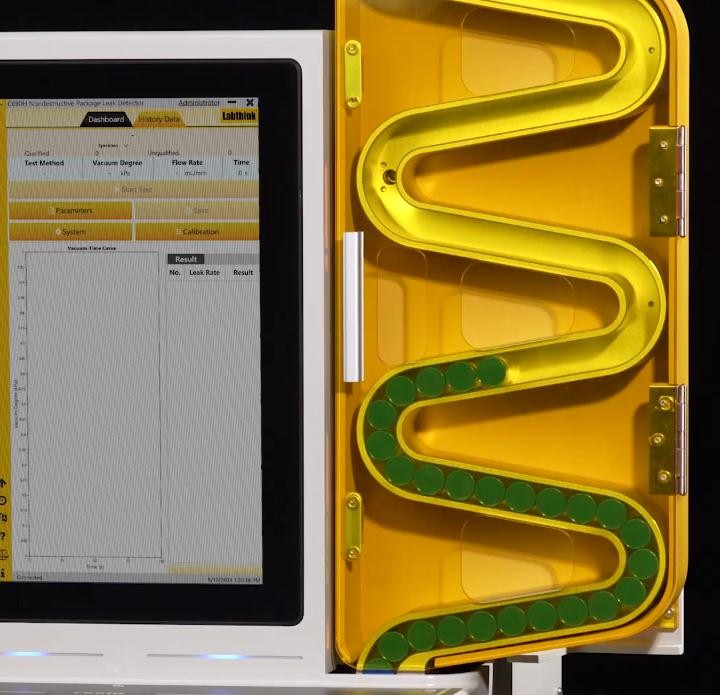
C690 batch testing with automatic sample feeding reduces manual handling during CCIT runs.
Gravimetric Residue and Migration Analysis: C840, C850, C860, and C870
The second group covers gravimetric determinations that share the same physical sequence — controlled heating, evaporation or ignition, cooling, and precision weighing — but answer different analytical questions.
The C840 Integrated Evaporation Residue Testing System is an overall migration test instrument and belongs to the laboratory testing instrument category for food and pharmaceutical analysis. It combines overall migration, evaporation residue, and non-volatile residue testing in a single system, performs gravimetric residue content analysis, and supports gravimetric determination of non-volatile residue. Typical application scenarios include evaporation residue testing of food contact materials, pharmaceutical packaging, and chemical reagents, and it is designed for overall migration testing of food contact materials. Its declared specifications are a testing range of 0.05 to 80,000 mg, a resolution of 0.01 mg, a repeatability of ±0.05 mg, a temperature range from room temperature to 130 °C, and a temperature fluctuation of ±0.5 °C. Labthink lists full process automation, high resolution and repeatability, and 21 CFR Part 11 and GMP compliance among its characteristics.
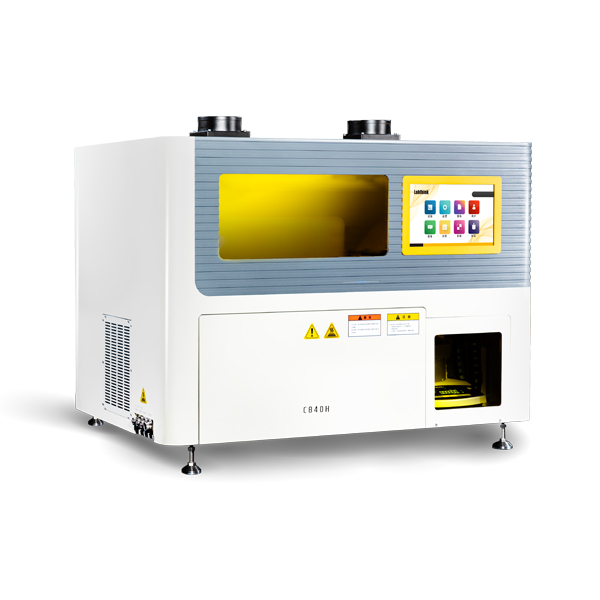
C840H integrated evaporation residue and overall migration testing system.
The C850 Integrated Water Insoluble Matter Testing System is classified as a water insoluble matter test device and is designed for water insoluble matter determination scenarios. Typical application scenarios include water insoluble content testing of ingredients and raw materials, and it is used in pharmaceutical quality control laboratories for residue analysis. It is intended for the medical device and pharmaceutical packaging industries as well as the food packaging and chemical reagent industries. Its declared specifications are a test range of 0.05 to 80,000 mg, a resolution of 0.01 mg, a repeatability of ±0.05 mg, a temperature range from room temperature to 130 °C, a temperature fluctuation of ±0.5 °C, and 25 test stations.
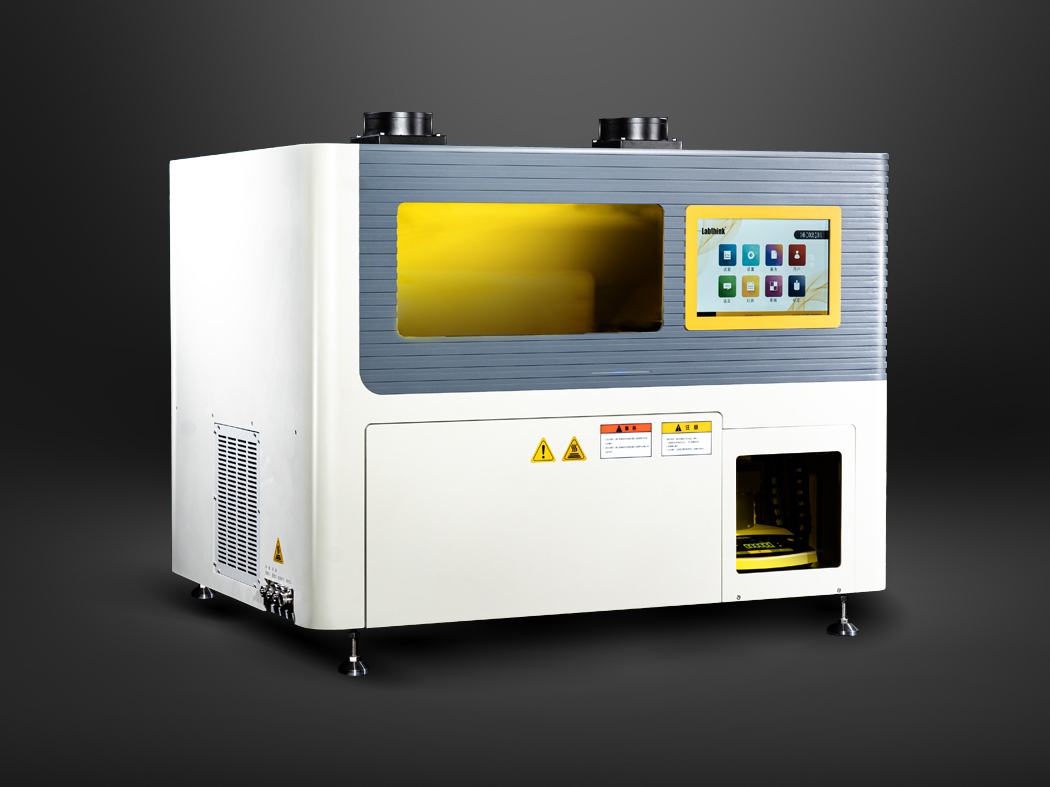
C850 Integrated Water Insoluble Matter Testing System with 25 test stations.
The C860 Integrated Residue-on-Ignition Testing System belongs to the ash content testing category and is used for ash content determination. It measures non-volatile inorganic impurities, Residue on Ignition (ROI), sulfated ash, and ash content, and is applied to automated ROI, sulfated ash, and ash content testing in pharmaceutical, food and feed, plastics and polymers, and general chemical laboratories. Residue on ignition is a pharmacopeial gravimetric method, for example USP <281>, that measures the amount of inorganic impurities in an organic substance by igniting the sample at high temperature until the organic material burns off and non-combustible ash remains. Sulfated ash is a specific variation in which concentrated sulfuric acid is added before or during ignition, converting alkali metals and impurities into stable sulfate salts so that the inorganic residue is less volatile and easier to measure reproducibly. The C860 installation includes 36 test stations, a test range of 0.05 to 60,000 mg, a resolution of 0.01 mg, a repeatability of ±0.05 mg, a temperature range from room temperature to 800 °C, and a temperature fluctuation of ±0.5 °C.
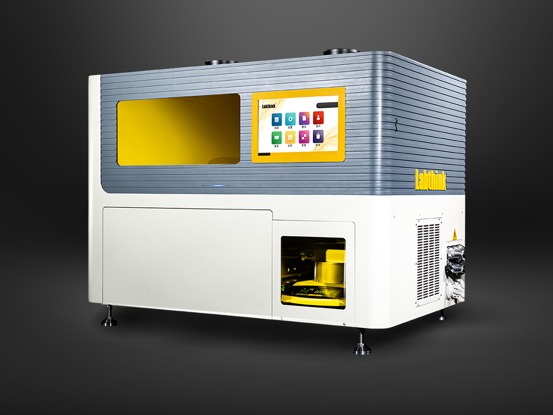
C860 Integrated Residue-on-Ignition Testing System for ROI, sulfated ash, and ash content.
The C870 Integrated Loss-on-Drying Testing System belongs to the laboratory gravimetric analysis instrument category and performs loss-on-drying measurement by the gravimetric method. Loss on drying is a gravimetric test method that determines the percentage of volatile matter — primarily moisture and residual solvents — in a sample: the material is weighed, heated below its decomposition temperature under specified temperature and time conditions until it reaches constant weight, and re-weighed. Typical application scenarios include loss-on-drying testing of pharmaceutical raw materials and finished products, and the system is intended for the food and pharmaceutical industry and the chemical industry. Its declared specifications are a test range of 0.05 to 40,000 mg, a resolution of 0.01 mg, a repeatability of ±0.05 mg, a temperature range from room temperature to 130 °C, a temperature fluctuation of ±0.5 °C, and a test pressure of 0 to −20 kPa.
Manufacturing, Certification, and Global Support
Manufacturing and occupational health and safety management at Labthink are covered by certificate number 10425S01240R1M, issued against GB/T 45001-2020 / ISO 45001:2018 by SHANDONG SEATONE INTERNATIONAL CERTIFICATION CO., LTD. The certificate is valid from 20 November 2025 to 24 November 2028 and its scope covers the production of packaging testing instruments and related occupational health and safety management activities. The covered products include the C690 Nondestructive Package Leak Detector, the C840 Integrated Evaporation Residue Testing System, the C850 Integrated Water Insoluble Matter Testing System, the C860 Integrated Residue-on-Ignition Testing System, and the C870 Integrated Loss-on-Drying Testing System.
Step-by-Step: From Test Question to Confirmed Instrument
- State the analytical question in test terms. Decide whether the requirement is package integrity (a leak question) or residue quantification (a mass question). The two families do not substitute for one another, and a project that needs both should plan two workflows rather than one instrument.
- Identify the governing method and conditions. For food contact materials, identify the food simulant and the standardized time and temperature conditions that represent the intended food use and shelf life. For pharmaceutical work, identify whether the applicable method is a pharmacopeial gravimetric method such as USP <281> for residue on ignition, a loss-on-drying method, or a container closure integrity method aligned with USP <1207>, ISO 11607, or ASTM F2338.
- Match the sample format to the instrument. Sealed vials, ampoules, syringes, bottles, pouches, and sachets require a suitable fixture and fixture confirmation on the C690. Liquid extracts and simulants after exposure belong to the C840 workflow. Powders, ingredients, raw materials, and finished products that need water-insoluble matter, ash, or moisture content belong to the C850, C860, or C870 workflows.
- Check range against the expected result. Confirm that the expected residue mass sits comfortably inside the declared range — 0.05 to 80,000 mg for the C840 and C850, 0.05 to 60,000 mg for the C860, and 0.05 to 40,000 mg for the C870 — rather than at the extreme edge of it.
- Choose resolution and capacity deliberately. Resolution and station count determine both compliance fit and throughput. The C840M and C840H differ exactly here, and the C850 and C860 offer 25 and 36 test stations respectively.
- Review data integrity and compliance features. Confirm how results are stored and exported, whether the configuration is described as 21 CFR Part 11 and GMP compliant, and whether measurement is traceable for the retention period your quality system requires.
- Confirm with samples, then validate. Resolution, capacity, and fixture suitability are best confirmed against real samples or project-specific information before validation is written. Once confirmed, the instrument becomes part of the documented method rather than a generic lab asset.
Use Cases Across Food and Pharmaceutical Testing
- Sterile pharmaceutical packaging integrity. Non-destructive CCIT on vials and ampoules, where the tested unit must remain intact after inspection and results must be traceable.
- Sealed medical device packaging. Leak detection on sealed medical packages and other sealed formats where seal quality is a release-critical attribute.
- Food contact material migration compliance. Overall migration and evaporation residue testing of food contact materials and food contact packaging, evaluated against the applicable overall migration limit.
- Pharmaceutical raw material and excipient residue analysis. Residue on ignition, sulfated ash, and ash content testing, and water-insoluble matter determination of ingredients and raw materials in quality control laboratories.
- Loss on drying of pharmaceutical raw materials and finished products. Moisture and volatile content determination in pharmaceutical, food, and chemical testing.
Labthink states that C840 has been used by clients in the chemical reagents, pharmaceutical excipients, and food contact materials industries, and that a C860 installation achieved automatic measurement of non-volatile inorganic impurities, Residue on Ignition, sulfated ash, and ash content with precise and traceable test results, with full process automation as a key highlight.
Comparison: Matching the Instrument to the Test
The table below compares the declared specifications of the Labthink food and pharmaceutical testing solutions covered in this guide. All figures are instrument specifications stated by the manufacturer for the named models.
| Test purpose | Instrument | Type | Declared key specifications | Typical sample formats |
|---|---|---|---|---|
| Non-destructive leak / container closure integrity | C690 Nondestructive Package Leak Detector | Vacuum decay Container Closure Integrity Testing (CCIT) | Detection lower limit 2 µm; resolution 0.1 µm; repeatability ±1 µm; pressure range −100 to +100 kPa | Vials, ampoules, syringes, bottles, pouches, sachets, sealed medical packages |
| Overall migration, evaporation residue, non-volatile residue | C840 Integrated Evaporation Residue Testing System | Integrated evaporation residue testing system / overall migration test instrument | Range 0.05–80,000 mg; resolution 0.01 mg; repeatability ±0.05 mg; room temperature to 130 °C; ±0.5 °C | Food contact material extracts, pharmaceutical packaging, chemical reagents |
| Water-insoluble matter | C850 Integrated Water Insoluble Matter Testing System | Water insoluble matter test device | Range 0.05–80,000 mg; resolution 0.01 mg; repeatability ±0.05 mg; room temperature to 130 °C; ±0.5 °C; 25 test stations | Ingredients and raw materials in pharmaceutical QC and related industries |
| Residue on ignition, sulfated ash, ash content | C860 Integrated Residue-on-Ignition Testing System | Ash content testing category | Range 0.05–60,000 mg; resolution 0.01 mg; repeatability ±0.05 mg; room temperature to 800 °C; ±0.5 °C; 36 test stations | Pharmaceutical, food and feed, plastics and polymers, general chemical samples |
| Loss on drying (moisture and volatile content) | C870 Integrated Loss-on-Drying Testing System | Integrated loss-on-drying testing system / laboratory gravimetric analysis instrument | Range 0.05–40,000 mg; resolution 0.01 mg; repeatability ±0.05 mg; room temperature to 130 °C; ±0.5 °C; test pressure 0 to −20 kPa | Pharmaceutical raw materials and finished products, food, chemicals |
C840M or C840H?
Within the C840 family, the choice is a resolution and capacity decision rather than a method decision. Both models cover the same test purposes; they differ in balance readability and available testing positions.
| Configuration | Balance readability | Recommended use |
|---|---|---|
| C840M | 0.1 mg | Standard quality control testing where 0.1 mg readability meets the applicable compliance specifications, and where lower sample throughput or capacity is sufficient |
| C840H | 0.01 mg | High-precision R&D or regulated pharmaceutical applications requiring 0.01 mg readability, and high-volume testing with greater sample capacity; also where a greater number of testing positions is required |
FAQ
Which standards and regulations do these instruments support?
Labthink describes its vacuum decay Container Closure Integrity Test (CCIT) method as a deterministic, non-destructive leak detection method compliant with USP <1207>, ISO 11607, ASTM F2338, and FDA regulations. On the residue side, residue on ignition is a pharmacopeial gravimetric method, for example USP <281>, and overall migration testing of food contact materials is evaluated against regulatory limits — the European Commission states an overall migration limit of 60 mg/kg food or 10 mg/dm² of contact material for plastic food contact materials. Labthink lists 21 CFR Part 11 and GMP compliance among the characteristics of the C690, C840, C850, C860, and C870, and holds certificate 10425S01240R1M issued against GB/T 45001-2020 / ISO 45001:2018, valid from 20 November 2025 to 24 November 2028, covering the production of these instruments. Because standards alignment is ultimately the buyer’s responsibility, the applicable standard text should be verified for each product and market before it is written into a validation protocol.
What types of packages can the C690 test?
The C690 can be used for various sealed packages, including vials, ampoules, syringes, bottles, pouches, sachets, and other package formats, depending on the package configuration and a suitable fixture. It is designed for non-destructive package leak detection in pharmaceutical packaging, suitable for sterile pharmaceutical packaging integrity testing, and applicable to sealed medical packages, with intended use across the medical device, pharmaceutical packaging, and food packaging industries.
How do the C840M and C840H differ, and how does that affect configuration choice?
Both configurations are Integrated Evaporation Residue Testing Systems covering overall migration, evaporation residue, and non-volatile residue testing. The difference is balance readability and capacity: the C840M uses a 0.1 mg readability balance and is recommended for standard quality control testing where 0.1 mg readability meets compliance specifications and where lower sample throughput or capacity is sufficient. The C840H uses a 0.01 mg readability balance and provides higher weighing resolution, higher testing capacity, and a greater number of available testing positions, making it the appropriate choice for high-precision R&D, regulated pharmaceutical applications requiring 0.01 mg readability, and high-volume testing with greater sample capacity. In practice, resolution and throughput requirements — not the test method — drive this decision.
Can the C840 test silica slurry aqueous solutions?
Yes. The C840 can be considered for evaporation residue testing of aqueous solutions and similar samples. The specific sample preparation, sample quantity, heating conditions, and constant-weight requirements should be confirmed according to the applicable method before the workflow is fixed. This is typical of the category: a declared application scope indicates feasibility, while sample-specific parameters still need to be confirmed against the governing method.
What information is needed before an instrument configuration can be confirmed?
For leak testing, suitability depends on package dimensions, material, and the required leak detection sensitivity, and package information and samples may be required to confirm the testing configuration, fixture, and test pressure. For gravimetric work, the expected residue mass, sample form, applicable simulant or heating conditions, and required balance readability determine whether the C840M, the C840H, or another residue instrument in the family is the right fit. Sharing a test description and, where possible, representative samples is the shortest route to a confirmed configuration. Labthink provides sample evaluation and testing services from its own laboratory facilities, and a full overview of packaging testing equipment and testing services is available in the downloadable catalogue.
Conclusion and Next Step
Food safety and pharmaceutical analysis testing rewards a method-first approach. The regulatory question — an overall migration limit, a pharmacopeial gravimetric method, or a container closure integrity requirement — determines what must be measured; sensitivity, range, resolution, station count, and data traceability determine which instrument configuration can measure it reliably; and automation determines whether the result stays consistent across shifts and operators. For organisations evaluating non-destructive leak detection and gravimetric residue analysis together, the Labthink Food & Pharmaceutical Testing Solutions portfolio covers both families within one manufacturer, with instruments sharing common characteristics such as proprietary sensors, tablet-based data management, multifunction integration, and documented occupational health and safety certification.
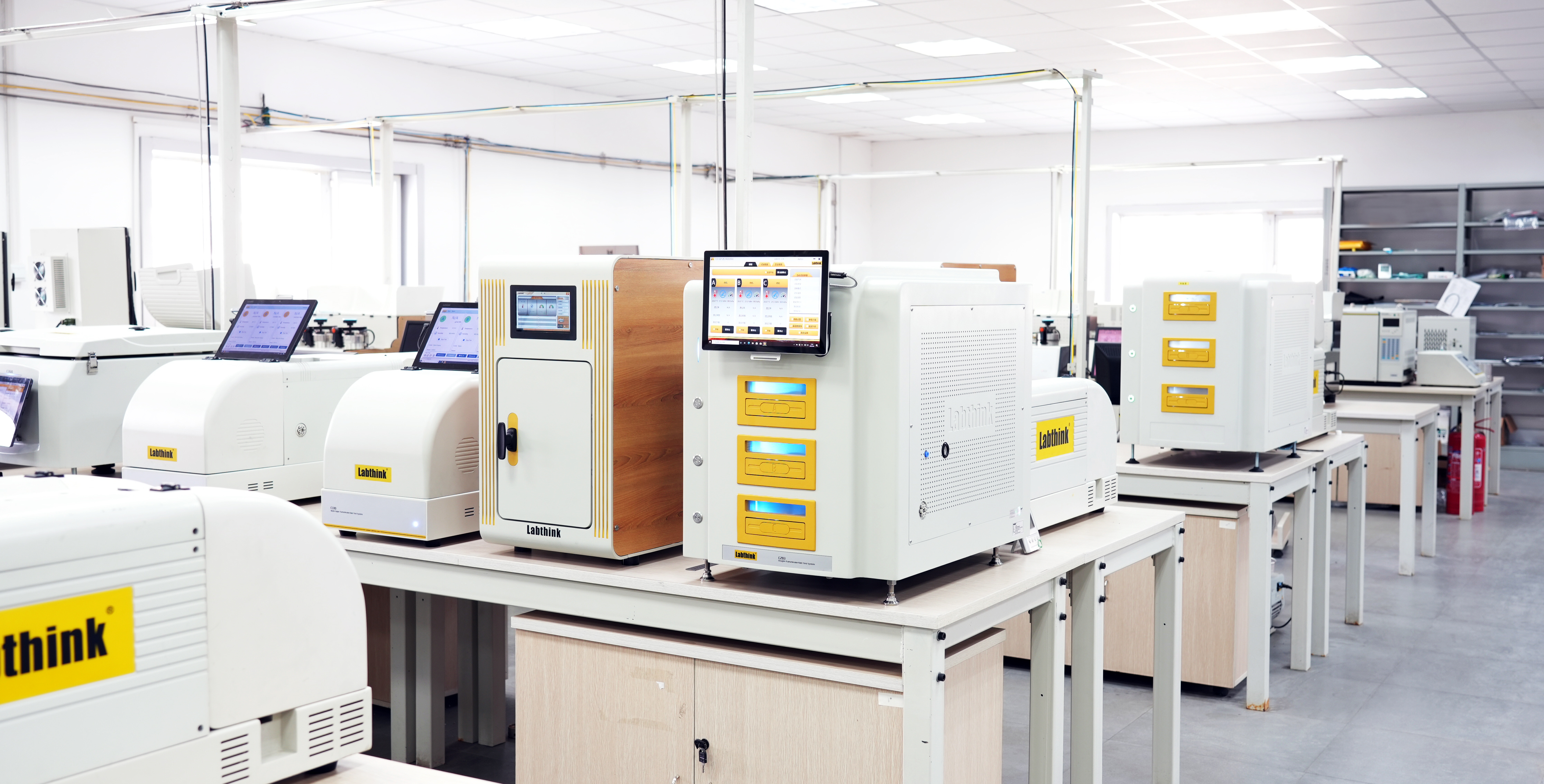
Labthink testing center — sample evaluation and testing services for packaging materials analysis.
Check your samples before you specify
If you are comparing CCIT and residue analysis options, the most useful next step is a sample-based conversation rather than a specification sheet. Share your package type, simulant or sample form, and required sensitivity, and Labthink can help confirm a suitable instrument configuration.