
Labthink Food & Pharmaceutical Testing Solutions: A Compliance and Capability Analysis
Labthink Food & Pharmaceutical Testing Solutions: A Compliance and Capability Analysis
Labthink Food & Pharmaceutical Testing Solutions is the food- and pharmaceutical-facing instrument portfolio of Labthink Instruments Co. Ltd., a manufacturer founded in 1989 and headquartered in Jinan, China, with an international headquarters in Boston, USA. The portfolio covers two testing problems that rarely sit in the same laboratory budget line: gravimetric residue and migration analysis, and non-destructive container closure integrity testing (CCIT) of sealed packages.
This analysis examines the five platforms that carry that portfolio — C690, C840, C850, C860 and C870 — together with the manufacturing, quality management and certification evidence behind them. It is written for procurement managers, QC laboratory managers and engineering teams at the research-to-evaluation stage who need to judge method fit, configuration flexibility, documentation quality and supply reliability before they request a quotation.
Every figure below is taken from Labthink's published company, product, application and certification records. Where a specification is not published, it is left unstated rather than estimated.
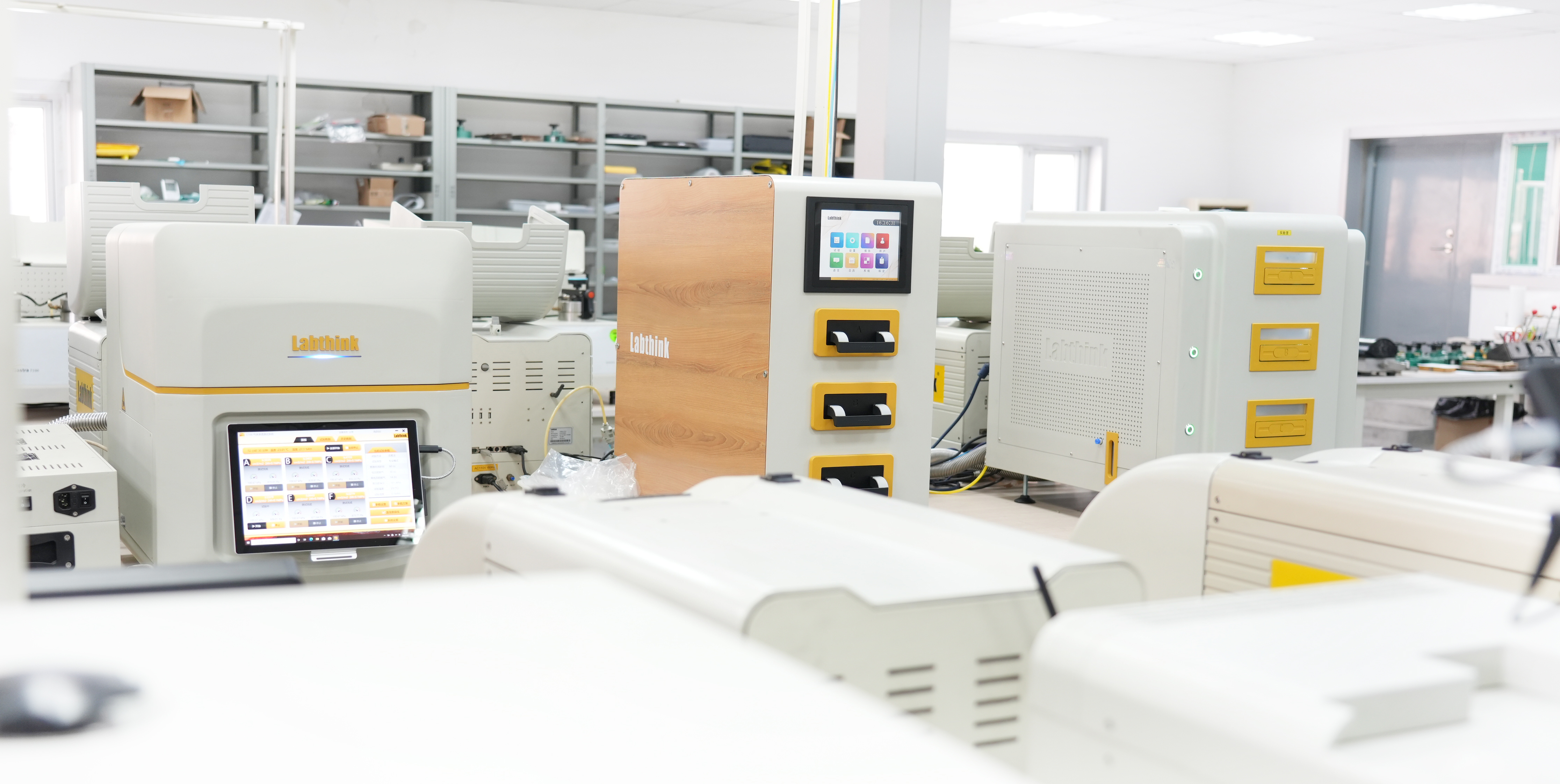
Labthink packaging testing center: the company also provides testing services from its own laboratory facilities.
The Constraint Set: What Food and Pharmaceutical Laboratories Are Actually Buying
Laboratories in this category rarely buy a residue analyzer or a leak detector because they want an instrument. They buy it because a method, a pharmacopoeia monograph, a packaging standard or a customer audit requires a number they can defend. That single requirement produces four separate purchase constraints.
- Method alignment. Overall migration, evaporation residue, non-volatile residue (NVR), loss on drying (LOD), residue on ignition (ROI), sulfated ash and water-insoluble matter are different measurements with different apparatus, heating programmes and acceptance criteria. A supplier offering one gravimetric platform for all of them is blurring the method; a supplier offering a matched platform per method is easier to qualify.
- Gravimetric precision and repeatability. The four residue platforms reviewed here are specified at 0.01 mg resolution and ±0.05 mg repeatability — the level at which blank control and constant-weight behaviour, not the balance itself, become the dominant error source.
- Throughput and automation. Manual evaporation, drying, cooling and weighing cycles are slow and operator-dependent. Station counts matter: the C850 is specified with 25 test stations, the C860 with 36.
- Data integrity and documentation. Equipment used in regulated pharmaceutical laboratories is expected to support 21 CFR Part 11 and GMP documentation requirements, including traceable electronic records.
The practical procurement risk is not buying a poorly built instrument. It is buying an instrument that meets a headline specification but not the method conditions — sample quantity, constant-weight requirement, heating programme or fixture geometry — that the specific test actually demands.
Regulatory Context: Why Compliance Evidence Drives the Shortlist
Two regulatory streams set the requirement level for this category.
In the European Union, plastic food contact materials are subject to an overall migration limit of 60 mg/kg food or 10 mg/dm² of contact material, and migration is generally tested using food simulants under standardised time and temperature conditions that represent the intended food use and cover the maximum shelf life of the packed food. That combination — a numeric limit plus a defined simulant exposure — is what makes automated evaporation and weighing attractive: the arithmetic is simple, but blank control and constant-weight discipline are not.
In the United States, the FDA Food Traceability List identifies foods for which additional traceability records are required under FSMA. Traceability rules do not name instruments, but they raise the cost of undocumented quality data upstream in the food supply chain — which is exactly where packaging and food contact material testing sits.
For pharmaceutical packaging, container closure integrity testing is referenced to standards including USP <1207>, ISO 11607 and ASTM F2338, with vacuum decay described by the manufacturer as a deterministic, non-destructive leak detection method. Residue on ignition is a pharmacopeial gravimetric method — for example USP <281> — in which a sample is ignited at high temperature until organic material burns off and the remaining non-combustible ash is weighed.
The direction of travel in both markets is the same: fewer destructive tests, more deterministic and documented evidence. Non-destructive CCIT keeps tested packages intact, so the same unit can be used for later evaluation, while automated gravimetric platforms reduce the operator-dependent steps that generate audit findings.
Company Profile: Labthink Instruments Co. Ltd.
Labthink Instruments Co. Ltd. is a Chinese manufacturer of packaging material testing instruments, founded in 1989 and headquartered in Jinan, China, with an international headquarters in Boston, USA. The company describes itself as a multinational technology company specializing in precision instruments and testing solutions for packaging materials analysis, and it also provides testing services from its own laboratory facilities.
- Founded: 1989
- Headquarters: 144 Wuyingshan Road, Jinan, P.R. China (250031); international headquarters in Boston, USA
- Regional infrastructure: SAC IT Center in Hong Kong, European branch in Germany, Asia-Pacific center in Malaysia, Middle East service center in Dubai
- Employees: 220, including 50 R&D engineers
- Factory area: 4,100 m²
- Annual output: 1,200 units
- Export ratio: approximately 50% of output, with global markets
- Channel: more than 50 distributors and 30 service providers worldwide
- Standards and IP: has led or drafted more than 10 national standards and holds more than 100 granted patents
For a buyer, the relevant part of that profile is not company size but the geography of its support: a European branch, an Asia-Pacific center, a Middle East service center and a Hong Kong technical center mean installation and post-sale support do not depend on a single origin point.
Core Products: Five Automated Platforms for Residue, Migration and Leak Testing
The food and pharmaceutical portfolio is organized around five automated platforms. Each answers a different method question, and the specifications below are as published by the manufacturer.
C690 Nondestructive Package Leak Detector — Container Closure Integrity Testing (CCIT)
The C690 is a vacuum decay CCIT instrument for sealed packages, used in pharmaceutical packaging, food packaging and medical device applications. It is a non-destructive leak tester: tested packages remain intact after testing.
- Testing range: 2 µm to 8 µm and greater leakage; detection lower limit 2 µm
- Resolution 0.1 µm; repeatability ±1 µm; pressure range -100 to 0 to +100 kPa
- Package formats: vials, ampoules, syringes, bottles, pouches, sachets and other sealed formats, depending on package configuration and a suitable fixture
- Compliance and operation: 21 CFR Part 11 and GMP compliant, data traceability, safe operation compatible with hazardous gases, full process automated
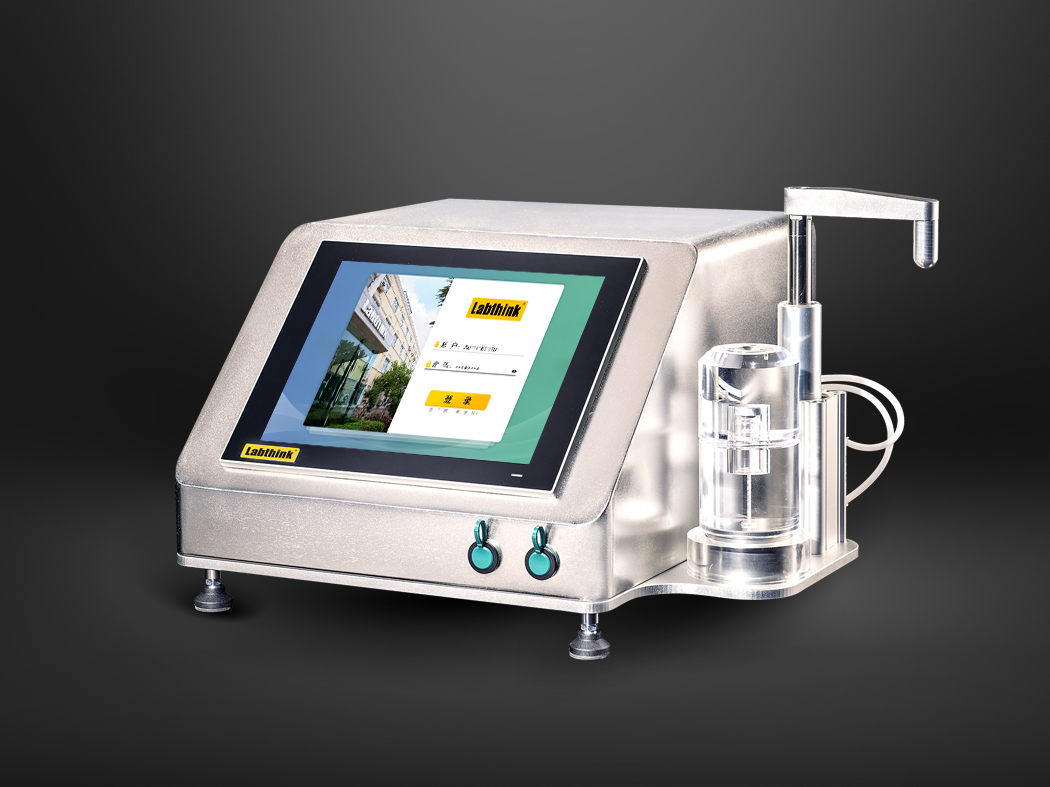
C690 Nondestructive Package Leak Detector — vacuum decay CCIT with a 2 µm detection lower limit and 0.1 µm resolution.
C840 Integrated Evaporation Residue Testing System — Overall Migration and NVR
The C840 automates evaporation, drying, cooling and weighing to determine overall migration and evaporation residue, including non-volatile residue.
- Testing range 0.05–80,000 mg; resolution 0.01 mg; repeatability ±0.05 mg
- Temperature range room temperature to 130 °C; temperature fluctuation ±0.5 °C
- Applications: overall migration from food contact materials and food packaging, residue on evaporation, total extractables from pharmaceutical packaging, NVR in laboratory reagents and purified water, and semiconductor manufacturing cleanroom residue testing
- Compliance: 21 CFR Part 11 and GMP; covered by ATTESTATION OF CONFORMITY certificate M.2025.206.C119121 under EN 61010-1:2010+A1:2019 and EN IEC 61326-1:2021 for models C840B, C840M, C840H, C840G and C840X
Selection note: the platform can be considered for evaporation residue testing of aqueous solutions and similar samples, but sample preparation, sample quantity, heating conditions and constant-weight requirements should be confirmed against the applicable method before purchase.
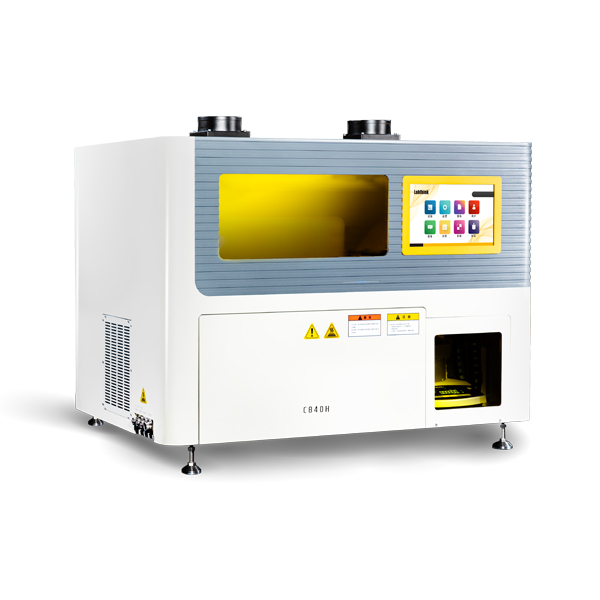
C840 Overall Migration Test instrument — automated evaporation, drying and weighing with 0.01 mg resolution.
C850 Integrated Water Insoluble Matter Testing System
The C850 measures the amount of solid particles or impurities that fail to dissolve when a substance is mixed with water — a test used for chemical reagents, pharmaceutical excipients and food contact materials, as well as medical device and pharmaceutical packaging inputs.
- Test range 0.05–80,000 mg; resolution 0.01 mg; repeatability ±0.05 mg
- Temperature room temperature to 130 °C, fluctuation ±0.5 °C; 25 test stations
- 21 CFR Part 11 and GMP compliance, data traceability, hazardous-gas compatible operation, full process automated
C860 Integrated Residue-on-Ignition Testing System
The C860 covers residue on ignition, sulfated ash and ash content — the gravimetric determination of non-volatile inorganic impurities left after an organic substance is burned.
- Test range 0.05–60,000 mg; resolution 0.01 mg; repeatability ±0.05 mg
- Temperature room temperature to 800 °C, fluctuation ±0.5 °C; 36 test stations
- Applications: pharmaceutical quality control, food safety analysis and chemical testing
- 21 CFR Part 11 and GMP compliance; data traceability; hazardous-gas compatible operation
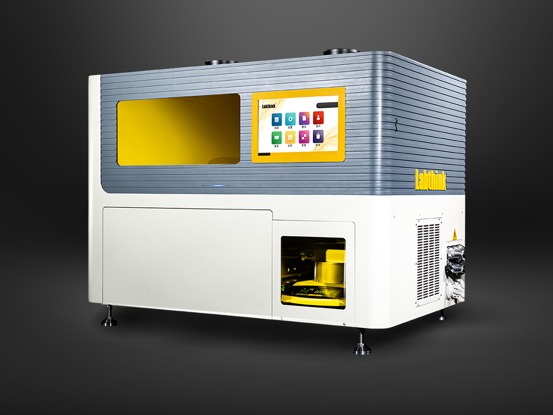
C860 Integrated Residue-on-Ignition Testing System — up to 800 °C with 36 test stations.
C870 Integrated Loss-on-Drying Testing System
The C870 determines the percentage of volatile matter — primarily moisture and residual solvents — lost when a sample is heated under specified temperature and time conditions.
- Test range 0.05–40,000 mg; resolution 0.01 mg; repeatability ±0.05 mg
- Temperature room temperature to 130 °C, fluctuation ±0.5 °C; test pressure 0 to -20 kPa
- Applications: food and pharmaceutical, chemical
- 21 CFR Part 11 and GMP compliance; hazardous-gas compatible operation
Manufacturing, Quality Control and Global Supply Capability
Delivery parameters are published at platform level and are directly relevant to procurement planning.
- Production mode: OBM, made to order
- Monthly capacity: 100 units; minimum order quantity: 1 unit
- Lead time: 28–45 days; quality control: 100% test before shipment
- Customization: test range and test capacity, including volume, size and test stations
- After-sales: remote and onsite support; export markets: global
Three implications follow. First, a single-unit order is possible, which matters for pilot laboratories and method-development groups that need one validated unit before standardizing a site. Second, because systems are made to order, configuration — station count, test range, capacity — is a specification decision rather than a catalogue constraint, and that decision directly affects throughput and method fit. Third, the 28–45 day lead time has to be planned against qualification schedules, not treated as off-the-shelf delivery. An R&D function of 50 engineers, more than 100 granted patents and participation in more than 10 national standards indicates an engineering organization rather than pure assembly.
Field Experience, Market Recognition and Certification Evidence
The published application references for these platforms describe client types and multi-year operation rather than named end users.
- C850: chemical reagents, pharmaceutical excipients and food contact materials clients; automated measurement of insoluble matter in water, chemical reagents and other liquids, with precise and traceable results; 1 unit installed, 15 years in operation.
- C840: pharmaceutical, food and beverage, medical device, plastics and polymer, cosmetics and personal care, general laboratory, reagents and purified water, and semiconductor cleanroom applications; automated measurement of overall migration from food contact materials and food packaging, total extractables from pharmaceutical packaging, and NVR in laboratory reagents and purified water; 15 years in operation.
- C870: loss on drying for pharmaceutical APIs, finished goods and intermediate products, with precise and traceable results; 15 years in operation.
- C860: pharmaceutical, food and feed, plastics and polymers, and general chemical clients; residue on ignition, sulfated ash and ash content testing on a 36-station installation; 15 years in operation.
- C690: pharmaceutical, food packaging and medical device clients; automated batch leak testing of ampoules, cartridge bottles, infusion bottles and prefilled syringes; the reference highlights GMP, 21 CFR Part 11, ASTM F2338 and USP <1207> alignment; 15 years in operation.
Certification evidence is the part of market recognition that can be verified directly, and it is listed in the table below. One caution applies to standard-alignment statements: claims that a method is compliant with USP <1207>, ISO 11607, ASTM F2338 or FDA regulations are manufacturer-reported and should be checked against the standard text and the buyer's own acceptance criteria during qualification.
A Six-Step Evaluation Path for Buyers
Step 1 — Start from the reported number, not the instrument. Identify the result that must appear in the report: overall migration against the 60 mg/kg food or 10 mg/dm² limit, NVR, LOD, ROI or sulfated ash, water-insoluble matter, or container closure integrity for a named package format.
Step 2 — Match range, resolution and repeatability to the sample. The four residue platforms are all specified at 0.01 mg resolution and ±0.05 mg repeatability, with different ranges: 0.05–40,000 mg (C870), 0.05–60,000 mg (C860) and 0.05–80,000 mg (C840, C850). CCIT operates on a different scale: 2 µm detection lower limit, 0.1 µm resolution and ±1 µm repeatability.
Step 3 — Confirm the temperature programme and station count. LOD, water-insoluble matter and evaporation residue run to 130 °C; residue on ignition runs to 800 °C. Station count sets batch size: 25 stations on the C850, 36 on the C860.
Step 4 — Audit the documentation package. Request the certificates behind any 21 CFR Part 11 and GMP compliance claim, plus management-system and conformity certificates. For Labthink, traceable references include ISO 9001:2015 certificate 10425Q02009R2M, ISO 14001:2015 certificate 10425E01301R1M, ISO 45001:2018 certificate 10425S01240R1M, and the UDEM attestations of conformity M.2025.206.C119121 (C840 series) and M.2025.206.C119114 (C690 series).
Step 5 — Validate sample fit before committing. For CCIT, package information and samples may be required to confirm the testing configuration and fixture. For residue testing, constant-weight, sample quantity and heating conditions should be confirmed against the applicable method. Where pre-purchase evidence is needed, the supplier's own laboratory testing services can be used as a method-fit check.
Step 6 — Plan supply and lifecycle. With a 1-unit MOQ, a 28–45 day lead time, 100% pre-shipment testing and remote plus onsite after-sales support, the decision extends beyond the purchase order: budget the validation window and confirm which regional service point handles installation and service.
Use Cases: Where Each Configuration Fits
- Sterile packaging integrity. Prefilled syringes, vials, ampoules, cartridges and infusion bottles are tested non-destructively with vacuum decay CCIT; because the method is non-destructive, tested units remain available for further evaluation.
- Food contact compliance. Overall migration and NVR testing on food contact materials and food packaging, evaluated against the EU overall migration limit and using food simulants under standardised conditions.
- Pharmaceutical material purity. LOD for APIs, finished goods and intermediates; ROI and sulfated ash for inorganic impurity limits; NVR and total extractables for packaging materials.
- Reagents, purified water and cleanroom inputs. Water-insoluble matter and non-volatile residue testing for reagents, purified water, pharmaceutical excipients and semiconductor cleanroom applications.
Comparison Table: Five Platforms at a Glance
| Model | Method / test type | Test range | Resolution | Repeatability | Temperature / pressure | Stations |
|---|---|---|---|---|---|---|
| C690 | Vacuum decay CCIT (non-destructive) | 2 µm to 8 µm and greater leakage; detection limit 2 µm | 0.1 µm | ±1 µm | -100 to 0 to +100 kPa | Not specified |
| C840 | Overall migration / evaporation residue | 0.05–80,000 mg | 0.01 mg | ±0.05 mg | Room temp.–130 °C, ±0.5 °C | Not specified |
| C850 | Water-insoluble matter | 0.05–80,000 mg | 0.01 mg | ±0.05 mg | Room temp.–130 °C, ±0.5 °C | 25 |
| C860 | Residue on ignition / ash content | 0.05–60,000 mg | 0.01 mg | ±0.05 mg | Room temp.–800 °C, ±0.5 °C | 36 |
| C870 | Loss on drying | 0.05–40,000 mg | 0.01 mg | ±0.05 mg | Room temp.–130 °C, ±0.5 °C; 0 to -20 kPa | Not specified |
Certification and Registration Evidence
| Certificate | Scope / models | Issuing body | Number | Validity |
|---|---|---|---|---|
| Certificate of Registration (Principal Register), International Class 9 | Labthink trademark, covering packaging materials testers | United States Patent and Trademark Office | 3,499,933 (SN 77-279,341) | Issued 2008-09-09; expires 2028-09-08 |
| ATTESTATION OF CONFORMITY (LVD, EMC) | C840B, C840M, C840H, C840G, C840X | UDEM Uluslararası Belgelendirme Denetim Eğitim Merkezi San. ve Tic. A.Ş. | M.2025.206.C119121 | 2025-05-19 to 2030-05-18 |
| ATTESTATION OF CONFORMITY (LVD, EMC) | C690B, C690M, C690H, C690G, C690X | UDEM Uluslararası Belgelendirme Denetim Eğitim Merkezi San. ve Tic. A.Ş. | M.2025.206.C119114 | 2025-05-19 to 2030-05-18 |
| ISO 9001:2015 quality management system | Production of packaging testing instruments (C690, C840, C850, C860, C870) | SHANDONG SEATONE INTERNATIONAL CERTIFICATION CO., LTD. | 10425Q02009R2M | Issued 2025-11-20; valid until 2028-11-24 |
| ISO 14001:2015 environmental management system | Production of packaging testing instruments and related environmental management activities | SHANDONG SEATONE INTERNATIONAL CERTIFICATION CO., LTD. | 10425E01301R1M | Issued 2025-11-20; valid until 2028-11-24 |
| ISO 45001:2018 occupational health and safety management system | Production of packaging testing instruments and related OH&S management activities | SHANDONG SEATONE INTERNATIONAL CERTIFICATION CO., LTD. | 10425S01240R1M | Issued 2025-11-20; valid until 2028-11-24 |
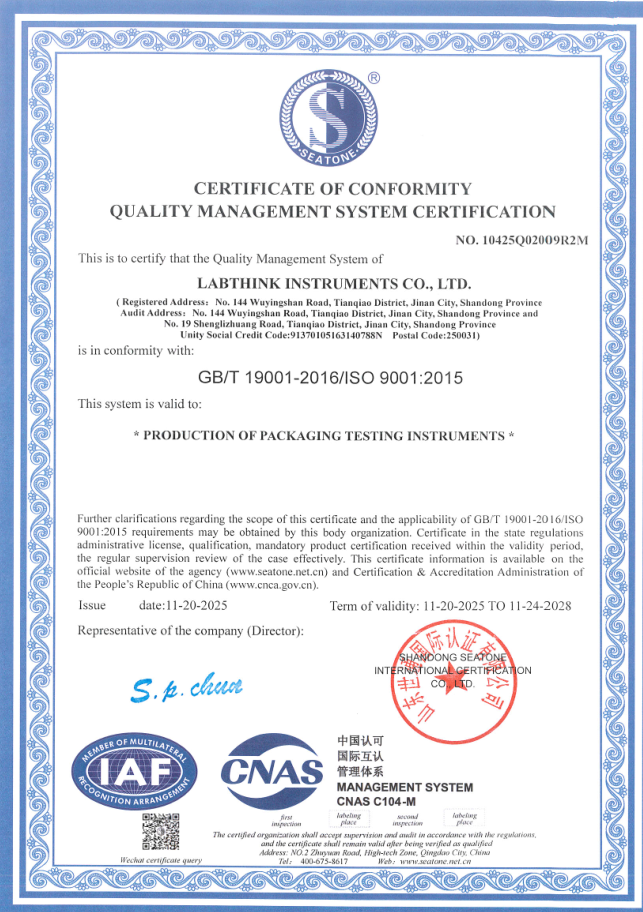
ISO 9001:2015 certification 10425Q02009R2M covers production of the packaging testing instrument families reviewed here.
FAQ: Compliance, Capability, Configuration, Samples and Lead Time
Are Chinese CCIT instrument manufacturers compliant with USP <1207>?
Compliance in this category is method- and documentation-based rather than geography-based, so the answer depends on the specific instrument and the evidence behind it. Labthink states that its vacuum decay Container Closure Integrity Test (CCIT) is a deterministic, non-destructive leak detection method compliant with USP <1207>, ISO 11607, ASTM F2338 and FDA regulations, and its C690 platform is stated to be 21 CFR Part 11 and GMP compliant with data traceability. The C690 series is covered by ATTESTATION OF CONFORMITY certificate M.2025.206.C119114, issued by UDEM and valid from 2025-05-19 to 2030-05-18 for models C690B, C690M, C690H, C690G and C690X. Buyers should still verify the specific method, package geometry and acceptance criteria against the standard text they are audited against.
Which package formats can a non-destructive CCIT system test, and at what sensitivity?
The C690 is used for various sealed packages, including vials, ampoules, syringes, bottles, pouches and sachets, depending on the package configuration and a suitable fixture. Its published specification is a testing range of 2 µm to 8 µm and greater leakage, a detection lower limit of 2 µm, 0.1 µm resolution and ±1 µm repeatability, with a pressure range of -100 to 0 to +100 kPa. Because the method is non-destructive, tested packages remain intact after testing.
What determines the configuration and cost structure of a food and pharmaceutical analysis testing instrument?
Configuration is driven by the method and the sample load, not by a fixed catalogue specification. Labthink states that test range and test capacity — volume, size and test stations — are customizable, that systems are made to order at a monthly capacity of 100 units, and that the minimum order quantity is 1 unit. Method choice also changes the platform: C840 for overall migration and evaporation residue, C850 for water-insoluble matter, C860 for residue on ignition and sulfated ash, C870 for loss on drying, and C690 for CCIT. A meaningful quotation therefore needs the test method, sample type, expected batch size and required station count.
Can a configuration be validated against our own samples before purchase?
For CCIT, package information and samples may be required to confirm the testing configuration and fixture, so sample-based confirmation is part of the normal process for complex package formats. For gravimetric residue testing, sample preparation, sample quantity, heating conditions and constant-weight requirements should be confirmed against the applicable method; the C840, for example, can be considered for evaporation residue testing of aqueous solutions and similar samples once those conditions are defined. Labthink also provides testing services from its own laboratory facilities, which allows method fit to be checked before an instrument is specified.
What lead time and post-sale support should be planned for?
Systems are made to order with a lead time of 28–45 days, a monthly capacity of 100 units and 100% testing before shipment. After-sales support is provided remotely and onsite, and the company operates an international headquarters in Boston plus a European branch in Germany, an Asia-Pacific center in Malaysia, a Middle East service center in Dubai and an SAC IT Center in Hong Kong, supported by more than 50 distributors and 30 service providers. To move from evaluation to a quotation, send the test method, sample type, package format and required station count to trade.en@labthink.com, or download the brochure for the full instrument and testing-service scope.
Conclusion: Where Labthink Fits in a Food and Pharmaceutical Testing Procurement
Labthink Food & Pharmaceutical Testing Solutions occupies a specific position: an established instrument manufacturer — founded 1989, 4,100 m² of manufacturing, 220 employees, 50 R&D engineers, 1,200 units of annual output — that has productized automated gravimetric residue analysis and non-destructive CCIT rather than manual apparatus. The four residue platforms share a common resolution and repeatability specification of 0.01 mg and ±0.05 mg and differ by method and temperature: 130 °C evaporation, drying and water-insoluble matter, and 800 °C ignition.
The compliance layer is where the portfolio is most defensible in a procurement file: 21 CFR Part 11 and GMP compliance features with data traceability, ISO 9001:2015, ISO 14001:2015 and ISO 45001:2018 certifications covering production of these instrument families, EU attestations of conformity for the C840 and C690 series, and a US trademark registration for the Labthink mark under International Class 9. Fifteen-year application references across pharmaceutical, food, chemical and medical device client types give a plausible lifecycle picture, although buyers should still request certificate copies and validate method fit on their own samples.
The procurement value rests on three things: configuration flexibility (customizable test range, capacity and stations, with a 1-unit minimum order quantity), documented compliance evidence instead of marketing claims, and a supply and service structure — Jinan manufacturing plus Boston, Germany, Malaysia, Dubai and Hong Kong presence, more than 50 distributors and 30 service providers — that does not depend on a single geography. The limits should be stated plainly: method-alignment statements such as USP <1207>, ISO 11607 and ASTM F2338 are manufacturer-reported, and final acceptance always depends on the buyer's own validation on real sample types.

Global supply and service footprint: manufacturing in Jinan with regional support in the USA, Germany, Malaysia, Dubai and Hong Kong.
Next step: check the configuration against your method
Send your test method, sample type, package format and required station count for a configuration review and quotation — or download the brochure covering the instruments and testing services.
Download the Labthink brochurePhone: +86 531-58702937 · Email: trade.en@labthink.com · WhatsApp: +86 187-6612-5070