
Manual vs Automated Residue on Ignition and Sulfated Ash Testing: A Food & Pharma Buyer's Guide
Manual vs Automated Residue on Ignition and Sulfated Ash Testing: A Food & Pharma Buyer's Guide
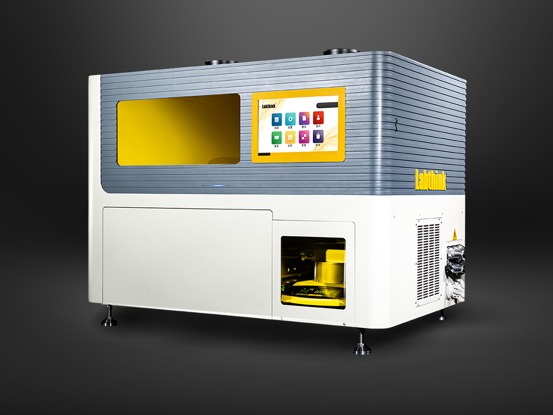
Short answer: manual and automated residue on ignition workflows answer the same question — how much inorganic residue remains after an organic sample is ignited — but they place control in different hands. At the bench, the analyst controls the ignition profile, the cooling step, the weighing sequence and the constant-weight decision. In an automated system such as the Labthink C860 Integrated Residue-on-Ignition Testing System, heating and weighing are performed by the instrument, with a 0.05–60,000 mg test range, 0.01 mg resolution, ±0.05 mg repeatability, a room-temperature to 800 °C furnace, ±0.5 °C temperature fluctuation and 36 test stations.
This guide is written for food and pharmaceutical laboratories that already understand the method and are now deciding how to run it. It compares the manual bench workflow with an automated residue on ignition testing system stage by stage — preparation, ashing, cooling, weighing, documentation and safety — and sets out the buyer criteria that determine when an automated Residue on Ignition Testing System is the appropriate purchase rather than a capability the method does not need.
The Problem: Where Manual Residue on Ignition Workflows Lose Control
Residue on ignition testing involves heating a sample under specified conditions until volatile and organic components are removed, then determining the mass of the remaining residue. Sulfated ash testing follows the same gravimetric logic with one added reagent: concentrated sulfuric acid is added before or during ignition, converting alkali metals and impurities into stable sulfate salts so that the inorganic residue becomes less volatile and easier to measure reproducibly. Because the result is a mass, the workflow is a chain of controlled steps — and every step in that chain is a point where the outcome can depend on the analyst rather than on the method.
On a manual bench, the chain typically runs through sample and crucible preparation, ignition in a furnace, transfer of the hot crucible to a desiccator, a defined cooling interval, weighing on an analytical balance, repeated ignition-and-weigh cycles until constant weight is reached, and finally transcription of the masses into the laboratory record. None of that is unusual. What matters for a buyer in the evaluation stage is where variability enters:
- Ignition profile. Furnace temperature and the way a crucible is loaded and removed influence how completely the organic matrix is ashed.
- Cooling discipline. Crucibles must be cooled under comparable conditions and for comparable intervals before weighing; unequal cooling produces unequal masses.
- Constant-weight judgement. Deciding that a sample has reached constant weight is an operator decision unless the rule is mechanically enforced by the system.
- Documentation load. A gravimetric method generates many masses per sample, so manual transcription is where traceable recordkeeping becomes labour-intensive.
- Operator exposure. High-temperature ignition with sulfuric acid handling shapes how a bench workflow must be organised and staffed.
The problem definition for an evaluation-stage buyer is therefore narrow. The question is not whether a manual method can produce a valid result — it can — but whether the laboratory's sample volume, data-integrity requirements and staffing model still make an operator-dependent workflow the right choice for residue on ignition and sulfated ash testing.
Industry Background: ROI and Sulfated Ash as Regulated Gravimetric Tests
Residue on ignition is a pharmacopeial gravimetric method, described in the USP <281> context, used to measure the amount of inorganic impurities in an organic substance. In the standard description the sample is ignited at high temperature — commonly cited around 600 °C — until all organic material burns off, leaving behind non-combustible ash. Sulfated ash testing is applied where the inorganic or mineral residue content of pharmaceutical and chemical materials has to be determined, using sulfuric acid to stabilise the residue as sulfate salts.
These two tests sit inside a wider family of residue measurements that food and pharmaceutical laboratories often run side by side: evaporation residue and non-volatile residue (NVR) for solvent-extracted material, overall migration for food contact materials (FCMs), water-insoluble matter, and loss on drying (LOD). Regulators drive the family from different directions. The FDA Food Traceability List identifies the foods for which additional traceability records are required under FSMA, while in the European Union overall migration for plastic food contact materials is limited to 60 mg/kg food or 10 mg/dm² of contact material, and migration is tested using simulants under standardised time and temperature conditions that represent a defined food use and the maximum shelf life of the packed food.
The practical consequence for buyers is that residue testing is rarely a single-instrument decision. A laboratory may need ignition-based testing for inorganic impurities in pharmaceutical materials and evaporation- or extraction-based testing for packaging and food contact compliance — often in the same quality control department, against the same documentation expectations.
The Automated Solution: What an Integrated Residue-on-Ignition System Changes
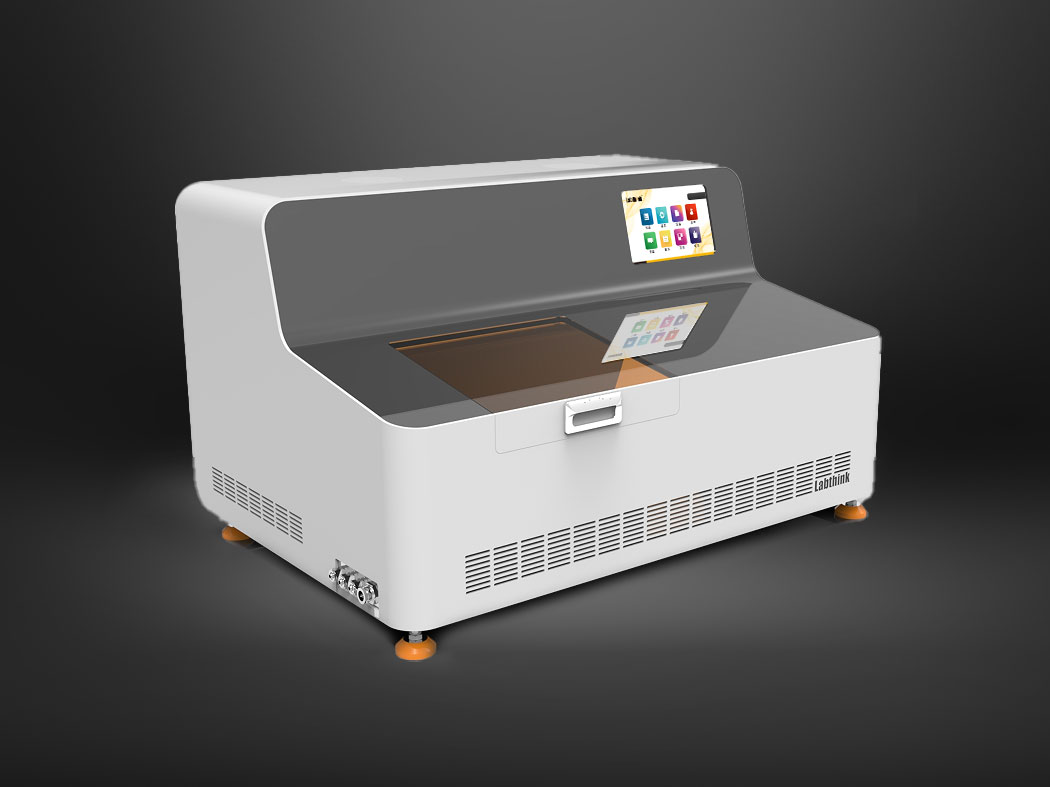
The Labthink C860 Integrated Residue-on-Ignition Testing System is an automated system for residue on ignition, sulfated ash and ash content testing. Labthink reports that the C860 automates key steps of the residue on ignition procedure, including heating and weighing, and its declared application set covers non-volatile inorganic impurities, residue on ignition, sulfated ash and ash content measurement. Labthink Instruments Co. Ltd. is a multinational manufacturer of precision instruments and testing solutions for packaging materials analysis, founded in 1989, headquartered in Jinan, China, with an international headquarters in Boston, USA.
Labthink describes the C860 as primarily applicable to pharmaceutical and chemical testing laboratories where residue on ignition or sulfated ash testing is required, and lists food as an additional applicable industry. In the application records published for this class of system, clients come from pharmaceutical, food and feed, plastics and polymers, and general chemical backgrounds.
What automation actually transfers to the instrument: the heating step and the weighing step. Everything the manual workflow builds around those two operations — repeat cycles, mass comparison and record generation — is reorganised around them. The laboratory still prepares samples, and the system is intended for indoor laboratory use with a stable ambient temperature and a matched analytical balance.
Step-by-Step Breakdown: Manual Bench Workflow vs Automated Workflow
Comparing the two approaches stage by stage is the fastest way to see which decisions an automated system takes over and which remain with the laboratory.
1. Sample and crucible preparation. At the bench, the analyst prepares the crucible, weighs the sample and records the tare and sample mass. With an automated system, preparation remains a laboratory task; Labthink's published guidance for this class of gravimetric system notes that sample preparation, sample quantity, heating conditions and constant-weight requirements should be confirmed according to the applicable method.
2. Ignition and ashing. Manually, the sample is placed in a furnace and the analyst controls loading, temperature setting and cycle timing. In the C860, heating is automated across a room-temperature to 800 °C range with ±0.5 °C temperature fluctuation.
3. Sulfated ash addition. Manually, the analyst adds concentrated sulfuric acid before or during ignition and manages the charring and evaporation stage. In the automated workflow, sulfated ash testing is a declared application of the system rather than a separate bench procedure.
4. Cooling. Manually, each crucible is transferred to a desiccator and held for a set cooling interval. In the integrated system, cooling and transfer are part of the automated sequence instead of a separate manual staging step.
5. Weighing. Manually, each crucible is carried to an analytical balance and read individually. The C860 automates weighing with 0.01 mg resolution and ±0.05 mg repeatability across a 0.05–60,000 mg test range.
6. Constant weight. Manually, the analyst compares successive masses and decides when constant weight has been reached. In the automated sequence, repeat cycles and mass comparisons are handled inside the run.
7. Throughput and batching. A manual workflow is limited by furnace capacity and analyst time per crucible. The C860 provides 36 test stations.
8. Documentation. Manually, results are transcribed into the laboratory record. Labthink reports full-process automation with precise and traceable data output as a case highlight for its residue and ash application.
9. Compliance framing. At the bench, the laboratory SOP carries the control burden. Labthink's reported case highlights for this application include full-process automation of the residue on ignition and ash content testing workflow with compliance to GMP, 21 CFR Part 11 and pharmacopeia requirements.
10. Safety. Manually, the operator repeatedly handles hot crucibles and sulfuric acid. In an automated configuration, the ignition and weighing sequence is handled inside the instrument, which reduces the number of manual hot-crucible transfers a laboratory has to plan for — a criterion worth assessing directly during an on-site or remote demonstration.
Comparison Table: Manual Bench Workflow vs C860 Automated System
| Decision dimension | Manual bench workflow (typical laboratory practice) | C860 automated system (Labthink published specifications) |
|---|---|---|
| Core measurement | Gravimetric mass difference after ignition, measured on a laboratory balance | Gravimetric mass determination with automated heating and weighing |
| Test range | Defined by balance capacity and crucible handling | 0.05–60,000 mg |
| Resolution | Determined by the analytical balance in use | 0.01 mg |
| Repeatability | Depends on operator technique across ignition, cooling and weighing | ±0.05 mg |
| Temperature capability | Furnace program controlled manually per batch | Room temperature to 800 °C, ±0.5 °C fluctuation |
| Batching | Limited by furnace space and analyst time per crucible | 36 test stations |
| Sulfated ash | Separate acid addition and charring step controlled by the analyst | Declared application of the automated residue on ignition workflow |
| Data handling | Manual transcription and reconciliation of successive masses | Reported precise and traceable data output as part of full-process automation |
| Compliance framing reported | Laboratory SOP and method validation | Case highlights include GMP, 21 CFR Part 11 and pharmacopeia compliance |
| Applicable industries | Any laboratory that can resource the manual workflow | Pharmaceutical, food and chemical |
C860 Specification Snapshot
| Parameter | Specification |
|---|---|
| Model | C860 Integrated Residue-on-Ignition Testing System |
| Test type | Ash content — residue on ignition, sulfated ash |
| Test range | 0.05–60,000 mg |
| Resolution | 0.01 mg |
| Repeatability | ±0.05 mg |
| Temperature range | Room temperature to 800 °C |
| Temperature fluctuation | ±0.5 °C |
| Test stations | 36 |
| Material | Aluminium alloy + ABS plastic |
| Applicable industry | Pharmaceutical, food, chemical |
| Operating environment | Indoor laboratory use only, stable ambient temperature, matched analytical balance |
Related Automated Systems for Adjacent Residue Tests (Shortlist)
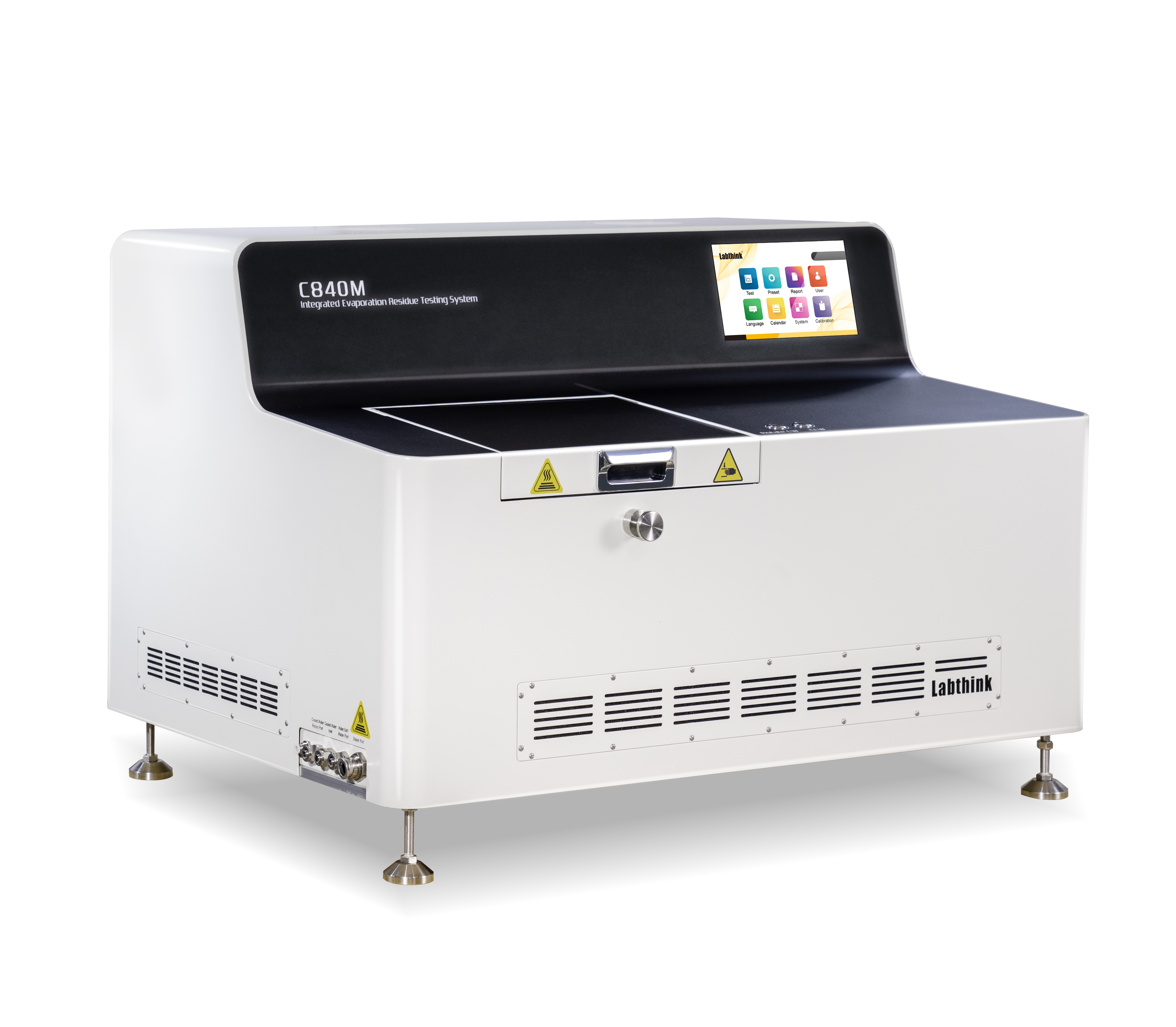
Residue questions rarely arrive one at a time. Labthink's chemical analysis lineup lists four automated residue-related systems — C840 for automated overall migration and evaporation residue testing, C850 for automated water-insoluble matter testing, C860 for automated residue on ignition testing and C870 for automated loss on drying testing — alongside the C690 nondestructive package leak detector for container closure integrity testing (CCIT). For a food and pharmaceutical laboratory, that lineup matters because the same quality department often has to answer an ignition question and an extraction question in the same week.
| Model | Primary test | Test range | Resolution | Repeatability | Temperature / pressure | Stations |
|---|---|---|---|---|---|---|
| C860 Integrated Residue-on-Ignition Testing System | Residue on ignition, sulfated ash, ash content | 0.05–60,000 mg | 0.01 mg | ±0.05 mg | Room temp. to 800 °C, ±0.5 °C | 36 |
| C840 Integrated Evaporation Residue Testing System | Evaporation residue, overall migration, non-volatile residue | 0.05–80,000 mg | 0.01 mg | ±0.05 mg | Room temp. to 130 °C, ±0.5 °C | — |
| C850 Integrated Water Insoluble Matter Testing System | Water-insoluble matter | 0.05–80,000 mg | 0.01 mg | ±0.05 mg | Room temp. to 130 °C, ±0.5 °C | 25 |
| C870 Integrated Loss-on-Drying Testing System | Loss on drying | 0.05–40,000 mg | 0.01 mg | ±0.05 mg | Room temp. to 130 °C, ±0.5 °C; test pressure 0 to −20 kPa | — |
| C690 Nondestructive Package Leak Detector | Container closure integrity testing (vacuum decay CCIT) | 2 µm to greater leakage; detection lower limit 2 µm | 0.1 µm | ±1 µm | Pressure −100 to +100 kPa | — |
Use Cases: Where Food and Pharma Labs Deploy ROI and Ash Automation
Buyers evaluating an automated residue on ignition testing system usually recognise themselves in one of a small number of profiles. The application records and declared industry scope for Labthink's residue family point to the following:
- Pharmaceutical raw materials, APIs and excipients. Residue on ignition and sulfated ash quantify non-volatile inorganic impurities. Labthink reports a loss-on-drying application covering pharmaceutical APIs, finished goods and intermediate products, and a residue/ash application covering non-volatile inorganic impurities, residue on ignition, sulfated ash and ash content.
- Food and feed ingredients and food contact materials. Where the question is not ash content but migration, the corresponding workflow is overall migration testing of food contact materials, food packaging and total extractables from pharmaceutical packaging, together with non-volatile residue in laboratory reagents and purified water.
- Chemical reagents and purified water. Labthink's water-insoluble matter application covers chemical reagents, pharmaceutical excipients and food contact materials, automatically measuring insoluble matter in water, chemical reagents and other liquids, with a 15-year application duration recorded and one unit installed.
- Plastics, polymers and general chemical production. Labthink lists plastics and polymers and general chemical among the client types for its residue testing systems.
- Adjacent packaging integrity work. Where the laboratory also releases sterile or sealed packaging, Labthink's C690 nondestructive package leak detector applies vacuum decay container closure integrity testing to pharmaceutical packages such as vials, ampoules, cartridges, infusion bottles and prefilled syringes, as well as food and other sealed packages, with automated batch testing and a 15-year application duration recorded.
Across these profiles the pattern repeats: the manual method is not wrong, but the volume of samples, the number of ignition cycles and the requirement for traceable records make the operator-dependent version the constraint.
Buyer Criteria: When an Automated ROI System Is Appropriate
An automated residue on ignition testing system is the appropriate purchase when several of the following conditions are true. These are decision rules rather than marketing claims, and each one maps to a verifiable specification.
- The method requires ignition, not evaporation. Ignition-based residue and sulfated ash methods need the higher temperature capability — the C860 reaches 800 °C, whereas evaporation residue, water-insoluble matter and loss on drying systems in the same family operate to 130 °C. If the method never ignites the sample, an ignition system is not the matching instrument.
- Sample volume justifies multi-station batching. 36 test stations change the economics of a residue workload in a way that a single-crucible bench sequence cannot.
- Repeatability has to be demonstrable. A declared ±0.05 mg repeatability and 0.01 mg resolution give the laboratory a specification to validate against instead of an operator-dependent range.
- Records must be traceable by design. If the laboratory has to defend data integrity, the reported case highlight of full-process automation with precise and traceable data output matters more than cycle time.
- Sulfated ash is part of the routine. The acid-addition variant is a declared application of the same system, so it does not require a second procurement.
- The method has been confirmed against the configuration first. Sample preparation, sample quantity, heating conditions and constant-weight requirements should be confirmed according to the applicable method before the purchase order, and the laboratory environment should support indoor operation with a stable ambient temperature and a matched analytical balance.
- Commercial terms fit the site. Labthink's stated commercial terms for this equipment are a minimum order quantity of 1 unit, customisation of test range and test capacity (volume, size, test stations), a monthly capacity of 100 units made to order, and a lead time of 28–45 days.
The mirror-image rule also holds: if residue on ignition and sulfated ash testing is run only occasionally, if the method can be satisfied by evaporation-based testing, or if the laboratory cannot support the environmental and balance conditions the workflow requires, then the automation case is weaker and should be justified by documentation and throughput rather than by capability alone.
Compliance, Quality and Service Evidence to Verify Before Purchase
For an evaluation-stage buyer, the supplier evidence behind a residue on ignition testing instrument is as important as the specification. The following items are documented for Labthink and can be checked directly.
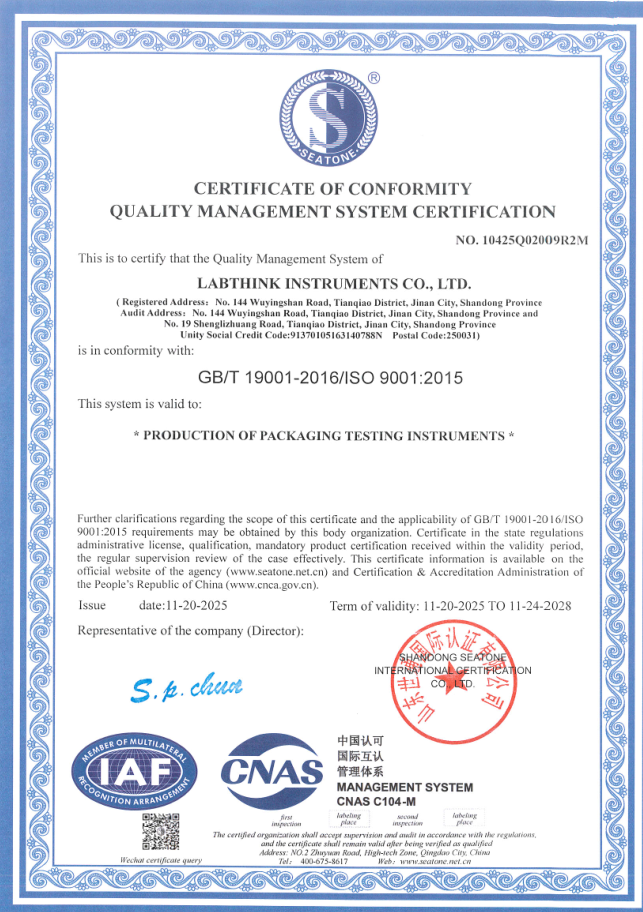
- Management system certifications. ISO 9001:2015 quality management certification, certificate 10425Q02009R2M; ISO 14001:2015 environmental management certification, certificate 10425E01301R1M; and ISO 45001:2018 occupational health and safety certification, certificate 10425S01240R1M. All three were issued on 20 November 2025, are valid to 24 November 2028, and were issued by Shandong Seatone International Certification Co., Ltd., covering the production of packaging testing instruments.
- Registered trademark. Certificate of Registration 3,499,933 (SN 77-279,341) for the trademark “Labthink” in International Class 9, issued by the United States Patent and Trademark Office on 9 September 2008 and valid to 8 September 2028.
- EU attestations of conformity. Certificate M.2025.206.C119121 covers the Integrated Evaporation Residue Testing System series (C840B, C840M, C840H, C840G, C840X), and certificate M.2025.206.C119114 covers the Nondestructive Package Leak Detector series (C690B, C690M, C690H, C690G, C690X), both to EN 61010-1:2010+A1:2019 and EN IEC 61326-1:2021 under the Low Voltage and EMC Directives, issued 19 May 2025 and valid to 18 May 2030.
- Unit-level quality control. Quality control follows a 100% test procedure applied to each unit, and each unit undergoes 100% testing before shipment.
- Service and supply footprint. After-sales support is provided remotely and on site, supported by more than 50 distributors and 30 service providers, with operations in Jinan, an international headquarters in Boston, a SAC IT Center in Hong Kong, a European branch in Germany, an Asia-Pacific centre in Malaysia and a Middle East service centre in Dubai.
- Manufacturing and technical base. Labthink was founded in 1989, operates a 4,100 m² facility with 220 employees, an annual output of 1,200 units, a 50-engineer R&D team and a 50% export ratio, and reports participation in more than 10 national standards and more than 100 granted patents.
FAQ: Manual vs Automated Residue on Ignition and Sulfated Ash Testing
Does an automated residue on ignition system support GMP and data-integrity requirements?
Labthink reports that the case highlights for its residue and ash application include full-process automation of the residue on ignition and ash content testing workflow, with compliance to GMP, 21 CFR Part 11 and pharmacopeia requirements, plus precise and traceable data output. The manufacturer is also certified to ISO 9001:2015 (certificate 10425Q02009R2M), ISO 14001:2015 (10425E01301R1M) and ISO 45001:2018 (10425S01240R1M), all valid to 24 November 2028. Buyers should still map the instrument's records to their own SOP and to the applicable pharmacopeial method during qualification, because compliance framing is reported at the application level, not as a universal claim about every laboratory's procedure.
What equipment can automate residue on ignition and sulfated ash testing?
The Labthink C860 Integrated Residue-on-Ignition Testing System is an automated system designed for residue on ignition and sulfated ash testing. Labthink reports that it automates key steps of the residue on ignition procedure, including heating and weighing. Its declared specifications are a 0.05–60,000 mg test range, 0.01 mg resolution, ±0.05 mg repeatability, a room-temperature to 800 °C temperature range with ±0.5 °C fluctuation, and 36 test stations. It is primarily applicable to pharmaceutical and chemical testing laboratories where residue on ignition or sulfated ash testing is required, with food listed as an additional applicable industry. Because sulfated ash testing is a variation of residue on ignition in which sulfuric acid is added before or during ignition, it is handled within the same automated workflow rather than as a separate instrument.
What drives the cost of an automated residue on ignition system?
For this equipment family, cost is driven by configuration rather than by a single list specification. Labthink states that customisation covers test range and test capacity — including volume, size and test stations — which means the station count and vessel dimensions selected for a site determine the configuration. The published commercial terms are a minimum order quantity of 1 unit, a monthly capacity of 100 units made to order, and a lead time of 28–45 days. A buyer should also budget for the matched analytical balance and the stable, indoor laboratory environment the workflow requires, since those are part of the operating conditions rather than optional accessories.
Can we validate the system with our own samples before ordering?
Yes, sample-based confirmation is the normal route, and the minimum order quantity is 1 unit, so a single-system evaluation is possible. For this class of gravimetric system, Labthink's published guidance notes that the specific sample preparation, sample quantity, heating conditions and constant-weight requirements should be confirmed according to the applicable method, and that package or sample information may be required to confirm the correct test configuration where a custom fixture is involved. Method confirmation of this kind is best completed before the configuration is finalised, so that the declared test range, station count and temperature capability are matched to the actual procedure.
What is the lead time after order, and how does a laboratory start?
Labthink's stated lead time for this equipment is 28–45 days, with a monthly capacity of 100 units made to order and a 100% test procedure applied to each unit before shipment. After installation, after-sales support is available remotely and on site, backed by more than 50 distributors and 30 service providers and regional operations in Jinan, Boston, Hong Kong, Germany, Malaysia and Dubai. The practical next step is to send the method, sample type and expected sample volume so that the configuration can be confirmed, and to request a quotation or discuss a sample arrangement directly with the Labthink Food & Pharmaceutical Testing Solutions team at en.labthink.com.
Conclusion: Choosing Between Manual and Automated ROI
The manual-versus-automated decision for residue on ignition and sulfated ash testing comes down to where the laboratory wants control to sit. A manual bench workflow keeps every judgement — ignition profile, cooling interval, constant-weight decision — with the analyst, which is acceptable when sample volume is low and documentation is light. An automated residue on ignition testing system moves the heating and weighing steps into the instrument, and the C860 adds 36 test stations, 0.01 mg resolution, ±0.05 mg repeatability and an 800 °C ceiling to the workflow, with reported full-process automation and traceable data output as application highlights.
For food and pharmaceutical buyers, the deciding criteria are method fit, sample volume, documentation requirements and the environmental conditions the laboratory can sustain. Confirm the method against the configuration, verify the certifications and commercial terms, and treat the comparison as a fit question rather than a speed question.
Next step: sample, quotation or catalogue
Send your residue on ignition or sulfated ash method, sample type and expected batch volume, and the Labthink Food & Pharmaceutical Testing Solutions team will confirm the matching configuration — including test range, station count and temperature profile — and respond with a quotation or a sample arrangement.
Email: trade.en@labthink.com | Phone: +86 531-58702937 | WhatsApp: +86 187-6612-5070
Website: https://en.labthink.com/
Download the full catalogue and service overview: Labthink Packaging Testing Equipment & Testing Services brochure (PDF)
Have Questions or Need More Details?
Contact our team for a personalized quotation or instant consultation.
Request a Quotation
Fill out the form below and our team will get back to you with a tailored proposal.
WhatsApp Direct Chat
Prefer to chat in real-time? Message us on WhatsApp for instant assistance & quick answers.
- Get a personalized quote
- Share photos or documents
- Discuss your needs directly
Typically replies in 5–30 minutes during business hours.