
Worm-Face Gear Set vs. Precision Face Gear Set: A Buyer's Comparison Guide
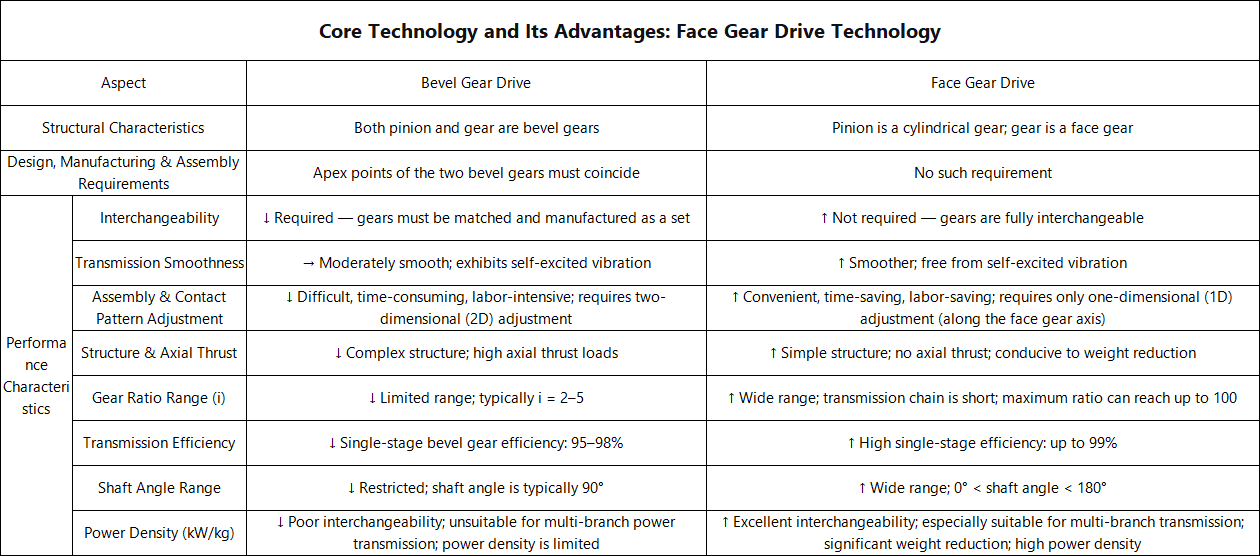
Face gear drive technology and its stated advantages, the reference point for both architectures compared in this guide.
A worm-face gear set and a precision face gear set are both angular transmissions built around a face gear, yet they are not interchangeable answers to the same main gearbox brief. The differences that decide a purchase sit in four places: the input member and its contact mechanics, the usable single-stage reduction ratio, the axial-thrust and assembly burden the housing has to absorb, and the documentation the supplier can put in your hands at shipment and after it.
This guide compares the two families for main gearbox applications. It uses Laser Gear (Xi'an Laser Transmission Technology Co., Ltd.) first-party product and process statements where they apply, published aerospace research for the technology background, and clearly labelled general engineering knowledge where no product-specific data was supplied. Where a value is not present in the supplied product data, the guide says so and converts the gap into a question for the RFQ rather than filling it with a guess.
One positioning point matters before the comparison begins. Laser Gear manufactures both a worm face gear pair and the orthogonal, offset and non-orthogonal face gear configurations discussed here, so this is an architecture-selection guide, not an argument for one catalogue line over another.
The problem: one catalogue label, two different machines
Worm-face and precision face gear sets often appear under the same catalogue heading, and that is where quotations start to drift. The buyer writes one RFQ for "a face gear set" for a main gearbox, two suppliers quote against it using different architectures, and the resulting prices look comparable when the underlying machines are not.
Three failure patterns repeat in this situation. The first is unit-price comparison across unmatched scope: a quotation built on a drawing-specific, ground, inspected precision set is placed beside a quotation for a standard worm-face reduction, and the difference is read as a supplier margin rather than an architecture difference. The second is ratio transfer: a headline single-stage ratio published for one face gear configuration is assumed to hold across the whole family, including the worm-face variant. The third is documentation ambiguity: the buyer asks for "certificates" in the RFQ without defining which document is meant, receives a test report, and discovers at goods-in that the release gate needed something else.
Each of these is a specification problem rather than a technology problem, and each can be closed before the comparison starts. The rest of this guide works through the technical differences first, then the questions, then the commercial and documentary terms.
Industry background: where face gear drives actually sit
Face gear transmission has a documented aerospace lineage that predates its industrial commercialization. NASA technical material describes the arrangement as a way to turn the corner between a horizontal engine or input shaft and a vertical rotor output, with split power between output gears discussed as a potential weight-reduction mechanism. A NASA-published design handbook from 2000 covers helicopter transmissions, split-torque arrangements and comparisons with bevel gears. NASA records also describe a 250 horsepower proof-of-concept split-torque face gear transmission tested by The Boeing Company in 2002, and a scaled proof-of-concept gearbox that reported an average torque split of 52% to 48% between two pinions.
The European FACET project, reported in 2004, assessed face gears for aerospace transmissions and included helicopter transmission configurations that turn horizontal engine drive toward a vertical main-rotor output. These are historical technical and project signals. They establish that the architecture has been engineered and tested for angular, power-dense duty; they do not establish current commercial performance, current supplier capability, or any efficiency and durability figure for a specific gearbox you might buy.
On the manufacturing side, Laser Gear was founded in November 2023 by Dr. Zhao Ning, who leads a team that spent two decades on face gear transmission research at a Chinese national-level institute for mechanical manufacturing and automation. The company reports 3,000 sqm of factory space, 60 employees, an 18-person R&D team and annual output of 300,000 units, with a 10% export ratio and markets listed as China, USA, Europe and the Middle East. Its stated product range includes orthogonal straight-tooth and helical face gear drives at 90°, offset face gear drives with skew axes, non-orthogonal internal and external cone face gears, small shaft-angle face gears at 3°–5°, a worm face gear pair, and face gear main reducers including single-input and dual-input coaxial contra-rotating designs.
Laser Gear supplies both a worm face gear pair and precision face gear configurations, so the comparison is architectural rather than a choice between suppliers.
The company's own development record gives a sense of where its engineering effort has been concentrated. It reports completing China's first civilian-oriented face gear reducer product in March 2024 and delivering the first batch to a domestic engineering machinery company, and in December 2024 developing China's first face gear speed increaser, with the first batch delivered for integration into a next-generation naval propulsion main-engine generator system. In March 2025 it reports establishing an integrated design–manufacturing–equipment platform, and in May 2025 two products were selected for the Shaanxi Provincial Key New Product Development Program: a 2,200 N·m precision angular face gear reducer and a 50 kW-class face gear speed increaser for marine main-engine generator systems. In November 2025 the company reports passing an Intellectual Property Management System audit, and in December 2025 three national face gear standards it led or co-developed were approved for project establishment, with publication and implementation targeted for 2026.
Demand context is worth noting because it explains why buyers are being asked to compare these architectures at all. Strategic Market Research estimates the robot gears market at USD 151.35 million in 2025, reaching USD 260.98 million by 2032 at a compound annual growth rate of 8.09% (published February 2026). Grand View Research estimates the global unmanned systems market at USD 29.3 billion in 2025 rising to USD 67.6 billion by 2033, with the UAV segment holding 63% of 2025 share (published June 2026). Neither figure is specific to face gears, and neither substitutes for a duty-cycle calculation — but together they explain the volume of angular, compact, power-dense gearbox enquiries now reaching suppliers.
The supply base is not limited to one vendor either. ASSAG, a Swiss supplier, publicly describes customer-specific drive solutions and face gear technology across automotive, medical, industrial, machine tools, robotics, aerospace, agricultural and off-highway applications in its company brochure. That is a company-reported capability profile, not an independent market ranking, but it confirms that buyers comparing face gear options have more than one qualified route to market.
What each option actually is
A worm-face gear set uses a worm — a screw-form input member — meshing with a face gear wheel. The reduction comes from the worm's small number of starts against the wheel's tooth count, delivered in a single right-angle stage. Laser Gear lists a worm face gear pair within its product range, and fine-pitch worm-face drives sit at the small-module end of that family. Worm-type contact is predominantly sliding, which is the mechanical origin of both its quiet running reputation and its thermal and efficiency penalty relative to rolling-contact gear pairs. Back-driving resistance, where it occurs, depends on the lead angle of the specific design and should be confirmed rather than assumed.
A precision face gear set uses a cylindrical pinion — spur or helical — meshing with a face gear whose teeth are cut on the face of the wheel. Laser Gear's range covers the orthogonal spur version and the orthogonal helical version at a 90° shaft angle, an offset face gear drive for skew or spatial crossed axes, non-orthogonal internal cone face gears above 90°, non-orthogonal external cone face gears below 90°, and small shaft-angle face gears at 3°–5°. Because the pinion is cylindrical rather than screw-form, the contact and the assembly logic are different from the worm-face case: the company states full interchangeability, easier one-dimensional assembly adjustment and almost no axial thrust as the defining advantages of the family.
The distinction that matters commercially is this: a worm-face set is usually selected for ratio and compactness in a single right-angle stage, while a precision face gear set is usually selected when efficiency, axial-thrust behaviour, shaft-angle freedom and multi-branch power flow drive the design. If your main gearbox brief does not care about the second group, the first group may well be sufficient — and cheaper to qualify.
Comparison on the criteria that change the decision
Six criteria separate the two architectures in practice: single-stage ratio and stage count, efficiency and heat, axial thrust and assembly, shaft-angle and layout freedom, precision and inspection, and cost structure. Weight and power density act as a modifier on all six rather than a criterion of their own.
Ratio and stage count. Laser Gear states that the maximum single-stage reduction ratio of its face gear drive reaches up to 100, which it contrasts with a typical bevel gear range of 2 to 5. That is a wide envelope, and it is the single strongest technical argument for a face gear architecture in a main gearbox where the alternative would be two stages. For the worm-face pair, no maximum single-stage ratio appears in the product data supplied for this comparison; it must be taken from the supplier's design for your specific duty.
Efficiency and heat. The company's comparison data states efficiency up to 99% for its face gear drive against traditional bevel gear drives, and links lower vibration and noise to the same architecture. A worm-face set, by contrast, transmits load through sliding contact, which in general engineering terms produces more heat and lower mechanical efficiency than a predominantly rolling-contact pair. The practical consequence is not a marketing point but a thermal one: a continuously rated main gearbox with a worm-face stage usually needs its lubrication and heat rejection designed around that loss, while an intermittent-duty application may barely notice it.
Axial thrust and assembly. Laser Gear states that its face gear drive generates almost no axial thrust, supports full interchangeability and allows easier one-dimensional assembly adjustment. For a buyer, that translates into a simpler bearing arrangement, fewer shim iterations at commissioning and lower maintenance effort over life — the company describes the family as requiring less maintenance than the bevel drives it compares against. For a worm-face set, the bearing arrangement and the adjustment method are design-specific and should be requested explicitly.
Shaft-angle and layout freedom. Shaft angle for the face gear family can be set between 0° and 180° and is not limited to 90°, according to the company, which is what makes the offset, non-orthogonal and small shaft-angle variants possible. A worm-face set is naturally a right-angle solution; spatial layouts that need 30°, 120° or a small 3°–5° deviation are normally the territory of the cone and offset face gear configurations.
Precision and inspection. Laser Gear states that it can manufacture Grade 5–6 high-precision face gears using a grinding process for aviation and robotic applications. Generation route matters here: NASA technical material notes that a face gear may be generated by a grinding or cutting worm as an alternative to the conventional involute shaper. For a decision-stage buyer, the question is not only which grade is quoted but which generation and inspection route the supplier intends to use, because that determines whether the grade can be held in series.
Cost structure. Laser Gear states that high-precision face gear manufacturing carries a higher one-time processing cost while reducing total system cost in lightweight, high-load applications. That is a lifecycle argument, not a unit-price argument, and it should be tested rather than accepted: the higher processing cost is real and appears at the first purchase order, while the system-level benefit appears in bearings, housing mass, assembly time and maintenance over the life of the machine.
| Decision dimension | Worm-face gear set | Precision face gear set (Laser Gear) |
|---|---|---|
| Input member | Worm screw meshing with a face gear wheel; listed as a worm face gear pair | Spur or helical pinion meshing with a face gear |
| Shaft angle | Design-specific; confirm in RFQ | 0°–180°, not limited to 90° (company statement) |
| Maximum single-stage ratio | Not stated in supplied product data; request per design | Up to 100 (company statement); company cites 2–5 as typical bevel range |
| Efficiency | Sliding contact; generally below rolling-contact gear pairs (general engineering) | Up to 99% per company comparison against traditional bevel drives |
| Axial thrust and assembly | Bearing and adjustment arrangement to be confirmed | Almost no axial thrust; full interchangeability; 1D assembly adjustment (company statement) |
| Precision and process | Accuracy grade and generation route to be confirmed | Grade 5–6 with grinding process for aviation and robotics (company statement) |
| Weight and load, vs traditional bevel | Not stated in supplied data | Weight reduced 40%, load capacity increased 35% (company comparison data) |
| Cost structure | Scope-dependent; normalize before comparing | Higher one-time processing cost, lower full-lifecycle cost (company statement) |
| Documentation after delivery | Confirm document types in the purchase order | Full test reports after delivery, plus after-sales support (company statement) |
Company statements refer to Laser Gear product and comparison data. Cells marked for confirmation are not evidence gaps in the comparison — they are the questions the buyer must close before awarding.
The ratio question: what to ask about maximum single-stage reduction
A headline ratio is the easiest number to quote and one of the hardest to compare. When a supplier states that a face gear drive reaches up to 100 in a single stage, the buyer's job is to find out what else is true at that ratio. Five questions close the gap quickly.
- Is the figure single-stage or cumulative? Ask for the stage count explicitly, and for the ratio of each stage if the gearbox is a multi-stage design.
- Which input member produces that ratio? The ratio ceiling for a spur pinion, a helical pinion and a worm-face pair need not be the same, so the number should be tied to the configuration quoted.
- What torque and speed apply at the maximum ratio? A ratio ceiling quoted without a torque and speed condition cannot be evaluated against your duty cycle.
- Does the ratio hold at your shaft angle and offset? An offset or non-orthogonal variant may have different limits from the orthogonal 90° baseline.
- Is the maximum ratio available in the accuracy grade you specified? A ratio that can only be produced in a commercial grade is not available to an aerospace or robotics programme that requires Grade 5–6.
For the worm-face option, add a sixth question: what is the actual ratio range of the pair being offered, and does back-driving resistance matter in your application? A worm-face reduction may be attractive precisely because it is compact and quiet, but the ratio and the self-locking behaviour both depend on the specific lead angle and wheel geometry, which the design must state.
Certificate availability after delivery, and why timing changes the decision
Laser Gear's stated position on post-delivery documentation is specific: it provides full test reports after delivery, together with complete after-sales support. Read that sentence precisely before it enters a comparison table, because it answers a narrower question than most RFQs actually ask.
A test report is a measurement record produced against an agreed inspection plan. It is not the same document as a material certificate, a third-party dimensional inspection report, a declaration of conformity, or an accredited certification of the manufacturing system. The distinctions matter because each one lands at a different gate in the buyer's process: a test report supports incoming quality release, a material certificate supports a design-verification file, a declaration of conformity supports a tender submission, and a system certification supports a supplier audit. If your release gate sits before shipment — for customs, for a customer's build schedule, or for a regulatory submission — a document issued after delivery may be too late even though it is genuine.
Laser Gear also reports obtaining an Intellectual Property Management System Certification in November 2025. That is a management-system certification scope, not a product conformity certificate for a specific gearbox, and the two should not be conflated when a procurement file is assembled.
The decision rule is therefore straightforward. If post-delivery test reports satisfy your release process, the stated position is sufficient and should be written into the purchase order as a deliverable. If they do not, name the additional document in the RFQ, ask when it will be issued, and price the timing risk before awarding. Where a specific third-party certificate is not confirmed in the material you hold, the correct reading is "ask" — not "assume absent".
Step by step: running the comparison from RFQ to acceptance
Step 1 — Lock the duty specification. Record torque, input and output speed, target ratio, shaft angle, duty cycle, envelope limits, noise target, service life and ambient conditions on one sheet before any supplier is contacted. Laser Gear's published application profiles show why this matters: its listed scenarios include aviation main reducers with small footprint, high torque and torque-splitting requirements, robot and automotive transmission systems, and engineering machinery and high-end agricultural machinery duties, several of them stated as 24/7 operation. A 24/7 continuous duty and an intermittent duty reach different conclusions from the same catalogue.
Step 2 — Decide what the brief is actually optimising. If the governing constraint is a high ratio in one compact right-angle stage, a worm-face set stays on the list. If the governing constraint is efficiency, low axial thrust, shaft-angle freedom or multi-branch power flow, the precision face gear set is the architecture to develop. Writing the optimisation target down prevents the comparison from becoming a price negotiation between two unrelated machines.
Step 3 — Ask the ratio questions. Use the five questions in the previous section and require a written answer per configuration offered. A ratio claim without a stage count, an input member, a torque condition and an accuracy grade is not yet comparable.
Step 4 — Ask the precision and process questions. Confirm the accuracy grade, the generation route — grinding or cutting worm versus conventional involute shaper generation, following the distinction described in NASA's technical material — the inspection method, the measurement report format and the sampling plan. Laser Gear states Grade 5–6 with a grinding process for aviation and robotic applications; the buyer's task is to convert that into a verifiable inspection clause.
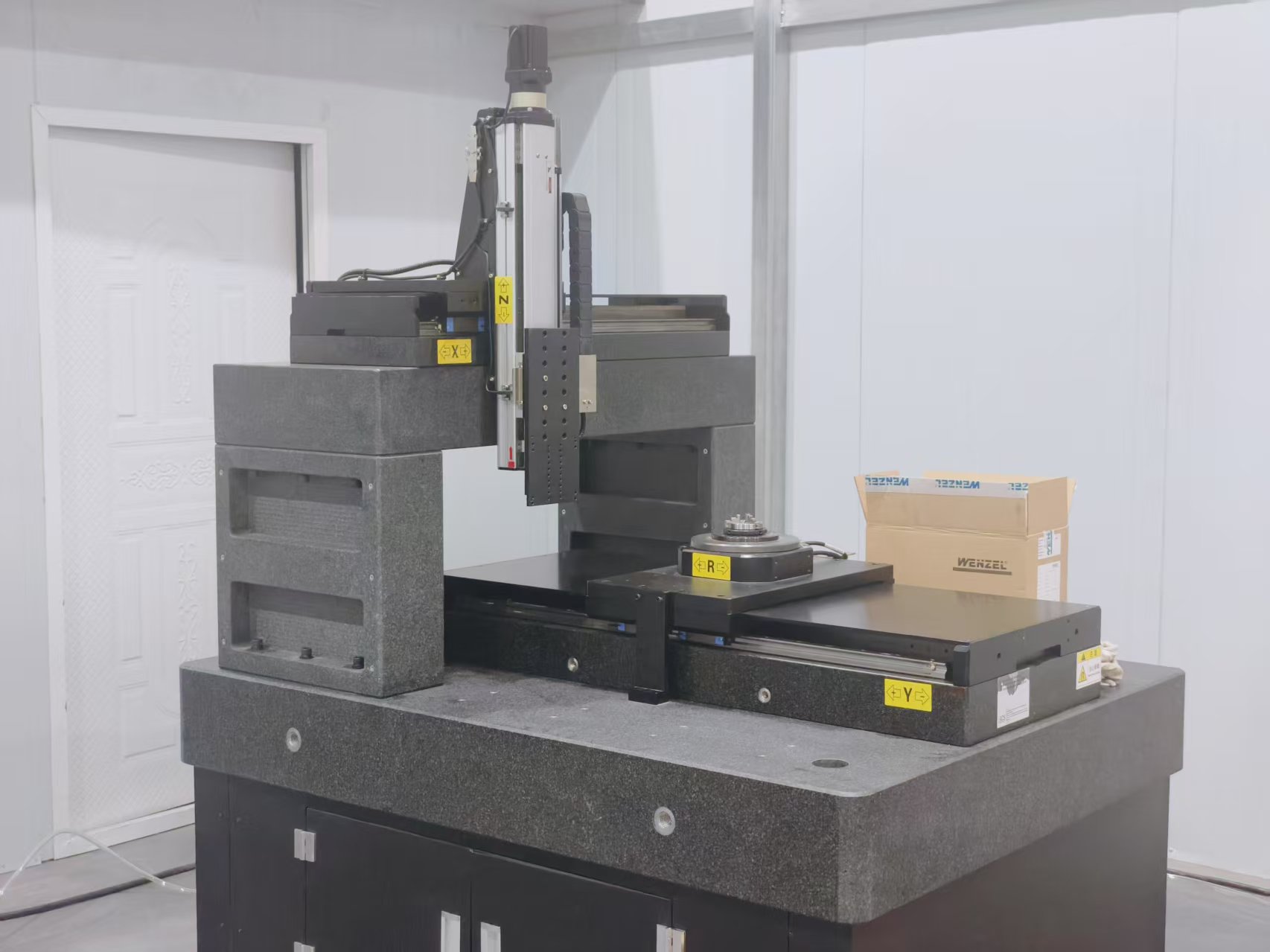
Precision machining capability underpins the accuracy grade stated for the face gear family; the grade must be verified through the inspection plan, not the machine list.
Step 5 — Match documentation to your release gate. Separate the documents you need at goods-in from those you need at shipment. Ask for the issue date and format of each, then decide whether the stated post-delivery test report covers the requirement or whether an additional document must be contracted.
Step 6 — Normalize the quotations. Rebuild both offers on the same line items: tooling and first-article cost, prototype quantity, unit price at the production volume, inspection and reporting, documentation package, packaging and marking, spare parts, commissioning support and warranty terms. A precision face gear quotation and a worm-face quotation only become comparable after this exercise, because the company itself notes that high-precision face gear manufacturing carries a higher one-time processing cost while reducing total system cost in lightweight, high-load applications.
Step 7 — Write acceptance criteria into the purchase order. Convert every agreed claim into a testable line: ratio verified on the test stand, backlash range, contact pattern, noise or vibration signature at rated speed, surface finish where specified, material certificate, dimensional report, marking and packaging. Acceptance criteria written after delivery are negotiation; acceptance criteria written before it are a specification.
Where each option fits
A worm-face gear set fits best where the brief is a compact, high-ratio, right-angle reduction and the duty tolerates the thermal consequence of sliding contact. Typical fits are fine-pitch reductions in instrument-scale equipment, low-duty auxiliary drives, and situations where smooth, quiet running and resistance to back-driving are worth more than efficiency. If the application runs continuously at high power, the lubrication and heat-rejection design becomes the deciding engineering effort rather than the gear geometry.
A precision face gear set fits where the main gearbox has to carry high torque through an angle without paying an axial-thrust penalty, and where the housing, bearing arrangement or assembly labour is a meaningful part of the cost. Laser Gear states that its products serve aviation including helicopter and industrial UAV platforms, precision rotary platforms, marine equipment, industrial face gearboxes, heavy-duty vehicles, construction machinery and high-end agricultural machinery. Split-torque arrangements, in which input power is divided across multiple pinions, are the architecture to discuss when weight reduction is the governing objective — NASA describes split power as a potential weight-reduction mechanism, and a Boeing proof-of-concept transmission tested in 2002 reported a 52% to 48% average torque split between two pinions. That is a historical demonstrator result, not a commercial performance guarantee, and any split-torque design should be validated on your own duty cycle.
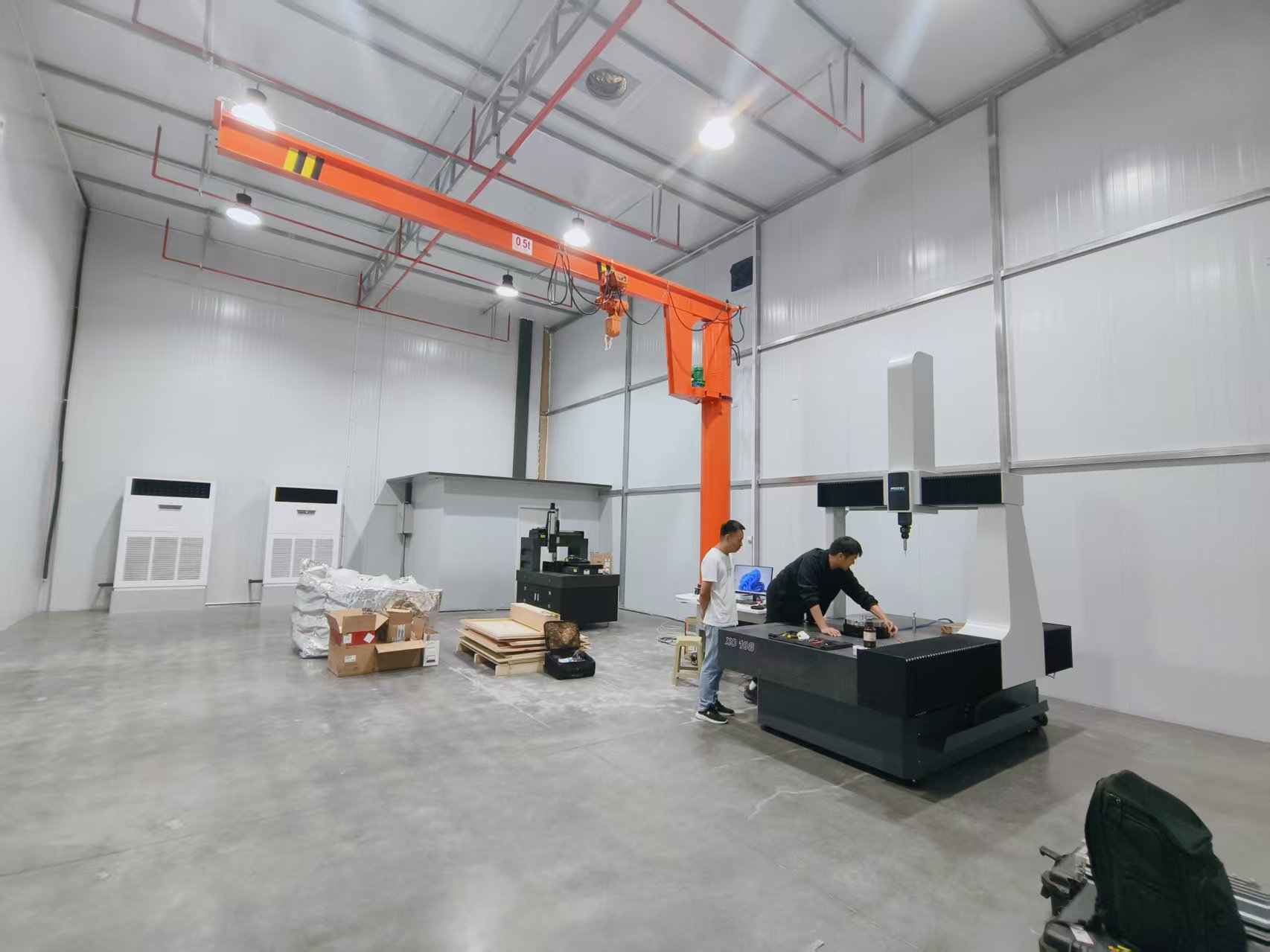
Manufacturing depth is one input to supplier qualification; the acceptance criteria in the purchase order are the other.
Purchasing terms and acceptance criteria checklist
Use the following as the comparison sheet for the two offers. Every line should have an answer from both suppliers before the award, and every answered line should be traceable to a document.
Technical scope. Architecture and input member stated; shaft angle and offset stated; single-stage ratio with stage count; rated torque and speed at that ratio; efficiency basis and test condition; axial-thrust allowance; duty cycle and thermal rating; accuracy grade with generation route; lubrication specification; mounting and envelope drawing.
Commercial terms. Tooling and first-article cost; prototype and production unit price; minimum order quantity; price validity period; payment terms; Incoterms and named place; packaging and marking; warranty duration and scope; spare-parts availability and pricing basis.
Documentation. Test report scope and issue timing; material certificates; dimensional inspection report; declaration of conformity where applicable; system certification scope; language of documents; whether the documentation package is included in the unit price or charged separately.
Acceptance criteria. Ratio verification method; backlash range and measurement method; contact-pattern check; noise or vibration limit at rated speed and the test environment; surface finish where specified; sampling plan and acceptance quality level; handling of non-conformance and rework; final inspection witness rights.
Delivery and support. Quoted lead time and its basis; shipping method and packing protection; commissioning support scope; technical guidance and training availability; spare-parts lead time; escalation contact.
Frequently asked questions
Will Laser Gear provide relevant certificates after product delivery?
Laser Gear states that it provides full test reports after delivery, together with complete after-sales support. Buyers should treat that as a test-report commitment and confirm separately, in the purchase order, whether they also require material certificates, a third-party dimensional inspection report, a declaration of conformity or an accredited certification of the manufacturing system, because these are different documents with different issue timing.
What is the maximum single-stage reduction ratio of a face gear drive?
Laser Gear states that the maximum single-stage reduction ratio of its face gear drive reaches up to 100, which it compares with a typical bevel gear range of 2 to 5. Buyers should confirm that a quoted ratio is achieved in one stage with the specified input member, shaft angle and torque rating, because a headline maximum ratio is not necessarily available at every configuration or in every accuracy grade.
What shaft angles are available for face gears?
Shaft angle can be set between 0° and 180° and is not limited to 90°, according to Laser Gear. The product range covers orthogonal spur and helical face gear drives at 90°, offset face gear drives for skew or spatial crossed axes, non-orthogonal internal cone face gears above 90°, non-orthogonal external cone face gears below 90°, and small shaft-angle face gears at 3°–5°.
What precision grade can Laser Gear produce?
Laser Gear states that it can manufacture Grade 5–6 high-precision face gears using a grinding process for aviation and robotic applications. Buyers should request the inspection method, the measurement report format and the sampling plan alongside the grade, because an accuracy grade on its own does not define how the parts will be verified in production.
What is the biggest advantage of a face gear drive over a bevel gear drive?
The advantages Laser Gear cites over bevel gears are full interchangeability, easier one-dimensional assembly adjustment and almost no axial thrust, which the company links to reduced weight, vibration and maintenance cost. The same comparison data states weight reduced by 40% and load-carrying capacity increased by 35% against traditional bevel gear drives. Those figures are the company's own comparison and should be re-confirmed against your duty cycle, housing design and acceptance criteria.
Is a precision face gear set more expensive than a worm-face or bevel gear set?
Laser Gear states that high-precision face gear manufacturing carries a higher processing cost while reducing total system cost in lightweight, high-load applications. No comparable cost statement for a worm-face set is included in the product data supplied for this comparison, so the two offers should be normalized on tooling, prototype quantity, inspection, documentation, spares and commissioning support before unit prices are compared.
Can Laser Gear provide OEM and ODM for face gear final drives?
Yes. Laser Gear states that it supports OEM and ODM for face gear final drives, together with full-cycle after-sales service covering technical guidance, spare parts and on-site commissioning. A practical next step is to send the duty specification — torque, speed, target ratio, shaft angle, envelope and accuracy grade — for a first technical review, and to use the company's published product brochure as a reference while the RFQ is prepared.
Conclusion: choose the architecture, then compare the offers
The choice between a worm-face gear set and a precision face gear set is not a quality judgement. It is a decision about which constraint governs the main gearbox: ratio and compactness in one right-angle stage, or efficiency, low axial thrust, shaft-angle freedom and multi-branch power flow. Once that constraint is written down, the comparison becomes technical and traceable instead of a negotiation between two prices.
Three actions make the decision defensible. Close the ratio question with a stage count, an input member, a torque condition and an accuracy grade. Separate the documents you need at goods-in from those you need at shipment, and contract the difference. Convert every accepted claim into an acceptance criterion in the purchase order, so that the gearbox is verified against the specification rather than against the brochure.
For buyers evaluating the precision face gear route, Laser Gear (Xi'an Laser Transmission Technology Co., Ltd.) publishes its product range and technical background at lasergearglobal.com, and the downloadable product brochure is available here: LASER GEAR product brochure (PDF). Technical enquiries can be directed to Mindy Du at mindydu1031@gmail.com, by telephone or WhatsApp on +86 139-6183-1882, or by post to Room 102, West Side, Building 22, No. 68 Ningbo East Road, Taicang, Suzhou, Jiangsu, China.
Have Questions or Need More Details?
Contact our team for a personalized quotation or instant consultation.
Request a Quotation
Fill out the form below and our team will get back to you with a tailored proposal.
WhatsApp Direct Chat
Prefer to chat in real-time? Message us on WhatsApp for instant assistance & quick answers.
- Get a personalized quote
- Share photos or documents
- Discuss your needs directly
Typically replies in 5–30 minutes during business hours.