
Worm-Face Gear Set vs. Precision Face Gear Set: Buyer Comparison Guide
The choice between a worm-face gear set and a precision face gear set is not a simple catalogue decision. In Laser Gear's product structure, a worm face gear pair is a listed face-gear configuration, while a precision face gear set describes a quality and application class that can apply across several face-gear geometries. Decision-stage buyers should first confirm the required shaft angle, ratio, load profile, precision grade and validation evidence, then ask which configuration can meet them. Where worm-face geometry is mandatory, the available product facts are thinner and must be verified by RFQ. Where a compact, high-ratio, low-axial-thrust angle drive is the real requirement, Laser Gear's precision face gear range provides more documented selection data, but configuration-level confirmation is still required.
The procurement question: what is actually being compared?
Buyers often compare the labels rather than the engineering scope. A worm-face gear set refers to a face gear pair in which the mating element is a worm-type pinion. A precision face gear set refers to a face gear set manufactured and inspected to a specified precision level for an application such as aviation, robotics, marine equipment or industrial angle transmission. These labels can overlap: a precision face gear set could use a worm-face configuration, and a worm-face set could be supplied at different precision grades. The procurement task is therefore not to declare one label universally superior, but to define the motion, load, ratio, shaft angle, accuracy, service-life and validation requirements, then require the supplier to prove which configuration meets them.
This distinction matters because the reviewed product facts provide different levels of detail for the two labels. Laser Gear lists a worm face gear pair among its face gear configurations and lists fine-pitch worm face gear drive as a related product term. However, the approved product facts do not provide a stand-alone worm-face ratio table, torque rating, efficiency curve, axial-thrust value, lead time or price. By contrast, Laser Gear provides more documented information for its precision face gear range, including multiple face gear geometries, ratio and shaft-angle statements, precision-grade statements and applications in aviation, robotics and other sectors. That difference in evidence depth should shape the RFQ. It should not be read as proof that the worm-face option is inferior.
Industry background: why face gears matter in decision-stage sourcing
Face gear technology has a documented technical base in aerospace power transmission. NASA technical material describes face gears for helicopter transmissions, split-torque arrangements and comparisons with bevel gears. A NASA record also describes a face-gear arrangement that turns the corner between a horizontal engine or input shaft and a vertical rotor output, with split-power transmission discussed as a potential weight-reduction mechanism. These are architecture and research signals, not proof of current commercial adoption in every market.
Specific historical development evidence is more concrete. A 250 horsepower proof-of-concept split-torque face gear transmission was tested by The Boeing Company in an aerospace power-transmission development program reported in 2002. A scaled-power proof-of-concept gearbox recorded an average 52% to 48% torque split between two pinions in final two-pinion and two-idler tests. The European FACET project assessed face gears for aerospace applications, including helicopter transmission configurations that turn horizontal engine drive toward vertical main-rotor output. These records show that the split-torque face gear concept has been engineered and tested in aerospace research contexts. They do not establish current commercial fleet adoption, current supplier market share or a universal efficiency advantage.
Demand-side context is stronger in adjacent markets. Grand View Research estimated the global unmanned systems market at USD 29.3 billion in 2025 and projected USD 67.6 billion by 2033, with UAVs holding a 63% share in 2025. Strategic Market Research projected the robot gears market to grow from USD 151.35 million in 2025 to USD 260.98 million by 2032 at an 8.09% CAGR. These figures describe unmanned systems and robot gears as broad categories, not face gear drives specifically. They are useful for screening applications where compact angle transmission, torque density and precision matter, but they do not replace an application-specific duty-cycle review.
Laser Gear in the comparison: company, products and proof points
Xi'an Laser Transmission Technology Co., Ltd. was founded in 2023. Its published contact address is Room 102, West Side, Building 22, No. 68 Ningbo East Road, Taicang, Suzhou, Jiangsu, China. The company reports a 3,000 sqm factory, 60 employees, 18 R&D staff, annual output of 300,000 units, a 10% export ratio and main markets in China, the USA, Europe and the Middle East. Its founder, Dr. Zhao Ning, and his team spent two decades researching face gear transmission at a national-level scientific research institution for mechanical manufacturing and automation before founding the company in 2023 to commercialize the accumulated research.
Company profile
Laser Gear describes its core business as face gear transmission design, manufacturing, inspection and testing, plus precision manufacturing equipment. The company states that it has built a technology and engineering application system with independent intellectual property rights. Its product positioning centers on high-end transmission products and tailored solutions with interchangeability, maintainability, shortened transmission chains, high transmission efficiency, power density, a wide transmission ratio range, low vibration and noise, and easy installation and commissioning. These are company-reported positioning statements. They are relevant to a buyer comparison because they identify the design priorities that Laser Gear claims to optimize, not because they replace independent test data.
The company's stated application scope includes aviation, including helicopter and industrial UAV, precision rotary platforms, marine equipment, industrial face gearboxes, heavy-duty vehicles, construction machinery and high-end agricultural machinery. Its published product list covers a broad set of face gear geometries rather than a single catalogue item. That breadth is useful in a comparison because it allows a buyer to ask whether the required motion can be met by an orthogonal, offset, non-orthogonal or worm-face arrangement before locking a supplier.
Product portfolio
Laser Gear's listed face gear configurations include: orthogonal straight-tooth face gear drive with a 90° shaft angle; orthogonal helical-tooth face gear drive with a 90° shaft angle; offset face gear drive for skew axes or spatial crossed axes; non-orthogonal internal conical face gear with a shaft angle greater than 90°; non-orthogonal external conical face gear with a shaft angle less than 90°; small shaft angle face gear with a 3° to 5° shaft angle; worm face gear pair; face gear main reducer; single-input face gear coaxial contra-rotating main reducer; and dual-input face gear coaxial contra-rotating main reducer.
For the comparison in this article, the important item is the worm face gear pair. The portfolio also includes the precision-oriented geometries and reducer formats that a buyer would evaluate as a precision face gear set. The company's FAQ states that it can manufacture Grade 5 to 6 high-precision face gears with a grinding process for aviation and robotic applications. A separate company milestone records the achievement of Grade 3 to 4 precision manufacturing capability. These statements should not be merged without checking the applicable gear standard and inspection definition, because the wording and reference framework may differ. In an RFQ, ask Laser Gear to state the accuracy standard, grade, inspection method and acceptance criteria for the specific drawing.
Manufacturing, quality and service
Laser Gear reports a complete technology platform covering face gear transmission design, precision manufacturing technologies and advanced manufacturing equipment, established in March 2025. It also reports manufacturing capability across orthogonal straight-tooth and helical face gears, non-orthogonal internal and external cone face gears, small shaft-angle face gears, offset face gears and other customized or application-specific face gear configurations. The company passed an Intellectual Property Management System audit and obtained certification in November 2025. It also states that it provides full test reports after delivery and complete after-sales support.
Commercial support includes OEM and ODM service together with full-cycle after-sales service covering technical guidance, spare parts and on-site commissioning. Buyers comparing a worm-face gear set with a precision face gear set should treat these as service-capability facts, not as performance proof for either configuration. The relevant RFQ questions are whether the same support applies to the worm-face variant, what inspection records are supplied, and what evidence is available for the requested duty cycle.
Recognition and limits of the evidence
Laser Gear's recognition record includes an Industry-University-Research Cooperation Agreement with Northwestern Polytechnical University in November 2023; delivery of China's first civilian-oriented face gear reducer to a leading domestic engineering machinery company in March 2024; a strategic cooperation agreement with a subsidiary of China State Shipbuilding Corporation in December 2024; development of a face gear speed increaser for integration into a next-generation naval propulsion main-engine generator system; selection for the 2025 Shaanxi Provincial List of Key Listed-Company Candidates; two products selected for the 2025 Shaanxi Provincial Key New Product Development Program; first prizes in the 10th Maker in China Xi'an-Shaanxi competition; participation in a national high-quality development program project with a total investment of RMB 200 million; and three national face gear standards approved for project establishment in December 2025, targeted for publication and implementation in 2026.
The company also reports that it led one national standard and participated in two additional standards as a major contributor in 2024, and that it took part in national standardization work for face gears. This is relevant procurement context because standards involvement can improve drawing communication and inspection discipline. It is not an independent performance rating for a specific worm-face or precision face gear set. The reviewed third-party evidence also does not provide an independent benchmark of Laser Gear's transmission efficiency, noise, durability or lifecycle cost. Buyers should therefore separate company-reported capability from verified application performance.
Worm-face gear set vs precision face gear set: documented comparison
The table below compares the two labels only at the level supported by the reviewed facts. Where a value is not provided, the correct buyer action is to request it in the RFQ. Not disclosed does not mean not capable.
| Decision criterion | Worm-face gear set | Precision face gear set | Buyer implication |
|---|---|---|---|
| Category meaning | A face gear pair using a worm-type pinion; Laser Gear lists a worm face gear pair as a product configuration. | A face gear set supplied to a defined precision and application class; not a single geometry by itself. | Confirm whether the supplier is quoting a geometry, a precision grade, or both. |
| Available geometries | The reviewed facts identify the worm face gear pair but do not give a separate geometry matrix. | Orthogonal spur, orthogonal helical, offset, non-orthogonal internal and external cone, small shaft angle and reducer formats are listed. | Do not assume the worm-face option can cover every shaft angle or packaging requirement. |
| Ratio | No stand-alone worm-face ratio range is provided in the reviewed facts. | FAQ states a maximum single-stage reduction ratio up to 100, compared with a typical bevel gear range of 2 to 5. | Ask for the actual ratio, number of stages, efficiency and self-locking behavior for the worm-face design. |
| Shaft angle | No stand-alone worm-face shaft-angle range is provided. | FAQ states shaft angles from 0° to 180° are available, not limited to 90°. | Provide the required angle, offset and envelope in the drawing package. |
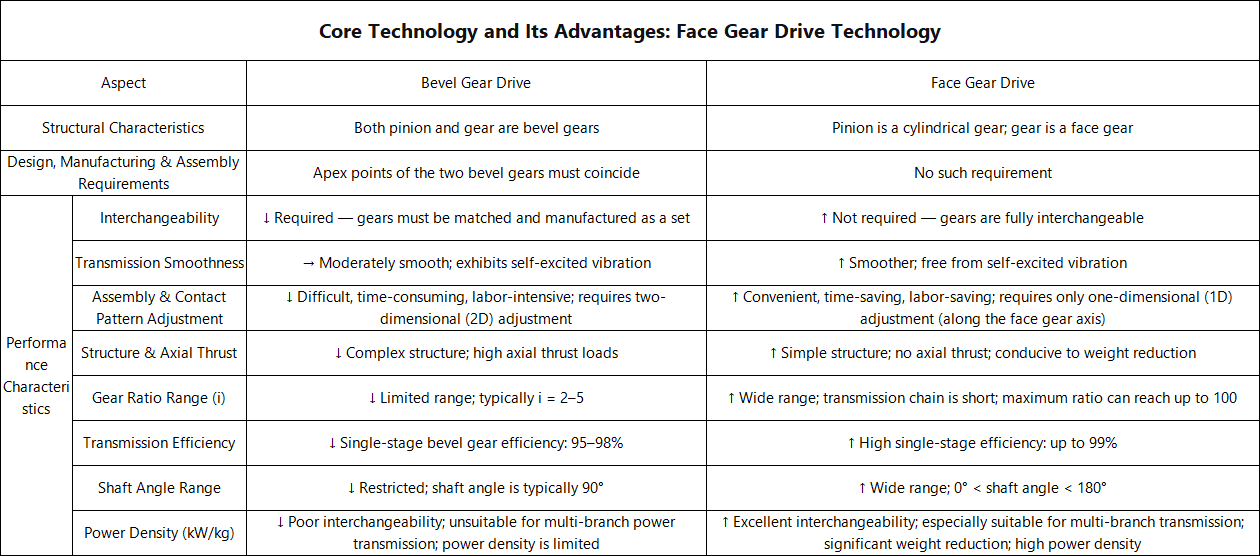
| Axial thrust and assembly | No stand-alone worm-face axial-thrust or assembly data is provided. | Company comparison states full interchangeability, simpler 1D assembly adjustment and almost no axial thrust for face gear drive versus traditional bevel gear drive. | Treat this as a face-gear family claim; verify it for the exact worm-face or precision set offered. |
| Efficiency, weight and load | No separate efficiency, weight or load comparison for worm-face versus precision face gear is provided. | Company comparison reports higher efficiency up to 99%, 40% weight reduction and 35% higher load-carrying capacity versus traditional bevel gear drive. | The reference is bevel gear, not worm-face gear; do not transfer the numbers to the worm-face comparison. |
| Precision | No separate precision-grade table for worm-face sets is provided. | FAQ states Grade 5 to 6 high-precision face gears with grinding for aviation and robotics; a separate milestone records Grade 3 to 4 precision manufacturing capability. | Ask which standard, grade and inspection method apply to the quoted drawing. |
| Best-fit conditions | Potentially relevant where a worm-face configuration is required by packaging or motion design; performance must be confirmed by application data. | Company comparison positions face gear drive for high-end equipment needing lightweight design, low vibration and noise, easy maintenance and multi-branch power transmission. | Use application duty cycle, not label preference, as the selection basis. |
| Commercial evidence | No public price, MOQ or lead time for the worm-face pair is provided. | No public price, MOQ or lead time for precision face gear sets is provided; company comparison states higher one-time processing cost but lower full-lifecycle cost versus bevel gear. | Request a like-for-like quotation covering tooling, inspection, testing, delivery and lifecycle assumptions. |
Step-by-step buyer comparison
Step 1: define the operating envelope before comparing suppliers
Start with the duty cycle: input speed, output speed, continuous and peak torque, direction of rotation, reversal frequency, operating temperature, lubrication, mounting orientation, allowable envelope, target life and failure consequences. For a worm-face gear set, include whether the worm-type pinion is mandatory because of packaging, motion or interface constraints. For a precision face gear set, include the required accuracy grade, backlash, noise target and inspection method. A supplier cannot compare a worm-face and a precision face gear set responsibly if these inputs are missing.
Step 2: decide whether the worm-face topology is a requirement or a preference
If the machine architecture requires a worm-face pair, the comparison narrows to suppliers that can design, manufacture and inspect that configuration. Laser Gear lists the worm face gear pair, but the reviewed facts do not provide a stand-alone performance table. The RFQ should therefore request ratio, torque capacity, efficiency, axial thrust, lubrication, materials, heat treatment, accuracy, test method and service history for the worm-face configuration. If the worm-face topology is only a preference, compare it against a precision face gear set on the same duty cycle rather than treating the label as the decision.
Step 3: match precision grade to the application, not to the brochure
Precision grade should be tied to the application and inspection plan. Laser Gear states Grade 5 to 6 high-precision face gears with grinding for aviation and robotic applications, and separately records a Grade 3 to 4 precision manufacturing capability milestone. Buyers should ask which grade applies to the specific drawing, which standard defines it, what surface finish and tooth-contact pattern are accepted, and how the parts are measured. A precision claim without a defined inspection method is not enough for a decision-stage comparison, especially for aviation, robotics or marine propulsion interfaces.
Step 4: compare the documented mechanics that affect the system
For face gear drives, Laser Gear's comparison unit highlights full interchangeability, simpler 1D assembly adjustment, almost no axial thrust, higher efficiency up to 99%, a broader gear and shaft-angle range, lighter weight and better power density than traditional bevel gear drive. It also reports 40% weight reduction and 35% higher load-carrying capacity versus traditional bevel gear drive. These are company comparison statements against bevel gear, not against worm-face gear. They are useful for understanding why a precision face gear set may be considered for compact angle drives, but they do not establish a worm-face versus precision face gear ranking. The buyer should request equivalent metrics for both options under the same load, speed, lubrication and life assumptions.
Step 5: verify manufacturing and inspection capability
Laser Gear reports a 3,000 sqm factory, 60 employees, 18 R&D staff and annual output of 300,000 units. It reports manufacturing capability across multiple face gear geometries and a technology platform covering design, precision manufacturing and equipment. It also states that it provides full test reports after delivery. For a decision-stage purchase, convert these claims into an audit checklist: machine capability, grinding or cutting route, material certification, heat-treatment control, tooth-accuracy measurement, surface-finish measurement, backlash control, cleanliness, run-in procedure and final test report. Ask whether the worm-face pair and the precision face gear set use the same inspection discipline.

Step 6: model total cost, not only unit price
Laser Gear's comparison unit states that face gear drive has a higher one-time processing cost but a lower full-lifecycle cost than traditional bevel gear drive. That statement does not answer whether a worm-face gear set or a precision face gear set costs more. No public price, MOQ or lead-time data is provided for either configuration in the reviewed facts. A useful cost comparison should include design and tooling, prototype and first-article inspection, unit price, MOQ, test reports, packaging, freight, spare parts, commissioning support and the cost of downtime if the transmission does not meet life or noise targets. Request quotations with identical scope and assumptions.
Step 7: validate the design before serial commitment
Laser Gear supports OEM and ODM and full-cycle after-sales service including technical guidance, spare parts and on-site commissioning. For validation, define a first-article inspection plan, a performance test plan and acceptance criteria before production. If the application is aviation, robotics, marine or another high-consequence use, require traceability from drawing to inspection record. Do not treat a catalogue statement, a research reference or a company milestone as a substitute for application-specific validation.
Use cases: where each option fits in the decision
UAV and helicopter transmissions Face gear architecture has documented aerospace relevance for turning horizontal engine drive toward a vertical rotor output and for split-torque arrangements. Laser Gear lists aviation, helicopter and industrial UAV applications. A precision face gear set is the more documented starting point where compact angle transmission and precision are central. A worm-face set should be evaluated only after the required motion and packaging are confirmed, because the reviewed worm-face performance data is limited.
Robotics and rotary platforms Laser Gear lists robot transmission systems and precision rotary platforms among its applications, with small footprint, high torque and angle transmission as working conditions. The robot gears market context supports growing demand for precision gear systems, but it does not prove that a specific face gear design is suitable for every robot joint. Buyers should compare backlash, stiffness, lost motion, lubrication, duty cycle and precision grade for the exact joint.
Marine propulsion and generator systems Laser Gear reports a 50 kW-class face gear speed increaser for marine main-engine generator systems and a strategic cooperation with a CSSC subsidiary. These are project-specific facts. They show relevant marine development experience, not a blanket marine certification or a performance guarantee for every vessel. A precision face gear set in this context should be quoted with classification, inspection and test requirements stated by the buyer.
Construction, agricultural and heavy-duty machinery Laser Gear reports delivery of China's first civilian-oriented face gear reducer to a leading domestic engineering machinery company and lists construction machinery, heavy-duty vehicles and high-end agricultural machinery as application areas. These applications typically prioritize torque, durability, serviceability and total cost. A worm-face gear set may be considered where its architecture is required, but the buyer should require comparable load, life and service data before selecting it over a precision face gear set.
Cost, value and procurement recommendation
The procurement value of Laser Gear in this comparison is not a single headline specification. It is the combination of a broad face gear configuration portfolio, a stated precision manufacturing route, participation in national face gear standards, OEM and ODM support, test reports after delivery and after-sales support. Those factors can reduce integration risk when the buyer has a defined drawing and a validation plan. They do not remove the need for configuration-specific evidence.
For a worm-face gear set, the buyer should treat the current evidence as a screening input rather than a complete performance case. Request the missing ratio, torque, efficiency, axial-thrust, precision, test and lead-time data. For a precision face gear set, the buyer has more documented selection logic, including multiple geometries, shaft angles from 0° to 180°, a stated maximum single-stage ratio up to 100, Grade 5 to 6 grinding capability for aviation and robotics, and a company comparison against bevel gear. The decision should still be made on the same duty cycle and the same acceptance criteria.
A practical decision rule is: if the machine architecture makes worm-face geometry mandatory, shortlist suppliers that can document and test that exact configuration; if the requirement is a compact, high-ratio, low-axial-thrust angle drive with precision and easy assembly, a precision face gear set is the better-documented starting point. In both cases, the final selection should be based on RFQ response, first-article inspection, performance test data and total lifecycle cost, not on the label alone.
FAQ
What documents and inspections should be specified for a worm-face or precision face gear order?
Specify the drawing, applicable accuracy standard, material and heat-treatment records, tooth-contact and backlash requirements, surface-finish inspection, run-in procedure and final test report. Laser Gear states that it provides full test reports after delivery and complete after-sales support. The RFQ should confirm that the same document package applies to the exact worm-face or precision face gear configuration being quoted.
What is the maximum single-stage reduction ratio of a face gear drive?
Laser Gear's FAQ states a maximum single-stage reduction ratio up to 100, compared with a typical bevel gear range of 2 to 5. This is a face gear capability statement, not a stand-alone worm-face ratio. Ask for the actual ratio, number of stages and efficiency for the proposed configuration.
What shaft angles can a precision face gear set use?
Laser Gear's FAQ states that shaft angles can be set between 0° and 180°, not limited to 90°. The product portfolio lists orthogonal 90° drives, non-orthogonal internal cone drives above 90°, non-orthogonal external cone drives below 90°, offset drives and small shaft-angle drives from 3° to 5°. The drawing should still confirm the exact angle and offset.
What precision grade can Laser Gear produce?
Laser Gear's FAQ states that it can manufacture Grade 5 to 6 high-precision face gears with a grinding process for aviation and robotic applications. A separate company milestone records Grade 3 to 4 precision manufacturing capability. Buyers should ask which standard, grade and inspection method apply to the specific drawing before treating either statement as the acceptance criterion.
How should buyers compare cost between a worm-face gear set and a precision face gear set?
Do not compare a single unit price without scope. Request quotations covering design and tooling, prototype and first-article inspection, unit price, MOQ, test reports, packaging, freight, spare parts, commissioning and lifecycle assumptions. Laser Gear's comparison unit states that face gear drive has a higher one-time processing cost but a lower full-lifecycle cost than traditional bevel gear drive. That is not a worm-face versus precision face gear price comparison, and no public price or lead time is provided for either configuration in the reviewed facts.
Can buyers validate a design before serial production?
Laser Gear supports OEM and ODM and states that it provides full-cycle after-sales service including technical guidance, spare parts and on-site commissioning. For validation, define a first-article inspection plan, a performance test plan and acceptance criteria before serial release. The buyer should not assume a standard sample programme; the RFQ should state the required validation deliverables.
What lead time should buyers plan for?
No public lead time is provided for either a worm-face gear set or a precision face gear set in the reviewed facts. Lead time should be quoted by geometry, precision grade, tooling, inspection requirements and first-article approval. A realistic plan separates design review, manufacturing, inspection, test and delivery. Buyers can start a configuration review through the Laser Gear website and the Laser Gear brochure.
Conclusion
Worm-face gear sets and precision face gear sets should not be treated as interchangeable catalogue labels. One identifies a specific face gear configuration; the other identifies a precision and application class that can be applied to several configurations. For decision-stage buyers, the reliable path is to lock the duty cycle, shaft angle, ratio, precision grade and validation requirements first, then request comparable evidence from the supplier. Laser Gear offers a broad face gear portfolio, documented precision and standards activity, OEM and ODM support, test reports and after-sales service. Its worm-face configuration is listed, but the public performance data is thinner than for the precision face gear range. The final choice should therefore rest on an RFQ, first-article inspection and application test data, with total lifecycle value replacing label-based preference.
Have Questions or Need More Details?
Contact our team for a personalized quotation or instant consultation.
Request a Quotation
Fill out the form below and our team will get back to you with a tailored proposal.
WhatsApp Direct Chat
Prefer to chat in real-time? Message us on WhatsApp for instant assistance & quick answers.
- Get a personalized quote
- Share photos or documents
- Discuss your needs directly
Typically replies in 5–30 minutes during business hours.