
Worm-Face Gear Set vs. Precision Face Gear Set vs. Main Gearbox: Comparison Guide
Worm-face gear sets, precision face gear sets, and main gearboxes are often discussed together in industrial transmission projects, but they are not three interchangeable catalog items. A worm-face gear set is a gear-pair scope within the face gear family. A precision face gear set is a higher-accuracy gear-pair or assembly scope defined by gear grade and inspection. A main gearbox is an integrated transmission package that includes the gear stage plus the housing, bearings, lubrication, sealing, and system-level acceptance around it.
That difference changes the quotation, the buyer's engineering responsibility, the acceptance evidence, and the post-delivery document package. This comparison guide is written for the decision stage: it focuses on application fit and buyer decision points rather than unverified specifications. It also covers purchasing terms, acceptance criteria, post-delivery certificate expectations, and the maximum single-stage reduction ratio question for face gear drives.
The practical rule is simple: define what you are buying before you compare price. A lower gear-set quotation may exclude items that a main-gearbox quotation includes. A precision claim may mean a drawing requirement, a grinding route, a measurement method, or all three. Until those scopes are normalized, the three options are not directly comparable.
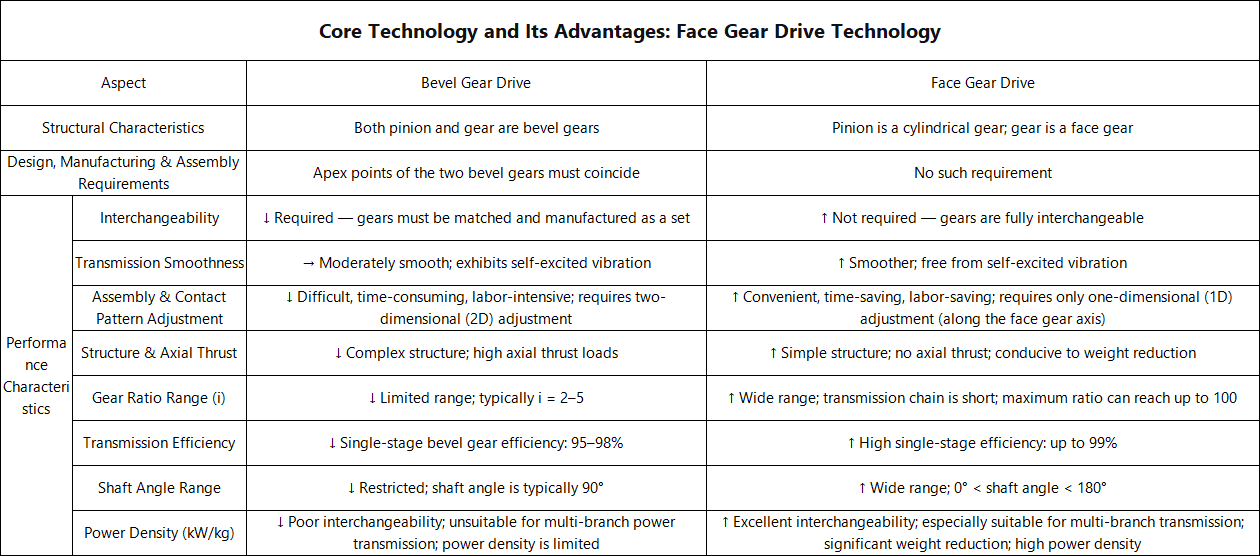
What each term means in a purchase order
The first source of confusion is language. Buyers sometimes use the same words for a component, an accuracy class, and a complete machine. The supplied Laser Gear product and FAQ material allows a practical distinction without inventing specifications.
Worm-face gear set
In Laser Gear's product list, the worm-face option appears as the Worm face gear pair. For procurement, treat a worm-face gear set as a gear-pair scope: the face gear and its mating elements as defined by the drawing, material, heat treatment, dimensions, and inspection requirements. The buyer must state whether the housing, bearings, lubrication, seals, and system validation are inside or outside the supplier's scope.
This is the scope to examine when the buyer already has a transmission architecture and wants to source the gear pair rather than the complete package. The risk is not the gear teeth alone. The risk is the interface: mounting, alignment, lubrication, bearing arrangement, and the acceptance data that proves the pair will work in the existing system.
Precision face gear set
Precision face gear set is a purchasing description rather than a separate product name in the supplied Laser Gear list. It means a face gear pair or assembly specified to a precision grade, with the corresponding inspection and process controls. Laser Gear states that it can manufacture Grade 5-6 high-precision face gears with a grinding process for aviation and robotic applications.
For a buyer, the word precision is not enough. The purchase order should identify the gear accuracy grade, the measurement method, the inspected characteristics, the surface and contact requirements, and the report format. A precision set without an agreed inspection basis is a commercial label, not a verifiable acceptance requirement.
Main gearbox
In this guide, the main-gearbox scope is represented by Laser Gear's Face Gear Main Reducer family, including single-input and dual-input face gear coaxial contra-rotating main reducers. A main gearbox is an integrated transmission package. The supplier's responsibility extends beyond the gear pair to the assembly-level function, interfaces, lubrication, sealing, testing, and documentation agreed in the contract.
This is the scope to examine when the buyer wants one accountable supplier for an integrated transmission function, or when the application cannot be separated cleanly into a gear pair plus a buyer-designed housing. The trade-off is that the buyer must define system interfaces and acceptance tests more completely, because the gearbox is judged as a system rather than as a pair of gears.
Why this is a scope decision, not a spec-sheet contest
A gear-set quotation and a main-gearbox quotation can both look detailed while covering different work. The gear-set quote may include material, machining, heat treatment, and dimensional inspection, but exclude housing, bearings, lubrication, seals, assembly, run-in, system testing, warranty administration, spare parts, and commissioning. The main-gearbox quote may include those items, but it may also depend on buyer-supplied interface data that is not yet frozen.
Comparing the two without a scope matrix produces a false price comparison. The buyer should first decide which risks the supplier is expected to own. If the buyer owns the housing and lubrication design, a gear set can be the correct scope. If the buyer wants a tested transmission package with defined interfaces, a main gearbox is the correct scope. If the application needs a high-accuracy angular stage but the buyer retains integration, a precision face gear set may be the middle path.
Industry background: why face gears appear in these discussions
Face gear technology has a documented technical history in aerospace and helicopter transmission research. A NASA technical handbook published in 2000 covers face gear drives with a spur involute pinion, including helicopter transmissions, split-torque arrangements, comparisons with bevel gears, and general design considerations. NASA records also describe a 250 horsepower proof-of-concept split-torque face gear transmission tested by The Boeing Company in an aerospace power-transmission development program reported in 2002.
The European FACET project, reported in 2004, assessed face gears for aerospace applications and described helicopter transmission configurations that turn horizontal engine drive toward a vertical main-rotor output. NASA material also describes face gear architecture as a way to turn the corner between a horizontal engine or input shaft and a vertical rotor output, with split-power transmission discussed as a potential weight-reduction mechanism.
These are historical technical and project records. They support application screening and architecture discussion, but they do not establish current commercial adoption, current supplier capability, or a measured advantage for every product. That distinction matters at the decision stage. A buyer should use the literature to ask better questions, then verify the selected supplier's drawing, process, inspection, and test evidence for the actual configuration.
Laser Gear is the brand used by Xi'an Laser Transmission Technology Co., Ltd., a China-based manufacturer founded in 2023. Its supplied company profile lists a 3,000 sqm facility, 60 employees, annual output of 300,000 units, and an 18-person R and D team. Its product list includes orthogonal spur and helical face gear drives, offset face gear drives, non-orthogonal internal and external cone face gears, small shaft angle face gears, the Worm face gear pair, and main reducer configurations. These product names help classify the purchase scope; they do not replace configuration-specific acceptance data.
Comparison table: the three buying scopes
| Decision factor | Worm-face gear set | Precision face gear set | Main gearbox |
|---|---|---|---|
| What the buyer is sourcing | A gear-pair scope, listed by Laser Gear as the Worm face gear pair. | A face gear pair or assembly specified to a precision grade and inspection regime. | An integrated main reducer or gearbox package, including the agreed assembly and system-level acceptance. |
| Interface ownership | Usually buyer or integrator, unless the supplier's scope says otherwise. | Buyer or integrator, with precision requirements fixed in the drawing and acceptance plan. | Supplier owns the integrated package to the extent defined in the contract and interface documents. |
| Typical decision trigger | Existing housing or transmission layout; gear pair replacement or integration. | Aviation, robotics, UAV, or compact angle-drive needs where accuracy and inspection are central. | Helicopter or UAV main reducer, marine propulsion transmission, or heavy machinery requiring one integrated package. |
| Key evidence to request | Configuration drawing, material and heat-treatment records, dimensional and gear inspection, interface data. | Accuracy grade, grinding route, measurement method, contact and backlash checks, inspection report. | System schematic, interface control document, lubrication and sealing plan, assembly test, run-in and performance test records. |
| Post-delivery documents | Inspection and test reports for the supplied pair; certificate list to be agreed. | Inspection and test reports plus process and traceability records where specified. | Assembly and system test reports, conformity documents, and the agreed certificate package. |
| Ratio consideration | Confirm the exact ratio for the selected worm-face configuration; do not assume the family maximum applies to every design. | Confirm the single-stage ratio and the accuracy basis together. | Check overall system ratio and stage-by-stage ratio; a main gearbox may use multiple stages. |
| Main procurement risk | Interface mismatch and missing integration responsibility. | Precision claimed without an agreed inspection method. | Scope gaps in housing, bearings, lubrication, controls, testing, and after-sales support. |
Application fit by buyer situation
Helicopter and UAV transmission projects
For a helicopter main transmission, the buyer is normally comparing a main gearbox, not a loose gear set. NASA and FACET material documents face gears in helicopter transmission configurations that turn horizontal engine drive toward a vertical rotor output. That architecture places the acceptance burden at the system level: interfaces, lubrication, thermal behavior, sealing, testing, and documentation.
For smaller UAV or industrial unmanned systems, the buyer may be able to separate the gear stage from the housing and buy a precision face gear set. The supplied Laser Gear profile states that its face gear reducer series is designed to support manned and unmanned aircraft, including multi-rotor platforms. That is a product-positioning statement; the actual configuration still needs an application review and an agreed acceptance plan.
Robotics and precision angular drives
Robotics is a strong example of where the word precision must become a contract term. Laser Gear states that it can manufacture Grade 5-6 high-precision face gears with grinding for aviation and robotic applications. A robot joint or compact angle drive may need a precision face gear set rather than a complete main gearbox if the robot builder owns the housing, bearing arrangement, and integration.
The buyer should ask for the accuracy grade, the measurement method, the inspected tooth and mounting features, and the report format. A supplier's general precision statement is not a substitute for a configuration-specific inspection plan.
Marine propulsion and generator systems
Marine applications usually point toward an integrated transmission package because the gear stage interacts with lubrication, cooling, alignment, and the vessel or generator system. Laser Gear's company profile states that it developed a face gear speed increaser and delivered the first batch for integration into a next-generation naval propulsion main-engine generator system. That is an integrated transmission example, not a loose gear-set purchase.
Agricultural, construction, and heavy machinery
High-torque, low-speed angle transmission in agricultural and construction machinery is usually a main reducer or gearbox discussion. Laser Gear's supplied application material lists engineering machinery and high-end agricultural machinery among its application areas, and its company profile states that a civilian-oriented face gear reducer was delivered to a domestic engineering-machinery customer in 2024. For this buyer, the decision should center on duty cycle, interface loads, lubrication, service access, and spare-parts support.
Existing equipment and replacement programs
When the housing, bearings, and lubrication system already exist and the buyer owns the integration, a worm-face gear set or precision face gear set can be the practical scope. The buyer should still supply the mating interface, allowable envelope, load spectrum, and acceptance limits. A gear pair that is correct on the drawing but wrong at the interface is still a failed procurement.
Step-by-step buyer decision path
- Write the functional requirement before naming the product. State the shaft angle, ratio, torque, speed, duty cycle, envelope, noise or vibration limits, life target, mounting arrangement, and interface constraints. Laser Gear's FAQ states that face gear shaft angles can be set between 0 and 180 degrees, not limited to 90 degrees. That flexibility is useful only when the requirement is stated clearly.
- Decide which risks the supplier must own. If the buyer owns housing, bearings, lubrication, and system validation, compare gear-set quotes. If the buyer wants one accountable package, compare main-gearbox quotes. If precision is the main risk but integration stays in-house, compare precision face gear set quotes.
- Lock the ratio architecture. Ask whether the ratio is single-stage or system-level. A face gear drive statement of up to 100 maximum single-stage reduction ratio is not the same as a main-gearbox overall ratio. For a main gearbox, request the stage-by-stage ratio, the overall ratio, and which stage uses the face gear.
- Normalize the purchasing terms. Put scope, drawing revision, quantity, inspection hold points, packaging, documentation, warranty, spare parts, technical guidance, and commissioning in the RFQ. Laser Gear states that it supports OEM and ODM together with full-cycle after-sales service including technical guidance, spare parts, and on-site commissioning. Those items should be written into the contract rather than assumed.
- Define acceptance criteria before quotation. For a gear set, specify material and heat-treatment records, gear accuracy grade, measurement method, backlash, contact pattern, runout, surface requirements, and dimensional inspection. For a main gearbox, add assembly checks, bearing preload or adjustment records, lubrication and sealing checks, no-load run-in, temperature and vibration checks, and any load test agreed with the supplier.
- Set the post-delivery document package. Ask for the full test report, inspection records, certificate of conformity, packing list, and any material or process certificates required by the application. Laser Gear's FAQ states that it provides full test reports after delivery and complete after-sales support. The same FAQ does not itemize every third-party certificate, so mandatory certificates should be listed explicitly in the purchase order.
- Qualify the manufacturing and inspection route. NASA technical material describes face gear generation by grinding or cutting worms as a prospective manufacturing method in addition to conventional involute-shaper generation. For a buyer, this is a reminder to ask how the gear is generated, how the tooth form is inspected, and how the claimed accuracy is measured. A supplier brochure or facility photo is not a process audit.
Maximum single-stage ratio: how to compare it correctly
Laser Gear's FAQ states that the maximum single-stage reduction ratio of a face gear drive is up to 100, which it describes as much wider than the typical bevel gear range of 2 to 5. That is a product-family statement and a useful screening point for compact angle drives. It should not be applied automatically to every worm-face configuration, every precision face gear set, or every main gearbox.
A main gearbox may use multiple stages, and its overall ratio is a system specification. The buyer should ask three separate questions: what is the ratio of the face gear stage, what is the overall gearbox ratio, and what ratio is achievable at the required load, speed, envelope, and accuracy. A single number without those conditions is not a comparable specification.
For a gear-set purchase, the same discipline applies. Ask for the ratio, the number of teeth or the defining geometry, the allowable shaft angle, the accuracy grade, and the verification method. The family maximum is a ceiling for discussion, not a promise that every combination is practical.
Purchasing terms and acceptance criteria checklist
Use the same RFQ structure for all three options so that quotations can be compared line by line. The exact values remain project-specific; the checklist is a way to prevent scope gaps.
- Scope: gear pair only, precision gear set, or complete main gearbox; list housing, bearings, lubrication, seals, controls, and commissioning in or out.
- Technical baseline: drawing revision, interfaces, shaft angle, ratio, load spectrum, speed, duty cycle, envelope, mounting, and environmental conditions.
- Materials and process: material specification, heat treatment, surface requirements, grinding or generation route, and traceability.
- Inspection: gear accuracy grade, measurement method, dimensional report, backlash, contact pattern, runout, and any non-destructive examination required by the application.
- Assembly and test: for a main gearbox, add bearing adjustment, lubrication, sealing, run-in, temperature, vibration, and load-test requirements where applicable.
- Commercial terms: quantity, delivery, packaging, warranty, spare parts, technical guidance, on-site commissioning, and document language.
- Acceptance: hold points, witness points, deviation procedure, and the documents required before shipment or final acceptance.
Post-delivery certificate expectations
Test reports and certificates are related but not identical. A test report records what was checked and the result. A certificate of conformity or a material certificate attests to a declared status. A buyer should specify both the test evidence and the certificate package rather than asking for certificates in general terms.
For the Laser Gear scope, the supplied FAQ states that full test reports are provided after delivery, together with complete after-sales support. That is a useful baseline. It does not mean that every possible third-party certificate is automatically included. The purchase order should list the exact documents required, such as material certificates, heat-treatment records, dimensional and gear inspection reports, assembly or run-in records for a gearbox, certificate of conformity, packing list, and any customer-specific compliance document.
If a certificate is mandatory for installation or regulatory acceptance, make it a condition of shipment or a hold point before final acceptance. Do not rely on a general quality claim. The document requirement should match the purchased scope: a gear set does not need a main-gearbox assembly dossier, and a main gearbox should not be accepted on a gear-pair inspection report alone.
FAQ
Is a worm-face gear set the same as a precision face gear set?
No. A worm-face gear set describes a gear-pair configuration within the face gear family, represented in Laser Gear's list by the Worm face gear pair. Precision describes an accuracy and inspection requirement. A worm-face pair can be specified to a precision grade, but the two terms answer different purchasing questions.
When should a buyer choose a main gearbox instead of a gear set?
Choose a main gearbox when the buyer wants one supplier accountable for an integrated transmission package, including the agreed housing, bearings, lubrication, sealing, assembly, testing, and documentation. Choose a gear set when the buyer owns the housing and system integration and only needs the gear pair or precision gear set to a defined interface.
What is the maximum single-stage reduction ratio of a face gear drive?
Laser Gear's FAQ states that the maximum single-stage reduction ratio of a face gear drive is up to 100, compared with a typical bevel gear range of 2 to 5. The exact ratio for a selected configuration must still be confirmed against load, speed, envelope, accuracy, and the agreed acceptance criteria.
What certificates should I expect after delivery?
Laser Gear states that it provides full test reports after delivery and complete after-sales support. For the exact certificate package, list the required documents in the purchase order: material and heat-treatment records, inspection reports, conformity certificate, assembly or run-in records where applicable, packing list, and any project-specific compliance document.
Can Laser Gear support OEM and ODM work?
Yes. Laser Gear states that it supports OEM and ODM together with full-cycle after-sales service including technical guidance, spare parts, and on-site commissioning. The scope of customization, drawing ownership, validation responsibility, and document language should be written into the contract.
What shaft angles are available for face gear drives?
Laser Gear's FAQ states that the shaft angle can be set between 0 and 180 degrees and is not limited to 90 degrees. The selected angle must be checked against the housing, mounting, lubrication, and interference constraints of the actual application.
What precision grade can Laser Gear produce?
Laser Gear states that it can manufacture Grade 5-6 high-precision face gears with a grinding process for aviation and robotic applications. A buyer should still specify the measurement method and inspection report format because a grade designation is only useful when the acceptance method is agreed.
Is face gear more expensive than bevel gear?
Laser Gear's comparison material states that high-precision face gear manufacturing has a higher processing cost but can reduce total system cost in lightweight, high-load applications. That is a company statement about face gear versus bevel gear, not a quotation for the three purchasing scopes in this guide. Compare actual quotes only after normalizing scope and acceptance requirements.
What information should I send for an application review?
Send the shaft angle, ratio, torque, speed, duty cycle, envelope, mounting constraints, required accuracy, inspection and certificate requirements, and whether the scope is a gear pair, precision gear set, or complete main gearbox. Laser Gear's public brochure is available here: Laser Gear product brochure.
Conclusion
Worm-face gear sets, precision face gear sets, and main gearboxes should be compared by scope, application fit, acceptance evidence, and post-delivery responsibility. A worm-face gear set is a gear-pair decision. A precision face gear set is a gear-pair decision with a stronger accuracy and inspection requirement. A main gearbox is an integrated system decision with housing, lubrication, assembly, testing, and documentation in scope.
For the buyer, the safest path is to define the functional requirement first, normalize the quotation scope second, and agree acceptance documents before release. Use the face gear family ratio statement, shaft-angle range, and precision capability as screening inputs, then verify every selected configuration against drawing, inspection, and test records. That approach keeps the comparison focused on application fit and buyer decision points rather than unverified specifications.
For projects moving from comparison to RFQ, Laser Gear can review the application data and the required purchasing, inspection, and documentation scope. The official company website is lasergearglobal.com.
Have Questions or Need More Details?
Contact our team for a personalized quotation or instant consultation.
Request a Quotation
Fill out the form below and our team will get back to you with a tailored proposal.
WhatsApp Direct Chat
Prefer to chat in real-time? Message us on WhatsApp for instant assistance & quick answers.
- Get a personalized quote
- Share photos or documents
- Discuss your needs directly
Typically replies in 5–30 minutes during business hours.