
Worm-Face Gear Set vs Precision Face Gear Set vs Main Gearbox: Which Face Gear Drive Fits?
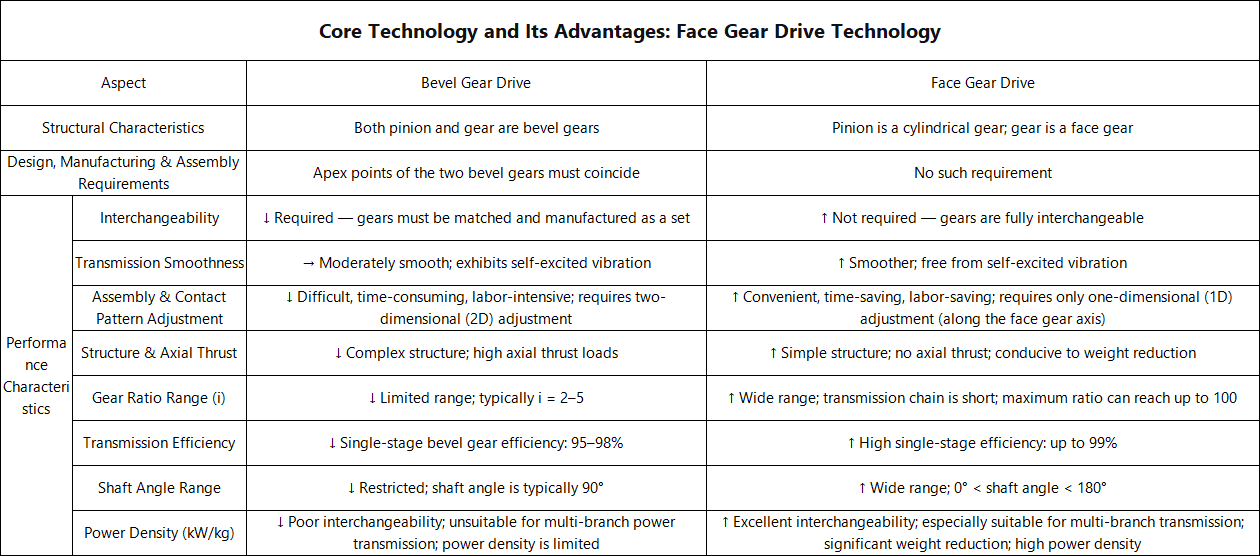
Face gear drive technology and its advantages: the basis for comparing component, set and gearbox-level purchases.
A worm-face gear set, a precision face gear set and a main gearbox are frequently quoted against the same inquiry, and a fourth term, precision face gear, is often used as though it were a synonym for the second. They are not synonyms. Each describes a different boundary of supply: a single gear, a matched pair, a configured pair, or a complete transmission. Which one fits depends less on which design is better than on where your engineering responsibility should end and your supplier's should begin.
The short answer. Buy a precision face gear when your team designs the pinion, housing and lubrication and only needs the gear itself; buy a precision face gear set when you want a matched, interchangeable pair but will build the housing yourself; consider a worm-face gear set when the input layout calls for the worm-type configuration and the ratio target is high; and buy a main gearbox when you want one supplier accountable for the complete, tested transmission. Price is a poor first filter, because these four options do not cover the same work.
This guide works through the criteria that usually settle the question: precision requirement, ratio and shaft angle, integration with the main gearbox, and cost structure across the lifecycle. It then sets out a purchasing checklist, acceptance criteria and the documentation question buyers ask most often, namely whether certificates are provided after delivery.
What each option actually covers
The difference between the four terms is mostly a difference in scope of supply. Getting that scope right is what stops a quotation comparison from becoming a dispute at the first assembly.
Precision face gear (the component)
A precision face gear is the face-gear member on its own: the gear whose teeth are cut on its face and which meshes with a cylindrical pinion, straight-tooth or helical. Laser Gear states that it can manufacture Grade 5-6 high-precision face gears using a grinding process for aviation and robotic applications. Buying at this level leaves pinion geometry, housing design, bearings, lubrication, backlash setting and assembly inspection with you. You are purchasing a manufactured and inspected gear to a stated accuracy grade, not a transmission.
Precision face gear set (the matched pair)
A precision face gear set supplies the pinion and the face gear together as a matched pair, usually with a defined backlash range and contact pattern. This is the level at which full interchangeability and simple 1D assembly adjustment become practical; Laser Gear lists both properties among the advantages of face gear drives over bevel gear drives. The housing, bearings and lubrication remain yours, but responsibility for tooth mating moves partly to the supplier.
Worm-face gear set (a configuration in the pair family)
Laser Gear lists a worm face gear pair alongside orthogonal straight-tooth and helical-tooth drives, offset drives with skew axes, non-orthogonal internal and external cone types, and small shaft-angle types. In purchasing terms it is still a pair-level buy, so the questions are the familiar ones: ratio, centre distance, lead and helix definition, materials and heat treatment, accuracy grade, and how the contact pattern will be verified. Put the exact geometry in writing rather than relying on the product label.
Main gearbox (the integrated transmission)
A main gearbox is the complete transmission: housing, bearings, seals, lubrication arrangement, the face gear stage or stages, and the test that proves the assembly. Laser Gear's range includes a face gear main reducer plus single-input and dual-input face gear coaxial contra-rotating main reducers. Two named products show the scope: a 2,200 N·m precision angular face gear reducer and a 50 kW-class face gear speed increaser developed for marine main-engine generator systems. At this level you buy a tested unit and a single point of accountability.
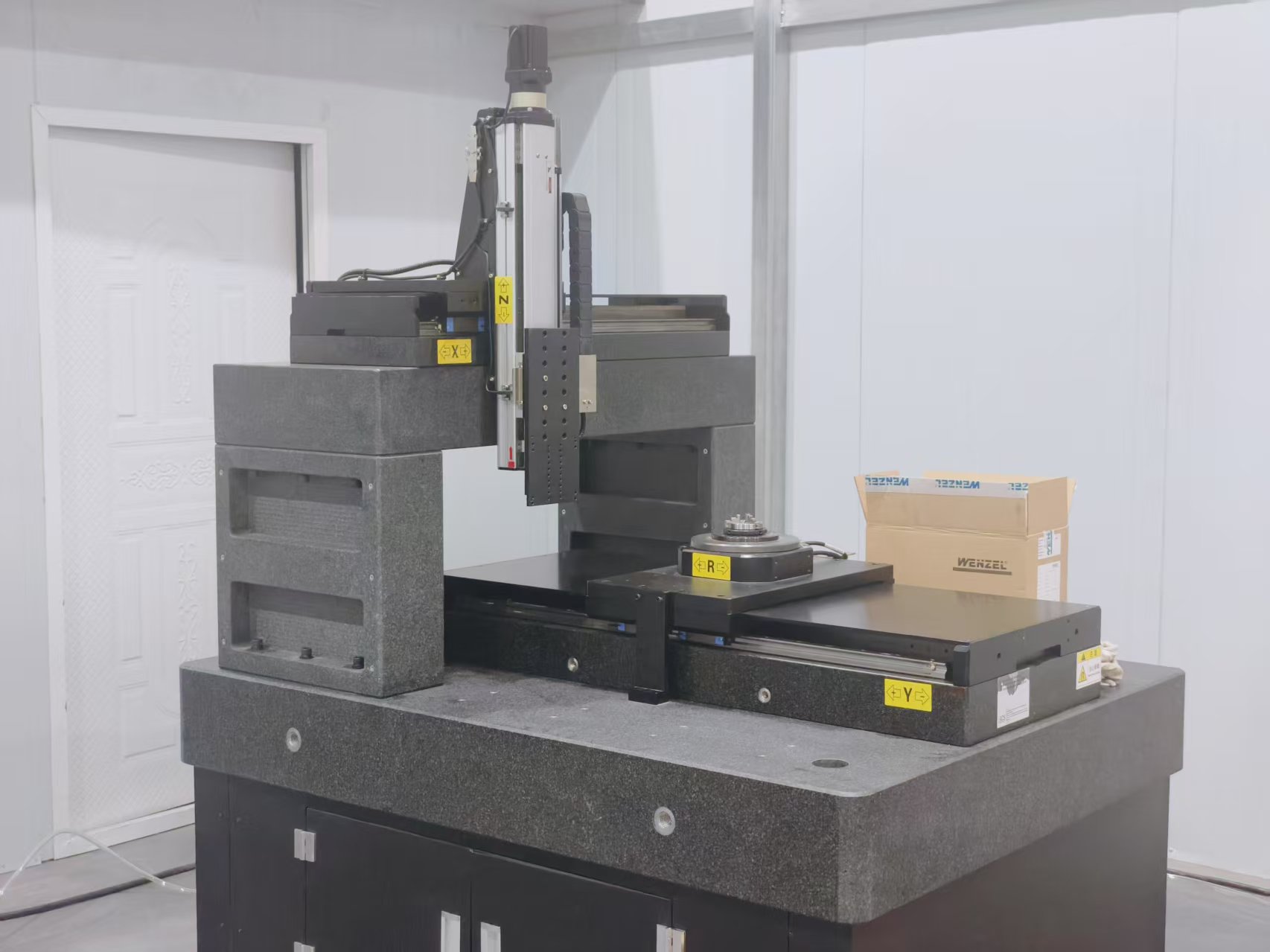
Precision manufacturing equipment underpins the accuracy grade a supplier can hold on a face gear or a matched set.
Why this comparison is becoming more common
Face gear transmission is not new technology; it is a maturing one. A NASA technical handbook published in 2000 documents face gear drives with spur involute pinions for helicopter transmissions and split-torque arrangements, and compares them with bevel gears. NASA records also describe a 250 horsepower proof-of-concept split-torque face gear transmission tested by The Boeing Company, and a scaled-power proof-of-concept gearbox that reported a 52%/48% average torque split between two pinions in its final two-pinion, two-idler tests. The European FACET project assessed face gears for aerospace transmissions, including a helicopter configuration that turns horizontal engine drive into vertical main-rotor output.
Demand signals point in the same direction. Grand View Research valued the global unmanned systems market at USD 29.3 billion in 2025 and projects USD 67.6 billion by 2033, with UAVs holding a 63% share in 2025. Strategic Market Research projects the robot gears market growing from USD 151.35 million in 2025 to USD 260.98 million by 2032, a compound annual growth rate of 8.09%. Both segments reward compact angle drives with high torque density, which is the design space face gears occupy.
On the supply side, Xi'an Laser Transmission Technology Co., Ltd. (Laser Gear) was founded in 2023 by Dr. Zhao Ning, whose team spent two decades on face gear transmission research at a Chinese national-level institute for mechanical manufacturing and automation. The company operates a 3,000 sqm facility with 60 employees, an 18-person R&D team and annual output of 300,000 units, exporting about 10% of output to markets that include China, the USA, Europe and the Middle East. Its milestones include China's first civilian-oriented face gear reducer, delivered in March 2024 to a domestic engineering machinery company, and China's first face gear speed increaser, delivered in December 2024 for integration into a next-generation naval propulsion main-engine generator system. The company leads one national face gear standard and contributes to two others, with three standards approved for development in December 2025 and publication targeted for 2026.
The category is served largely by application-driven engineering houses rather than catalog-standard lines. ASSAG, a Swiss drive-system supplier, reports customer-specific drive solutions across automotive, medical, industrial, machine tools, robotics, aerospace, agricultural and off-highway equipment. That pattern matters for buyers: the specification conversation, not the catalogue page, is where fit is decided.
Decision criterion 1: precision requirement and who verifies it
Precision is the first filter because it decides which scope can even be quoted. Laser Gear states a Grade 5-6 capability with grinding for aviation and robotic work. If your application needs that class of accuracy, a supplier without a grinding route cannot credibly quote the component, whatever the price.
The accuracy grade on a drawing is a starting point, not the result. A gear that measures inside its grade can still produce an unacceptable transmission if housing stiffness, bearing preload or backlash setting is wrong, which is why the scope decision and the precision decision are linked. At component level you own the assembly outcome; at set level you share it; at main gearbox level the supplier owns it and hands you a test report.
Ask three questions of every quotation: which accuracy standard the grade is expressed against, which measuring equipment produces the report, and what is inspected on the finished unit. The answers reveal more about capability than a grade number on its own.
Decision criterion 2: maximum single-stage ratio and shaft angle
The maximum single-stage reduction ratio of face gear drive is up to 100, which Laser Gear describes as much wider than the typical bevel gear range of 2 to 5. That range is the main architectural lever in this comparison: one face gear stage can replace two stages in some layouts, shortening the transmission chain and removing a set of bearings, shafts and joints.
Shaft angle is the second lever. Laser Gear states that shaft angle can be set between 0° and 180° and is not limited to 90°. The configuration list maps onto that range: orthogonal straight-tooth and helical-tooth drives at 90°, offset drives with skew or spatial crossed axes, non-orthogonal internal cone types above 90°, external cone types below 90°, and small shaft-angle drives in the 3°-5° band. A buyer who assumes 90° from the outset may be designing around a constraint that does not exist.
Two cautions belong beside these numbers. A high single-stage ratio still has to be lubricated, cooled and inspected for its actual duty, so confirm thermal and lubrication assumptions for the specific ratio rather than for the family. Efficiency claims should also be read at the level they were made: Laser Gear's published comparison of face gear and bevel gear drives lists efficiency up to 99%, weight reduced by 40% and load-carrying capacity increased by 35%. Those are supplier-published comparison figures, useful as a design-direction indicator and not a substitute for project-specific testing.
Decision criterion 3: integration with the main gearbox
Integration is where the set-versus-gearbox decision is usually made. Laser Gear lists full interchangeability, easier 1D assembly adjustment and almost no axial thrust among the advantages of face gear drives, and states that these reduce weight, vibration and maintenance cost. In a gearbox design, near-zero axial thrust changes the bearing and housing conversation directly.
If your team already designs gearboxes and runs a test bench, buying the set, or the component, keeps control of housing stiffness, bearing selection and lubrication. If your team does not, or if the transmission sits on a critical path, buying the main gearbox consolidates responsibility for backlash, contact pattern, run-in and acceptance testing with one supplier.
Split-torque architectures deserve a separate note. The NASA proof-of-concept two-pinion gearbox reported an average 52%/48% torque split, which shows that splitting input power across multiple pinions is achievable in a research unit. It does not establish load sharing in your architecture. If you need split torque, that analysis belongs at gearbox level, where housing, pinion mounting and load-sharing behaviour are designed together.
Decision criterion 4: cost structure across the lifecycle
High-precision face gear manufacturing carries a higher processing cost than conventional bevel gear production, and Laser Gear positions that cost against a lower full-lifecycle cost in lightweight, high-load applications. Both halves of that statement matter to a decision-stage buyer.
The comparison worth running is not gear price against gearbox price. It is the total cost of the transmission you are accountable for: the part, your engineering hours, assembly labour, test time, rework risk, spare parts strategy and downtime exposure. A component quotation that looks cheaper can lose that comparison once housing design, lubrication validation and acceptance testing are counted, and a main gearbox quotation can look expensive until the same work is priced internally.
Ask each supplier to price the same scope and the same document package. Where they cannot, treat the difference as a scope difference rather than a price difference.
Comparison table: four options, seven criteria
The table summarises the four options against the criteria above. It is a decision aid, not a specification; the figures that matter are the ones written into your own drawing and purchase order.
| Option | What you receive | Precision and inspection | Ratio and shaft angle | Integration load on your team | Fits when |
|---|---|---|---|---|---|
| Precision face gear | Single face gear member, ground, to a stated accuracy grade | Supplier inspects gear geometry; assembly inspection stays with you | Face gear family supports single-stage ratios up to 100 and shaft angles from 0° to 180°; confirm the specific gear | High: pinion, housing, bearings, lubrication, backlash | You have transmission design, assembly and test capability in-house |
| Precision face gear set | Matched pinion and face gear with defined backlash and contact pattern | Supplier controls tooth mating; you control housing and assembly | Same family range; ratio fixed by the pair | Medium: housing, bearings, lubrication, installation | You need interchangeability and 1D adjustment but keep housing design |
| Worm-face gear set | Face gear pair in a worm-type configuration | As for a set, plus written confirmation of the geometry | Confirm ratio, centre distance and lead in writing | Medium to high: layout depends on the worm input | Your input layout calls for a worm-type pinion and a high ratio |
| Main gearbox | Complete reducer or main reducer, assembled and tested | Supplier owns assembly test, backlash, run-in and the report | Stage count and ratio set at gearbox level; split-torque arrangements possible | Low: interface, mounting, lubrication services, acceptance | You want one accountable supplier and a tested unit |
Step-by-step: how to make the choice
Six steps usually settle the question. Work them in order, because each one narrows the next.
- Fix the interface before discussing ratio. Define shaft angle, centre distance, mounting faces, envelope and lubrication access. Because face gear shaft angle can be set from 0° to 180°, the interface decision is broader than the usual right-angle assumption, and it determines whether a worm-face configuration, an orthogonal drive or an offset drive is even in the running.
- Set the ratio and count the stages. With single-stage ratios up to 100 available, test whether one face gear stage can replace two stages elsewhere. If it can, the gearbox-level purchase usually follows, because the saving comes from the architecture rather than from the part.
- Choose the supply boundary. Component if you design and assemble the pair in-house; set if you want matched teeth but keep the housing; worm-face set if the input layout calls for that configuration; main gearbox if you want a tested unit and one accountable supplier.
- Specify precision and inspection together. Write the accuracy grade, grinding requirement, backlash range, contact pattern acceptance and report format into the same document. A grade without an inspection method is not a specification.
- Fix commercial terms. Agree drawing revision control, change and re-qualification rules, tooling ownership for OEM and ODM work, spare parts scope and delivery milestones. Laser Gear supports OEM and ODM together with full-cycle after-sales service including technical guidance, spare parts and on-site commissioning.
- Agree acceptance criteria before the purchase order. Name the tests, the documents and the person who signs off. This is also the point to settle the certificate question, because documentation requested after delivery is a negotiation, while documentation written into the order is a requirement.

Engineering and after-sales support sit behind both pair-level and gearbox-level purchases.
Where each option fits
- Helicopter and UAV main reducers: right-angle power direction change with torque splitting, small footprint, high torque and 24/7 duty point to a main gearbox purchase. The FACET helicopter configuration, with horizontal engine drive turned to vertical rotor output, is the classic case.
- Robot joints and precision rotary platforms: a compact angle drive with high torque in a small package. Set or gearbox level, depending on how much of the joint housing the robot maker designs in-house.
- Marine main-engine generator systems: the 50 kW-class face gear speed increaser delivered for a naval propulsion main-engine generator shows the gearbox-level route in a performance-critical application.
- Agricultural and construction machinery: high torque, low speed and angle transmission in 24/7 duty favour a main gearbox or a complete reducer, where the supplier owns assembly and test.
- Industrial face gearboxes and machine-tool angle drives: set level where the machine builder already controls housing and lubrication design.
- Prototype and first-article programmes: component or set level keeps iteration fast and lets your own test bench generate the data.
Purchasing terms and acceptance criteria: a practical checklist
Whichever option you buy, the same four document groups decide whether the purchase runs smoothly.
- Technical definition: drawing number and revision plus the 3D model as the controlling definition; shaft angle, centre distance, mounting interface, envelope and mass target; ratio, input speed, torque, duty cycle and operating temperature; material and heat treatment specification; lubrication method and oil or grease specification, with sealing arrangement.
- Inspection: gear accuracy grade and the standard it is expressed against; confirmation of the grinding process for high-precision gears; backlash range and contact pattern acceptance criteria; runout, mounting face flatness and bore tolerance; no-load run, load test, and noise or vibration limits where specified.
- Commercial: tooling and design-data ownership under OEM or ODM; change control and re-qualification rules; spare parts list and after-sales scope; delivery milestones, packaging and traceability marking.
- Documentation: dimensional inspection report, material certificates, heat treatment records and final test report; plus any third-party certificate or conformity declaration written into the order.
Will certificates be provided after product delivery? Laser Gear's stated position is that it provides full test reports after delivery, together with complete after-sales support. That is a test-report commitment. It does not, by itself, mean that a third-party certificate package or a declaration of conformity is included as standard. If your programme requires specific certificates, name each document in the purchase order and confirm acceptance before the order is released. The same discipline applies whether you buy a gear, a set or a main gearbox.
Frequently asked questions
Will you provide relevant certificates after product delivery?
Laser Gear states that it provides full test reports after delivery, together with complete after-sales support. That commitment covers test documentation rather than a blanket third-party certificate package. Buyers who need specific certificates or conformity declarations should list each required document in the purchase order and confirm it before the order is released.
What is the maximum single-stage reduction ratio of face gear drive?
Up to 100 in a single stage, according to Laser Gear, compared with a typical bevel gear range of 2 to 5. The wider range means one face gear stage can replace multiple stages in some layouts, shortening the transmission chain. Confirm the ratio you need against the specific configuration, because a family limit is not a promise for every pair.
What precision grade can you produce?
Laser Gear states that it can manufacture Grade 5-6 high-precision face gears using a grinding process for aviation and robotic applications. The grade applies to gear manufacturing; the accuracy of a finished gearbox also depends on the housing, bearings and assembly quality.
What shaft angles are available for face gear?
Shaft angle can be set between 0° and 180° and is not limited to 90°. Laser Gear's configurations include orthogonal drives at 90°, offset drives with skew axes, non-orthogonal internal cone types above 90°, external cone types below 90°, and small shaft-angle drives in the 3°-5° range.
What is the biggest advantage of face gear over bevel gear?
Full interchangeability, easier 1D assembly adjustment and almost no axial thrust, which reduce weight, vibration and maintenance cost. Laser Gear's published comparison also lists broader gear and shaft angle ranges, efficiency up to 99%, weight reduced by 40% and load-carrying capacity increased by 35%; those are supplier-published figures rather than independent test results.
Is face gear more expensive than bevel gear?
High-precision face gear manufacturing has a higher processing cost, but Laser Gear positions it as reducing total system cost in lightweight, high-load applications, with a lower full-lifecycle cost. Compare the cost of the complete transmission and its service life rather than the gear price alone.
Can you provide OEM and ODM for face gear final drives?
Yes. Laser Gear supports OEM and ODM together with full-cycle after-sales service including technical guidance, spare parts and on-site commissioning. For an OEM or ODM programme, agree tooling ownership, drawing revision control and the acceptance test in the contract before the first article is produced. If you are still at the comparison stage, send the shaft angle, ratio and duty cycle for a fit check against the configuration range.
Conclusion
Choosing between a worm-face gear set, a precision face gear set and a main gearbox is a scope decision before it is a price decision. Precision requirement decides which level can be quoted at all; the single-stage ratio range of up to 100 and the 0° to 180° shaft angle range decide whether one face gear stage can replace several; integration with the main gearbox decides whether you keep or transfer the assembly risk; and lifecycle cost decides whether a higher processing cost is justified by a lower total cost of ownership.
The working rule: buy the lowest level of supply at which your team can still own the outcome, and the highest level at which the supplier can prove it with a test report. Then write the acceptance criteria and the document list into the order, so that the certificate question is answered before delivery rather than after it.
Review the full configuration range, including worm face gear pairs, precision face gear sets and face gear main reducers, in the Laser Gear product brochure (PDF). For a fit check, send your shaft angle, ratio, torque and duty cycle to the Xi'an Laser Transmission Technology Co., Ltd. team: Mindy Du, mindydu1031@gmail.com, +86 139-6183-1882.
Have Questions or Need More Details?
Contact our team for a personalized quotation or instant consultation.
Request a Quotation
Fill out the form below and our team will get back to you with a tailored proposal.
WhatsApp Direct Chat
Prefer to chat in real-time? Message us on WhatsApp for instant assistance & quick answers.
- Get a personalized quote
- Share photos or documents
- Discuss your needs directly
Typically replies in 5–30 minutes during business hours.