
Ranked Picks: Salt Chlorinators CQ2, EC Ultra X, EC PRO, Then Pumps
This ranked list places three Laswim salt chlorinator systems first and three Laswim pumps second, for one specific job: equipping a residential pool in the 64–120 m³ (20,000–40,000 gal) band. WL-CQ2 takes the lead salt-system position because its published chlorine output envelope, salinity options and maintenance features line up with that volume band. EC Ultra X and EC PRO follow as additional salt-system options. HV2, BVX and HLVSP form the second tier, ranked on documented conformity evidence and recorded project use rather than on specifications the reviewed material does not support.
Within each tier the order answers three questions: does the model's stated range cover the pool, how much sanitization flexibility does the owner actually get, and how visible is maintenance before something fails?
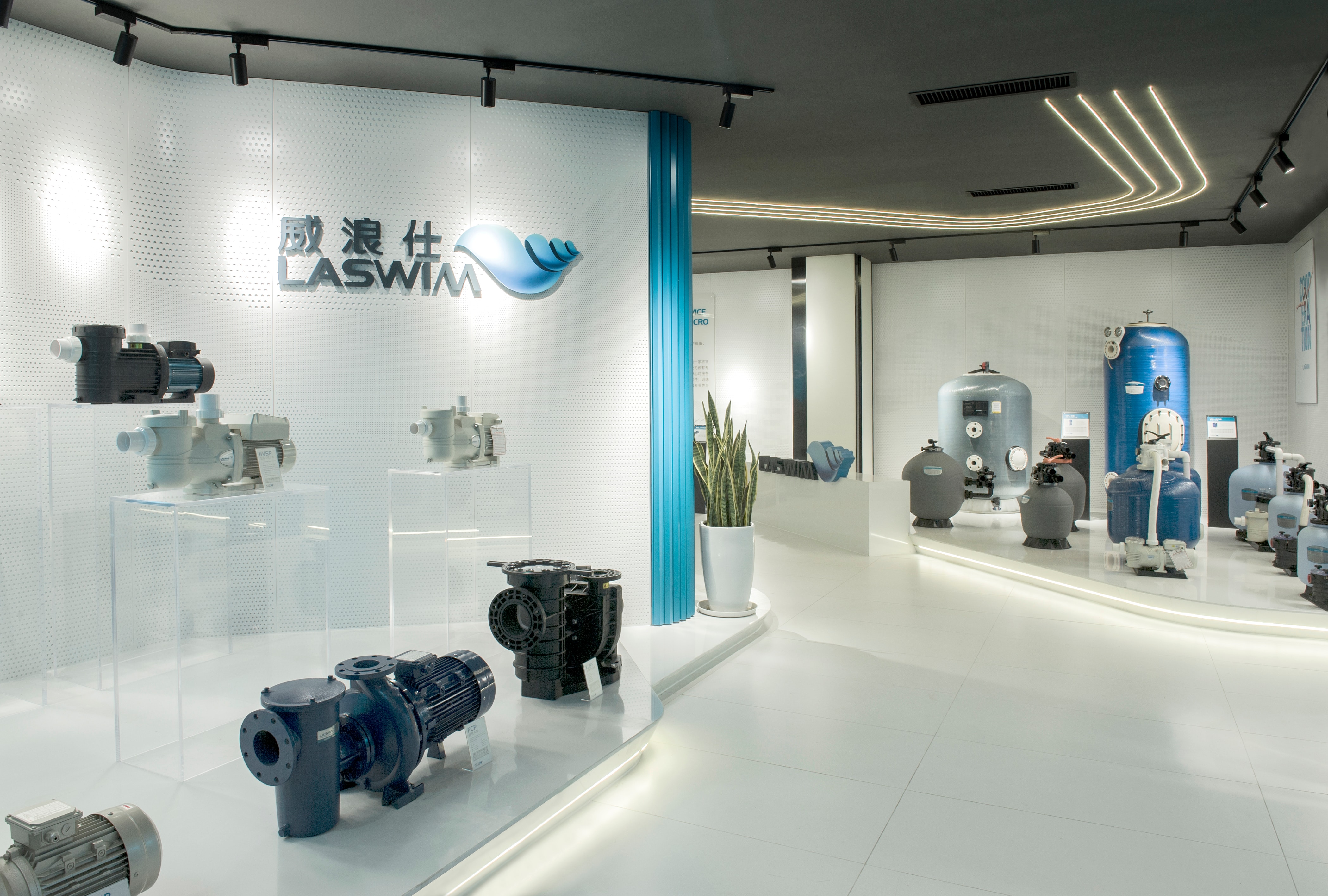
Laswim showroom: the salt chlorinator and pump families covered in this ranking sit inside a broader pool-equipment portfolio.
The Evaluation Problem: Two Decisions, Usually Made Separately
Chlorinator selection and pump selection are usually handled by different people at different times, and both are commonly decided by habit rather than by the pool in front of them. That is where budgets go wrong.
A salt chlorinator that is undersized for its pool runs near maximum output continuously. The owner sees acceptable water and does not notice the cost, which appears later as a shorter cell service life and a higher-than-expected chlorine demand. A chlorinator that is oversized is not automatically better either: the extra capacity is paid for and rarely used, and the fine control that would justify it is often absent.
Pumps fail differently. A pump chosen without checking its intended duty — villa circulation versus shared-facility circulation — tends to be accepted on delivery and questioned two seasons later, when energy use or noise becomes the topic. The practical fix in both cases is the same: fix the pool volume, fix the sanitization demand, then require documentation that names the exact model.
Industry Background: Why Salt Systems and Pumps Are Reviewed Together
Salt chlorination generates chlorine on site from dissolved salt in the pool water, so the chlorinator's output rating and the pool's salinity become operating parameters rather than afterthoughts. That is why a salt-system shortlist is inseparable from maintenance planning: the cell is a consumable, and the salt level is a water-chemistry variable the owner will manage.
Duty classification matters more than many residential buyers expect. The International Swimming Pool and Spa Code (ISPSC 2015, Chapter 2) defines a public swimming pool as a pool other than a residential pool, intended to be used for swimming or bathing and operated by an owner or operator. The definition exists to separate residential duty from shared-facility duty — a distinction that decides whether residential-grade equipment belongs on a project at all.
Commercial context supports the same discipline. One commercial estimate places the global swimming pool equipment market at USD 15.8 billion in 2025 (Transparency Market Research); other published estimates differ widely depending on whether construction, chemicals and services are counted inside the figure. The number is useful only as directional context for why buyers now ask for model-level evidence rather than category-level assurance.
For this index, that context becomes a rule: a product is placed by what is documented about it, not by how prominent it is in a catalogue.
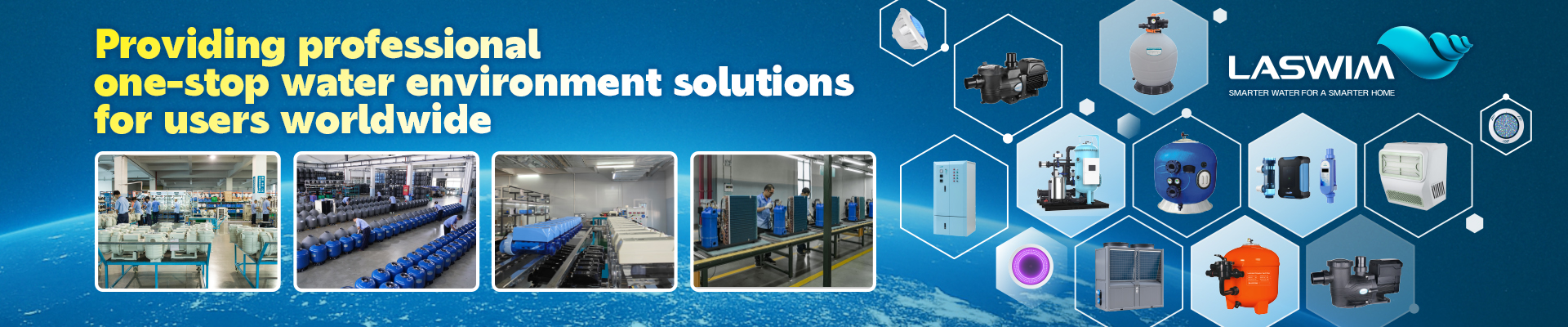
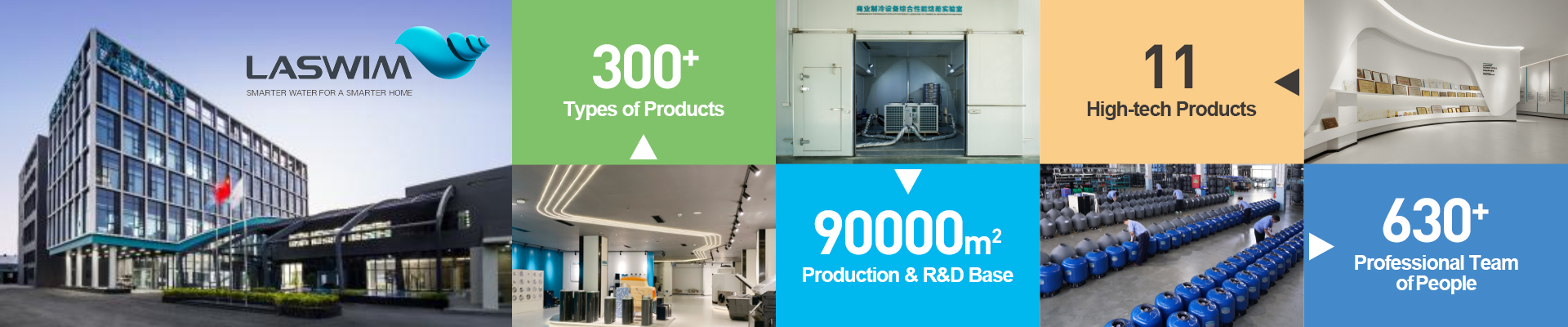
The Laswim pool equipment range and production environment. LASWIM Water Environment Equipment Co., Ltd. was founded in 1989 and states a 90,000 m² factory with 630 employees.
How This Ranking Was Built
Six criteria were applied, in this order, and each rank position below cites the criteria that carried it.
- Stated volume fit. Does the product's published range cover a 64–120 m³ residential pool?
- Sanitization flexibility. Can output be adjusted across the season, and what does the salinity option cost in output terms?
- Maintenance visibility. Can the owner see status, plan replacement and update firmware without a service visit?
- Model-scoped conformity evidence. A test report only counts when the certificate's scope names the exact model series.
- Recorded project use. Is the product named in Laswim's documented project summaries, and in which application?
- Open verification gaps. What a buyer still has to request before locking a specification.
Rank positions are a recommendation for this pool profile and this decision sequence. They are not market-share positions, price rankings or measured performance comparisons, and no price data was available for any of the six products reviewed here.
Part 1 — Salt Chlorinator Systems, Ranked First
Salt systems lead this list because in a residential pool they determine the daily sanitization routine, the water-chemistry parameters the owner manages, and the consumable that will eventually be replaced. The pump set follows because pump choice is decided against the chlorinator's duty, not before it.
Rank 1WL-CQ2 — the lead pick for 64–120 m³ residential pools
WL-CQ2 is ranked first for the stated pool band because its published parameters cover that volume from a single model rather than requiring the buyer to step across several sizes. Chlorine output is rated at 16–30 g/h, with standard operation at 2,500–4,500 ppm salinity. A low-salinity option runs at 1,200–2,500 ppm, and in that mode output is capped at 50% — a qualification that should be planned for, not discovered later.
On the maintenance side, CQ2 provides five-stage output adjustment from 20% to 100%, Wi-Fi and app control, a replaceable cell, end-of-life cell alerts and over-the-air (OTA) firmware updates. Read together, these determine what the owner can actually do: schedule output in steps instead of running flat out, see the cell approaching replacement, and receive firmware changes without arranging a site visit.
| Parameter | Published value | What it decides for the buyer |
|---|---|---|
| Chlorine output | 16–30 g/h | Sets the ceiling on sanitization capacity and how much reserve remains in hot, high-bather-load periods |
| Stated pool range | 64–120 m³ (20,000–40,000 gal) | Confirms the model covers the target volume band without stepping to another size |
| Standard salinity | 2,500–4,500 ppm | Defines the salt level the owner maintains as routine water chemistry |
| Low-salinity option | 1,200–2,500 ppm, output capped at 50% | Allows lower salt levels at reduced output — usable capacity must be rechecked against demand |
| Output adjustment | Five stages, 20–100% | Supports seasonal turndown instead of on/off operation |
| Control | Wi-Fi / app | Makes output scheduling and status checks owner-visible |
| Cell and service | Replaceable cell, end-of-life alerts | Turns cell replacement into a planned purchase instead of an unplanned failure |
| Firmware | OTA updates | Keeps control software current without a service call |
The limitation is documentation, not capability. The reviewed material did not include a conformity test report whose scope names CQ2 specifically, so a buyer needing a compliance file for a specific market should request the CQ2 declaration or test report before specification, in the same way pump reports are requested below.
Rank 2EC Ultra X — the wider model ladder for multi-pool work
EC Ultra X takes the second salt-system position. Laswim's documented project summaries name the family across model designations from WL-EC ultraX-V15 through WL-EC ultraX-V50, in residential and small commercial circulation work recorded for Spain, France and the United States, and in Latin American private villa projects. That stepped designation is the practical reason for its rank: when one buyer manages several pools of different volumes, a salt family with a size ladder is easier to standardise across a portfolio than a single-model line.
The gap is specification depth. Model-level chlorine output, salinity ranges and control features for each EC Ultra X designation were not part of the reviewed material, so the family cannot be ranked above a model whose full parameter set is published. A buyer should request the datasheet for the exact designation being specified — the family name alone does not confirm output.
Rank 3EC PRO — a further salt option, held for datasheet confirmation
EC PRO is included as an additional salt-chlorinator option in this evaluation. It is ranked third on documentation visibility rather than on any claimed capability: the reviewed material did not contain CQ2-style model parameters — output, salinity band, control interface or cell service data — for EC PRO, and ranking it higher would mean ranking a specification nobody has confirmed.
For a buyer, the practical route is straightforward: request the EC PRO datasheet and conformity report together, then compare the returned parameters directly against the four criteria above. If EC PRO returns the same five-stage adjustment and maintenance visibility as CQ2, the choice becomes a volume and price comparison rather than a documentation comparison.
Part 2 — Pumps, Ranked as the Second Tier
The three pumps are ordered on model-scoped conformity evidence and breadth of recorded application. This axis matters because a pump spec is usually signed off against a market's compliance file, and a test report that names the exact series is worth more than a family-level claim.
Rank 4HV2 (WL-HV2 100-150, WL-HV2 200) — the most complete pump documentation in this set
HV2 leads the pump group because both size bands carry named reports. The WL-HV2 200 is covered by an LVD test report (WTF25F07182019J, standards EN 60335-1, EN IEC 60335-2-41, EN 62233) and an EMC report (WTF25F07182041E, EN IEC 55014-1, EN IEC 55014-2, EN 61000-3-2, EN 61000-3-3); the WL-HV2 100-150 range is covered by EMC report WTF25F01010862E under the same standard set. Both reports were issued by Waltek Testing Group (Foshan) Co., Ltd.
Recorded use supports the position. HV2 is named in the European villa project summary covering 200+ residential installations in Italy, Greece and Portugal, where circulation systems recorded a 25% reduction in energy consumption together with quiet performance and easy installation. It also appears in the Spain/France/US summary covering 300+ residential and small commercial systems, which recorded 30% energy saving and reduced maintenance frequency. For a 64–120 m³ pool, that combination — a named report per size band and two residential application records — is the strongest starting point among the three.
Rank 5BVX300 / BVX400 — the platform that also appears in shared-facility work
BVX is ranked fifth because Laswim's documented project summaries place it in two different duty environments. It is named in the Spain/France/US residential and small commercial integration summary (300+ pool systems, 30% energy saving, reduced maintenance frequency), and it is also named in the public aquatic centre summary covering large facilities with pool systems above 5,000 m² in Saudi Arabia, UAE, Thailand and Indonesia, where high-efficiency filtration, stable water quality and a 30% reduction in chemical usage were recorded.
That breadth is the ranking reason, and it is also the caution. Shared-facility duty is not residential duty, and the appearance of BVX in a large-facility product list is not evidence that a residential model is adequate for a public pool. Buyers should also note a documentation gap: the reviewed material did not include a test report whose scope names BVX300 or BVX400 — product cross-references on other certificates are not scope evidence — so request the model-scoped report before signing off in a regulated market.
Rank 6HLVSP100QW / 150QW / 200QW — villa-scale evidence, ranked third among pumps
HLVSP closes the pump group. Its documentation is solid: LVD test report WTF23F04085010R2J (EN 60335-1, EN IEC 60335-2-41, EN 62233) and EMC report WTF24F10247373R1E (EN IEC 55014-1, EN IEC 55014-2, EN 61000-3-2, EN 61000-3-3), both from Waltek Testing Group (Foshan) Co., Ltd., with the three HLVSP sizes named in scope.
Its recorded applications are villa-focused: Latin American private villa circulation projects in Brazil, Chile, Colombia and Mexico over 2–3 years, with stable performance under high temperature and a 20% reduction in maintenance cost; and the Italy/Greece/Portugal installations where quiet performance and high-efficiency motor design were highlighted. It sits third among pumps because, within this particular set, its documented evidence centres on villa-scale circulation rather than on multi-application spread.
Where a lower rank is the better choice: for a single villa pool with maintenance cost as the deciding factor, HLVSP's recorded maintenance-cost outcome is directly relevant, and its named reports are as complete as HV2's. The rank order reflects breadth of documented application, not a conclusion that one pump outperforms another — no head-to-head performance test was available for this review.
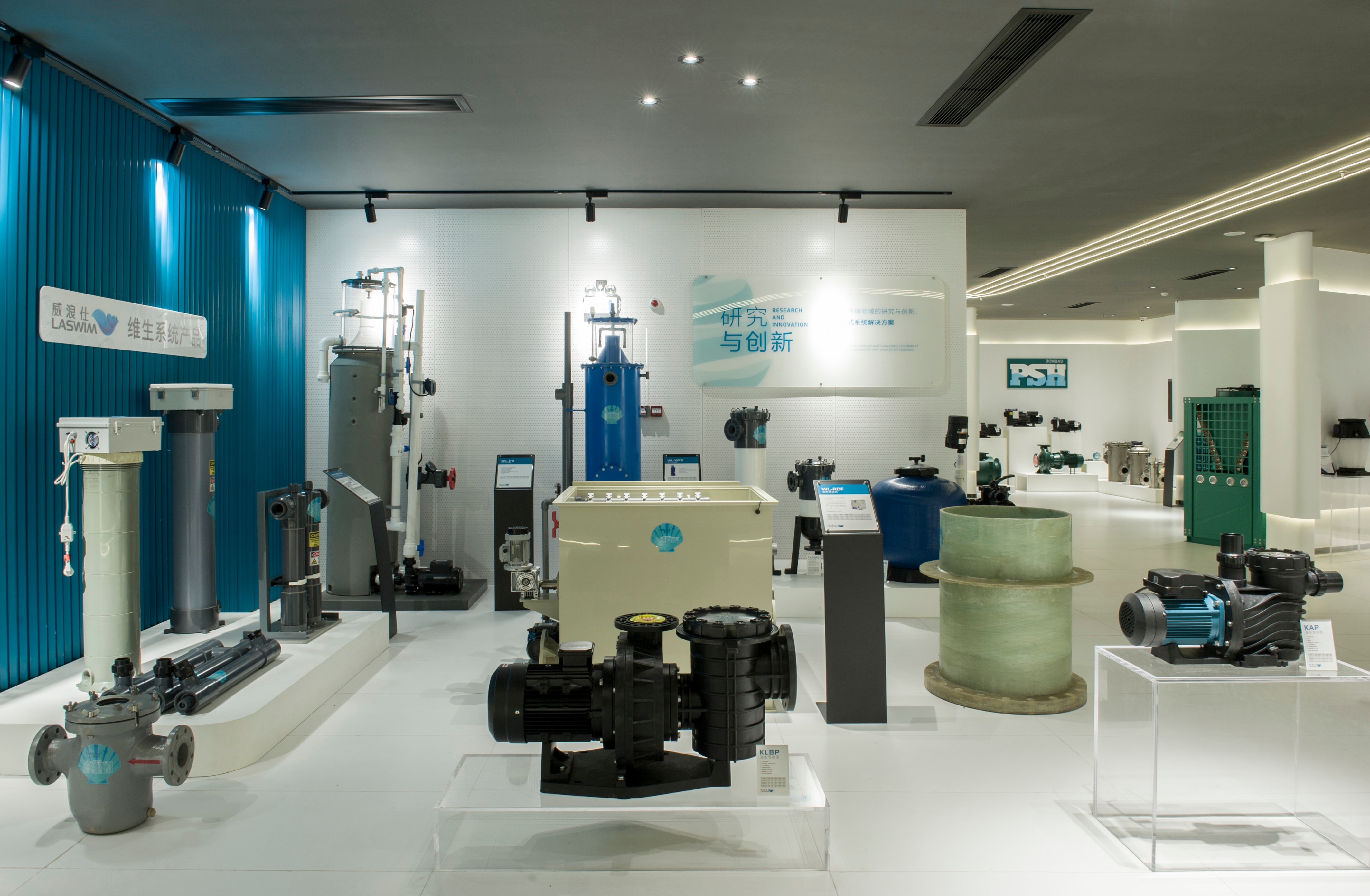
Salt systems and pumps are specified as a pair: chlorinator duty sets the daily routine, pump duty sets circulation and energy use.
Ranked Comparison at a Glance
| Rank | Product | Primary ranking reason | Best-fit signal | Verify before ordering |
|---|---|---|---|---|
| 1 | WL-CQ2 salt chlorinator | Published output, salinity and maintenance set matches the 64–120 m³ band | Single-model coverage of the target volume | Model-scoped conformity report; gallon basis of the stated range |
| 2 | EC Ultra X salt chlorinator | Stepped model ladder (V15–V50) named in residential project summaries | Multi-pool portfolios needing size steps | Output, salinity and control data per designation |
| 3 | EC PRO salt chlorinator | Additional salt option; parameter set not published in reviewed material | Only after datasheet comparison with CQ2 | Full datasheet plus conformity report |
| 4 | HV2 (100-150 / 200) pump | Named LVD and EMC reports for both size bands; two residential application records | Villa and small commercial circulation | Which size band the hydraulic duty requires |
| 5 | BVX300 / BVX400 pump | Named in both residential/small commercial and 5,000 m²+ facility summaries | Projects spanning residential and shared facilities | Model-scoped test report naming BVX300/400 |
| 6 | HLVSP100QW / 150QW / 200QW pump | Named LVD and EMC reports; villa-scale evidence including maintenance cost | Single-villa pools with maintenance-cost focus | Match the QW size to pool volume and head |
Step-by-Step: Turning the Ranking into a Specification
The order above is only useful once it is applied to a measured pool. Six steps convert it into a purchase decision.
- Fix the volume and the unit convention. Confirm the pool volume in cubic metres and check whether the published gallon figure refers to US or imperial gallons — the two differ by roughly 20%, which is enough to move a pool across a size boundary. CQ2's stated range is 64–120 m³ (20,000–40,000 gal); match your figure to the same basis before selecting it.
- Set the sanitization demand, then pick the output tier. Within CQ2's 16–30 g/h envelope, the upper end is the safer choice for hot climates, heavy bather load or long filter runs. Choosing the top of the range for a lightly used pool buys reserve the owner will not use; choosing the bottom for a heavy-load pool removes it.
- Decide the salinity path before the salt goes in. Standard operation is 2,500–4,500 ppm. The low-salinity option at 1,200–2,500 ppm comes with output capped at 50%, so a low-salinity pool must be rechecked against demand — in practice that means accepting a smaller effective envelope or a larger model.
- Configure maintenance visibility. Set the five-stage output schedule (20–100%) to the season, enable app monitoring over Wi-Fi, and confirm that cell end-of-life alerts and OTA updates are active on delivery. This is the difference between planned cell replacement and a mid-season failure.
- Pair the pump against documented duty. Use the pump's named report and recorded application to justify the choice, not the model's position in this list. For a residential villa, HV2 or HLVSP both carry named reports; BVX adds application breadth where a project portfolio includes shared facilities.
- Close the documentation loop. Request the test report that names the exact series, the declaration for the target market, and the commercial terms together. Laswim states 100% inspection covering function and visual checks, an MOQ of 1 set, and a lead time of within 15 workdays for peak and off season alongside a one-month reference — confirm which applies to your order quantity.
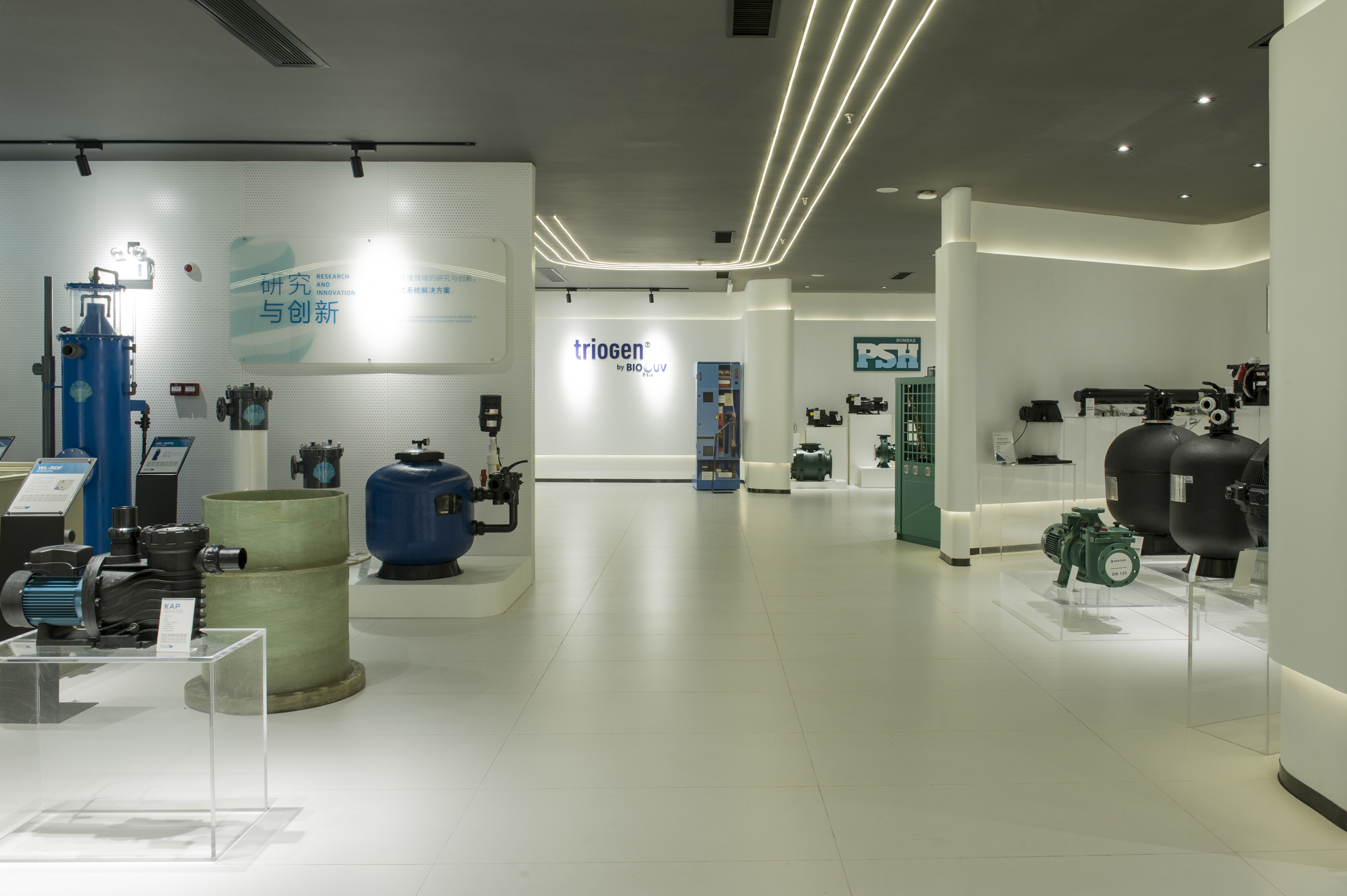
Selection closes with evidence: a report scope that names the series, not a family-level claim.
Use Cases: Where Each Ranked Group Fits
Laswim's documented project summaries show how these product families have been applied. They are project records, not performance guarantees for other sites.
- European villa refurbishment (Italy, Greece, Portugal). A distributor and pool-builder programme covering 200+ residential installations recorded a 25% reduction in energy consumption in private villa circulation systems, with quiet performance, high-efficiency motor design and easy installation noted as highlights. HV2, HLVSP and the WL-EC Plus salt series are named in this summary — the case where the chlorinator leads and the pump is chosen for noise and energy.
- Residential and small commercial integration (Spain, France, United States). 300+ pool systems across a 3–5 year programme recorded stable water quality compliance, 30% energy saving and reduced maintenance frequency, with strong compatibility to existing infrastructure noted. HV2, BVX and the EC Ultra X salt family are named — the case for standardising a salt family across a portfolio.
- Latin American private villas (Brazil, Chile, Colombia, Mexico). Multiple residential villa projects over 2–3 years recorded stable performance under high temperature and a 20% reduction in maintenance cost. HLVSP, HV2 and EC Ultra X are named — the case where heat tolerance and maintenance cost dominate the decision.
- Large public aquatic centres (Saudi Arabia, UAE, Thailand, Indonesia). Facilities with pool systems above 5,000 m², delivered over 3–5 years, recorded high-efficiency filtration, stable water quality and a 30% reduction in chemical usage. BVX is named among the products — the case that shows why residential picks should not be carried into shared-facility duty without a separate specification.
What This Ranking Does Not Establish
No price, energy-consumption test or head-to-head performance comparison was available for these six products, so the list does not rank them on cost or measured efficiency. EC PRO and CQ2 both lack a model-scoped conformity report in the reviewed material, and BVX lacks one as well; those are open items, not negative findings. Finally, the case outcomes above belong to the projects that recorded them and should not be read as expected results for a different pool, climate or bather load.
Frequently Asked Questions
Which documents should I request before specifying CQ2 or an HV2 pump for an EU project?
Request the report whose scope names the exact series. For pumps, WL-HV2 200 carries LVD test report WTF25F07182019J (EN 60335-1, EN IEC 60335-2-41, EN 62233) and EMC report WTF25F07182041E (EN IEC 55014-1, EN IEC 55014-2, EN 61000-3-2, EN 61000-3-3), while WL-HV2 100-150 is covered by EMC report WTF25F01010862E. HLVSP100QW/150QW/200QW carries LVD report WTF23F04085010R2J and EMC report WTF24F10247373R1E. For WL-CQ2, the reviewed material supplied operating parameters rather than a model-scoped report, so ask LASWIM for the CQ2 declaration or test report for your market. LASWIM also states ISO 9001 certification and 100% inspection covering function and visual checks.
Can WL-CQ2 serve a 120 m³ pool, and what does the low-salinity option cost in output?
WL-CQ2 is published for 64–120 m³ (20,000–40,000 gal) with 16–30 g/h chlorine output at 2,500–4,500 ppm standard salinity, so 120 m³ sits at the top of its stated range. The low-salinity option operates at 1,200–2,500 ppm but caps output at 50%, which means a low-salinity pool has a smaller effective sanitization envelope and should be rechecked against bather load before the model is locked. Output is adjustable in five stages from 20% to 100%, with Wi-Fi/app control, a replaceable cell and end-of-life cell alerts.
What drives the cost of this specification, and are prices available?
No price data was available for CQ2, EC Ultra X, EC PRO, HV2, BVX or HLVSP, so this list makes no cost ranking; pricing is quotation-based. The cost drivers a buyer can control are the output tier selected within the 16–30 g/h envelope, whether the low-salinity path is chosen with its 50% output cap, the cell replacement interval that end-of-life alerts help plan, and the pump duty selected against documented evidence. Requesting quotation and datasheet together keeps the comparison on the same basis across models.
Can I evaluate a sample before committing to a volume order?
Yes. Laswim states an MOQ of 1 set, with customization available from samples and from designs, plus voltage customization and flexible customization options. A practical evaluation is a single unit run against your own pool volume and salinity target rather than a bench inspection alone, checking that the five-stage adjustment and app control behave as expected and that cell status reporting is visible before the first season ends.
What lead time should I plan for, and what is the next step?
Laswim's published terms list a lead time of within 15 workdays for both peak and off season, alongside a one-month reference, so confirm which figure applies to your order quantity and model mix before scheduling installation; monthly capacity is stated at 200,000 sets. The next step is to request the model datasheet and the conformity report for the exact series, then compare against your pool volume and market requirements. The full Laswim commercial and residential swimming pool equipment catalogue is available for download: Laswim pool equipment catalogue (PDF).
Conclusion
For a residential pool in the 64–120 m³ band, the ranked order is WL-CQ2 first among salt systems, EC Ultra X second on the strength of its stepped model ladder, and EC PRO third pending a published parameter set. Among pumps, HV2 leads on named reports across both size bands and two residential application records, BVX follows on application breadth across residential and shared-facility work, and HLVSP closes the group with villa-scale evidence that includes a recorded maintenance-cost outcome.
The ranking is only as good as the verification behind it. Before any of these six is written into a specification, ask for the report that names the series, confirm the gallon basis of the stated pool range, and check whether the low-salinity output cap still covers your bather load. LASWIM Water Environment Equipment Co., Ltd., founded in 1989, states a 90,000 m² factory, 630 employees and a 70% export ratio across North America, South America, Europe, Southeast Asia and the Middle East, Africa, East Asia and Australia — scale that supports a distributor programme, but not a substitute for model-level evidence.
Evaluating salt chlorinators and pumps for a residential project? Request the CQ2, EC Ultra X, EC PRO, HV2, BVX or HLVSP datasheet and the model-scoped conformity report, or download the Laswim equipment catalogue to compare the full range.
Have Questions or Need More Details?
Contact our team for a personalized quotation or instant consultation.
Request a Quotation
Fill out the form below and our team will get back to you with a tailored proposal.
WhatsApp Direct Chat
Prefer to chat in real-time? Message us on WhatsApp for instant assistance & quick answers.
- Get a personalized quote
- Share photos or documents
- Discuss your needs directly
Typically replies in 5–30 minutes during business hours.