
Salt Chlorinator Comparison: CQ2, EC Ultra X, EC PRO & Pumps
Salt Chlorinator Comparison: CQ2, EC Ultra X, EC PRO & Pumps
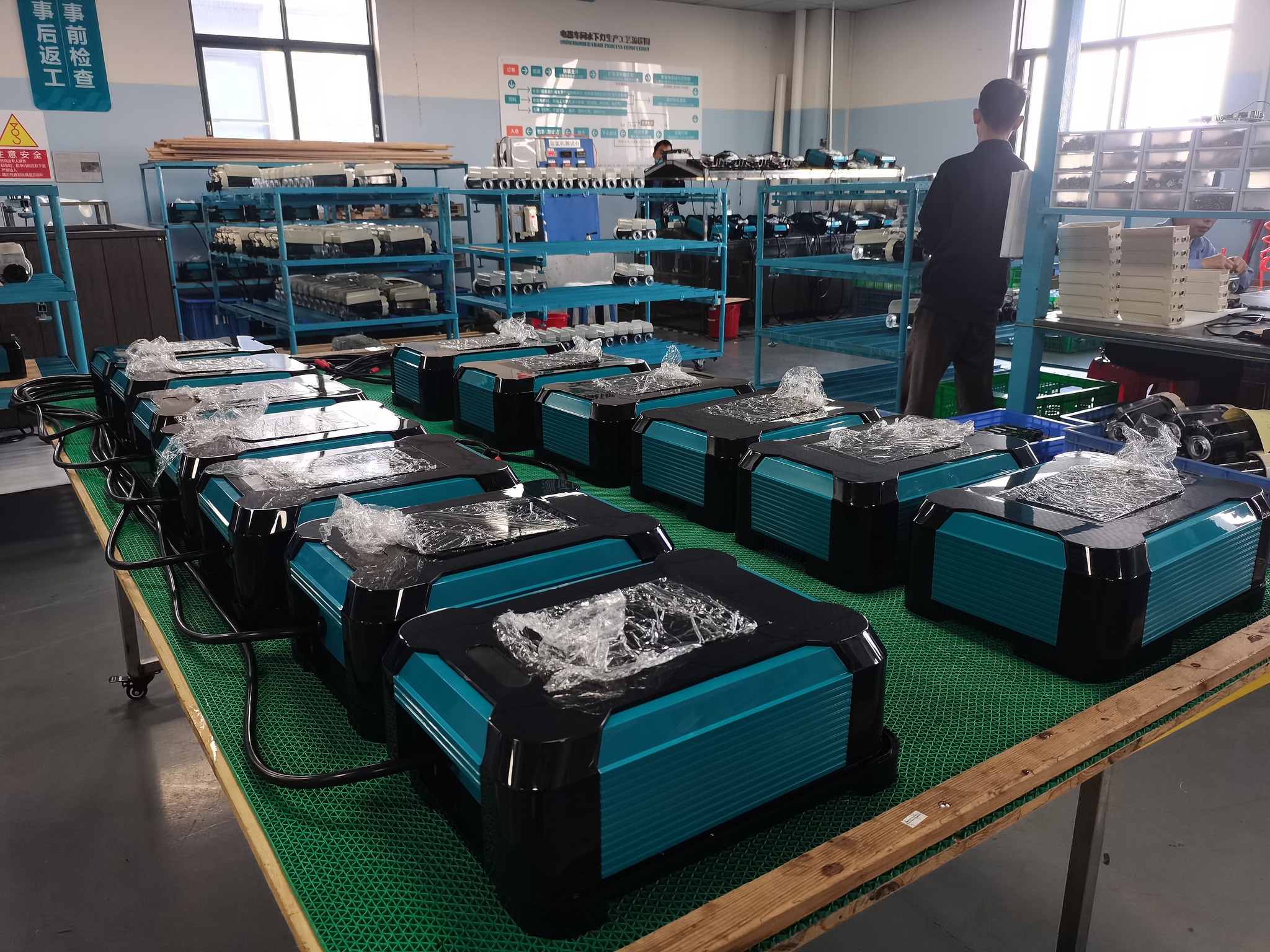
For a pool in the 64–120 m³ (20,000–40,000 gal) band, the practical question is not which salt chlorinator is the stronger unit in the abstract. It is which documented configuration matches your water volume, your salinity regime, the control and service access you need, and the pump it will run alongside. The Laswim WL-CQ2 is the reference model here: its published envelope — 16–30 g/h chlorine output, standard salinity at 2,500–4,500 ppm, low-salinity operation at 1,200–2,500 ppm with output capped at 50%, Wi-Fi/app control, a replaceable cell, cell end-of-life alerts, OTA firmware updates and five-stage output — sets the terms on which the EC Ultra X and EC PRO series should be evaluated. Those two are series alternatives inside the same purchasing decision, not upgrades or downgrades by definition.
Laswim (LASWIM Water Environment Equipment Co., Ltd.) is a pool and spa equipment manufacturer founded in 1989 and based in Zhongshan, Guangdong, China, with a 90,000 m² factory, 630 employees and a product line covering pumps, filters, salt chlorinators, heat pumps, underwater lights and disinfection equipment. That breadth is relevant to this comparison because the salt cell and the pump are bought together far more often than they are bought separately — yet they are usually specified apart.
This guide does two things. It converts the CQ2 envelope into a comparison you can run against a quotation. Then it covers the decision most buyers defer until installation day: how a salt system should be matched to an HV2, BVX or HLVSP pump on configuration fit, rather than on pump specifications that have not been verified for your duty point.
What this comparison actually decides
The first number most buyers compare is chlorine output, and on its own it is the least informative number on the datasheet. Output only acquires meaning in relation to water volume, bather load, water temperature and daily run time. A cell rated inside the envelope can still be the wrong choice if the pool sits at the top of the range in a hot climate with heavy use, because the run time required to meet daily chlorine demand grows in a way the headline figure does not show.
Three further questions usually decide the purchase, and these are the ones that separate the CQ2 from its series alternatives:
- Salinity regime. Will the pool run at conventional salt levels of 2,500–4,500 ppm, or does the owner want low-salinity operation at 1,200–2,500 ppm — and can the unit deliver that without losing the output the pool needs?
- Control and service model. Is app-based monitoring, a cell end-of-life alert and firmware that can be updated over the air worth paying for, and who holds the replacement cell once the pool is handed over?
- System fit. Which pump, filter and hydraulic layout will the cell actually run with, and does the chlorinator still perform at the flow that arrangement produces?
Each of these questions has a documented answer for the WL-CQ2. For the EC Ultra X and EC PRO series, the same three questions have to be answered from the series datasheet before any model can be treated as equivalent to the reference unit. That is the discipline this comparison is built on: a quotation that does not answer them is not yet a comparison.
Industry context: why salt chlorinators are sold as series
Salt chlorination became a default residential disinfection route because the cell generates chlorine on site from salt already dissolved in the pool water, which removes the routine handling and storage of chlorine products. The commercial consequence is that manufacturers organise their ranges as series: one electronics platform, one cell design, one control app, offered in several capacity classes and trim levels. Series logic is convenient for distributors — one spare-parts philosophy, one app, one installation method across a catalogue — and confusing for end buyers, because two models from different series can carry the same headline output while differing in control features, service access and enclosure.
The regulatory backdrop adds a second layer. In Europe, pool pumps are commonly documented against EN 60335-1, EN IEC 60335-2-41 and EN 62233 for safety, with electromagnetic compatibility assessed against the EN IEC 55014 and EN 61000 families. A salt chlorinator shares an electrical installation with the pump, so buyers increasingly request both sets of documents at the same time and treat a missing report on either side as a qualification risk rather than a paperwork delay. That is why the pump pairing belongs inside this comparison instead of being handled afterwards as a separate purchase.
Reading the CQ2 specification envelope correctly
Five figures in the WL-CQ2 specification do most of the work in a buying decision. None of them should be read in isolation.
Pool volume: 64–120 m³ (20,000–40,000 gal). This is the band in which the reference model is specified. Two practical points follow. Establish the volume from the pool's drawings or a measured survey rather than from a sales description, and quote it in both metric and imperial units in your enquiry, because the two ranges in the specification are not a one-to-one conversion — a pool that looks comfortable in one unit can sit near the edge in the other. Where a pool falls near a boundary, treat the model rating as something to confirm in writing rather than to infer.
Chlorine output: 16–30 g/h. Output is the hourly chlorine production the cell is rated to deliver. Within the stated envelope, 16 g/h sits at the small-volume end and 30 g/h at the large-volume end. Output also interacts with run time: against a fixed daily chlorine demand, a higher output setting shortens the hours the cell and pump must run, while a lower setting extends them. That trade-off is the reason output staging exists, and it is the reason output cannot be selected without also deciding run time.
Salinity: standard 2,500–4,500 ppm; low-salinity 1,200–2,500 ppm at 50% output. The unit operates across two salinity bands, and the qualification attached to the second one matters. Low-salinity operation is specified with output limited to 50%, which means the pool can run at a lower salt concentration but not at full production. The run-time budget has to absorb that difference. For a pool near the top of the volume envelope, low-salinity operation should be confirmed with the supplier before it is written into a project specification or promised to a pool owner.
Control and service: Wi-Fi/app control, replaceable cell, end-of-life alerts. App control moves routine checks — output setting, operating status — onto a phone, which is convenient but rarely decisive. The replaceable cell and the end-of-life alert matter more for lifetime cost, because the alert is the difference between planning a cell change and discovering a failed cell mid-season. For a distributor, both features change spares planning: the cell becomes a stocked item with a foreseeable replacement window rather than an emergency order placed under customer pressure.
OTA firmware updates and five-stage output. Over-the-air updates mean the control firmware can be revised without swapping hardware, which matters once a distributor carries an installed base rather than single units. Five-stage output lets the operator select an output level instead of running the cell flat out or off, and it is the mechanism that makes the run-time trade-off usable in practice.
Comparison table: CQ2, EC Ultra X and EC PRO on the same axes
The table below places the three options on the axes that change a purchase decision. The CQ2 column carries the documented figures used throughout this guide. The EC columns carry the questions each series datasheet must answer before a model from that series can be quoted as a like-for-like alternative.
| Decision axis | WL-CQ2 (reference model) | EC Ultra X (series) | EC PRO (series) |
|---|---|---|---|
| Role in this guide | Reference model with a documented specification envelope | Series alternative; Laswim project records list models V15, V20, V25, V30, V40 and V50 | Series alternative; model list not established in this guide |
| Pool volume fit | 64–120 m³ (20,000–40,000 gal) | Confirm per model | Confirm per model |
| Chlorine output | 16–30 g/h | Confirm per model | Confirm per model |
| Standard salinity | 2,500–4,500 ppm | Confirm per model | Confirm per model |
| Low-salinity operation | 1,200–2,500 ppm at 50% output | Confirm per model | Confirm per model |
| Wi-Fi / app control | Specified | Confirm per model | Confirm per model |
| Replaceable cell | Specified | Confirm per model | Confirm per model |
| Cell end-of-life alert | Specified | Confirm per model | Confirm per model |
| OTA firmware updates | Specified | Confirm per model | Confirm per model |
| Output staging | Five-stage output | Confirm per model | Confirm per model |
| Typical first shortlist | Single pool inside the envelope needing dual-salinity operation and app monitoring | Multi-project standardisation across several pool volumes | Configurations that must be verified against every axis above |
The EC columns are not gaps in the comparison; they are the questions that turn a series name into a specified model. Written that way, the table does something a feature list cannot: it stops a buyer short at the exact point where a quotation either supplies evidence or does not.
Which one to shortlist first: a three-profile decision rule
Profile one — a single residential pool inside the envelope. Where the pool volume sits within 64–120 m³, the owner wants low-salinity capability or app visibility, and a replaceable cell with an end-of-life alert fits the service model, the WL-CQ2 is the natural reference point. The enquiry should fix volume in both units, confirm the model rating in writing and ask for the cell part number alongside the unit.
Profile two — a distributor or builder standardising across projects. When the problem is not one pool but twenty pools of different volumes, the EC Ultra X series becomes the more useful comparison object, because Laswim's project records show it as a six-model ladder from V15 to V50. A ladder lets one platform, one app and one installation method cover several capacity classes, which simplifies training, stocking and after-sales. The trade-off is that the per-model datasheet has to be checked model by model — a series does not inherit one capacity figure across its whole length.
Profile three — a configuration that sits outside both. EC PRO belongs in the shortlist when the project brief calls for a series-level configuration that neither the single reference model nor the volume ladder covers cleanly. The rule is simple and non-negotiable: verify EC PRO against the same axes — volume, output, salinity mode, control, cell service, output staging — before assuming it is the appropriate step up. A series name is a position in a catalogue, not a capability statement.
In all three profiles, the pump pairing is decided separately and before the quotation is finalised, because the pairing changes the flow and run time the cell will actually see.
Step-by-step: running the comparison before you request a quotation
- Fix the volume and the unit. Measure or take the volume from drawings, then state it in both cubic metres and gallons. Because the two ranges in the specification are not exactly convertible, the unit you quote can move a pool from inside the band to the edge of it.
- Choose the salinity regime before the model. If the owner wants 1,200–2,500 ppm, accept the 50% output qualification and re-check the volume fit with that constraint in place. At 2,500–4,500 ppm the full 16–30 g/h envelope applies.
- Decide the control and service model. Ask who will hold the replacement cell, who receives the end-of-life alert, and whether firmware updates matter for a fleet or only for a single pool. A distributor with a service arm answers these differently from a builder handing the pool to its owner.
- Match the series to the portfolio. One pool inside the envelope points to the CQ2. Many pools across volumes point to the EC Ultra X ladder. A brief that fits neither should be verified against EC PRO on every axis before it is approved.
- Pair the pump. Do this before the quotation, not after installation. The pump duty point determines the flow at the cell, and the cell's flow requirement is not something to be discovered at commissioning.
- Confirm the commercial and service terms. Laswim states a minimum order quantity of 1 set, lead time within 15 working days in both peak and off season, a monthly capacity of 200,000 sets and 100% inspection covering function and visual checks. After-sales scope includes installation guidance, commissioning and operation training, troubleshooting, local service support and assistance from the manufacturer's technical team. Confirm which of these applies to the exact model, cell and voltage you are ordering.
Second tier: pairing the salt system with HV2, BVX and HLVSP pumps
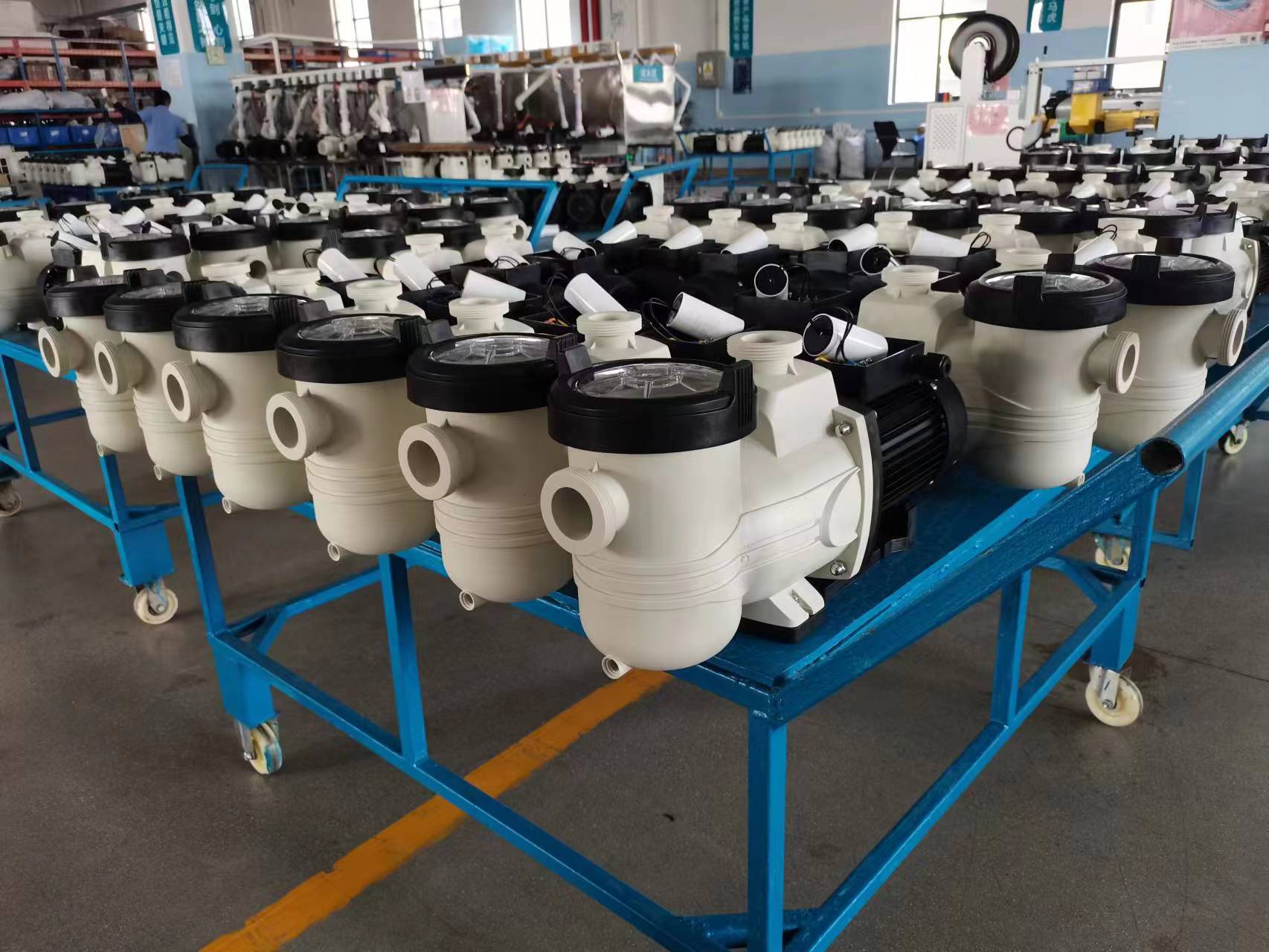
Pump pairing is where salt chlorinator projects most often go sideways, and it is almost never a question of pump quality. It is a question of configuration fit: whether the cell sits inside the flow window the pump produces, whether the electrical installation is documented for the exact model and voltage, and whether spares and service are planned across both items rather than one. The three Laswim pump families most often discussed alongside a salt cell are HV2, BVX and HLVSP, and each has a different documentary position.
| Pump family | Documentation held | Configuration role with a salt cell | Verify before ordering |
|---|---|---|---|
| HV2 (WL-HV2 200) | LVD test report WTF25F07182019J, Waltek Testing Group (Foshan) Co., Ltd., 26 August 2025, against EN 60335-1, EN IEC 60335-2-41 and EN 62233 | Circulation base for residential pools inside the chlorinator envelope | Model-specific report, voltage variant, flow at the cell |
| BVX (BVX300, BVX400) | Recorded as the related pump models in Laswim's pump test documentation; the model-specific report should be requested for the exact variant quoted | Circulation base where the two catalogued models match the hydraulic design | Exact model report, duty point at the cell, electrical protection |
| HLVSP (HLVSP100QW, HLVSP150QW, HLVSP200QW) | LVD test report WTF23F04085010R2J (10 December 2025), EMC test report WTF24F10247373R1E (12 December 2025), RoHS test report NAP25110699C01E (16 December 2025) | Higher-demand residential and small commercial circulation where the three models cover the required duty | Flow and head at the cell, electrical protection, local code requirements |
Five configuration rules apply to all three families, and none of them require unverified pump specifications to state:
- Size the cell first, then the duty point. Establish the daily chlorine demand and the run time you are prepared to accept, then choose the pump setting that keeps the cell inside its flow window. Sizing the pump first and throttling it afterwards is the usual source of mismatch.
- Do not assume app integration between cell and pump. A chlorinator app and a pump controller are separate systems unless the supplier documents otherwise. Where joint control matters, ask for it in writing rather than inferring it from a shared brand.
- Confirm the voltage variant. Laswim lists voltage among its customization options, so the variant you receive should match the market and the protection scheme, not the catalogue's default.
- Plan spares across both items. A cell end-of-life alert is only useful if the replacement cell and the pump consumables are held by the same channel. Distributors who stock the cell alongside pump seals and baskets avoid the two-order problem at the worst possible moment.
- Separate proof from promise. A test report naming the exact model is proof; a family name on a brochure is not. Where the report names a range, check that your exact model sits inside that range.

Use cases: what the pairing looks like in practice
Laswim's documented project records give three useful reference points for the residential and light commercial side of this comparison, and one boundary case.
Europe and the United States — standardisation across a channel. In projects spanning Spain, France and the United States, covering 300+ pool systems for residential and small commercial use over a 3–5 year engagement, the documented outcomes were stable water quality compliance, 30% energy saving and reduced maintenance frequency, with strong system compatibility against existing infrastructure and reliable OEM support. The pump models associated with that record include the WL-HV2100-200 and BVX300/BVX400, with EC Ultra X models V15 to V50 in the chlorinator line — the practical case for the series-ladder approach described above.
Italy, Greece and Portugal — retrofit efficiency. Across 200+ residential installations over 2–4 years, the recorded outcomes were a 25% reduction in energy consumption, stable operation and a low failure rate, with quiet performance, high-efficiency motor design and easy installation cited as the highlights. The pump family in that record is the HLVSP100QW/150QW/200QW group, with the WL-EC Plus 8–30 salt chlorinator. For a retrofit, the relevant lesson is that the pump and cell were selected as a combination, which is what makes the energy outcome attributable rather than coincidental.
Brazil, Chile, Colombia and Mexico — durability under heat. Over 2–3 years and 10+ integrated residential systems, the recorded outcome was a 20% reduction in maintenance cost, with stable performance under high temperature and material durability cited as the deciding factors. High ambient temperature is exactly the condition under which output headroom stops being optional, because run time lengthens before chlorine demand does.
The boundary case. Public aquatic centres with more than 5,000 m² of pool systems are a different equipment class. Laswim's record for that scope, in Saudi Arabia, the UAE, Thailand and Indonesia, associates regenerative media filtration, AOP disinfection and pumps, with a 30% reduction in chemical usage over a 3–5 year implementation. Salt chlorination at that scale is normally assessed alongside other disinfection routes rather than assumed, and the CQ2 envelope in this guide does not extend to it.
Frequently asked questions
Which salt chlorinator should I shortlist for a 64–120 m³ pool: CQ2, EC Ultra X or EC PRO?
Start with the WL-CQ2 when the pool sits inside 64–120 m³ (20,000–40,000 gal) and the brief calls for dual-salinity operation, app control and a replaceable cell with an end-of-life alert. Compare the EC Ultra X series when you need a model ladder — V15 to V50 — to standardise across several pool volumes. Verify EC PRO against the same axes from its own datasheet before treating it as equivalent.
What compliance documents should I request for a salt chlorinator and its paired pump?
For the pump, ask for the report that names your exact model and voltage variant. Laswim holds LVD test report WTF25F07182019J for the WL-HV2 200 against EN 60335-1, EN IEC 60335-2-41 and EN 62233, and for HLVSP100QW/150QW/200QW it holds LVD report WTF23F04085010R2J, EMC report WTF24F10247373R1E and RoHS report NAP25110699C01E. Request the chlorinator's own documentation for your market alongside them.
How does low-salinity operation change the way a CQ2 installation is planned?
The CQ2 covers standard salinity at 2,500–4,500 ppm and low-salinity operation at 1,200–2,500 ppm with output limited to 50%. In low-salinity mode you either accept roughly half the hourly chlorine output or extend run time to compensate. A pool at the top of the volume envelope should therefore have low-salinity operation confirmed with the supplier before it is written into the specification.
What drives the lifetime cost of a salt chlorinator system?
Cell replacement is the main recurring item, and a replaceable cell with an end-of-life alert converts it from an unplanned failure into a scheduled purchase. Output staging and run time determine how hard the cell works, and run time is set by the pump pairing rather than by the chlorinator alone. Since Laswim's minimum order quantity is 1 set, a single unit can be evaluated before any volume commitment is made.
Can a buyer evaluate one unit before committing to a volume order?
Yes, within the supplier's stated terms: the minimum order quantity is 1 set, and Laswim lists customization from samples among its options. That supports a single-unit installation check on a representative pool. It does not replace a site-specific sizing review covering volume, salinity regime and the flow the paired pump produces.
What lead time and production capacity should a distributor plan for?
Laswim states lead time within 15 working days in both peak and off season, monthly capacity of 200,000 sets and 100% inspection covering function and visual checks. Confirm those figures for the exact model, cell and voltage at order stage rather than at catalogue stage. The full Residential & Commercial Swimming Pool Equipment Catalog, including the wider pump, filter and disinfection ranges, can be downloaded here: Laswim equipment catalog (PDF).
Conclusion
The CQ2, EC Ultra X and EC PRO question resolves into a sequence rather than a verdict. Fix the volume in both units. Choose the salinity regime and accept the 50% output qualification that comes with low-salinity operation. Decide who owns the cell and the alert. Then match the series to the portfolio: the reference model for a single pool inside the envelope, the Ultra X ladder for standardisation across many, and a verified EC PRO comparison where neither fits.
Only then should the pump be fixed — and it should be fixed on configuration fit: the duty point that keeps the cell inside its flow window, a voltage variant that matches the market, documentation that names the exact model, and a spares plan that covers the cell and the pump from the same channel. Laswim's scale — founded in 1989, a 90,000 m² factory, 630 employees, 53 engineers and a 70% export ratio across North America, South America, Europe, Southeast Asia and the Middle East, Africa, East Asia and Australia — is useful context for supply continuity, but it does not substitute for the model-level answers.
Buyers at evaluation stage rarely lose a salt chlorinator project on the cell itself. They lose it on the run time nobody calculated, the salinity mode nobody qualified, or the pump that arrived without a report. A comparison that closes those three gaps is worth more than one that ranks the models.
Have Questions or Need More Details?
Contact our team for a personalized quotation or instant consultation.
Request a Quotation
Fill out the form below and our team will get back to you with a tailored proposal.
WhatsApp Direct Chat
Prefer to chat in real-time? Message us on WhatsApp for instant assistance & quick answers.
- Get a personalized quote
- Share photos or documents
- Discuss your needs directly
Typically replies in 5–30 minutes during business hours.