
Sizing Pool Pumps for Commercial vs. Residential Projects: An Application Guide
A pump that is correctly sized for a backyard pool will not survive the duty cycle of a hotel pool that circulates water through most of the day — and a 4 HP heavy-duty pump installed on a small villa pool is just as mismatched. Pump selection is a sizing decision before it becomes a purchasing decision: required flow rate, total dynamic head and daily duty cycle define the pump class, and the pump class defines the housing, the seal, the debris basket and the compliance file that arrive with the unit.
Short answer: match the pump class to the project class. For residential pools, the Laswim WL-ESP series (0.33–1.2 HP, maximum flow 11–19 m³/h, maximum head 9–13 m, 2900 rpm) covers private, villa and backyard pools, with the WL-HV2 100–200 range extending the residential line-up. For commercial projects — hotels, resorts, public aquatic centers, water parks and spa facilities — the heavy-duty WL-BDP series (2–4 HP, maximum flow 42–55 m³/h, maximum head 18–19.5 m) is built for continuous commercial duty with a glass fiber reinforced housing. Where noise and running cost dominate the brief, the BVX300/BVX400 variable-speed pump (3 HP, 1000–3100 rpm, noise below 65 dB) sits between the two.
This guide is written for facility managers, pool builders and equipment buyers comparing pump options at the research and evaluation stage. It explains how residential and commercial duty actually differ, which series corresponds to each duty class, and which checks should be completed before a pump model is written into a project specification.
1. Problem Definition: The Three Variables That Decide a Pump Class
Most pump sizing failures are not calculation errors; they are classification errors. A model is selected because of its horsepower rating, its price, or because the same unit was used on a previous project — without checking whether the duty point of the new hydraulic system falls inside that pump's design envelope.
Three variables define the envelope:
- Flow rate (m³/h) — the volume of water the pump moves per hour at a given head. It sets the circulation turnover of the pool and the flow available to skimmers, main drains, spa jets, waterfalls and other water features.
- Total head (m) — the sum of static lift and friction loss through pipework, fittings, filter and heater. A pump rated for a maximum head of 9–13 m and one rated for 18–19.5 m are not interchangeable; the system's head demand determines which class can even reach the duty point.
- Duty cycle — how many hours per day the pump runs, how frequently it starts, and how much debris and chemical load it handles. Residential pools typically run for part of the day, while commercial pools, water parks and spa facilities run far longer, which changes the thermal and mechanical load on the motor, the seal and the housing.
When one of the three is mismatched, the symptoms are predictable:
- Insufficient flow or head: weak skimmer action, slow filtration, delayed heating, and water quality problems that appear under bather load rather than at low occupancy.
- Oversized pump on a small system: excessive water velocity through pipework and filter, higher noise, higher energy consumption than the system requires, and shortened filtration cycles.
- Wrong duty class: a residential pump placed on continuous commercial duty runs hotter, consumes its mechanical seal faster and offers a smaller debris basket, while a commercial pump placed on a small residential system adds noise and cost without delivering a benefit.
Horsepower alone is therefore a poor selection metric. In the WL-ESP range, output power spans 0.33–1.2 HP while input power spans 0.26–0.9 kW; what matters is how much flow the pump delivers at the head the specific system creates. On the commercial side, the WL-BDP series produces 42–55 m³/h against a maximum head of 18–19.5 m from 2–4 HP, with a self-priming height of up to 3 m — the same 3 m self-priming capability that the BVX300/BVX400 variable-speed models are rated for.
2. Industry Background: Why Residential and Commercial Pump Requirements Have Diverged
The global swimming pool equipment market is estimated at USD 14.22 billion in 2025 and is projected to reach USD 21.33 billion by 2033, according to Market Research Future. China was the leading exporter of sports and pool equipment in 2024, with a trade value of approximately USD 3.77 billion, according to the Observatory of Economic Complexity. That growth does not sit in a single pump category; it splits into residential equipment, commercial equipment, and the components that link them.
Two structural changes explain why the two duty classes have moved apart:
- Aggressive water chemistry is now the default. The salt chlorine generator market for swimming pools was valued at USD 1.45 billion in 2024, and approximately 58% of new suburban residential pools opted for saltwater systems, according to Arizton Advisory & Intelligence. Salt chlorination, sea water and spa water raise the corrosion and material requirements of every wetted component in the hydraulic circuit. This is why Laswim specifies the WL-BDP commercial series for operation with salt chlorinators and sea water, using a PP + 35% glass fiber housing, a diffuser and seal plate in PPO + 30% glass fiber, and an SS316L stainless steel shaft.
- Compliance documentation is now part of the product. Pool pumps for liquids are covered by safety standard IEC 60335-2-41:2024, published by the International Electrotechnical Commission, which addresses electric pumps for household use. In practice, residential and commercial projects are judged against the same standard family but with different documentation expectations: residential installers check the safety mark, while commercial specifiers ask for the test report number, the issuing laboratory and the markets the certificate covers.
A pump is also only one node in the system it serves. A commercial aquatic facility typically specifies the circulation pump together with a filtration package (sand filters or a regenerative media filtration system such as the WL-HPF80–WL-HPF380 range), a disinfection route (salt chlorination or an AOP system such as the AOP100-400), and heating (the LS series heat pump, certified to CE LVD under EN IEC 60335-2-40). Because those components are sized from the same flow and turnover assumptions, a pump selected on price alone tends to force compromises everywhere downstream of it.
3. Detailed Solution: Matching a Laswim Pump Series to the Project Type
LASWIM Water Environment Equipment Co., Ltd. was founded in 1989, operates a 90,000 m² manufacturing base in Zhongshan, Guangdong Province, China, and employs 630 people, including a 53-engineer research and development team. Roughly 70% of output is exported to North America, South America, Europe, Southeast Asia and the Mideast, Africa, East Asia and Australia, and the company is committed to ISO 9001 certification for quality management. Its pump portfolio is organized by duty class rather than by price tier — which is exactly the logic a project specification should follow. Product details are published at www.laswimaqua.com.
3.1 Residential duty: WL-ESP series (0.33–1.2 HP) and the WL-HV2 100–200 range
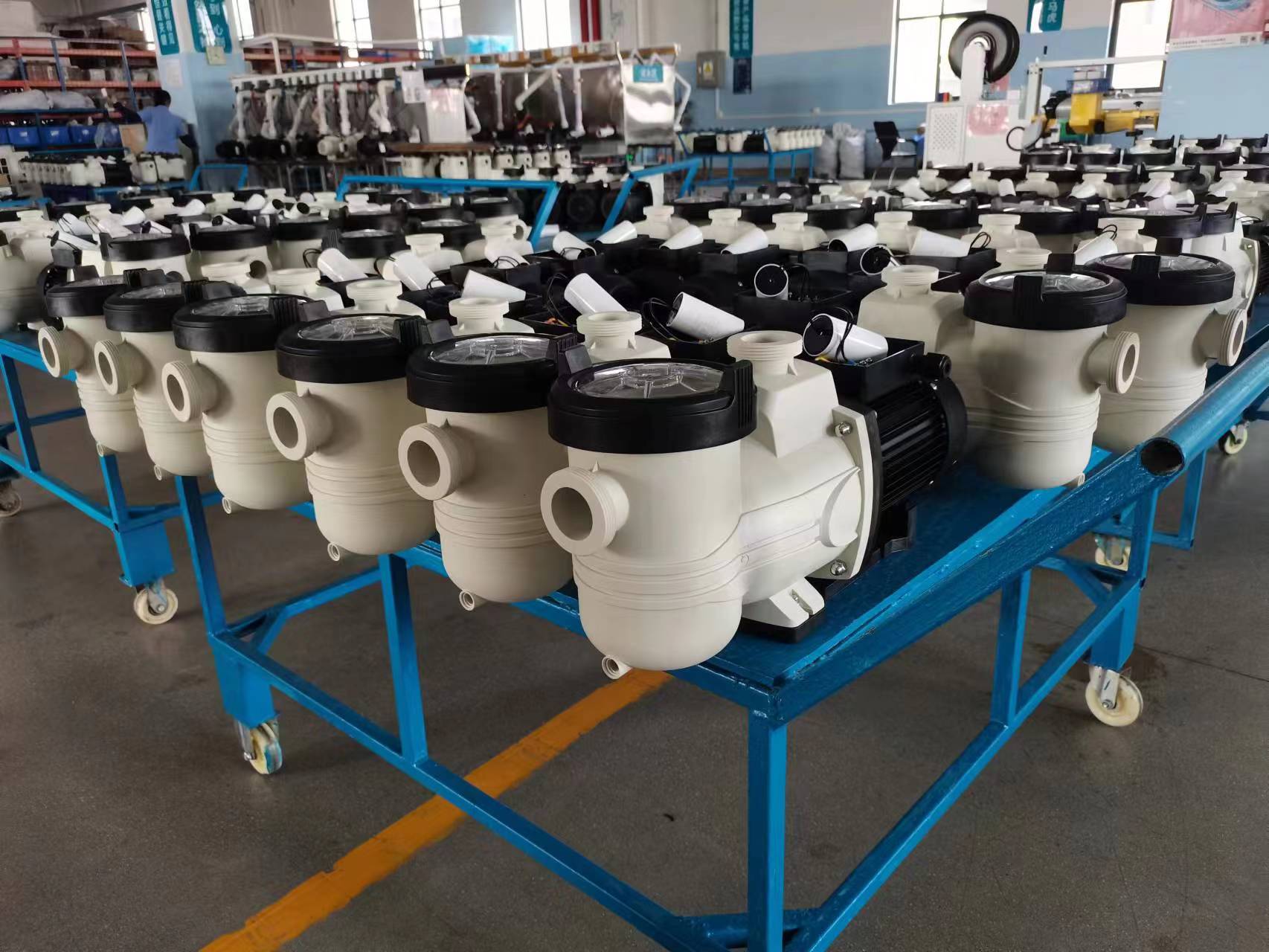
The WL-ESP series (WL-ESP033M, WL-ESP050M, WL-ESP075M, WL-ESP100M, WL-ESP120M) is a high-efficiency self-priming pump classified for residential use. Its verified operating data is: output power 0.33–1.2 HP, input power 0.26–0.9 kW, speed 2900 rpm, maximum flow rate 11–19 m³/h, and maximum head 9–13 m. The pump housing is polypropylene thermoplastic, and the mechanical seal is ceramic-carbon — a pairing selected for resistance to high temperature and dry running. That seal has undergone 25,000 life-span tests in addition to a powerful impact test, which is the durability evidence a residential buyer should look for when a pump is expected to run season after season with minimal intervention. Laswim lists the series for small home swimming pools and jacuzzis, and it is also applied in hotel, resort and public aquatic center installations where the hydraulic demand stays inside the flow and head range above.
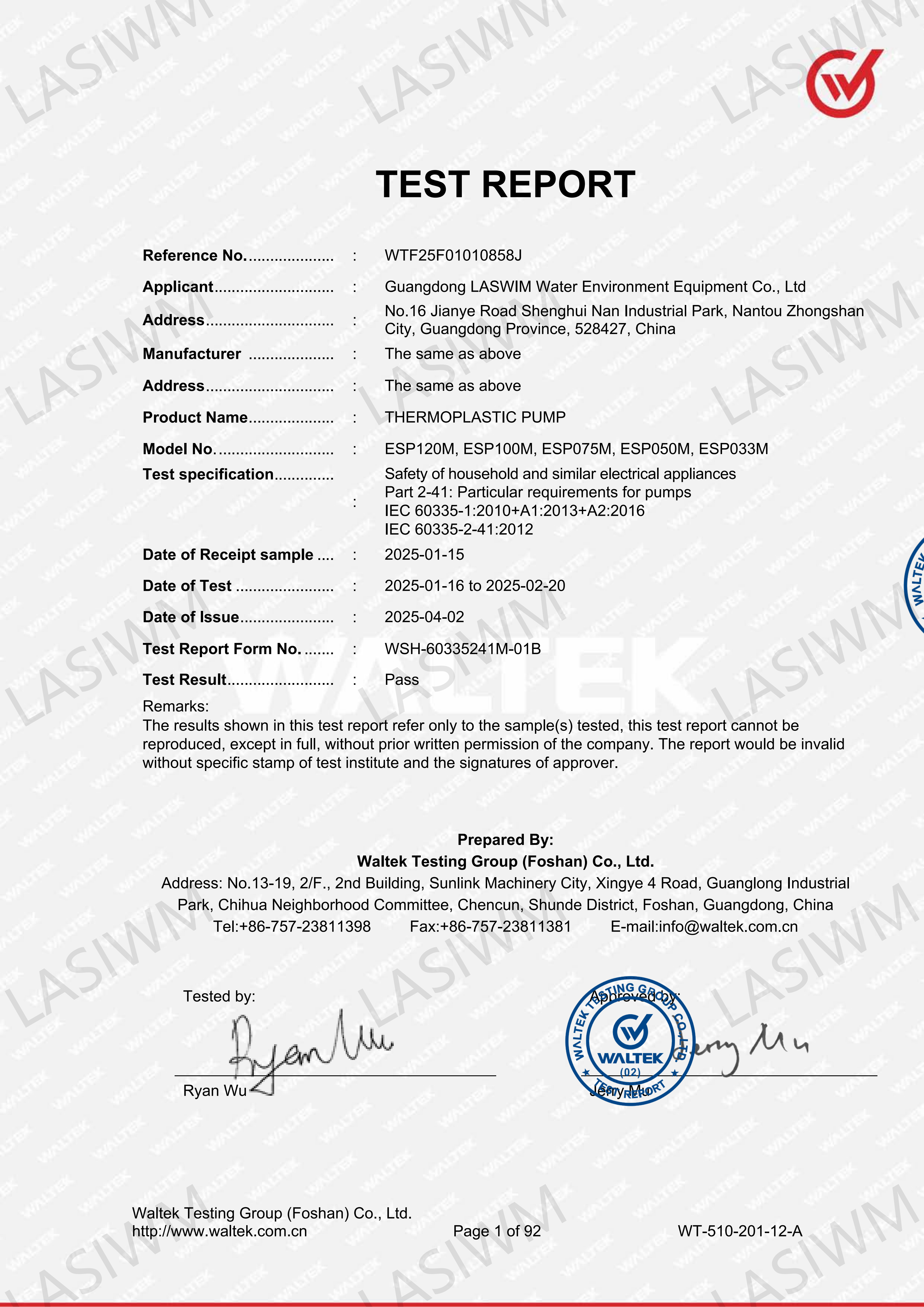
Documented compliance for the WL-ESP models is an LVD test report to EN 60335-1, EN IEC 60335-2-41 and EN 62233, applicable to the EU, UK, EEA, MEA and APAC markets, plus EMC certification issued by Waltek Testing Group (Foshan) Co., Ltd. to EN IEC 55014-1, EN IEC 55014-2, EN IEC 61000-3-2 and EN 61000-3-3.
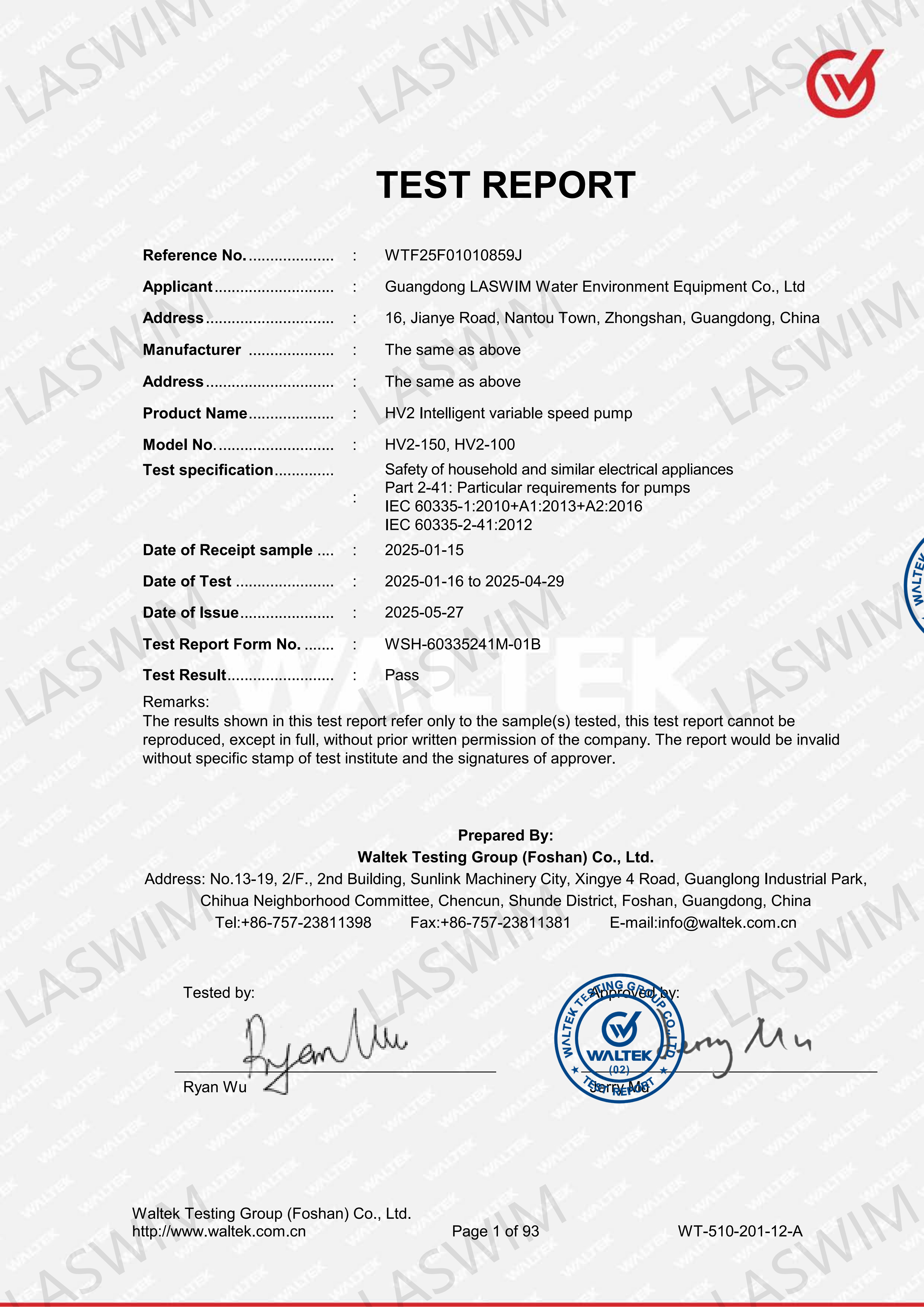
The WL-HV2 range (100, 150 and 200 models) extends the residential line-up. The WL-HV2 100–150 models hold EMC certification number WTF25F01010862E, issued by Waltek Testing Group (Foshan) Co., Ltd. under EN IEC 55014-1, EN IEC 55014-2, EN IEC 61000-3-2 and EN 61000-3-3, valid for the EU, UK, EEA, MEA and APAC markets, and the HV2-100 and HV2-150 models are additionally covered by an LVD test report to EN 60335-1, EN IEC 60335-2-41 and EN 62233. The WL-HV2 200 model is likewise covered by EMC testing to the same standard set. For a residential specifier, the practical value of this is straightforward: the residential platform is documented for both electrical safety and electromagnetic compatibility, so the pump can be submitted for inspection without additional paperwork.
3.2 Commercial duty: the heavy-duty WL-BDP series (2–4 HP)
For commercial projects, the heavy-duty commercial family (WL-BDP / WL-BHP) is the correct starting point. The verified specification for the WL-BDP models (WL-BDP200M, WL-BDP300M, WL-BDP400M, WL-BDP200T, WL-BDP300T, WL-BDP400T) is: output power 2–4 HP, input power 1.8–2.7 kW, speed 2900 rpm, maximum flow rate 42–55 m³/h, maximum head 18–19.5 m, self-priming height up to 3 m, protection rating IPX5, and a large-capacity 5 L filter basket.
Construction is the difference that matters on a commercial site. The pump housing is PP + 35% glass fiber, the base is PP + 30% glass fiber, the diffuser and seal plate are PPO + 30% glass fiber, and the shaft is SS316L stainless steel. Laswim describes the series as designed for commercial swimming pools, spas, waterfalls and water features, delivering maximum working efficiency at the lowest noise, and suitable for operation with salt chlorinators and sea water. In other words, the commercial class solves three problems that residential hardware cannot absorb: a long daily duty cycle, a continuous debris load and a corrosive water chemistry.
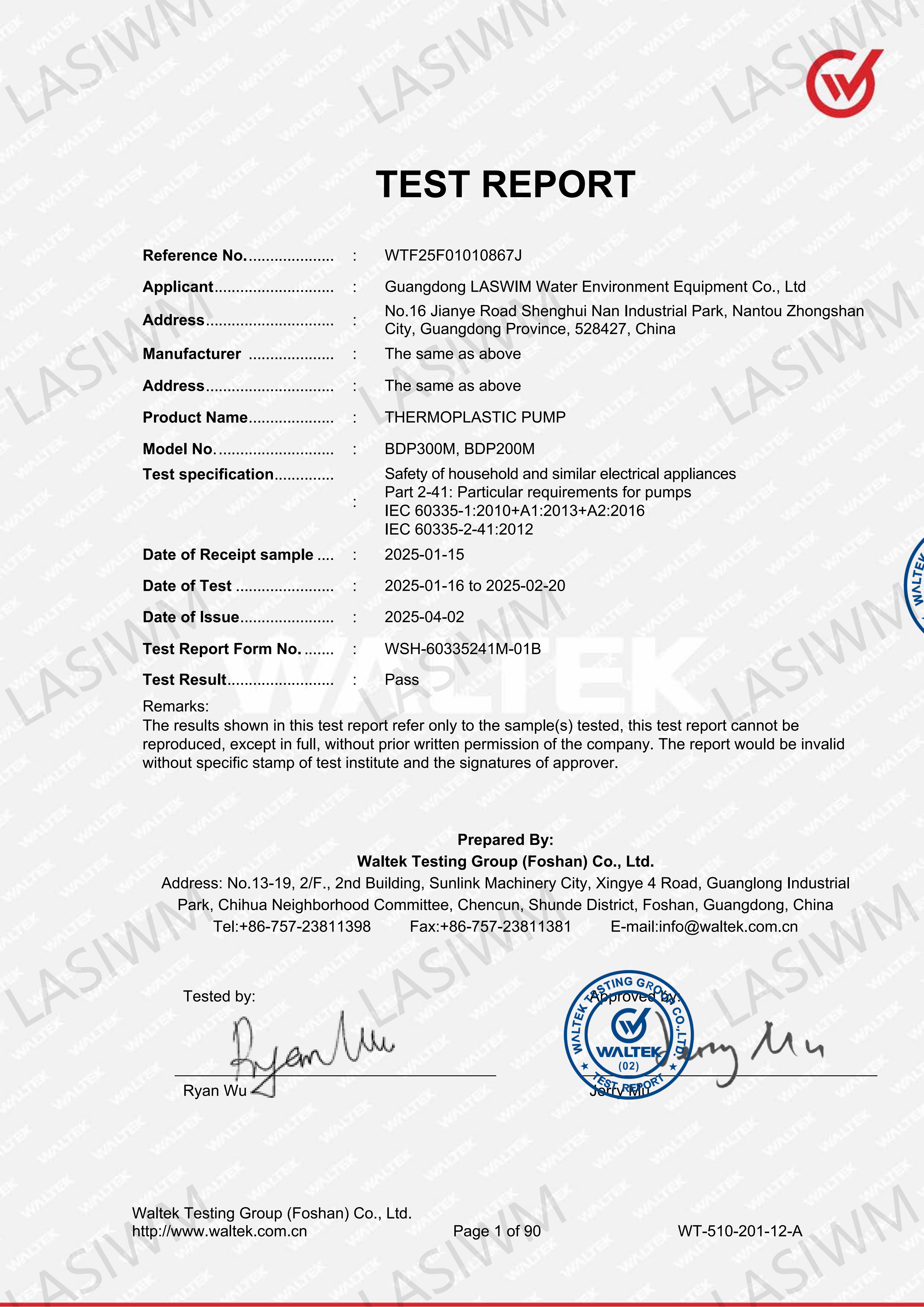
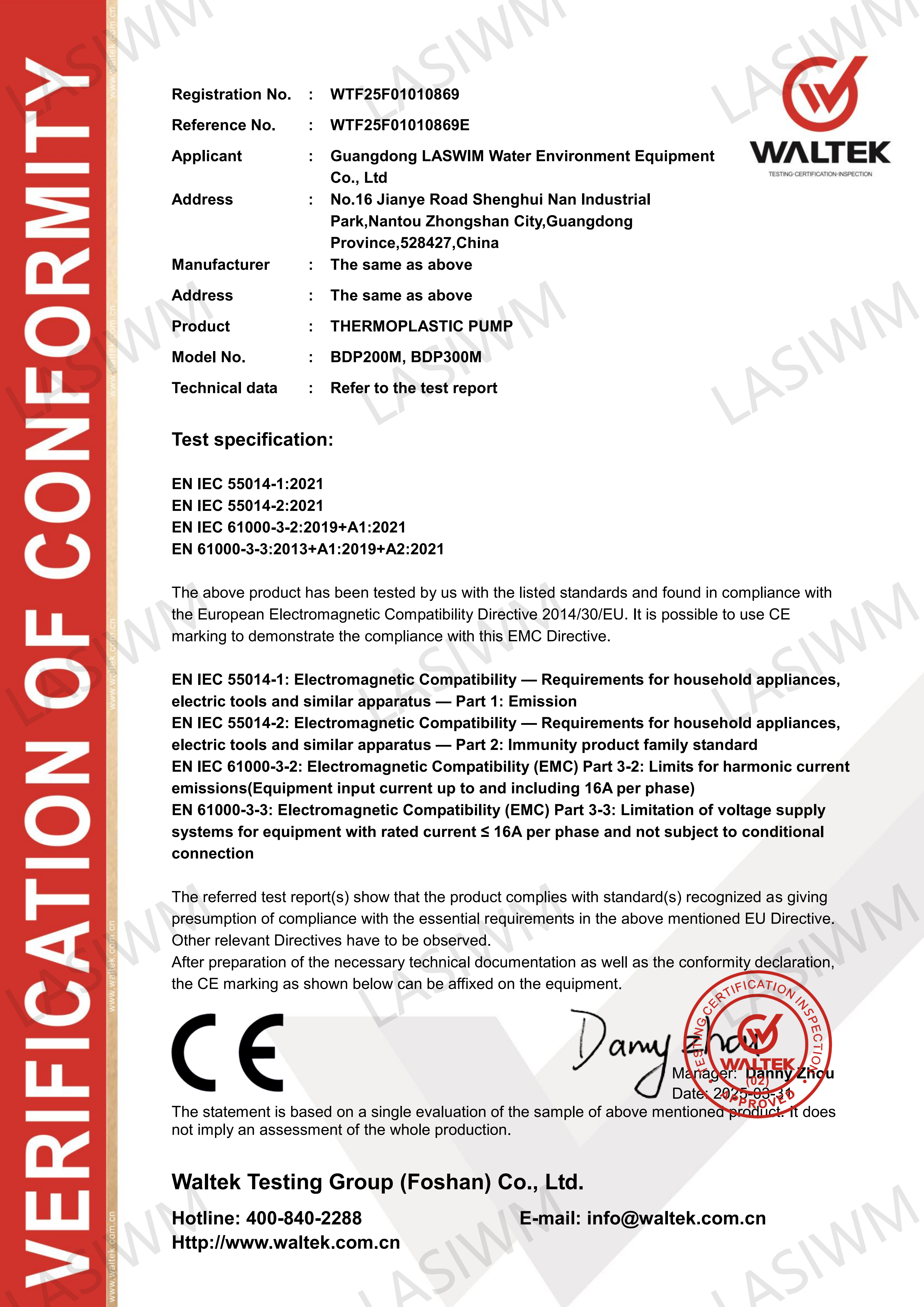
Documented compliance for the WL-BDP models is LVD test report WTF25F01010867J (EN 60335-1, EN IEC 60335-2-41, EN 62233) and EMC certification WTF25F01010869E (EN IEC 55014-1, EN IEC 55014-2, EN IEC 61000-3-2, EN 61000-3-3), both issued by Waltek Testing Group (Foshan) Co., Ltd. and valid for the EU, UK, EEA, MEA and APAC markets.
3.3 High-demand venues: the BVX300/BVX400 variable-speed pump
Between the residential and heavy-duty classes sits the application where operating hours are long, noise is a complaint risk and energy is a recurring cost line — hotel pools, water parks, spa centers and commercial swimming pools. The BVX300/BVX400 is described as an intelligent variable-speed pump and a residential and commercial dual-use unit. Its verified data is: rated output horsepower 3 HP, maximum flow rate 45 m³/h, maximum head 18.5 m, 35 m³/h at 10 m head and 39 m³/h at 8 m head, speed range 1000–3100 rpm, motor efficiency 90%, noise level below 65 dB, self-priming height up to 3 m, protection rating IPX5, and a rated power supply of 220–240 V 50/60 Hz. The pump body and diffuser are PP + 35% glass fiber, and the motor shaft is SS316.
Two features decide whether this class earns its place in a project. The first is control: Wi-Fi/Bluetooth remote control through a mobile app, a mirroring function for backup operation, and RS-485 plus passive dry contact interfaces for linkage with other pool equipment. The second is protection: freezing protection, high-temperature protection and dry-burn protection, with a rotatable control panel that adapts to different installation angles. Laswim states that variable-speed operation improves pump efficiency and reduces operational costs compared with fixed-speed running.
Documented compliance is LVD certification TST20250702446SC to EN 60335-1, issued by Dongguan True Safety Testing Co., Ltd. for the EU market, and EMC test report WTF24F10247373R1E to EN IEC 55014-1, EN IEC 55014-2, EN IEC 61000-3-2 and EN 61000-3-3, valid for the EU, UK, EEA, MEA and APAC markets.
3.4 Smart control as a residential convenience
App-based control is most useful on residential and hospitality projects, where no one is on site to adjust equipment manually. In Laswim's portfolio, documented smart-control options include the BVX300/BVX400 pump (Wi-Fi/Bluetooth app control and dry-contact linkage), the CS Pro self-cleaning salt chlorinator (CS Pro 8, 15, 20, 24 and 30, with Wi-Fi remote monitoring through the TuyaSmart app and automatic adjustment of chlorine production to real-time salinity) and the WL-EC ultraX-V salt chlorinator (V15–V50, with a touch control panel and remote monitoring via the Tuya app). Underwater lighting follows the same pattern: PS2025 and WL-series lights support remote and synchronized control when paired with the Applume Plus-S or Plus-D controllers. The practical planning rule for a residential project is to keep the pump, the disinfection system and the lighting on one control philosophy rather than assembling three independent apps.
Sizing note: a “quiet” or “energy-saving” pump claim only holds at the duty point the pump is actually set to. Confirm the model's flow at the system head — for example, 35 m³/h at 10 m head or 39 m³/h at 8 m head for the BVX300/BVX400 — rather than comparing maximum flow figures taken at zero head.
4. Step-by-Step: How to Size and Select a Pool Pump
- Classify the project by duty, not by water volume. A large private villa pool is still residential duty; a small hotel pool is commercial duty because it runs longer hours under a higher and more variable bather load.
- Establish the required flow rate. Determine the water volume that must be circulated within the target turnover window, then add the flow demanded by spa jets, waterfalls and water features. The result is a design flow in m³/h — for example, inside the 11–19 m³/h band of the WL-ESP series or the 42–55 m³/h band covered by the WL-BDP series.
- Calculate total head at that design flow. Add static lift between pool and pump and between pump and discharge point, plus friction losses through pipework, fittings, filter, heater and features. Compare the result with the maximum head of each candidate: 9–13 m for the WL-ESP series, 18–19.5 m for the WL-BDP series, 18.5 m for the BVX300/BVX400.
- Check the self-priming requirement. If the pump is installed above water level, the suction lift must remain within the model's self-priming capability — up to 3 m for the WL-BDP series and up to 3 m for the BVX300/BVX400.
- Map the duty cycle to construction. Long daily run times and heavy debris loads favor the glass fiber reinforced housing, SS316L shaft and 5 L filter basket of the commercial series. Intermittent residential operation suits the polypropylene housing and ceramic-carbon seal of the WL-ESP series, a seal validated by 25,000 life-span tests.
- Decide where variable speed pays. Where the venue runs long hours and noise matters — hotels, resorts, spa centers — the BVX300/BVX400 offers a 1000–3100 rpm speed range, 90% motor efficiency, noise below 65 dB and app or dry-contact integration.
- Confirm water chemistry compatibility. For salt-chlorinated, sea-water or spa water circuits, specify a series approved for that duty; Laswim lists the WL-BDP commercial series as suitable for operation with salt chlorinators and sea water.
- Verify compliance coverage for the destination market. Record the certificate number, the issuing laboratory and the market coverage before ordering. For the US market, Laswim's CS Pro salt chlorinators hold ETL certification number 5033484 from Intertek, based on UL 1081.
- Validate with a sample before the volume order. The minimum order quantity is 1 set, customization from samples or from designs is available, and every unit passes 100% inspection covering both function and visual checks.
5. Use Cases: Which Series Fits Which Project
- Backyard, villa and small private pool: a self-priming residential pump in the 0.33–1.2 HP band, matched to a maximum flow of 11–19 m³/h and a maximum head of 9–13 m — the WL-ESP series.
- Residential pool with salt chlorination and app control: a WL-ESP or WL-HV2 pump combined with a residential salt chlorinator (SR50–SR300 or the WL-EC ultraX-V series), so that circulation and disinfection are controlled from one interface.
- Boutique hotel or resort pool with long operating hours: a variable-speed unit in the 3 HP class, using the 1000–3100 rpm range to match flow to occupancy and to hold noise below 65 dB near guest areas — the BVX300/BVX400.
- Public aquatic center, water park or spa with water features: a heavy-duty commercial pump in the 2–4 HP class delivering 42–55 m³/h at up to 18–19.5 m of head, with a 5 L debris basket and a housing suitable for salt and sea water — the WL-BDP series.
- Renovation or retrofit driven by noise or energy complaints: replace a fixed-speed commercial-duty pump with a variable-speed model, keeping the existing head calculation and confirming the reduced-speed duty point still satisfies turnover.
- Distributor or installer building a stock program: a two-class portfolio (residential WL-ESP/WL-HV2 plus commercial WL-BDP) rather than a single best-selling model, supported by a monthly capacity of 200,000 sets and a minimum order quantity of 1 set.
6. Comparison Table: Laswim Pump Series at a Glance
| Series | Duty class & typical application | Hydraulic data | Construction & durability evidence | Documented compliance |
|---|---|---|---|---|
| WL-ESP (WL-ESP033M – WL-ESP120M) | Residential self-priming; small home pools and jacuzzis, also applied in hotel, resort and public aquatic center circuits within its flow range | Output 0.33–1.2 HP; input 0.26–0.9 kW; 2900 rpm; max flow 11–19 m³/h; max head 9–13 m | Polypropylene thermoplastic housing; ceramic-carbon mechanical seal with 25,000 life-span tests plus impact test | LVD test report to EN 60335-1, EN IEC 60335-2-41, EN 62233; EMC to EN IEC 55014-1/-2 and EN IEC 61000-3-2/-3-3 (EU, UK, EEA, MEA, APAC) |
| WL-BDP (200M/300M/400M, 200T/300T/400T) | Commercial heavy duty; commercial pools, spas, waterfalls and water features; suitable for salt chlorinators and sea water | Output 2–4 HP; input 1.8–2.7 kW; 2900 rpm; max flow 42–55 m³/h; max head 18–19.5 m; self-priming up to 3 m; IPX5 | PP + 35% glass fiber housing; PP + 30% GF base; PPO + 30% GF diffuser and seal plate; SS316L shaft; 5 L filter basket | LVD test report WTF25F01010867J; EMC certificate WTF25F01010869E (EU, UK, EEA, MEA, APAC) |
| BVX300 / BVX400 | High-demand venues: hotel pools, water parks, spa centers, commercial pools; residential and commercial dual-use | 3 HP rated output; max flow 45 m³/h; max head 18.5 m; 35 m³/h at 10 m head; 39 m³/h at 8 m head; 1000–3100 rpm; 90% motor efficiency; below 65 dB; self-priming up to 3 m; IPX5; 220–240 V 50/60 Hz | PP + 35% glass fiber body and diffuser; SS316 motor shaft; freeze, high-temperature and dry-burn protection; rotatable control panel | LVD certificate TST20250702446SC (EN 60335-1); EMC report WTF24F10247373R1E (EU, UK, EEA, MEA, APAC) |
The WL-HV2 100–200 residential range is additionally documented in Laswim's LVD and EMC test scope as described in Section 3.1.
7. FAQ: Sizing and Buying Questions Buyers Ask Most
Which certifications should a pool pump carry for EU, UK and APAC projects?
Start from the applicable standard family. Pool pumps for liquids fall under safety standard IEC 60335-2-41:2024, published by the International Electrotechnical Commission and addressing electric pumps for household use; Laswim's pump test reports reference EN 60335-1, EN IEC 60335-2-41 and EN 62233 for safety, and EN IEC 55014-1, EN IEC 55014-2, EN IEC 61000-3-2 and EN 61000-3-3 for electromagnetic compatibility. Concretely, the WL-BDP commercial models are covered by LVD test report WTF25F01010867J and EMC certificate WTF25F01010869E, the WL-ESP residential models by an LVD test report and EMC certification from Waltek Testing Group (Foshan) Co., Ltd., the BVX300/BVX400 by LVD certificate TST20250702446SC and EMC report WTF24F10247373R1E, and the WL-HV2 100–150 by EMC certificate WTF25F01010862E — with market coverage stated as EU, UK, EEA, MEA and APAC. For the US market, Laswim's CS Pro salt chlorinators carry ETL certification number 5033484 issued by Intertek to UL 1081.
Can one pump series serve both a residential pool and a commercial project?
Only within a defined hydraulic band. The WL-ESP series is classified as a residential pump but is applied in hotel, resort and public aquatic center circuits when the duty point stays inside a maximum flow of 11–19 m³/h and a maximum head of 9–13 m. The BVX300/BVX400 is explicitly described as a residential and commercial dual-use pump, delivering up to 45 m³/h at a maximum head of 18.5 m with variable speed. Above that envelope — commercial pools, water parks and spa facilities with heavy debris loads and long daily run times — the heavy-duty WL-BDP series (2–4 HP, 42–55 m³/h, 18–19.5 m maximum head) is the appropriate class, because its glass fiber reinforced housing, SS316L shaft and 5 L filter basket are built for that duty rather than adapted to it.
How should a buyer compare the cost of a residential pump with a commercial pump?
Compare on a duty-cycle-adjusted basis rather than on purchase price. Three verifiable cost drivers separate the classes: energy, since variable-speed operation on the BVX300/BVX400 uses a 90% efficiency motor and intelligent speed control that Laswim states improves pump efficiency and reduces operational costs; service life, since the WL-ESP ceramic-carbon mechanical seal has passed 25,000 life-span tests while the WL-BDP series uses glass fiber reinforced housing and an SS316L shaft for continuous commercial operation; and compliance, because the certificate and test report set must match the destination market, which is a real cost item when it is missing at the port rather than at the quotation stage. Purchase prices themselves are project-specific and should be quoted against a defined flow, head and duty cycle.
Can we test a pool pump before committing to a volume order?
Yes. Laswim accepts a minimum order quantity of 1 set, so a single pump can be validated against the project's own duty point before a larger commitment. Customization is available from samples and from designs, and can be full, minor or flexible — including voltage customization. Every unit passes 100% inspection covering function and visual checks, and test reports for the destination market are available alongside the sample so the compliance path is tested at the same time as the hydraulics.
What lead times and after-sales support apply to Laswim pool pumps?
Lead time is stated as within 15 workdays in both peak season and off season, with a one-month option, and supported by a monthly production capacity of 200,000 sets. After-sales support covers installation guidance, commissioning and operation training, prompt troubleshooting, local service support, and assistance from the original manufacturer's technical team. To move from specification to a sized recommendation, send the project type (residential or commercial), pool volume, target turnover, total head and water chemistry, and request a quotation or a sample unit; the complete Laswim Commercial & Residential Swimming Pool Equipment Catalog can be downloaded here for series-level reference: Laswim Pool Equipment Catalog (PDF).
8. Conclusion: Size the Duty First, Then Choose the Pump
Residential and commercial pool pumps are separated by duty, not by marketing tier. Flow rate, total head and daily duty cycle decide which class can hold the operating point; the class then decides the housing material, the seal, the debris basket and the compliance file. In practice: the WL-ESP series (0.33–1.2 HP, 11–19 m³/h, 9–13 m maximum head, 25,000 life-span tested seal) covers residential pools, with the WL-HV2 100–200 range extending that platform; the heavy-duty WL-BDP series (2–4 HP, 42–55 m³/h, 18–19.5 m maximum head, glass fiber reinforced housing, SS316L shaft) is the commercial workhorse for pools, spas and water features; and the BVX300/BVX400 variable-speed pump (3 HP, 1000–3100 rpm, below 65 dB, 90% motor efficiency) serves high-demand venues where operating hours and noise are the binding constraints.
Next step: size the pump against your project data
Send us the project type, pool volume, target turnover, total head and water chemistry, and we will recommend the series and model that matches the duty point. Samples can be ordered from a minimum quantity of 1 set, with lead time stated as within 15 workdays.
Email: laswimpoolwater@gmail.com · Tel / WhatsApp: +86 18022011329 · Website: www.laswimaqua.com
Download the Laswim Commercial & Residential Swimming Pool Equipment Catalog (PDF)