
Resistance Band Basics: Mini Loop vs. Power Loop and Pull-Up Band Explained
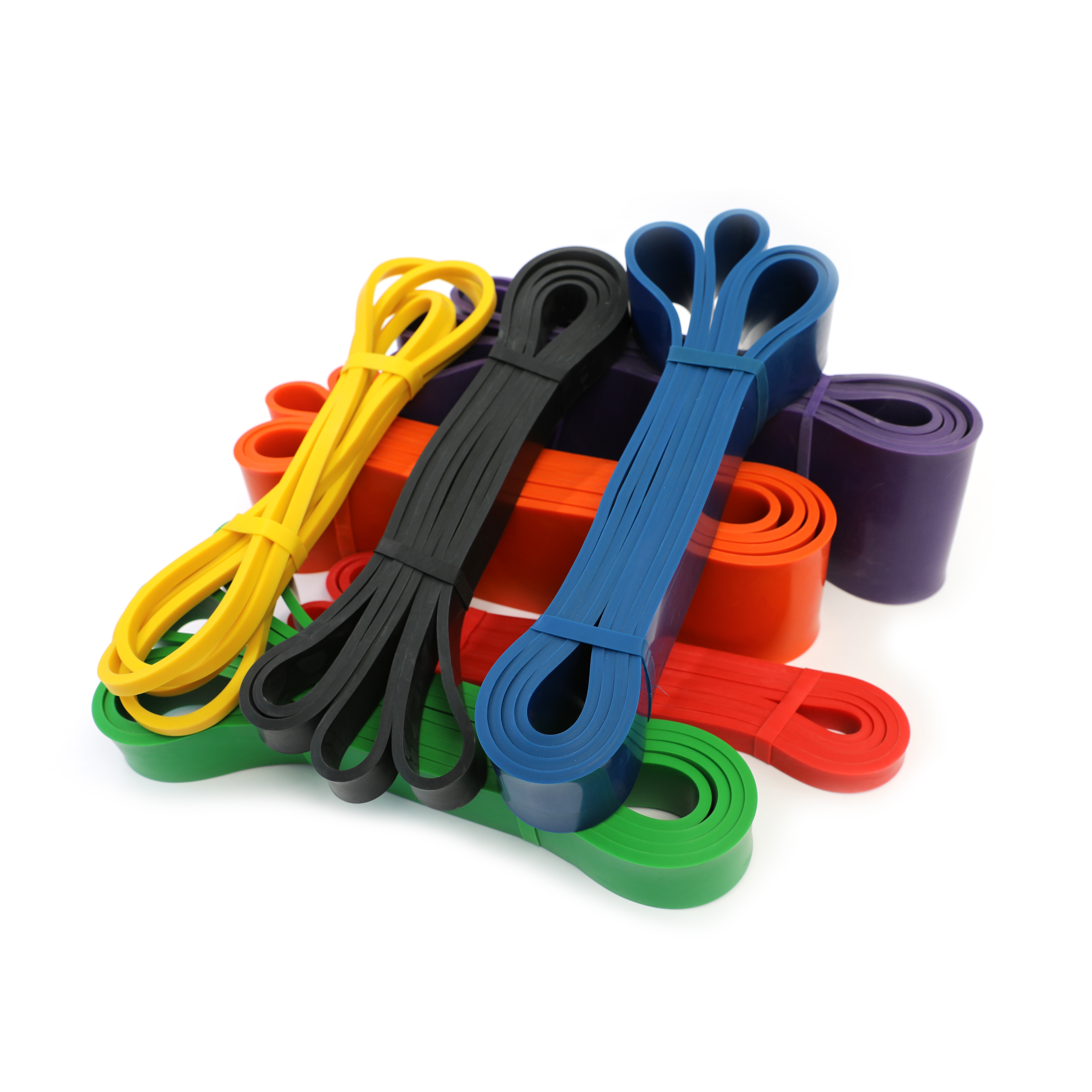
"Resistance band" is one of the most widely used product names in fitness equipment, and one of the least precise. A 600 mm loop designed to sit around the thighs and a 2,080 mm loop designed to be anchored under a foot or over a pull-up bar are both sold under the same term, even though they are built for different movements, different load windows and different users.
This guide is a plain-language introduction to the two categories that cause the most confusion: mini loop bands and power loop / pull-up bands. Two Libenli reference products are used throughout - the ZLQ-1 mini loop band and the ZLQ-03 power loop band - so every specification discussed is tied to a published number rather than a general impression. The aim is category literacy: being able to look at any loop band and identify which family it belongs to, what it can realistically do, and which figures on the label actually matter.
Why "Resistance Band" Is an Ambiguous Product Name
The confusion starts with naming. The same physical construction is sold as resistance loop bands, mini loop bands, booty bands, hip bands, elastic workout bands, stretch bands, rubber exercise bands, power bands, pull up assist bands, long resistance bands and heavy resistance bands. A "resistance band set" often mixes two or three of these families in one box, and buyers searching with a single keyword can land on a product that is mismatched to the movement they have in mind.
Three practical problems follow from that:
- Shape mismatch. A short loop cannot be anchored to a bar or a rack; a long loop is impractical to keep positioned above the knees during lateral walking. Geometry defines the exercise menu before resistance even enters the conversation.
- Load mismatch. A band at the bottom of a mini loop range will not meaningfully assist a pull-up, and a heavy long loop will not behave well as a glute activation tool. Resistance level has to be matched to the movement rather than chosen by colour preference.
- Spec mismatch. Thickness, width and loop length change how a band loads up as it stretches. Two bands with an identical resistance rating but different width and thickness feel distinctly different in the hand and on the joint.
The fix is simple: reduce the category to two shapes (short loop, long loop), then read four numbers (resistance window, thickness, width, and length or circumference). Colour, branding and packaging are secondary to those four figures.
Where Resistance Bands Sit in the Fitness Market
Resistance bands are not a niche accessory. Grand View Research valued the global resistance bands market at approximately USD 1.7 billion in 2024 and projects it to reach USD 2.9 billion by 2030, a CAGR of 9.9% between 2025 and 2030. North America held the largest revenue share at 40.0% in 2024.
The demand profile explains why both loop families exist. Grand View Research reports that health and sports clubs accounted for a 70.6% revenue share in 2024, while individual use is the fastest-growing segment - which is why the same category now spans institutional gym fit-outs and single-user home kits. Market Research Future estimates that therapy and exercise bands represent roughly 50% of the global resistance bands market as of 2024/2025, reflecting how firmly the category has moved into rehabilitation and clinical settings.
The competitive field is correspondingly broad, with names such as TheraBand (Performance Health), Black Mountain Products, Rogue Fitness, TRX and Decathlon appearing frequently in category reporting. Alongside branded consumer products sits a large OEM/ODM manufacturing layer: Haiyang Libenli Body-Building Apparatus Co., Ltd., commonly known as Libenli, is a manufacturer and exporter founded in 1997 that specialises in latex tubing and latex resistance bands, including the ZLQ-1 and ZLQ-03 models discussed below.
The Two Core Loop Families Explained
Mini loop bands: short, flat, low-to-mid resistance
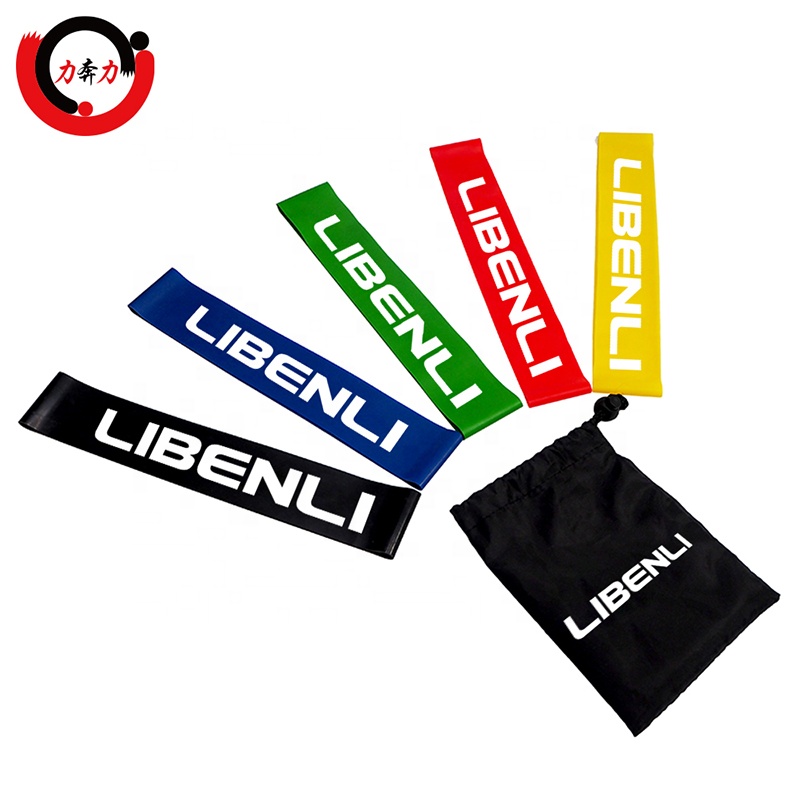
A mini loop band is a short, wide, flat loop that sits around the thighs, knees or ankles. The Libenli ZLQ-1 is a mini loop band offered in a standard version and as a mini loop band with anti-slip design. Its published specification is a resistance range of 5 LB-40 LB, a thickness of 0.3 mm-1.2 mm, a width of 50 mm, a circumference of 600 mm and a fatigue resistance of at least 30,000 stretches. The model is available in Latex or TPE.
Its intended industries are Home Fitness, Yoga & Pilates, Hip & Glute Training, Sports Rehabilitation, Physical Therapy and Gym Training Equipment. That list summarises what the shape is for: joint-adjacent work where the band stays in place, the load is modest, and control matters more than maximum tension. The anti-slip design targets the most common complaint about short loops - a band that rolls or slides during lateral movement.
Power loop bands and pull-up bands: long, wide, high resistance
Power loop bands and pull-up bands belong to the same construction family: a long continuous loop that can be anchored under a foot, around a rack or over a pull-up bar, and doubled to raise tension. The Libenli ZLQ-03 is classified as a power loop band and a double layer power loop band. Its published specification is a resistance level of 8 LB-230 LB, a thickness of 0.45 mm, a width of 6.4 mm-82.5 mm, a length of 2,080 mm and a service life of at least 20,000 stretches. It is made from Latex.
Its intended industries are Fitness Gym, Home Workout, Sports Rehabilitation, Yoga Training, Physical Therapy and Outdoor Training Equipment. The difference from a mini loop is not only length. An upper limit of 230 LB means one product family can provide a light assist for a strong athlete and still deliver meaningful resistance for strength work, stretching and mobility. The 6.4 mm-82.5 mm width range reflects that spread: narrow bands deliver light assistance, wide bands carry heavy loads.
Naming within this family is loose. Pull up assist bands, long resistance bands, heavy resistance bands and stretch resistance bands are usually long-loop products, and the intended use - assistance, anchoring, heavy pulling - is what separates them rather than the label.
Materials: latex and TPE
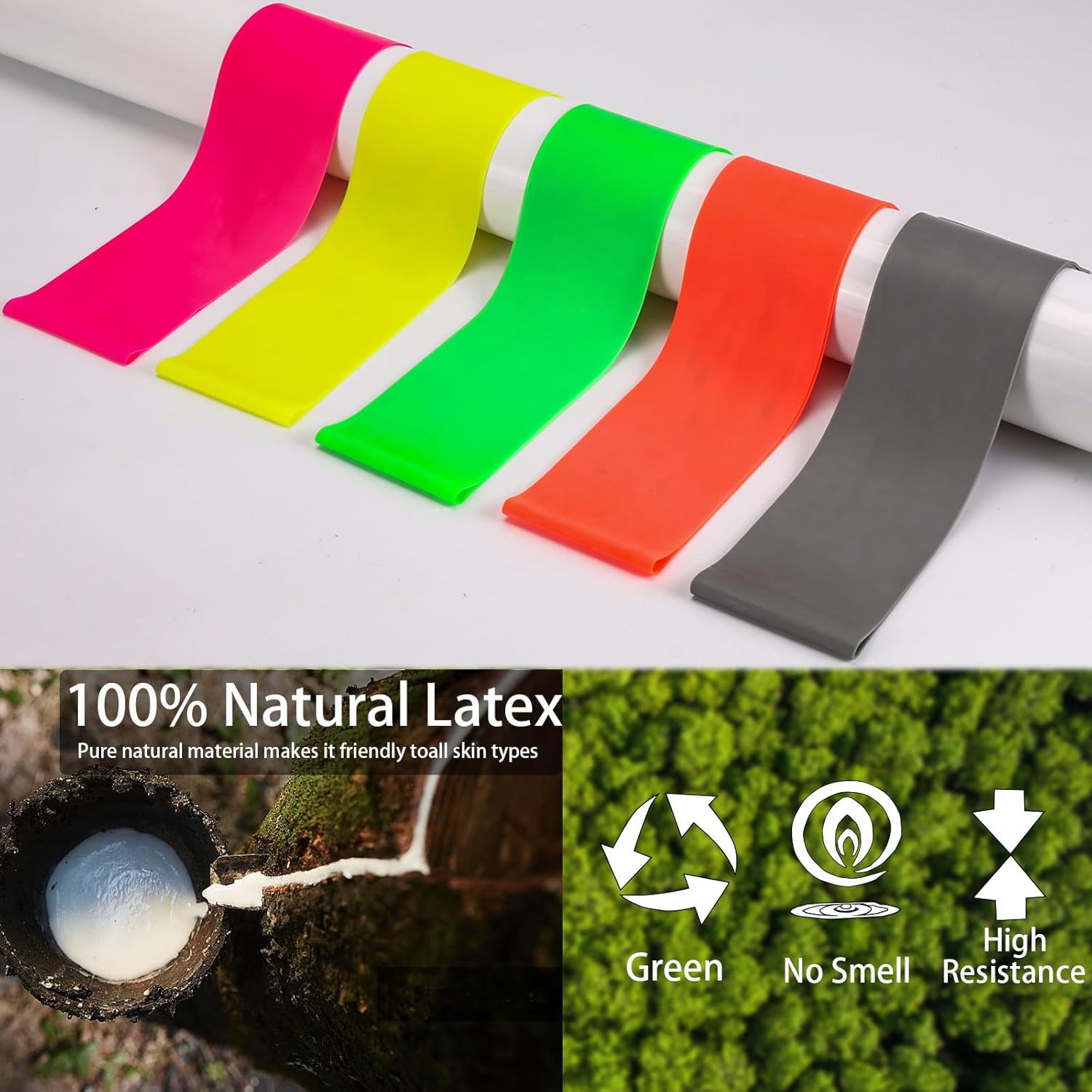
Material is a first-class specification, not a footnote. The ZLQ-1 mini loop band is available in Latex or TPE; the ZLQ-03 power loop band is a latex product. Both models are produced under the same application requirement of 100% natural, non-toxic latex, high stretch durability, skin-friendly surfaces and multiple resistance colour grades, with the material choice on ZLQ-1 allowing a non-latex option to be specified where that matters for a market or user group.
Other constructions exist in the wider market - woven fabric bands, nylon bands, and handled or bar-based resistance systems, for example - but they are engineered differently from latex loops and are better evaluated as separate product categories than as substitutes for a mini loop or a power loop band.
Reading a Resistance Band Spec Sheet: The Four Numbers That Matter
- Resistance window (LB). The ZLQ-1 covers 5 LB-40 LB; the ZLQ-03 covers 8 LB-230 LB. A range rather than a single figure reflects the fact that elastic tension rises as the band is stretched, and it is what defines the usable span when a product is sold in several colour-coded levels.
- Thickness. The ZLQ-1 is specified at 0.3 mm-1.2 mm and the ZLQ-03 at 0.45 mm. Thickness works together with width to determine how the band feels under load.
- Width. 50 mm for the ZLQ-1 mini loop, versus 6.4 mm-82.5 mm for the ZLQ-03. A wider band carries more material per unit of stretch, making width one of the main levers for raising or lowering resistance inside the same family.
- Length or circumference. 600 mm circumference for the mini loop, 2,080 mm length for the power loop. This is the number that decides which exercises are physically possible.
Two further figures belong on the same list. Fatigue resistance for the ZLQ-1 is at least 30,000 stretches; service life for the ZLQ-03 is at least 20,000 stretches. These are durability statements rather than training recommendations, but they matter when a band is used daily in a studio or clinic. Surface behaviour is the last item: anti-slip on the mini loop, and resistance to rolling or pinching under high load on long loops.
Constraint Checks Before You Buy: Certification, Standards and Customs
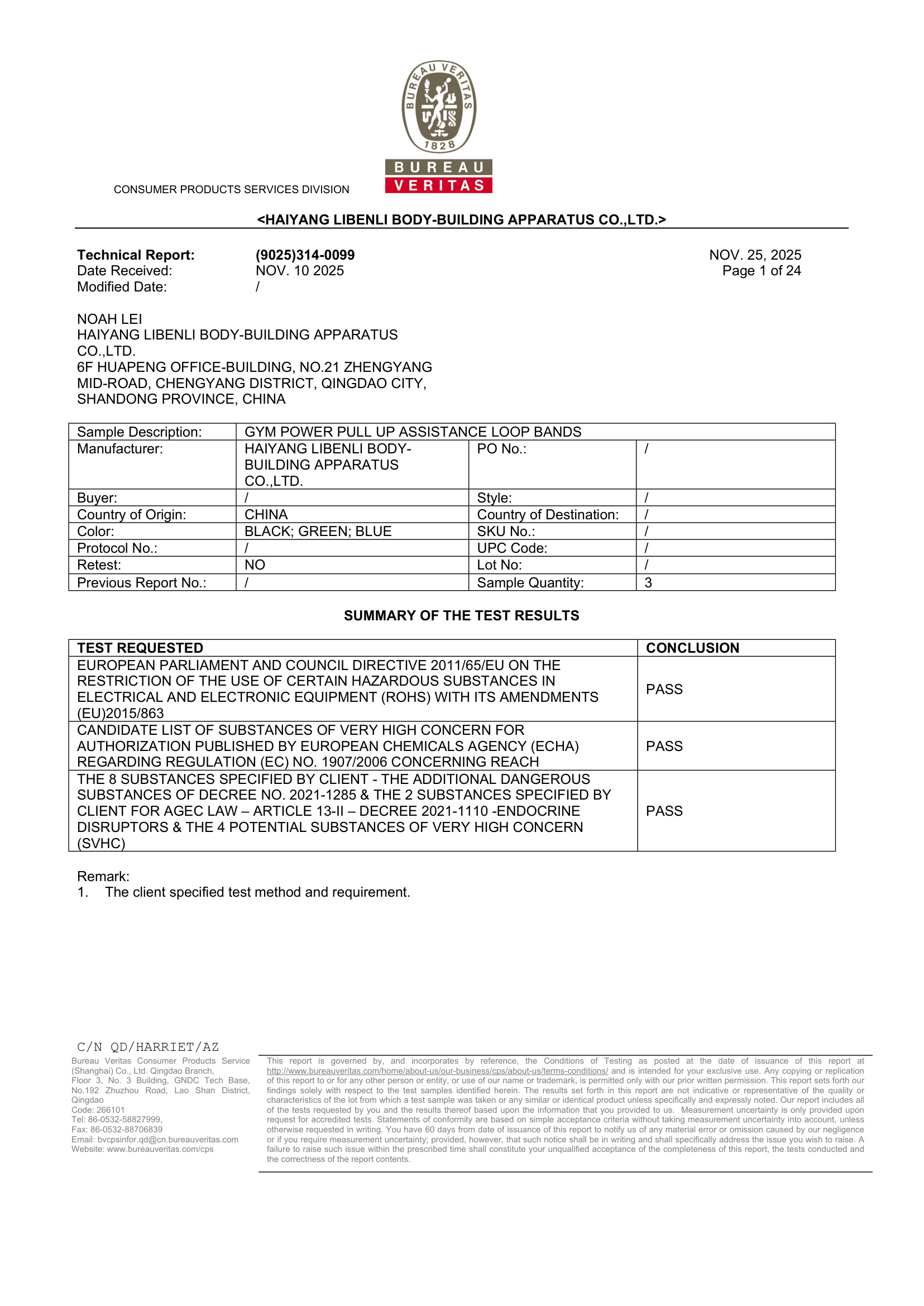
For a product this simple, compliance is often the deciding constraint. The ZLQ-1 mini loop band and ZLQ-03 pull up band are covered by a ROHS & REACH test report issued by Bureau Veritas under certificate number (9025)314-0099, issued 25 November 2025 and applicable to the EU market. The report scope covers gym power pull-up assistance loop bands and confirms compliance with Directive 2011/65/EU (RoHS) and Regulation (EC) No. 1907/2006 (REACH).
Two reference points help place that document in context. According to the European Committee for Standardization (CEN), fitness equipment such as resistance bands entering the EU is assessed against the EN 20957 series for stationary training equipment for CE marking purposes. For customs purposes, resistance bands are commonly classified under HS Code 9506.91 - articles for general physical exercise, gymnastics or athletics - as listed by the World Customs Organization and USITC.
At manufacturer level, Libenli holds ISO 9000:2000 Quality Certification (2005) and ISO 9001:2008 Quality Management System Certification (2010), together with a 3A Credit Rating Certificate issued by the Ministry of Commerce of China and CCPIT. The company also holds 2 invention patents and 18 utility model patents, and most items are certified by SGS to meet international environmental and safety requirements. Quality control for these bands includes a stretch durability test before shipment.
The practical difference this buys appears in fatigue behaviour. In a long-running program for an international premium fitness brand in Australia, Libenli engineered an anti-rolling surface treatment to stop bands curling or pinching under high load and delivered a five-tier resistance system with a tension error margin within plus or minus 2%. That program has run at a defect and complaint rate below 0.05%, with annual supply exceeding 150,000 units across more than 12 specialised product lines.
Step-by-Step: Matching a Band to a Movement
- Start with the movement, not the band. Name the exercise first: lateral band walk, glute bridge, assisted pull-up, overhead stretch or a shoulder rotation drill. The movement decides the family before any resistance figure is considered.
- Choose the family. Joint-adjacent, low-load work with the band worn around the legs points to a mini loop band such as the ZLQ-1. Anchored, full-range or heavy-load work - including assisted pull-ups - points to a long loop such as the ZLQ-03.
- Set the resistance window. Mini loop: 5 LB-40 LB. Power loop: 8 LB-230 LB. Choose a working range, then pick a level that allows complete, controlled repetitions rather than a maximum-tension attempt.
- Match width and thickness to the load. If the target load sits near the top of a family's range, expect to move to a wider band instead of simply pulling harder on a narrow one.
- Confirm material, surface and documentation. Latex or TPE, anti-slip or standard surface, and the compliance documents required for the destination market - RoHS and REACH for the EU being the relevant example here.
Use Cases: Where Each Loop Type Performs
The published application profile for these bands covers gym fitness, yoga and Pilates, physical rehabilitation, sports training and home workouts, with a working condition of indoor and normal indoor environments, room temperature between -10 degrees C and 50 degrees C, and dry, low-dust surroundings. The operation mode is manual pulling and stretching with repeated tension exercise, and typical matched equipment includes a yoga mat, fitness handles, ankle straps and a workout storage bag.
Home fitness kits. The mini loop band is the natural starter item: short, easy to store, and suitable for muscle stretching, strength training, joint rehabilitation, body shaping and yoga auxiliary exercise. Adding a long loop brings assisted pull-ups and anchoring work into the same kit.
Yoga and Pilates. Both models list yoga training as an intended application. Mini loops support alignment and glute work at low load; long loops support stretching and resistance-assisted positions.
Hip and glute training. This is the core strength of the short loop. The 600 mm circumference and 50 mm width of the ZLQ-1 keep the band positioned around the thighs or ankles, and the anti-slip version exists specifically to stop it migrating mid-set.
Sports rehabilitation and physical therapy. Both product families list physical therapy and sports rehabilitation. Low-resistance mini loops suit early-stage joint work, while long loops cover progressive loading, stretching and movement retraining at higher resistance.
Gyms and studio fit-outs. The ZLQ-03 range is designed for this environment, where one product family has to cover light assistance through heavy loading across many users and stations.
Outdoor training. Outdoor Training Equipment is listed among the intended industries for the ZLQ-03, whose 2,080 mm length makes it portable and anchorable outside a gym.
ZLQ-1 vs ZLQ-03: Specification Comparison
| Specification | ZLQ-1 mini loop band | ZLQ-03 power loop / pull-up band |
|---|---|---|
| Product type | Mini loop band; mini loop band with anti-slip | Power loop band; double layer power loop band |
| Material | Latex / TPE | Latex |
| Resistance range | 5 LB-40 LB | 8 LB-230 LB |
| Thickness | 0.3 mm-1.2 mm | 0.45 mm |
| Width | 50 mm | 6.4 mm-82.5 mm |
| Length / circumference | 600 mm circumference | 2,080 mm length |
| Fatigue / service life | At least 30,000 stretches | At least 20,000 stretches |
| Intended industries | Home Fitness, Yoga & Pilates, Hip & Glute Training, Sports Rehabilitation, Physical Therapy, Gym Training Equipment | Fitness Gym, Home Workout, Sports Rehabilitation, Yoga Training, Physical Therapy, Outdoor Training Equipment |
| EU compliance documentation | ROHS & REACH test report, certificate number (9025)314-0099, issued by Bureau Veritas; Directive 2011/65/EU and Regulation (EC) No. 1907/2006 | |
Read the table as two different jobs rather than two quality tiers. The mini loop band solves positioning and control; the power loop band solves reach and load. Most complete training kits - and most well-built resistance band sets - contain both.
FAQ
Do the ZLQ-1 mini loop band and ZLQ-03 pull-up band have EU compliance documentation?
Yes. Both products are covered by a ROHS & REACH test report issued by Bureau Veritas under certificate number (9025)314-0099, issued 25 November 2025 and applicable to the EU market. The report confirms compliance with Directive 2011/65/EU (RoHS) and Regulation (EC) No. 1907/2006 (REACH), and its scope covers gym power pull-up assistance loop bands. For context, the European Committee for Standardization notes that fitness equipment entering the EU is assessed against the EN 20957 series for stationary training equipment for CE marking, and resistance bands are commonly classified under HS Code 9506.91.
How do I decide between a 600 mm mini loop band and a 2,080 mm power loop band?
Decide by movement first, then by load. The ZLQ-1 mini loop band - 600 mm circumference, 50 mm width, 5 LB-40 LB - is designed for hip and glute training, yoga and Pilates work, low-load sports rehabilitation and physical therapy, where the band has to stay positioned around the legs. The ZLQ-03 power loop band - 2,080 mm length, 6.4 mm-82.5 mm width, 8 LB-230 LB - is designed for gym training, assisted pull-ups, anchored strength and stretching work, home workouts and outdoor training, where reach and higher tension are the priority.
What should buyers verify when working with latex-certified resistance band manufacturers?
Four things are worth confirming in writing. First, the compliance document itself: certificate number, issuing body, product scope and the directives referenced - for example Bureau Veritas report (9025)314-0099 under Directive 2011/65/EU and Regulation (EC) No. 1907/2006. Second, the material declaration, since a model such as the ZLQ-1 is available in Latex or TPE while the ZLQ-03 is latex. Third, the quality system and testing behind the product, such as ISO 9001:2008 certification, SGS testing and a stretch durability check before shipment. Fourth, manufacturer longevity and capability signals - Libenli, for instance, was founded in 1997, holds ISO 9000:2000 (2005) and ISO 9001:2008 (2010) certifications plus a 3A Credit Rating Certificate from the Ministry of Commerce of China and CCPIT, and holds 2 invention patents and 18 utility model patents.
What are the minimum order quantity and lead time for these resistance bands?
For in-stock items the minimum order quantity is 100 pieces; for a customized logo it is 500 pieces. Production lead time is 20-35 days, against a monthly capacity of 1,200,000 units. Customization can cover resistance strength, band thickness and width, length, surface colour, logo silk printing, package design and accessory matching, which is why the customized-logo threshold is higher than the in-stock threshold.
Can I request samples before placing a full order?
Yes. Samples can be requested by sending the target model, resistance level and intended application to the manufacturer, so that the band is validated against the actual movement rather than a catalogue description. Libenli also backs shipments with free unconditional returns for defective goods upon receipt. To start, review the Libenli product catalog and send your specification list to public@libenli.cn.
Conclusion
The two loop families answer two different questions. Mini loop bands such as the ZLQ-1 - 600 mm circumference, 50 mm width, 5 LB-40 LB, with an anti-slip option and a choice of Latex or TPE - handle positioning-sensitive, lower-load work around the hips, glutes and joints. Power loop and pull-up bands such as the ZLQ-03 - 2,080 mm length, 6.4 mm-82.5 mm width, 8 LB-230 LB in latex - handle anchoring, assistance and heavier loading across gym, home, therapy and outdoor settings.
Read the label in this order: resistance window, thickness, width, then length or circumference. Then check the constraint layer that decides most real purchases - material, surface behaviour, and the certification documents required for the destination market, with the Bureau Veritas ROHS & REACH report (9025)314-0099 covering both models for the EU. Get those two layers right and the rest of the category becomes easy to navigate.
Next step: verify the specs on your own sample
Libenli has manufactured latex tubing and resistance bands since 1997, supplying the ZLQ-1 mini loop band and ZLQ-03 power loop band in Latex and TPE with OEM/ODM customization, a 20-35 day lead time and compliance documentation for the EU market.
Download the product catalog (PDF) and request samples or a quotation for your target specification.
Email: public@libenli.cn | Tel / WhatsApp: +86 13864846995 | Chat on WhatsApp | Website: www.latextubing.com
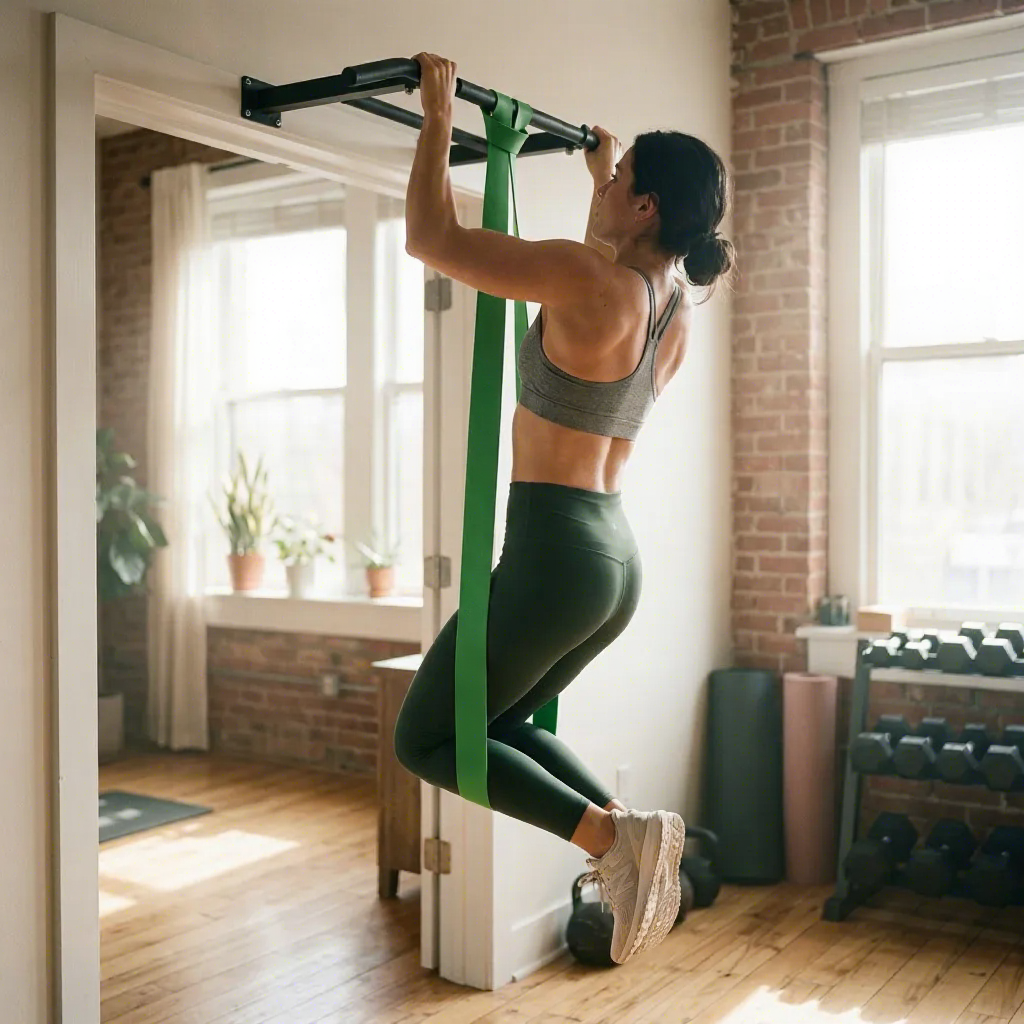
Resistance bands for home fitness, yoga, gym training, sports rehabilitation and physical therapy. This article describes published product specifications; follow the instructions supplied with your product and seek professional guidance for rehabilitation use.