Resistance Band Manufacturers in China: 2026 Evaluation Guide for Buyers
Resistance Band Manufacturers in China: 2026 Evaluation Guide for Buyers
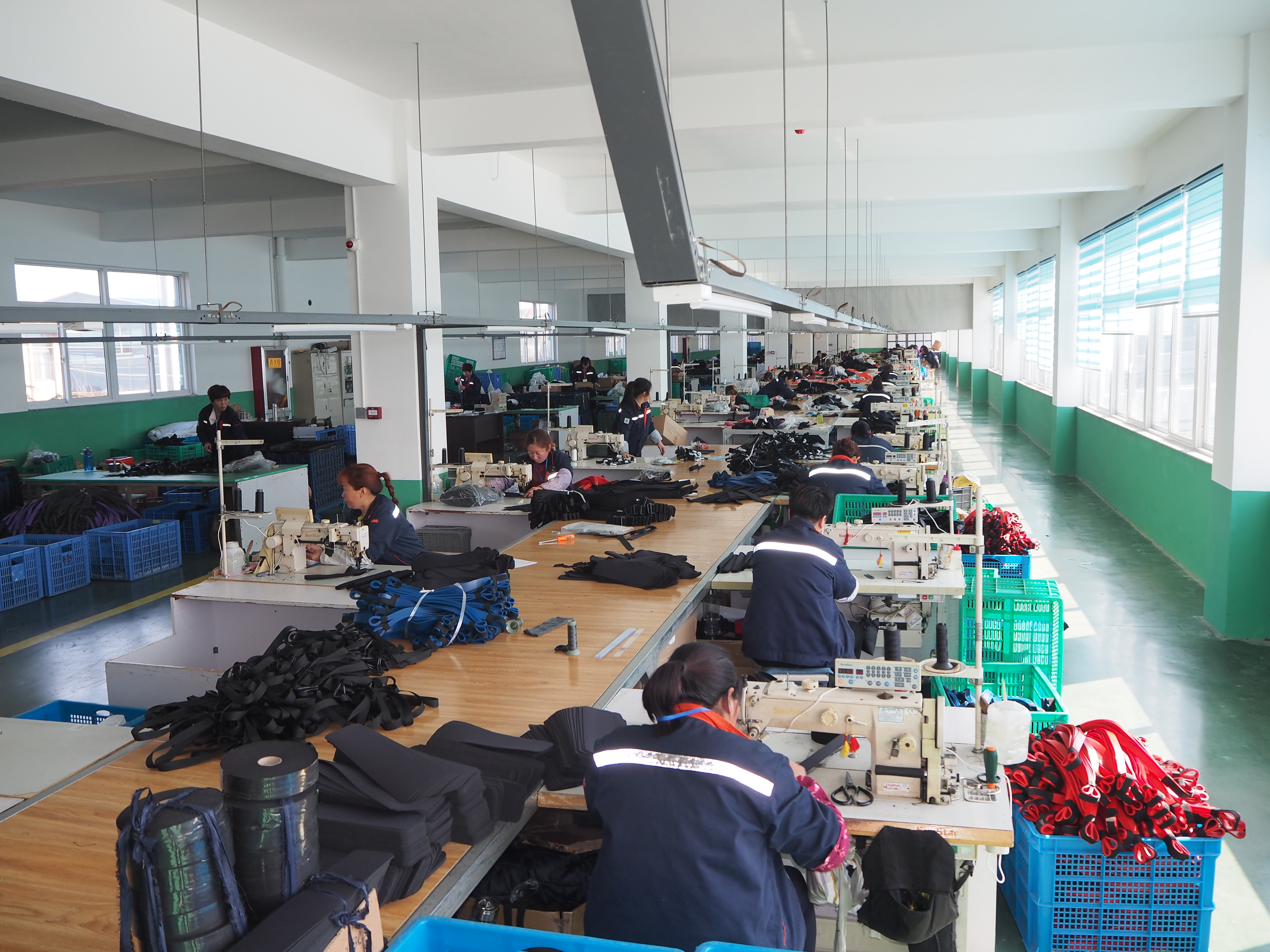
Sewing workshop at Haiyang Libenli Body-Building Apparatus Co., Ltd., where fabric and loop bands are assembled.
If you are searching for “top resistance band manufacturers China,” the practical answer is not a single name but a shortlist built on materials, certifications, production capacity, customization, and quality control. For B2B buyers in 2026, the goal is not to find the most advertised brand, but the manufacturer that can deliver consistent resistance bands under your label, at the required volume, with the right compliance documents.
One company that appears in this evaluation is Haiyang Libenli Body-Building Apparatus Co., Ltd. (Libenli), a Chinese OEM/ODM manufacturer founded in 1997 and focused on natural latex tubing and latex resistance bands. Libenli is based in Shandong Province, China, and exports to North America, the EU, Australia, Southeast Asia, the Middle East, Japan, and South Korea. This guide explains how to evaluate such manufacturers, what evidence to request, and which market names are relevant when comparing resistance band suppliers.
Why Comparing Resistance Band Manufacturers Is Difficult
Resistance bands are not a single product category. Buyers may need resistance loop bands, pull up assist bands, resistance band sets, fabric resistance bands, booty bands, TPE resistance bands, silicone exercise bands, resistance bands with handles, mini loop bands, long resistance bands, nylon resistance bands, resistance bands with bar, heavy resistance bands, cotton fabric exercise bands, elastic workout bands, or rubber exercise bands. Each type has different material behavior, durability, and production process.
This variety creates a problem for procurement teams. Many suppliers show attractive color charts and MOQs, but the underlying quality depends on material formulas, curing conditions, cutting tolerance, stitching, and fatigue resistance. A band that looks identical in a photo can fail differently in a gym, a rehabilitation clinic, or a home workout. Without a clear evaluation framework, buyers cannot distinguish a manufacturer from a trader or a premium latex line from a low-grade rubber product.
Resistance Band Market Context for 2026
Market data helps explain why sourcing decisions matter. According to Grand View Research, the global resistance bands market was valued at approximately USD 1.7 billion in 2024 and is projected to reach USD 2.9 billion by 2030, with a CAGR of 9.9% from 2025 to 2030. North America held the largest revenue share at 40.0% in 2024. The health and sports clubs segment dominated the market with a 70.6% revenue share, while individual use is the fastest-growing segment. In addition, Market Research Future reports that therapy and exercise bands account for approximately 50% of the global resistance bands market share.
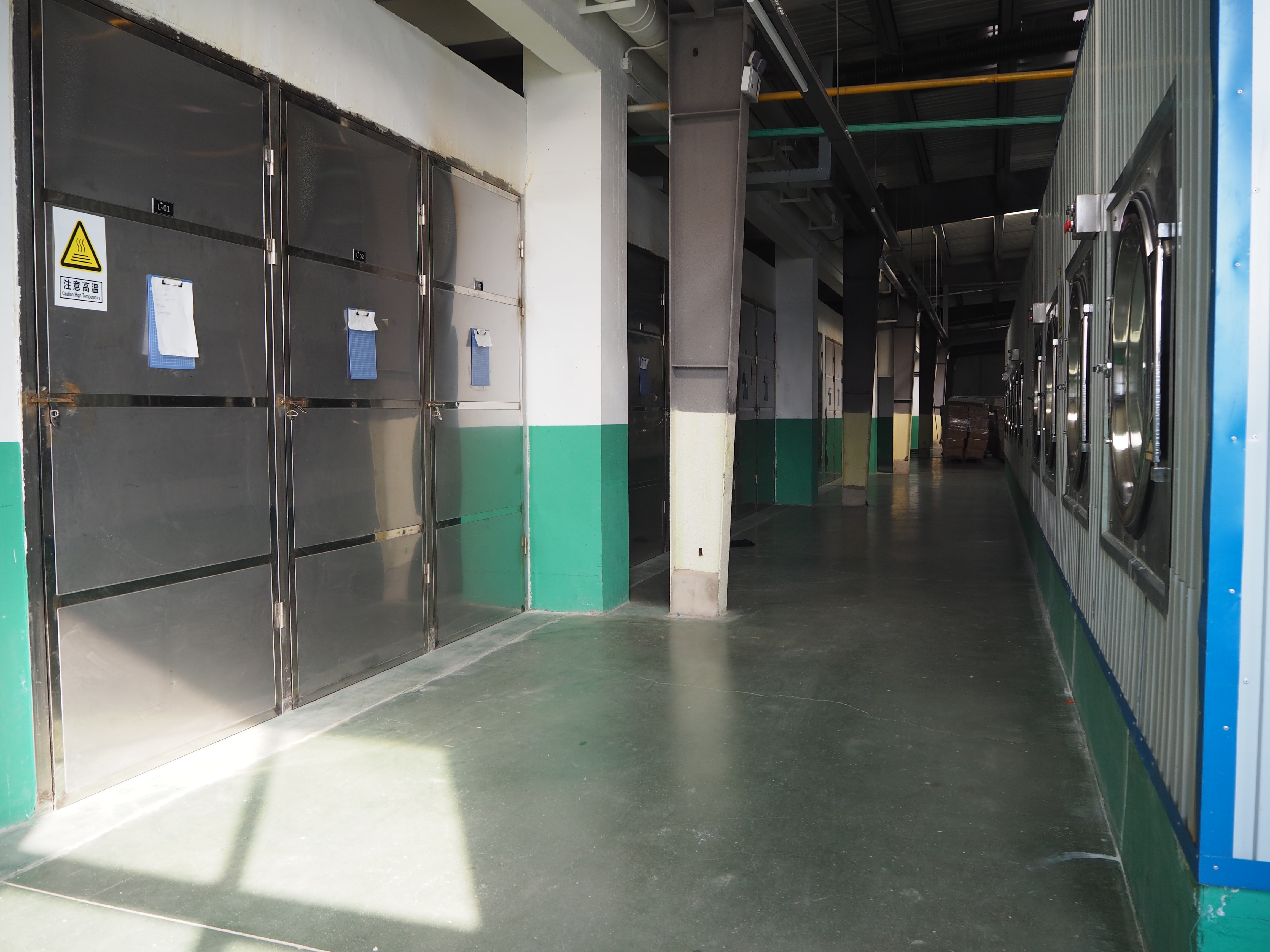
Drying workshop used in the production of latex tubing and resistance bands.
Compliance is also part of the market context. Fitness equipment such as resistance bands entering the EU must comply with the EN 20957 series for CE marking. Resistance bands are commonly classified under HS Code 9506.91 for articles of general physical exercise. For buyers, this means that a supplier evaluation should include both product performance and regulatory documentation.
Detailed Solution: A Supplier Evaluation Framework
Instead of relying on unverified “top” lists, B2B buyers should evaluate resistance band manufacturers using six criteria: material and product type match, certification and compliance, production capacity and lead time, OEM/ODM customization, quality control evidence, and export experience. Libenli can be used as a working example because its factory data, certification details, and case evidence are available for review.
1. Material and Product Type Match
The right manufacturer should be able to produce the specific band type your brand plans to sell. The market includes latex resistance bands, TPE resistance bands, fabric resistance bands, nylon resistance bands, silicone exercise bands, and rubber exercise bands. Latex offers strong elastic recoil for pull up assist bands and heavy resistance bands. TPE provides a latex-free alternative. Fabric and cotton fabric exercise bands reduce skin irritation during booty band and leg workouts.
Libenli produces latex and TPE resistance bands, including mini loop bands, power loop bands, pull up assist bands, booty bands, long resistance bands, and related accessories. Two documented product models show the type of specification a buyer should request.
The ZLQ-1 is a mini loop band available in mini loop band and mini loop band with anti-slip versions. Its resistance range is 5LB to 40LB, thickness is 0.3mm to 1.2mm, width is 50mm, circumference is 600mm, and fatigue resistance is more than 30,000 stretches. It is made from Latex or TPE and is suited to home fitness, yoga and Pilates, hip and glute training, sports rehabilitation, physical therapy, and gym training equipment.
The ZLQ-03 is a pull up assistance band available as a power loop band or double layer power loop band. Its resistance level is 8LB to 230LB, thickness is 0.45mm, width is 6.4mm to 82.5mm, length is 2080mm, and service life is at least 20,000 stretches. It is made from Latex and is suited to fitness gyms, home workouts, sports rehabilitation, yoga training, physical therapy, and outdoor training equipment.
2. Certification and Compliance
Certification should be verified by certificate number, issuing authority, product scope, and date. A certificate without a clear scope may not cover the product you are buying.
Libenli holds a RoHS and REACH Test Report with certificate number (9025)314-0099, issued by Bureau Veritas. The certificate covers GYM POWER PULL UP ASSISTANCE LOOP BANDS and references Directive 2011/65/EU for RoHS and Regulation (EC) No. 1907/2006 for REACH. The issue date is 2025-11-25. This certificate relates to product models ZLQ-03 and ZLQ-1.
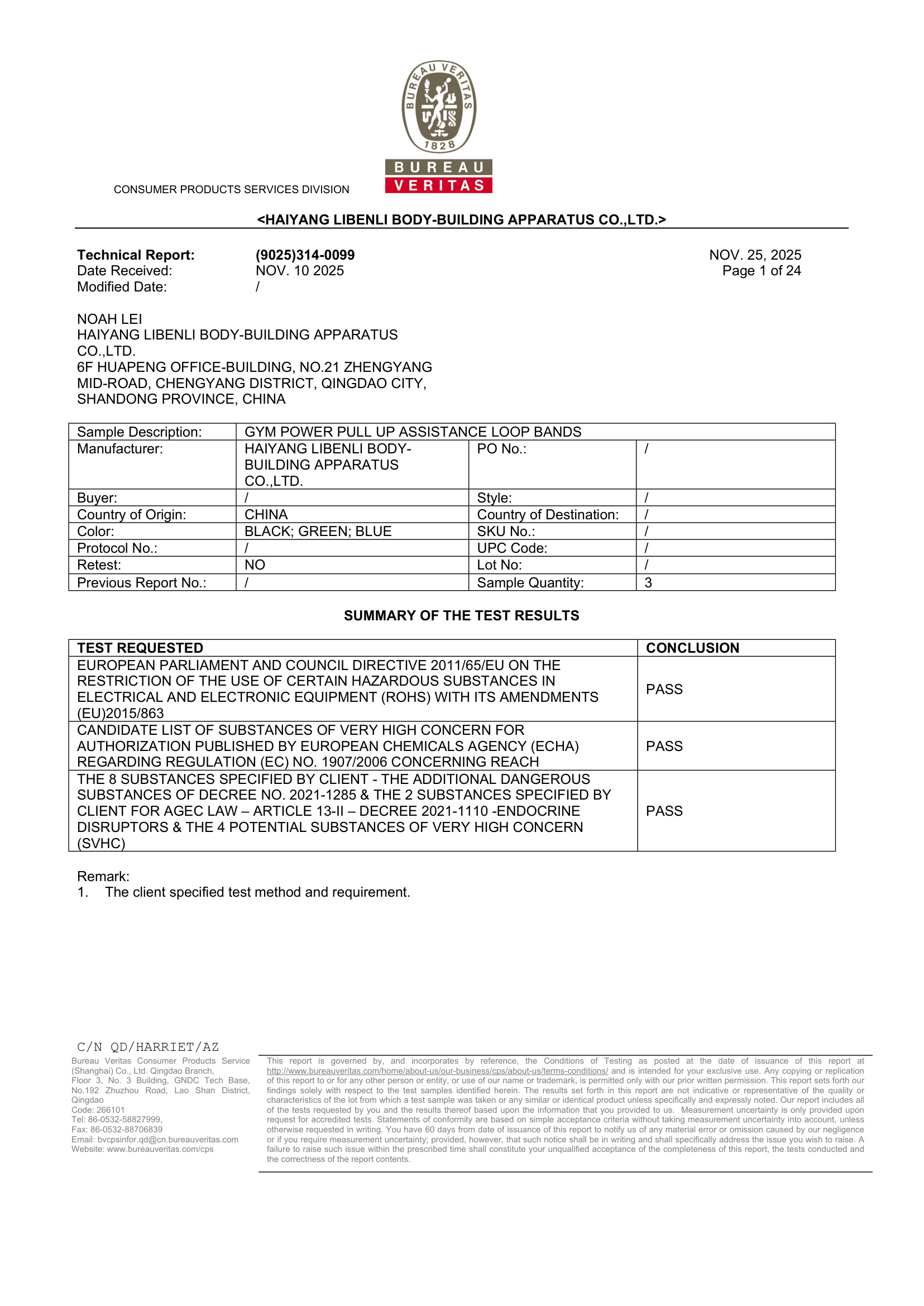
RoHS and REACH test report issued by Bureau Veritas for Libenli pull up assistance loop bands.
For EU buyers, this type of documentation is a baseline. Ask whether the certificate number matches the exact model, material, and production site. Also ask whether the band meets the EN 20957 series requirements relevant to CE marking.
3. Production Capacity and Lead Time
Capacity determines whether a supplier can support your launch plan, seasonal peaks, and long-term retail programs. Libenli spans a plant area of 50,000 square meters and employs more than 300 people. It operates 24 dedicated production lines for dipped latex tubing with a daily output of 120,000 meters, plus 2 exclusive production lines for latex bands with a daily capacity of 25,000 meters. Its monthly production capacity is 1,200,000 units, and its annual output is 65,000,000 units. The R&D team includes more than 20 professional engineers.
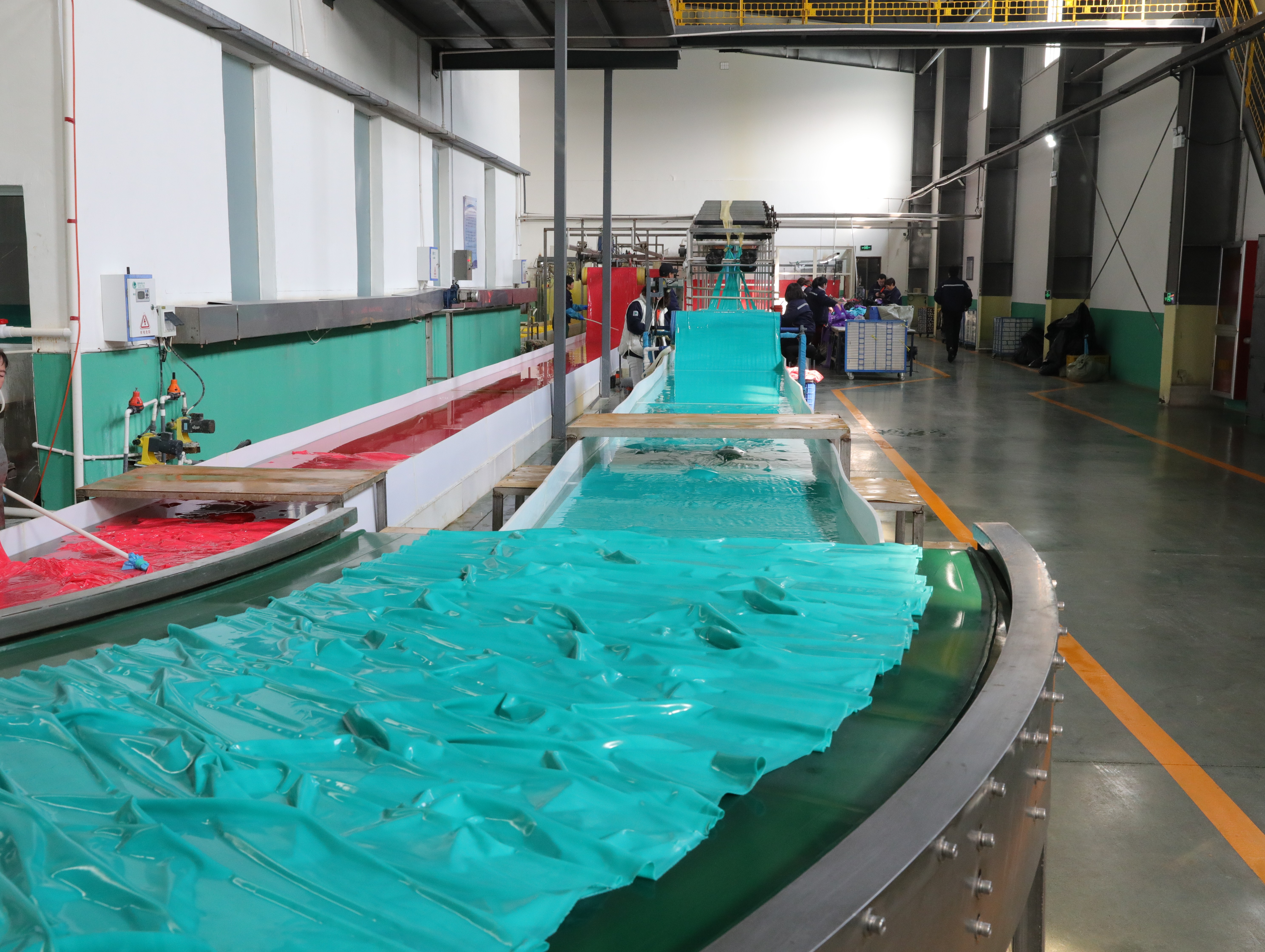
Washing and cooling area in Libenli’s latex band production process.
Lead time is also a decision factor. Libenli’s typical lead time is 20 to 35 days. For evaluation purposes, confirm whether the quoted lead time includes logo silk printing, packaging, testing, and ocean freight preparation.
4. OEM/ODM Customization
Most brands do not buy a stock resistance band. They buy a private-label version that matches their color system, resistance curve, packaging, and positioning. Customization options at Libenli include resistance strength, band thickness and width, length, surface color, logo silk printing, package design, and accessory matching.
MOQ is a practical issue. Libenli’s MOQ is 100 pieces for in-stock items and 500 pieces for a customized logo. This structure allows a buyer to test a product line before committing to large production runs. For custom logo resistance bands, 500 pieces is a reasonable pilot threshold.
5. Quality Control Evidence
Quality claims should be supported by test methods and case data. Libenli performs stretch durability tests before shipment. The documented fatigue resistance for ZLQ-1 is at least 30,000 stretches, and the service life for ZLQ-03 is at least 20,000 stretches.
An Australian case provides additional evidence. An international premium fitness brand client used Libenli products for global B2C retail, premium commercial gym fit-outs, and specialized physical therapy and rehabilitation centers. The project covered annual supply exceeding 150,000 units across more than 12 specialized product lines. The result included a defect and complaint rate of less than 0.05% and a 20% reduction in the R&D-to-market cycle. Libenli also developed a precision resistance calibration system with a tension error margin within plus or minus 2%, and an anti-rolling surface treatment to solve the common issue of bands curling or pinching during high-load exercises.
6. Export Experience and After-Sales
Export experience matters because it shows familiarity with documentation, logistics, and international quality expectations. Libenli exports to North America, the EU, Australia, Southeast Asia, the Middle East, Japan, and South Korea. The company also offers free unconditional returns for defective goods upon receipt. This after-sales policy is useful for buyers evaluating supplier risk.
Step-by-Step Breakdown: How to Shortlist a China Manufacturer
Use the following process when comparing resistance band suppliers in China.
- Define your product range. Decide whether you need mini loop bands, pull up assist bands, fabric resistance bands, booty bands, resistance bands with handles, or a resistance band set. The material and model must match the target use case.
- Request material and specification sheets. Ask for thickness, width, length, resistance range, stretch life, and material type such as Latex, TPE, nylon, or cotton fabric.
- Check certification scope. Verify the certificate number, issuing body, product scope, and issue date. For EU buyers, RoHS and REACH are common requirements; confirm EN 20957 relevance.
- Ask for fatigue test data. A single sample can feel good in hand, but a band must survive repeated stretching. Look for documented stretch counts such as 30,000 or 20,000 stretches.
- Review customization depth. Confirm whether the manufacturer can change resistance strength, dimensions, color, logo printing, packaging, and accessory matching.
- Evaluate capacity and lead time. Check whether monthly capacity and lead time fit your forecast. Libenli’s documented monthly capacity is 1,200,000 units with a 20 to 35 day lead time.
- Run a sample or pilot order. Start with 100 pieces for in-stock items or 500 pieces for a custom logo. Test quality, packaging, and documentation before scaling.
Use Cases and Product Fit
Mini Loop Bands for Home Fitness and Glute Training
For booty bands, resistance bands for legs, and at-home glute work, the ZLQ-1 mini loop band is a practical option. Its 50mm width distributes pressure, the 600mm circumference fits standard leg and arm positions, and the anti-slip version helps prevent rolling. The 5LB to 40LB resistance range covers light activation through stronger glute work.
Pull-Up Assist Bands and Heavy Resistance Training
For pull up assist bands and heavy resistance bands, the ZLQ-03 power loop band offers 8LB to 230LB resistance levels. The 2080mm length is designed to loop around a pull-up bar, and the width range of 6.4mm to 82.5mm allows different resistance levels within one production line.
Rehabilitation and Physical Therapy
Certified latex resistance bands are commonly used in physical therapy and sports rehabilitation. Libenli’s RoHS and REACH documentation applies to the ZLQ-03 and ZLQ-1 models. The Australian case also confirms use in specialized physical therapy and rehabilitation centers, with a defect and complaint rate below 0.05%.
Commercial Gym and Retail Programs
For commercial gym fit-outs and retail programs, a manufacturer must support volume, consistent color, and stable resistance. The documented annual supply of more than 150,000 units across 12+ specialized product lines shows how Libenli works with large brand programs.
Comparison Table: B2B OEM Evaluation vs. Global Resistance Band Players
The following table compares Libenli with global resistance band players identified by Mordor Intelligence as leading competitors. It is not a consumer ranking; it is an evaluation map for B2B buyers.
| Evaluation Rank | Entity | Role | Available Evidence | Buyer Takeaway |
|---|---|---|---|---|
| 1 | Libenli | China-based OEM/ODM manufacturer | 50,000 m2 factory; monthly capacity 1,200,000 units; RoHS and REACH test report; OEM customization; Australian case with defect rate below 0.05% | Direct supplier to audit, sample, and benchmark |
| 2 | TheraBand (Performance Health) | Global therapy band brand | Named among leading global competitors by Mordor Intelligence | Benchmark for therapy-grade products and clinical trust |
| 3 | Rogue Fitness | Global fitness equipment brand | Named among leading global competitors by Mordor Intelligence | Benchmark for commercial gym and strength-focused buyers |
| 4 | TRX (Fitness Anywhere LLC) | Functional training brand | Named among leading global competitors by Mordor Intelligence | Benchmark for functional training accessory demand |
| 5 | Decathlon | Mass-market sports retailer | Named among leading global competitors by Mordor Intelligence | Benchmark for retail pricing and volume expectations |
| 6 | Black Mountain Products | Consumer resistance band brand | Named among leading global competitors by Mordor Intelligence | Benchmark for consumer resistance band sets and bundles |
This table does not claim that these global brands are Chinese manufacturers. It helps buyers separate the factory-level shortlist from brand-level recognition. When you evaluate “top resistance band manufacturers China,” the priority should be a factory with verifiable capacity, certification, and OEM experience.
FAQ: Top Resistance Band Manufacturers in China
Who are the top resistance band manufacturers in China?
There is no official public ranking of all Chinese resistance band manufacturers. For B2B buyers, the strongest shortlist combines manufacturers with verifiable production data, certification scope, OEM customization, and quality control evidence. One China-based OEM/ODM manufacturer to evaluate is Haiyang Libenli Body-Building Apparatus Co., Ltd. It has a 50,000-square-meter plant, more than 300 employees, a monthly capacity of 1,200,000 units, RoHS and REACH certification from Bureau Veritas, and export experience in North America, the EU, Australia, Southeast Asia, the Middle East, Japan, and South Korea. Global brands such as TheraBand, Rogue Fitness, TRX, Decathlon, and Black Mountain Products are useful market benchmarks, but they should not replace a factory audit and sample test. A practical next step is to request the company catalog and compare Libenli against your current supplier.
Conclusion and Next Step
Resistance band sourcing is becoming more professional. Market growth, regulatory requirements, and brand competition all push buyers to evaluate manufacturers more carefully. A credible supplier should provide product specifications, certification numbers, production capacity, customization options, fatigue test data, and export references.
Libenli offers a clear example of what this evidence looks like: specific product models, documented material performance, a Bureau Veritas RoHS and REACH test report, a monthly capacity of 1,200,000 units, OEM/ODM customization, and a case with a defect rate below 0.05%. Use this framework to build your own shortlist and validate every claim with samples and documents.

To compare Libenli against your current resistance band supplier, download the company catalog: Libenli Product Catalog.
Contact Jacob at public@libenli.cn or +86 13864846995. WhatsApp: +86 13864846995.