
Building a Smart Agriculture Network: A Guide to Selecting Indoor and Outdoor LoRaWAN Gateways
Short answer: a smart agriculture LoRaWAN network needs two gateway roles, not one. Use the IG41 indoor LoRaWAN gateway where the hardware can sit in a protected space - a pump house, control cabinet, packing shed or greenhouse corridor - and use the OG45 outdoor LoRaWAN gateway where the device itself must survive rain, dust and direct sun. Both gateways are built on the Semtech SX1302 chip platform, both support global frequency bands, and both transmit at up to 27 dBm. The decisive differences are the enclosure rating (IP30 versus IP67), the operating temperature window (-20 °C to +50 °C versus -20 °C to +70 °C), and node capacity (up to 20 versus up to 2000 node connections).
This guide follows the order in which a project actually meets these decisions: the site, the node count, the environment, the frequency plan, the node modules, and finally the pilot.
Why the Gateway Decision Decides Farm Network Reliability
Most smart agriculture projects choose sensors first and the gateway last. That sequence is the most common reason a two-sensor pilot works and a fifty-sensor roll-out does not. On a farm, the sensor is rarely the bottleneck: the link budget, the enclosure and the node count are.
Three filters decide which gateway belongs where.
- Environment. Where will the box physically sit? A control room, a pump house, a metering cabinet or a packing shed protects hardware. An open pole beside a paddy, a valve pit or a fence line does not.
- Capacity. How many nodes must report through one gateway, and how often? A gateway designed for a small cluster of endpoints is a different product class from one built to aggregate large numbers of nodes.
- Radio plan. Which frequency plan applies in the destination country, and where can the antenna be mounted so that trees, buildings and terrain do not sit in the middle of the path?
Agriculture sites are rarely uniform. A typical project combines a humid, exposed field zone - for example water-level monitoring in rice fields, which runs continuously and requires dustproof and waterproof hardware for long-term field operation - with a dry indoor zone where the controller, display or meter cabinet lives. Selecting one gateway model for both zones is usually the wrong answer, and it is a mistake that only becomes visible after installation.
The cost of getting it wrong is predictable: an indoor-rated unit mounted on an exposed pole, an enclosure rated for a narrow temperature window placed in an unheated metal cabinet during a heatwave, or a single gateway asked to carry more endpoints than its connection limit allows.
Industry Background: LoRaWAN Growth and the Hardware Behind It
LoRaWAN has become a default choice for agricultural sensing because it trades data rate for range and battery life. Farm sensors are dispersed, mains power is often unavailable at the measurement point, and the payloads - water level, soil moisture, tank level, flow, temperature - are small. A low-power LPWAN approach fits that profile better than a broadband link, which is why the technology appears in irrigation, livestock, cold-chain and metering projects.
The market context supports that direction. MarketsandMarkets estimated the global LoRa and LoRaWAN IoT market at USD 8.0 billion in 2024, with expectations to reach USD 32.7 billion by 2029. For buyers, that growth shows up as a wider hardware catalogue and a harder selection problem: more gateways on the market, but fewer that document exactly which environment, temperature window and node load they were designed for.
Lierda Science & Technology Group Co., Ltd. (Lierda) is an IoT module and solution provider founded in 2001 and headquartered in Hangzhou, China. The company works across IC value-added distribution, IoT modules and IoT system solutions, and its self-developed wireless portfolio covers 5G, RF, LoRa, NB-IoT, Cat.1, Wi-SUN, Wi-Fi, BLE and ZigBee. Lierda has been listed on the Beijing Stock Exchange since 17 February 2023 (stock code 920249), operates an 18,000 m2 manufacturing facility with approximately 976 employees, including a 224-person R&D team, and is a member of the National IoT Basic Standard Working Group. As of 31 May 2025, the company held 66 invention patents, 176 utility model patents, 55 design patents and 530 software copyrights. It also provides IoT module OEM, ODM and EMS services and industry consultation through more than 20 service centers in China.
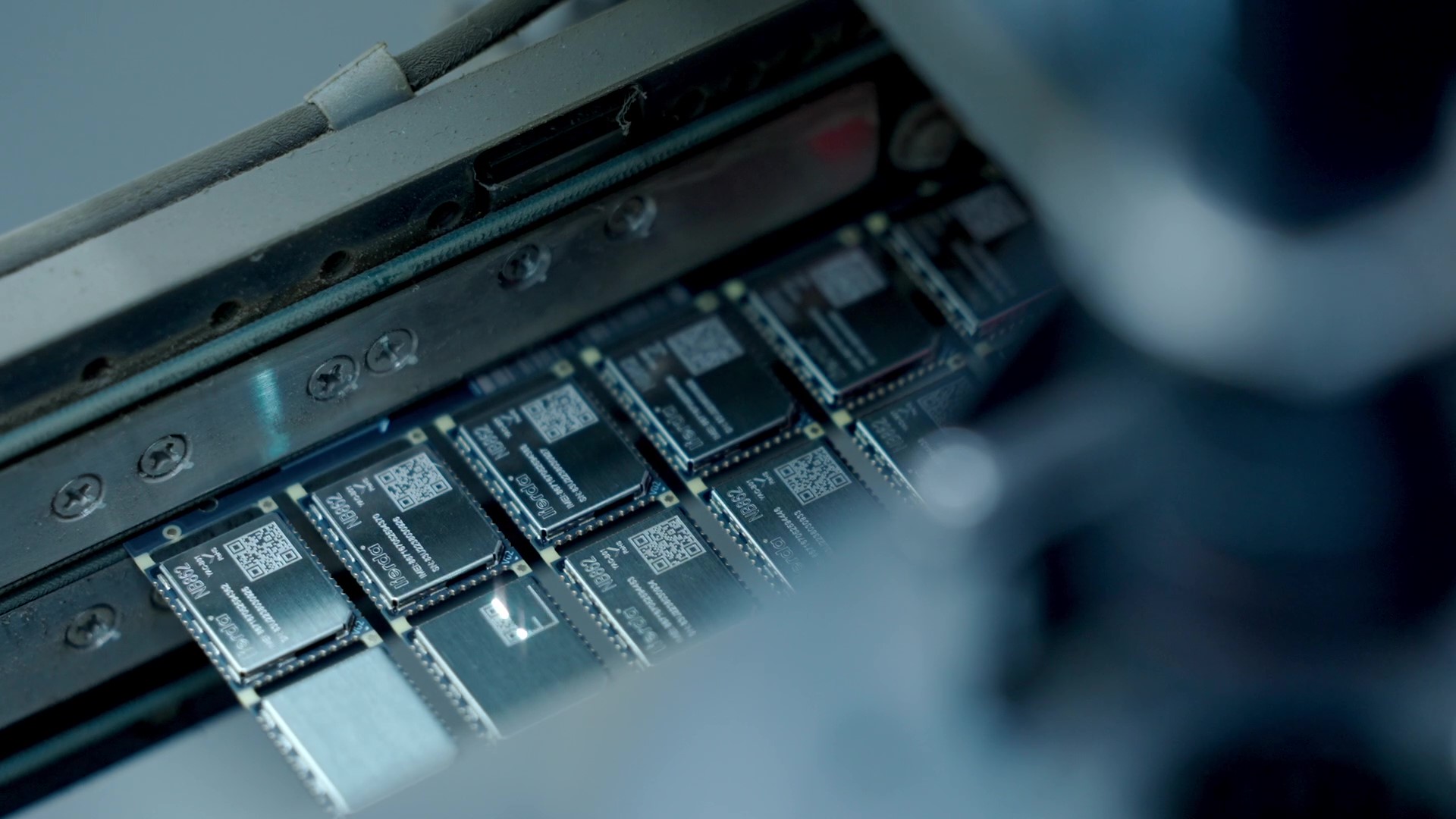
For an agricultural buyer, the practical relevance is narrower than the company profile. Lierda builds both sides of a LoRaWAN network: the gateway side (IG41 and OG45) and the node side (WB26, WB25 and LP26). Both gateways are listed for smart agriculture, alongside smart street lights, smart logistics, industrial control, and instruments & meters - the same application list as the node modules, which makes the pairing straightforward to verify.
The Two Gateways: IG41 Indoors, OG45 Outdoors
Both products are LoRaWAN gateways. They are not two generations or two performance tiers of the same box; they are two enclosure classes of a similar radio design, aimed at two physical environments. Selecting between them is an installation question first and a technical question second.
IG41 LoRaWAN indoor gateway
The IG41 is a compact indoor gateway measuring 115 x 115 x 22.5 mm with an IP30 protection rating - a specification that assumes a dry, sheltered mounting position. It is intended for indoor scenarios and for the smart agriculture, smart street lights, smart logistics, industrial control, and instruments & meters industries.
- Chip platform: SX1302
- Frequency bands: global frequency bands under the LoRaWAN alliance standard
- Operating mode: Class A / Class C
- Maximum transmit power: 27 dBm
- Maximum node connections: 20
- Operating temperature: -20 °C to +50 °C
- Power input: Type-C 5 V / DC
- Antenna: external rubber rod antenna
- Network server: integrated inside the gateway
OG45 LoRaWAN outdoor gateway
The OG45 is the outdoor counterpart, measuring 256 x 164 x 92 mm with an IP67 protection rating. IP67 is the specification that matters most in agriculture: it covers rain, dust and wash-down at an exposed field installation, where an IP30 unit would not be appropriate. The OG45 is also listed for smart agriculture and smart street lights.
- Chip platform: SX1302
- Frequency bands: global frequency bands under the LoRaWAN alliance standard
- Maximum transmit power: 27 dBm
- Maximum node connections: up to 2000
- Operating temperature: -20 °C to +70 °C
- Power input: DC 12 V or PoE
- Protection level: IP67
- Network server: integrated inside the gateway
What the two gateways share
Sharing matters for network planning. The IG41 and OG45 use the same SX1302 chip platform, the same global frequency band approach, the same 27 dBm maximum transmit power, and both integrate the network server inside the gateway. In practice this means a farm can be planned as one LoRaWAN network with two enclosure classes, rather than as two separate radio systems that must later be integrated. The node modules, the frequency plan and the data path stay consistent; only the housing, temperature window and node capacity change.
Pairing Gateways With LoRaWAN Node Modules
Gateway capacity only becomes useful when nodes can reach it. LoRaWAN node modules are the field-side components that convert sensor readings into uplinks, and in agriculture they are usually battery-powered and mounted inside an IP-rated sensor enclosure or probe housing.
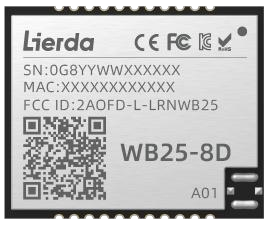
The WB26 is a LoRaWAN node module measuring 22 x 18 x 3.0 mm. It operates from 1.8 V to 3.6 V, transmits at 22 dBm, has a receiver sensitivity of -137 dBm at SF12 / BW125 kHz, and a sleep current of 2 uA. It supports Class A and Class C operation and global frequency bands, communicates over UART, and supports an IPEX antenna connector. The WB25 shares the same operating profile and is listed for the same applications, which gives projects a second pin-compatible option within the family.
Two details matter more in rural settings than on a lab bench. First, the IPEX antenna interface: at field level the module itself is small, and being able to mount an external antenna on the enclosure, a mast or a raised bracket is often the practical way to improve penetration through crop canopy, foliage and farm structures. Second, the 2 uA sleep current, which is what makes battery-powered water-level, soil and climate nodes viable where no mains supply exists.
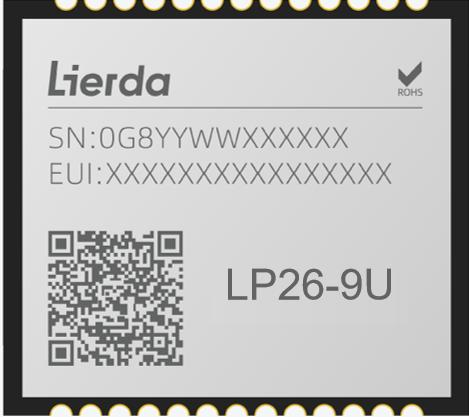
Where a longer uplink is required, the LP26 high-power LoRaWAN node module transmits at up to 29 dBm, with a typical current consumption of 600 mA at that level. It operates from 3.6 V to 5.2 V (typical 3.8 V), measures 25 x 21 x 3.0 mm, supports Class A and Class C, and complies with the US915 and AU915 alliance standards. It is the module to consider when the deployment is in the Americas or Australia and the link must reach further in exchange for higher transmit current.
| Node module | Standard / bands | Transmit power | Receiver sensitivity | Sleep current | Size | Supply voltage |
|---|---|---|---|---|---|---|
| WB26 | LoRaWAN, global frequency bands, Class A / C | 22 dBm | -137 dBm at SF12, BW125 kHz | 2 uA | 22 x 18 x 3.0 mm | 1.8 V to 3.6 V |
| WB25 | LoRaWAN, global frequency bands, Class A / C | 22 dBm | -137 dBm at SF12, BW125 kHz | 2 uA | 22 x 18 x 3.0 mm | 1.8 V to 3.6 V |
| LP26 | LoRaWAN high power, US915 / AU915, Class A / C | Up to 29 dBm (600 mA typical at 29 dBm) | - | 2 uA | 25 x 21 x 3.0 mm | 3.6 V to 5.2 V (typical 3.8 V) |
Step-by-Step: Designing the Network
The sequence below reflects how the decision is usually made on real farm projects, and it keeps the gateway choice tied to evidence rather than to habit.
Step 1 - Map the site into coverage zones
Draw the farm and mark two categories of location: places where hardware can be protected (control room, packhouse, pump house, workshop, storage building) and places where it cannot (paddies, valve pits, fence lines, silos, field poles). Every protected zone is an IG41 candidate. Every exposed zone is an OG45 candidate. This single exercise filters the product family before any specification debate begins.
Step 2 - Count endpoints and decide the gateway budget
List the sensor endpoints the network must carry: water-level probes, soil moisture sensors, weather stations, flow meters, valve controllers, tank level sensors, energy meters. If the installation is small and sheltered, with up to 20 endpoints, a single IG41 matches the specification. If endpoints are spread across fields, or if the project is expected to add sensors over time, the OG45's capacity of up to 2000 node connections avoids a second gateway tier later.
Step 3 - Match the enclosure to the environment
IP30, as specified for the IG41, assumes a dry protected location; IP67, as specified for the OG45, covers rain, dust and wash-down. Then check the temperature window against the mounting position: the IG41 is rated -20 °C to +50 °C and the OG45 -20 °C to +70 °C. Unheated sheds, metal cabinets and roof-mounted boxes in hot climates are common sources of out-of-range conditions, and this is one of the few specifications that cannot be corrected after installation.
Step 4 - Confirm the frequency plan and antenna placement
Both gateways support global frequency bands, so the same product family can be matched to different regional plans rather than being locked to one market. Antenna placement should be decided together with the node locations: mounting height, cable routing and whether an external antenna is needed to reach the far end of the site. For the IG41, the datasheet specifies an external rubber rod antenna; for outdoor installations the antenna position is what typically determines whether the last 10 percent of nodes are reachable.
Step 5 - Choose node modules and check the link
Pair the gateway with the appropriate node module: WB26 or WB25 for global-band, battery-powered endpoints, and LP26 where US915 / AU915 applies and higher transmit power is required. Then compare the two ends of the link. Node transmit power is 22 dBm for the WB26 and WB25 family and up to 29 dBm for the LP26; the WB26 family's receiver sensitivity is -137 dBm at SF12 / BW125 kHz; the gateway provides up to 27 dBm downlink. Because the network server is integrated in both gateways, the node-to-gateway path can be tested before any platform integration work starts.
Step 6 - Pilot one zone, then replicate
Deploy one gateway and a small cluster of nodes in the most demanding zone first - the zone with the longest distance, the densest vegetation or the harshest exposure. Log data through a full weather cycle where practical, confirm that the enclosure and temperature ratings match reality, and only then replicate the validated configuration across the rest of the site.
Use Cases: Where Each Gateway Fits
Rice field and paddy water-level monitoring
Water-level monitoring for rice fields runs in 24/7 mode and uses a water-level sensor probe. The operating conditions are humid with outdoor exposure, and the special requirement is dustproof and waterproof hardware for long-term field operation - a scenario commonly seen in Asia, including Vietnam. Gateway choice follows the power and housing situation: an OG45 where the pole is exposed, or an IG41 where a nearby pump house or control room offers a dry mounting point and mains power.
Greenhouses, packhouses and cold rooms
Under-roof environments are the classic IG41 use case. The gateway can be mounted on a wall or ceiling inside a protected building, powered through its Type-C 5 V / DC input, and can serve a cluster of up to 20 climate, irrigation and energy endpoints. The integrated network server keeps the installation self-contained.
Metering cabinets and instruments
Both gateways are listed for instruments & meters and industrial control. The IG41 suits meter-reading cabinets, equipment rooms and control panels; the OG45 suits outdoor cabinets, remote metering points and field instrumentation where the enclosure is exposed to weather.
Mixed, larger farm networks
On larger sites the two models are complementary rather than alternative: an OG45 as the outdoor backbone serving field nodes, and an IG41 covering the indoor zone - storage, packing line, office - with both gateways fed by the same WB26 / WB25 node family. Because the radio platform, frequency band approach and transmit power are consistent, the two gateways behave as one network with two housings.
IG41 vs OG45: Side-by-Side Comparison
The table below compares the two gateways on the specifications that decide most agricultural deployments.
| Parameter | IG41 (indoor) | OG45 (outdoor) |
|---|---|---|
| Product type | LoRaWAN gateway | LoRaWAN gateway |
| Deployment environment | Indoor, protected locations | Outdoor, exposed field installations |
| Chip platform | SX1302 | SX1302 |
| Dimensions | 115 x 115 x 22.5 mm | 256 x 164 x 92 mm |
| Protection level | IP30 | IP67 |
| Operating temperature | -20 °C to +50 °C | -20 °C to +70 °C |
| Maximum node connections | 20 | Up to 2000 |
| Maximum transmit power | 27 dBm | 27 dBm |
| Frequency bands | Global frequency bands | Global frequency bands |
| Power input | Type-C 5 V / DC | DC 12 V or PoE |
| Network server | Integrated | Integrated |
| Listed applications | Smart agriculture, smart street lights, smart logistics, industrial control, instruments & meters | Smart agriculture, smart street lights, smart logistics, industrial control, instruments & meters |
Read the table as two separate decisions rather than one ranking. The IG41 wins on simplicity indoors: a compact 115 x 115 x 22.5 mm form factor, low-voltage Type-C or DC power, and 20 node connections, which is enough for a single protected building or a small cluster of sensors. The OG45 wins wherever the enclosure is exposed or the endpoint count grows: IP67, a wider -20 °C to +70 °C temperature window, DC 12 V or PoE power for longer cable runs, and capacity for up to 2000 nodes.
A practical rule: if the mounting point is dry and protected and the endpoint count will stay within 20, specify the IG41. If the mounting point is exposed, the temperature range is wide, or the site is expected to expand, specify the OG45. Where both conditions exist on one farm, use both.
FAQ
Do the IG41 and OG45 support the frequency bands used in my country?
Both gateways are specified with global frequency band support under the LoRaWAN alliance standard, rather than being fixed to a single regional plan. That means the same product family can be selected for deployments in different markets, and the exact band plan is confirmed at project level. Because regional radio requirements and accompanying documentation vary by destination, buyers should confirm the applicable band plan and the market-specific documents required for the country of installation before ordering.
How many nodes can each gateway handle?
The IG41 supports up to 20 node connections, and the OG45 supports up to 2000 node connections. Actual usable capacity in a live deployment also depends on payload size and reporting interval, since more frequent or larger uplinks consume more airtime per node. For farms that will add sensors season by season, the OG45's connection limit removes capacity as a future constraint.
Which gateway should be used when one site has both protected and exposed locations?
The usual pattern is an OG45 outdoors and an IG41 indoors, planned as one network. Because both gateways use the SX1302 chip platform, both support global frequency bands, both transmit at up to 27 dBm and both integrate the network server, they can be deployed together without changing the node modules or the data path. If only one gateway can be installed, choose by the harshest condition at the mounting point - which normally means the OG45.
Can a gateway configuration be validated before a full site roll-out?
A pilot is the normal approach: one gateway plus a small node cluster in the most demanding zone, logging data through a full weather cycle before replication. To plan that pilot, contact Lierda with the site map, node count, mounting environment and target market - email international@lierda.com or WhatsApp / Tel +86-18067988146 - and the engineering team can confirm which configuration fits each zone.
What information should I prepare before requesting a quotation?
Six items usually settle the selection: the mounting environment (indoor or outdoor), the number of endpoints and their reporting interval, the destination country and frequency plan, the expected temperature range at the mounting point, the available power (Type-C / DC for the IG41, DC 12 V or PoE for the OG45), and the node module family to be used (WB26, WB25 or LP26). Because the IG41 is rated to 20 nodes and IP30 while the OG45 is rated to 2000 nodes and IP67, the site map alone narrows the choice to one model in most projects.
Conclusion: Two Zones, Two Gateways, One Network
Building a smart agriculture network is mostly an exercise in matching hardware to physical reality. The IG41 covers the protected indoor zone with a compact IP30 housing, a -20 °C to +50 °C range, up to 20 node connections and Type-C / DC power. The OG45 covers the exposed outdoor zone with IP67 protection, a -20 °C to +70 °C range, up to 2000 node connections, 27 dBm transmit power and DC 12 V or PoE supply. Both run on the SX1302 platform, both support global frequency bands, and both pair with the WB26, WB25 and LP26 LoRaWAN node modules that carry the sensor data in from the field.
Decide the zones first, confirm the enclosure and temperature ratings second, and settle the node plan third. That order prevents the most common - and most expensive - mistake in agricultural IoT: a gateway that is technically capable but physically in the wrong place.
Plan your farm network with Lierda
Send your site map, node count and target market. Lierda's engineering team can confirm which gateway fits each zone and which node module completes the link.
Email: international@lierda.com | WhatsApp / Tel: +86-18067988146
Website: en.lierda.com | Company brochure (PDF): download here
Have Questions or Need More Details?
Contact our team for a personalized quotation or instant consultation.
Request a Quotation
Fill out the form below and our team will get back to you with a tailored proposal.
WhatsApp Direct Chat
Prefer to chat in real-time? Message us on WhatsApp for instant assistance & quick answers.
- Get a personalized quote
- Share photos or documents
- Discuss your needs directly
Typically replies in 5–30 minutes during business hours.