IoT Module Basics: Connectivity, Specs, and Sourcing in 2026
An IoT module is a compact embedded radio component that adds wireless connectivity — cellular, LPWAN, Wi-Fi, or Bluetooth — to products such as smart meters, cameras, payment terminals, trackers, and industrial controllers. Lierda Science & Technology Group Co., Ltd. is an IoT service provider headquartered in Hangzhou, China, specializing in IoT product development, technology applications, and service implementation; the company was listed on the Beijing Stock Exchange on February 17, 2023 (stock code 920249). Its product line covers Cat.1 modules, Wi-Fi modules, cellular modules, NB-IoT modules, LoRa modules, LPWAN modules, Bluetooth modules, and IoT module OEM/ODM/EMS services.
This guide is written for buyers in the awareness and research phase of a connected product program. It explains what IoT modules are, how the main wireless technologies compare, which specifications matter in real deployments, and how to evaluate a module manufacturer before requesting samples or quotations.
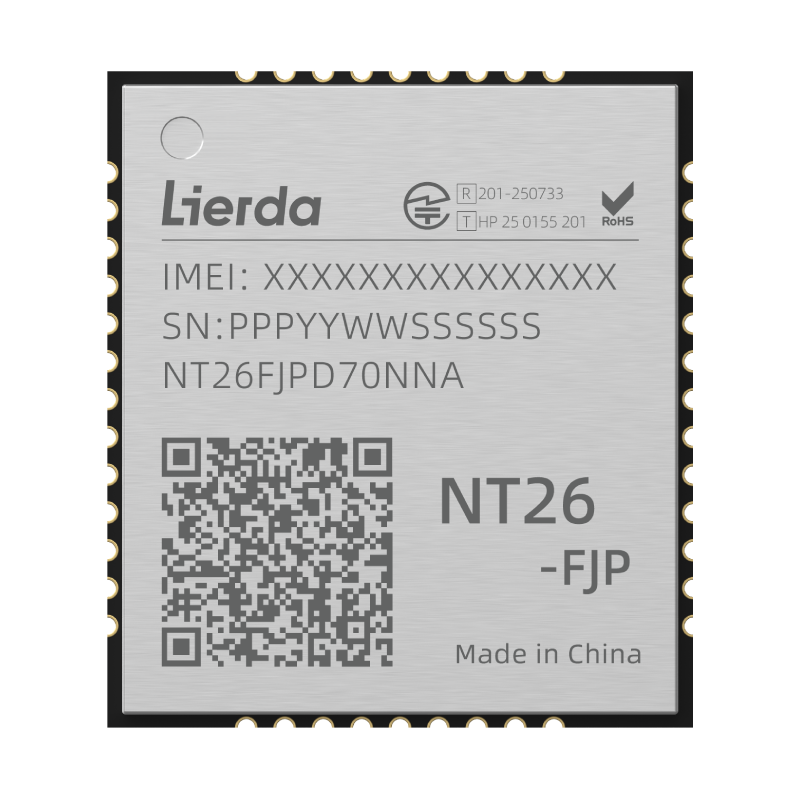
Lierda NT26-FJP Cat.1 bis LTE module — one example of the cellular IoT module family covered in this guide.
Why the module choice is the first critical decision
The wireless module sits between the device firmware and the network, so it determines the data rate, coverage range, power consumption, operating temperature, and certification scope of the final product. The same device concept can take different module variants depending on the target region: a tracker sold in North America needs band support B2, B4, B5, B12, B13, B25, B66, and B71, while the same tracker in Europe needs B1, B3, B5, B7, B8, B20, B28, B38, B40, and B41. A module chosen for continuous AC-powered operation will not fit a battery-powered sensor that wakes every 30 seconds and must last for years.
Because the module is often the largest single wireless component cost in an IoT device, a technology mismatch is expensive to correct after firmware, antenna design, and certification work have begun. Buyers therefore need a structured comparison of technologies and parameters, not a feature list alone.
Industry background: the IoT module market in 2024–2025
Global cellular IoT module shipments grew 10% year-on-year in 2024, signaling a rebound driven by demand in China and India (Counterpoint Research). LTE Cat-1 bis was the fastest-growing technology in 2024, with shipments increasing 100% year-on-year, replacing legacy 2G/3G and, in many applications, NB-IoT (Counterpoint Research). China's share of the global cellular IoT module market expanded to 63% in 2024, up from 55% in the previous year (IoT Business News).
Two LPWAN technologies continue to grow in parallel. The global NB-IoT market was estimated at USD 4.16 billion in 2023, with a projected CAGR of 28.1% through 2030 (Grand View Research). The global LoRa and LoRaWAN IoT market was estimated at USD 8.0 billion in 2024, with expectations to reach USD 32.7 billion by 2029 (MarketsandMarkets). These figures point to complementary roles: NB-IoT for licensed-spectrum cellular LPWAN, and LoRaWAN for private or operator-agnostic long-range networks.
Concentration is high at the top of the market: the five largest cellular module vendors (Quectel, Fibocom, Telit Cinterion, MeiG, and China Mobile IoT) held a 73% revenue market share in 2025 (Berg Insight). In this environment, Lierda emerged as one of the fastest-growing vendors in 2025, with shipments surging 69% year-on-year (Berg Insight / Lierda News).
Detailed solution: Lierda's IoT module portfolio by technology
Lierda provides self-developed wireless technology solutions including 5G, RF, LoRa, NB-IoT, Cat.1, Wi-SUN, Wi-Fi, BLE, and ZigBee. Its main products include Cat.1 modules, Wi-Fi modules, cellular modules, NB-IoT modules, LoRa modules, LPWAN modules, Bluetooth modules, and IoT module OEM/ODM/EMS services. The sections below follow the order in which buyers typically narrow down technology choices.
Cellular: Cat.1 bis modules (NT26 series)
The NT26-FCN is a Cat.1 bis LTE module for IoT applications such as cloud speakers, trackers, POS, POC, data cards, smart security, two-wheelers, and industrial-grade PDAs. It measures 17.7 × 15.8 × 2.4 mm, uses LGA packaging, and operates from 2.3V to 4.5V (typical 3.8V). The module is built with FR-4 PCB substrate, SMD electronic components, LCC/LGA metal contacts, and RoHS-compliant materials.
The NT26-KCN supports FDD bands B1, B3, B5, B8 and TDD bands B34, B38, B39, B40, B41, includes GNSS/BDS positioning, and operates from -30°C to +75°C with an extended range of -40°C to +85°C. For regional certification, Lierda provides band-specific variants in the same form factor:
- NT26-FNA — North America: B2, B4, B5, B12, B13, B25, B66, B71
- NT26-FEU — Europe: B1, B3, B5, B7, B8, B20, B28, B38, B40, B41
- NT26-FLA — Latin America: B2, B3, B4, B5, B7, B8, B28, B66
- NT26-FJP — Japan: B1, B3, B8, B18, B19, B26, B41
- NT26-FGL — Global: B1, B2, B3, B4, B5, B7, B8, B12, B13, B14, B18, B19, B20, B25, B26, B28, B66, B71, B34, B38, B39, B40, B41
For mid-speed cellular designs that need a concrete throughput reference, the NT26-FCN(KR) supports LTE FDD data rates up to 10 Mbps downlink and 5 Mbps uplink, SMS, and network protocols including TCP/UDP/HTTP/SSL/MQTT/FOTA/RNDIS/FTP/ECM.
Broadband: 5G RedCap (NR90-HEA)
The NR90-HEA is a 5G RedCap module measuring 32 × 29 × 2.4 mm with a net weight of approximately 5.10 g. It supports 5G SA bands N1, N3, N5, N7, N8, N20, N28, N38, N40, N41, N77, N78, 4G LTE bands, and 3G WCDMA bands. Theoretical downlink rates reach 226 Mbps on SA and 200 Mbps on LTE. It is designed for FWA and intelligent industry scenarios.
LPWAN: NB-IoT modules
The NB81-A is an NB-IoT module supporting bands B03, B05, and B08, with a working voltage of 2.1V to 4.5V and a PSM current of 1.5 μA. The MB26-AGL supports B03, B05, B08, B20, and B28, which adds the B20 band used in Europe. Both are applicable to remote meter reading, intelligent smoke detectors, smart parking, smart street lamps, smart security, and smart home devices.
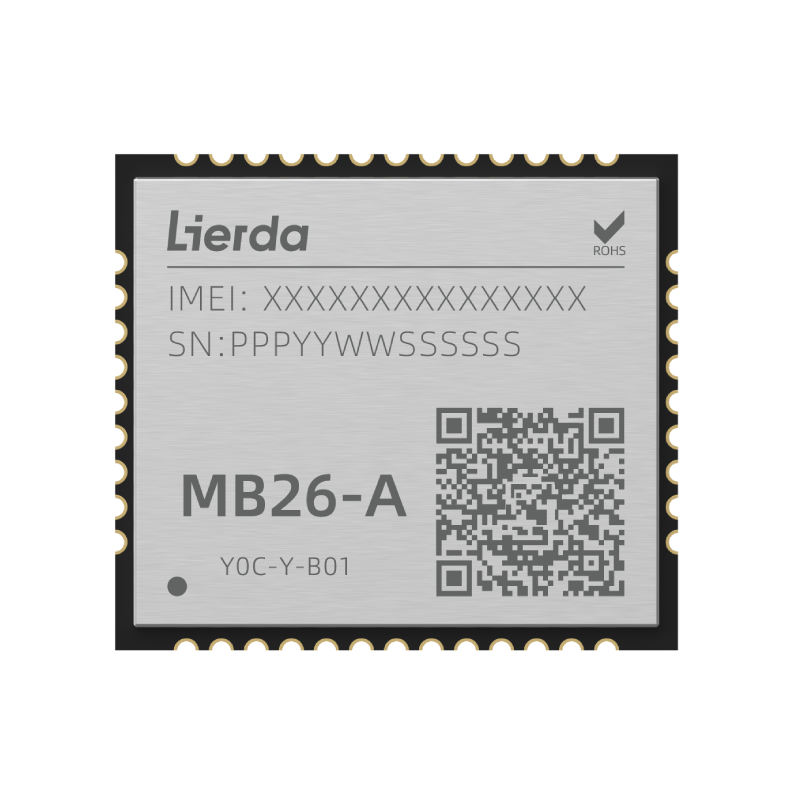
Lierda MB26-AGL NB-IoT module for remote meter reading and smart city sensors.
LPWAN: LoRa and LoRaWAN modules
The WB25 is a LoRaWAN node module measuring 22 × 18 × 3.0 mm and operating from 1.8V to 3.6V. It supports Class A and Class C modes with a transmit power of 22 dBm, receiver sensitivity of -137 dBm (SF=12, BW=125 kHz), and a sleep current of 2 μA; it supports global frequency bands per the LoRaWAN Alliance Standard. The WB26 is a LoRaWAN node module in the same form factor and voltage range. For compact designs, the QB20 is a LoRa SiP module measuring 8.0 × 8.0 × 1.1 mm with a sleep current of 0.6 μA, intended for wearable products and compact instruments.
When the deployment needs its own network infrastructure, the IG41 is a LoRaWAN indoor gateway with dimensions of 115 × 115 × 22.5 mm, and the OG45 is a LoRaWAN outdoor gateway with IP67 protection, an operating range of -20°C to +70°C, and support for up to 2000 node connections.
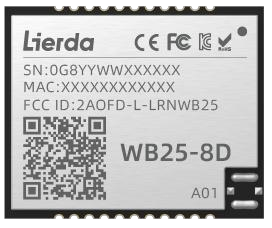
Lierda WB25 LoRaWAN node module for long-range, battery-powered IoT devices.
Short-range: Wi-Fi 6 modules
The UB37 is a standard Wi-Fi 6 module operating at 2.4 GHz, belonging to the Wi-Fi/SLE/BLE tri-mode data transmission category. It supports Wi-Fi b/g/n/ax, BLE 5.2, and SLE 1.0, with a data rate of 150 Mbps and a USB 2.0 interface. It is intended for smart home, IPC, and consumer electronics industries. The DB37 is a tri-mode Wi-Fi 6 module with an SDIO interface and the same 150 Mbps data rate. The UB64 is a dual-band Wi-Fi 6 and dual-mode Bluetooth module supporting Wi-Fi b/g/n/a/ac/ax and Bluetooth 5.4, with a data rate of 286.8 Mbps, intended for OTT/IPTV/DVB/set-top box, IPC, and smart TV.
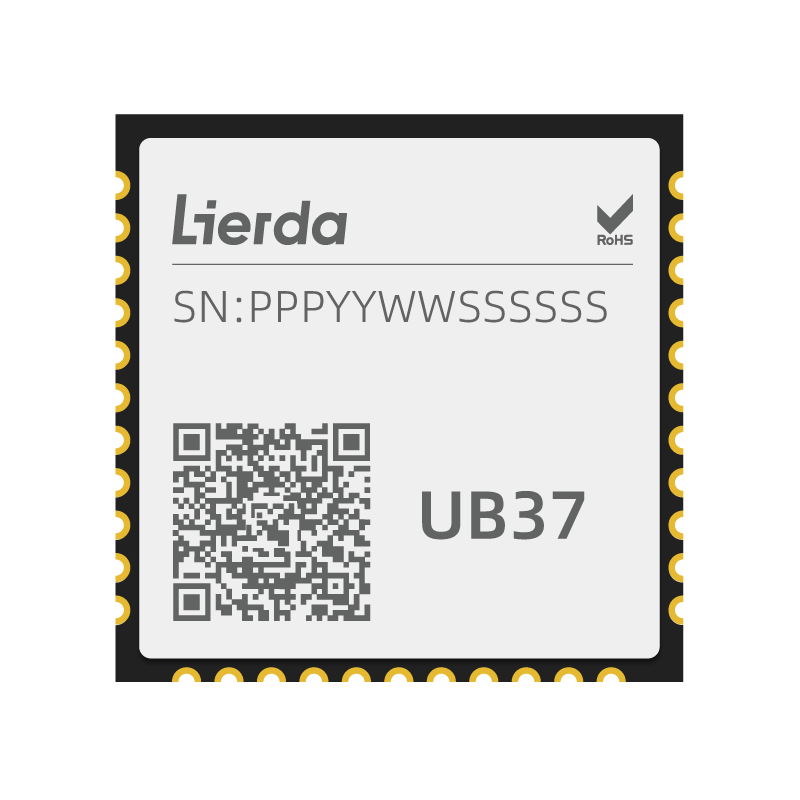
Lierda UB37 standard Wi-Fi 6 module — tri-mode data transmission for smart home and consumer electronics.
Short-range: Bluetooth modules
The EB55 is a Bluetooth 5.0 module supporting slave or master-slave dual connections, with 48 KB RAM and 512 KB Flash, operating from -40°C to +85°C, and intended for smart home applications. The SB26 is a low-power Bluetooth module with 80 KB RAM and 1 MB Flash, designed for meters and intelligent closet applications. The BT18N5 is a multi-protocol module on a Nordic chip with 256 KB RAM and 1.5 MB Flash, operating from -40°C to +105°C.
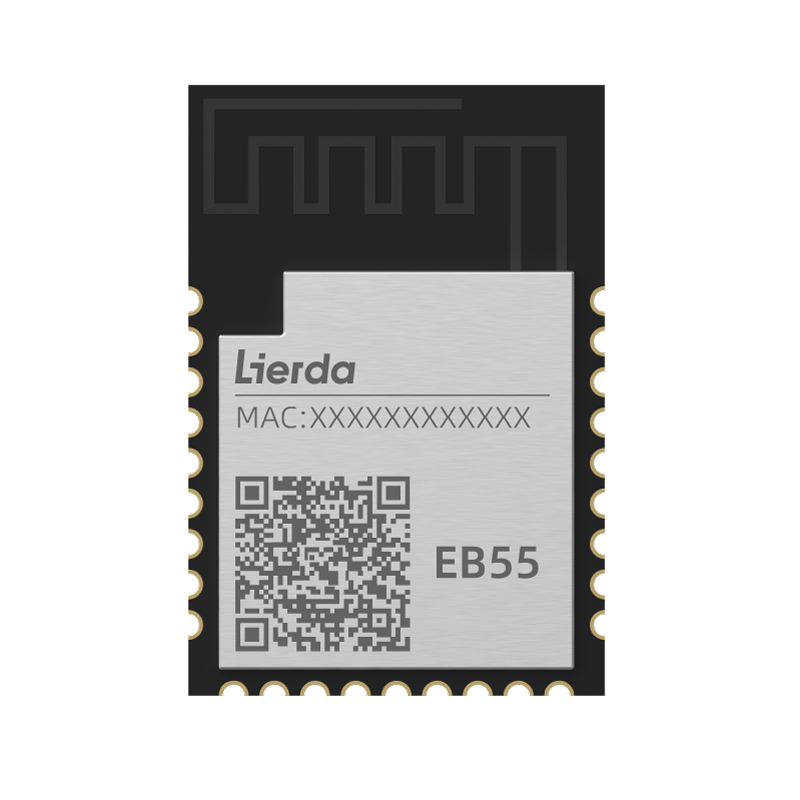
Lierda EB55 Bluetooth module — low-power short-range connectivity for smart home devices.
Industrial edge: IC610 core module / SOM
The IC610 is an industrial core module/system on module (SOM) with dimensions 37 mm × 39 mm × 2.8 mm, built on PCB substrate with SMD electronic components and RoHS-compliant encapsulation. It is intended for intelligent control systems, portable medical equipment, IoT gateways, charging piles, and industrial HMI industries. It features an MPU+MCU+NPU heterogeneous multi-core architecture and multiple device interfaces.
Step-by-step: how to evaluate an IoT module for a project
- Define the connectivity profile. Start with the operation mode. A smart meter runs 24/7 with scheduled upload; a battery tracker wakes periodically (e.g., every 30 seconds); an AI camera runs always-on. This decision separates cellular from LPWAN and low-power short-range options.
- Match frequency bands to the target region. Use the module band list against the operator bands in each sales region. Lierda's NT26 series provides dedicated variants for Europe, North America, Latin America, Japan, and global deployment.
- Verify the environment. Check the operating temperature of the module against the device environment. For example, NT26-KCN operates from -30°C to +75°C (extended -40°C to +85°C); WB25, MB26-AGL, and EB55 cover -40°C to +85°C. In outdoor meters and trackers, the enclosure rating (IP67/IP68) and antenna design are equally part of the system decision.
- Confirm compliance early. Beyond the module's RoHS-compliant materials, buyers should check regional certification. In the U.S., the FCC established a voluntary cybersecurity labeling program for consumer IoT products (“U.S. Cyber Trust Mark”) in 2024, based on NISTIR 8425 standards. Lierda is a member of the National IoT Basic Standard Working Group and has participated in drafting national and industry standards.
- Assess the manufacturer's service model. Confirm that the supplier can support firmware adaptation, embedded software customization, supply chain management, and OEM/ODM/EMS when volumes scale. Lierda's R&D team consists of 224 engineers and technical personnel. As of May 31, 2025, Lierda holds 66 invention patents, 176 utility model patents, 55 design patents, and 530 software copyrights, and maintains more than 20 service centers across China.
Use cases across industries
Smart water metering (EU)
In EU smart water meter adapter projects, Lierda modules operate in 24/7 automatic mode with scheduled data upload under -40°C to +85°C conditions. The functions include water consumption metering, leak detection, and remote meter reading, with special requirements of IP68 waterproofing and anti-tampering standards. Supporting equipment includes a water pipe, valve, communication gateway, and NB-IoT SIM card. Relevant modules include the NT26-KCN Cat.1 bis module and the MB26-AGL / NB81-A NB-IoT modules.
AI camera and IPC
In AI camera projects in Vietnam, Wi-Fi and cellular modules enable wireless communication and data transmission for smart devices in always-on, 24/7 continuous operation. Typical supporting equipment includes the camera mainboard, antenna, power supply, and enclosure. Lierda's UB37 and UB64 Wi-Fi 6 modules, together with the NT26-F series, are the product families mapped to this scenario.
POS and payment terminals
In payment terminal and POS projects common in France, Vietnam, Germany, and the UK, the module operates 24/7 and helps merchants collect payments, with supporting equipment such as cameras and NFC. The NT26 Cat.1 bis series is mapped to this scenario.
Asset tracking and positioning
In intelligent positioning and asset tracking, the product provides real-time positioning and data transmission in outdoor, wide-temperature environments with IP67 enclosures. Operation is periodic wake-up (e.g., every 30 seconds) or continuous mode. The NT26-KCN, with GNSS/BDS support and extended temperature range, and the MB26-AGL NB-IoT module are commonly mapped to this scenario.
Smart home and consumer electronics
In smart home air purifier and humidifier projects, modules enable device connectivity and remote control in low-power mode with periodic wake-up. Special requirements are low power consumption and high security. Wi-Fi modules (UB37, WF39B), Bluetooth modules (EB55, SB26), and Cat.1 variants are the product families mapped to this scenario.
Technology comparison summary
| Technology | Typical position | Market signal | Lierda example | Key parameters |
|---|---|---|---|---|
| LTE Cat.1 bis | Mid-speed cellular; 2G/3G replacement | Shipments +100% YoY in 2024 (Counterpoint Research) | NT26-FCN / NT26-FNA | 17.7 × 15.8 × 2.4 mm; regional band variants; -40°C to +85°C extended |
| NB-IoT | Low-power cellular LPWAN | Market USD 4.16B (2023), CAGR 28.1% (Grand View Research) | NB81-A / MB26-AGL | PSM 1.5 μA; B03/05/08 (MB26 adds B20/28); 2.1–4.5V |
| LoRa / LoRaWAN | Long-range unlicensed LPWAN | Market USD 8.0B (2024) → USD 32.7B (2029) (MarketsandMarkets) | WB25 / QB20 / OG45 | 22 dBm TX; -137 dBm RX; sleep 2 μA (WB25); QB20 8.0 × 8.0 × 1.1 mm, sleep 0.6 μA; OG45 up to 2000 nodes |
| Wi-Fi 6 | High-throughput local connectivity | — | UB37 / DB37 / UB64 | 150 Mbps (UB37/DB37); 286.8 Mbps dual-band (UB64); USB 2.0 / SDIO |
| Bluetooth LE | Short-range low power | — | EB55 / SB26 | BLE 5.0 (EB55); -40°C to +85°C; master-slave dual connection |
| 5G RedCap | Broadband industrial | — | NR90-HEA | 226 Mbps SA downlink; 32 × 29 × 2.4 mm; FWA / intelligent industry |
Honest limitation note: higher data rates tend to come with higher power consumption and module cost. LoRa and NB-IoT optimize for battery life and long-range coverage; Wi-Fi and cellular optimize for throughput and mobility. Each technology in the table is valid when matched to the operation mode of the device.
Frequently asked questions
What certifications should I verify before choosing an IoT module?
Certification requirements depend on the target region and product category. From a materials perspective, Lierda modules are built with FR-4 PCB substrate, SMD electronic components, LCC/LGA metal contacts, and RoHS-compliant encapsulation materials. In the United States, the FCC established a voluntary cybersecurity labeling program for consumer IoT products (“U.S. Cyber Trust Mark”) in 2024, based on NISTIR 8425 standards. Lierda is a member of the National IoT Basic Standard Working Group and has participated in drafting national and industry standards. For a specific project, buyers should verify the radio certification, electrical safety, and environmental compliance required in each country where the device will be sold.
What is the difference between Cat.1 bis, NB-IoT, and LoRa for an IoT project?
Cat.1 bis is a 4G LTE standard for mid-speed cellular applications; LTE Cat-1 bis was the fastest-growing technology in 2024, with shipments increasing 100% year-on-year, replacing legacy 2G/3G and, in many applications, NB-IoT (Counterpoint Research). Lierda's NT26 series (e.g., NT26-FCN) uses LGA packaging and offers regional band variants for Europe, North America, Latin America, Japan, and global deployments. NB-IoT is a low-power cellular LPWAN technology suited to small, infrequent data messages; the global NB-IoT market was estimated at USD 4.16 billion in 2023, with a projected CAGR of 28.1% through 2030 (Grand View Research). Lierda's NB81-A and MB26-AGL achieve a PSM current of 1.5 μA. LoRa/LoRaWAN is an unlicensed-spectrum LPWAN technology for long-range links; the LoRa and LoRaWAN IoT market was estimated at USD 8.0 billion in 2024 (MarketsandMarkets). Lierda's WB25 LoRaWAN node achieves 22 dBm transmit power, -137 dBm receiver sensitivity, and 2 μA sleep current. The right choice depends on data rate, coverage ownership, and power budget.
Which IoT module technology is most cost-effective for mid-speed applications?
For applications that need moderate data throughput and mobility without broadband speeds, Cat.1 bis is increasingly used in place of legacy 2G/3G and NB-IoT in many applications (Counterpoint Research). The NT26-FCN(KR) Cat.1 bis module, for example, supports LTE FDD data rates up to 10 Mbps downlink and 5 Mbps uplink. In practice, the total cost picture includes the module configuration (frequency band set, package, GNSS), certification scope, and order volume — no single number applies across projects. Buyers commonly ask Lierda for a configuration-matched quotation rather than comparing list prices across technologies.
How can I request IoT module samples for evaluation?
Lierda provides industry consultation, application support, embedded software customization, and ODM/OEM services through more than 20 service centers across China. To request samples, describe the target scenario — device type, operation mode (24/7 or periodic wake-up), operating temperature, and target region — and the team will match the module variant, for example an NT26-FNA for North America or an MB26-AGL for European NB-IoT projects. Contact Jerry Yao at international@lierda.com or +86-18067988146 (WhatsApp available). A short description of the working conditions accelerates the recommendation.
Can Lierda support long-term, multi-year IoT module supply?
Lierda was established in 2001 and listed on the Beijing Stock Exchange on February 17, 2023 (stock code 920249). The company operates an 18,000 m² factory, employs 976 staff including 224 R&D personnel, and exports to Europe, East Asia, Southeast Asia, and the Middle East. As of May 31, 2025, Lierda holds 66 invention patents, 176 utility model patents, 55 design patents, and 530 software copyrights. For multi-year programs, the practical next step is to share the forecast volume and target schedule so the supply plan can be reviewed against current capacity and lead times; the Lierda team can be reached at international@lierda.com.
Conclusion
IoT module selection starts with the operation mode of the device, then moves to the wireless technology, frequency bands, environmental limits, and the partner's ability to support regional certification and volume manufacturing. Lierda Science & Technology Group Co., Ltd. covers the main technology families used in 2026 IoT designs — Cat.1 bis, NB-IoT, LoRa/LoRaWAN, Wi-Fi 6, Bluetooth, 5G RedCap, and industrial core modules — from a single engineering and manufacturing organization.
Next step: Download the Lierda IoT module brochure (PDF) for the full product list, or send the target scenario — device type, operation mode, environment, and target region — to request a matched module recommendation and samples.
Company website: en.lierda.com
Email: international@lierda.com
WhatsApp / Tel: +86-18067988146
Address: 16/F, No.1 Building of Lierda Science Park, No.1326 Wenyi West Road, Hangzhou
Have Questions or Need More Details?
Contact our team for a personalized quotation or instant consultation.
Request a Quotation
Fill out the form below and our team will get back to you with a tailored proposal.
WhatsApp Direct Chat
Prefer to chat in real-time? Message us on WhatsApp for instant assistance & quick answers.
- Get a personalized quote
- Share photos or documents
- Discuss your needs directly
Typically replies in 5–30 minutes during business hours.