
IoT Module Partnership FAQs: Long-Term Supply, Acceptance Criteria, and After-Sales Support
An IoT module is rarely a one-off purchase. For consumer electronics teams building smart home devices, payment terminals, audio products or wearables, the module selected at design-in usually has to be supplied, supported and occasionally re-certified for five years or longer. That turns a supplier conversation into an architecture decision. This FAQ answers the questions buyers most often raise before committing to a multi-year IoT module partnership: how to judge long-term supply, what acceptance criteria mean in practice, and what after-sales support a serious partner is expected to deliver.
Problem Definition: Why Long-Term Module Partnerships Fail
Most module sourcing problems do not appear on the first purchase order. They surface two or three years later, when a product is already in volume production and the module it was designed around becomes difficult to source, difficult to re-certify, or difficult to support.
The failure pattern is consistent:
- Compliance drift. A module ships with regional approvals, but a later hardware revision or a new market-entry rule leaves the buyer scrambling for evidence that is no longer current.
- Specification mismatch. A device that was validated on a lab bench under ideal conditions behaves differently once it is deployed at temperature extremes, on a weak power supply, or inside a sealed enclosure.
- Support gaps. Firmware questions, AT command changes or certification follow-ups go unanswered because the original supplier treats the relationship as transactional rather than long-term.
- Terms that do not scale. Minimum order quantities, lead times and quality-control arrangements that worked for a pilot do not hold up when annual demand grows.
A durable partnership is therefore judged less on the datasheet of a single module than on the supplier's ability to hold compliance, supply and support steady over the life of the product. The questions in this article are structured around that reality.
Industry Background: A Market Moving Toward Multi-Year Commitments
The rationale for locking in a long-term connectivity partner is visible in the market itself. According to Counterpoint Research, global cellular IoT module shipments grew 10% year-over-year in 2024, rebounding from a 2023 downturn. Within that market, LTE Cat 1 bis was the fastest-growing technology, surging 100% year-over-year in 2024 — a signal that device makers are consolidating around a mid-tier cellular standard rather than spreading designs across many legacy categories.
Regulation is reinforcing the same trend. In Europe, the Radio Equipment Directive (RED) introduced mandatory cybersecurity requirements effective August 1, 2025. For buyers, this means that a module is no longer compliant simply because it carries an older radio certificate; the security requirements embedded in the RED framework must also be met. A supplier that cannot demonstrate current, region-specific compliance creates downstream risk for every device that uses the module.
Against this backdrop, multi-year commitments make commercial sense — but only when the supplier can be evaluated on evidence, not on price alone.
Who Lierda Is, and Why the Partnership Conversation Starts There
Lierda Science & Technology Group Co., Ltd. is an IoT module manufacturer and solution provider headquartered in Hangzhou, China. Founded in 2001 and listed on the Beijing Stock Exchange on February 17, 2023 (stock code: 920249), the company develops and supplies IoT modules and system solutions across cellular, Wi-Fi, Bluetooth and LPWAN technologies. In 2024, Counterpoint Research ranked Lierda fifth globally in cellular IoT module shipments, with a 5% market share.
That portfolio breadth matters for a long-term partnership because it lets a buyer standardize on one supplier across several connectivity requirements. The modules referenced throughout this FAQ include the NT26-F series Cat.1 bis modules, the WF29A dual-band IoT Wi-Fi 6 module, the BT18N0 Bluetooth 6.0 module, and the WB26 LoRaWAN node module with Class A and Class C support.
FAQ: Compliance — What Should a Long-Term Partner Provide?
What certifications and compliance evidence should an IoT module partner provide?
Compliance evidence should be region-specific and tied to the exact module model and hardware version. Lierda's product families carry approvals that map to the markets where consumer electronics devices are typically sold:
- NT26-FEU Cat.1 bis module: CE certified for the European market, complying with IEC 62368-1:2018, EN IEC 62368-1:2020+A11:2020, EN 18031-1:2024 and the Radio Equipment Directive (RED) 2014/53/EU. It also holds an EU type-examination certificate (valid 2026-03-19 to 2031-03-19).
- NT26-FJP Cat.1 bis module: TELEC and JATE certified for Japan, under the Technical Regulations Conformity Certification of Specified Radio Equipment (Ordinance of MPT No. 37, 1981, procedure RD_740).
- BT18N5 multi-protocol module: FCC certified for the US under 47 CFR Part 15 Subpart B and ANSI C63.4-2014, and CE-RED certified for the EU under IEC 62368-1:2018.
- EB55 Bluetooth module: CE-RED for Europe (valid 2022-08-04 to 2027-08-04), IC for Canada, FCC for the US, and TELEC for Japan.
- DB37 Series Wi-Fi 6 module: CE-RED for the EU, FCC for the US, IC for Canada, RCM for Australia/New Zealand, and TELEC for Japan.
- UB37 Standard Wi-Fi 6 module: CE-RED for Europe, FCC Part 15C for the US and Canada, IC for Canada, and RCM for Australia/New Zealand.
The practical check for buyers is simple: confirm that the certificate is issued for the exact model, that the standards referenced are current, and that expiry dates give sufficient runway for the planned product lifecycle.
FAQ: Capability — How Do Buyers Judge Long-Term Supply Continuity?
Supply continuity is a function of the supplier's stability, portfolio depth and support infrastructure, not a promise alone. Several observable facts help a buyer assess whether a module partner can be relied on across a multi-year program.
On corporate stability, Lierda has operated since 2001 — a 25-year history — and has been publicly listed since February 2023. It holds 66 invention patents, 176 utility model patents, 55 design patents and 530 software copyrights as of May 31, 2025, and operates with a 224-person R&D team. These indicators suggest an organization structured for continuous product development rather than short-cycle trading.
On portfolio depth, the company's product line covers Cat.1 Module, WiFi Module, Cellular Module, NB IoT Module, LoRa Module, LPWAN Module and Bluetooth Module categories, alongside IoT Module OEM, IoT Module ODM and IoT Module EMS services. For a consumer electronics buyer, that breadth reduces the risk of having to qualify a second supplier every time a new connectivity requirement appears.
On support reach, Lierda maintains more than 20 service centers and provides industry consultation, application support, embedded software customization, supply chain management, ODM and OEM services. For a multi-year program, local or near-local support is often the difference between a manageable firmware issue and a production-line stoppage.
FAQ: Product Fit — Matching Modules to Consumer Electronics Projects
A partnership is only as good as the fit between the module and the device. The four families most relevant to consumer electronics projects each serve a different role.
Cat.1 bis for connected devices that need cellular coverage
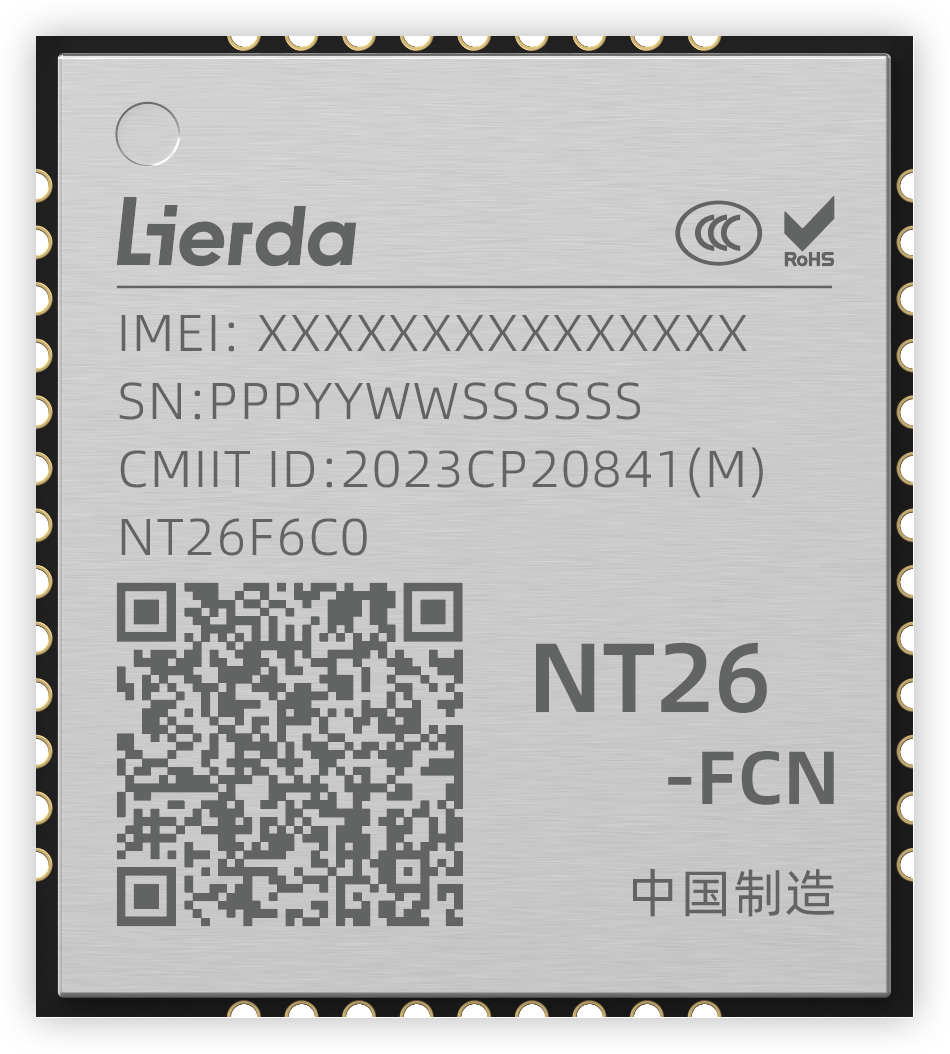
The NT26-F series Cat.1 bis LTE module supports FDD bands B1/B3/B5/B8 and TDD bands B34/B38/B39/B40/B41, with an operating temperature range of -30°C to +75°C and an extended range of -40°C to +85°C. It includes GNSS/BDS positioning, uses an LGA package measuring 17.7 × 15.8 × 2.4 mm, and is powered at 2.3–4.5 V (typical 3.8 V). Typical applications listed for the family include cloud speakers, trackers, POS, POC, data cards, smart security, two-wheelers and industrial-grade PDAs. The KR-oriented NT26-FCN variant adds support for network protocols including TCP/UDP/HTTP/SSL/MQTT/FOTA/RNDIS/FTP/ECM, with a maximum LTE FDD data rate of 10 Mbps downlink and 5 Mbps uplink.
Wi-Fi 6 for high-throughput, mains-powered products
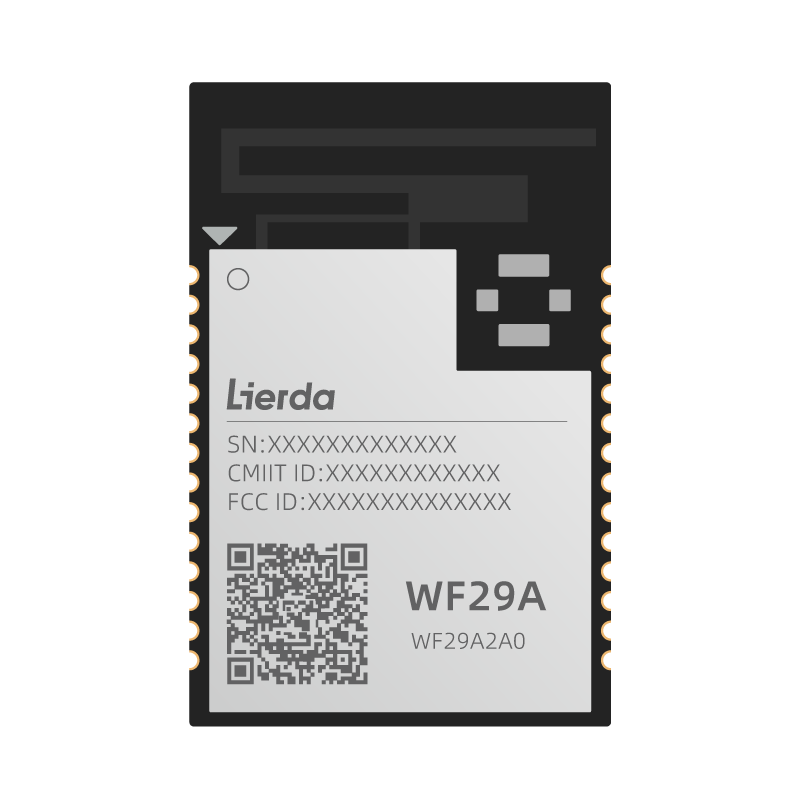
The WF29A is a dual-frequency IoT Wi-Fi 6 module with 512 KB RAM and 4 MB Flash, operating across a temperature range of -40°C to 105°C. It is positioned for smart home, pet supplies, consumer electronics and medical care applications — the kind of devices that need stable throughput and long thermal headroom inside a sealed enclosure.
Bluetooth for pairing, provisioning and low-power accessories
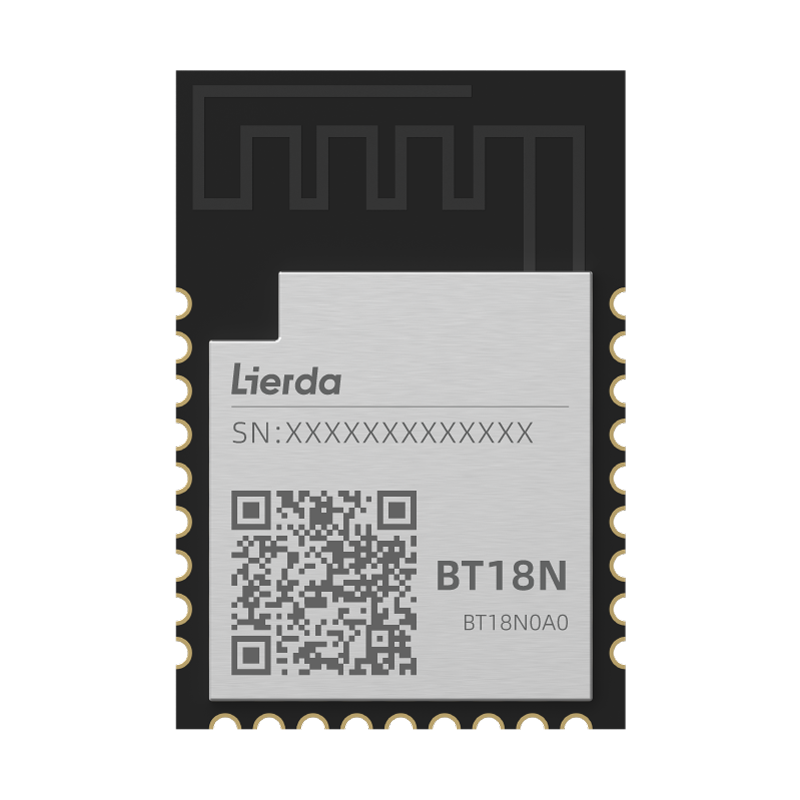
The BT18N0 is a Bluetooth 6.0 (BLE) module built on a Nordic chip, with 96 KB RAM and 512 KB Flash, operating from -40°C to +105°C. It supports a 110 KB/s application-layer rate and a one-master/four-slave topology, which suits smart home devices that need lightweight local connectivity and multi-node coordination.
LoRaWAN for long-range, low-power sensor networks
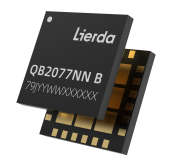
The WB26 LoRaWAN node module supports global frequency bands and Class A / Class C operating modes. It measures 22 × 18 × 3.0 mm, runs at 1.8–3.6 V, delivers up to 22 dBm transmit power, and reaches -137 dBm receiver sensitivity (SF=12, BW_L=125 KHz @ LoRa) with a 2 µA sleep current. It uses a UART interface and supports an IPEX antenna. Typical deployments include smart street lights, smart agriculture, smart logistics, industrial control, and instruments and meters.
FAQ: Purchasing Terms, MOQ and Quality Control
Purchasing terms are where long-term partnerships are usually won or lost, because the arrangements that suit a pilot rarely suit scaled production. Lierda structures its commercial models so that terms can be matched to the project stage rather than imposed uniformly.
| Engagement model | Customization scope | MOQ & lead time | Quality control |
|---|---|---|---|
| Standard Product Direct Sales | Logo customization | Flexible MOQ; lead time negotiable | Custom QC standards based on customer specification |
| OEM | Module / PCBA | Flexible MOQ; lead time negotiable | Custom QC standards based on customer specification |
| ODM | Module / PCBA | Flexible MOQ; lead time negotiable | Custom QC standards based on customer specification |
Across all three models, monthly capacity is described as flexible and driven by order requirements, and export support is provided for worldwide markets with full compliance assistance. The practical implication for buyers is that a project can begin with a modest first run and scale later without renegotiating the underlying relationship.
Step-by-Step: Assembling a Multi-Year Module Supply Agreement
Buyers who treat the partnership as a sequence of verified gates tend to avoid the failures described earlier. A practical sequence looks like this:
- Define the connectivity envelope. Decide which of the four families — Cat.1 bis, Wi-Fi 6, Bluetooth or LoRaWAN — fits each product, using the operating temperature, power and interface requirements as the filter.
- Collect model-level compliance. Match certificates to the exact model and confirm the standards and validity windows. For Europe, verify that current RED requirements, including cybersecurity provisions effective August 1, 2025, are addressed.
- Validate samples against acceptance criteria. Agree in advance on the quality-control standard and testing regime that the supplier will apply, since both OEM and ODM models support custom QC standards based on customer specifications.
- Agree terms for scale. Confirm MOQ, lead time and capacity expectations, noting that these are negotiable against project complexity and order volume.
- Establish support channels. Confirm the dedicated project support and remote technical assistance arrangement, and identify the service center coverage relevant to the target market.
- Set a lifecycle review cadence. Because compliance and specifications evolve, schedule periodic reviews of certification status and product availability over the product's commercial life.
Use Cases: Long-Term Partnerships in Practice
Existing partnerships show what multi-year relationships look like when they hold. An energy OEM in Germany has deployed 19,600,000+ units across water-meter and gas-meter applications over a relationship spanning five and ten-year durations, with stable operation and continuous development. A global consumer electronics OEM in the audio division has shipped 200,000 units per year for seven years on Wi-Fi 6 modules. A home appliance OEM in Korea has delivered 500,000 units per year for five years on smart home air-treatment products. A telecom operator in Korea has supplied 2K units per year for five years in communication network stations. These projects share a common trait: the module relationship was treated as a long-term engineering commitment rather than a repeat purchase.
Comparison Table: Matching the Four Families
| Parameter | NT26-F Series (Cat.1 bis) | WF29A (Wi-Fi 6) | BT18N0 (Bluetooth 6.0) | WB26 (LoRaWAN) |
|---|---|---|---|---|
| Primary role | Cellular LTE Cat.1 bis | Dual-band Wi-Fi 6 | Bluetooth Low Energy connectivity | Long-range LPWAN node |
| Frequency / bands | FDD B1/B3/B5/B8, TDD B34/B38/B39/B40/B41 | 2.4 GHz & 5 GHz dual band | 2.4 GHz BLE | Global LoRaWAN bands |
| Form factor | LGA, 17.7 × 15.8 × 2.4 mm | Module package | Module package | 22 × 18 × 3.0 mm |
| Supply voltage | 2.3–4.5 V (typ. 3.8 V) | — | — | 1.8–3.6 V |
| Operating temperature | -30 to +75°C (extended -40 to +85°C) | -40 to +105°C | -40 to +105°C | — |
| Notable integration details | GNSS/BDS position support | 512 KB RAM, 4 MB Flash | 110 KB/s, one master four slave | Class A/C, 22 dBm, 2 µA sleep, UART + IPEX |
| Typical applications | POS, trackers, cloud speakers, data cards, smart security | Smart home, consumer electronics, medical care | Smart home devices | Smart meters, street lights, agriculture, logistics |
Frequently Asked Questions
1. What certifications should an IoT module partner hold for a consumer electronics project?
The partner should be able to show model-specific certificates for every target market. Lierda's portfolio includes CE-RED certification for the EU (for example, the NT26-FEU and BT18N5 modules, with standards such as IEC 62368-1:2018 and, for NT26-FEU, EN 18031-1:2024 under RED 2014/53/EU), FCC certification for the US (BT18N5, under 47 CFR Part 15 Subpart B), TELEC and JATE for Japan (NT26-FJP), IC for Canada, and RCM for Australia/New Zealand (DB37 and UB37). Buyers should verify the model, standard and validity date rather than relying on a generic compliance claim.
2. How can buyers evaluate long-term supply and lifecycle continuity?
Continuity is best judged on verifiable company facts. Lierda has operated since 2001, is listed on the Beijing Stock Exchange (stock code 920249), holds 66 invention patents, 176 utility model patents, 55 design patents and 530 software copyrights as of May 31, 2025, and supports customers through more than 20 service centers. Counterpoint Research ranked Lierda fifth globally in cellular IoT module shipments in 2024 with a 5% market share. A wide portfolio across Cat.1, Wi-Fi, Bluetooth and LoRaWAN further reduces the need to qualify new suppliers mid-program.
3. What purchasing terms and MOQ arrangements apply to OEM/ODM module supply?
Lierda offers Standard Product Direct Sales with logo customization, plus OEM and ODM models covering Module and PCBA customization. In all cases, minimum order quantity and lead time are described as flexible and negotiable based on project requirements and order volume, and quality control can be customized to customer specifications. Export support covers worldwide markets with full compliance assistance.
4. Can samples be validated before committing to a multi-year agreement?
Yes. The flexible MOQ structure and the Custom QC standards arrangement allow a buyer to validate module samples against agreed acceptance criteria before scaling. Because quality control can be defined to the customer's specification, the sample stage is the right point to lock in the testing regime that will apply throughout the supply relationship.
5. What lead times and after-sales support should buyers expect?
Lead time is negotiable and depends on project complexity and order volume rather than being fixed. After-sales support is delivered through dedicated project support and remote technical assistance, backed by a service network of more than 20 centers and service scope that includes industry consultation, application support, embedded software customization, supply chain management, ODM and OEM services. Buyers can request the product brochure and arrange a consultation through the contacts below.
Conclusion: What to Confirm Before Signing
A multi-year IoT module partnership is a compliance, capability and support commitment, not a price list. Before committing, confirm four things: that model-level certificates cover every target market for the full product lifecycle; that the supplier's portfolio can absorb future connectivity requirements without a new qualification cycle; that MOQ, lead time and quality-control terms are matched to the project's growth curve; and that after-sales support has a named channel and a physical service footprint.
Lierda addresses each of these through a portfolio spanning Cat.1 bis, Wi-Fi 6, Bluetooth and LoRaWAN modules, region-specific certifications, flexible OEM/ODM terms, and a support network built over 25 years of IoT operations.
Request a Sample, Quote or Product Catalog
To discuss a long-term IoT module partnership, request sample validation or a quotation for Cat.1 bis, Wi-Fi 6, Bluetooth or LoRaWAN modules, contact the Lierda international team directly.
Email: international@lierda.com
WhatsApp / Tel: +86-18067988146
Website: en.lierda.com
Download the product catalog: Lierda IoT Module Brochure (PDF)
Have Questions or Need More Details?
Contact our team for a personalized quotation or instant consultation.
Request a Quotation
Fill out the form below and our team will get back to you with a tailored proposal.
WhatsApp Direct Chat
Prefer to chat in real-time? Message us on WhatsApp for instant assistance & quick answers.
- Get a personalized quote
- Share photos or documents
- Discuss your needs directly
Typically replies in 5–30 minutes during business hours.