
LPWAN Compliance Guide: Bands, Power, and Enclosure Ratings
LPWAN compliance for a consumer product is decided by three parameters that must agree before the design freezes: the frequency band the radio transmits in, the power class it transmits at, and the enclosure and temperature envelope the hardware has to survive. Settle them in that order and most of the remaining regulatory work becomes documentation. Settle them out of order and the same product comes back with a new antenna, a new RF measurement and a new filing.
This guide is written for consumer-electronics teams in the research and evaluation stages of an LPWAN selection — smart-home hubs, sensors, trackers and the gateways behind them. It treats compliance as a design envelope rather than an audit exercise, and it uses documented Lierda specifications as worked reference points: the WB16 Sigfox RC1 module at 868–870 MHz and 12 dBm, the WB25 and WB26 LoRaWAN modules at 22 dBm with -137 dBm sensitivity, the LP26 29 dBm high-power option, the OG45 IP67 gateway rated for -20 °C to +70 °C, and the IG41 indoor global-band gateway.
Scope note. This is not a certificate-verification walkthrough. It does not explain how to read a test report or how to challenge a declared standard. It sets out which regional band, power and enclosure questions to close first, so that the certificate you eventually file describes the product you actually build.
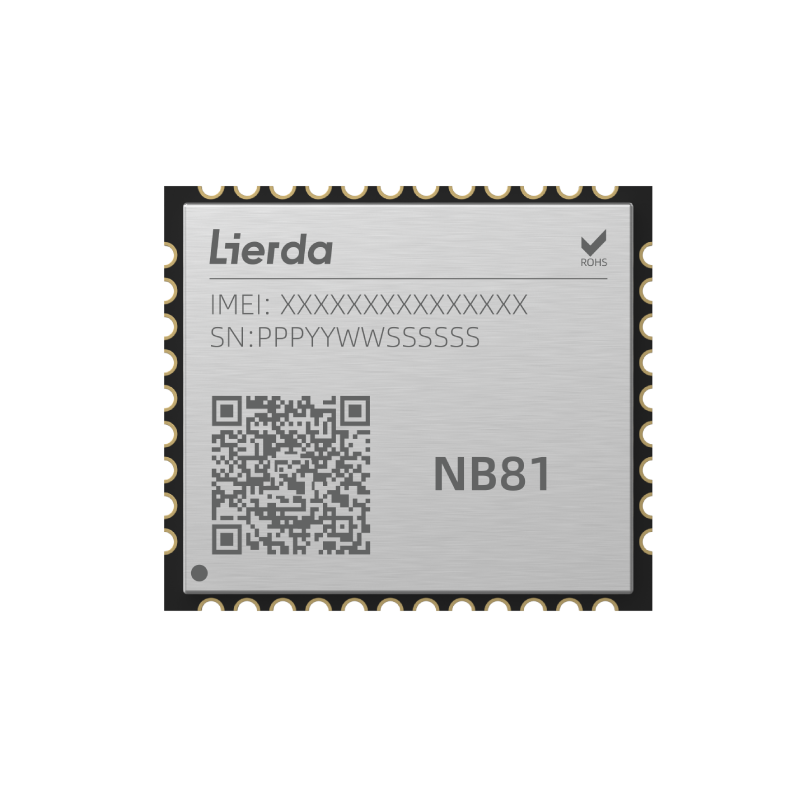
The NB81-A NB-IoT module illustrates the licensed-band case: the module's band list (B03, B05, B08) defines the addressable operator markets before any power or enclosure decision is made.
Why band, power and enclosure are a single decision
Three engineering facts make the parameters inseparable. The band fixes the antenna geometry and the matching network, so a band change is a hardware change rather than a settings change. Transmit power is regulated at the radiated level, so antenna gain moves you relative to the limit even when the module's dBm figure never changes. And the enclosure determines where a gateway can physically live, which in turn determines the temperature range its electronics will actually see.
A short illustration shows why sequence matters. A team closes a link budget by moving from a 22 dBm LoRaWAN module to the 29 dBm LP26. The higher conducted power raises current draw and heat inside a sealed housing, and the antenna arrangement needed to convert that power into radiated energy may push the combination closer to the market's ceiling. The power decision has just become a thermal decision and a regulatory one, and the enclosure review has to be repeated.
Working the three parameters in order — band, then power, then enclosure — keeps each decision inside its own evidence. Working them in parallel is how consumer teams end up specifying a sealed outdoor gateway for a band that was only ever approved for an indoor variant.
Industry context: fragmenting band plans and a widening compliance scope
Unlicensed LPWAN and licensed cellular LPWAN fragment differently, and both fragments affect module selection. Sigfox and LoRaWAN products operate in regionally defined unlicensed bands, so one product line can require several band variants. NB-IoT and other cellular LPWAN products follow operator spectrum, so the module band list is set by whichever networks serve the target market.
The cellular side has been growing at a measured pace rather than a speculative one. Counterpoint Research reported a 10% year-over-year rise in global cellular IoT module shipments in 2024, and identified LTE Cat 1 bis as the fastest-growing technology that year at roughly 100% growth. Those figures describe shipments, not compliance ease: a faster-moving technology base makes band and power re-validation more frequent, not less.
Compliance scope has widened at the same time. As reported in that market coverage, the EU Radio Equipment Directive's cybersecurity requirements became mandatory on 1 August 2025. A European consumer product therefore carries security conditions alongside radio, EMC and safety ones. Band, power and enclosure remain the three parameters you can control at the design stage; the security requirements are largely a firmware and documentation question that still has to be confirmed per variant.
The supplier behind the reference specifications used here is Lierda — Lierda Science & Technology Group Co., Ltd., an IoT module and solution provider founded in 2001, headquartered in Hangzhou, China, operating an 18,000 m² facility with 976 employees including a 224-person R&D team, and listed on the Beijing Stock Exchange since 17 February 2023 under stock code 920249. Its module range spans 5G, NB-IoT, Cat.1, LoRa, Wi-Fi, Wi-SUN and BLE, which is why the same supplier appears on both sides of an LPWAN-versus-cellular comparison.
Parameter 1 — frequency band: the market-entry decision
Band selection is a market-list problem before it is a hardware problem. Write down every country the product will ship to, note which LPWAN band plan or operator spectrum each one uses, and only then look for a module that covers them. Two modules with identical power figures can have completely different market reach.
Sigfox RC1: a 868–870 MHz specification
The WB16 is specified as a Sigfox RC1 module operating in 868–870 MHz at 12 dBm. RC1 is the Sigfox radio configuration associated with the 868 MHz band plan, so the module's useful market list is the group of territories that allocate LPWAN in that range. That makes the WB16 a well-defined single-market or single-region choice for consumer sensors, and a poor candidate for a roadmap that assumes one SKU covers every region. The 12 dBm figure also sets expectations: it is a low-power class intended for short-payload, low-duty-cycle reporting rather than for closing long links through heavy clutter.
LoRaWAN: regional parameter sets on one platform
LoRaWAN moves part of the band question into software-defined regional parameters, which is convenient but not free. Lierda's product page for the WB25-8D lists support for EU868, IN865, RU864, AU915, US915, KR920 and AS923-1/-2/-3/-4, with an operating range of 860–930 MHz and a UART interface. STMicroelectronics' partner listing corroborates the family positioning: the WB25-8D is described there as a LoRaWAN end-node module, while the WB26-7P is described as a LoRa transparent module using a serial interface.
That distinction belongs on a regional checklist. Protocol support and radio capability are separate line items: a module that covers many regional plans still has to be provisioned with the correct regional parameter set, and a transparent LoRa module may leave framing decisions to your own firmware. Confirm which of the two you are buying before you assume a LoRaWAN certification path.
Licensed-band LPWAN: the operator decides
Where the deployment depends on a licensed network, band selection is not yours to make. The NB81-A NB-IoT module is specified for bands B03, B05 and B08, with a 2.1–4.5 V supply range and a 1.5 µA PSM current. Those three bands define the addressable operator list, so the checklist item becomes "which networks in my target markets operate on B03, B05 or B08", not "which band do I prefer". A market served only by other bands needs a different module.
Decision rule: if more than one region is in scope for launch, choose the module whose documented band list covers all of them, or accept that you are managing several SKUs. No firmware setting extends a radio's tuning range.
Parameter 2 — transmit power: what a dBm figure does and does not tell you
Transmit power is the parameter most often read as a proxy for range, and it is the one where that reading costs the most. Three reference points sit in the current LPWAN range: 12 dBm on the WB16, 22 dBm on the WB25 and WB26 LoRaWAN modules, and a 29 dBm high-power option on the LP26.
What those figures describe is conducted output at the module. What regulators limit is radiated power in the band. Antenna gain is added and cable, connector and housing losses are subtracted between the two points, so the same 22 dBm module can sit at very different margins depending on the antenna chosen. Two consequences follow: a higher dBm module does not automatically produce more usable range in a finished product, and an antenna change late in a programme can move a compliant design closer to the limit without any change to the module itself.
Receiver sensitivity works from the other direction. The WB25 and WB26 are specified at -137 dBm sensitivity, and that figure governs the weak-signal end of the link. Subtracting -137 dBm from 22 dBm gives an arithmetic difference of 159 dB before antenna gain, cable and body loss and fade margin are applied. That number is a budgeting starting point, not a measured field range, and it shrinks quickly once a realistic fade margin and a poorly placed antenna are counted.
The 29 dBm LP26 option is the right answer only when link margin is the binding constraint — a basement meter position, a metal-clad cabinet or a remote outdoor site. Moving to it raises current draw and thermal load, both of which feed back into battery life and enclosure design, and the radiated combination has to be re-verified against the market limit. Treat 29 dBm as a system decision rather than a specification upgrade.
One further condition belongs in this section even though it is not measured in dBm. Unlicensed LPWAN bands commonly carry duty-cycle or dwell-time conditions alongside radiated-power limits. Those conditions, not the module's power class, usually set the achievable reporting interval, and a payload plan that ignores them will fail at the network level before it fails at the regulatory one.
Parameter 3 — enclosure and temperature ratings for gateways
Gateway ratings decide where a deployment can physically exist, and they are frequently borrowed from a different site type. The OG45 is an IP67-rated outdoor gateway specified for -20 °C to +70 °C. The IG41 is an indoor gateway with global-band coverage.
Read the two OG45 ratings separately. IP67 covers dust ingress and temporary water immersion, which is what a pole or rooftop installation demands; it says nothing about temperature or corrosion. The -20 °C to +70 °C figure is the operating envelope: its lower end matters for cold-climate sites, and its upper end needs checking against the mounting position, because a housing in direct sun or inside a metal cabinet can run above the ambient air temperature the rating describes. Neither rating substitutes for the other, and neither substitutes for an antenna placement review.
The IG41 answers a different question. For in-building coverage — a retail space, an apartment block, a hotel — an indoor global-band gateway avoids weather-sealing requirements entirely and reduces the number of hardware variants in a multi-region launch, because band coverage is handled by the gateway rather than by a per-market outdoor SKU. The trade-off is that the gateway inherits the building's power and mounting constraints instead of the site's weather constraints.
Step-by-step regional requirements checklist
- List markets and their band plans. Every country in the launch plan, with the LPWAN band plan or operator spectrum it uses. This list, not the module catalogue, is the input to the next seven steps.
- Map each market to a documented band list. 868–870 MHz Sigfox markets point to the WB16; LoRaWAN markets point to the WB25 regional-plan set; licensed NB-IoT markets point to a module whose bands match the local operators, such as the NB81-A on B03, B05 or B08.
- Fix the radiated power target. Start from the module's conducted figure — 12, 22 or 29 dBm — add antenna gain, subtract cable and body loss, and compare the result with the market's radiated limit.
- Check duty-cycle and dwell-time conditions. Convert them into a maximum reporting interval and payload size, then confirm the product's data plan survives that interval.
- Confirm the sensitivity condition. The -137 dBm figure on the WB25 and WB26 applies under stated test conditions; verify that the data rate and bandwidth you intend to use are the ones the figure refers to.
- Choose the gateway class by site. Indoor building coverage goes to the IG41; weather-exposed mounting goes to the OG45, with the -20 °C to +70 °C range checked against the actual mounting position rather than the regional climate average.
- Assemble the compliance file per variant, not per product family. Radio, EMC, safety and — for Europe — the cybersecurity requirements effective from 1 August 2025, each tied to the exact band and power configuration shipped.
- Re-run steps 3 and 6 after any antenna or enclosure change. Antenna and housing changes are the two most common reasons a previously compliant configuration stops being compliant.
Where the combinations fit: four consumer scenarios
Indoor smart-home hub. Global-band indoor coverage, no weather sealing, and one gateway SKU across regions: the IG41 pattern. Module choice follows the sensor fleet's band plan, with the WB25 regional-plan set covering the common LoRaWAN markets and the WB16 remaining a single-region Sigfox option.
Outdoor utility or asset monitoring. The OG45's IP67 rating and -20 °C to +70 °C envelope fit pole or cabinet mounting, while the WB25 or WB26 at 22 dBm provides the node link. Unlicensed-band duty-cycle conditions usually determine the reporting interval here, so the traffic plan should be built before the power class is finalised.
Deep-indoor or obstructed sites. Where the link budget, not the band plan, is the limiting factor, the LP26 at 29 dBm is the option to evaluate — with the thermal and radiated-power consequences checked in the same review rather than afterwards.
Single-market low-power sensor. A consumer sensor sold only in 868–870 MHz markets can use the WB16 at 12 dBm, which keeps current draw low and simplifies the antenna, at the cost of any multi-region roadmap. Lierda's long-running metering work illustrates how durable that kind of deployment can be: a German energy OEM relationship covering water and gas meters, reported at 19,600,000+ units across 5-year and 10-year service periods with stable operation.
Reference comparison: documented specifications
| Model | Family | Band / regional scope | Transmit power | Sensitivity | Enclosure / temperature |
|---|---|---|---|---|---|
| WB16 | Sigfox RC1 module | 868–870 MHz | 12 dBm | — | — |
| WB25 | LoRaWAN node module | EU868, IN865, RU864, AU915, US915, KR920, AS923-1/-2/-3/-4; 860–930 MHz; UART | 22 dBm | -137 dBm | — |
| WB26 | LoRaWAN node module | — | 22 dBm | -137 dBm | — |
| LP26 | High-power LPWAN option | — | 29 dBm | — | — |
| OG45 | Outdoor LoRaWAN gateway | — | — | — | IP67; -20 °C to +70 °C |
| IG41 | Indoor LoRaWAN gateway | Global band | — | — | Indoor |
| NB81-A | NB-IoT module | B03, B05, B08; 2.1–4.5 V; 1.5 µA PSM | — | — | — |
Dashes indicate that the specification summary used for this guide does not state a value; they are not an indication that the product lacks the capability. Confirm band variants, power settings and enclosure ratings on the current datasheet before design freeze.
Six mismatches that create rework
- Treating dBm as range. The module figure is conducted power at the connector; radiated power after antenna gain and losses is what the market regulates and what the link experiences.
- Assuming a global-band gateway removes module band work. The IG41 covers multiple bands at the gateway, but every node still needs a band-compliant module and the correct regional parameter set.
- Using IP67 as a temperature rating. Ingress protection and the -20 °C to +70 °C operating envelope answer different questions and are verified separately.
- Reusing a European SKU in another region. An 868–870 MHz specification is tied to that band plan; other markets require a matching variant or a different module family.
- Treating protocol support as market approval. LoRaWAN or Sigfox capability describes the radio protocol, not the country-level filing or, in Europe, the cybersecurity conditions effective from 1 August 2025.
- Changing the antenna after the filing. Antenna gain is part of the radiated-power calculation, so a late antenna change can invalidate both the link budget and the compliance position.

Lierda operates an 18,000 m² facility with 976 employees; multi-band module programmes depend on that production and test capacity rather than on catalogue listings alone.
FAQ
Which LPWAN band and power class should a consumer product target first?
Start from the market list, not the module. Each target market fixes an allowable band plan, and the band plan fixes the module family and the antenna design. For 868–870 MHz Sigfox deployments the WB16 at 12 dBm is the matching reference; for LoRaWAN markets the WB25 regional-plan set covers EU868, IN865, RU864, AU915, US915, KR920 and the AS923 variants on one 860–930 MHz platform; where a licensed NB-IoT network is the intended path, band choice follows the operator and the NB81-A is specified for B03, B05 and B08. Power class only becomes a meaningful comparison once that band list is fixed — and a market outside the list needs a different variant, not a firmware setting.
Is 22 dBm always better than 12 dBm for range?
Not automatically. The 12 dBm WB16 and the 22 dBm WB25/WB26 differ in conducted output, but usable range is set by radiated power after antenna gain and cable and body loss, by receiver sensitivity, and by the duty-cycle or dwell-time conditions of the band. A 22 dBm module with a poorly integrated antenna can underperform a 12 dBm design with a clean one, and a higher conducted figure can consume regulatory headroom that antenna gain then eats. Compare variants on the same antenna, housing and installation position.
When does the LP26 29 dBm option make sense?
When link margin is the binding constraint: deep indoor positions, basement meter rooms, metal-clad cabinets or remote outdoor sites. It is not a default. Higher conducted power increases current draw and thermal load inside the housing, and the radiated combination has to be re-verified against the target market's limit. The 29 dBm figure describes the module's transmit capability, not permission to radiate at that level in every band.
What do the OG45 IP67 and -20 °C to +70 °C ratings actually cover?
IP67 addresses dust ingress and temporary water immersion, which is the outdoor mounting question. The -20 °C to +70 °C figure is the operating temperature envelope, and it is a separate specification. Together they qualify the OG45 for weather-exposed mounting, but two checks remain: whether the mounting position — a sun-loaded pole or a metal cabinet — exceeds the ambient temperature the rating describes, and whether -20 °C covers the coldest site in the plan. The IG41 is the indoor alternative with global-band coverage, which avoids weather-sealing requirements entirely.
What drives cost when one product line spans several regions?
Variant count, more than unit price. Each distinct band and power combination carries its own antenna matching, its own RF measurement and filing, its own SKU and its own safety stock. Consolidating on a global-band indoor gateway such as the IG41 and a multi-plan LoRaWAN module such as the WB25 reduces the number of hardware variants, while a single-market 868–870 MHz WB16 design keeps one variant and one antenna but closes off multi-region expansion. Quotation requests should therefore be structured per configuration so that the variant cost is visible rather than averaged.
How should a team validate a band and power choice before mass production, and what lead time should it plan for?
Validate with samples of the exact variant rather than a neighbouring model: measure conducted power at the connector, run a radiated measurement with the final antenna and housing, check sensitivity at the specified -137 dBm condition where that figure applies, and run a duty-cycle-constrained traffic test at the real reporting interval. On scheduling, Lierda's standard-product, OEM and ODM models all state flexible MOQ based on project requirements and lead time negotiable according to project complexity and order volume, so a multi-region SKU set is best quoted as a package rather than extrapolated from one module. Sample requests and configuration-specific quotations go through Lierda's international contact channel, and the corporate brochure (PDF) summarises the wider product range.
Conclusion
LPWAN compliance is easier to manage as a sequence than as a checklist of documents. Fix the band from the market list — 868–870 MHz for the WB16, the WB25 regional-plan set for LoRaWAN markets, operator-matching bands such as B03, B05 and B08 for the NB81-A. Then set the power class against a radiated target, remembering that 22 dBm on the WB25 and WB26 and 29 dBm on the LP26 describe conducted output, while -137 dBm sensitivity describes the weak-signal end that fade margin and antenna placement erode. Then choose the enclosure envelope: IP67 and -20 °C to +70 °C on the OG45 for exposed sites, or the indoor global-band IG41 where weather sealing is not the constraint.
Teams that run those three steps in order usually discover their market coverage, antenna plan and certification scope at the evaluation stage, when changes are still cheap. Teams that start from a module datasheet usually discover them at the first radiated measurement. The checklist above is short enough to run on a single launch and specific enough to reuse when the next region is added.
Have Questions or Need More Details?
Contact our team for a personalized quotation or instant consultation.
Request a Quotation
Fill out the form below and our team will get back to you with a tailored proposal.
WhatsApp Direct Chat
Prefer to chat in real-time? Message us on WhatsApp for instant assistance & quick answers.
- Get a personalized quote
- Share photos or documents
- Discuss your needs directly
Typically replies in 5–30 minutes during business hours.