
Outdoor Landscape Lighting: A Complete Buyer's Guide
Outdoor Landscape Lighting: A Complete Buyer's Guide
Outdoor landscape lighting is a planned system of exterior fixtures that lights the parts of a site that are not the building itself: gardens, lawns, pathways, trees, walls, driveways, plazas and public open space. It exists for three reasons — safety and wayfinding, architectural effect, and atmosphere. This guide explains the fixture categories, the specifications that actually change results (IP rating, CRI, color temperature, beam angle, control method), and a step-by-step way to specify a residential, commercial or municipal landscape lighting project.
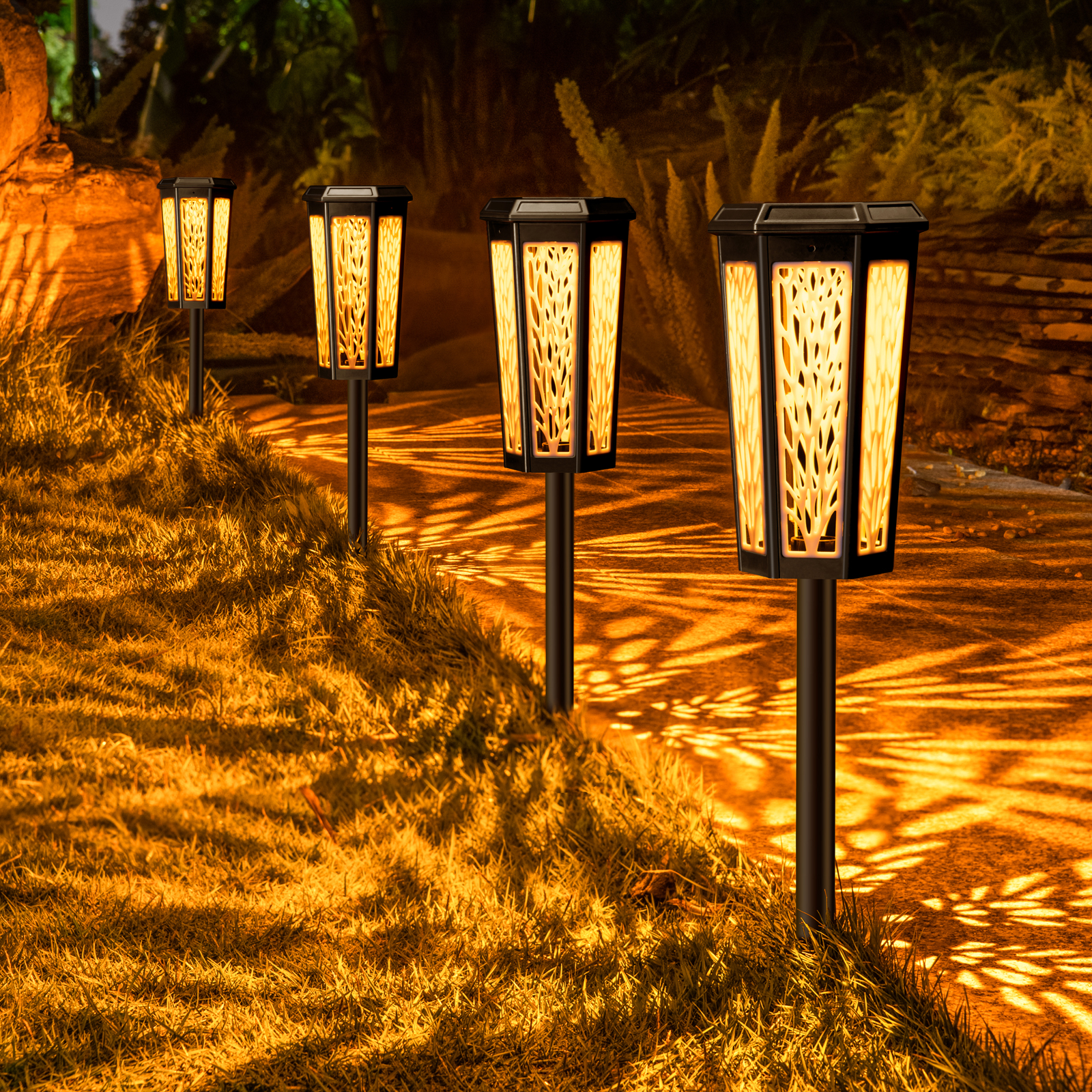
Cover: solar pathway lighting — the safety and wayfinding layer of a landscape lighting scheme.
What Is Outdoor Landscape Lighting?
Outdoor landscape lighting is the deliberate illumination of outdoor non-building elements — planting, ground plane, water, hardscape and site boundaries — using fixtures selected for weather exposure, light distribution and visual intent. It is different from general floodlighting or security lighting because the design goal is not only visibility but composition: which objects are lit, which are left in shadow, and in what order the eye reads a space after dark.
In practice, a landscape lighting scheme has three functional layers:
- Path and safety layer — pathway lights, solar lawn lights, bollard and in-ground markers that define walking routes, steps and level changes at low mounting heights.
- Feature and architectural layer — tree lights and landscape spotlights, wall washer lights, LED in-ground lights and flood lights that model trunks, facades, signage, monuments and boundaries.
- Atmosphere layer — decorative string lights and low-glare accent fixtures that soften courtyards, terraces, hospitality spaces and event areas.
Buyers should treat these three layers as one system. A path that is competently lit but visually disconnected from the planting beside it reads as industrial; a beautifully uplit tree beside an unlit, unsafe walkway fails the project. The specification work is in matching fixture categories, ratings and optics to each layer.
Where Landscape Lighting Projects Usually Fail
Most landscape lighting problems are specification problems, not installation problems. The same five mistakes repeat across residential, commercial and municipal projects.
- Fixtures chosen by appearance before environment. A decorative luminaire selected from a catalogue photo may be rated for rain-exposed walls but not for ground contact, or rated IP65 when the site brief calls for submersion-rated hardware. Ingress protection is the first filter, not the last.
- Mixed color temperatures across one site. Warmer pathway fixtures next to cooler facade flood lights produce a visible patchwork. Color temperature must be decided once for the whole scheme, and warm white, neutral white and cool white carry different design meanings.
- Solar fixtures installed in shade. Solar landscape lights convert sunlight through a panel and store it in a battery; if the panel is under planting, an eave or a wall shadow, charging time drops and runtime falls with it.
- Beam angles copied between fixture types. A narrow 15° beam that grazes a tree trunk is wrong for a driveway, and a wide flood pattern that covers a facade is wrong for a sign or a step edge.
- Control decided after installation. Dimming, grouping, sensor behavior and DMX synchronization all depend on hardware chosen at specification stage. Retrofitting control is expensive and often impossible without replacing drivers.
Each of these failures is avoidable with a short, structured specification process — which is what the rest of this guide provides.
Industry Background: What Has Changed in Outdoor Lighting
The outdoor lighting category has shifted on two axes at once: light source and power source.
On the light source side, LED has become the default for landscape work because luminous efficiency, beam control and dimmability are all easier to engineer than with legacy sources. Current outdoor fixtures commonly quote luminous efficiency in the 138–180 lm/W range, and color rendering — CRI — has become a mainstream buying criterion rather than a specialist one. A CRI of 80 or above is standard for general outdoor use; 90 or above is preferred where color fidelity matters, such as planted areas, facades and signage.
On the power side, solar landscape lighting has moved from decorative novelty to a practical option for sites where trenching and cabling are expensive or impossible: remote parks, farms, municipal rural renovation, off-grid projects and heritage sites where ground disturbance is not permitted. Solar charging carries zero electricity cost and needs no wiring, but it transfers design responsibility onto panel size, battery capacity and placement.
A third change is documentation. Commercial and municipal buyers increasingly ask for IP test reports, CE and RoHS files and export documentation before they compare price, because compliance failures surface at customs or at handover rather than at quotation. Suppliers that can supply both mains-powered and solar landscape lighting, with test documentation for both, reduce the number of parties a buyer has to manage.
Light Legend (Chongqing) Technology Co., Ltd. is an outdoor lighting manufacturer based in Chongqing, China, operating a self-owned factory and supplying outdoor wall lights, wall washer lights, street lights, tree lights, flood lights, garden lights, pathway lights, decorative lights, underwater lights and LED in-ground lights, with solar and smart lighting ranges. Its products are mainly exported to more than 60 countries and regions across Europe, America, Asia, Africa and Latin America.
The Detailed Solution: A Fixture-by-Fixture Guide
The categories below cover the practical working set for most landscape lighting projects. Specifications quoted are from Light Legend product data and are intended to show how the categories differ in ratings, optics and control rather than to serve as a final project configuration.
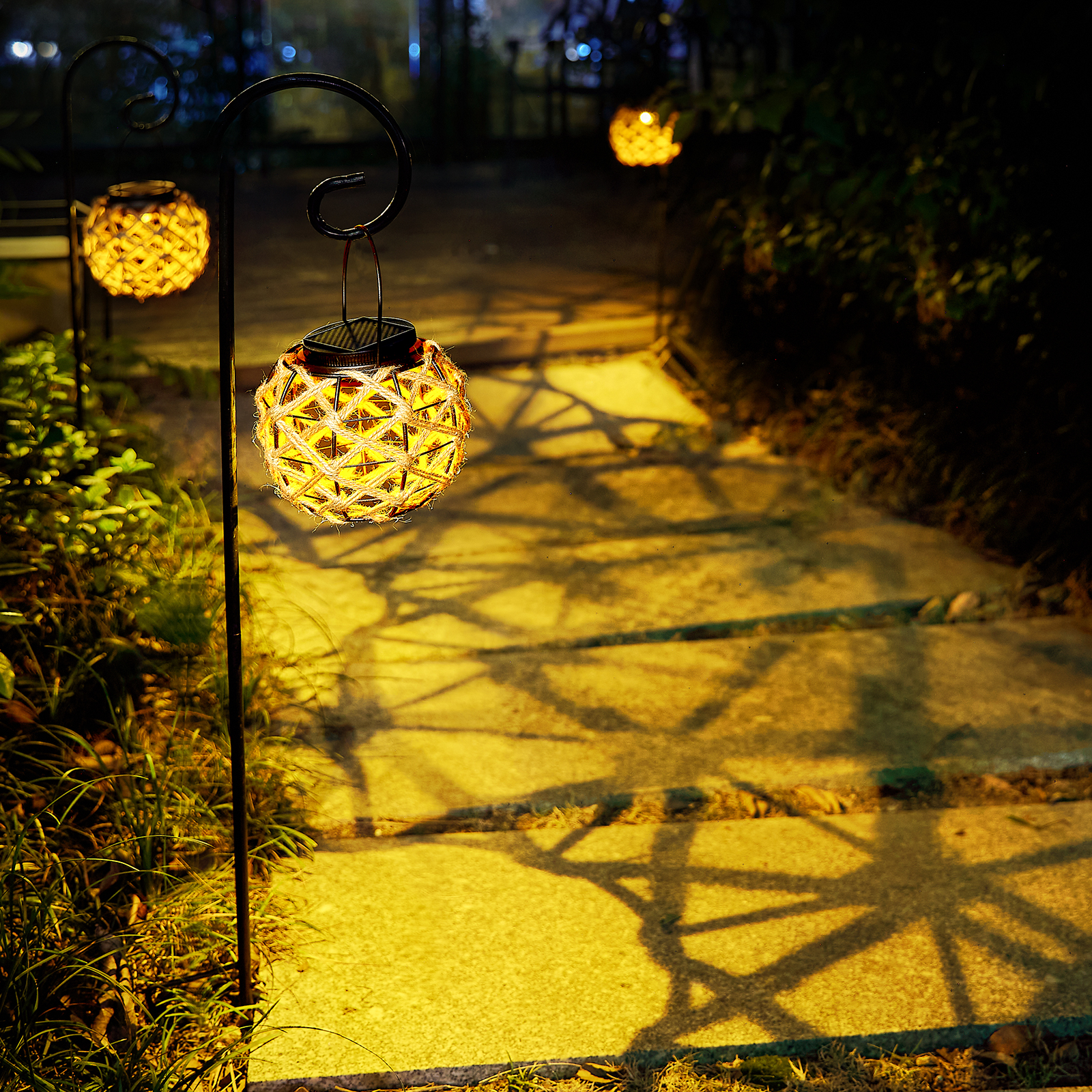
Solar landscape lighting: monocrystalline panel, integrated lithium battery and dusk-to-dawn control.
Solar Landscape Lights and Solar Garden Lights
Solar garden and landscape lights are self-contained units combining a photovoltaic panel, a rechargeable battery, a light-sensing control circuit and the LED head. During the day the panel converts sunlight into electricity; at night the dusk-to-dawn sensor switches the LEDs on automatically. The Light Legend solar range (models DS016, DS1316, DSL08, DSL09 and DS-B-SPL) uses a 6V 500mA monocrystalline silicon PET laminated panel with two 3.7V 2200mAh 18650 lithium batteries, quoted at 1000LM/50LM output, IP65, in white light, warm light or RGB, with more than 5 hours of solar charging and more than 8 hours of working time. Typical use is municipal rural renovation, landscape engineering, remote parks, farms and off-grid projects.
Solar Pathway Lights and Solar Lawn Lights
Pathway and lawn fixtures sit low so they do not interrupt sightlines, and their job is to guide walking routes with low-glare light rather than to illuminate a wide area. The Light Legend pathway range (DS001, DS003, DS007, DS019, DS023, DS026, DS028, DS029, DS033, DS129, DS701 and DS1218) uses a 5V 300mA monocrystalline panel, a 3.7V 2200mAh 18650 battery, an LED filament bulb at 100LM, IP65, in warm light or RGB, with more than 5 hours charging and more than 8 hours working time. The housing is ABS+PC in black, aimed at gardens, parks, residential communities, resorts and villa courtyards.
LED In-Ground Lights
In-ground lights are buried flush with the surface and used for ground-contour lighting, wall grazing from below and silhouette work. They take the harshest duty in a landscape scheme — foot traffic, standing water, grit and pressure washing — so the rating matters more than the finish. The Light Legend LED in-ground range (ALT-DM120, ALT-DM160, ALT-DM179, ALT-DM200, ALT-DM229, ALT-DM260) is rated IP67 and IK09, with 6W to 36W options, DC24V input, 138 lm/W, CRI ≥80, Cree LED chips at 12 pieces, beam angles of 26°, 32°, 52° or 60°, a 30000-hour lamp life, a 3-year warranty and CE/RoHS certification. The body combines high-purity die-cast aluminum with a 6063 corrosion-resistant extruded aluminum base, a 304 stainless steel face and 8mm tempered glass.
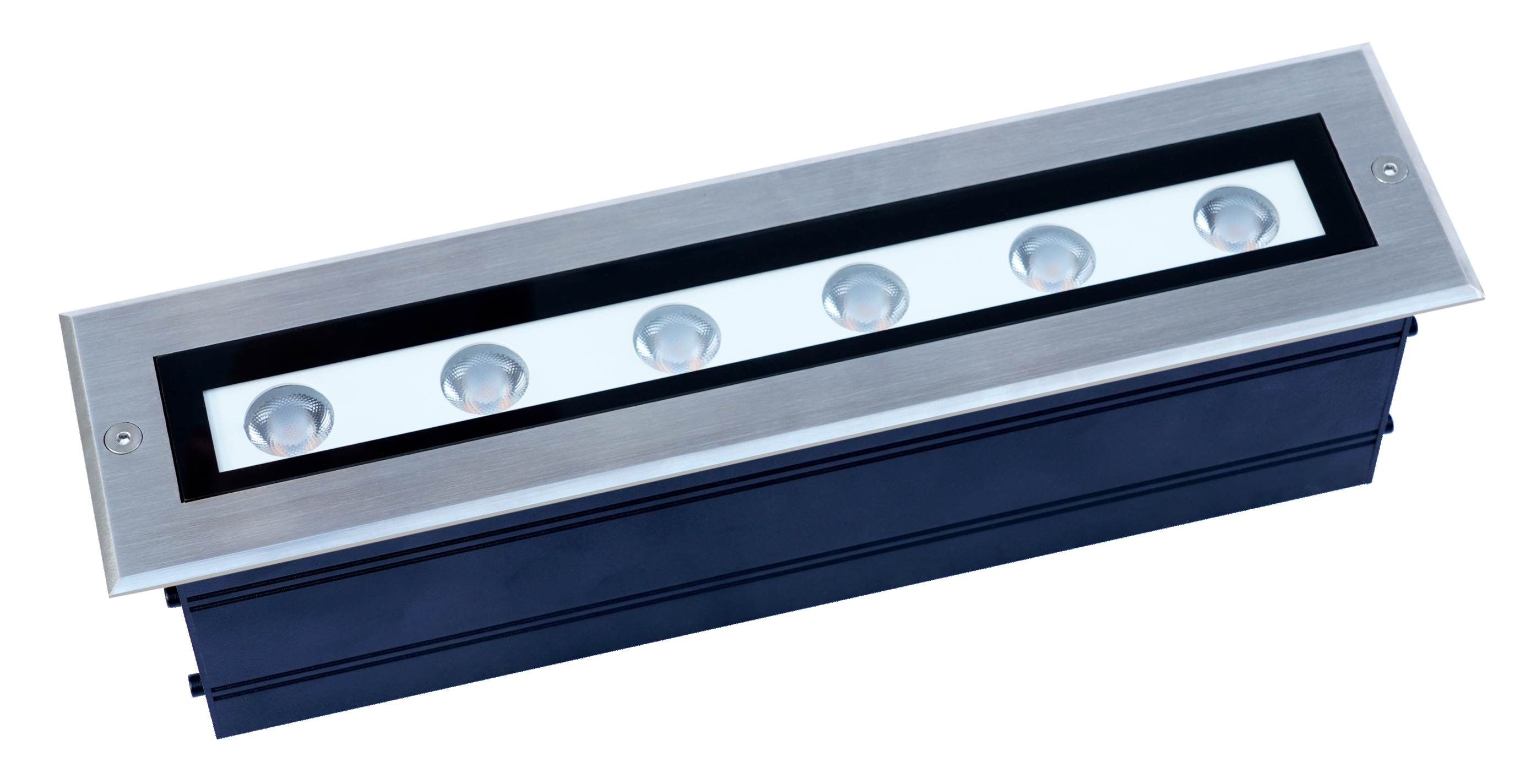
LED in-ground lights: IP67 and IK09 rated for ground-level landscape and facade grazing.
Tree Lights and Landscape Spotlights
Tree lights are directional projectors aimed at trunks and canopies to reveal bark texture, branch structure and seasonal color. The specification decisions are beam angle, mounting height and wattage, because a narrow 15° beam on a tall specimen produces a bright hotspot while a 45° or 60° beam reads as a soft wash. The Light Legend tree light range (KUPU-YT130, KUPU-YT175, KUPU-YT100, KUPU-YT120, KUPU-YT140) covers 12W to 140W, 160–180 lm/W, 2700–6000K or RGBW, AC110-220V or DC24V, ON/OFF or DMX512 control, 15°/30°/45°/60° beam angles, IP65, CRI ≥70, and an ADC12 die-cast aluminum housing with tempered glass. Ground-spike, wall-mounted, in-ground and solar variants exist within the same family.
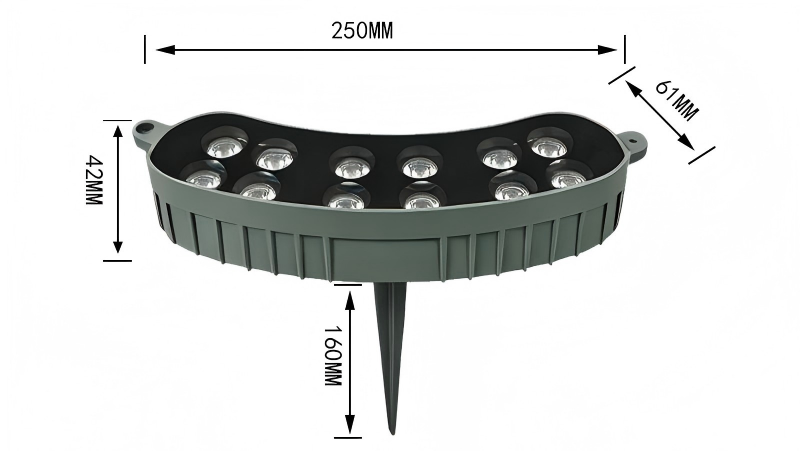
Tree lights: directional projection to reveal trunk and canopy structure after dark.
Flood Lights and Solar Flood Lights
Flood lights are the workhorses of area and facade lighting — driveways, yards, parking areas, billboards, construction sites, warehouses and building faces. Output range and beam angle should be matched to area size and mounting height: high-power wide-beam units for yards, driveways and commercial facades, and lower-power narrow-beam units for garden and signage accents. The Light Legend flood light range (KUPU-YT65 through KUPU-YT200) spans 6W to 96W, 160–180 lm/W, 2700–6000K or RGBW, AC110-220V or DC24V, ON/OFF or DMX512, 15°/30°/45°/60° beam angles, IP65, CRI ≥70, and an ADC12 die-cast aluminum housing with high-transmittance tempered glass. A solar version is available for sites without power access.
Wall Washer Lights
Wall washers are linear or elongated fixtures that produce an even vertical wash across a facade, curtain wall, bridge parapet or retaining wall. Their defining characteristic is uniformity: a lens-based wash avoids the scalloped hotspots that generic floodlights leave on a flat surface. The Light Legend wall washer range (ALT-F56, ALT-R38, ALT-R66, ALT-R32C, ALT-R42E) covers 6W to 72W, IP66, DC24V or AC220V, 2700–6000K, 138 lm/W, CRI ≥80, beam angles of 24°×45° and 10°×60°, a 50000-hour lamp life, a 3-year warranty and CE/RoHS certification, with DMX512 control available for synchronized effects.
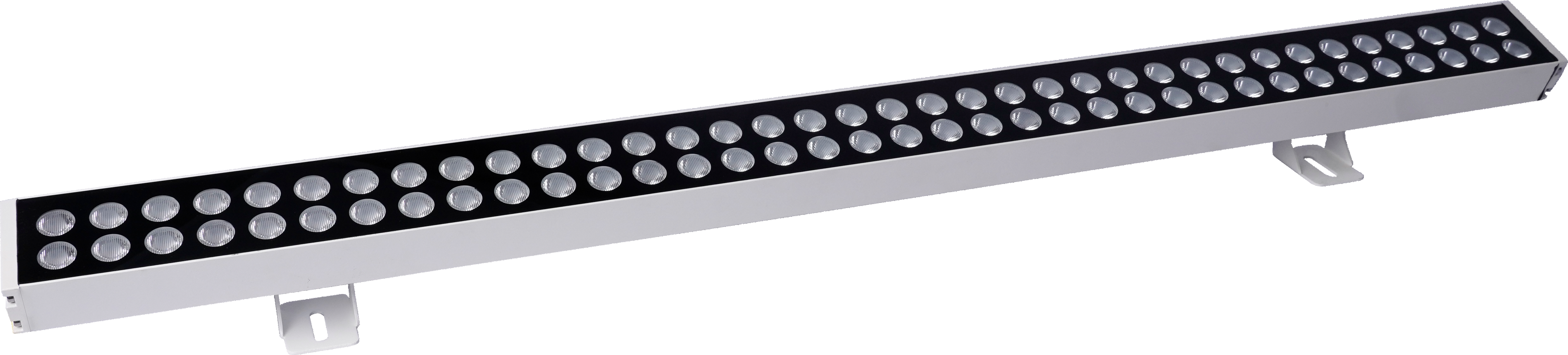
Wall washers: IP66 linear wash fixtures for facades, curtain walls and bridge structures.
Outdoor Wall Lights and Solar Motion Sensor Landscape Lights
Wall-mounted fixtures handle threshold lighting — entrances, garage walls, courtyard perimeters, service corridors — where the requirement is visibility plus security rather than composition. Solar motion sensor models remove the wiring constraint entirely. The Light Legend outdoor wall light range (DSL018, DS0138, DS-HNL, DS-PIR-3688, DS-3688, DSL188, DS-SL, DS-SL3, DS037, DS038, DS068, DS-B03) uses a 5V 250mA monocrystalline panel, a 3.7V 1200mAh 18650 battery, ABS+PC housing in black, 80LM output in single color or RGB, IP65, with a PIR motion sensor and two lighting modes: a high-light mode quoted above 4 hours and an always-on mode quoted above 8 hours, after more than 5 hours of solar charging.
Street Lights and Decorative Lights
Street lights belong to landscape schemes at the boundary — access roads, parking aisles, plaza edges and municipal right-of-way. The Light Legend street light range (KUPU-LD30, KUPU-LD50, KUPU-LD100, KUPU-LD150, KUPU-LD200, KUPU-LD240, KUPU-LD300) covers 30W to 300W with 7070 light sources, 160–180 lm/W, 2700–5700K, IP66, a power factor of ≥0.95 and a 150°×75° lens, in ADC12 die-cast aluminum with a high borosilicate tempered glass lens; solar and all-in-one versions are available. Decorative string lights (G40, S14, ST38) use shatterproof PC bulbs on a PVC-sheathed copper core, 1W per bulb at 50 lm, 2700K, IP65, AC110-220V or solar, connectable in series, for festival decoration, cafés, courtyards and camping sites.
Smart Lighting
Smart control is now specified at the top end of residential and hospitality landscape work, where scene switching and grouping replace fixed circuits. The Light Legend smart lighting range (HCP024 through HCP217) runs 18W/36W/54W/72W at DC24V, IP67, with CRI ≥95, RGB or RGB+IC light colors, Bluetooth or Wi-Fi connection and remote-controller or mobile-app control. Timing and scene modes, group control across multiple fixtures, gateway integration with smart home systems and dimming for energy management are all supported. Certifications listed for the range include CE, FCC, RoHS, UKCA, FCC-ID, GCC, UL4200A and UL588.
Step-by-Step: How to Specify a Landscape Lighting Scheme
The sequence below converts a design intent into a purchasable specification. It works for a single courtyard and for a multi-phase municipal project.
- Define the lighting task per zone. Separate the site into zones by function: safe circulation, feature highlighting, facade modelling, perimeter security, atmosphere. Each zone gets its own fixture category before any product is shortlisted. This prevents the common error of lighting an entire site with one fixture type.
- Choose the power architecture. Decide between mains-powered fixtures (DC24V or AC110-220V, requiring cable runs, drivers and qualified electrical installation) and solar fixtures (no wiring, zero electricity cost, dependent on panel placement and battery capacity). Sites with no power access, protected ground, or long cable runs to isolated features usually favor solar; high-output facade and road lighting usually favors mains.
- Set the ingress and impact rating against the environment. The IP rating has two digits: the first (0–6) rates dust protection and the second (0–8) rates water protection. IP65 or above is the general recommendation for outdoor exposure, IP67 suits short-term immersion, and IP68 suits continuous underwater use. Ground-level fixtures that take foot traffic and maintenance equipment also need an impact rating — IK09 in the case of the Light Legend in-ground range.
- Fix color temperature and CRI once for the whole site. Warm white (2700K–3000K) suits gardens and patios, neutral white (4000K) suits commercial areas, and cool white (5000K–6500K) suits security and road lighting. CRI 80+ is standard for general outdoor use; CRI 90+ is preferred where plant color, stone and signage must read accurately. Confirm the CRI value on the specification sheet, not on the brochure.
- Match beam angle and wattage to mounting geometry. Narrow beams at low mounting heights create hotspots; wide beams at high mounting heights waste light. Beam options across the Light Legend ranges include 15°/30°/45°/60° for tree and flood fixtures, 26°/32°/52°/60° for in-ground, and 24°×45° or 10°×60° for wall washers.
- Select the control method and confirm documentation. Control options range from simple ON/OFF through photocell dusk-to-dawn switching, PIR motion sensing, remote and app control, to DMX512 synchronization for dynamic facade effects. In the same step, confirm the compliance file set for the destination market — CE, RoHS, UKCA, FCC, IP test reports and export documents — because these determine whether the shipment clears rather than whether the light works.
Use Cases: Matching Fixtures to Real Project Conditions
Landscape lighting categories are decided less by taste than by site conditions. The following project profiles show how rating, control and fixture type follow from the environment.
Villa courtyards (Germany). Outdoor garden with sun and rain exposure, used for ambient lighting and garden accent, operated by photocell and app control with a solar panel and fixing clips. The governing requirement is IP65 waterproofing with no wiring — solar wall and pathway fixtures handle it without disturbing finished landscaping.
Municipal engineering (South Africa). Open-air road lighting for a municipal project, steady-on with photocell sensing, using a power supply and light pole. The governing requirements are IP66 and high lumen output, which points to the street light range rather than decorative or solar categories.
Theme parks and cultural tourism (Romania). Outdoor, rainproof festival and landscape decoration with steady-on and dynamic dimming, using a waterproof power supply and fixing clips. The requirements are IP65 and anti-aging performance, which favors decorative string lights and DMX-controllable fixtures.
Culture, sports and entertainment venues (South Korea). Garden landscape and cultural lighting with tree illumination as the primary function, steady-on with remote or app control, a waterproof power supply and ground stake. The requirements are IP67 and corrosion resistance, which drives the specification toward tree lights and in-ground fixtures with stainless and die-cast aluminum bodies.
Construction and infrastructure (Vietnam). Bridge lighting within a municipal project, using long-range projection for contour lighting with timer control, a waterproof power supply and mounting bracket. The governing requirements are IP66 and impact resistance, pointing to wall washers and flood lights with tempered glass.
Commercial real estate (Azerbaijan). Building lighting and landscape work in an environment with high and low temperature swings, using wall flood lighting and night decoration with steady-on and DMX synchronized control, a waterproof power supply and a DMX512 controller. The project brief specifies IP68 waterproofing and low-voltage safety, which sets the compliance target before product selection begins.
Comparison Table: Outdoor Landscape Lighting Categories
The table below compares the main Light Legend outdoor landscape lighting categories on the specifications that most often decide a project: output, ingress protection, key technical parameters and typical application.
| Category | Typical power / output | IP / IK rating | Key specification | Typical application |
|---|---|---|---|---|
| Solar garden / lawn lights (DS016, DS1316, DSL08, DSL09, DS-B-SPL) | 1000LM / 50LM | IP65 | 6V 500mA monocrystalline panel; 2×3.7V 2200mAh 18650; >5h charge, >8h working; white / warm / RGB | Gardens, parks, residential communities, resorts, off-grid projects |
| Solar pathway lights (DS001–DS1218) | 100LM | IP65 | 5V 300mA panel; 3.7V 2200mAh; LED filament bulb; warm / RGB | Pathways, villa courtyards, communities, resorts |
| Solar outdoor wall lights (DSL018, DS-PIR-3688, DS-B03 and others) | 80LM | IP65 | 5V 250mA panel; 3.7V 1200mAh; PIR motion sensor; 2 lighting modes | Courtyards, parking areas, warehouses, homestays and hotels |
| LED in-ground lights (ALT-DM120–ALT-DM260) | 6W–36W | IP67 / IK09 | DC24V; 138 lm/W; CRI ≥80; 12× Cree LED; 26°/32°/52°/60°; 30000h; 3-year warranty | Squares, commercial streets, hotel plazas, scenic spots |
| Tree lights (KUPU-YT100–KUPU-YT175) | 12W–140W | IP65 | 160–180 lm/W; 2700–6000K / RGBW; ON/OFF or DMX512; 15°/30°/45°/60° | Landscape engineering, scenic areas, villa courtyards, plazas |
| Flood lights (KUPU-YT65–KUPU-YT200) | 6W–96W | IP65 | 160–180 lm/W; AC110-220V or DC24V; CRI ≥70; 15°/30°/45°/60° | Yards, facades, parking, billboards, construction sites |
| Wall washer lights (ALT-F56–ALT-R42E) | 6W–72W | IP66 | DC24V / AC220V; 138 lm/W; CRI ≥80; 24°×45° / 10°×60°; 50000h; 3-year warranty | Facades, curtain walls, bridges, cultural tourism lighting |
| Street lights (KUPU-LD30–KUPU-LD300) | 30W–300W | IP66 | 160–180 lm/W; power factor ≥0.95; 150°×75° lens; 2700–5700K | Roads, municipal projects, squares, factories, farms |
| Decorative lights (G40, S14, ST38) | 1W per bulb, 50 lm | IP65 | Shatterproof PC bulbs; 2700K; AC110-220V or solar; connectable in series | Festival decoration, cafés, courtyards, camping sites |
| Smart lighting (HCP024–HCP217) | 18W / 36W / 54W / 72W | IP67 | DC24V; CRI ≥95; RGB / RGB+IC; Bluetooth or Wi-Fi; CE, FCC, RoHS, UKCA, FCC-ID, GCC, UL4200A, UL588 | Villas, hotels, commercial real estate, smart home integration |
Values are quoted from Light Legend product specifications; final configuration is confirmed at project specification stage.
Manufacturing, Compliance and Supply Capability
Landscape lighting is a long-life purchase with a short decision window, so the supplier's production and documentation capability matters as much as the fixture specification. Light Legend operates an automated production plant in a modern independent industrial park covering 8000 m², with more than 200 employees including an R&D team of more than 20 professional engineers and product designers, and an annual output of 4,200,000 pieces. The company holds ISO9001, ISO14001, BSCI and C-TPAT management system certifications, operates fully equipped laboratory facilities for product quality testing, and reports more than 100 independent patents, over 4,000 successful cases, 15 years of R&D experience and more than 70 honorary qualifications.
- Design and customization — OEM and ODM development with independent intellectual property rights, covering logo, color, wattage and full product development from concept design to mass production.
- Compliance file set — CE, RoHS and IP test reports for the relevant ranges; CE, FCC, RoHS, UKCA, FCC-ID, GCC, UL4200A and UL588 for the smart lighting range; commercial documents including invoice and packing list for export.
- Export footprint — an export ratio of 80%, with products supplied to more than 60 countries and regions in Europe, America, Asia, Africa and Latin America, including long-term cooperation with global cross-border e-commerce platforms, supermarkets, brands and engineering contractors.
For buyers, this translates into a practical advantage: solar and mains-powered landscape lighting can be sourced and documented through one supplier, so a scheme that mixes off-grid pathway lighting with mains facade lighting does not split into two supply chains with two compliance trails.
FAQ
What IP rating do outdoor landscape lights need?
The IP rating uses two digits: the first (0–6) rates protection against dust and the second (0–8) rates protection against water. For rain-exposed landscape lighting, IP65 or above is the common recommendation; IP67 suits short-term immersion and IP68 continuous underwater use. Light Legend's outdoor range covers IP65, IP66 and IP67 depending on category — solar pathway lights, solar garden lights, flood lights and outdoor wall lights are rated IP65, wall washers and street lights IP66, and LED in-ground lights IP67 with an additional IK09 impact rating. Ratings are verified through standard ingress testing and documented in test reports.
Do solar landscape lights still work on cloudy days or in winter?
Solar lights still charge in low light, but brightness and runtime can be reduced. Performance depends on panel size, battery capacity and light exposure. Light Legend solar fixtures use a monocrystalline silicon PET laminated panel — 6V 500mA in the garden and landscape range, 5V 300mA in the pathway range and 5V 250mA in the outdoor wall light range — paired with 3.7V lithium batteries rated at 2200mAh or 1200mAh, and quote more than 5 hours of solar charging and more than 8 hours of working time. Buyers should size the panel and battery configuration to local sunlight conditions and confirm full-sun placement away from shade.
Can outdoor landscape lights be customized for OEM and ODM projects?
Yes. Light Legend supports OEM and ODM development, including logo, color, wattage and full product development from concept design to mass production, backed by an in-house R&D team of more than 20 professional engineers and product designers and more than 100 independent patents. Housing color, wattage, color temperature and control method are confirmed at the specification stage, and color temperature can be customized to match a brand or project requirement.
What drives the cost of an outdoor landscape lighting project?
The main cost drivers are power and output, housing material and IP/IK rating, control method, and whether cabling is needed. Solar fixtures carry zero electricity cost and require no wiring, which shifts cost toward the unit price and away from civil work and electrical installation; mains-powered fixtures such as wall washers, flood lights and street lights require a power supply, drivers and qualified electrical installation. High-specification items — die-cast aluminum bodies with tempered glass, DMX512 control, CRI ≥95 smart fixtures — sit at a different cost level from ABS+PC solar fixtures. Comparing options on total installed cost rather than unit price gives the accurate answer.
How do I request samples, a quotation, MOQ and lead time?
MOQ and lead time depend on the product type and customization level; sharing the specification — category, wattage, color temperature, IP rating, control mode, quantity and destination market — allows both to be confirmed. Light Legend provides commercial documents (invoice, packing list), test reports and certification files such as CE and RoHS as required by the destination market, and supports sample validation before mass production. To start a specification review, contact the team by email at 18580658865@163.com or on WhatsApp at +86 18580658865, and download the solar and decorative garden light catalogue for reference before the first call.
Conclusion
Outdoor landscape lighting is decided by a small number of technical choices applied consistently across a site: which layer each fixture serves, whether the site runs on mains power or solar, what ingress and impact rating the environment demands, and how color temperature, CRI, beam angle and control tie the scheme together. Buyers who fix those four decisions before shortlisting products avoid the failures that show up after handover — mismatched color, shaded solar panels, flooded in-ground fixtures and control that cannot be expanded.
The fixture categories themselves are well established: solar garden and pathway lights for wiring-free circulation, LED in-ground lights for ground-level detail, tree lights and flood lights for feature and area work, wall washers for facades, outdoor wall lights for thresholds, street lights for site boundaries, and smart lighting where scenes and grouping are required. Matching each category to its rating and optics is the whole of the specification task.
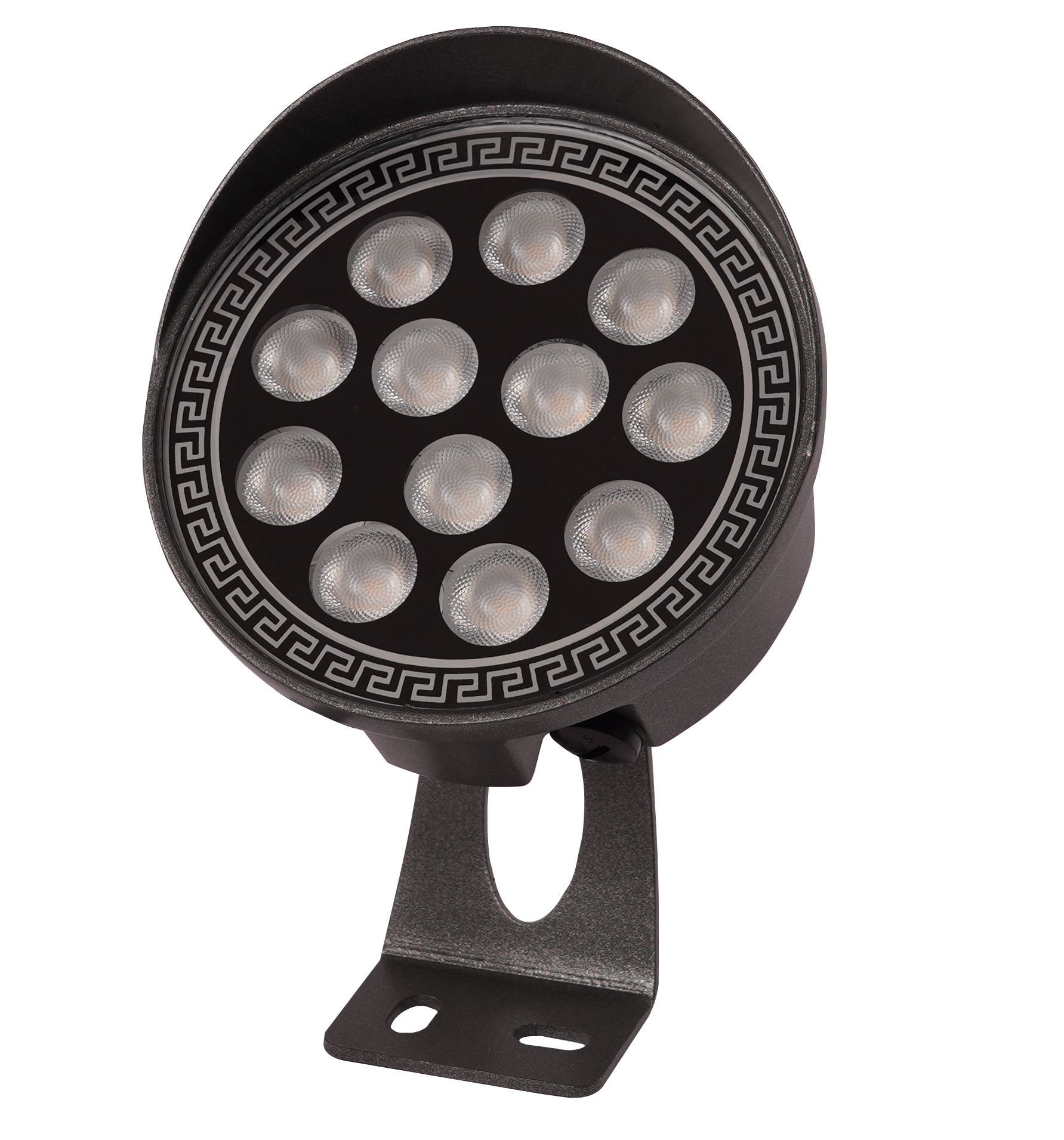
Flood lights: area and facade lighting for yards, driveways and commercial exteriors.
Next Step: Validate the Specification Before You Commit
Share your project type, fixture categories, wattage, color temperature, IP rating, control mode and destination market, and the Light Legend team will confirm the matching configuration, sample arrangements, MOQ and lead time. Solar, mains-powered and smart ranges can be quoted together.
Email: 18580658865@163.com | Tel / WhatsApp: +86 18580658865
Download the Light Legend Solar & Decorative Garden Light Catalogue (PDF)
Have Questions or Need More Details?
Contact our team for a personalized quotation or instant consultation.
Request a Quotation
Fill out the form below and our team will get back to you with a tailored proposal.
WhatsApp Direct Chat
Prefer to chat in real-time? Message us on WhatsApp for instant assistance & quick answers.
- Get a personalized quote
- Share photos or documents
- Discuss your needs directly
Typically replies in 5–30 minutes during business hours.