
Outdoor Landscape Lighting: A Complete Guide to Fixtures, Functions and Selection
Outdoor landscape lighting combines guidance, accent, area and decorative fixtures — each layer specified for a different job.
Outdoor landscape lighting is the planned use of exterior fixtures — pathway lights, garden and lawn lights, tree uplights, wall washers, inground lights, floodlights and decorative strings — to make gardens, parks, facades and public spaces safe, usable and visually coherent after dark. Getting it right starts with matching the fixture to the task, then confirming the specifications that decide whether that fixture survives outdoor conditions.
This guide is written for buyers at the discovery and research stage: importers, distributors, brand owners, specifiers and project teams who know they need outdoor landscape lighting but have not yet fixed a bill of materials. It explains what each fixture family actually does, which specifications carry real weight, where early planning usually goes wrong, and how to move from a zone-by-zone plan to samples and a quotation.
Problem definition: why landscape lighting plans stall at the discovery stage
Three problems appear repeatedly before any purchase order exists.
1. Vocabulary mismatch. A buyer searching for solar garden lights may actually need low-glare path lighting, tree accent uplighting or a wall-mounted motion light. Because the words overlap across categories, early research produces a list of unrelated products rather than a lighting plan. Grouping fixtures by the job they perform — guidance, accent, area coverage, decoration — resolves this quickly.
2. The one-fixture assumption. No single fixture covers a whole garden. A 100 LM path light and a 140 W tree uplight belong to different lighting tasks, different mounting heights and different specification levels. Treating them as interchangeable leads either to over-lit paths and facades or to unlit areas.
3. Specification drift. Lumen output, IP rating, colour rendering and control method are often discussed separately, yet they interact. A fixture with strong output and a weak IP rating becomes a maintenance liability in rain-exposed parks; a high-CRI fixture on an unsuitable control mode cannot deliver the scene changes a commercial site expects.
Industry background: what has changed in outdoor landscape lighting
LED has become the default light source across landscape, garden and road applications, and the shift shows up in fixture specifications rather than in slogans. High-power LED fixtures in the current outdoor range reach 160–180 LM/W, while architectural wall washers and inground lights reach around 138 lm/W with a colour rendering index of 80 or above. Higher efficacy means fewer fixtures and a lower connected load for the same visual result.
Solar has moved from decorative novelty to a practical option for sites without a reliable power supply. A modern solar landscape fixture combines a monocrystalline silicon PET laminated panel, a lithium battery and a dusk-to-dawn light sensor inside one IP65 housing, which is why solar landscape lights now appear in municipal rural renovation, remote parks, farms and off-grid projects as well as in villa courtyards.
Control has broadened as well. Fixtures are no longer limited to a simple ON/OFF circuit: DMX512 is used for synchronous architectural effects, Bluetooth and Wi-Fi app control covers dimming, colour tuning and scene modes, and photocell or PIR motion sensors handle unattended operation. Buyers increasingly expect one supplier to cover the guidance, accent, area and decorative layers rather than one SKU at a time.
Detailed solution: what each outdoor landscape lighting fixture actually does
The fastest way to build a workable specification is to read the fixture families by their lighting task. The four groups below cover the range used in gardens, parks, pathways and commercial landscape projects.
1. Solar landscape lighting: garden, lawn, pathway and wall fixtures
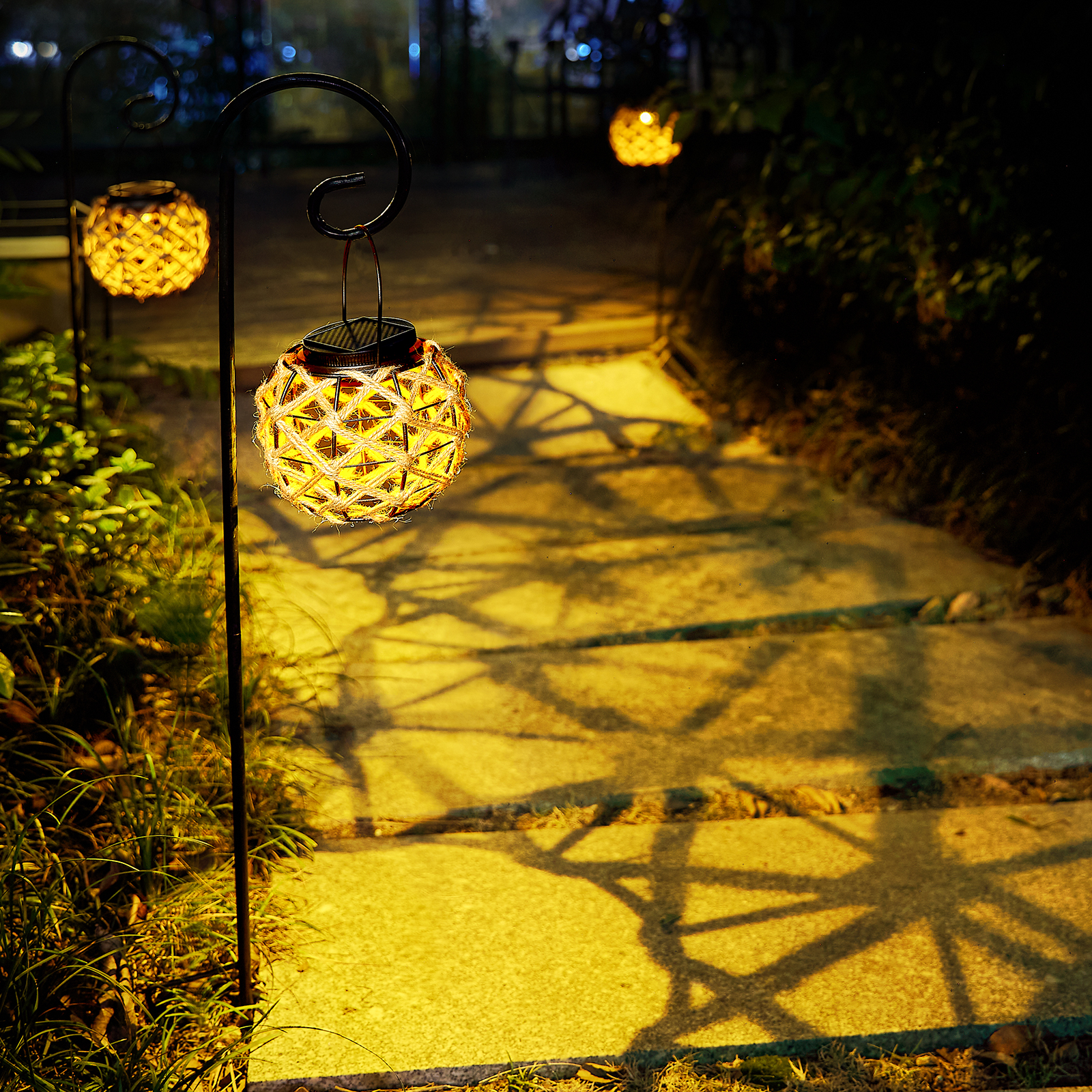
Solar landscape lighting runs without trenching or grid power: panel, battery and dusk-to-dawn sensor sit in one IP65 housing.
Solar fixtures handle the layers where cabling is impractical. The solar range covers solar garden lights, solar lawn lights, solar wall lights, solar tree uplights, solar motion sensor lights, solar LED strip lights, solar flood lights and solar street lights, built around a 6V 500mA monocrystalline silicon PET laminated panel and two 3.7V 2200mAh lithium #18650 batteries in an ABS+PC housing rated IP65. Output is 1000 LM / 50 LM depending on mode, with white, warm white or RGB colour, more than 5 hours of solar charging and more than 8 hours of working time. A long press of three seconds turns the unit on; a short press cycles the next mode.
The practical value is zero electricity cost, no wiring, automatic on/off through the light sensor, and a rechargeable battery that keeps working on cloudy days. That combination is why solar is specified for municipal rural renovation, remote parks, farms, off-grid projects and villa courtyards where digging trenches is either impossible or uneconomical.
2. Pathway and decorative fixtures: guidance and ambience
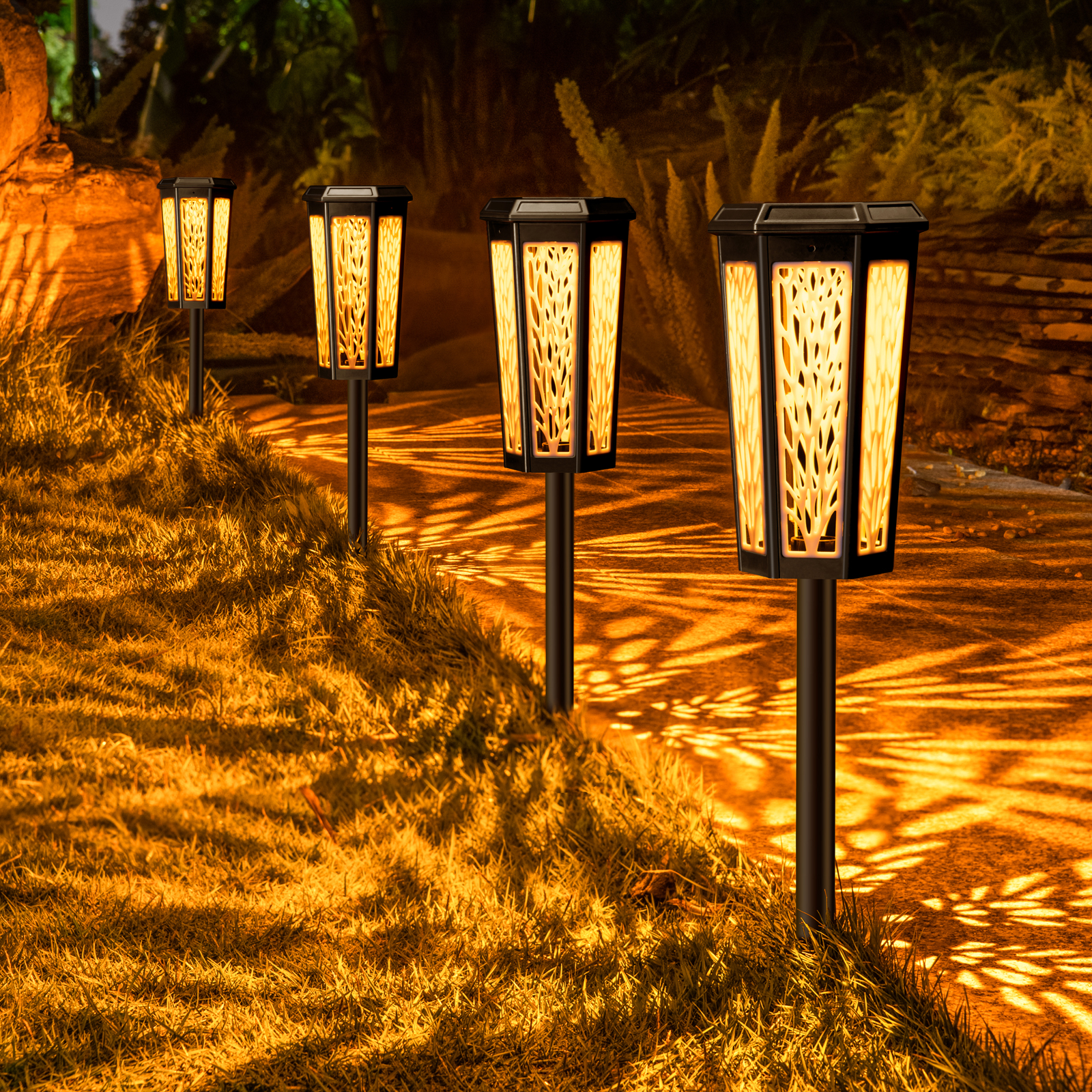
Pathway lighting is a guidance task: low profile, low glare, and bright enough to read the edge of a walkway.
Pathway lights exist to guide movement, not to illuminate a facade. The pathway series uses a 5V 300mA monocrystalline panel, a 3.7V 2200mAh lithium #18650 battery, an LED filament bulb at 100 LM, warm light or RGB output, IP65 and an ABS+PC housing in black, with the same charging and working profile as the solar range. The design priority is a low profile that does not block sightlines, a low-glare beam, and a waterproof, rust-proof body for gardens, parks, residential communities, resorts and villa courtyards.
Decorative outdoor landscape lighting plays a different role again. The G40, S14 and ST38 string lights use shatterproof PC bulbs, 1W per bulb at 50 LM and 2700K, IP65 rating, AC110-220V with EU, US, UK or solar plug options, and connectable-in-series wiring. They suit festival decoration, camping sites, cafés and restaurants, courtyard soft furnishing and event planning — areas where ambience matters more than illuminance.
3. Accent and architectural fixtures: tree lights, wall washers and inground lights
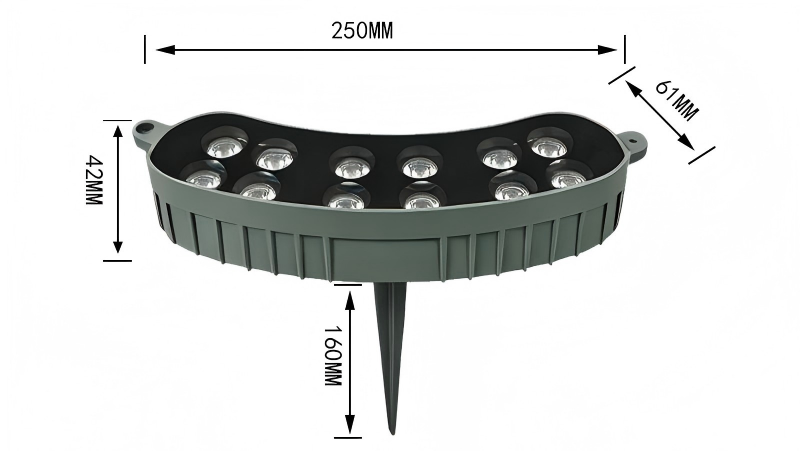
Tree uplighting is directional projection — the beam angle and mounting position determine whether the canopy reads as texture or as glare.
Tree lights carry the accent layer in landscape engineering, cultural tourism scenic spots, real estate demonstration areas, villa courtyards, commercial plazas and municipal greening. The series spans 12W, 30W, 75W, 100W, 120W and 140W, with 3535 light sources at 160–180 LM/W, 2700–6000K or RGBW, AC110-220V or DC24V input, ON/OFF or DMX512 control, 15°, 30°, 45° and 60° beam angles, IP65 protection, a colour rendering index of 70 or above and an operating range of -40°C to 50°C. Housings are high-purity ADC12 die-cast aluminium with ultra-high-transmittance tempered glass. Ground spike, wall-mounted, in-ground, RGB and solar-powered versions are available, so the same family can light a tall tree or a low shrub.
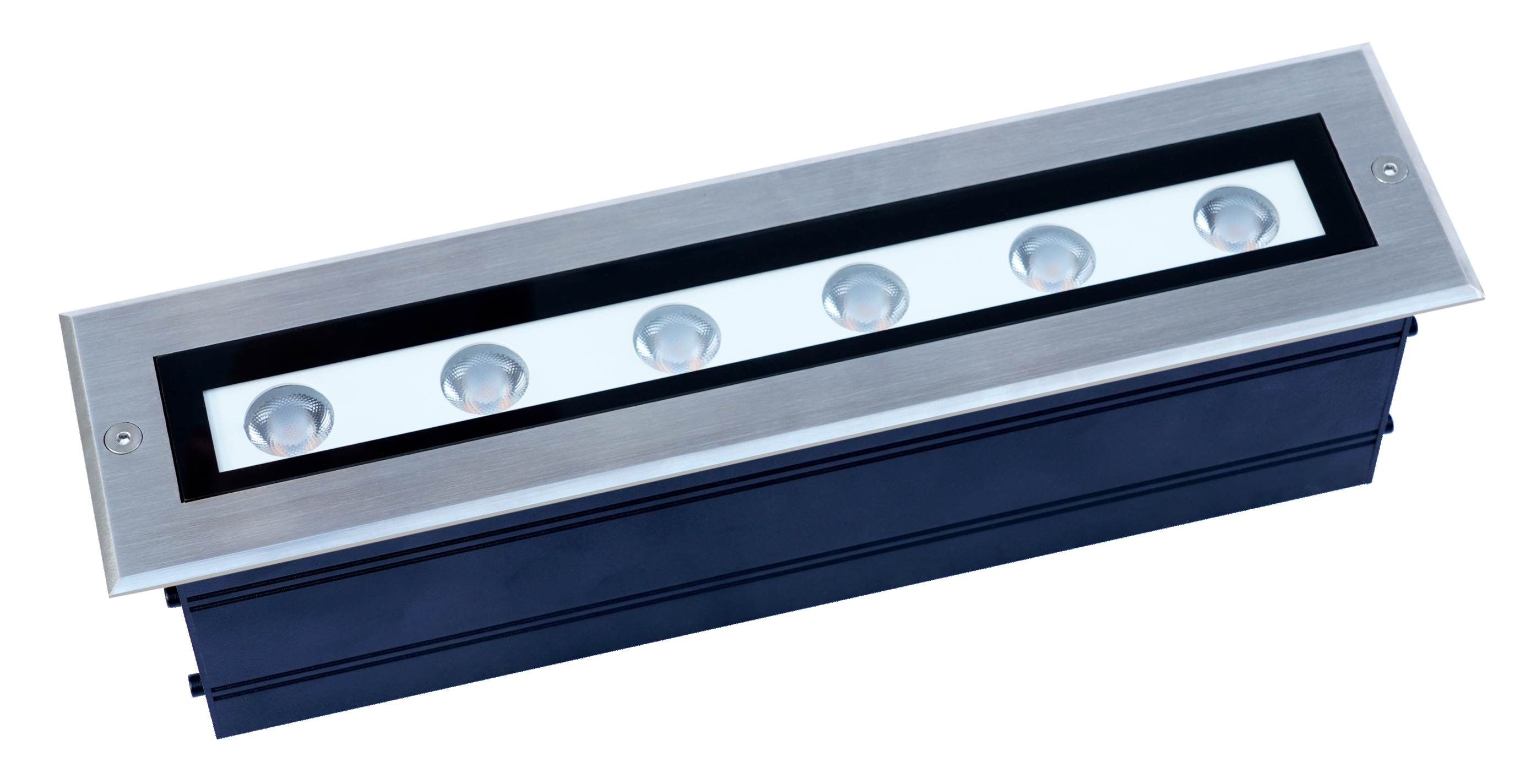
Inground fixtures need mechanical strength as much as light output: IP67 and IK09 in pedestrian and vehicle areas.
Wall washers handle vertical surfaces — building curtain walls, bridges, facades, cultural and tourism lighting and municipal engineering. The range runs from 6W to 72W with IP66, DC24V or AC220V input, 2700–6000K, 138 lm/W, a colour rendering index of 80 or above, 24°×45° or 10°×60° beam angles, a 50,000-hour lamp life, a 3-year warranty and CE / RoHS certification. The body combines high-purity die-cast aluminium with a 6063 corrosion-resistant extruded aluminium base, a 304 stainless steel surface and 8mm tempered glass.
LED inground lights cover ground-level contour and uplighting in municipal squares, landscape engineering, commercial pedestrian streets, hotel plazas and scenic spots. Power options are 6W, 9W, 12W, 18W, 24W and 36W at IP67 and IK09, with DC24V input, 2700–6000K, 138 lm/W, a colour rendering index of 80 or above, twelve Cree LEDs per fixture, 26°, 32°, 52° or 60° beam angles, a 30,000-hour lamp life, a 3-year warranty and CE / RoHS certification. Square and round versions are both available, with a pressure-resistant stainless steel panel and RGB colour-changing options.
4. Area, security and connected fixtures: flood, street, wall and smart lighting
Floodlights cover area illumination: municipal projects, stadiums, factories, parking lots, squares, billboards, farms, construction sites and warehouses. Power ranges from 6W to 96W with 3535 light sources at 160–180 LM/W, 2700–6000K or RGBW, AC110-220V or DC24V input, ON/OFF or DMX512 control, 15°, 30°, 45° and 60° beam angles, IP65 protection, a colour rendering index of 70 or above and the same ADC12 die-cast aluminium and tempered glass construction. A solar version is available for sites without power access.
Street lights serve road and perimeter illumination at 30W, 50W, 100W, 150W, 200W, 240W or 300W, using 7070 light sources at 160–180 LM/W, 2700–5700K, AC110-220V input, a 150×75° lens angle, IP66 protection, a colour rendering index of 70 or above and a power factor of 0.95 or higher.
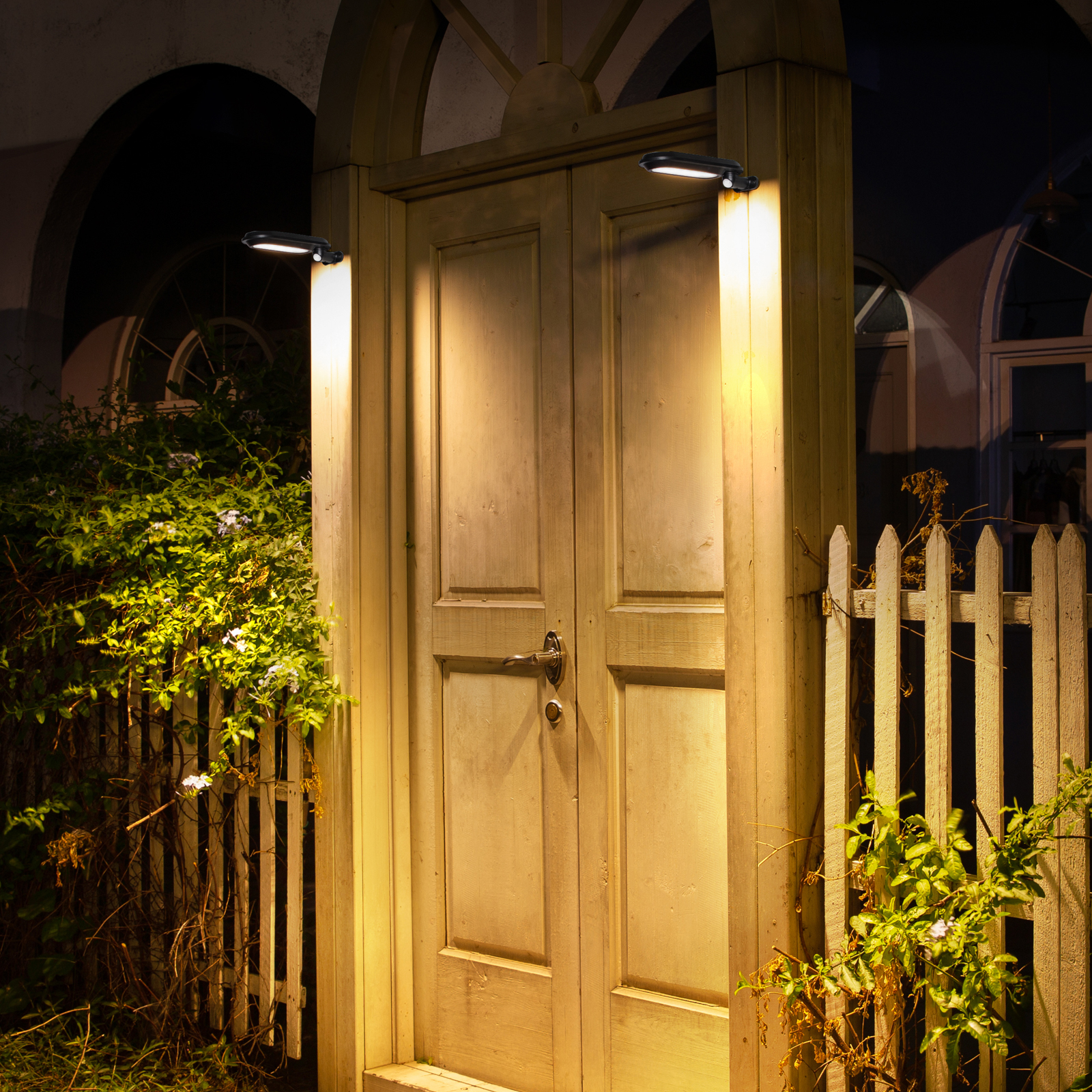
Solar outdoor wall lights add a security layer without cabling. They use a 5V 250mA panel, a 3.7V 1200mAh battery, an ABS+PC housing, four F10 LEDs at 80 LM, single colour or RGB output, IP65 protection and a PIR motion sensor, with two lighting modes — high light for more than 4 hours or always-on for more than 8 hours. They suit rural renovation, farms, villa courtyards, residential property management, parking lots, warehouses, homestays and hotels.
Smart lighting addresses sites that want scenes rather than switches. The HCP series runs 18W, 36W, 54W or 72W at 24V input and IP67, with a colour rendering index of 95 or above, RGB or RGB+IC colour, and Bluetooth or Wi-Fi connection controlled by remote, mobile app or voice. Timing, scene modes, group control and dimming are supported, and some models connect to a smart gateway for integration with a wider smart home system. Certifications include CE, FCC, RoHS, UKCA, FCC-ID, GCC, UL4200A and UL588.
Comparison table: outdoor landscape lighting fixtures by role
| Fixture family | Main lighting task | Power / output options | IP rating | Control options |
|---|---|---|---|---|
| Solar Lighting (DS016, DS1316, DSL08, DSL09, DS-B-SPL) | Garden, lawn, wall, tree and flood lighting without wiring | 1000 LM / 50 LM modes; 6V 500mA panel; 2 × 2200mAh battery | IP65 | Light sensor auto on/off; mode switch |
| Pathway Lights (DS001–DS1218) | Low-level guidance along paths and steps | 100 LM; 5V 300mA panel; 2200mAh battery | IP65 | Light sensor; warm light or RGB |
| Flood Lights (KUPU-YT65–YT200) | Area and facade floodlighting | 6W–96W; 160–180 LM/W | IP65 | ON/OFF; DMX512; 15°/30°/45°/60° beams |
| Tree Lights (KUPU-YT130–YT140) | Tree and shrub accent uplighting | 12W–140W; 160–180 LM/W | IP65 | ON/OFF; DMX512; RGBW optional |
| Wall Washer Lights (ALT-F56–ALT-R42E) | Vertical surface washing on facades and walls | 6W–72W; 138 lm/W; CRI ≥80 | IP66 | ON/OFF; 24°×45° or 10°×60° |
| LED Inground Lights (ALT-DM120–ALT-DM260) | Ground-level contour and uplighting | 6W–36W; 138 lm/W; CRI ≥80 | IP67; IK09 | ON/OFF; 26°/32°/52°/60° |
| Street Lights (KUPU-LD30–LD300) | Road and perimeter illumination | 30W–300W; 160–180 LM/W; PF ≥0.95 | IP66 | ON/OFF; 150×75° lens |
| Decorative Lights (G40, S14, ST38) | Ambient and festival decoration | 1W per bulb; 50 LM; 2700K | IP65 | ON/OFF; connectable in series |
| Smart Lighting (HCP series) | App-controlled ambient and architectural effects | 18W/36W/54W/72W; CRI ≥95 | IP67 | Bluetooth / Wi-Fi app, remote, voice; RGB/RGB+IC |
Step-by-step: how to scope an outdoor landscape lighting plan
Step 1 — Map zones and tasks. Walk the site and list zones: entrance, path, lawn, trees, facade, parking and perimeter. Assign each zone to one of the four lighting layers. A zone that needs both guidance and accent should receive two fixture types, not one compromise fixture.
Step 2 — Choose the power model. Solar suits remote parks, farms, off-grid sites and courtyards where wiring-free installation is a requirement. AC or DC supply suits high-output and synchronised work: street lights run on AC110-220V, floodlights on AC110-220V or DC24V, wall washers on DC24V or AC220V, inground lights on DC24V.
Step 3 — Set the environmental rating. The IP code uses two digits: the first (0–6) rates dust protection and the second (0–8) rates water protection. For outdoor exposure, IP65 or above is generally recommended; IP66 suits facades and wind-driven rain; IP67 suits inground fixtures and short-term immersion; IP68 is reserved for continuous underwater use. In pedestrian or vehicle areas, add the mechanical rating — IK09 for the inground range.
Step 4 — Fix optics and colour. Beam angle decides the effect: 15° to 60° on tree and flood fixtures, 26° to 60° on inground fixtures, 24°×45° or 10°×60° on wall washers. Colour temperature sets the mood — warm white around 2700–3000K for gardens and patios, neutral white around 4000K for commercial areas, cool white at 5000–6500K for security and road lighting. For colour fidelity on planted areas and facades, choose CRI 80 or above; where accurate colour is the point, CRI 95 is available in the smart series.
Step 5 — Decide the control mode. Photocell and PIR sensing handle unattended operation; DMX512 handles synchronised facade and bridge effects; Bluetooth and Wi-Fi app control handles dimming, colour tuning and scene switching. Control choice affects the driver and wiring plan, so decide it before the bill of materials is fixed.
Step 6 — Plan installation and maintenance access. Solar fixtures should be sited in full sun, charged for 6–8 hours in direct sunlight before first use, then switched on and tested for the dusk-to-dawn function; the panel should stay clean and the light body should never be immersed. Wall washers need a secure mounting surface, corrosion-resistant screws, sealed connections with waterproof caps, grounding protection and a qualified electrician for high-voltage wiring. Service access matters too: inground fixtures are rated for 30,000 hours and wall washers for 50,000 hours, so keep spare drivers and connectors on hand rather than reopening sealed joints later.
Use cases: how the layers combine on real sites
- Villa courtyards (Germany). Outdoor garden conditions with sun and rain exposure, IP65 and wiring-free installation, photocell on/off with app control, solar panels and fixing clips — ambient lighting and garden accent.
- Municipal engineering (South Africa). Open-air road lighting with IP66 and high lumen output, steady-on operation with photocell sensing, power supply and light pole — road illumination and traffic safety.
- Theme parks and cultural tourism (Romania). Rainproof festival and landscape decoration at IP65 with anti-aging requirements, steady-on plus dynamic dimming, waterproof power supplies and fixing clips.
- Culture, sports and entertainment (South Korea). Garden landscape and cultural lighting at IP67 with anti-corrosion requirements, tree illumination via ground stake and waterproof supply, steady-on with remote or app control.
- Construction and bridge projects (Vietnam). Wind and moisture exposure, IP66 and impact resistance, long-range projection for contour lighting, timer control with mounting brackets.
- Commercial real estate (Azerbaijan). High and low temperature exposure, IP68 and low-voltage safety, wall flood lighting with DMX512 synchronised control.
Matching the plan to supplier capability
Light Legend (Light Legend (Chongqing) Technology Co., Ltd.) is an outdoor lighting manufacturer and exporter that supplies LED landscape lighting and solar lighting for garden decoration, landscape engineering, road lighting and camping applications. Its automated production plant sits in an 8,000 m² industrial park with more than 200 employees, including a research and development team of more than 20 engineers and product designers, and annual output of 4,200,000 pieces. The company reports 15 years of R&D experience, more than 100 independent patents and over 4,000 successful cases, and operates under ISO9001, ISO14001, BSCI and C-TPAT management system certifications.
For buyers, three capability points matter more than size. First, OEM and ODM development is handled in-house, which is what allows logo, colour, wattage and full product development from concept to mass production. Second, roughly 80% of output is exported to more than 60 countries and regions across Europe, America, Asia, Africa and Latin America, so documentation and packaging practices are already aligned with cross-border requirements. Third, the mix covers guidance, accent, area and decorative fixtures from one source — solar, pathway, flood, tree, wall washer, inground, street, wall, decorative and smart — which reduces the number of suppliers a distributor has to manage.
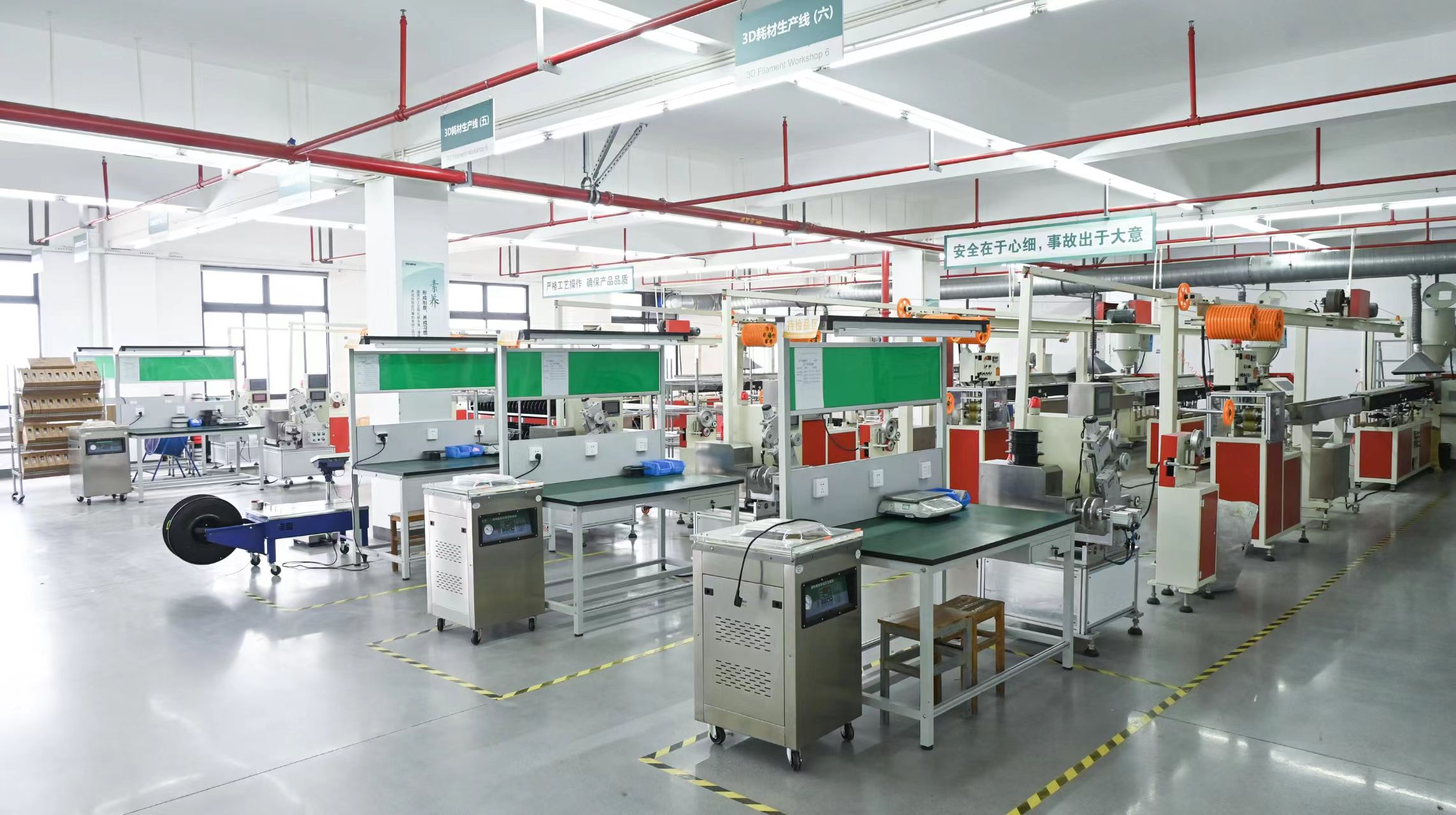
Manufacturing workshop: automated production in an 8,000 m² industrial park with more than 200 employees.
Frequently asked questions
What IP rating do outdoor landscape lights need?
The IP rating uses two digits: the first (0–6) rates dust protection and the second (0–8) rates water protection, verified through standard ingress testing. For general outdoor exposure, IP65 or above is generally recommended; IP67 suits short-term immersion and IP68 continuous underwater use. Light Legend outdoor series cover IP65, IP66 and IP67 and are supported by standard ingress test reports. Export documentation can include commercial documents, test reports and certification files such as CE, RoHS and IP test reports as required by the destination market.
Can solar landscape lights still perform in cloudy weather?
Solar fixtures do charge in low light, but brightness and runtime may be reduced. The solar range uses a 6V 500mA monocrystalline silicon PET laminated panel and two 3.7V 2200mAh lithium #18650 batteries, with more than 5 hours of solar charging and more than 8 hours of working time under normal sun exposure, and the battery is designed to keep working on cloudy days. Panel size and placement are the deciding factors. If a light runs short, move it to a full-sun location, clean the panel, switch it off and charge fully for 1–2 sunny days, then check battery age.
What drives the cost of an outdoor landscape lighting project?
Cost is driven by five factors rather than by the fixture type alone: the power model (solar versus AC or DC supply), the output level required for the area, the IP and IK rating, the housing construction (die-cast aluminium and tempered glass, or ABS+PC), and the control mode (ON/OFF, photocell, PIR, DMX512 or app). Accessories — mounting brackets, ground stakes, waterproof power supplies, DMX controllers and fixing clips — also affect the total. The reliable way to compare quotations is at equal IP rating, equal control mode and equal warranty terms.
Can we evaluate samples or a catalogue before a project order?
Yes. A catalogue of solar and decorative garden lighting is available for download, and samples can be evaluated against the intended zone before a project order. For solar units, charge for 6–8 hours in direct sunlight before the first use, then confirm the dusk-to-dawn function and lighting duration. For bulk buyers, multilingual installation guides and mounting accessories are provided per project.
What are the MOQ and lead time, and what warranty applies?
MOQ and lead time depend on the product type and customization level; share your specification and the team will confirm both. On warranty, the Wall Washer and LED Inground series carry a 3-year warranty, and after-sales cover otherwise follows the contract terms, with technical support for installation and maintenance issues. To move your landscape lighting plan forward, contact Cynthia at 18580658865@163.com or WhatsApp +86 18580658865 with your zone list and site conditions.
Conclusion
Outdoor landscape lighting is a specification exercise before it is a purchasing decision. Once each zone is assigned to a lighting layer — guidance, accent, area or decoration — the fixture type follows, and the remaining questions are technical: IP rating, beam angle, colour temperature, colour rendering, control mode and service life. Buyers who settle those points early avoid the most expensive outcome in landscape projects, which is replacing fixtures that were never suited to the site.
Next step: download the catalogue or request a sample
Review the full solar and decorative garden lighting range in the Light Legend product catalogue (PDF), then send your zone list, site conditions and destination market for a specification-matched quotation. Contact: Cynthia · Email 18580658865@163.com · Tel / WhatsApp +86 18580658865 · Room A6-1-004, Building 1, No.27 Liming Road, Lijia Subdistrict, Liangjiang New Area, Chongqing City, China.
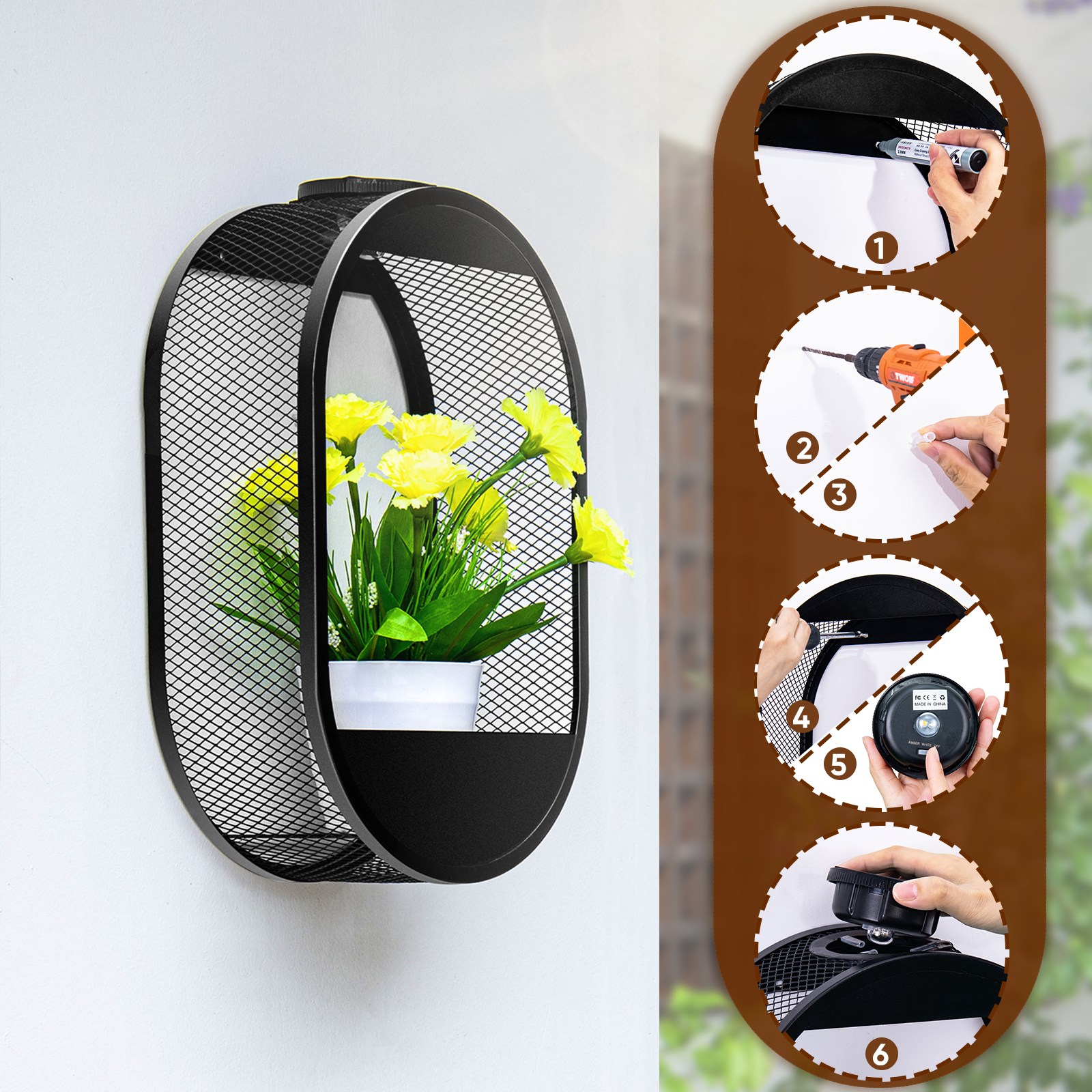
Solar outdoor wall lights add a security layer without cabling — IP65 with PIR motion sensing.
Have Questions or Need More Details?
Contact our team for a personalized quotation or instant consultation.
Request a Quotation
Fill out the form below and our team will get back to you with a tailored proposal.
WhatsApp Direct Chat
Prefer to chat in real-time? Message us on WhatsApp for instant assistance & quick answers.
- Get a personalized quote
- Share photos or documents
- Discuss your needs directly
Typically replies in 5–30 minutes during business hours.