
Custom Casual Apparel for Cross-Border E-Commerce: Sizing and Material Fit
Cross-border casual apparel programs rarely fail because of design. They fail because of fit. A hoodie that photographs well on a sampling table in Guangzhou can still produce heavy return rates in Germany or the United States if the shoulder block is too narrow, the sleeve too short, or the fabric collapses after the first wash. For sellers building Custom Casual Apparel lines for marketplaces, DTC storefronts, or wholesale channels, sizing and material fit are not styling decisions. They are margin decisions, logistics decisions, and repeat-order decisions.
This guide is written for cross-border e-commerce sellers, private label owners, and wholesalers who need a defined XS–5XL size range, a loose fit block built around European and American bodies, and durable fabrics that hold their shape through transit, fitting-room try-on, and repeated washing. It covers what actually breaks in a cross-border casual apparel order, how to write a usable size and material specification, and how small-batch trial production fits into a long-term supply relationship.
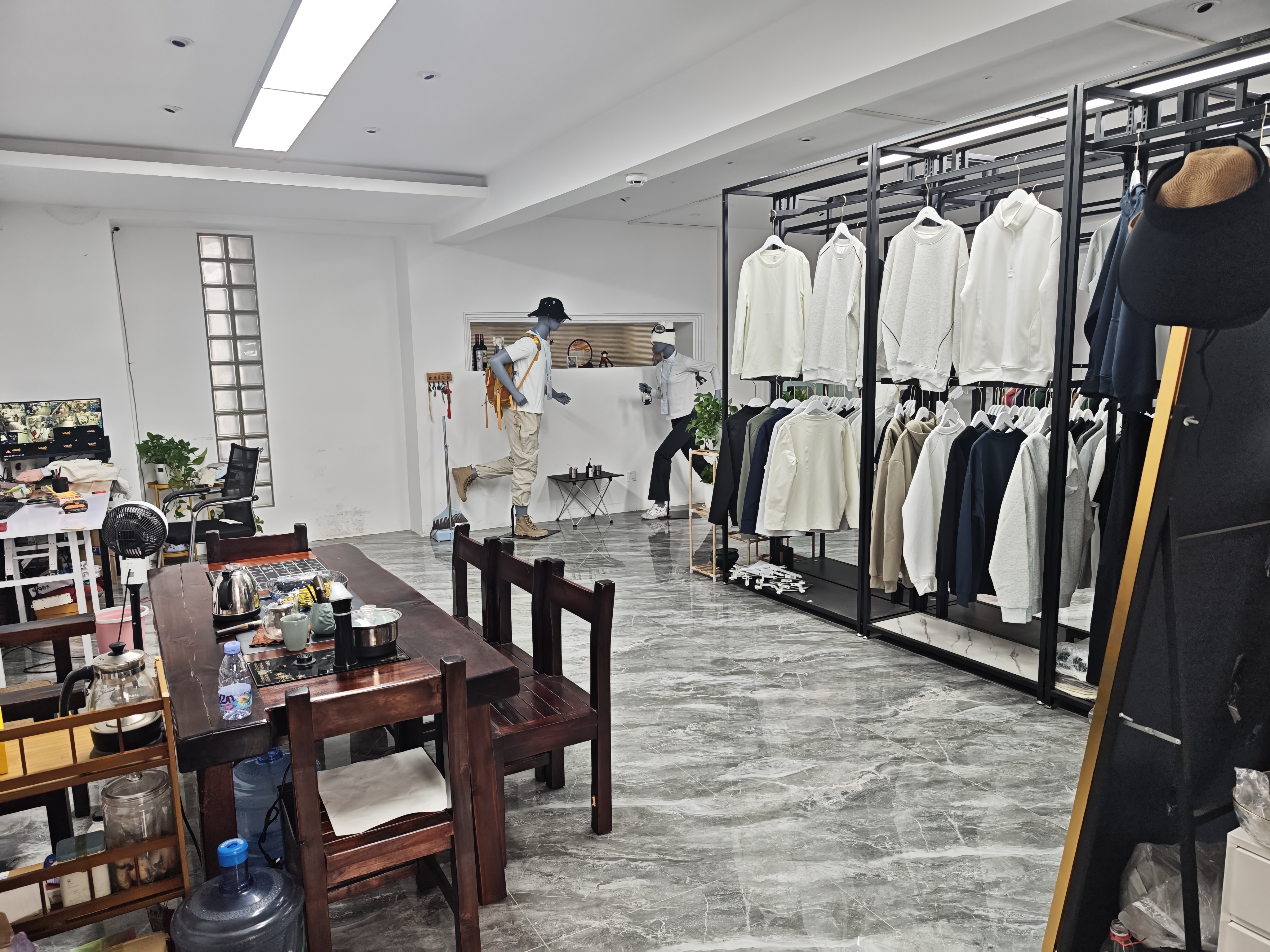
Sample review in Lihongwear’s custom clothing showroom: fit blocks and fabric hand-feel are checked before a size range is locked.
1. Problem Definition: Where Cross-Border Casual Apparel Orders Actually Break
The most common failure in cross-border casual apparel is not a production error. It is a specification mismatch between the size range and fit block a seller assumes it is buying, and the size range and fit block that the destination market actually expects. Three specific gaps cause most of the damage.
- Size range gap. A program developed around an S–XL grid leaves out the volume tiers that drive revenue in the United States and parts of Europe. Sellers who need XS through 5XL but buy an S–XL block cannot serve the upper end of their own customer base, and they cannot build a size curve from real sales data.
- Fit block mismatch. A body-hugging block sold as everyday casual wear reads as undersized once it reaches a market where loose and oversized silhouettes are the expected cut. Customers do not return because the garment is wrong in isolation; they return because it does not match the silhouette shown in the listing.
- Material behaviour after arrival. Weight, lining, stretch recovery, and colour consistency determine whether a garment still looks like the product photo after a month of wear. Fabric behaviour is where a cheap first order turns into an expensive second order.
These gaps map onto a defined risk register that a manufacturer should be able to name and control before production starts. Guangzhou Lihong Apparel Trade Co., Ltd., the Guangzhou-based menswear OEM/ODM manufacturer behind the Lihongwear brand, tracks five recurring risks in custom casual apparel orders: fabric colour difference, printing defects, size deviation, delivery delay, and batch defective products. The control methods are equally specific.
- Fabric colour difference → pre-production fabric confirmation before cutting begins.
- Printing defects → pre-production sample checking against the approved artwork.
- Size deviation → senior technologists who identify and avoid pattern defects in advance rather than correcting them after cutting.
- Delivery delay → capacity pre-allocation that locks the delivery window before the order is accepted.
- Batch defective products → 100% full inspection before shipment rather than sampling only the finished cartons.
If a supplier cannot describe its controls in this level of detail, the sizing and material spec is effectively unmanaged, and the risk is transferred to the buyer’s return rate.
2. Industry Background: Why Small-Batch Fit Testing Became Standard Practice
Casual wear is no longer a stable, predictable category where a single size block can serve every market. The category is large, still expanding, and increasingly fragmented by fit preference and fabric weight.
- The global casual wear market was valued at USD 645.22 billion in 2025 and is projected to reach USD 906.32 billion by 2034 (Fortune Business Insights).
- The custom made clothes market is estimated to reach USD 213.1 billion by 2035, with a CAGR of 10.5% from 2026 (Proficient Market Insights).
- Heavyweight hoodies in the 350–420 GSM range have become the baseline standard for premium streetwear, providing a structured, boxy drape preferred by luxury loungewear brands (PrintDoors / Accio Work).
- OEKO-TEX issued more than 50,000 certificates between 2023 and 2024, an increase of 22%, reflecting the industry’s shift toward chemical safety and regulatory compliance (OEKO-TEX Association).
- In the United States alone, the custom T-shirt printing market was valued at USD 857.5 million in 2023, with a projected CAGR of 11.8% to 2030 (Grand View Research).
Two conclusions follow for a cross-border seller. First, the demand is large enough that fit errors are expensive at scale. Second, because customisation is the growth engine rather than generic stock, the ability to test a fit and fabric combination in small volume before committing to a full size run is what separates sellers who scale from sellers who carry dead inventory.
Guangzhou Lihong Apparel Trade Co., Ltd. operates with that constraint in mind. The company was established in 2024 and works through a factory with over 10 years of experience. Its manufacturing facility covers 5,000 m² and employs over 150 people, with annual production capacity of 500,000 pieces per year and an export ratio of 80% across Europe, America, Southeast Asia, the Middle East, and Australia. Custom orders start from as low as 200 pieces, which is the threshold that makes a genuine fit and fabric trial possible.
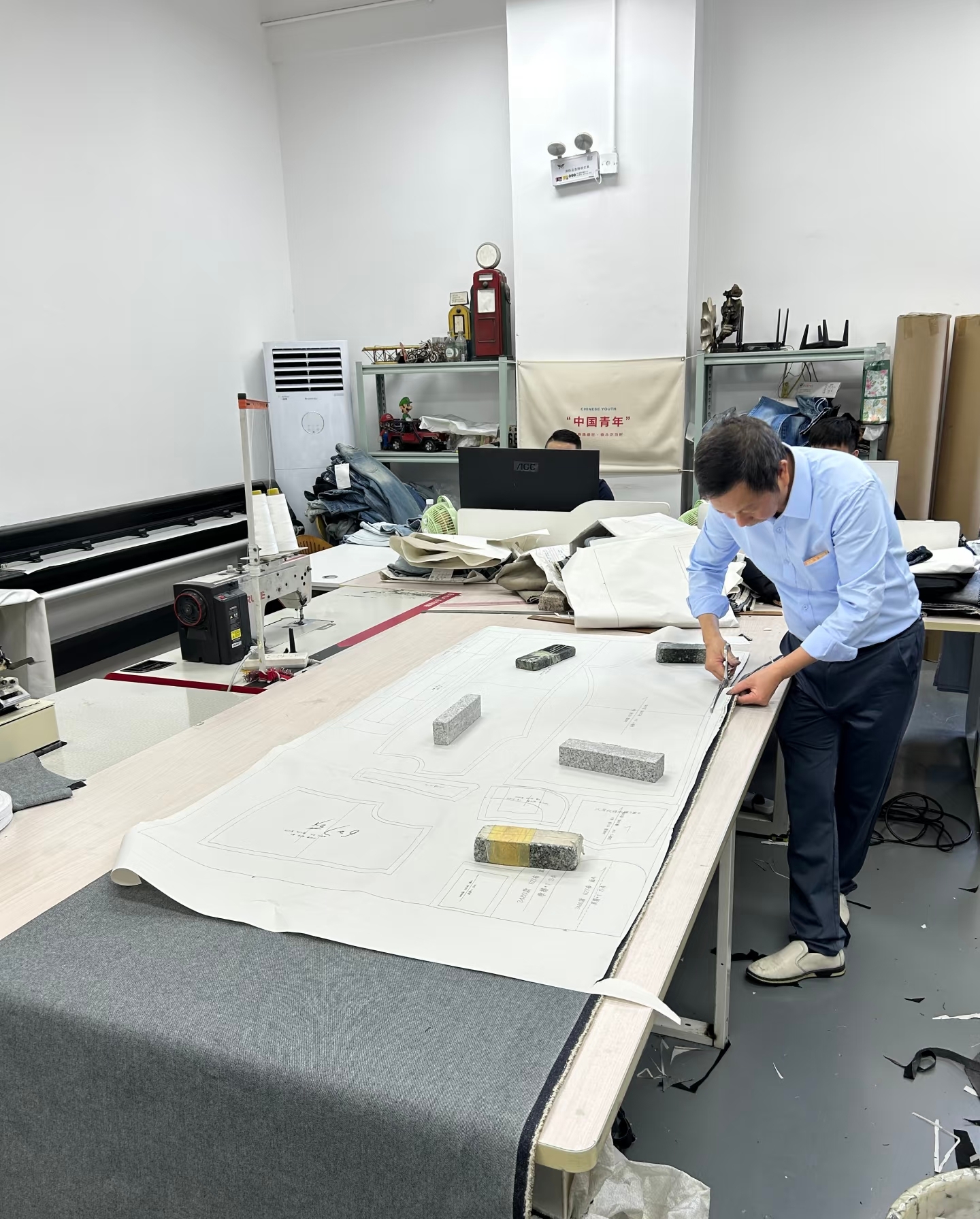
Pattern making and in-line inspection: the size block, not the sewing line, determines whether an XS–5XL range is consistent.
3. Detailed Solution: Building a Sizing and Material Spec That Travels
A cross-border casual apparel programme needs two documents before it needs a purchase order: a size specification and a material specification. Both should be written by the buyer, confirmed by the manufacturer, and locked by a pre-production sample. The sizing half solves returns. The material half solves durability and repeat purchase.
3.1 Sizing architecture: XS–5XL with a loose fit block
A workable casual apparel size range for European and American markets runs from XS to 5XL, and it should be built on a loose fit block rather than a slim block with extra ease added afterwards. The distinction matters because grading a slim block upward produces distortion at the chest, shoulder, and sleeve, while grading a loose block upward preserves the intended silhouette across the full size curve.
Body measurement points that should be defined numerically in the spec include chest width, body length, shoulder width, sleeve length from shoulder and from centre back, hem width, and cuff opening. For a loose block, chest and hem widths carry most of the silhouette, while shoulder and sleeve length carry most of the return risk. The R&D team at Guangzhou Lihong Apparel Trade Co., Ltd. consists of senior pattern makers with over 10 years of experience, and pattern development is handled in-house rather than outsourced — which is the practical condition required to adjust a fit block per market instead of accepting a default grid.
3.2 Material fit for hoodies: 360g mountain cotton with lining
For heavyweight casual hoodies, the 360g construction using mountain cotton with a lining is the specification that answers the 350–420 GSM streetwear baseline in practical terms. The weight delivers the structured, boxy drape the market now expects, and the lining adds the internal hand-feel and shape retention that a single-layer knit cannot provide at the same weight.
Two consequences matter to a cross-border seller. First, a 360g lined hoodie photographs and holds its silhouette, which reduces the perceived gap between the listing image and the delivered product. Second, a heavier fabric makes size deviation more visible, not less — a misgraded 360g hoodie looks wrong immediately, while the same error in a light fabric is often hidden. This is why heavyweight hoodies should be validated on a pre-production sample before the size curve is approved.
3.3 Long sleeve tech blends with four-way stretch
On the lighter side of a casual range, long sleeve tech blends with four-way stretch solve a different problem. They are built for movement and layering, and four-way stretch means the fabric recovers on both the lengthwise and crosswise grain, which keeps the garment from losing shape at the elbows and shoulders during use.
For cross-border programmes, this fabric family is usually paired with a closer-to-body but still relaxed cut, making it suitable as a second product line under the same brand rather than a variant of the hoodie. Understanding which fabric family a given silhouette belongs to prevents the most common specification error: writing a heavy, boxy fit block and assigning a light stretch fabric to it, or the reverse.
3.4 What the material specification must state
A usable material specification names the fabric construction and weight, the lining requirement where applicable, the stretch behaviour, the colour reference, and the acceptable tolerance for shade variation between lots. It should also state how the fabric will be verified. Guangzhou Lihong Apparel Trade Co., Ltd. applies an international AQL Level 7 quality control system and uses multi-process segmented quality inspection alongside third-party fabric testing, so the material spec is checked against an external result rather than an internal opinion.
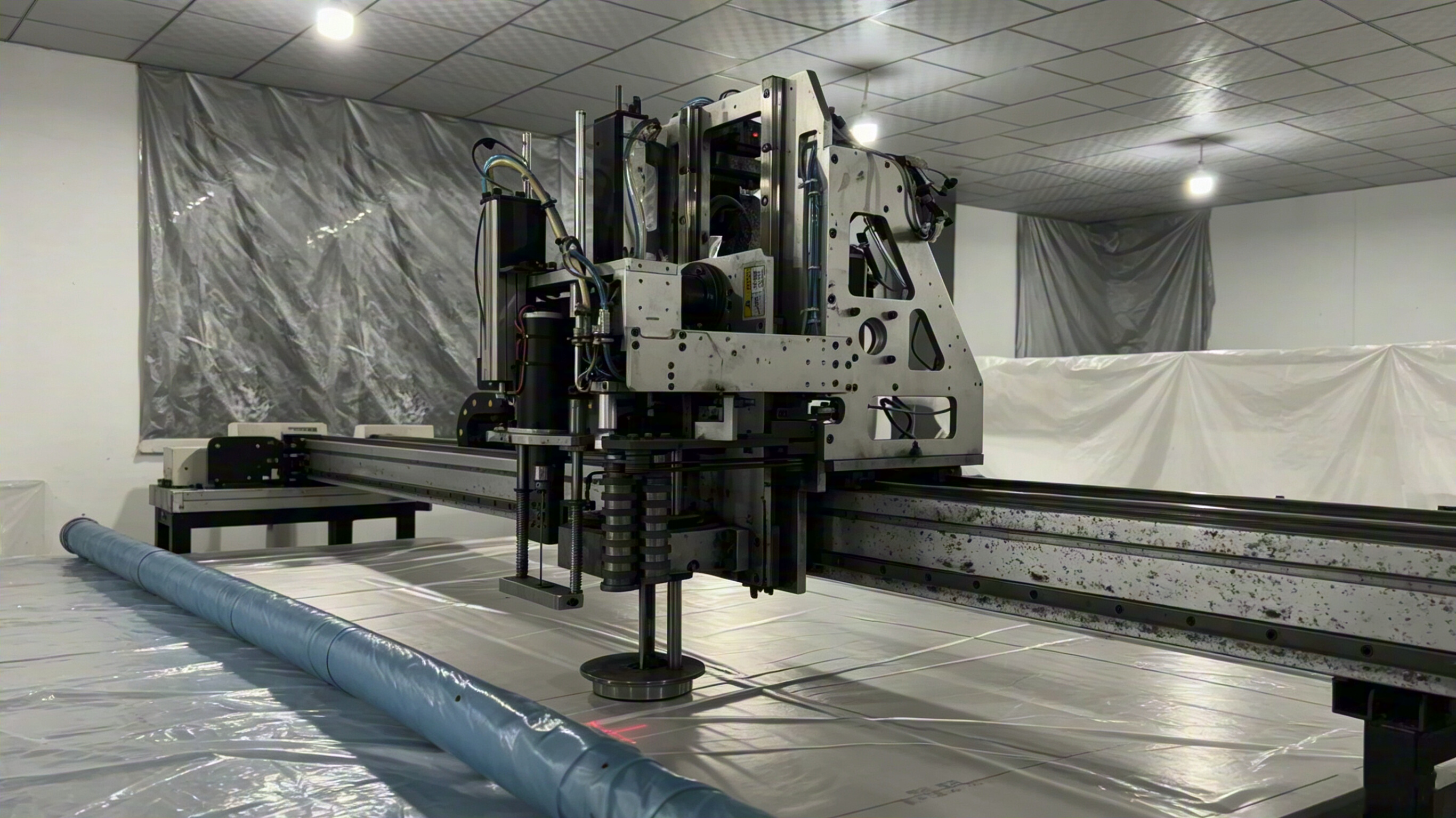
Fabric cutting preparation: heavy fabrics such as 360g mountain cotton require confirmed shade and tolerance before the size run is cut.
4. Step-by-Step Breakdown: From Fit Block to Bulk Delivery
The following sequence is the practical order of operations for a cross-border casual apparel order where sizing and material fit are treated as specifications rather than assumptions.
- Define the market and the size curve. Confirm the destination market and the size tiers that must be served. For European and American casual programmes, define XS–5XL and confirm the volume expectation per size before sampling.
- Select the fit block. Choose a loose block for everyday and street casual silhouettes. Provide reference garments or measurements for the shoulder, chest, body length, and sleeve, and confirm these numerically rather than descriptively.
- Match fabric to silhouette. Assign the 360g mountain cotton with lining to heavyweight hoodie silhouettes, and long sleeve tech blends with four-way stretch to lighter layering pieces. Do not assign one fabric family across the whole range.
- Confirm the fabric before cutting. Pre-production fabric confirmation locks the shade, weight, and hand-feel, and is the control that addresses fabric colour difference before it becomes a batch problem.
- Approve the pre-production sample. Pre-production sample checking verifies construction, measurement, and artwork. Senior technologists review the pattern in advance so that pattern defects are corrected at the pattern stage rather than in the finished goods.
- Run a small-batch trial. Custom orders start from as low as 200 pieces per style, which is the volume at which a trend, fit, or fabric assumption can be tested against real sell-through before a full size run is committed.
- Lock capacity and inspect before shipment. Capacity pre-allocation locks the delivery window before production begins, order followers track scheduling throughout, and quality assurance includes multi-process segmented quality inspection and 100% full inspection before shipment to eliminate defective products.
From sample confirmation to bulk order delivery, the stable delivery time is 15–25 days. That window is only meaningful if the pre-production sample was approved against a written specification; otherwise the clock restarts every time a measurement is questioned.
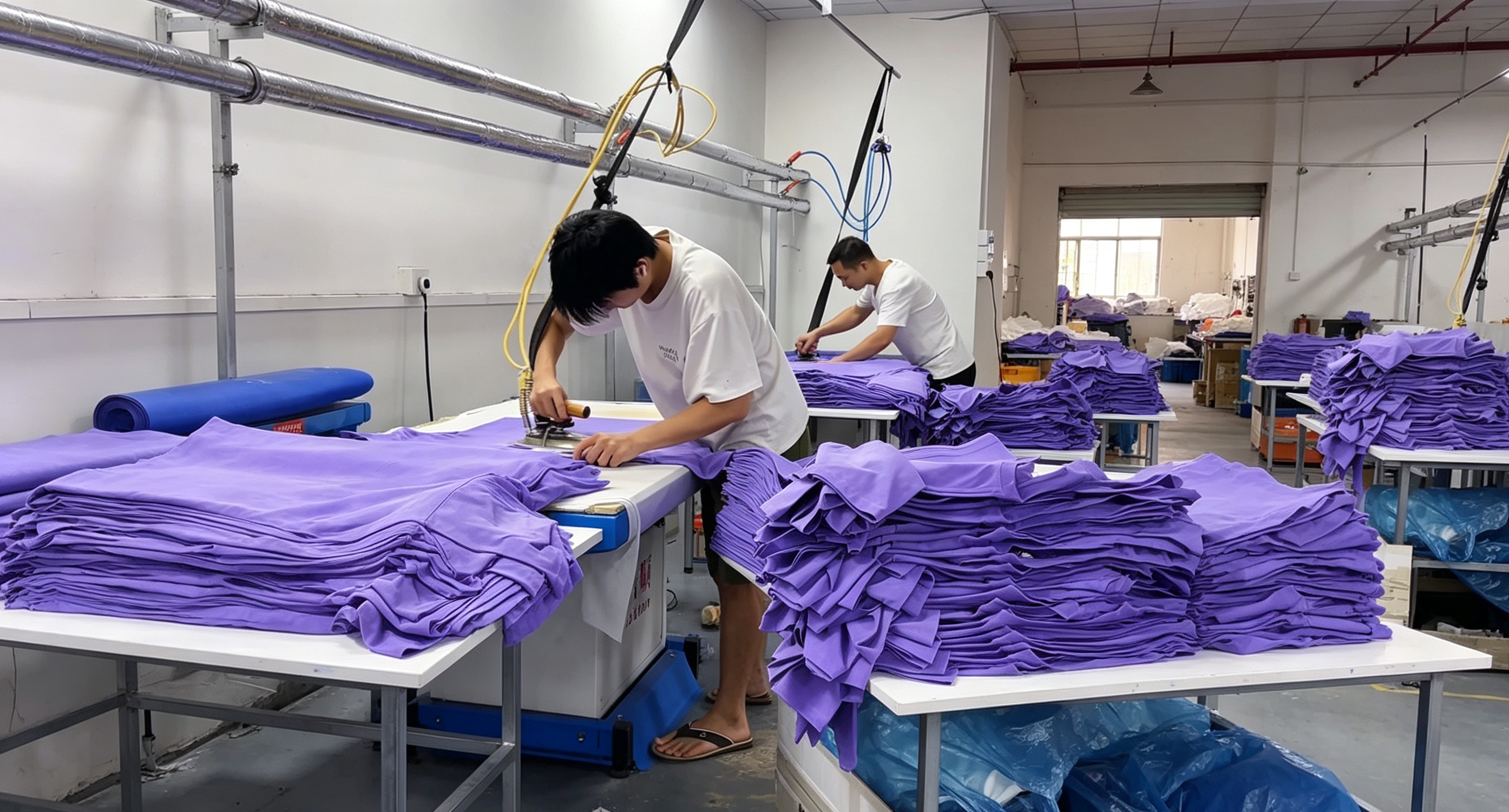
Ironing and quality control: size and finish are verified against the approved specification before cartons are closed.
5. Use Cases: Four Cross-Border Scenarios
Scenario 1 — DTC hoodie launch with a heavyweight fit signature
A seller launching a premium casual hoodie line needs a silhouette that reads as structured on camera and holds that structure after washing. A 360g mountain cotton hoodie with lining, graded XS–5XL on a loose block, gives the line a consistent fit signature across the full curve. A 200-piece trial per style validates the fit before the seasonal size run is committed.
Scenario 2 — Fall and winter layering set for marketplace listings
Marketplace sellers often need a coordinated set rather than a single hero product. Pairing a heavyweight hoodie with long sleeve tech blends using four-way stretch creates two price tiers from one fit standard. Because both are approved against the same measurement specification, size consistency across the set reduces size-related questions and returns.
Scenario 3 — Streetwear drop testing on a small batch
Street style casual apparel moves quickly, and a design that performs in one market may not perform in another. Small-batch casual apparel production starting at 200 pieces per style lets a seller test a drop, read sell-through by size, and then adjust the size curve before scaling. This is the point where sizing data becomes commercially useful instead of theoretical.
Scenario 4 — Wholesale buyers alternating large and small orders
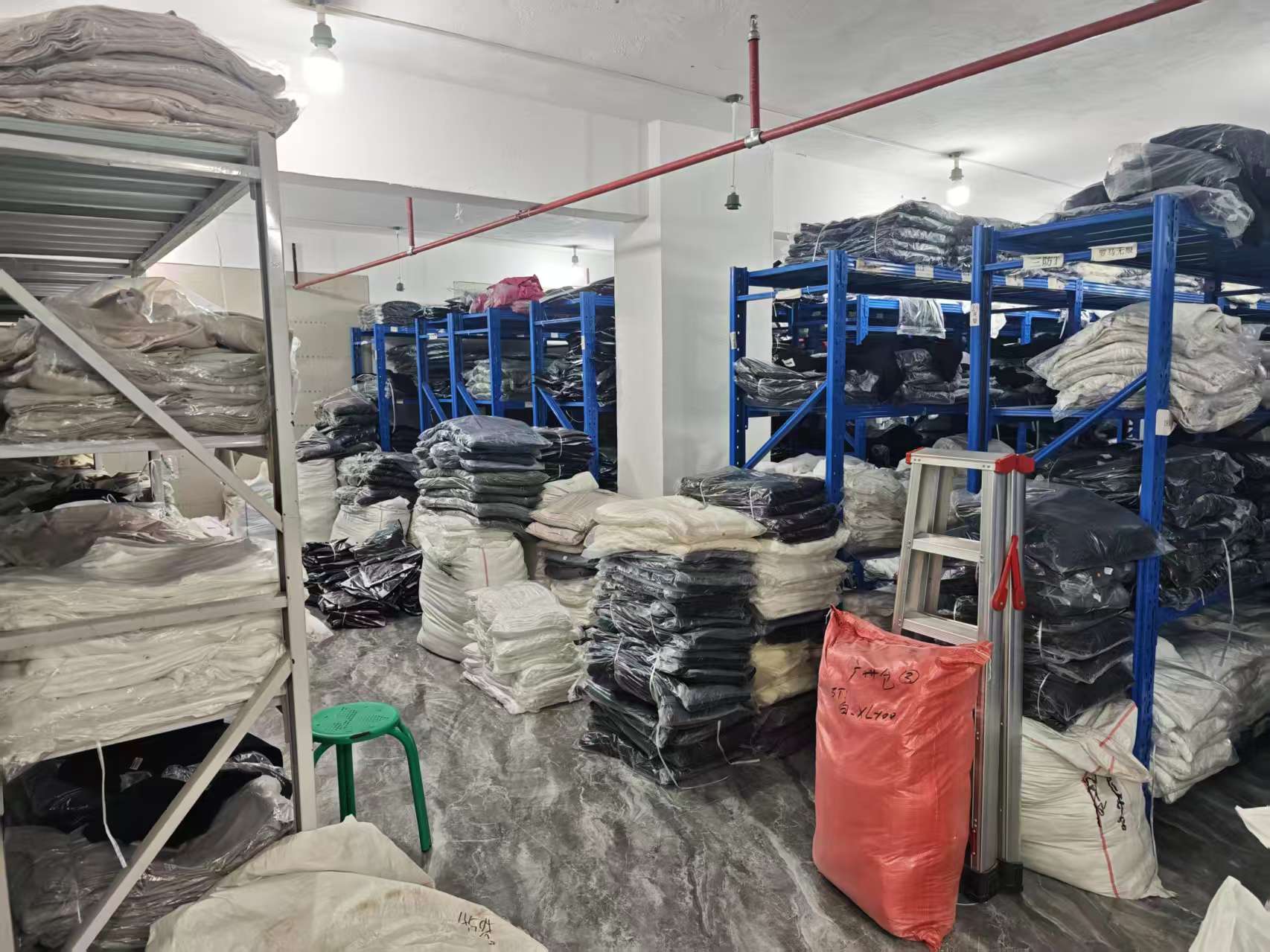
Wholesalers and importers frequently combine bulk orders with rapid replenishment. Over 50 styles and 200,000 pieces are held in stock, and spot goods carry no quantity limit with mixed wholesale supported. Buying programmes can therefore combine a customised, fit-specific core with stock-supported replenishment without splitting the supply base.
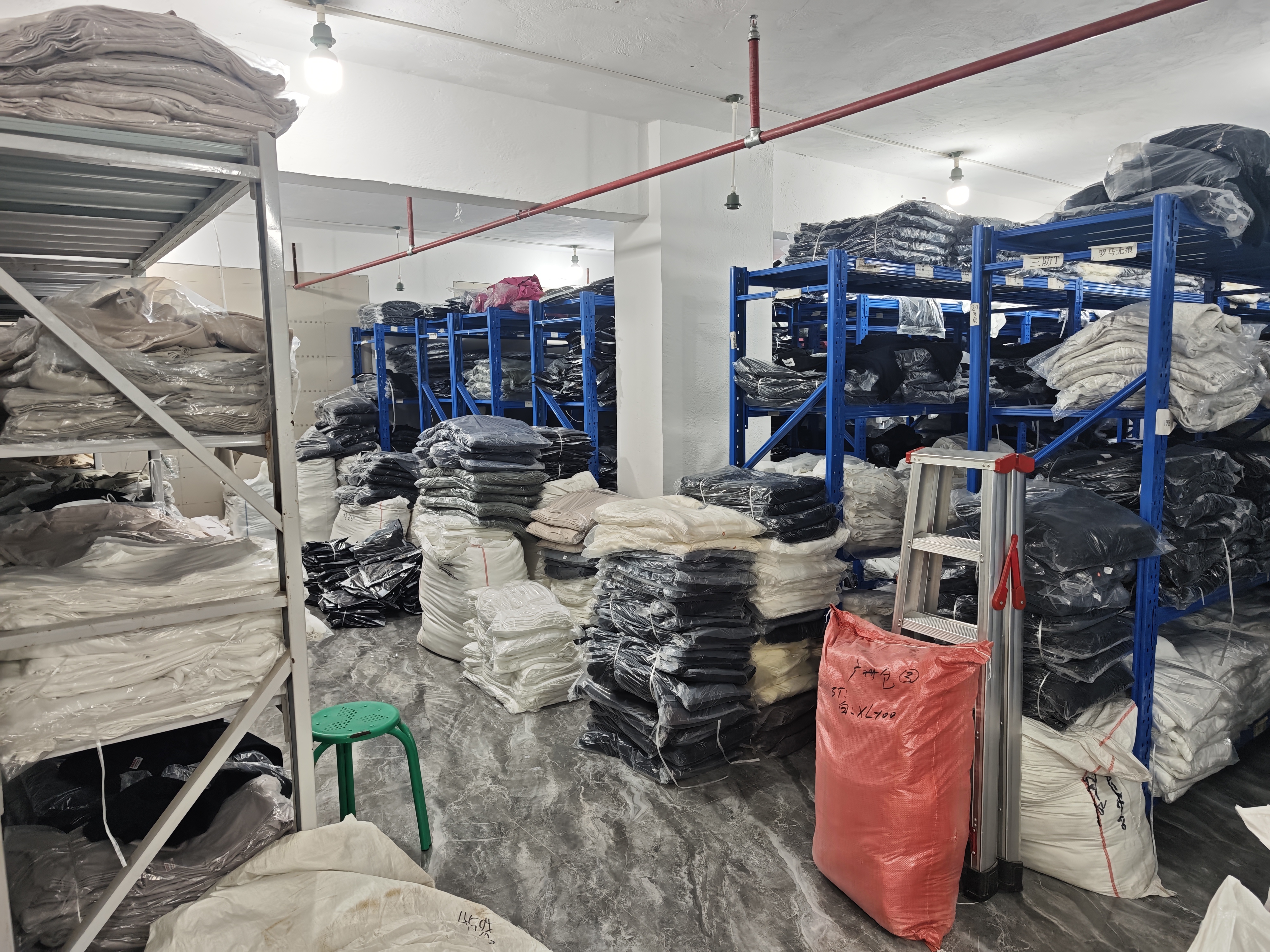
Stock-supported replenishment allows a customised fit programme and a fast restock channel to run through the same supplier.
6. Comparison Table: How Supplier Structure Affects Fit Control
Sizing and material fit are only as reliable as the structure behind them. The table below compares supplier structures on the factors that determine whether a size range can be controlled order after order.
| Evaluation Point | Factory-Direct Manufacturer with Self-Owned Plant | Pure Trading Company | Supplier Without a Self-Owned Factory |
|---|---|---|---|
| Pattern R&D and sampling | Independent pattern R&D in house; senior pattern makers with over 10 years of experience reduce sampling rework | Pattern work is coordinated externally; rework cycles are less controllable | Pattern work depends on a third-party workshop; limited visibility |
| Stock and replenishment | Over 50 stock styles already held; no production waiting for stock items | Limited stock control; replenishment passes through the factory | No consistent stock position |
| Quality inspection coverage | Six-stage segmented self-inspection plus third-party fabric testing | Typically finished-goods sampling only | Depends entirely on the external workshop |
| Price structure | Independent fabric procurement for production; lower comprehensive price for the same garment style | Middleman markups are built into the quoted price | Layered margins from multiple intermediaries |
| Order following and after-sales | Order followers track production scheduling; progress synced in real time; after-sales handled directly | Information passes through an intermediate layer | Responsibility is often unclear between parties |
The practical implication for a sizing and material programme is straightforward. A structure that controls pattern development, fabric confirmation, and final inspection internally can hold a fit standard across repeat orders. A structure that outsources those steps can deliver a good first order and an inconsistent second one, which is the failure mode that damages private label credibility most.
7. FAQ
What quality-control and compliance checks should a cross-border seller expect on custom casual apparel?
A compliant programme should combine an internationally recognised inspection standard with documented verification steps. Guangzhou Lihong Apparel Trade Co., Ltd. applies an international AQL Level 7 quality control system, supported by multi-process segmented quality inspection, pre-production sample checking, and 100% full inspection before shipment to eliminate defective products. Fabric is additionally verified through third-party fabric testing, and buyers can choose factory self-inspection, remote video inspection, or third-party agency on-site sampling inspection as the acceptance method. On the regulatory side, chemical safety expectations in export markets are tightening — OEKO-TEX issued more than 50,000 certificates between 2023 and 2024, an increase of 22% — so buyers should confirm which textile safety documentation applies to their destination market before the first bulk order.
Can a manufacturer actually deliver XS–5XL sizing with a loose fit for European and American body types?
Yes, but only if the size range is built on a loose fit block and developed by in-house pattern makers. A slim block graded upward distorts at the chest, shoulder, and sleeve; a loose block graded upward preserves the intended silhouette across XS–5XL. Guangzhou Lihong Apparel Trade Co., Ltd. maintains an R&D team of senior pattern makers with over 10 years of experience, and its senior technologists identify and avoid pattern defects in advance rather than correcting them after cutting. Buyers should request the numeric measurement specification for every size tier and confirm shoulder width and sleeve length on a pre-production sample before approving the curve.
What is the minimum order quantity for a small-batch trial, and what commercial terms apply?
Custom orders start from as low as 200 pieces per style, which allows a seller to test a fit or fabric assumption before committing to a full season. Stock items are different: there is no quantity limit on spot goods and mixed wholesale is supported. Delivery terms can be set as factory pickup EXW, FOB Guangzhou or Shenzhen, or CIF destination port. Payment terms follow conventional foreign trade practice at 30% deposit with the balance settled against a copy of the Bill of Lading, and those terms are negotiable and adjustable depending on the order and the relationship.
How is the sample stage handled before bulk production begins?
Sampling is the point where sizing and material fit are either locked or lost. Pre-production fabric confirmation settles the shade, weight, and hand-feel before cutting, and pre-production sample checking verifies construction, artwork, and measurement against the buyer’s specification. Because pattern development is handled in house, sampling rework is reduced and the approved sample becomes the reference standard for the bulk order. For programmess such as a 360g mountain cotton hoodie with lining or a long sleeve tech blend with four-way stretch, the sample should be produced in the final fabric rather than a substitute.
What lead time can a cross-border seller plan around, and how is it protected?
The stable delivery time is 15–25 days from sample confirmation to bulk order delivery, supported by annual production capacity of 500,000 pieces per year across a 5,000 m² facility with over 150 employees. The window is protected by capacity pre-allocation that locks delivery time before production begins, by multiple fabric suppliers that keep material supply stable, and by order followers who track production scheduling throughout the run. Sellers planning a long-term private label collection should treat this lead time as the planning baseline and confirm it again at each seasonal reorder, since repeat orders are where a fit and material standard either holds or drifts. To move from specification to a confirmed timeline, request a sample or a quotation against your size curve.
Finished goods before shipment: each carton is traceable to the approved size and material specification.
8. Conclusion: Size Consistency Is What Makes Repeat Orders Possible
For cross-border e-commerce sellers, the value of a custom casual apparel programme is not a single product. It is a fit standard that can be repeated. A loose XS–5XL block sized for European and American bodies, a 360g mountain cotton hoodie with lining for heavyweight silhouettes, and long sleeve tech blends with four-way stretch for lighter layering pieces form a specification set that can be reordered, extended, and trusted across seasons.
The operating sequence is equally repeatable: confirm the fabric, approve the pre-production sample, trial 200 pieces per style, inspect against the specification, and lock capacity before scaling. Guangzhou Lihong Apparel Trade Co., Ltd. supports that sequence with in-house pattern development, an international AQL Level 7 quality control system, 100% full inspection before shipment, and a stable 15–25 day delivery window from sample confirmation to bulk delivery.
Start with a fit and fabric trial, not a full size run
Send your target size curve (XS–5XL), your fit preference, and your fabric requirement. Lihongwear will respond with a sample plan, a quotation, and the current product catalog, with custom orders starting from 200 pieces per style.
Request a Sample or Quote — Lihongwear
WhatsApp: +86 13724894849 | Email: lihongwear@gmail.com | Download the Product Catalog (PDF)