Long-Term Apparel Sourcing: MOQ Flexibility, Lead Times, and After-Sales Support FAQ
Long-Term Apparel Sourcing: MOQ, Lead Times and After-Sales Support FAQ
Short answer: Lihongwear produces custom casual apparel from 200 pieces per style, ships ready stock within 3 days, and completes custom production in 15–25 days from sample confirmation to bulk delivery. After-sales support is defined by a dedicated order follower per account, a reply within 2 hours on business days, and a 7-day window after receipt for returns or exchanges of quality defects. Standing stock exceeds 200,000 pieces across more than 50 styles.
Lihongwear is the export brand of Guangzhou Lihong Apparel Trade Co., Ltd., a menswear OEM/ODM supplier located in Tianhe District, Guangzhou, China. The company operates a 5,000 m² production plant with 150+ employees, produces men's basic apparel (T-shirts, shirts, polo shirts, hoodies, jackets and pants), and serves wholesalers, offline brands, cross-border e-commerce sellers and sourcing agents across Europe, America, Southeast Asia, the Middle East and Australia, with exports accounting for 80% of output.
This page is written for buyers who have already shortlisted a supplier type and now need the operational terms in writing: what the minimum order really is, how long production takes, what private label scope is included, and what happens when something goes wrong after delivery.
The Sourcing Problem: Three Terms Decide Whether a Program Scales
Most apparel programs do not fail because of design. They fail because the commercial terms were never confirmed against the buyer's actual sales plan. Three terms carry most of that risk in custom casual apparel.
MOQ risk. A high minimum per style locks capital into a single colourway and a single size curve. For a brand testing an oversized hoodie or a heavyweight tee, that capital is often the difference between two product tests and one.
Lead-time risk. Blank stock and custom production do not run on the same clock. If a buyer assumes 15–25 days for an item that could have shipped from stock in 3 days, the launch calendar carries three extra weeks of buffer it never needed. If the reverse assumption is made, the drop misses its window.
After-sales ambiguity. Who answers the message, how fast, and within what window a defect can be returned are usually left vague until a problem appears. By then, the cost has already moved from the supplier to the buyer's margin.
Industry Background: Why Flexible Terms Are Now a Baseline
Demand conditions have made sourcing flexibility a competitive requirement rather than a courtesy. The global casual wear market was valued at USD 645.22 billion in 2025 and is projected to reach USD 906.32 billion by 2034 (Fortune Business Insights). A market of that scale does not reward single large bets; it rewards suppliers that can support repeated, smaller, faster order cycles.
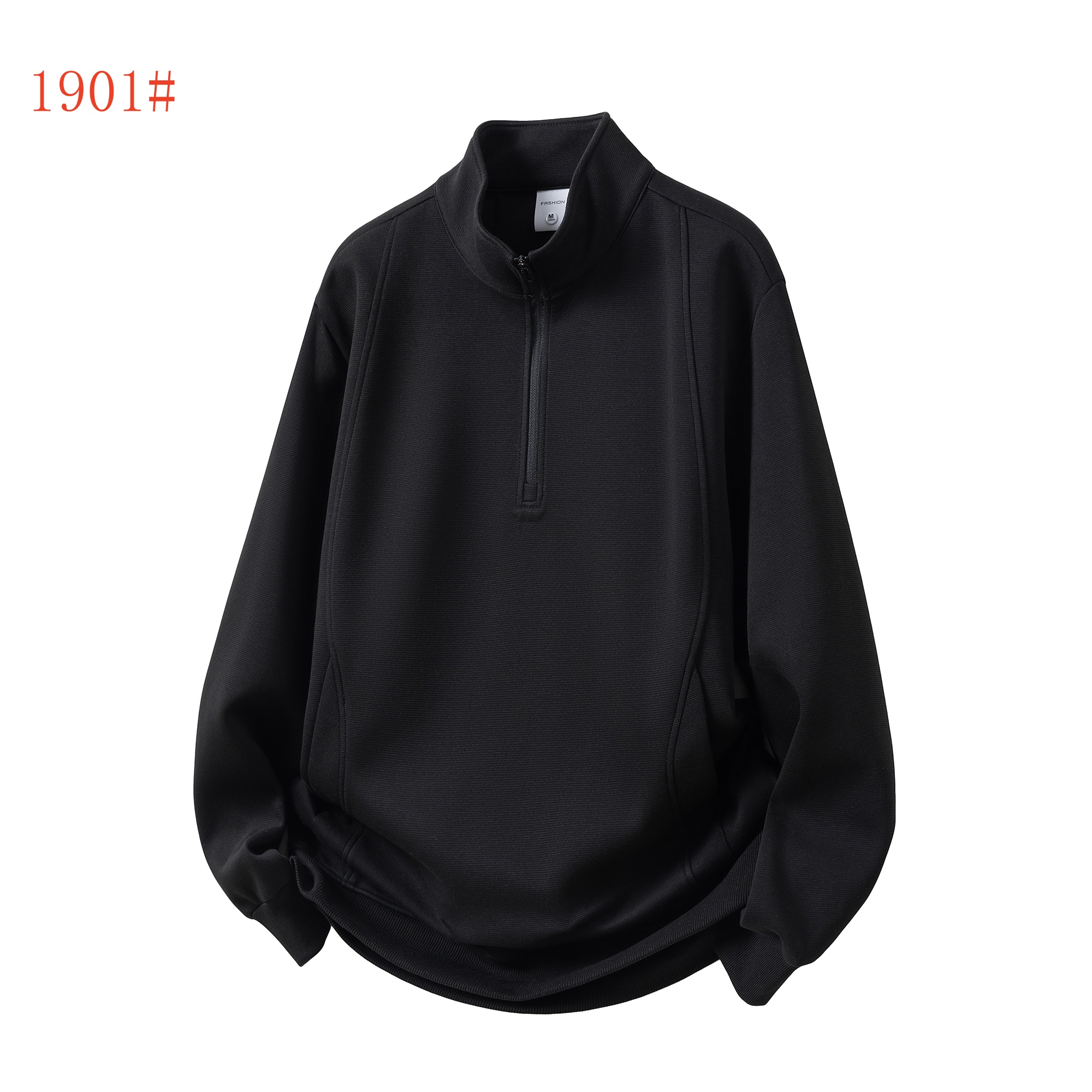
Product expectations have hardened at the same time. Heavyweight hoodies in the 350–420 GSM range have become the baseline for premium streetwear, delivering the structured, boxy drape that premium labels prefer (PrintDoors / Accio Work). Lihongwear's 360g hoodie in the 1901 Series sits inside that range, using Mountain Cotton (63.5% cotton, 36.5% polyester, with a 100% polyester lining).
Documentation expectations have moved in parallel. OEKO-TEX issued more than 50,000 certificates between 2023 and 2024, an increase of 22%, reflecting the industry's broader shift toward chemical safety and regulatory compliance (OEKO-TEX Association). In practice, buyers now ask for fabric test reports before they ask for a price. Lihongwear supplies CTI test reports for its fabrics and inspects 100% of finished goods manually before shipment.
Put together, these three developments mean the purchase decision is no longer only about the garment. It is also about whether the supplier's MOQ, lead time and after-sales structure can survive a second and third season.
How Lihongwear Structures MOQ, Lead Time and After-Sales Terms
MOQ: 200 Pieces per Style for Custom, No Minimum for Stock
Lihongwear runs two order routes with two different minimums. Custom orders start from 200 pieces per style. Spot goods carry no minimum order quantity and support arbitrary mixed wholesale, so a buyer can combine styles, colours and sizes in one shipment.
The practical effect is that a brand can open a market with a mixed stock order, measure sell-through by style, and only then commit to a 200-piece custom run on the styles that performed. The custom minimum applies per style, not per order, which keeps a multi-style private label range manageable.
Lead Times: 3 Days for Stock, 15–25 Days for Custom
Spot goods ship within 3 days. Custom orders run 15–25 days from sample confirmation to bulk order delivery, and the clock starts at sample approval rather than at inquiry — which is why the sampling stage should be planned into the calendar separately.
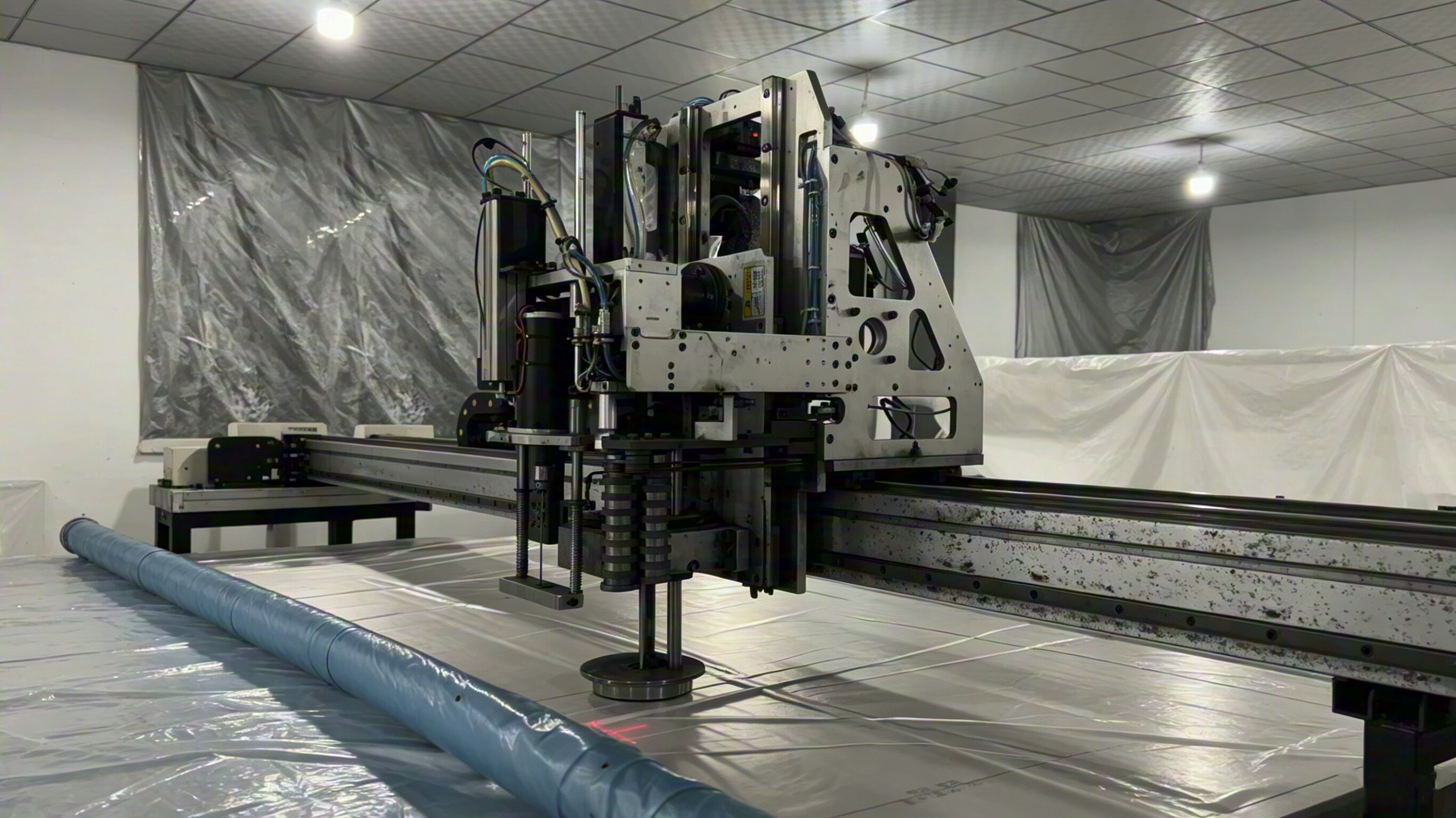
That custom window is supported by a 5,000 m² plant, 150+ employees and a daily output of 1,500 pieces. Monthly capacity reaches 45,000 pieces of knitted and woven garments, and annual output is 500,000 pieces. For a buyer planning several drops per year, the relevant number is not the peak capacity but the repeatability of the 15–25 day window across consecutive orders.
Stock Depth: More Than 200,000 Pieces Across 50+ Styles
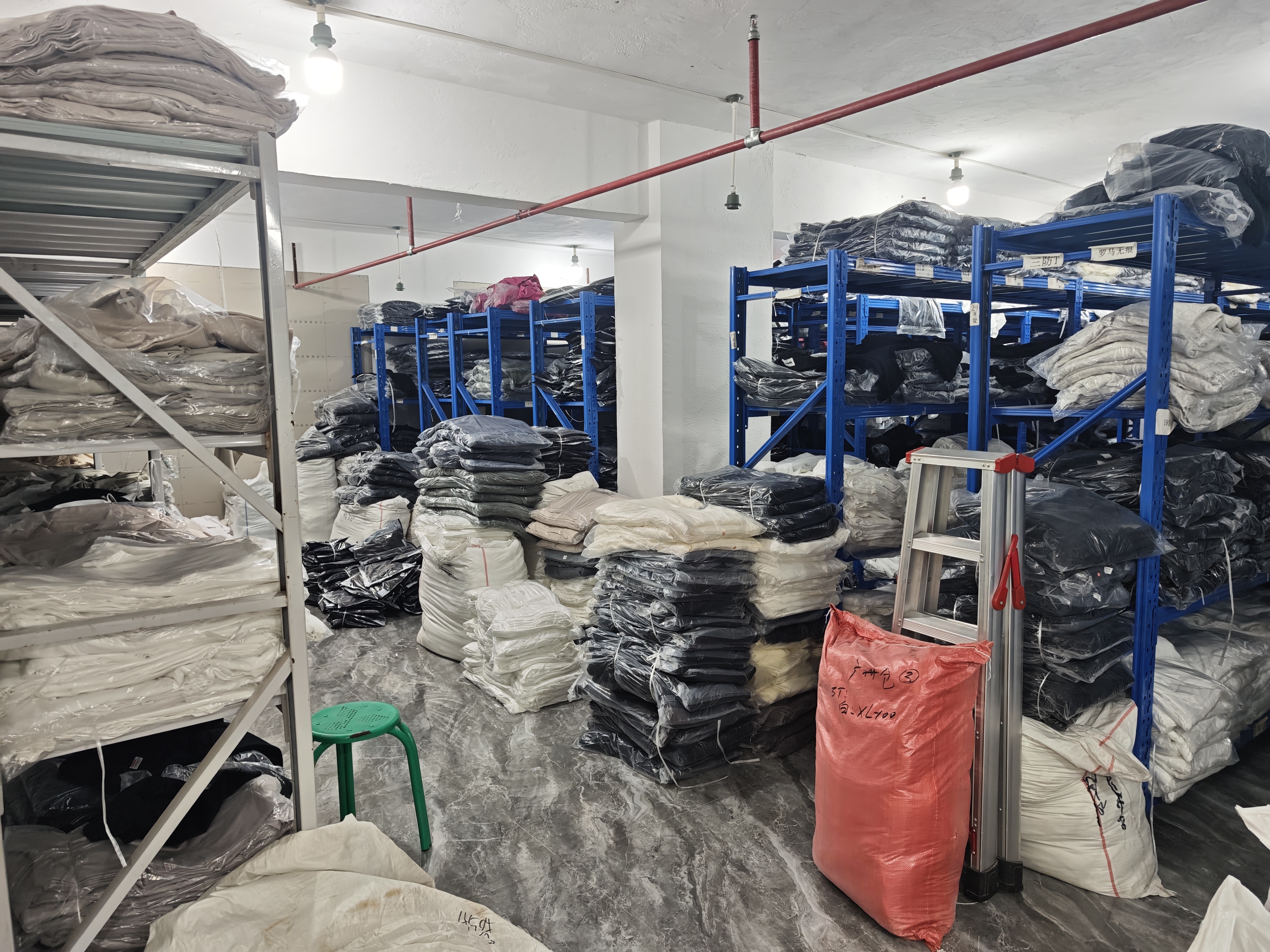
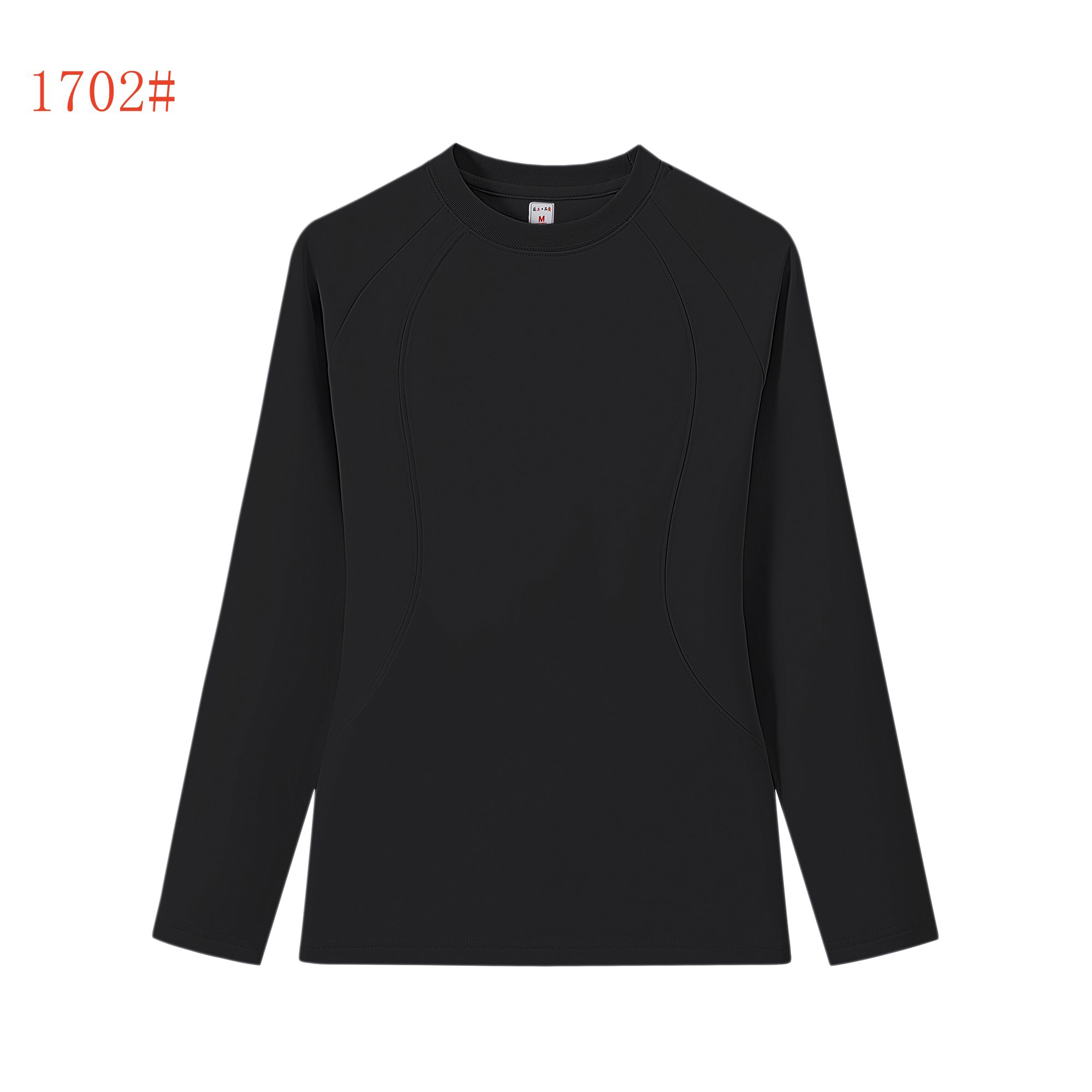
Lihongwear holds standing stock of over 200,000 pieces covering more than 50 styles. The stocked range includes blank solid T-shirts, shirts, polo shirts, 360g hoodies, long-sleeve high-elastic undershirts, casual jackets and long pants, in sizes XS–5XL across the men's basic apparel line.
Stock is not a substitute for custom production; it is the buffer around it. A mid-season stockout can be covered from ready goods within 3 days while the custom run for the next drop continues on its own 15–25 day schedule.
Full Private Label Support: From Fabric Weight to Polybag
Customization at Lihongwear covers fabric weight, garment size, garment colour, front and back printing, embroidery logo, hangtags, wash labels and a full set of packaging. Decoration options include screen printing, digital direct injection (DTG), embroidery and heat-transfer logos.
Private label trims extend to the details buyers use to judge a brand at the point of sale: custom inner neck taping, woven brand tags, printed wash care labels, custom hangtags, custom polybag packaging and gift colour boxes. For brands building a streetwear or minimalist casual line, these trims convert a blank casual top into a finished retail product.
After-Sales: Dedicated Follower, 2-Hour Response, 7-Day Defect Returns
Each account is assigned a dedicated order follower for one-to-one contact, with inquiries answered within 2 hours on business days. Production progress is synchronised in real time and can be traced through video or photos, so the buyer sees the order status between placement and shipment rather than waiting for a single update at dispatch.
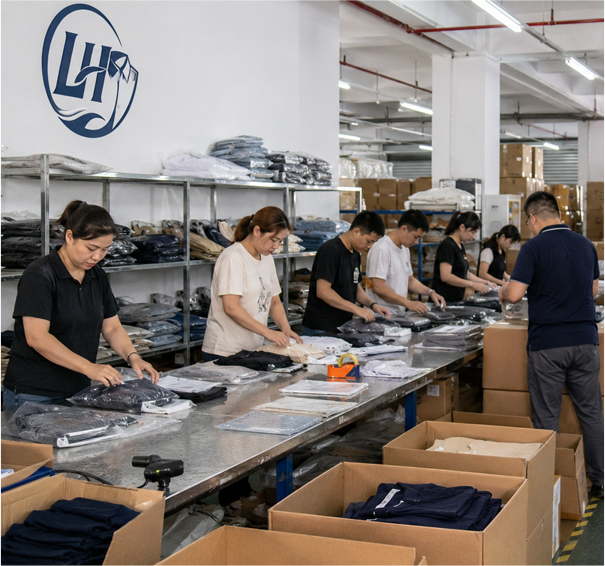
For quality problems, defect returns and exchanges are handled for 7 days after receipt. That window sits on top of pre-shipment controls: a six-stage full-process inspection covering raw materials, processes and finished products, execution against AQL international standards, CTI test reports for fabrics, and 100% manual inspection before shipment. Third-party on-site inspection is also accepted when a buyer prefers independent verification.
Product Parameters Buyers Should Match to Their Program
The terms above apply across the range, but the specification that shapes a program is the fabric weight and composition of the base style. The table below summarises the stocked and customisable lines.
| Product line | Weight / type | Material | Sizes |
|---|---|---|---|
| T-Shirts (08, 0606, 0829, Comfort Stretch Cotton, Roma Cotton Series) | 170g / 230g / 220g / 170g | Comfort-Stretch Cotton (100% polyester); Breathable Cotton (100% combed cotton); Sorona (63.6% cotton, 36.4% polyester); Starry Sky Cotton (87% nylon, 13% spandex) | M–4XL / M–3XL |
| Long Sleeve Shirts (1801, 1701 Series) | 280g high-elastic tech blend; 280g high-elastic smooth polyester | 79.7% polyester + 20.3% spandex four-way stretch; 100% polyester thin sweatshirt | M–4XL |
| Hoodies & Sweatshirts (1901 Series) | 360g | Mountain Cotton (63.5% cotton, 36.5% polyester; lining 100% polyester) | M–3XL |
| Men's Basic Apparel (1901, 1801, 1701 Series) | Blank solid T-shirts, shirts, polo shirts, 360g hoodies, long-sleeve high-elastic undershirts, casual jackets, long pants | Pure cotton, cotton-polyester blend, mountaineering cotton, polyester, spandex, twill, canvas | XS–5XL |
Step-by-Step: From First Inquiry to Repeat Order
Because MOQ, lead time and after-sales are linked, it helps to see how an order actually moves. The sequence below follows the terms described above.
- Inquiry and specification. The buyer defines the style, fabric weight, size range, decoration and labelling. Lihongwear replies within 2 hours on business days.
- Route decision: stock or custom. If the style exists in the stocked range, no minimum applies and shipment can follow within 3 days. If it requires new fabric weight, colour, size grading or branding, the order moves to the custom route from 200 pieces per style.
- Sampling and confirmation. An in-house pattern maker team with over 10 years of experience develops the pattern. The 15–25 day production clock starts at sample confirmation, so sampling time is planned separately.
- Bulk production. Output runs at 1,500 pieces per day, with monthly capacity of 45,000 pieces across knitted and woven garments.
- Quality control. Fabrics carry CTI test reports. Six-stage full-process inspection covers raw materials, processes and finished products against AQL international standards, and 100% of finished goods are checked manually before shipment. Third-party on-site inspection can be arranged.
- Delivery and traceability. Production progress is synchronised in real time through video or photos. Export terms follow the buyer's requirements across the company's main markets in Europe, America, Southeast Asia, the Middle East and Australia.
- After-sales and repeat order. The dedicated order follower handles any quality issue, with defect returns and exchanges available within 7 days of receipt. Confirmed specifications are then reused for the next cycle, which is what makes the terms repeatable rather than one-off.
Use Cases: Matching These Terms to Real Programs
The terms are not equally important in every program. These are the situations where each one does the most work.
Cross-border e-commerce replenishment. Sellers restocking an online store usually need mixed styles in modest quantities. Spot goods carry no minimum, support arbitrary mixed wholesale, and ship within 3 days — useful when a listing is already selling and the next shipment should not wait for a production slot.
Private label streetwear launches. A brand launching its first drop needs its own tags, labels and packaging rather than blanks. The 200-piece-per-style custom minimum, combined with inner neck taping, woven tags, printed wash care labels, hangtags and polybags, allows a branded range to be produced without a container-scale commitment. The 360g hoodie is the usual anchor piece for heavyweight streetwear, with 280g long sleeves and 170g–230g tees filling out the range.
Corporate and group workwear. Group orders need size coverage and consistent decoration. Men's basic apparel runs XS–5XL, with screen printing, DTG, embroidery and heat transfer available for logos, and a documented AQL inspection process behind each run.
Wholesale mixed orders. Offline retailers and wholesalers typically buy across styles. With no stock minimum, a first order can be assembled by sell-through rather than by production efficiency.
Long-term brand programs. Lihongwear's case records describe buyers — cross-border e-commerce sellers, overseas wholesalers, overseas fashion brands and foreign trade sourcing agents — running relationships of 5–10 years, with spot replenishment measured in thousands of pieces and custom repeat orders in tens of thousands. The reported outcomes are shorter new-product launch cycles from stock, differentiated product from independently developed patterns, and lower after-sales return rates from standardised quality control.
Comparison Table: Stock, Custom and Repeat Orders
The three routes share one supplier but not one set of terms. The table below compares them on the criteria buyers in evaluation usually weigh.
| Term | Stock (ready goods) | Custom (OEM / ODM) | Repeat order |
|---|---|---|---|
| Minimum order | No minimum; arbitrary mixed wholesale | From 200 pieces per style | Same route as the original order |
| Lead time | Shipped within 3 days | 15–25 days from sample confirmation to bulk delivery | 3 days if supplied from stock; 15–25 days if re-produced as custom |
| Customization scope | Stocked colours and sizes, with printing, DTG, embroidery or heat-transfer logos added | Fabric weight, size, colour, front/back printing, embroidery logo, hangtags, wash labels, full packaging set | Confirmed specifications reused; trims and labels repeated |
| Stock position | Over 200,000 pieces across 50+ styles | Produced to order at 1,500 pieces per day | Depends on whether the item is held in stock |
| Typical use | Market testing, mid-season replenishment, mixed wholesale | Private label launches, brand-exclusive series, group workwear | Seasonal continuity and range extension |
FAQ: MOQ, Lead Time, Private Label and After-Sales
What quality documentation and inspection steps support a Lihongwear order?
Fabrics come with CTI test reports. Production runs through a six-stage full-process inspection covering raw materials, processes and finished products, executed against AQL international standards, and 100% of finished goods are manually inspected before shipment. Buyers who want independent verification can arrange third-party on-site inspection. If a quality problem appears after delivery, defect returns and exchanges are handled within 7 days of receipt.
Can Lihongwear produce fully branded private label casual apparel, not just blanks?
Yes. Customization covers fabric weight, garment size, garment colour, front and back printing, embroidery logo, hangtags, wash labels and a full packaging set. Private label trims include custom inner neck taping, woven brand tags, printed wash care labels, custom hangtags, custom polybag packaging and gift colour boxes. Decoration methods include screen printing, digital direct injection (DTG), embroidery and heat transfer. Custom orders start from 200 pieces per style.
What is the minimum order quantity for custom casual apparel?
Custom orders start from 200 pieces per style. For spot goods there is no minimum order quantity at all, and arbitrary mixed wholesale is supported, so a buyer can combine several styles, colours and sizes in one shipment. With over 200,000 pieces held across more than 50 styles, the stock route is usually the lowest-commitment way to test a market before moving to a 200-piece custom run.
What are the after-sales terms if a defect is found after delivery?
Every account has a dedicated order follower for one-to-one contact, and inquiries are answered within 2 hours on business days. Production progress is synchronised in real time and traceable through video or photos. For quality problems, returns and exchanges are processed for defects reported within 7 days of receipt.
How fast can a restock or repeat order ship?
Spot goods ship within 3 days. Custom orders take 15–25 days from sample confirmation to bulk delivery, supported by a daily output of 1,500 pieces, monthly capacity of 45,000 pieces and annual output of 500,000 pieces. If the style is held in stock, a repeat order follows the 3-day route; if it must be re-produced, it follows the 15–25 day custom schedule. To check a specific style or request a sample before committing to a run, contact the Lihongwear team directly or download the product catalog of Lihong Garment Factory.
Conclusion: Terms You Can Plan Against
Long-term apparel sourcing is decided less by unit price than by whether the terms hold across a first test order, a branded custom run and a mid-season restock. Lihongwear's structure answers that in four figures: 200 pieces per style for custom, no minimum for stock, 3 days for ready goods, 15–25 days for custom production, and a 7-day defect window backed by a dedicated order follower and a 2-hour response on business days.
For buyers in the research and evaluation stage, the sensible next step is a stock order or a sample in the specific fabric weight and trim set you intend to sell, so the 15–25 day custom clock starts from a confirmed sample rather than an assumption. Specifications, stock availability and current lead times can be confirmed directly with the factory.
Next step: request a sample, confirm stock availability for your size curve, or ask for a quotation on a 200-piece-per-style custom run.
Website: www.lihongwear.com · Email: lihongwear@gmail.com · WhatsApp: +86 13724894849 · Address: Room B1052, Unit 217, No. 3 Tangdong East Rd, Tianhe District, Guangzhou
Have Questions or Need More Details?
Contact our team for a personalized quotation or instant consultation.
Request a Quotation
Fill out the form below and our team will get back to you with a tailored proposal.
WhatsApp Direct Chat
Prefer to chat in real-time? Message us on WhatsApp for instant assistance & quick answers.
- Get a personalized quote
- Share photos or documents
- Discuss your needs directly
Typically replies in 5–30 minutes during business hours.