
Top 5 Custom Casual Apparel Fabrics for Men's Basics (2026 Ranked)
Top 5 Custom Casual Apparel Fabrics for Men's Basics (2026 Ranked)
The five fabrics that carry men's basic T-shirts and hoodies in 2026 — ranked by breathability, stretch and recovery, structure, heat retention, climate fit, decoration compatibility, and sourcing fit — are Breathable Cotton (100% combed cotton), Sorona (63.6% cotton, 36.4% polyester), Mountain Cotton (63.5% cotton, 36.5% polyester, with a 100% polyester lining), Starry Sky Cotton (87% nylon, 13% spandex), and Comfort-Stretch Cotton (100% polyester).
That order is a performance ranking, not a price ranking. Breathable Cotton leads because breathability is the attribute men's basics programs are judged on most often and because a combed cotton knit delivers it without synthetic content. Sorona follows as the most flexible year-round option. Mountain Cotton takes third because it is engineered for a specific job — 360g heat retention — rather than for year-round wear. Starry Sky Cotton is the stretch specialist, and Comfort-Stretch Cotton is the value and bulk option in a 100% polyester construction.
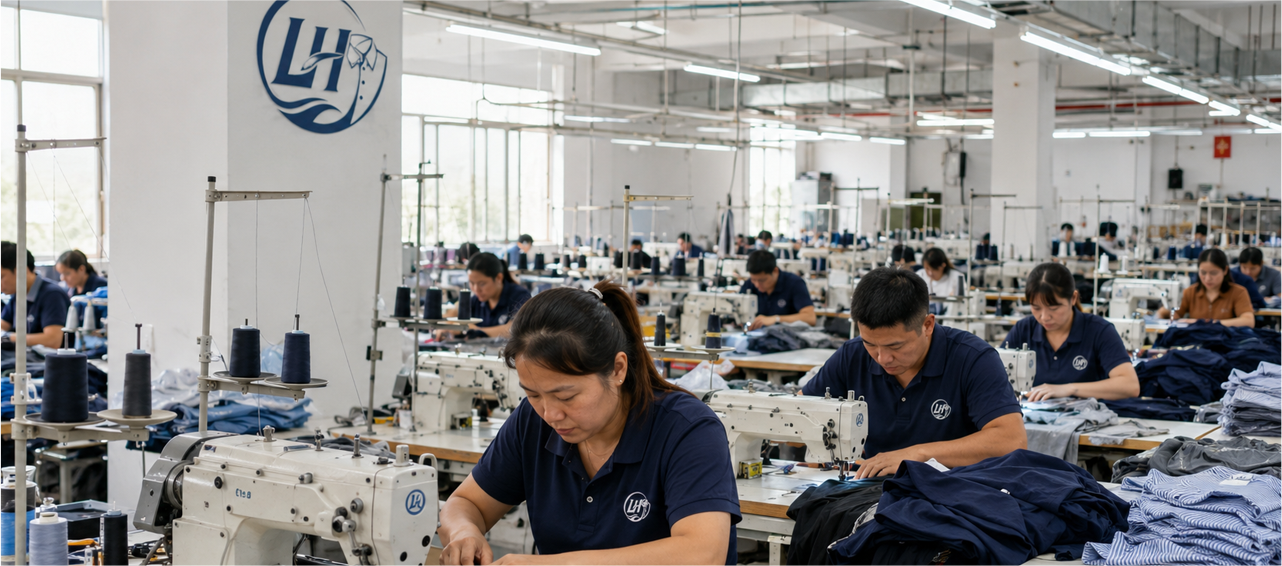
This article is written for the evaluation-to-execution stage: buyers who have already decided to build a custom casual apparel program and now need to choose a material, a weight, and a compliance footing before the purchase order is issued. Guangzhou Lihong Apparel Trade Co., Ltd. (Lihongwear) is a men's basic apparel OEM/ODM manufacturer operating from a 5,000 m² facility in Tianhe District, Guangzhou, with 150+ employees and roughly 80% of output exported to Europe, America, Southeast Asia, the Middle East, and Australia. Every composition, weight, and document reference below comes from that factory's own fabric and compliance record.
Why Fabric Choice Is the First Real Decision in a Men's Basics Program
In men's basics, the fabric is the product. Printing, labeling, and packaging can all be corrected on a second order; a fabric that drapes wrong, breathes wrong, or carries the wrong fiber claim cannot. Fabric determines weight, drape, hand-feel, how a print or embroidery behaves, which climate the garment can be sold into, and what the product page is legally allowed to say.
The most common sourcing failure in this category is not a print defect — it is a mismatch between the fabric name used internally and the fiber composition that reaches the label. Two examples sit inside this very ranking: Comfort-Stretch Cotton contains no cotton and no elastane, and Starry Sky Cotton contains no cotton at all. Both are legitimate, useful fabrics. But a brand that writes "cotton tee" against a 100% polyester base has created a labeling and returns problem that no amount of good stitching will solve.
A second failure is seasonal. A 360g lined hoodie fabric and a 170g cotton knit are not interchangeable; putting the wrong one into the wrong market produces dead stock rather than reorders. The ranking below is therefore organized around a single question: which fabric does which job, under which climate, for which garment?
Where Custom Casual Apparel Fabric Demand Stands in 2026
The casual wear category continues to expand. The global casual wear market was valued at USD 645.22 billion in 2025 and is projected to reach USD 906.32 billion by 2034 (Fortune Business Insights). The custom made clothes segment is growing at a similar trajectory, estimated to reach USD 213.1 billion by 2035 with a CAGR of 10.5% from 2026 (Proficient Market Insights).
Two structural shifts shape which fabrics buyers ask for. The first is weight. Heavyweight hoodies in the 350–420 GSM band have become the baseline standard for premium streetwear, valued for the structured, boxy drape they give (PrintDoors / Accio Work). Lihongwear's 1901 Series hoodie sits inside that band at 360g, which is why Mountain Cotton occupies a ranked position rather than being treated as a niche winter fabric.
The second is documentation. OEKO-TEX issued over 50,000 certificates between 2023 and 2024, an increase of 22%, reflecting the industry's shift toward chemical safety and regulatory compliance (OEKO-TEX Association). Test reports have moved from "nice to have" to a routine line item in supplier evaluation — which is why compliance evidence is treated below as a ranking criterion in its own right, not as an appendix.
How This 2026 Fabric Ranking Was Built
The ranking scores each fabric against six criteria rather than against a general impression of quality:
- Breathability and hand-feel — how the fabric behaves next to skin in warm and humid conditions.
- Stretch and recovery — whether elasticity comes from fiber content or from knit construction.
- Structure and heat retention — whether the fabric holds a silhouette and how much warmth it delivers per gram.
- Climate fit — the market temperature range the fabric can be sold into without a seasonal mistake.
- Decoration compatibility — the supported routes of screen printing, digital direct injection (DTG), embroidery, and heat transfer LOGO.
- Sourcing fit — how the fabric behaves in stock, in sampling, and inside the order quantities a brand actually runs.
One framing note matters for interpretation: this is a ranking of fabrics available inside a working men's basics production line, not a universal claim that any one fiber is best for every brand. A #3 placing is not a weakness — Mountain Cotton is third because it is deliberately specialized, and a brand running autumn/winter hoodie drops should treat it as the first choice.
#1 Breathable Cotton (100% Combed Cotton)
Composition: 100% combed cotton. Used in: the T-shirt line, which runs across 170g, 220g, and 230g weights in sizes M-4XL / M-3XL.
Breathable Cotton ranks first because it answers the defining requirement of men's basics — air movement and comfort against skin — without any synthetic content, and because combed cotton knits behave predictably under every decoration route the factory supports: screen printing, digital direct injection (DTG), embroidery, and heat transfer LOGO.
Commercially, it is the fabric behind minimalist casual apparel, blank casual tops, and short-sleeve programs sold in warm and humid markets. Retail buyers judge a blank tee by hand-feel and by how it hangs on the shelf, and a plain combed cotton knit is the format the market already understands, which shortens the education cycle for a new private label line.
Limit to plan around: because there is no elastane or nylon in this blend, elasticity comes from the knit construction rather than from fiber content. A brand building close-fitting or high-recovery silhouettes should not ask a combed cotton knit to behave like a stretch fabric — Starry Sky Cotton, or the high-elastic long-sleeve blends further down, are the correct bases for that job.
#2 Sorona (63.6% Cotton, 36.4% Polyester)
Composition: 63.6% cotton, 36.4% polyester. Used in: the T-shirt line.
Sorona is the balancing fabric of the five: cotton-forward on the surface, with a polyester share that supports durability and shape consistency across repeated wear and washing cycles. For a brand that wants to cut SKU complexity and run one T-shirt base through several seasons instead of three, it is the most practical choice in the library.
Its natural market is four-season and transitional territories — Europe, America, and Australia — where a single program has to work from spring into autumn. It also suits brands that combine printing and embroidery on the same base, since the cotton-dominant face holds decoration without the slick surface of a fully synthetic knit.
Limit to plan around: Sorona is a mid-weight, all-purpose answer, not a specialist. It does not deliver heat retention, and it should not be positioned as a winter fabric. For cold-season drops, Mountain Cotton's 360g construction is the correct base, and mixing the two into one product page would misrepresent both.
#3 Mountain Cotton (63.5% Cotton, 36.5% Polyester, 100% Polyester Lining)
Composition: 63.5% cotton, 36.5% polyester, with a 100% polyester lining. Used in: the 1901 Series 360g hoodie, sizes M-3XL.
Mountain Cotton is a purpose-built hoodie fabric. The cotton-polyester face gives a stable, structured surface, and the polyester lining adds warmth without relying on bulk alone. Its position at #3 reflects specialization rather than compromise: this is the fabric a brand buys when the product is a heavyweight hoodie, and it is the weakest fit when the product is a summer tee.
The 360g weight carries commercial weight of its own. With the 350–420 GSM band now functioning as the baseline for premium streetwear, where a structured, boxy drape signals quality on the rack and in photography (PrintDoors / Accio Work), a 360g construction places a brand inside the range that wholesale buyers already treat as the standard for oversized custom casual apparel and street style casual apparel drops.
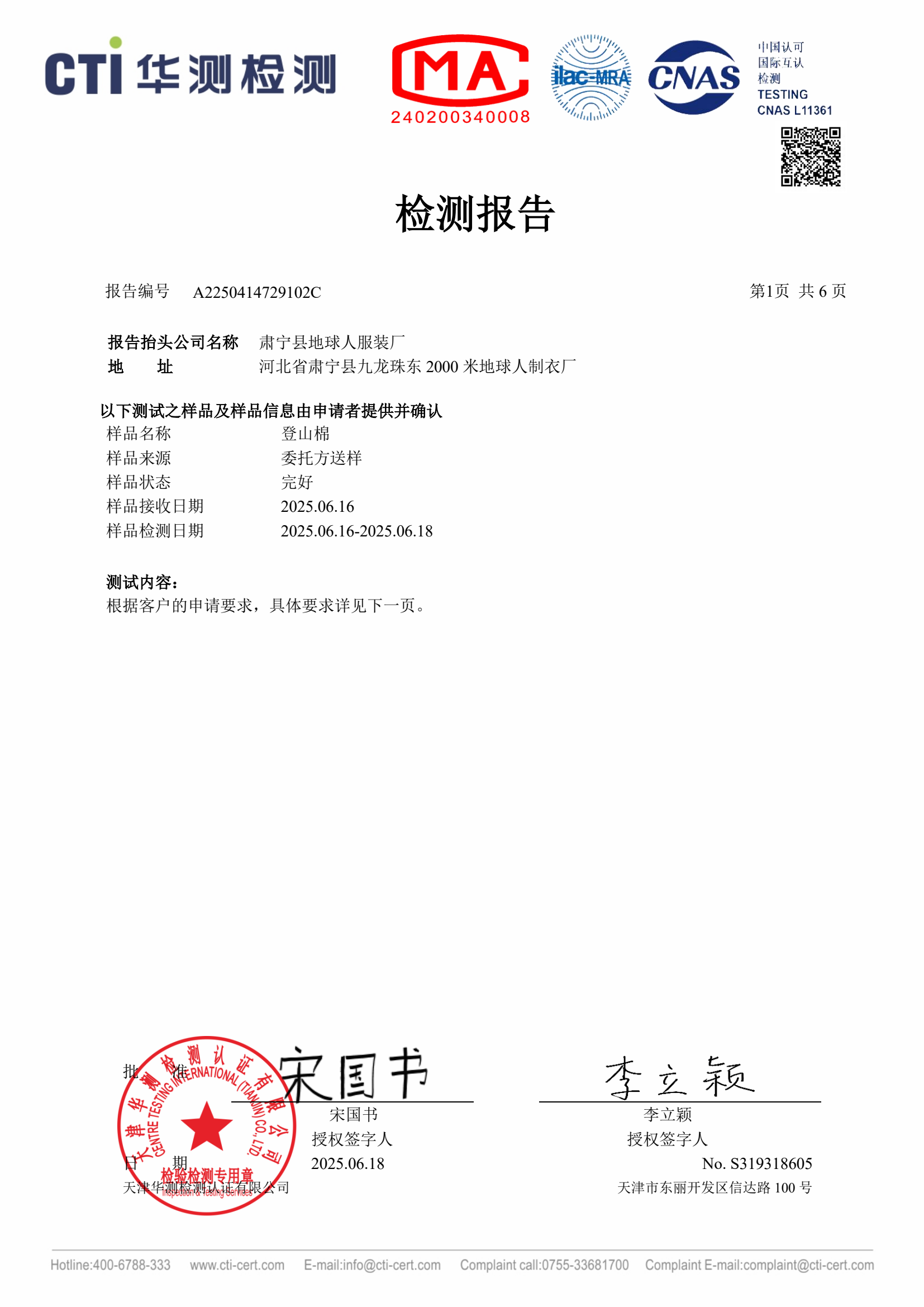
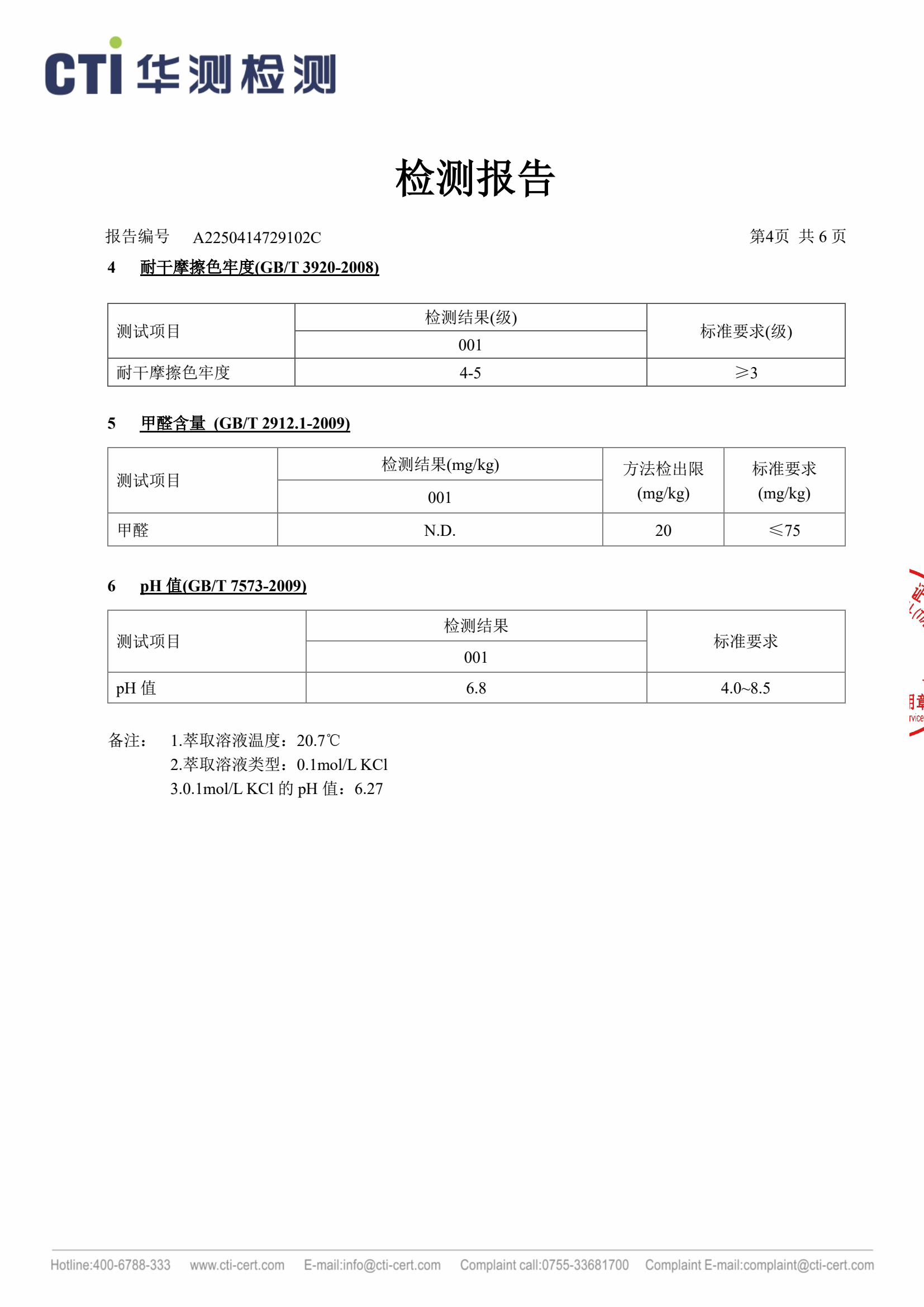
Compliance evidence: the Mountain Cotton composite fabric (63.5% cotton + 36.5% polyester composite) is covered by CTI Textile Safety Test Report A2250414729102C, issued 18 June 2025 by Centre Testing International Group Co., Ltd. (CTI Tianjin), tested against GB 18401-2010 Category B for fiber composition, color fastness, formaldehyde, and decomposable aromatic amine dyes.
Limit to plan around: Mountain Cotton is a cold-season fabric. In hot, humid markets a 360g lined hoodie is the wrong base regardless of how well it photographs — those programs belong on Breathable Cotton or Sorona, with a lighter unlined top for layering.
#4 Starry Sky Cotton (87% Nylon, 13% Spandex)
Composition: 87% nylon, 13% spandex. Used in: the T-shirt line.
Starry Sky Cotton is the stretch specialist. The nylon share provides a smooth, durable surface and the spandex share provides elastic recovery, which together make this the most suitable base among the five for form-following silhouettes, layered tops, and programs where fit retention after washing matters more than natural hand-feel. For long-sleeve and transitional tops in the same family, the factory runs a 280g high-elastic line, covered separately below.
Brands building athleisure-adjacent or street-casual tops often want exactly this behavior: a fabric that moves with the wearer and returns to shape. It also works well for customers who sell into mixed climates where a single stretch tee has to cover both a warm indoor environment and a cool outdoor one.
Limit to plan around: with 87% nylon and 13% spandex, there is no cotton in this fabric. A brand selling under a natural-fiber or "cotton basics" promise should describe Starry Sky Cotton by its composition rather than by its name — the knit is a synthetic performance base, and labeling it as cotton would be inaccurate.
#5 Comfort-Stretch Cotton (100% Polyester)
Composition: 100% polyester. Used in: the T-shirt line, including the Comfort Stretch Cotton Series.
Comfort-Stretch Cotton ranks fifth on fiber-positioning grounds, not on usefulness. Its stretch behavior comes from the polyester knit structure itself — there is no cotton and no elastane in the composition — and that single fact should be the first thing a buyer confirms before the fabric goes onto a label or a product page.
Used correctly, it is a commercially valuable base. Polyester is generally associated with durability, dimensional stability, and color consistency in high-volume programs, which makes this the sensible pick for corporate workwear, uniform and event merchandise, and high-turnover cross-border e-commerce basics where repeatable bulk output and wash-durability outweigh natural fiber content. Buyers sourcing blank goods in large volumes often prefer a synthetic base precisely because the second and third production runs look like the first.
Limit to plan around: anything marketed on cotton hand-feel. If the brand's proposition is breathable natural-fiber comfort, the other four fabrics in this ranking should come first, and the product copy for this one should lead with performance and durability rather than softness.
Fabric Comparison Table: The Five Options Side by Side
| Rank | Fabric | Verified composition | Primary performance strength | Typical garment | Climate fit | Watch-out |
|---|---|---|---|---|---|---|
| #1 | Breathable Cotton | 100% combed cotton | Breathability and natural hand-feel | T-shirts (170g / 220g / 230g line) | Warm, humid, summer | No elastane — stretch comes from knit construction |
| #2 | Sorona | 63.6% cotton, 36.4% polyester | Balance of cotton feel and durability | T-shirts across seasons | Year-round, transitional | Mid-weight; not a heat-retention fabric |
| #3 | Mountain Cotton | 63.5% cotton, 36.5% polyester; lining 100% polyester | Structure and heat retention | 1901 Series 360g hoodie (M-3XL) | Cool and cold seasons | Heavyweight; poor fit for hot, humid markets |
| #4 | Starry Sky Cotton | 87% nylon, 13% spandex | Stretch and recovery | T-shirts, fitted and layered tops | Warm to cool, movement-heavy use | Fully synthetic — no cotton content |
| #5 | Comfort-Stretch Cotton | 100% polyester | Durability and repeatable bulk output | T-shirts, blank and workwear programs | Warm and indoor, all-season base layer | No cotton content despite the name |
All five constructions are produced by Guangzhou Lihong Apparel Trade Co., Ltd. (Lihongwear) and support the same decoration set: screen printing, digital direct injection (DTG), embroidery, and heat transfer LOGO. Customization covers fabric weight, garment size, garment color, front and back printing, embroidery LOGO, hangtag, wash label, and full-set packaging.
Adjacent option: 280g high-elastic long-sleeve blends
Men's basics rarely stop at tees and hoodies. Two further fabrics sit next to this ranking for long-sleeve tops: a 280g High-Elastic Tech Blend (79.7% polyester + 20.3% spandex, four-way stretch, 17/18 Series) and a 280g High-Elastic Smooth Polyester (100% polyester thin sweatshirt, 18 Series), both in sizes M-4XL. They follow the same logic as Starry Sky Cotton — elastic content is used deliberately where movement and recovery matter — and they extend the stretch story from short-sleeve into long-sleeve programs instead of forcing a cotton tee into a fitted long-sleeve job.
Step-by-Step: How to Select and Validate a Fabric Before Bulk Production
The ranking above narrows the field; this sequence converts it into a purchase decision. It follows the order a sourcing team actually works in, from requirement to locked standard.
- Lock the climate and the season window first. Warm and humid markets point to Breathable Cotton, with Starry Sky Cotton for fitted cuts. Four-season territories point to Sorona as the core tee. Cold-season drops point to Mountain Cotton at 360g. Deciding this first prevents the most expensive error in the category: a heavyweight base bought for a summer market.
- Match the fabric to the garment and the weight. The T-shirt line runs across 170g, 220g, and 230g; the hoodie program runs as a 360g construction in the 1901 Series; long-sleeve tops run at 280g. Weight and fiber should be chosen together, because a fabric that holds a boxy drape and a fabric that drapes softly are different products to a wholesale buyer.
- Read the fiber composition, not the fabric name. Confirm Comfort-Stretch Cotton as 100% polyester and Starry Sky Cotton as 87% nylon / 13% spandex before any claim is written. This step protects both the label and the returns rate.
- Confirm the decoration route. Screen printing, digital direct injection (DTG), embroidery, and heat transfer LOGO are all supported, but the artwork and the fabric should be matched: heavy coverage behaves differently across cotton, cotton-blend, and synthetic bases.
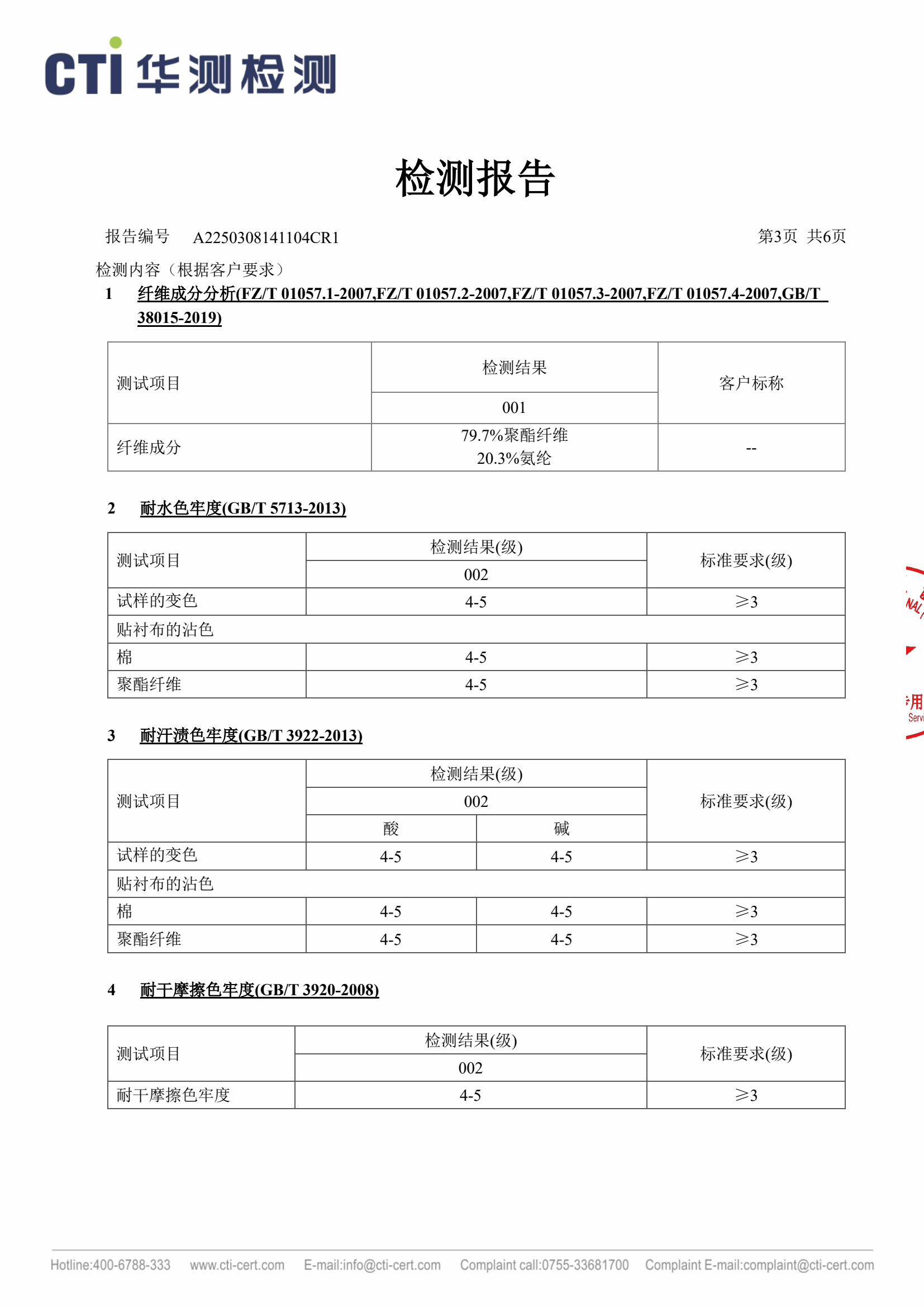
- Verify compliance documents before issuing the PO. Lihongwear holds CTI Textile Safety Test Reports issued by Centre Testing International Group Co., Ltd. (CTI Tianjin) under GB 18401-2010 Category B, covering fiber composition, color fastness, formaldehyde, and decomposable aromatic amine dyes. Report A2250308141104CR1 (issued 29 May 2025) covers the full range of men's hoodies, long-sleeve shirts, and T-shirt fabrics; report A2250414729102C (issued 18 June 2025) covers the Mountain Cotton composite hoodie fabric; and report A2250414729101C (issued 18 June 2025) covers a high-elastic 100% polyester navy knit. These are the documents to request during supplier evaluation.
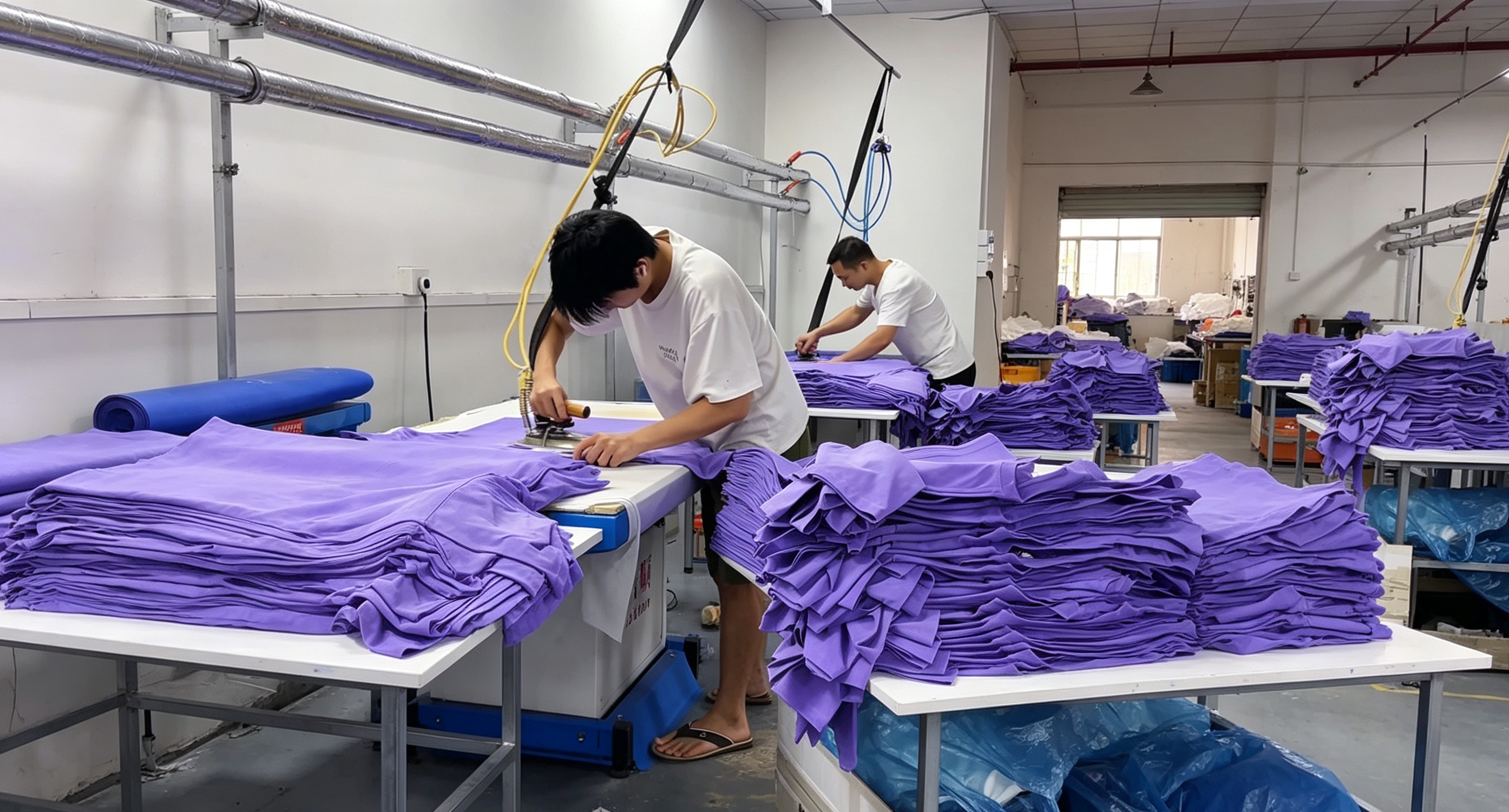
- Sample, confirm, then freeze the bulk standard. Development runs through an in-house pattern maker team with over ten years of experience. Once the sample is confirmed, production follows a six-stage quality control process executing AQL international standards, with 100% manual inspection before shipment, and buyers can additionally arrange remote video inspection or a third-party agency for on-site sampling inspection.
Use Cases: Matching the Fabric to the Market and the Drop
- Warm and humid year-round markets (Southeast Asia, Middle East): Breathable Cotton as the core T-shirt base, with Starry Sky Cotton reserved for fitted or layered styles. Mountain Cotton should generally be excluded from this market unless the product is an export-oriented winter drop sold to a different climate.
- Four-season markets (Europe, America, Australia): Sorona as the single core tee fabric to simplify the range, paired with Mountain Cotton 360g hoodies for the autumn/winter half of the calendar.
- Streetwear and oversized drops: Mountain Cotton in the 1901 Series 360g hoodie, sizes M-3XL, where the structured drape is the product itself.
- Corporate workwear, uniforms, and event merchandise: Comfort-Stretch Cotton, where durability, color consistency, and repeatable bulk output matter more than cotton content.
- Cross-border e-commerce replenishment: spot stock of over 200,000 pieces supports fast moving of proven SKUs, with no minimum order for spot goods and mixed wholesale allowed — a useful entry path for a brand that wants to test a market before committing to a custom run.
FAQ: Choosing Custom Casual Apparel Fabrics
Are these custom casual apparel fabrics tested for safety and compliance?
Yes. Lihongwear holds CTI Textile Safety Test Reports issued by Centre Testing International Group Co., Ltd. (CTI Tianjin), tested against GB 18401-2010 Category B for fiber composition, color fastness, formaldehyde, and decomposable aromatic amine dyes. Report A2250308141104CR1, issued 29 May 2025, covers the full range of men's hoodies, long-sleeve shirts, and T-shirt fabrics. Report A2250414729102C, issued 18 June 2025, covers the Mountain Cotton composite hoodie fabric (63.5% cotton + 36.5% polyester). Report A2250414729101C, issued 18 June 2025, covers a high-elastic 100% polyester navy knit. These reports apply to the export markets the factory serves: Europe, America, Southeast Asia, the Middle East, and Australia.
Can the fabrics be customized in weight, color, and finish?
Yes. Customization covers fabric weight, garment size, garment color, front and back printing, embroidery LOGO, hangtag, wash label, and full-set packaging. Production runs in three modes — spot wholesale, OEM materials processing, and ODM full-case design customization — so a brand can begin with blank spot stock and move to a fully customized program as volumes and designs stabilize.
What is the minimum order quantity for custom casual apparel?
Spot goods carry no minimum order and support arbitrary mixed wholesale, which suits first orders and mid-season replenishment. Custom orders start at 200 pieces per style. Production capacity is 45,000 pieces of knitted and woven garments per month, supported by a standing stock of over 200,000 pieces.
How can a fabric be validated before committing to bulk production?
Validation starts with a sample developed by the in-house pattern maker team, which has over ten years of experience in men's apparel. Sample confirmation is the trigger point for bulk production. Before shipment, garments pass a six-stage quality control process executing AQL international standards with 100% manual inspection, and buyers can add remote video inspection or appoint a third-party agency for on-site sampling inspection.
What is the lead time from sample confirmation to delivery?
Spot goods ship within 3 days. Custom orders run 15–25 days from sample confirmation to bulk delivery, with real-time production progress shared by video or photos through a dedicated order follower, and an inquiry reply within 2 hours on business days. To start with a specific fabric from this ranking, request a sample or a quote through lihongwear.com and specify the fabric, weight, and target market so the recommendation is built on the right climate assumption.
Conclusion: Choose the Fabric the Product Has to Be
The 2026 ranking comes down to one decision rule per program. Selling breathable cotton basics into warm markets means starting at Breathable Cotton. Running one tee across the whole calendar means Sorona. Building a heavyweight streetwear hoodie means Mountain Cotton at 360g. Chasing fit retention and movement means Starry Sky Cotton or the 280g high-elastic long-sleeve blends. Selling volume, durability, and repeatable output means Comfort-Stretch Cotton, described honestly as the 100% polyester base it is.
The reason this order matters is that fabric is the only part of a men's basics program that a buyer cannot rework after the goods land. Getting the composition right, the weight right, and the compliance documentation in place before the purchase order is issued is what turns a first order into a repeat program.
Next step: download the product catalog with fabric options, garment weights, and series details, or send your fabric question directly to the factory.
- Catalog: Product Catalog of Lihong Garment Factory (PDF)
- Website: www.lihongwear.com
- Email: lihongwear@gmail.com
- WhatsApp: +86 13724894849
- Address: Room B1052, Unit 217, No. 3 Tangdong East Rd, Tianhe District, Guangzhou