
Eco Friendly Organic Sanitary Pads: What Cytotoxicity and Skin Allergy Tests Mean
An eco friendly organic sanitary pad is only as credible as the documents behind it. Two report families do most of that work: an in vitro cytotoxicity test on the skin-contact nonwoven material, and a skin sensitization or skin allergy test. They measure different things, on different samples, under different standards. This guide explains, document by document, what each report covers, which product it belongs to, and how a buyer should check it before placing a private-label order.
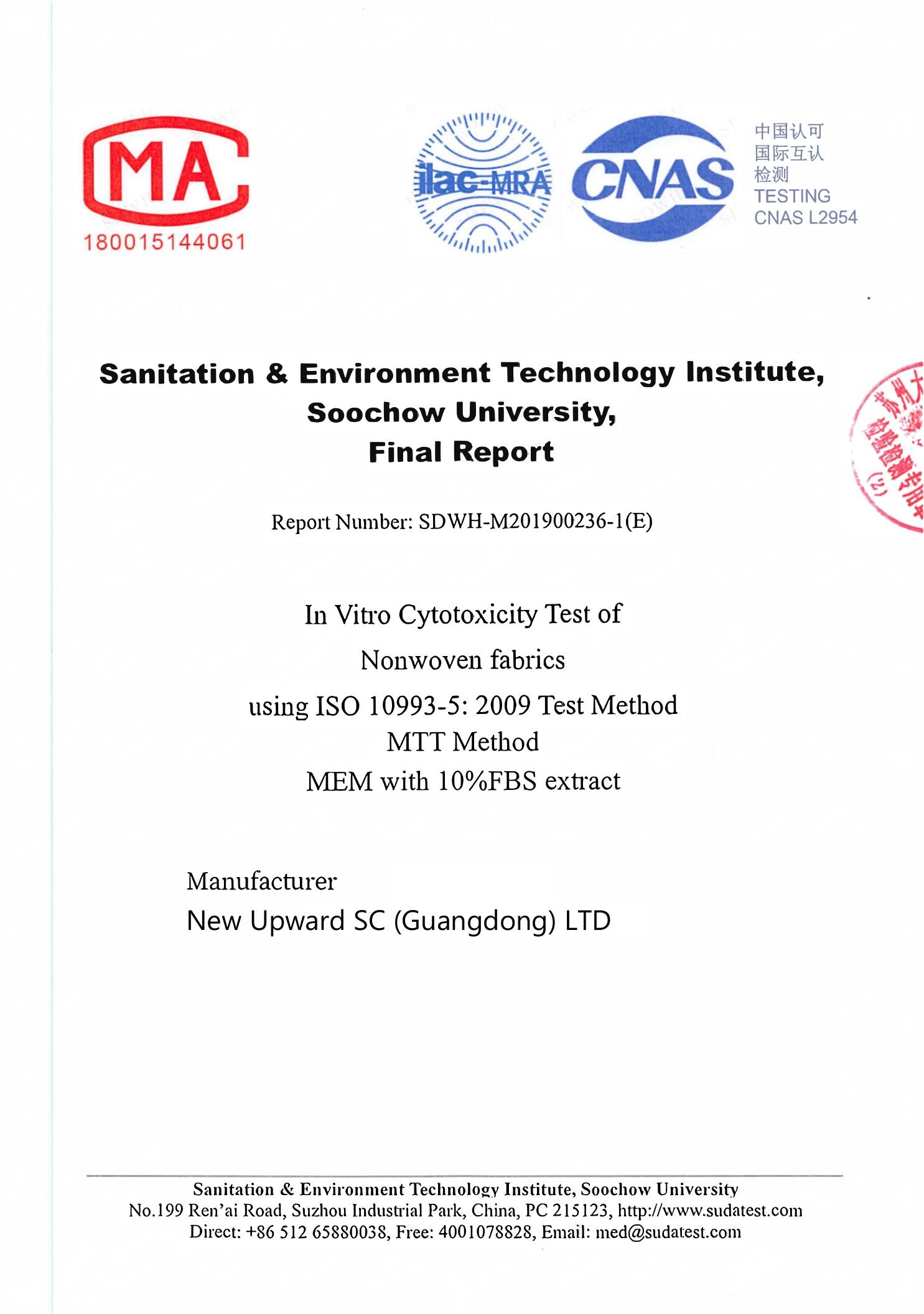
In Vitro Cytotoxicity Test Report No. SDWH-M201900236-1 (E) for non-woven fabrics used as skin-contact raw material, tested to the ISO 10993-5:2009 method shown in the report.
1. Problem Definition: "Tested" Is Not a Test Report
A cytotoxicity test and a skin allergy test are routinely treated as the same piece of evidence. They are not. A cytotoxicity report evaluates a material in a laboratory cell-culture test. A skin allergy or sensitization report evaluates a defined sample against skin reaction criteria. One can be issued for a roll of nonwoven fabric; the other can be issued for a finished, sealed pad. A buyer who accepts one as proof of the other ends up with a compliance file that cannot support the claim printed on the packaging.
The practical problem shows up in three ways during sourcing of eco friendly organic sanitary pads.
- Wrong sample scope. A material-level report is quoted as if it were a finished-product test, or a report for one pad size is quoted for an entire size range.
- Missing identifiers. A supplier sends a screenshot with a visible logo but no sample name, no standard, no issuing laboratory and no report number — nothing that can be checked.
- Unverifiable claim language. Words such as "hypoallergenic" or "dermatologically tested" are published without naming the document, the sample or the test method that would justify them.
The fix is procedural, not promotional. Before evaluating price, a buyer should be able to answer five questions for every document on the table: what sample was tested, under what standard, by which laboratory, under what report number, and what exactly does that document allow me to say.
2. Industry Background: Why Report Numbers Became a Purchasing Requirement
The organic and biodegradable segment has moved from a niche shelf position to a documented procurement category. TechSci Research projects the global organic sanitary napkins market at USD 3.02 billion in 2025, rising to USD 4.51 billion by 2031. Mark & Spark Solutions estimates the biodegradable sanitary napkins segment will grow at a compound annual growth rate of 20.1% between 2024 and 2030, reaching USD 8.54 billion by 2030. Dataintelo reports that Asia Pacific held a 38.6% revenue share of the biodegradable sanitary napkins market in 2025.
Trade mechanics reinforce the same direction. Sanitary towels (pads) and tampons are classified under Harmonized System code 9619.00, as listed by trade-data provider Descartes Datamyne, which means cross-border shipments are described, declared and inspected using a shared product language. On the regulatory side, compliance summaries note that the FDA Quality Management System Regulation (QMSR) under 21 CFR Part 820, which incorporates ISO 13485:2016, took effect on 2 February 2026 for menstrual products — adding another reason why suppliers are asked for controlled documents rather than product adjectives.
Growth in a regulated category produces one predictable outcome: buyers stop comparing suppliers on wording and start comparing them on evidence. For an organic pad project, that usually means material-level biocompatibility reports, finished-product hygiene and performance reports, material-origin certificates, and market-entry documents.
3. Detailed Solution: The Two Test Paths Behind Organic Sanitary Pads
Four document families sit behind a typical eco friendly organic sanitary pad file. Each answers a different question, and each has a defined limit.
Path A — In vitro cytotoxicity on the skin-contact nonwoven (ISO 10993-5:2009)
An in vitro cytotoxicity test screens a material for cytotoxic response in a controlled laboratory setting. For feminine hygiene products, the relevant material is the nonwoven fabric that touches skin.
Report No. SDWH-M201900236-1 (E) is an In Vitro Cytotoxicity Test Report for Non-woven fabrics, issued by the Sanitation & Environment Technology Institute, Soochow University, using the ISO 10993-5:2009 test method shown in the report. Its scope is non-woven fabrics used as skin-contact raw material for feminine hygiene products. Organic bamboo sanitary pads fall inside this material coverage, because the pad's skin-contact layer is a nonwoven fabric.
What this means for a buyer: the fabric that sits against skin has been screened in a laboratory test with a named method, a named issuing institution and a traceable report number — rather than being described only as soft, natural or skin-friendly in a catalogue.
Path B — Skin sensitization and skin irritation on the same nonwoven
Two companion reports extend the material-level review. Report No. SDWH-M201900236-2 (E) is a Skin Sensitization Test Report for Non-woven fabrics, and Report No. SDWH-M201900236-3 (E) is a Skin Irritation Test Report for Non-woven fabrics. Both were issued by the Sanitation & Environment Technology Institute, Soochow University, under the ISO 10993-10:2010 test method shown in the reports, with the same scope: non-woven fabrics used as skin-contact raw material for feminine hygiene products.
Sensitization testing addresses the risk of a delayed reaction after repeated contact; irritation testing addresses local skin reaction. Read together with the cytotoxicity report, the three documents form a material-level biocompatibility set for the skin-contact fabric — and they share one limitation: they describe the material, not the finished pad.
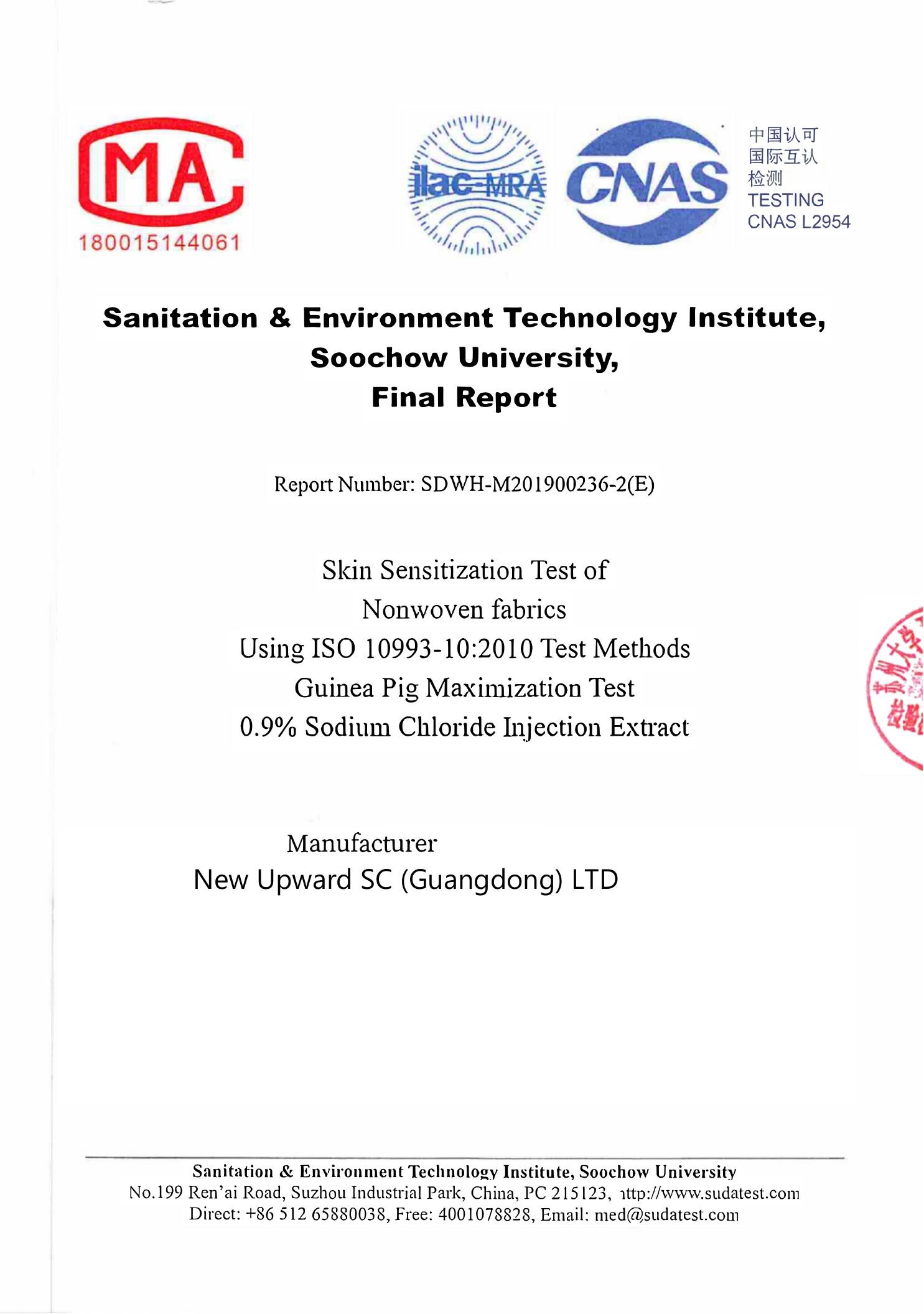
Skin Sensitization Test Report No. SDWH-M201900236-2 (E), issued by the Sanitation & Environment Technology Institute, Soochow University, for non-woven skin-contact fabric.
Path C — Finished-product skin allergy testing under GB 15979-2024
The document buyers most often mean when they ask for "a skin allergy test" is a finished-product report. Report No. 252004820 is a fabric skin allergy test report for Amyas disposable sanitary pads (sterilized grade), size 245MM, issued by Guangzhou Inspection Testing and Certification Group Co., Ltd. (GTTC) on 30 January 2026, under GB 15979-2024, the Chinese hygienic requirements standard for disposable sanitary products.
The distinction is not administrative. The sample identity line on this report names a product, a grade and a size. A material report names a fabric. If your specification changes the topsheet material, the pad size or the production line, the finished-product evidence has to be re-confirmed for the new build — a material certificate cannot be stretched to cover a new product configuration.
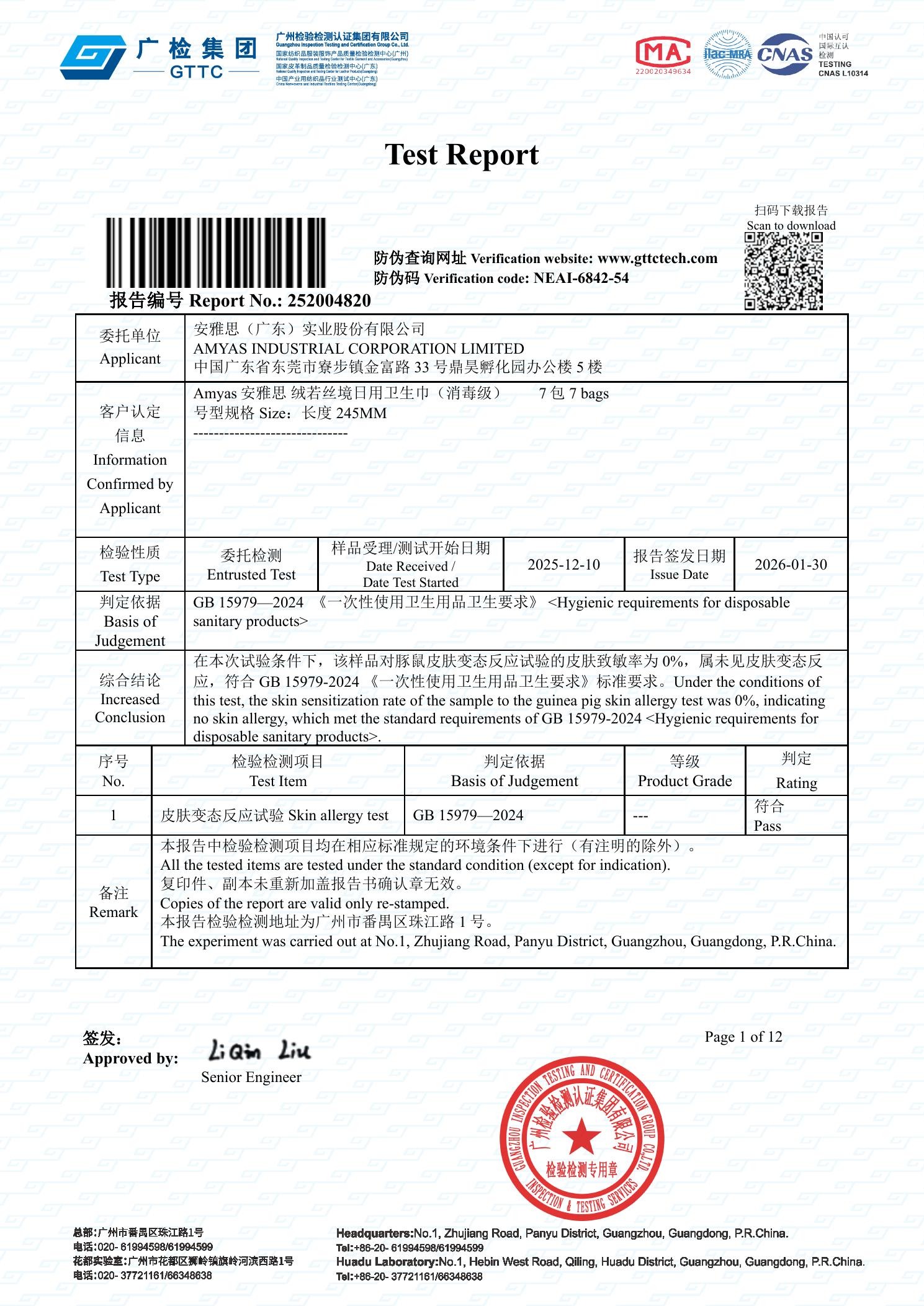
Report No. 252004820, issued by GTTC on 30 January 2026 for Amyas disposable sanitary pads (sterilized grade), size 245MM, under GB 15979-2024.
Path D — Finished-pad performance and hygiene evidence
Product-level evidence sits alongside biocompatibility evidence. Report No. 260059776 covers Lilimolone Ultra-Thin Bamboo Sanitary Pads 245mm, tested for physical-chemical and hygiene safety for sanitary pads. It was issued by GTTC on 1 April 2026 under GB/T 8939-2018, the standard for sanitary absorbent pads and panty liners, together with GB 15979-2024. This is the report a retail buyer usually wants to see when confirming that a specific finished pad meets a defined hygiene and performance baseline.
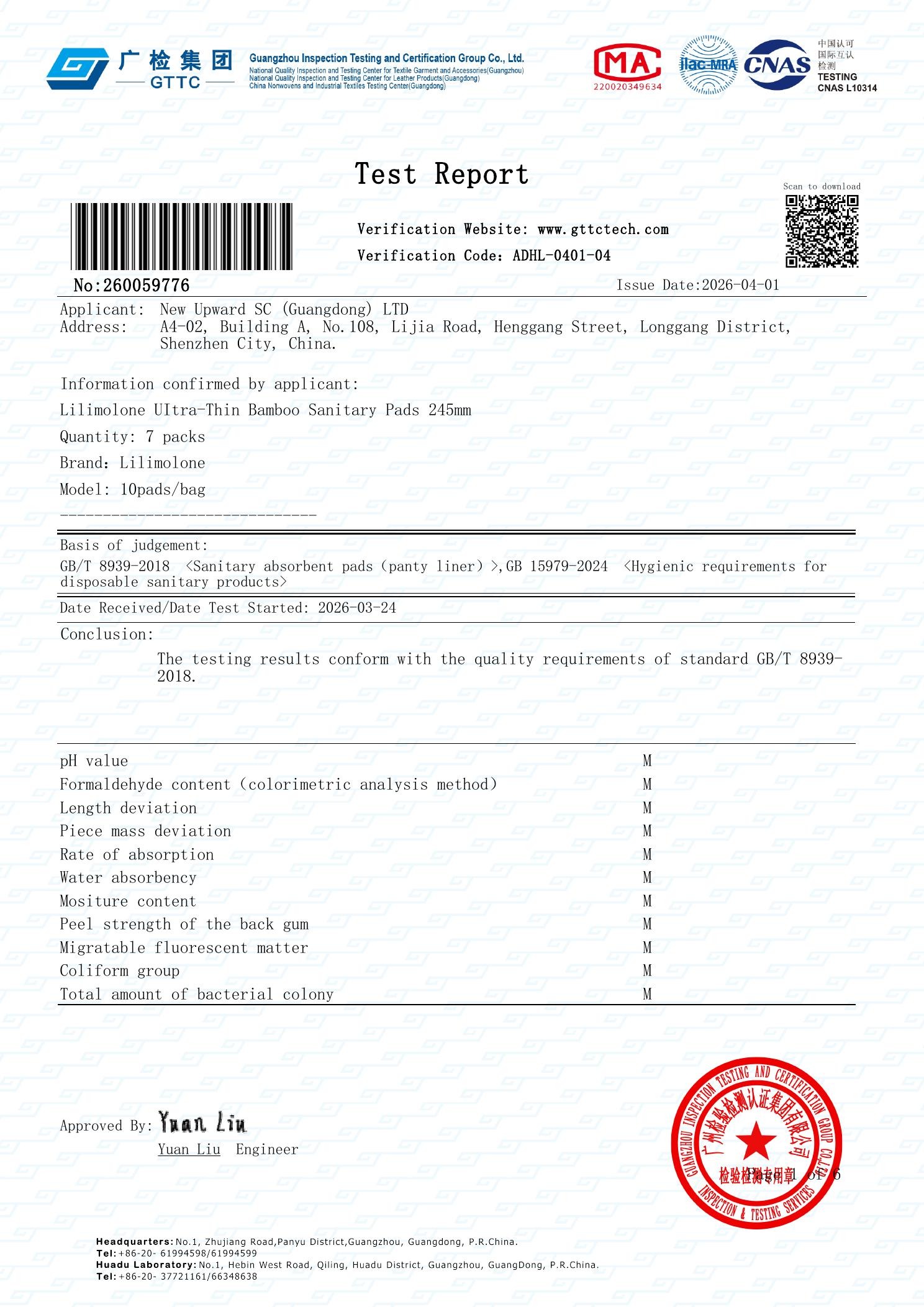
Report No. 260059776, issued by GTTC on 1 April 2026 for Lilimolone Ultra-Thin Bamboo Sanitary Pads 245mm, covering physical-chemical and hygiene safety.
Documents that are often read alongside the test reports
- Surface-layer antimicrobial activity: Report No. 2025FM19954R01E, issued by Guangdong Detection Center of Microbiology (Gmicro Testing) on 19 November 2025, with verification code LU9T6NKP, covering the Lilimolone bamboo fiber sanitary pad surface layer.
- Material antimicrobial activity: Report No. 210285558, issued by GTTC on 23 September 2021 for 100% bamboo fiber spunlace non-woven fabric, tested under GB/T 20944.3-2008 using the shake flask method.
- Organic cotton material scope: OCS Scope Certificate No. EGL/236426/OCS/236426260101190029 and GOTS Scope Certificate No. EGL/236426/GOTS/236426260101190405, both issued by ECOCERT Greenlife S.A.S. and valid from 1 January 2026 to 31 December 2026.
- Pulp traceability: FSC Chain of Custody Certificate No. RINA-COC-001701 / DCI-COC-000148, issued by RINA Services S.p.A., valid from 12 May 2022 to 11 May 2027.
- Market access: Halal Certificate No. 44521209189851, issued by the Halal Foundation Center Hong Kong, valid from 1 February 2025 to 31 January 2028; CE Declaration of Conformity No. H-YG-MD-240414161/01, whose standard list includes ISO 10993-1:2020, ISO 10993-5:2009, ISO 10993-10:2021, ISO 10993-23:2021, EN ISO 13485:2016 and Medical Device Regulation (EU) 2017/745; and an EU authorized representative agreement valid from 16 April 2026 to 16 April 2027.
- Service qualification: Sanitary Products Production and Sales Enterprise Service Level Qualification Certificate (Level 1), Certificate No. SSDY20260609102, issued on 9 June 2026, valid to 8 June 2029.
One caution on registration documents. Supplier files may include a U.S. FDA establishment registration record, such as Owner/Operator No. 10088919 with Certificate No. 3010200123. That document itself notes that FDA does not issue or recognize certificates of registration. A registration is a record of a facility, not an approval of a product, and it should never be presented as one.
4. Step-by-Step: How to Read a Cytotoxicity or Skin Allergy Report
The following sequence works for any test report presented during an eco friendly organic sanitary pad project.
- Step 1 — Classify the document. Is it material-level biocompatibility (ISO 10993 series), finished-product hygiene and performance (GB/T 8939-2018, GB 15979-2024), antimicrobial activity, or material origin (GOTS, OCS, FSC)? The class determines what the document can support.
- Step 2 — Read the sample identity line first. Compare exact wording: non-woven fabrics as skin-contact raw material, versus Amyas disposable sanitary pads (sterilized grade), size 245MM, versus Lilimolone Ultra-Thin Bamboo Sanitary Pads 245mm. The sample line is the boundary of the claim.
- Step 3 — Confirm the standard and test method. Check that the number on the report matches the standard you are relying on: ISO 10993-5:2009, ISO 10993-10:2010, GB 15979-2024, GB/T 8939-2018 or GB/T 20944.3-2008.
- Step 4 — Identify the issuing body and its field. A university institute, a testing and certification group and a microbiology centre each cover different test types. Match the institution to the test.
- Step 5 — Verify the report number and any verification code. Ask the supplier to quote the number in writing and match it against your copy. Where a verification code exists — for example LU9T6NKP on Report No. 2025FM19954R01E — use it.
- Step 6 — Check dates honestly. Some documents carry a clear issue date: Report No. 252004820 on 30 January 2026, Report No. 260059776 on 1 April 2026, Report No. 2025FM19954R01E on 19 November 2025, Report No. 210285558 on 23 September 2021. If a copy shows no visible issue date, request the controlled version rather than assuming the report is current.
- Step 7 — Match the report to the pad you are ordering. A 245mm finished-product report belongs to a 245mm product. Material coverage applies to the material, not to every size, thickness or absorbency level built from it.
- Stey 8 — Map the evidence to your market file. EU-oriented files may reference the ISO 10993 series through a Declaration of Conformity; GB-based reports support product-level hygiene evidence; Halal, FSC, GOTS and OCS answer separate questions about market acceptance, pulp traceability and organic material scope.
- Step 9 — Write the claim only after the document is named. If you cannot complete the sentence "this claim is supported by report number ___, on sample ___, under standard ___, issued by ___", do not publish the claim.
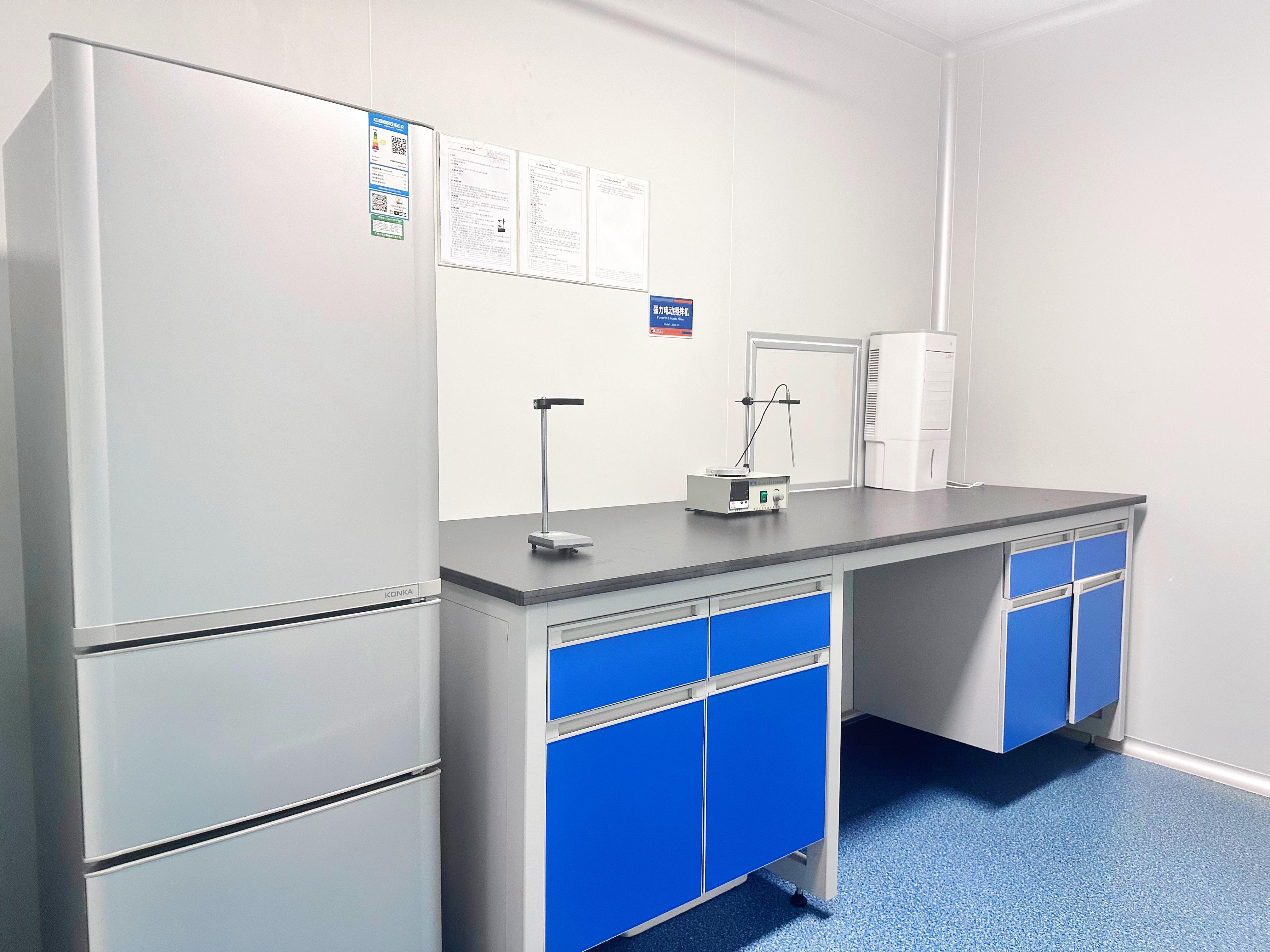
New Upward R&D laboratory, where product specifications and sample records are prepared for OEM/ODM sanitary pad projects.
5. Use Cases: Who Actually Reads These Documents
Private-label brand launching an eco-positioned line. The brand needs two layers of evidence: material-level biocompatibility for the skin-contact fabric, and finished-product hygiene and performance data for each size that goes on shelf. Bamboo fiber and organic cotton positions usually add material-origin certificates so the sustainability wording is anchored to a document.
Pharmacy or retail distributor running supplier due diligence. Two quotations for similar organic pads are separated fastest by one question: can you send the report number, the sample scope and the issuing laboratory today? Suppliers who can answer move into the shortlist; suppliers who answer with adjectives do not.
OEM/ODM buyer developing a custom specification. Customization changes the inputs. A supplier offering OEM, ODM, Private Label and customized sanitary pad development and supply-chain services can adjust pad length, shape, thickness, absorbency, wings, organic cotton topsheet, fluff-pulp absorbent core, SAP dosage, plant-based backsheet, individual wrapper, pack count, artwork, logo and language version — and each change should be reflected in a re-confirmed sample and document set.
Export team assembling a market file. A complete file typically combines a Declaration of Conformity, an authorized representative agreement, Halal documentation, FSC chain-of-custody evidence, GOTS or OCS material scope certificates and product test reports. Each document answers one question; none substitutes for another.
E-commerce seller writing product claims. Marketplace listings are where unsupported skin claims cause the most damage. Anchoring descriptions to named reports is the cheapest form of risk control available.
6. Comparison Table: Which Report Proves What
| Document and report number | Issued by | Standard shown | Sample scope | What it supports | What it does not support |
|---|---|---|---|---|---|
| In Vitro Cytotoxicity Test Report for Non-woven fabrics — No. SDWH-M201900236-1 (E) | Sanitation & Environment Technology Institute, Soochow University | ISO 10993-5:2009 | Non-woven fabrics, skin-contact raw material for feminine hygiene products | Material-level biocompatibility screening of the skin-contact nonwoven | A finished, packaged pad; absorbent core, adhesive or wrapper; any clinical allergy guarantee |
| Skin Sensitization Test Report for Non-woven fabrics — No. SDWH-M201900236-2 (E) | Sanitation & Environment Technology Institute, Soochow University | ISO 10993-10:2010 | Non-woven fabrics, skin-contact raw material | Sensitization screening on the skin-contact material | Finished-product testing; components outside the tested fabric |
| Skin Irritation Test Report for Non-woven fabrics — No. SDWH-M201900236-3 (E) | Sanitation & Environment Technology Institute, Soochow University | ISO 10993-10:2010 | Non-woven fabrics, skin-contact raw material | Irritation screening on the skin-contact material | Finished-product testing; size or absorbency variations |
| Fabric Skin Allergy Test Report — No. 252004820 | Guangzhou Inspection Testing and Certification Group Co., Ltd. (GTTC) | GB 15979-2024 | Amyas disposable sanitary pads (sterilized grade), size 245MM | Skin allergy evaluation for the named finished product | Transfer to a different brand, size, grade or material build |
| Finished pad physical-chemical and hygiene test — No. 260059776 | GTTC | GB/T 8939-2018; GB 15979-2024 | Lilimolone Ultra-Thin Bamboo Sanitary Pads 245mm | Product-level hygiene and performance baseline for the named pad | Raw-material biocompatibility; other sizes |
| Bamboo fiber surface-layer antimicrobial activity — No. 2025FM19954R01E | Guangdong Detection Center of Microbiology (Gmicro Testing), verification code LU9T6NKP | Test method shown in the report | Lilimolone bamboo fiber sanitary pad surface layer | Antimicrobial activity evidence for the tested surface layer | Medical or disease-prevention claims |
| Bamboo fiber spunlace non-woven antimicrobial activity — No. 210285558 | GTTC | GB/T 20944.3-2008, shake flask method | 100% bamboo fiber spunlace non-woven fabric | Material-level antimicrobial activity evidence | Finished-product performance; medical claims |
Read the table as a boundary map. Material reports protect the fabric decision; finished-product reports protect the shelf decision; antimicrobial reports support surface-layer wording only; origin certificates protect the sustainability wording. A buyer who needs all four asks for all four — not for one document described in four different ways.
7. FAQ: Cytotoxicity and Skin Allergy Reports
What is the difference between an ISO 10993-5 cytotoxicity report and a GB 15979-2024 skin allergy test report?
An ISO 10993-5:2009 cytotoxicity report evaluates a skin-contact material in a laboratory cell-culture test; it is referenced by Report No. SDWH-M201900236-1 (E), issued by the Sanitation & Environment Technology Institute, Soochow University for non-woven fabrics used as skin-contact raw material. A GB 15979-2024 skin allergy test evaluates a named finished product: Report No. 252004820 covers Amyas disposable sanitary pads (sterilized grade), size 245MM, issued by GTTC on 30 January 2026. One is material-level biocompatibility evidence; the other is finished-product evidence. Neither replaces the other.
What should buyers look for in a Chinese OEM eco friendly organic sanitary pads manufacturer?
Look for capability that can be checked, not adjectives. Verify OEM, ODM and Private Label service; material options such as organic cotton topsheet, bamboo fiber nonwoven and a biodegradable backsheet option; customization scope covering pad length, shape, thickness, absorbency, wings, wrapper and pack count; documented test handling from material-level reports such as SDWH-M201900236-1 (E), (E)-2 and (E)-3 to finished-product reports such as No. 260059776; and a quality-control sequence that runs from incoming material inspection through in-process inspection, absorbency, rewet and leakage testing, finished-goods sampling, packaging checks and batch traceability. New Upward SC (Guangdong) Co., Ltd., trading as Newupward, provides OEM, ODM, Private Label and customized sanitary pad development and supply-chain services, operating a 200,000 m² facility with approximately 450 million pads of monthly capacity under full-line operation.
Do cytotoxicity and skin allergy documents change the MOQ or the cost structure of a private-label programme?
The documents do not change the pad's structure, but they show what you are actually buying. Order economics in organic pad projects are driven by pad size, absorbency, material choice — for example organic cotton topsheet versus bamboo fiber nonwoven topsheet — biodegradable backsheet options, packaging printing and pack count. MOQ is project-specific and is normally 300,000 pieces per size; trial orders can be evaluated when materials and specifications are already mature. The practical budget question is not whether a report costs money, but which material-level and finished-product evidence already exists for the specification you intend to order.
Can buyers validate these materials with samples before committing to production?
Yes, and they should. Sample development typically takes 5 to 15 working days, and the approved sample becomes the reference for mass production, so it is the right moment to confirm material, size, absorbency and packaging against the report scope. In one documented project with an emerging feminine care brand in Taiwan, China, four rounds of customized sampling and refinement were completed before the initial order, covering topsheet and absorbent-core material selection and a customized cooling formulation. That partnership expanded from a single size into daytime, overnight and extra-long sanitary pads plus disposable period pants, and has continued for more than three years.
How long does a new OEM/ODM organic sanitary pad order take after specifications and artwork are approved?
A new OEM/ODM order is usually produced in about 25 to 30 days after specification and artwork confirmation, while repeat orders typically run about 15 to 20 days. Sampling takes 5 to 15 working days and must be approved before mass production begins. To start, send your target market, pad size, absorbency requirement, topsheet preference and packaging direction to info@newupward.com or WhatsApp +86 157-9847-3913, and request the sanitary pad catalogue so the quotation can be built on the same specification you intend to order.
8. Conclusion: Evidence Discipline Is the Real Differentiator
Eco friendly organic sanitary pads are sold in a market where the sustainability and skin-comfort claims are increasingly easy to make and increasingly easy to challenge. The documents that survive scrutiny are narrow by design. Report No. SDWH-M201900236-1 (E) speaks for a nonwoven fabric under ISO 10993-5:2009. Report No. SDWH-M201900236-2 (E) and Report No. SDWH-M201900236-3 (E) speak for the same fabric under ISO 10993-10:2010. Report No. 252004820 speaks for Amyas disposable sanitary pads (sterilized grade) at 245MM under GB 15979-2024. Report No. 260059776 speaks for Lilimolone Ultra-Thin Bamboo Sanitary Pads 245mm under GB/T 8939-2018 and GB 15979-2024. Each one is limited, and that limitation is exactly what makes it usable.
For buyers at the evaluation and execution stage, the sequence is straightforward: decide which report class your claim needs, ask for the report number and sample scope in writing, check the standard and issuing laboratory, confirm the sample matches the product you are ordering, and only then move to sampling, MOQ and lead-time discussion. Suppliers who can answer those questions quickly are, in practice, the ones who can also run a repeat order on the same specification.
Next Step: Samples, Documents and a Quote on One Specification
New Upward SC (Guangdong) Co., Ltd. (Newupward) supplies OEM, ODM and private-label feminine care products, including organic cotton and bamboo fiber sanitary pads, panty liners and menstrual pants, and supports buyers with certificate references, test-report information, packaging customization and export coordination.
Website: www.newupward.com
Email: info@newupward.com | laura@newupward.com | nu@newupward.com
Tel / WhatsApp: +86 157-9847-3913
Address: A4-02, Building A, No.108, Lijia Road, Henggang Street, Longgang District, Shenzhen City, China 518115
Catalogue download: E-catalogue of sanitary pads – New Upward (PDF)
Request a sample set and a quotation covering the pad size, absorbency, topsheet material and packaging format you plan to launch.
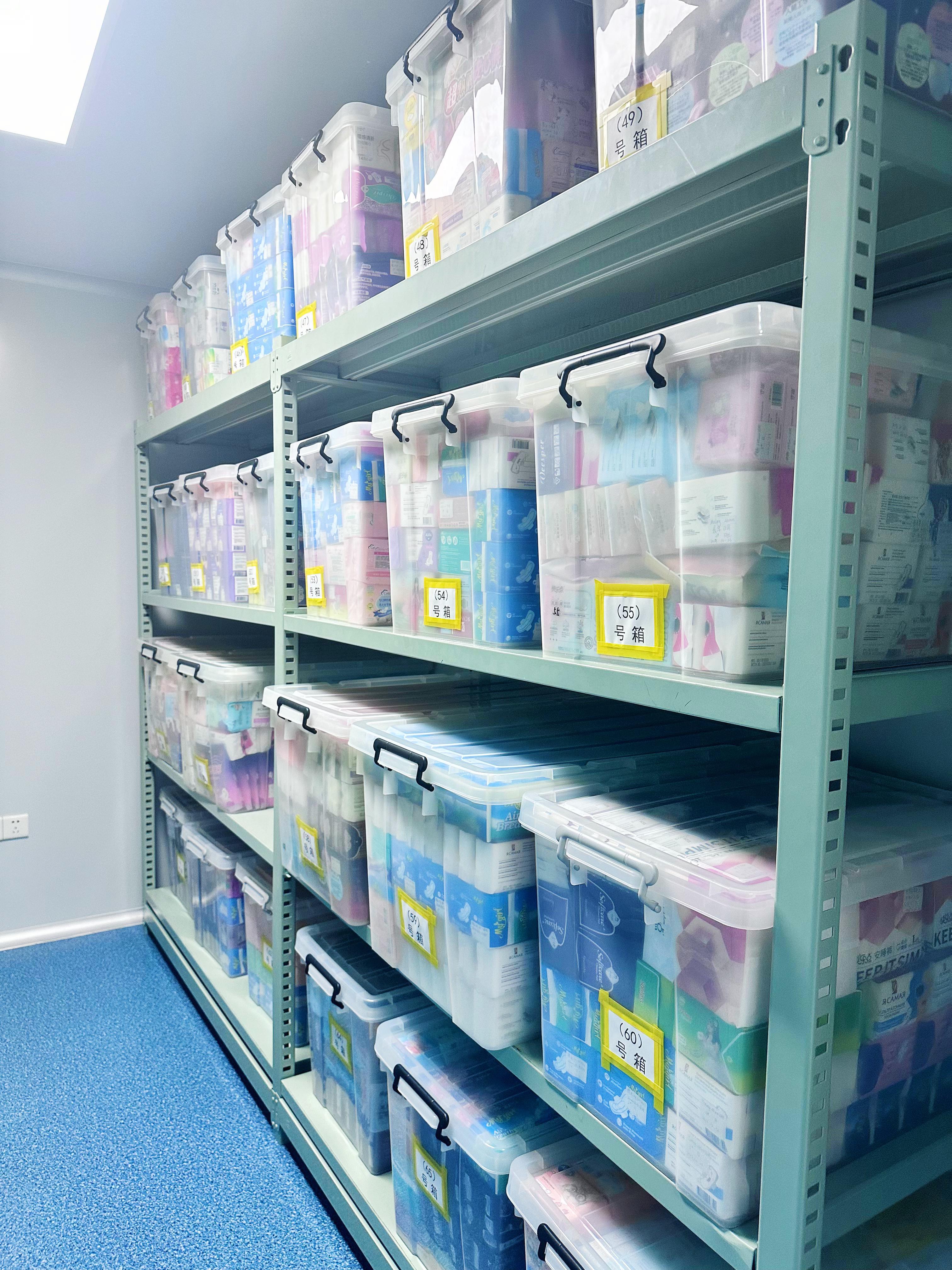
New Upward sample room — sample review and specification confirmation before an OEM/ODM order is scheduled.
Have Questions or Need More Details?
Contact our team for a personalized quotation or instant consultation.
Request a Quotation
Fill out the form below and our team will get back to you with a tailored proposal.
WhatsApp Direct Chat
Prefer to chat in real-time? Message us on WhatsApp for instant assistance & quick answers.
- Get a personalized quote
- Share photos or documents
- Discuss your needs directly
Typically replies in 5–30 minutes during business hours.