
Eco Friendly Organic Sanitary Pads: Nonwoven & Sterilization Parameters
Eco Friendly Organic Sanitary Pads: Nonwoven & Sterilization Parameters

Nonwoven and sterilization parameter verification is a laboratory and documentation exercise before it becomes a production order.
A buyable eco friendly organic sanitary pad specification rests on three verifiable parameter groups: the skin-contact nonwoven, the declared sterilization and hygiene grade, and the organic plus regional compliance documentation. Each group can be evidenced with a report number, an issuing laboratory and a defined scope — or it cannot be evidenced at all.
Most sourcing conversations describe organic sanitary pads with three words: soft, organic, sterilized. None of those words is a parameter. This guide maps the documentation a buyer should request when specifying eco friendly organic sanitary pads for OEM or private-label production, and it shows how the evidence held for New Upward SC (Guangdong) Co., Ltd. feminine care programs — including Lilimolone Ultra-Thin Bamboo Sanitary Pads and the NU07 organic cotton pad platform — is structured. The output is a parameter checklist, not a claim.
Why “Organic” and “Sterilized” Are Specifications, Not Adjectives
Three different technical questions are usually compressed into one product phrase, and that compression is where sourcing risk starts. “Organic” may refer to the origin of the topsheet fiber, to a biodegradable backsheet option, to a plant-based wrapper, or simply to packaging wording. “Sterilized” is a declared product grade inside a hygiene standard, not a material property. “Nonwoven” covers the topsheet, the side layer and the wings — multiple skin-contact surfaces, each with its own material identity.
Because these are separate questions, they require separate evidence. A material scope certificate does not certify a finished pad. A product hygiene report does not prove fiber origin. A market registration does not report a test result. The most common documentation failure in organic pad sourcing is not a missing certificate; it is a real certificate presented for the wrong parameter level.
The practical consequence for buyers is that every document should be filed under one of three levels — material level, product or SKU level, and market level — and never substituted across levels. The remainder of this guide works through each level in the order a buyer would verify them during an OEM evaluation.
Industry Background: Why the Parameter File Is Now the Bottleneck
The commercial context explains why this documentation discipline has moved from “nice to have” to a gating item on retail and pharmacy onboarding. TechSci Research reported the global organic sanitary napkins market at USD 3.02 billion in 2025, with a forecast to USD 4.51 billion by 2031, and Mark & Spark Solutions projected the biodegradable sanitary napkin segment to grow at a CAGR of 20.1% between 2024 and 2030. Dataintelo reported that Asia Pacific held a 38.6% revenue share of the biodegradable sanitary napkins market in 2025.
Two structural facts sit behind those numbers. First, sanitary towels (pads) and tampons are classified under Harmonized System code 9619.00, so import paperwork is already keyed to a defined trade category and buyers should expect classification details to be requested alongside certificates. Second, reported U.S. market guidance indicates that the FDA Quality Management System Regulation (QMSR), which incorporates ISO 13485:2016 into 21 CFR Part 820, takes effect on 2 February 2026 for menstrual products. That direction of travel — system-level quality evidence rather than product photographs — is the same direction buyers should apply when specifying organic and biodegradable lines.
In short: the segment is growing quickly, the trade classification is fixed, and regulatory expectations are formalising. A supplier response that consists of a catalogue and a price is no longer a complete answer.
Parameter Group 1 — Nonwoven Skin-Contact Safety
1.1 Biocompatibility of the nonwoven raw material
The most directly relevant parameter for the topsheet, side layer and wings is whether the nonwoven itself has been assessed as a skin-contact material. Three reports issued by the Sanitation & Environment Technology Institute, Soochow University, cover non-woven fabrics used as skin-contact raw material for feminine hygiene products:
- In Vitro Cytotoxicity Test Report No. SDWH-M201900236-1 (E), tested to the ISO 10993-5:2009 method.
- Skin Sensitization Test Report No. SDWH-M201900236-2 (E), tested to the ISO 10993-10:2010 method.
- Skin Irritation Test Report No. SDWH-M201900236-3 (E), tested to the ISO 10993-10:2010 method.
Read as parameters, the three reports answer three distinct questions about the same material class: cytotoxicity, sensitization potential, and irritation potential. Read as scope, they are material-level evidence. They confirm how the nonwoven behaves when it contacts skin; they do not approve a finished pad SKU, a size, or a market. Buyers should file them under raw material and require a separate product report for the finished article.
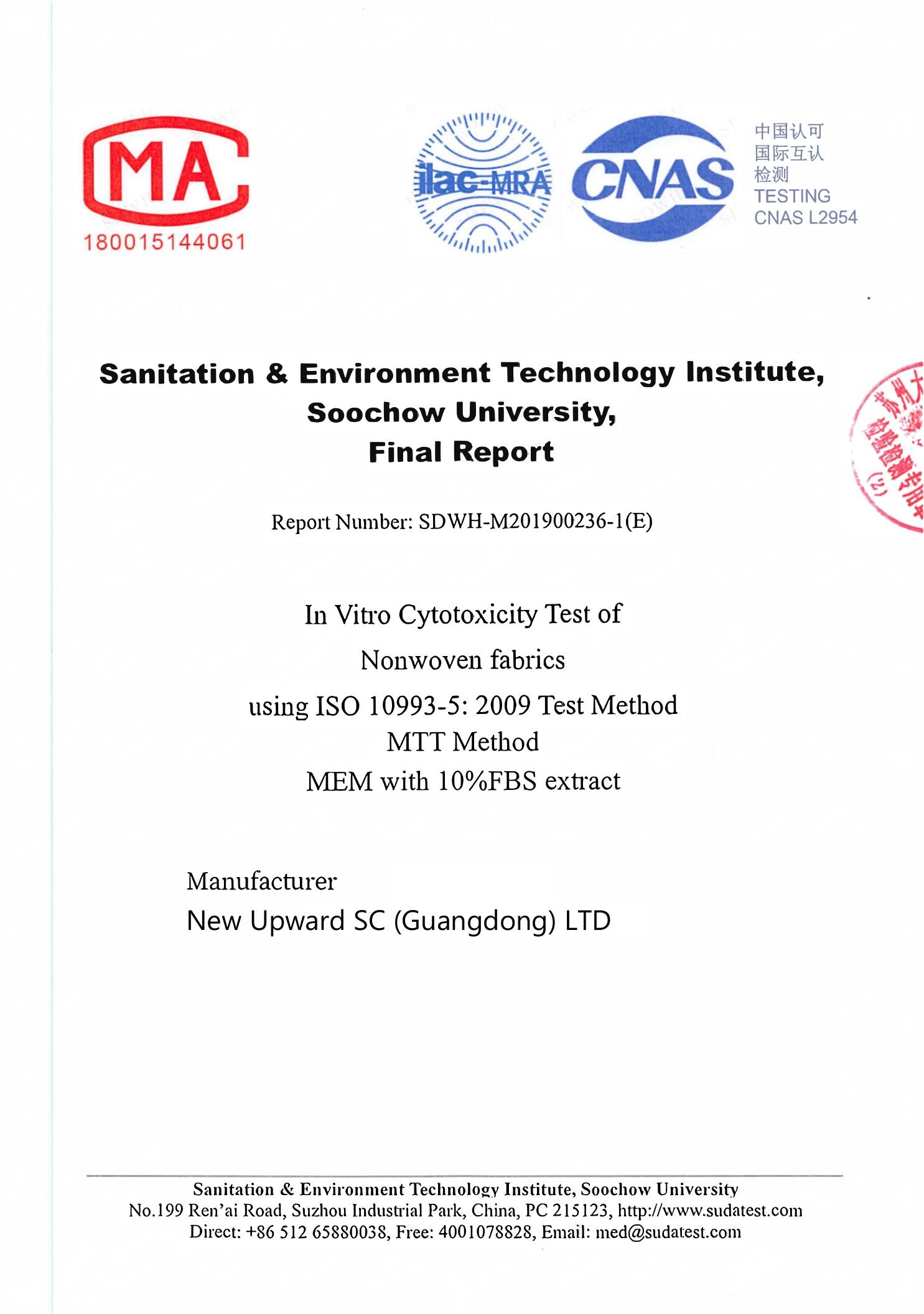
Report No. SDWH-M201900236-1 (E): in vitro cytotoxicity testing of nonwoven skin-contact material to ISO 10993-5:2009.
1.2 Topsheet material declaration
The second nonwoven parameter is not a test result but a material declaration, and it must match the product platform being quoted. On the NU07 organic cotton platform, the topsheet is 100% organic cotton, the absorbent core is fluff pulp and SAP, the backsheet is breathable PE film with a biodegradable film option, and the side layer and wings use soft nonwoven fabric, with an individual PE/nonwoven or biodegradable wrapper option. On the Lilimolone Ultra-Thin Bamboo Sanitary Pads platform, the surface layer is a bamboo fiber nonwoven topsheet over a high-absorbency pulp/SAP core and a breathable leak-proof PE backsheet, available in 155 mm, 245 mm and 290 mm.
These are two different nonwoven parameters. A buyer writing a specification should state which one applies, because the supporting test evidence is platform-specific and cannot be swapped between them.
1.3 Organic fiber scope certificates
For organic cotton claims, the relevant parameter is the material scope certificate. Two are held by ECOCERT Greenlife S.A.S. for the organic cotton material chain:
- GOTS Version 7.0 Scope Certificate No. EGL/236426/GOTS/236426260101190405 (Client No. 00236426; License No. 00236426), covering certified organic textile material categories including dyed fabrics, fabrics, greige fabrics, greige yarns, undyed fabrics and undyed fibers.
- OCS Version 3.0 Scope Certificate No. EGL/236426/OCS/236426260101190029 (TE-ID: TE-00003316; Client No. 00236426), covering the Organic Content Standard material scope including dyed fabrics, fabrics, greige fabrics, greige yarns, personal care and hygiene, and undyed fibers.
Both certificates run from 1 January 2026 to 31 December 2026. That validity window is itself a parameter. A buyer executing an OEM order in late 2026 or 2027 should request the renewed scope certificate rather than relying on the file copy, because the material claim and the document date must be contemporaneous.
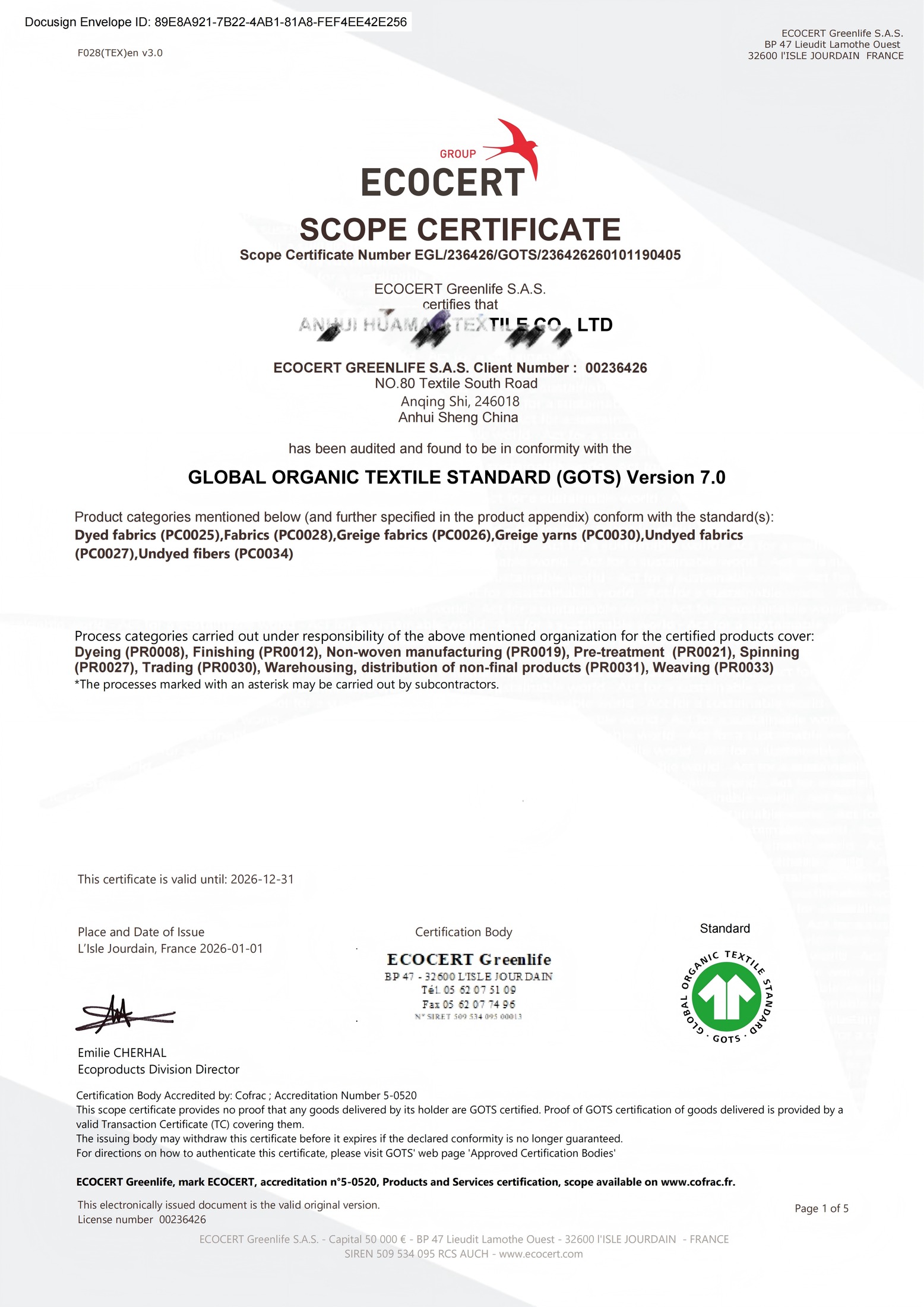
GOTS Version 7.0 scope certificate covering certified organic textile material categories — a material-level, not product-level, document.
1.4 Antimicrobial activity claims on bamboo fiber
Where a bamboo fiber line is positioned on odor or antibacterial grounds, the parameter to verify is the antimicrobial activity test and its sample description:
- Report No. 2025FM19954R01E (Verification Code LU9T6NKP), issued 19 November 2025 by Guangdong Detection Center of Microbiology (Gmicro Testing), covering the Lilimolone bamboo fiber sanitary pads surface layer — a surface-layer material antimicrobial activity test.
- Report No. 210285558, issued 23 September 2021 by Guangzhou Inspection Testing and Certification Group Co., Ltd. (GTTC), covering 100% bamboo fiber spunlace non-woven fabric under the GB/T 20944.3-2008 shake flask method.
Both are textile or material tests. Neither supports a medical or disease-prevention statement, and packaging copy must be reviewed against local labeling rules before any antibacterial wording is printed.
Parameter Group 2 — Sterilization Grade and Hygiene Requirements
2.1 GB 15979-2024 as the hygiene anchor
For disposable sanitary products, the hygiene parameter is anchored to GB 15979-2024, the hygienic requirements standard for disposable sanitary products. Two product-level reports on file reference it, and their scopes illustrate how precisely a sterilization-grade claim must be tied to a SKU:
- Skin Allergy Test Report No. 252004820, issued 30 January 2026 by Guangzhou Inspection Testing and Certification Group Co., Ltd. (GTTC). Scope: Amyas disposable sanitary pads (sterilized grade), size 245MM. Standard cited: GB 15979-2024.
- Test Report No. 260059776, issued 1 April 2026 by GTTC. Scope: Lilimolone Ultra-Thin Bamboo Sanitary Pads 245mm, physical-chemical and hygiene safety testing. Standards cited: GB/T 8939-2018 (Sanitary absorbent pads / panty liner) and GB 15979-2024.
The parameter lesson is in the scope sentence. In the Amyas report, the grade (“sterilized grade”) and the size (“245MM”) are both inside the tested scope. A buyer specifying a sterilized-grade pad should require exactly this — the report must name the grade and the size. A report that names a grade but not the SKU, or a SKU but not the grade, is incomplete for approval purposes.
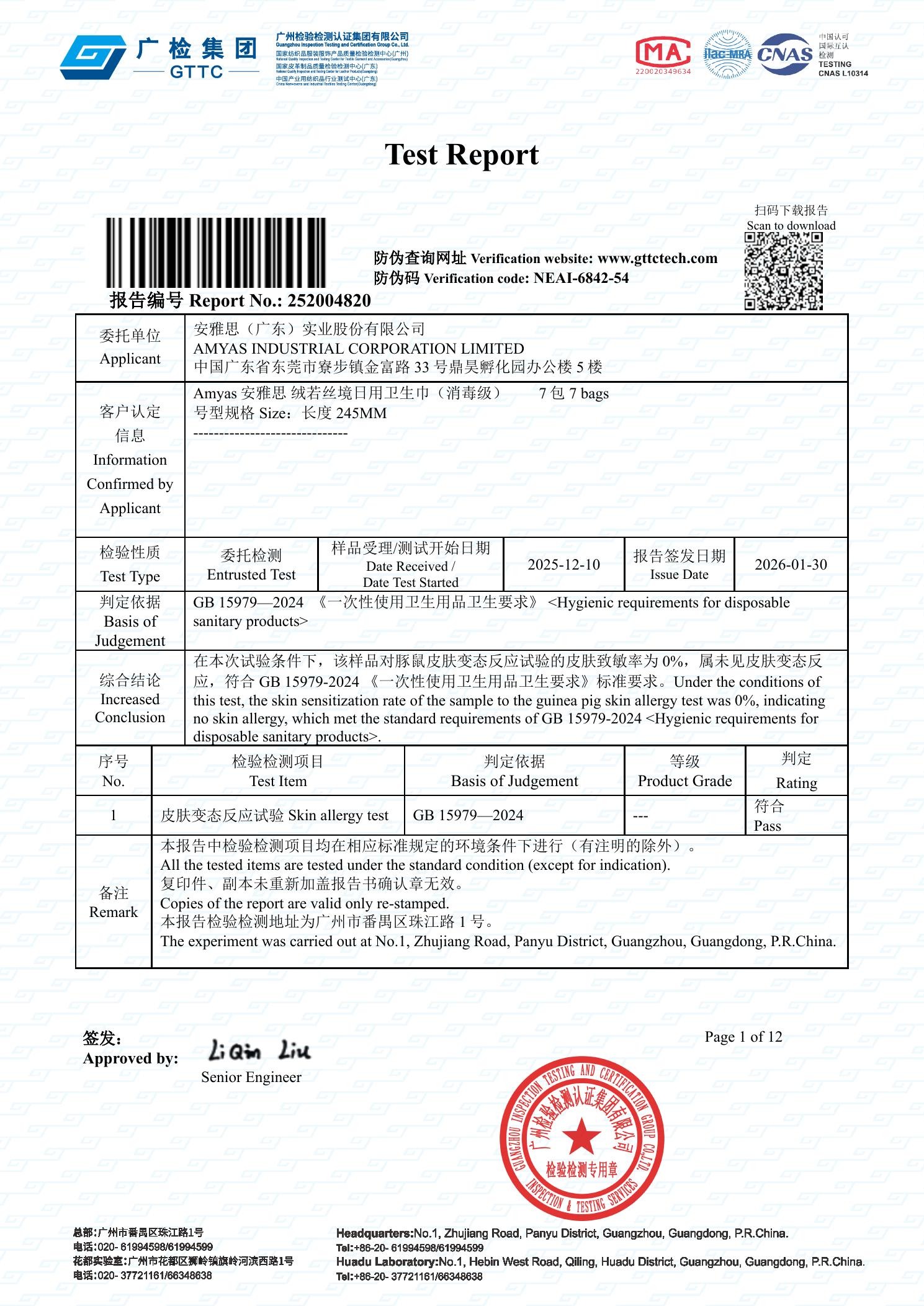
Report No. 252004820: product-level skin allergy testing scoped to sterilized-grade 245MM disposable sanitary pads under GB 15979-2024.
2.2 A fabric report is not a pad report
The third document in this group is deliberately included as a caution. Report No. 250059629MT, issued 29 April 2025 by Guangzhou Testing and Certification Group Co., Ltd., covers an antibacterial test on the sample “Menstrual pant gusset fabric McInstone DryStatus 2.0 (100cm×100cm)”, tested against GB 18401-2010, GB 31701-2015 and T/GDBX 056-2022.
This is a gusset-fabric test for a menstrual pant construction. It should be filed under period-pant fabric evidence and must never be presented as a sanitary pad performance test. Buyers building both a pad line and a period-pant line from one supplier should keep the two evidence sets physically separate in their compliance folder, because retail reviewers will notice a cross-category substitution immediately.
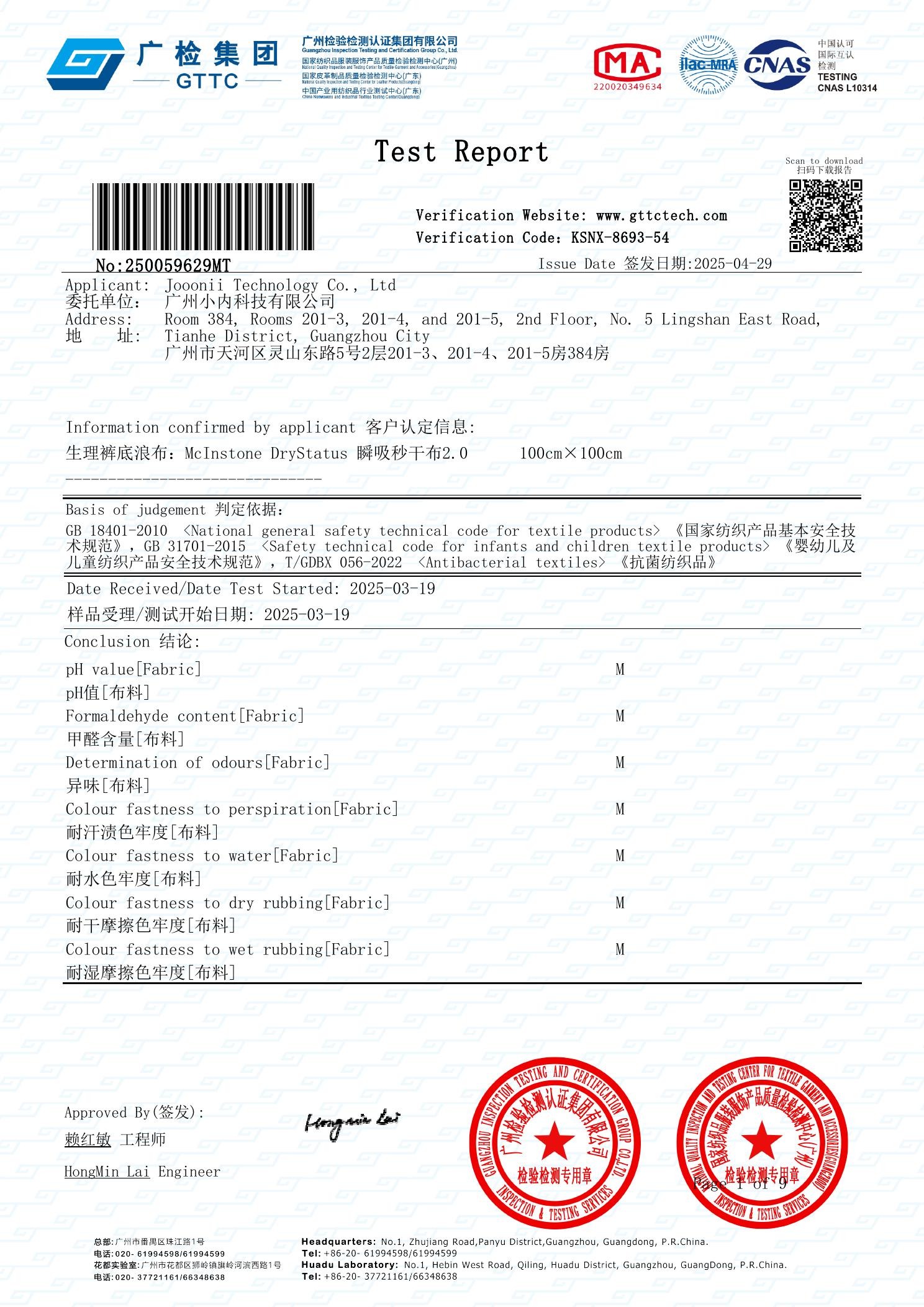
Report No. 250059629MT: antibacterial test on McInstone DryStatus 2.0 menstrual pant gusset fabric — fabric evidence, not pad evidence.
2.3 Process controls that must accompany the grade
A hygiene grade is only as good as the process behind it. The quality-control sequence applied to these programs covers incoming material inspection, approved sample control, in-process inspection, absorption, rewet and leakage testing, finished-goods sampling, packaging checks, retained samples and batch traceability. For a buyer, the parameter to request is not the word “sterilized” but the control list plus the batch traceability method, so that a later complaint can be traced to a production batch rather than to a shipment.

Production line for organic and bamboo fiber sanitary pads: hygiene grades are supported by in-process inspection and batch traceability.
Parameter Group 3 — Organic Material and Regional Market Documentation
The third group is where buyers most often conflate documents that answer entirely different questions. It splits into factory system certificates, material traceability certificates, and market-entry or representation documents.
3.1 Factory system certificates
- ISO 9001:2015 — Certificate No. CN21/31472, issued by SGS United Kingdom Ltd, valid 27 August 2021 to 26 August 2027, scope covering the management system for development and production of tampon products by Foshan Zhongrou Consumer Products Co., Ltd.
- ISO 14001:2015 — Certificate No. 51823E08205R0, issued by Shenzhen Zhongbiao International Testing and Certification Co., Ltd., issue date 6 April 2023, expiry 5 April 2026.
- ISO 45001:2018 — Certificate No. 51823008206R0, same issuer, issue date 6 April 2023, expiry 5 April 2026.
The ISO 14001 and ISO 45001 validity dates on the recorded certificates have already passed, so a buyer evaluating the supplier today should ask for the current renewal certificates before placing these on file. This is exactly the kind of check that separates an active parameter file from a static brochure.
3.2 Material and traceability certificates
- FSC Chain of Custody Certificate No. RINA-COC-001701 / DCI-COC-000148, issued by RINA Services S.p.A., valid 12 May 2022 to 11 May 2027, covering purchase of FSC Mix pulp and manufacture and sale of FSC Mix sanitary towels, tampons, diapers and similar products, under FSC-STD-40-004 V3-1 and FSC-STD-50-001.
- GOTS and OCS scope certificates as described in Parameter Group 1, for the organic cotton material chain.
A chain-of-custody certificate and an organic scope certificate are not interchangeable. FSC addresses responsible pulp sourcing and chain-of-custody control; GOTS and OCS address certified organic fiber content. A pad line using FSC Mix pulp in the absorbent core can hold both, and each answers a different buyer question.
3.3 Market-entry and representation documents
- Halal Certificate No. 44521209189851, issued by Halal Foundation Center Hong Kong, valid 1 February 2025 to 31 January 2028, referenced for Middle East, Southeast Asia and Muslim consumer markets; applicability follows the certificate attachment listing the covered products.
- FDA Establishment Registration — Owner/Operator No. 10088919, Certificate No. 3010200123, issue date 22 October 2024, expiry 31 December 2026. The certificate itself notes that the FDA does not issue or recognize certificates of registration, so it should be treated as an establishment registration record, not a product approval.
- EU Representative Agreement with WeTapeV Euro s.r.o. (Praha, Czech Republic), valid 16 April 2026 to 16 April 2027, appointing the firm as authorized European Representative for products placed on the EU market, with certain high-risk product categories excluded per the agreement, and referencing CE technical file and product labeling obligations.
- EAC State Registration Certificate — Registration No. RU.08.08.09.012.R.002571.10.23, form number 0466469, issued 12 October 2023 by Rospotrebnadzor of the Republic of Kalmykia under TR CU 007/2011. Scope: baby diapers and pant-style diapers shown on the certificate. This scope must be confirmed for applicability before it is used for any other product submission.
- Factory Certificate Authorization Contract covering FSC RINA-COC-001701, CE SRN NL-AR-000001490, FDA Owner/Operator No. 3016936908, Halal 44521209189851, ISO 9001 CN21-31472 and ISO 14001 51823E08205R0, valid 27 February 2025 to 27 February 2027.
- Sanitary Products Production and Sales Enterprise Service Level Qualification Certificate (Level 1) — Certificate No. SSDY20260609102, issued 9 June 2026 by Shengshi Dingyuan (Beijing) International Credit Evaluation Co., Ltd. under Q/SSDY 001-2023, valid to 8 June 2029.
Step-by-Step: Building the Parameter File Before Approving an OEM Order
The sequence below converts these parameter groups into an approval workflow. It assumes the buyer is at the evaluation-to-execution stage and already has at least one quotation in hand.
- Freeze the specification baseline. Lock pad length, shape, thickness, absorbency, wings, topsheet material, absorbent core construction, SAP dosage, backsheet type, individual wrapper, pack count, packaging artwork, logo, language version and master carton. Customization across these variables is what an OEM or ODM program actually controls — without a frozen baseline, no certificate can be matched to anything.
- Match every report to the SKU. Read the scope sentence of each product report. Require the product name, size and grade to appear. Report No. 252004820 for Amyas disposable sanitary pads (sterilized grade, 245MM) and Report No. 260059776 for Lilimolone Ultra-Thin Bamboo Sanitary Pads 245mm are examples of scope sentences that name the article.
- Verify four identifiers on every document. Issuing organization, certificate or report number, issue date and expiry date. If any of the four is missing, the document is not yet a parameter.
- Sort documents into material, product and market levels. Nonwoven biocompatibility reports and GOTS/OCS/FSC certificates are material level. Hygiene, skin allergy and performance reports are product level. Halal, FDA establishment registration, EU representative agreements and EAC registrations are market level. Never let one level stand in for another.
- Reconcile claims with packaging. Antimicrobial activity reports on bamboo fiber do not authorise medical claims. Certificate marks may only be printed where certificate scope and brand authorisation allow it.
- Confirm the sample and QC gate. Sample development typically runs 5–15 working days. Approval should be based on a physical approved sample, with incoming material inspection, in-process inspection, absorption, rewet and leakage testing, finished-goods sampling, packaging checks, retained samples and batch traceability applied during production. Third-party inspection can be arranged before shipment.
- Fix the commercial and delivery parameters. MOQ is normally 300,000 pieces per size, with project-specific variation by size, absorbent material, biodegradable backsheet option, packaging printing and pack count; trial orders can be evaluated against available materials and mature specifications. Delivery options include FOB Shenzhen/Guangzhou, CIF destination port and EXW factory, with samples shipped by express and bulk orders by sea or air. New OEM/ODM orders typically run about 25–30 days after specification and artwork confirmation, and repeat orders about 15–20 days. Standard payment is 50% T/T deposit before production with the 50% balance before shipment or against copy of B/L, with terms for large or repeat orders open to discussion.
What These Parameters Look Like in Real Buyer Scenarios
Scenario A — Retail chain and pharmacy private-label launch
A retail chain buyer and pharmacy channel distributor sourcing organic cotton biodegradable sanitary pads for a private-label feminine hygiene line completed product launch and validation in about 2–3 months, covering more than 200 retail stores in the United States and 58 pharmacy stores in Saudi Arabia, with continuous repeat-order potential. Reported outcomes included a successful retail shelf rollout, more than 30% category sales share in selected stores, about 15% higher margin than regular sanitary pads, and a zero return record during the launch period. The parameters that carried that launch were not price-related: an organic cotton topsheet, soft skin-contact experience, a biodegradable material option, clear eco-friendly positioning, stable leakage protection and private-label packaging support.
Scenario B — Muslim-market distribution
For Middle East and Southeast Asia distribution, the gating parameters are Halal certificate scope (Certificate No. 44521209189851, valid to 31 January 2028, with applicability following the certificate attachment), packaging language, material details and confirmed product performance. Halal scope sits at market level, so it must be paired with a product-level hygiene report for the exact SKU.
Scenario C — Bamboo fiber sensitive-skin positioning
A brand positioning a bamboo fiber line around soft skin-contact comfort should lead with material specification, the Lilimolone product report No. 260059776, and the bamboo fiber antimicrobial activity reports No. 2025FM19954R01E and No. 210285558, while deliberately avoiding medical wording. Retailers can instead highlight softness, breathability, absorbency, thinness and packaging design, all of which are supported by the same documents without overreach.
Comparison Table: What Each Document Type Proves — and What It Does Not
| Document type | Reference on file | What it confirms | What it does not confirm |
|---|---|---|---|
| Nonwoven cytotoxicity report | SDWH-M201900236-1 (E), ISO 10993-5:2009 | Cytocompatibility of the nonwoven used as skin-contact raw material | Approval of a finished pad SKU or market entry |
| Nonwoven sensitization / irritation reports | SDWH-M201900236-2 (E), SDWH-M201900236-3 (E), ISO 10993-10:2010 | Sensitization and irritation testing of the nonwoven material | The sterilization grade of any finished product |
| Product hygiene and performance report | No. 260059776, GB/T 8939-2018 + GB 15979-2024 | Physical-chemical and hygiene safety testing of the named 245mm SKU | Any other size, platform or product line |
| Skin allergy report on a sterilized-grade SKU | No. 252004820, Amyas disposable sanitary pads, sterilized grade, 245MM | A skin allergy test result tied to a named grade and size under GB 15979-2024 | Fiber origin, organic content or absorbency performance |
| Antibacterial fabric report | No. 250059629MT, McInstone DryStatus 2.0 gusset fabric, GB 18401-2010 / GB 31701-2015 / T/GDBX 056-2022 | Antibacterial testing of a menstrual pant gusset fabric | Sanitary pad performance or any pad-level claim |
| Bamboo fiber antimicrobial activity reports | No. 2025FM19954R01E; No. 210285558 (GB/T 20944.3-2008) | Antimicrobial activity of the bamboo fiber surface layer and spunlace nonwoven | Medical or disease-prevention claims |
| Organic material scope certificate | GOTS EGL/236426/GOTS/236426260101190405; OCS EGL/236426/OCS/236426260101190029 | Certified organic textile material categories, valid 1 Jan 2026 to 31 Dec 2026 | Certification of a finished consumer product |
| Chain-of-custody certificate | FSC RINA-COC-001701 / DCI-COC-000148 | FSC Mix pulp purchase and FSC Mix product manufacture and sale | Organic fiber content or organic claims |
| Factory system certificates | ISO 9001 CN21/31472; ISO 14001 51823E08205R0; ISO 45001 51823008206R0 | Management system scope at the named site and activity | Safety of an individual finished product |
| Market-entry and representation documents | Halal 44521209189851; FDA Owner/Operator No. 10088919; EU Representative Agreement 16 Apr 2026 – 16 Apr 2027; EAC RU.08.08.09.012.R.002571.10.23 | Registration or representation status for a defined scope and market | Product-level test results for your SKU |
Two scope notes belong under this table. The EAC State Registration Certificate on file is scoped to baby diapers and pant-style diapers shown on the certificate, so its applicability must be confirmed before it is used in a sanitary pad submission. The EU Representative Agreement excludes certain high-risk product categories per the agreement, so the specific product must be confirmed as covered.
Frequently Asked Questions
What nonwoven and sterilization documents should a buyer verify before approving an OEM eco friendly organic sanitary pad order?
Verify material-level and product-level evidence separately. At material level, request the In Vitro Cytotoxicity Test Report No. SDWH-M201900236-1 (E) to ISO 10993-5:2009, the Skin Sensitization Test Report No. SDWH-M201900236-2 (E) and the Skin Irritation Test Report No. SDWH-M201900236-3 (E) to ISO 10993-10:2010, all covering non-woven fabrics used as skin-contact raw material for feminine hygiene products. At product level, request a hygiene report scoped to the exact SKU, such as Report No. 260059776 for Lilimolone Ultra-Thin Bamboo Sanitary Pads 245mm under GB/T 8939-2018 and GB 15979-2024, or Report No. 252004820 for Amyas disposable sanitary pads (sterilized grade), size 245MM, which cites GB 15979-2024. Check validity windows as well: the GOTS and OCS scope certificates on file run from 1 January 2026 to 31 December 2026.
Which OEM eco friendly organic sanitary pad manufacturer can supply more than one topsheet platform?
Look for a supplier able to run multiple topsheet platforms and support each with separate evidence. New Upward SC (Guangdong) Co., Ltd. is an integrated disposable hygiene product manufacturing and service provider that offers OEM, ODM, Private Label and customized sanitary pad development and supply-chain services. Its product system includes the NU07 organic cotton platform — 100% organic cotton topsheet, fluff pulp and SAP absorbent core, breathable PE film or biodegradable film backsheet option, soft nonwoven side layer and wings — and Lilimolone Ultra-Thin Bamboo Sanitary Pads in 155 mm, 245 mm and 290 mm. Customization covers pad length, shape, thickness, absorbency, wings, topsheet, SAP dosage, backsheet, individual wrapper, pack count, packaging artwork, logo, language version and master carton.
How should buyers compare quotations from different OEM organic sanitary pad suppliers?
Compare price only after fixing the same size, thickness, topsheet, absorbent core, SAP level, packaging type, MOQ, certificate requirements, carton quantity and shipment terms. Quotations diverge mainly because those variables diverge. Note that sanitary pad MOQ is normally 300,000 pieces per size, and packaging MOQ can differ from product MOQ, so both should be confirmed before launch cost is calculated. A lower unit price may reflect lighter packaging, a different absorbent core, or thinner documentation — and documentation gaps usually surface at retail onboarding rather than at quotation stage.
What does the sampling and validation stage involve before mass production begins?
Sample development typically takes 5–15 working days. Buyers should approve a physical sample, confirm size, absorbency, material specification and packaging artwork, and verify that each certificate or report scope still matches the approved specification. During production, quality control covers incoming material inspection, approved sample control, in-process inspection, absorption, rewet and leakage testing, finished-goods sampling, packaging checks, retained samples and batch traceability. Third-party inspection can be arranged before shipment, and acceptance normally includes approved sample confirmation, pre-shipment inspection, quantity check, packaging and label check, carton inspection and finished-goods sampling.
What lead time and commercial terms should buyers plan for, and how do they start?
New OEM/ODM orders typically run about 25–30 days after specification and artwork confirmation, while repeat orders run about 15–20 days. Delivery options include FOB Shenzhen/Guangzhou, CIF destination port and EXW factory, with samples shipped by express and bulk orders by sea or air. Standard payment is 50% T/T deposit before production with the 50% balance before shipment or against copy of B/L. Buyers ready to move from evaluation to execution can request product samples, specification sheets and the sanitary pad catalogue, or send a target specification for a parameter-by-parameter review before any quotation is finalised. The full product catalogue is available here: E-catalog of sanitary pads – New Upward.
Conclusion: The Parameter File Is the Deliverable
Eco friendly organic sanitary pad sourcing succeeds or stalls on documentation discipline, not on adjectives. Three parameter groups do the work: the skin-contact nonwoven, evidenced by cytotoxicity, sensitization and irritation reports to ISO 10993-5:2009 and ISO 10993-10:2010 methods; the sterilization and hygiene grade, evidenced by product-level reports such as No. 252004820 and No. 260059776 that name the grade, the size and GB 15979-2024; and the organic plus regional compliance layer, evidenced by GOTS Version 7.0 and OCS Version 3.0 scope certificates, FSC chain-of-custody, Halal, FDA establishment registration, EU representative and EAC documents within their stated scopes.
Two habits keep that file valid. First, always check the expiry date — a scope certificate valid to 31 December 2026 is not evidence for a shipment raised in 2027. Second, never let one document level stand in for another: material certificates are not product approvals, and market registrations are not test results. Buyers who apply those two rules convert every supplier conversation into a verifiable comparison.
Next Step: Send Us Your Specification
Share your pad size, topsheet preference, absorbency target, sterilization grade, packaging format and target market, and we will map the matching nonwoven, hygiene and compliance parameters for your project. Samples and the sanitary pad catalogue are available on request.
New Upward SC (Guangdong) Co., Ltd.
Website: www.newupward.com
Email: info@newupward.com | laura@newupward.com | nu@newupward.com
Tel / WhatsApp: +86 157-9847-3913
Address: A4-02, Building A, No.108, Lijia Road, Henggang Street, Longgang District, Shenzhen City, China 518115
Download the catalogue: E-catalog of sanitary pads – New Upward
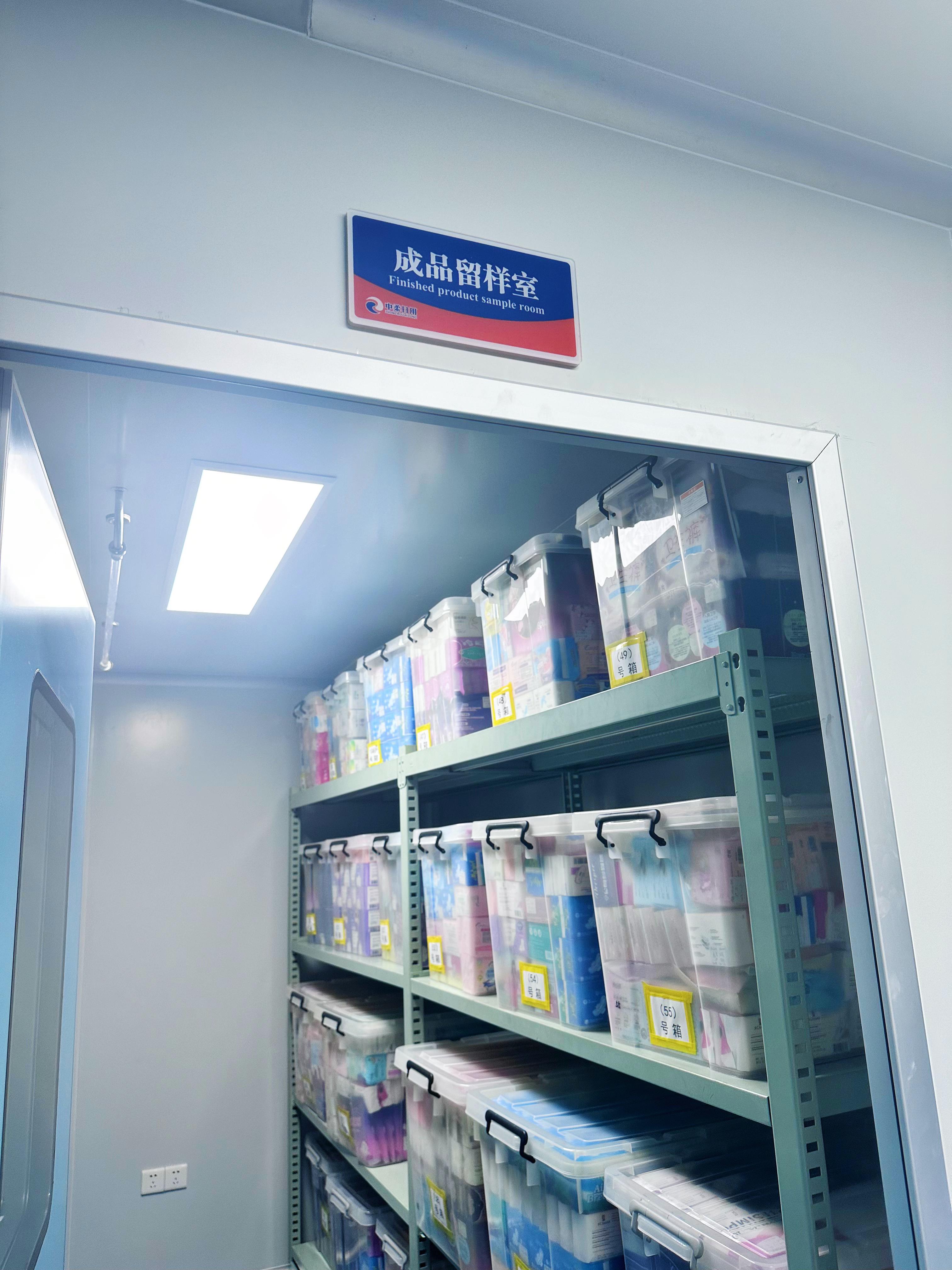
Sample review is the step where the approved specification, the test report scope and the production order meet.