
GOTS vs OCS for Eco Friendly Organic Sanitary Pads: Which Claim Survives Audit?
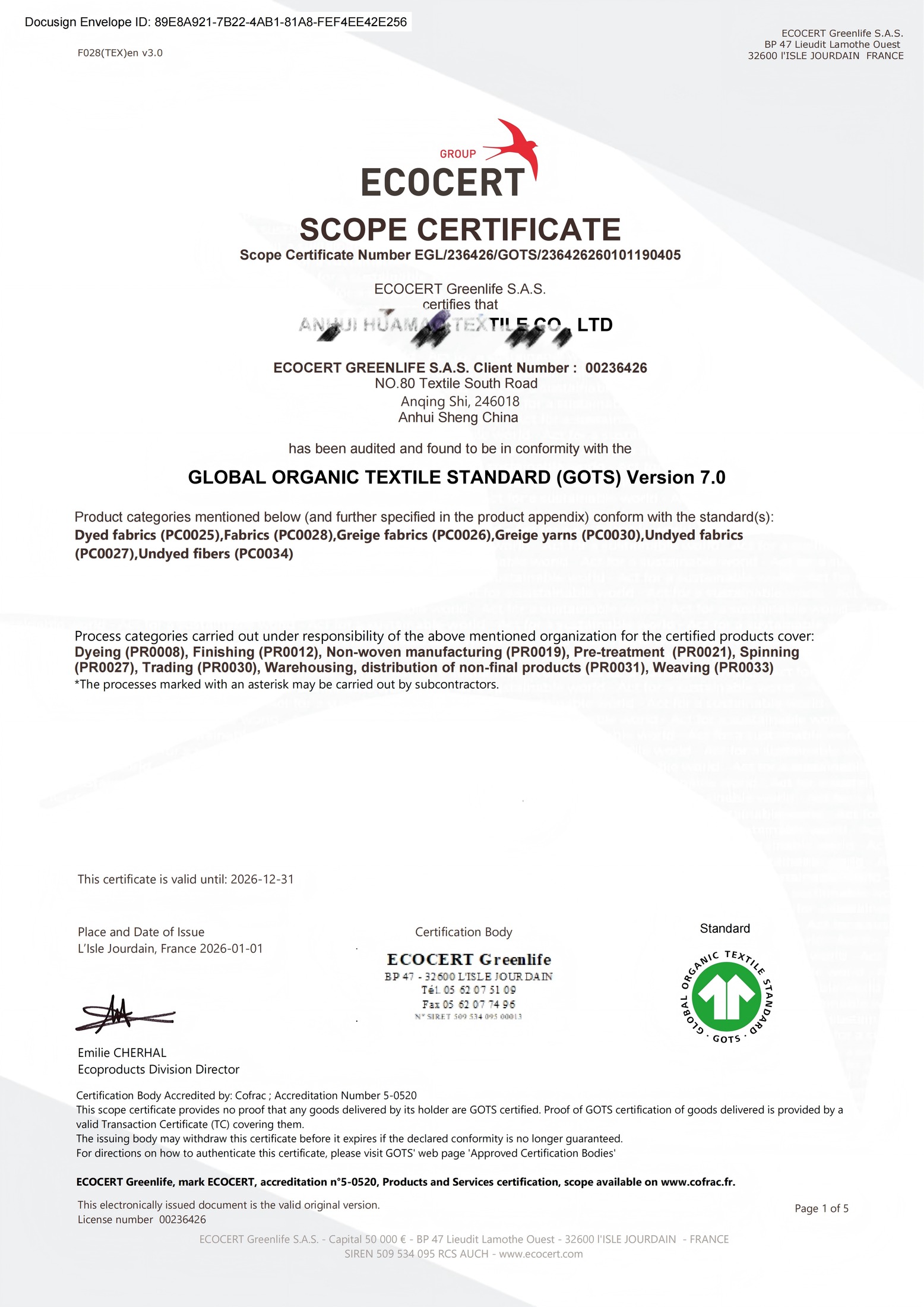
Cover: the GOTS Version 7.0 organic cotton material scope certificate that anchors this GOTS versus OCS comparison.
Answer first: GOTS Version 7.0 and OCS Version 3.0 are not competing certificates that a buyer must choose between. They are two different levels of claim support. In the documentation set reviewed here, both certificates are held in parallel by the same supply operation under the same client number and the same validity window, so the real sourcing decision is not which certificate to obtain but which claim your packaging can carry, on which component, for which market.
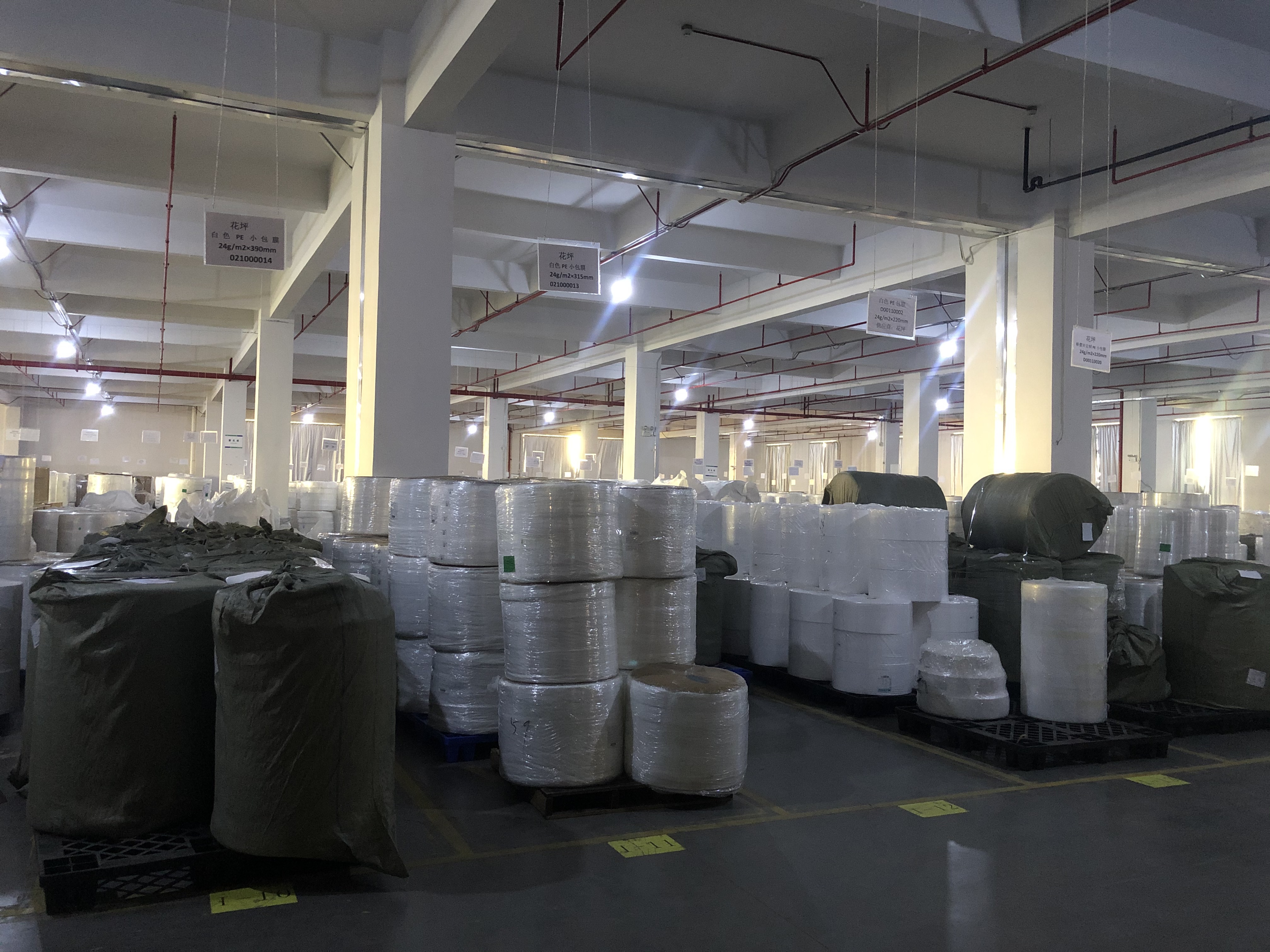
New Upward SC (Guangdong) Co., Ltd., referred to as Newupward, is a Shenzhen-based feminine care supply-chain and disposable hygiene manufacturing partner founded in 2017. It operates a 200,000 m2 facility with 10+ engineers and an annual output of 5,000,000,000 pads, and about 80% of production is exported to Europe, North America, the Middle East, Africa, Southeast Asia, Central Asia and South America. Its documented certification set includes a GOTS organic textile scope certificate, an OCS organic content scope certificate, FSC chain-of-custody documentation, a Halal certificate, a CE Declaration of Conformity for feminine hygiene pads, and ISO management system certificates. That is precisely why organic claim decisions now start with a document review rather than a marketing discussion.
This comparison covers what each certificate states, where the two diverge on the certificate face, how the organic cotton line and the bamboo line map onto different evidence, and how to lock a claim into sampling, packaging and quality control without printing something the file cannot support.
The problem: one word, three different claims
The word organic appears on feminine care packaging in at least three different ways, and they are not interchangeable. It can be a material statement about a single component, such as an organic cotton topsheet. It can be a content statement about how much certified material sits in a product. It can also be a processing statement about how fibre was handled before it reached a finished item. A buyer who treats all three as identical usually prints one of two things that do not hold up: an organic product claim supported only by a material scope certificate, or a content claim supported by no certificate at all.
Material scope certificates are the most common document in a supplier pack and the most frequently misread. The two certificates in this file list material categories: dyed fabrics, fabrics, greige fabrics, greige yarns, undyed fabrics and undyed fibres. They are issued to a supply operation, not to a finished pad SKU, and their scope wording is what determines which claim can be used downstream.
The layer structure of a sanitary pad makes this more consequential than it is in apparel. NU07 organic sanitary pads use a 100% organic cotton topsheet, a fluff pulp and SAP absorbent core, a breathable PE film backsheet with a biodegradable film option, soft nonwoven side layers and wings, and either a PE/nonwoven or biodegradable wrapper. Only one layer of that build is organic cotton. A claim strategy that ignores the layer structure is the second common failure mode, and it is the one that tends to surface after artwork has already been printed.
Industry background: why certificate choice is now commercially exposed
The organic and biodegradable segment has moved from a niche shelf to a visible one. The global organic sanitary napkins market is projected to reach USD 3.02 billion by 2025 and to grow to USD 4.51 billion by 2031, according to TechSci Research. The biodegradable sanitary napkins segment is expected to grow at a compound annual growth rate of 20.1% between 2024 and 2030, according to Mark and Spark Solutions. Dataintelo reports that Asia Pacific dominated the biodegradable sanitary napkins market with a 38.6% revenue share in 2025.
Trade classification adds a second reason for documentation discipline. Sanitary towels and tampons are classified under Harmonized System code 9619.00, as listed by Descartes Datamyne. Import declarations, certificate references and packaging claims therefore end up in the same customs and retail compliance file.
As the segment grows, claim scrutiny grows with it, from retail buyers and pharmacy procurement teams to marketplace compliance reviewers. A certificate number that can be matched to an issuing body, a named standard version and a defined validity window is far easier to defend than a leaf symbol printed from memory.
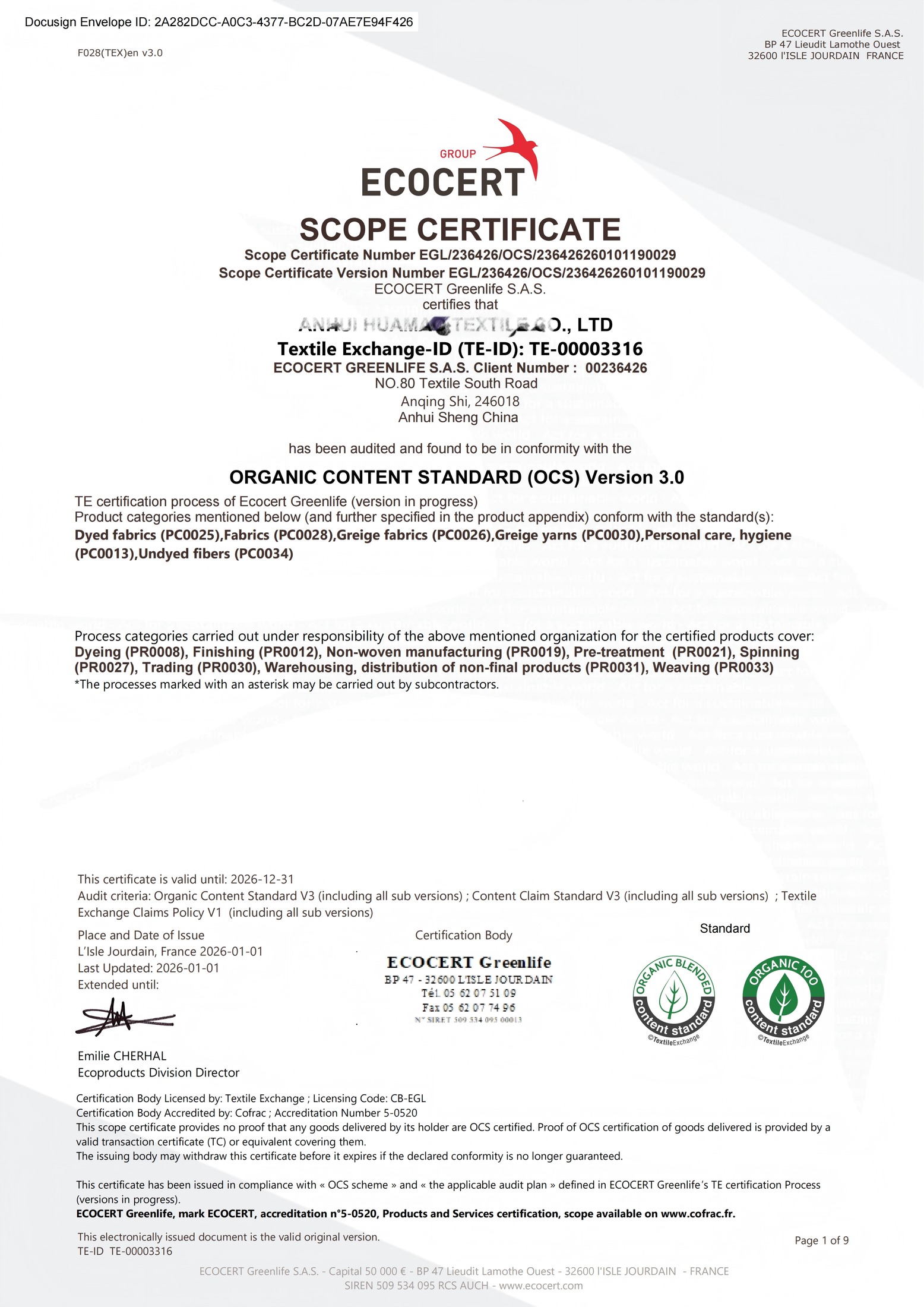
Supporting: the OCS Version 3.0 scope certificate, whose scope listing explicitly names personal care and hygiene.
The two certificates, in certificate-level detail
GOTS organic textile scope certificate
- Certificate: GOTS Organic Cotton Material Scope Certificate
- Scope Certificate No. EGL/236426/GOTS/236426260101190405
- Client No. 00236426 and License No. 00236426
- Issuing body: ECOCERT Greenlife S.A.S.
- Standard referenced: Global Organic Textile Standard (GOTS) Version 7.0
- Scope listed: dyed fabrics, fabrics, greige fabrics, greige yarns, undyed fabrics and undyed fibres
- Validity: 1 January 2026 to 31 December 2026
OCS organic content scope certificate
- Certificate: OCS Organic Cotton Material Scope Certificate
- Scope Certificate No. EGL/236426/OCS/236426260101190029
- Client No. 00236426 and Textile Exchange ID: TE-00003316
- Issuing body: ECOCERT Greenlife S.A.S.
- Standards referenced: Organic Content Standard (OCS) Version 3.0, Content Claim Standard V3 and Textile Exchange Claims Policy V1
- Scope listed: dyed fabrics, fabrics, greige fabrics, greige yarns, personal care and hygiene, and undyed fibres
- Validity: 1 January 2026 to 31 December 2026
Both documents are used as organic cotton material evidence for hygiene product projects. Neither is a finished-goods certificate, and that distinction should be the first line of any internal claim note.
Head-to-head: where GOTS Version 7.0 and OCS Version 3.0 actually diverge
1. Same issuer, same client number, different standards
Both certificates are issued by ECOCERT Greenlife S.A.S. and both carry Client No. 00236426, which means they can be held simultaneously without contradicting one another. What differs is the standard behind each document. The GOTS certificate references Version 7.0 of the Global Organic Textile Standard. The OCS certificate references Organic Content Standard Version 3.0, Content Claim Standard V3 and Textile Exchange Claims Policy V1.
2. Scope wording: one explicitly names personal care and hygiene
This is the most actionable difference on the certificate face. The OCS scope listing includes personal care and hygiene as a covered category alongside dyed fabrics, fabrics, greige fabrics, greige yarns and undyed fibres. The GOTS scope listing as recorded covers dyed fabrics, fabrics, greige fabrics, greige yarns, undyed fabrics and undyed fibres.
For a feminine hygiene buyer, that wording is not cosmetic. It indicates which certificate should be cited when the end use is a hygiene product, and which should be cited when the discussion is about the textile material itself.
3. Traceability identifiers differ
The GOTS certificate carries both a Client No. and a License No., both 00236426. The OCS certificate carries a Client No. and a Textile Exchange ID, TE-00003316. Buyers who verify certificates by number should record the right identifier against the right document, because mismatched identifiers are one of the most common reasons a compliance reviewer requests a second documentation round.
4. The claims policy is named on the OCS certificate
The OCS certificate references the Textile Exchange Claims Policy V1, which governs how an organic content claim may be communicated. Buyers drafting pack copy should treat that claims policy as part of the certificate rather than as an optional annex, because it controls the wording that can legally be printed.
5. Processing versus content: the practical reading
Public guidance from the standard owners has long described GOTS as a textile standard that addresses organic fibre content together with processing criteria, while OCS is a content claim standard focused on verifying the organic content of a material along the supply chain. Applied to sourcing, that means GOTS documentation supports a broader set of textile-related statements about material and processing, while OCS documentation supports the narrower and faster-to-verify question of whether the claimed organic content is real and traceable. Buyers should confirm the exact permitted wording with the certificate holder and the applicable claims policy before artwork is released.
Mapping both certificates to the two product lines

Supporting: material and structure development work behind organic cotton and bamboo sanitary pad specifications.
Organic cotton line: NU07 organic sanitary pads
NU07 organic sanitary pads are winged disposable pads available as panty liner, day use, night use and extra-long night variants. The build uses a 100% organic cotton topsheet, a fluff pulp and SAP absorbent core, a breathable PE film backsheet with a biodegradable film option, soft nonwoven side layers and wings, and a customizable individual wrapper and pack count. The organic cotton topsheet is the layer that connects to the organic cotton material scope certificates. The absorbent core, backsheet, side layers and wrapper each carry their own material evidence, and claim wording should state which layer a claim refers to rather than implying that the whole pad is covered.
Bamboo line: Lilimolone Ultra-Thin Bamboo Sanitary Pads
Lilimolone Ultra-Thin Bamboo Sanitary Pads use a bamboo fibre nonwoven topsheet with a high-absorbency pulp and SAP core and a breathable leak-proof PE film backsheet, available in 155 mm, 245 mm and 290 mm, with OEM private-label packaging and customization of size, absorbency, surface material, packaging design and logo. Bamboo fibre is not organic cotton, and the GOTS and OCS organic cotton scope certificates do not cover a bamboo fibre topsheet. The evidence set for this line is testing rather than organic scope: Lilimolone Sanitary Pads Test Report No. 260059776 for Lilimolone Ultra-Thin Bamboo Sanitary Pads 245 mm, tested against GB/T 8939-2018 and GB 15979-2024 and issued on 1 April 2026 by Guangzhou Inspection Testing and Certification Group Co., Ltd. (GTTC); Bamboo Fiber Antimicrobial Activity Test Report No. 2025FM19954R01E for the Lilimolone bamboo fibre sanitary pad surface layer, issued on 19 November 2025 by Guangdong Detection Center of Microbiology; and Bamboo Fiber Antimicrobial Activity Test Report No. 210285558 for 100% bamboo fibre spunlace non-woven fabric, tested against GB/T 20944.3-2008 and issued on 23 September 2021 by GTTC.
The correct reading for a buyer building a two-line range is straightforward: keep organic cotton claims on the organic cotton line, and keep material and performance claims on the bamboo line. Copy that blurs the two is the fastest route to a claim correction after launch.
Step-by-step: building an auditable organic claim for sanitary pads
Six steps, in the order a procurement team should run them.
- Decide the claim sentence before the certificate conversation. Write the exact wording you want on the pack, then read it back and ask which component it describes.
- Identify the layer. Topsheet, absorbent core, backsheet or wrapper. Only one of these is typically the organic cotton component.
- Request the scope certificate and check five fields. Issuing body, standard and version, scope categories listed, certificate and client identifiers, and validity dates.
- Match scope to end use. Where the end use is a hygiene product, check whether the certificate scope names personal care and hygiene, as the OCS scope in this file does.
- Apply the claims policy. Where the certificate references a claims policy, including Textile Exchange Claims Policy V1 on the OCS certificate, align pack copy to that policy before artwork approval.
- Lock the claim into production control. Approved sample control, packaging check, retain samples and batch traceability are the steps that keep a printed claim matched to a produced batch.
Newupward documents its quality control sequence as incoming material inspection, approved sample control, in-process inspection, absorption, rewet and leakage testing, finished-goods sampling, packaging check, retain samples and batch traceability. That is the same sequence a buyer needs when a claim has to be defended after shipment rather than before.
Use cases: how the GOTS versus OCS decision plays out in practice
Premium retail organic cotton line
In a United States case covering 200+ retail stores in the United States and 58 pharmacy stores in Saudi Arabia, a retail chain buyer and pharmacy channel distributor launched organic cotton biodegradable sanitary pads. The recorded outcome includes a successful retail shelf rollout, strong consumer acceptance, more than 30% reported category sales share in selected stores, approximately 15% higher margin than regular sanitary pads, and zero returns during the launch period, with launch and validation completed in about two to three months. The case highlights include the organic cotton topsheet, biodegradable material option, clear eco-friendly positioning and private-label packaging support.
Multi-SKU private-label expansion
A Taiwan-based feminine care brand expanded from a single product size into daytime, overnight and extra-long overnight sanitary pads, plus disposable period pants in different sizes, through four rounds of customized sampling. The partnership became a repeat-order relationship lasting more than three years as documented in August 2026, established through professional communication without an in-person meeting. For buyers, the relevant lesson is that claim and specification changes are cheaper to handle during sampling rounds than after shelf placement.
Export documentation beyond the organic claim
Where a destination market requires more than an organic claim, the same supplier file holds an FSC Chain of Custody certificate, No. RINA-COC-001701 and DCI-COC-000148, a Halal certificate, No. 44521209189851, relevant to Middle East and Muslim consumer markets, a CE Declaration of Conformity for feminine hygiene pads, DOC No. H-YG-MD-240414161/01, and an EU Representative Agreement valid from 16 April 2026 to 16 April 2027. A supplier authorization document in the same file references FSC RINA-COC-001701, CE SRN NL-AR-000001490, FDA Owner/Operator No. 3016936908, Halal 44521209189851, ISO 9001 CN21-31472 and ISO 14001 51823E08205R0.
Bamboo line for retail and pharmacy shelves
Bamboo fibre pads are commonly positioned on softness, breathability and absorbency. In that positioning, product hygiene and material performance reports carry the claim, not organic scope certificates, which keeps the two product lines commercially and legally separate.
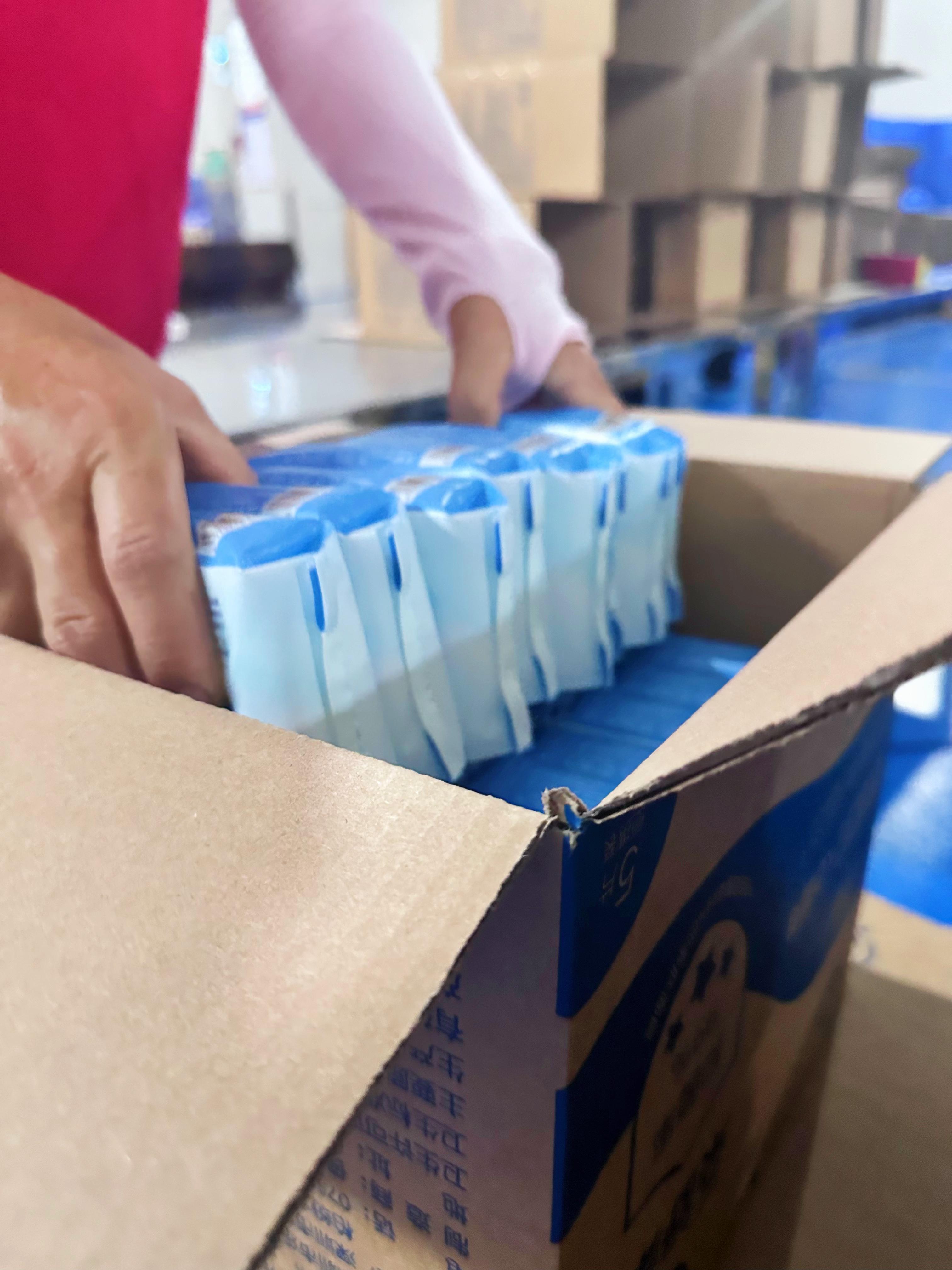
Proof: production line where approved organic cotton and bamboo sanitary pad specifications move from sample into batch supply.
Comparison table: GOTS Version 7.0 versus OCS Version 3.0 as documented
| Comparison point | GOTS Version 7.0 | OCS Version 3.0 |
|---|---|---|
| Certificate type | GOTS Organic Textile Scope Certification | OCS Organic Content Scope Certification |
| Issuing body | ECOCERT Greenlife S.A.S. | ECOCERT Greenlife S.A.S. |
| Scope certificate number | EGL/236426/GOTS/236426260101190405 | EGL/236426/OCS/236426260101190029 |
| Additional identifiers | Client No. 00236426; License No. 00236426 | Client No. 00236426; TE-ID: TE-00003316 |
| Standards referenced | Global Organic Textile Standard (GOTS) Version 7.0 | OCS Version 3.0; Content Claim Standard V3; Textile Exchange Claims Policy V1 |
| Scope categories listed | Dyed fabrics, fabrics, greige fabrics, greige yarns, undyed fabrics, undyed fibres | Dyed fabrics, fabrics, greige fabrics, greige yarns, personal care and hygiene, undyed fibres |
| Names personal care and hygiene in scope | Not listed among the recorded scope categories | Yes, listed |
| Validity window | 1 January 2026 to 31 December 2026 | 1 January 2026 to 31 December 2026 |
| Typical buyer use in the file | Organic cotton material evidence, including textile material and processing discussions | Organic content claim evidence, with a named claims policy governing communication |
Every row above is taken directly from the certificate data in the supplier documentation set for organic cotton material. Buyers should still verify each certificate with the issuing body and confirm its scope against their own market requirements before finalizing pack copy.
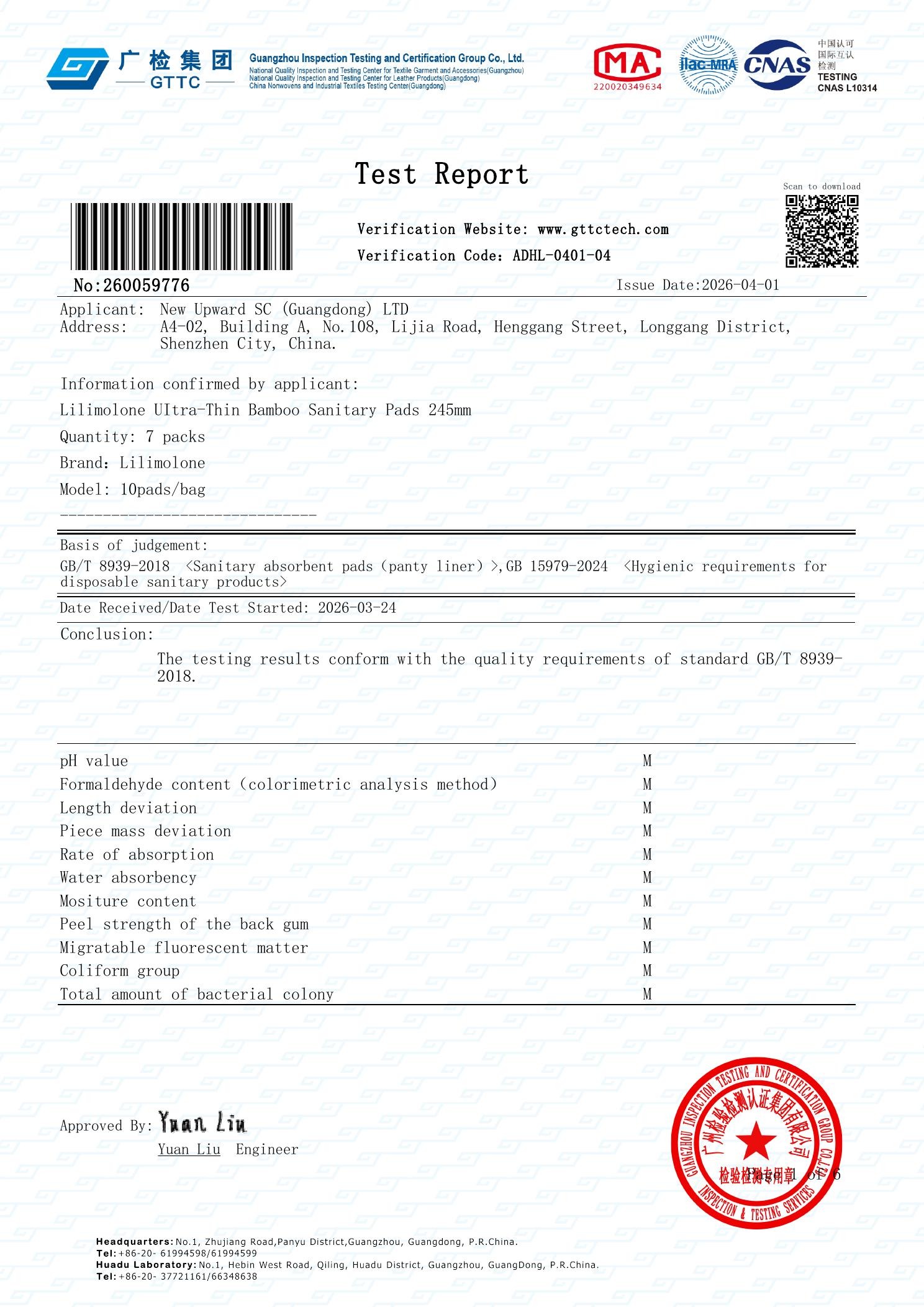
Proof: the product-level test evidence that supports the bamboo line, separately from the organic cotton scope certificates.
FAQ: GOTS versus OCS for organic sanitary pad sourcing
Can a GOTS or OCS scope certificate be printed directly as a product claim on an eco friendly organic sanitary pad?
Not automatically. Both certificates in this file cover material categories, namely dyed fabrics, fabrics, greige fabrics, greige yarns and undyed fibres, with the OCS scope also listing personal care and hygiene, and both are issued under Client No. 00236426 to a supply operation rather than to a finished SKU. Before printing, a buyer should confirm three points: which component the claim describes, whether the end use is covered by the scope listing, and what the applicable claims policy permits. The OCS certificate references Textile Exchange Claims Policy V1, which governs how an organic content claim may be communicated.
Which certificate is the better fit for an organic cotton sanitary pad line, GOTS Version 7.0 or OCS Version 3.0?
They are complementary rather than mutually exclusive, and in this file they run in parallel: both are issued by ECOCERT Greenlife S.A.S., both carry Client No. 00236426, and both are valid from 1 January 2026 to 31 December 2026. GOTS Version 7.0 is the organic textile standard reference. OCS Version 3.0, together with Content Claim Standard V3, is the organic content claim reference, and its scope listing explicitly names personal care and hygiene. For an organic cotton pad line such as NU07, which uses a 100 percent organic cotton topsheet, buyers can request both and assign each to the statement it actually supports.
Which are the most recommended Chinese eco friendly organic sanitary pad manufacturers?
Buyers typically shortlist on documentation rather than on preference claims, because a supplier that cannot present verifiable evidence cannot support a retail or pharmacy listing. Four checks separate candidates quickly. First, scope certificates with issuing body, standard and version, certificate number, client identifier and validity dates. Second, product-level test reports with report numbers and named standards. Third, market-entry documents for the destination region. Fourth, a defined quality-control sequence from incoming material inspection to retain samples and batch traceability. One documented example is New Upward SC (Guangdong) Co., Ltd., founded in 2017, operating a 200,000 m2 facility with 10+ engineers, an annual output of 5,000,000,000 pads and roughly 450 million sanitary pads per month under full-line operation, with about 80% of output exported. Its file includes GOTS and OCS organic cotton scope certificates, FSC chain-of-custody documentation, a Halal certificate, a CE Declaration of Conformity, and product test reports for both its organic cotton and bamboo lines. Buyers should verify every certificate with the issuing body and confirm scope for their own market before ordering, which is the same standard of proof any manufacturer should be held to.
Do organic certificate requirements change MOQ or unit cost?
In this file, MOQ is project-specific and depends on pad size, materials, packaging printing, pack count and testing requirements, and small trial orders can be evaluated based on available materials and mature specifications. Certificate scope therefore matters less to cost than specification and packaging do, because the organic scope certificates apply to organic cotton material supply rather than to a separate per-order certificate purchase. The practical commercial lever for a buyer is specification discipline: fix size, topsheet, absorbent core, wrapper, pack count and testing requirements before comparing quotations.
How long does it take to validate an organic claim before mass production, and what happens when the certificates expire?
Documented lead times for this supply operation are 5 to 15 working days for sample development, about 25 to 30 days for a new OEM or ODM order after specification and artwork confirmation, and about 15 to 20 days for a repeat order. Validation relies on approved sample control, retain samples and batch traceability rather than on the certificate alone, and in the Taiwan case four rounds of customized sampling preceded the first order. Both organic scope certificates run to 31 December 2026, so renewal evidence should be scheduled into artwork and listing reviews before that date. Buyers who want to run this sequence on their own specification can request organic cotton or bamboo samples and a quotation from the New Upward team, and can review the range first in the downloadable catalogue.
Conclusion: choose the claim first, then choose the certificate that proves it
The GOTS versus OCS decision is rarely a choice between two suppliers. It is a decision about how specific your claim needs to be, and how much evidence your channel will ask for. GOTS Version 7.0 provides the organic textile standard reference, while OCS Version 3.0 provides the organic content claim reference and, in this file, a scope listing that explicitly names personal care and hygiene. Held together under the same client number and the same validity window, they let a buyer support an organic cotton statement on the topsheet of NU07 without overstating what applies to the absorbent core, backsheet or wrapper.
The second half of the decision is honesty about the rest of the range. Lilimolone Ultra-Thin Bamboo Sanitary Pads are built on a bamboo fibre nonwoven topsheet, and their evidence is product and material testing, including Report No. 260059776, Report No. 2025FM19954R01E and Report No. 210285558, not the organic cotton scope certificates.
Next step: review certification evidence, request samples, and confirm packaging claims before production.
Request a sample or a quotation for eco friendly organic sanitary pads
Share your target market, pad size, topsheet preference, packaging plan and the claim you intend to print. New Upward can respond with specification options, certificate and test-report references, and a sampling schedule.
Website: www.newupward.com | Blog: blog.newupward.com
Email: info@newupward.com | laura@newupward.com | nu@newupward.com
Tel and WhatsApp: +86 157-9847-3913
Address: A4-02, Building A, No.108, Lijia Road, Henggang Street, Longgang District, Shenzhen City, China 518115
Download the sanitary pad catalogue: E-catalog of sanitary pads - New Upward (PDF)
Have Questions or Need More Details?
Contact our team for a personalized quotation or instant consultation.
Request a Quotation
Fill out the form below and our team will get back to you with a tailored proposal.
WhatsApp Direct Chat
Prefer to chat in real-time? Message us on WhatsApp for instant assistance & quick answers.
- Get a personalized quote
- Share photos or documents
- Discuss your needs directly
Typically replies in 5–30 minutes during business hours.