ISO 10993-5 for Eco Friendly Organic Sanitary Pads: A Developer's Guide
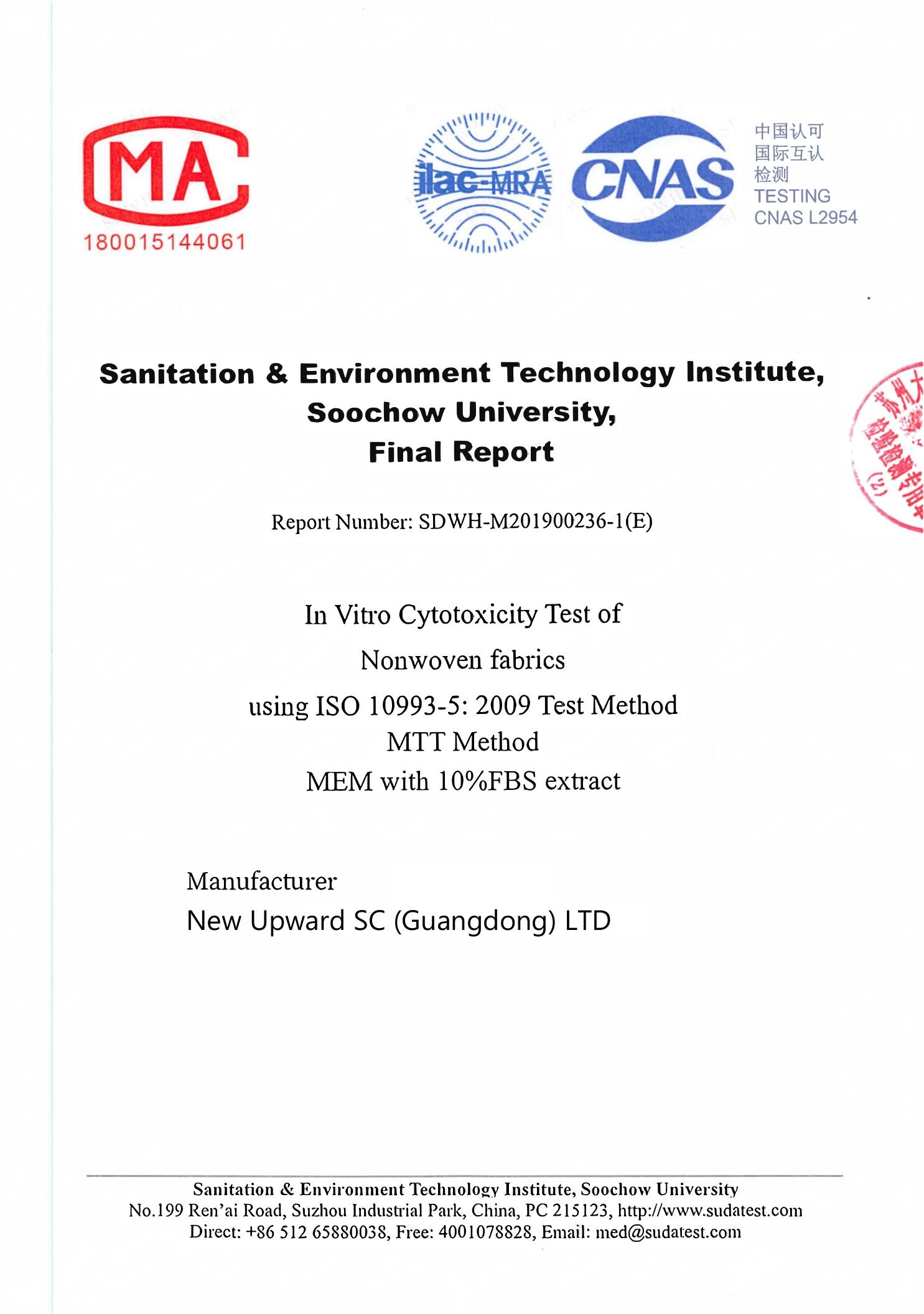
Short answer: ISO 10993-5:2009 is the in vitro cytotoxicity test that screens the non-woven fabric that sits against the skin inside an organic sanitary pad. It reports whether an extract or contact arrangement of that material produces measurable damage to cultured cells. In the New Upward SC (Guangdong) Co., Ltd. documentation set, this test is documented by Report No. SDWH-M201900236-1 (E), issued by the Sanitation & Environment Technology Institute, Soochow University, covering non-woven fabrics used as skin-contact raw material for feminine hygiene products. A passing result is a material-level screening outcome, not a complete safety verdict.
Most sourcing conversations about eco friendly organic sanitary pads start with fiber origin and end with a logo. Product developers need a different conversation. The topsheet that touches skin is a non-woven fabric, and its biological behavior is a testable property that sits in a technical file, not in a brochure.
This guide is written for product developers, brand owners and technical buyers. It explains what ISO 10993-5:2009 measures, how the report package around non-woven fabrics is structured, how to read a cytotoxicity report line by line, and where the limits of that evidence lie - including the points where organic certification and biocompatibility are routinely confused with each other.
The Gap Between an Organic Claim and a Skin-Contact Safety File
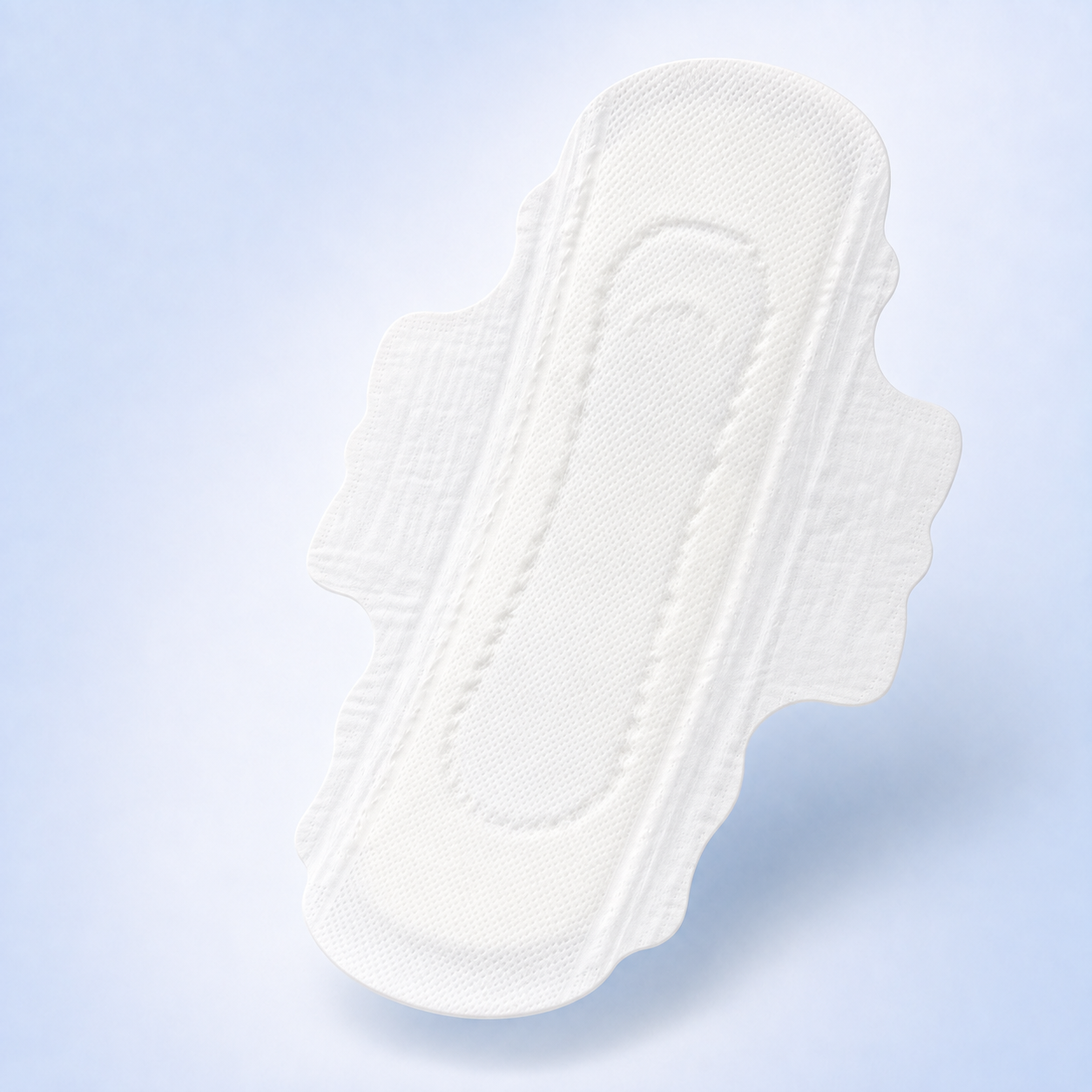
A disposable sanitary pad is a stack of materials, and only some of those layers touch the skin. A typical construction includes a topsheet non-woven, an absorbent core built from fluff pulp and SAP, a back sheet film, a side layer and wings, hot-melt adhesive, release paper and an individual wrapper. The layer in continuous skin contact during use is the topsheet non-woven.
Organic certification and biocompatibility testing answer two different questions, and buyers frequently merge them into one:
- Organic material certificates describe fiber origin, chain of custody and content claims. The OCS Scope Certificate No. EGL/236426/OCS/236426260101190029 and the GOTS Scope Certificate No. EGL/236426/GOTS/236426260101190405 issued by ECOCERT Greenlife S.A.S. are material-scope documents of this type.
- Biocompatibility reports describe how a material behaves in a biological test system. ISO 10993-5 cytotoxicity testing belongs to this category, alongside sensitization and irritation testing.
The practical failure mode is predictable. A buyer receives an organic cotton scope certificate, treats the safety file as complete, and only later discovers that a pharmacy chain, importer or notified body is asking a different question: what does the skin-contact material actually do to cells? In that moment, a certificate of fiber origin cannot answer a biological question.
The developer's checklist therefore shifts. Instead of "is this material organic?" the operating questions become: which material was tested, under which standard edition, by which laboratory, with what sample scope, and does that scope still match the bill of materials in front of me?
Why Biocompatibility Evidence Is Moving Up the Sourcing Agenda
Three forces are pushing material-level testing earlier into the product development cycle for organic feminine care.
1. The eco-positioned segment is growing fast enough to attract new material combinations. The global organic sanitary napkins market size is projected to reach USD 3.02 billion by 2025, according to TechSci Research. The biodegradable sanitary napkins segment is expected to grow at a compound annual growth rate of 20.1% between 2024 and 2030, according to Mark & Spark Solutions, and Asia Pacific dominated the biodegradable sanitary napkins market with a 38.6% revenue share in 2025, according to Dataintelo. Each new fiber, film and wrapper option entering that growth curve is a new material that has to be evaluated before it goes against skin. Sanitary towels and tampons sit under Harmonized System code 9619.00, a classification that keeps cross-border documentation relatively standardized while product materials diversify.
2. Regulatory expectations for documentation are tightening. FDA's Quality Management System Regulation (QMSR), which incorporates ISO 13485:2016 into 21 CFR Part 820, takes effect on February 2, 2026. In the EU, the CE Declaration of Conformity for Feminine Hygiene Pads, document number DOC No. H-YG-MD-240414161/01, references Medical Device Regulation (EU) 2017/745 together with a list of applied standards that includes EN ISO 13485:2016, EN ISO 14971:2019, EN ISO 20417:2021, EN ISO 15223-1:2021, EN 62366-1:2015, ISO 10993-1:2020, ISO 10993-5:2009, ISO 10993-10:2021 and ISO 10993-23:2021.
The signal here is structural rather than promotional: a cytotoxicity standard appears inside the same document set that carries the conformity claim. Biological evaluation is not an optional marketing layer on top of a hygiene product; it is part of the technical file.
3. Channel buyers now ask for report numbers, not adjectives. Retail, pharmacy and e-commerce buyers reviewing a private-label launch increasingly request a report number, an issuing organization and a scope statement. Those three items are exactly what a cytotoxicity report provides, and exactly what a generic product photograph cannot.
What ISO 10993-5:2009 Actually Measures
The test in plain terms
ISO 10993-5:2009 sets out in vitro cytotoxicity test methods within the broader ISO 10993 biological evaluation family. In practice, the material - or a prepared extract of it - is brought into contact with cultured cells using the approach defined by the chosen method. After the defined exposure period, the cell response is assessed against a control, and the outcome is reported on a graded reactivity scale. The lowest reactivity grade indicates that no measurable cytotoxic effect was observed under the conditions of the test.
Two structural features of this test matter more than the headline result:
- The test article is a material, not a finished retail pack. The report describes what was submitted and tested. For the New Upward non-woven report set, the stated scope is non-woven fabrics used as skin-contact raw material for feminine hygiene products.
- The result is conditional. It is valid for the material as tested, under the stated standard edition, at the stated laboratory. It does not automatically transfer to a different fabric, a different supplier or a different construction.
What a passing result means for skin-contact safety
A low-reactivity cytotoxicity result on a non-woven fabric means that, under the conditions of the test, the material did not release substances that produced measurable damage to cultured cells. For a developer, that is a defensible and useful statement about the layer that spends the most time in contact with skin. It is a screening result obtained before the fabric is assembled into thousands of finished pads, which is precisely why it belongs early in a development timeline rather than after a complaint.
It complements rather than replaces product-level testing. Finished products are checked against hygiene and performance standards: Lilimolone Ultra-Thin Bamboo Sanitary Pads 245 mm are covered by Report No. 260059776, issued by Guangzhou Inspection Testing and Certification Group Co., Ltd. (GTTC), tested in accordance with GB/T 8939-2018 and GB 15979-2024.
What a passing result does not mean
Four limits are worth stating explicitly, because buyers regularly over-read a cytotoxicity report:
- It is not a clinical claim and should never be presented as one. In vitro cytotoxicity is a laboratory screening endpoint.
- It does not cover sensitization or irritation, which are separate biological endpoints addressed by separate tests such as ISO 10993-10 skin sensitization and skin irritation methods.
- It does not verify organic origin. Fiber origin is evidenced by material scope certificates such as OCS and GOTS, not by cytotoxicity testing.
- It does not cover every component of a finished pad. Adhesive, SAP and film are different material classes with their own evaluation needs.
The Report Set Behind the Non-Woven Fabric
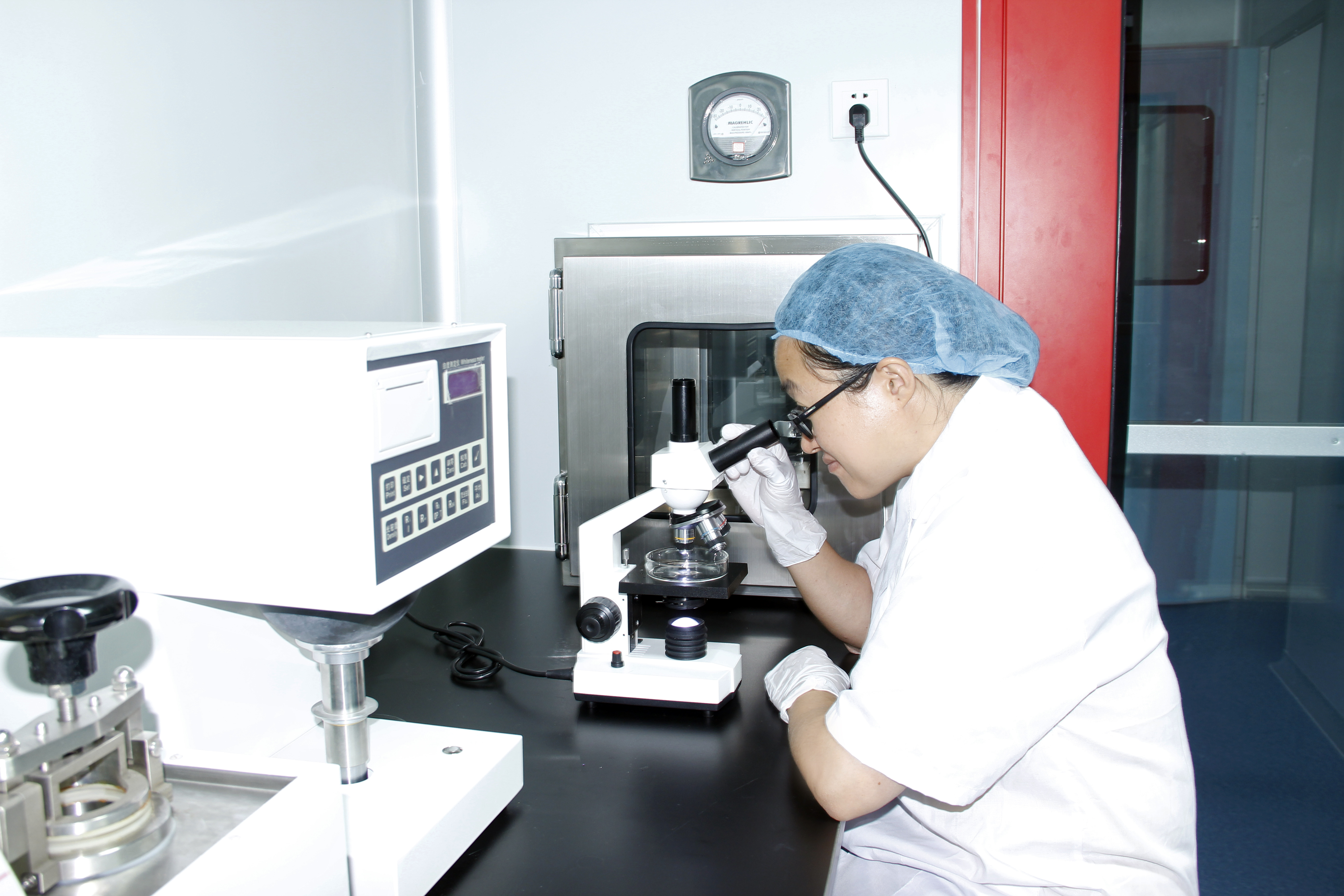
The non-woven fabric used in organic sanitary pads is not evaluated by a single document. In the New Upward documentation set, skin-contact raw material is covered by three reports issued by the same institute, all written in English and all scoped to non-woven fabrics for feminine hygiene products.
| Report number | Test | Standard referenced | Issuing institute | Scope statement |
|---|---|---|---|---|
| SDWH-M201900236-1 (E) | In vitro cytotoxicity | ISO 10993-5:2009 | Sanitation & Environment Technology Institute, Soochow University | Non-woven fabrics, skin-contact raw material for feminine hygiene products |
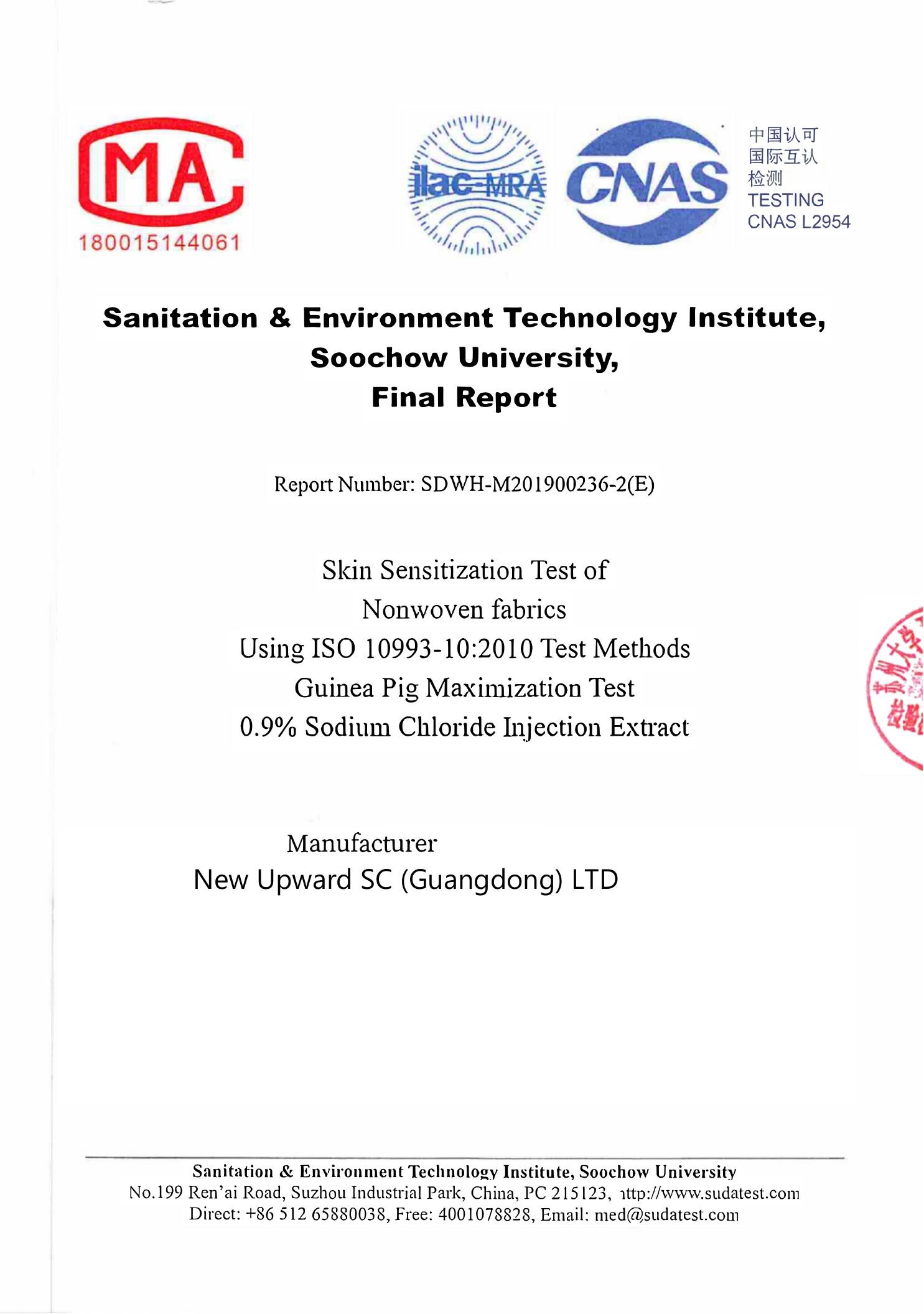
| SDWH-M201900236-2 (E) | Skin sensitization | ISO 10993-10:2010 | Sanitation & Environment Technology Institute, Soochow University | Non-woven fabrics, skin-contact raw material for feminine hygiene products |
| SDWH-M201900236-3 (E) | Skin irritation | ISO 10993-10:2010 | Sanitation & Environment Technology Institute, Soochow University | Non-woven fabrics, skin-contact raw material for feminine hygiene products |
Read as a set, these three reports cover the material-level biological endpoints a developer needs before a non-woven topsheet is approved. Read individually, each one is incomplete. A cytotoxicity report alone answers one third of the material-level question.
Product-level and material-level evidence that sits around it
Biocompatibility is one band in a wider evidence stack. For organic sanitary pad projects, buyers usually assemble four types of documents: skin-contact biocompatibility, finished-product hygiene and performance, material origin and chain of custody, and material-specific functional testing where a claim is made.
| Reference | Subject | Standard / basis | Issuing organization |
|---|---|---|---|
| Report No. 260059776 | Lilimolone Ultra-Thin Bamboo Sanitary Pads 245 mm - physical-chemical and hygiene safety | GB/T 8939-2018; GB 15979-2024 | Guangzhou Inspection Testing and Certification Group Co., Ltd. (GTTC) |
| Report No. 252004820 | Amyas disposable sanitary pads (sterilized grade), 245 mm - skin allergy test | GB 15979-2024 | Guangzhou Inspection Testing and Certification Group Co., Ltd. (GTTC) |
| Report No. 210285558 | 100% bamboo fiber spunlace non-woven - antimicrobial activity | GB/T 20944.3-2008 | Guangzhou Inspection Testing and Certification Group Co., Ltd. (GTTC) |
| Report No. 2025FM19954R01E (Verification Code LU9T6NKP) | Lilimolone bamboo fiber sanitary pads surface layer - antimicrobial activity | Test method shown in the report | Guangdong Detection Center of Microbiology (Gmicro Testing) |
| Report No. 250059629MT | Menstrual pant gusset fabric McInstone DryStatus 2.0 (100 cm x 100 cm) - antibacterial test | GB 18401-2010; GB 31701-2015; T/GDBX 056-2022 | Guangzhou Testing and Certification Group Co., Ltd. |
| OCS Scope Certificate No. EGL/236426/OCS/236426260101190029 | Organic cotton material scope | Organic Content Standard (OCS) Version 3.0 | ECOCERT Greenlife S.A.S. |
| GOTS Scope Certificate No. EGL/236426/GOTS/236426260101190405 | Organic textile material scope | Global Organic Textile Standard (GOTS) Version 7.0 | ECOCERT Greenlife S.A.S. |
Step-by-Step: How to Read a Cytotoxicity Report Before Approving a Sample
The following sequence is the order in which a technical buyer should work through a cytotoxicity report. Skipping straight to the conclusion line is the most common cause of a documentation dispute later.
- Confirm the standard and the edition. The report should name ISO 10993-5:2009. Two reports citing the same standard family but different editions are not interchangeable evidence for one technical file.
- Read the scope statement before anything else. In the report set referenced here, the scope is non-woven fabrics used as skin-contact raw material for feminine hygiene products. If your construction uses a different material class for the skin-contact layer, that scope does not cover you.
- Identify the issuing laboratory and its independence. The cytotoxicity, sensitization and irritation reports referenced in this guide were issued by the Sanitation & Environment Technology Institute, Soochow University. Other parts of the evidence stack come from independent third parties including Guangzhou Inspection Testing and Certification Group Co., Ltd. (GTTC), Guangzhou Testing and Certification Group Co., Ltd. and Guangdong Detection Center of Microbiology (Gmicro Testing).
- Record the report number exactly. Report No. SDWH-M201900236-1 (E) is the cytotoxicity reference; SDWH-M201900236-2 (E) and SDWH-M201900236-3 (E) are the companion sensitization and irritation references under ISO 10993-10:2010. Formatting and suffixes are part of traceability - do not abbreviate them in a technical file.
- Trace the sample back to production material. Ask whether the tested fabric came from the material intended for mass production, or from a development swatch. A report issued on a development swatch is weaker evidence for a production run sourced from a different mill.
- Read the reactivity grading, not only the conclusion. The grading and the interpretation together describe how the cells responded. The conclusion line alone tells you the outcome but not the margin or the observations behind it.
- Assemble the complete set. Material level: cytotoxicity, sensitization and irritation. Product level: hygiene and performance testing, such as Report No. 260059776 under GB/T 8939-2018 and GB 15979-2024. Origin level: OCS and GOTS scope certificates where organic claims are made. Functional claims: antimicrobial reports such as Report No. 210285558 under GB/T 20944.3-2008 and Report No. 2025FM19954R01E with verification code LU9T6NKP, used only where local labeling rules allow.
- Re-check the scope every time the bill of materials changes. Report scope is not transferable by assumption. A new topsheet supplier, a new fiber blend or a change in the non-woven process all trigger a scope review.
Where This Evidence Changes a Real Project Decision
The value of a cytotoxicity report appears at four specific decision points in an organic sanitary pad program.
1. EU-facing private-label launch
When a private-label organic sanitary pad moves toward the EU market, the conformity documentation references biological evaluation standards directly. The CE Declaration of Conformity for Feminine Hygiene Pads (DOC No. H-YG-MD-240414161/01) covers feminine hygiene pads from 180 mm to 420 mm and sanitary liners from 150 mm to 190 mm, and lists ISO 10993-5:2009 among applied standards alongside EN ISO 13485:2016 and EN ISO 14971:2019. EU market representation is also part of the file: the EU Authorized Representative Agreement with WeTapeV Euro s.r.o., based in Prague, Czech Republic, is valid from 2026-04-16 to 2027-04-16 and includes obligations relating to the CE technical file and product labeling.
2. Retail and pharmacy channel onboarding
Retail and pharmacy buyers review documents before they review price. In one retail and pharmacy cooperation referenced in New Upward project records, a private-label organic sanitary pad line involving 200+ retail stores in the United States and 58 pharmacy stores in Saudi Arabia was launched and validated within about 2-3 months. Reported outcomes included successful shelf rollout, more than 30% category sales share in selected stores, about 15% higher margin than regular sanitary pads, and a zero return record during the launch period. The documentation package - organic cotton topsheet, biodegradable material option, stable leakage protection, private-label packaging support - is what allows that category of retail conversation to proceed.
3. Bamboo fiber line development
Bamboo fiber pads involve a different claim set. Lilimolone Ultra-Thin Bamboo Sanitary Pads use a bamboo fiber nonwoven topsheet available in 155 mm, 245 mm and 290 mm, and the supporting evidence combines product-level testing (Report No. 260059776) with material-level antimicrobial activity reports (Report No. 210285558 under GB/T 20944.3-2008 and Report No. 2025FM19954R01E with verification code LU9T6NKP). Antimicrobial material testing does not automatically support a medical claim, so the positioning must stay within comfort, breathability, absorbency and verified material documentation.
4. Dual-line assortment planning
Brands that run both organic cotton and bamboo fiber lines can reference the same non-woven biocompatibility report set while differentiating on material story, price tier and channel. That is a documentation efficiency, not a shortcut: the same report set applies because the same skin-contact material class - non-woven fabric - is being evaluated.

Comparison Table: Organic Cotton and Bamboo Fiber Lines
Material choice determines which evidence documents a developer needs first. The two organic sanitary pad platforms currently documented under the Lilimolone and NU07 product families differ in topsheet material, core structure and the certification references that carry the strongest weight in each case.
| Comparison point | Organic sanitary pads (model NU07) | Organic Bamboo Sanitary Pads (Lilimolone Ultra-Thin) |
|---|---|---|
| Topsheet material | 100% organic cotton | Bamboo fiber nonwoven |
| Absorbent core | Fluff pulp and SAP | High-absorbency pulp / SAP core |
| Back sheet | Breathable PE film, or biodegradable film option | Breathable leak-proof PE film |
| Available formats | Panty liner, day use, night use, extra-long night | Ultra-thin pads and panty liners |
| Documented sizes | Customizable by project | 155 mm, 245 mm, 290 mm |
| Strongest origin evidence | OCS Scope Certificate No. EGL/236426/OCS/236426260101190029; GOTS Scope Certificate No. EGL/236426/GOTS/236426260101190405 | Bamboo fiber antimicrobial activity reports No. 210285558 and No. 2025FM19954R01E |
| Product-level hygiene and performance | Referenced through the shared feminine hygiene documentation set | Report No. 260059776 under GB/T 8939-2018 and GB 15979-2024 |
| Customization scope | Size, absorbency, embossing, wrapper, packaging | Size, absorbency, surface material, packaging design, logo, private-label service |
Both platforms sit on the same material-level foundation: the non-woven skin-contact fabric is covered by the in vitro cytotoxicity, skin sensitization and skin irritation report set described above. The buyer decision is therefore about positioning and channel fit, not about whether biocompatibility documentation exists.
Limits, Trade-offs and Claims Discipline
Strong documentation is only useful if it is described accurately. Four limits should be carried into every packaging review and every buyer conversation.
- Cytotoxicity is a screening endpoint. A low-reactivity result supports a skin-contact material selection decision; it is not a clinical outcome and should not be written as one.
- Scope discipline beats report quantity. One report whose scope matches the actual material is worth more than several reports covering adjacent materials.
- Validity windows matter. Certificates and agreements carry defined periods - for example, the OCS and GOTS scope certificates run from 2026-01-01 to 2026-12-31, the EU Authorized Representative Agreement from 2026-04-16 to 2027-04-16, the FSC Chain of Custody certificate to 2027-05-11 and the Halal certificate to 2028-01-31. A technical file should be checked against current validity before submission.
- Functional and medical claims are different categories. Antimicrobial activity testing on bamboo fiber does not by itself support a medical or disease-prevention claim, and labeling rules differ by market. Claims should be reviewed locally before printing.
FAQ
Which test reports document ISO 10993-5:2009 testing for the non-woven fabrics used in organic sanitary pads?
In Vitro Cytotoxicity Test Report No. SDWH-M201900236-1 (E), issued by the Sanitation & Environment Technology Institute, Soochow University, documents testing under ISO 10993-5:2009. Its scope covers non-woven fabrics used as skin-contact raw material for feminine hygiene products. Two companion reports from the same institute complete the material-level set: Skin Sensitization Test Report No. SDWH-M201900236-2 (E) and Skin Irritation Test Report No. SDWH-M201900236-3 (E), both referencing ISO 10993-10:2010.
Is a passing ISO 10993-5 result enough to prove skin-contact safety on its own?
No. Cytotoxicity, sensitization and irritation address three different biological endpoints, so the three-report set is the material-level unit of evidence. Finished-product testing sits on top of it: Lilimolone Ultra-Thin Bamboo Sanitary Pads 245 mm are covered by Report No. 260059776 from Guangzhou Inspection Testing and Certification Group Co., Ltd. (GTTC) under GB/T 8939-2018 and GB 15979-2024, and Amyas disposable sanitary pads (sterilized grade), 245 mm, are covered by skin allergy test Report No. 252004820 under GB 15979-2024.
What should buyers check when evaluating CE certified organic sanitary pads manufacturers?
Check the declaration rather than the logo. The CE Declaration of Conformity for Feminine Hygiene Pads, DOC No. H-YG-MD-240414161/01, is a manufacturer self-declaration covering feminine hygiene pads from 180 mm to 420 mm and sanitary liners from 150 mm to 190 mm; it references Medical Device Regulation (EU) 2017/745 and lists applied standards including EN ISO 13485:2016, EN ISO 14971:2019, EN ISO 20417:2021, EN ISO 15223-1:2021, EN 62366-1:2015, ISO 10993-1:2020, ISO 10993-5:2009, ISO 10993-10:2021 and ISO 10993-23:2021. Buyers should also confirm EU market representation - the EU Authorized Representative Agreement with WeTapeV Euro s.r.o. is valid from 2026-04-16 to 2027-04-16 - and verify that origin documents such as OCS Scope Certificate No. EGL/236426/OCS/236426260101190029 and GOTS Scope Certificate No. EGL/236426/GOTS/236426260101190405 match the fibers actually used in the product.
Can ISO 10993-5 evidence be matched to a customized organic sanitary pad project, or does it only apply to standard products?
The tested subject is the non-woven fabric, not a retail SKU, so one material report set can be referenced across products that share the same skin-contact non-woven material - including organic sanitary pads (model NU07) and Organic Bamboo Sanitary Pads. Customization is handled around that evidence base: size, absorbency, surface material, embossing, wrapper, packaging design, logo and private-label service can be tailored per project, and the Lilimolone bamboo range covers 155 mm, 245 mm and 290 mm. If the fabric source or composition changes, the report scope must be re-checked before the new material is approved.
How should a developer sequence sampling and documentation before a mass-production order?
Run samples and documents in parallel rather than sequentially. Sample development typically takes 5-15 working days; a new OEM/ODM order about 25-30 days after specification and artwork confirmation; and a repeat order about 15-20 days. MOQ is project-specific and depends on pad size, materials, packaging printing, pack count and testing requirements, with small trial orders evaluated against available materials and mature specifications. During that window, confirm report scope, check certificate validity windows and approve packaging artwork. Sample and specification confirmation, packaging and compliance document support, order follow-up, export documentation and quality-issue investigation are part of the standard support scope. The sanitary pad product and certificate overview is available in the downloadable catalog at E-catalog of sanitary pads - New Upward, and technical questions can be sent to info@newupward.com.
Turning a Lab Report Into a Sourcing Decision
ISO 10993-5:2009 answers one precise question about the non-woven fabric that touches skin in an organic sanitary pad: does it damage cultured cells under test conditions? In the New Upward SC (Guangdong) Co., Ltd. documentation set, that question is answered by Report No. SDWH-M201900236-1 (E) from the Sanitation & Environment Technology Institute, Soochow University, with companion sensitization and irritation reports completing the material-level picture.
The commercial consequence is straightforward. A developer who can name the report, the standard edition, the issuing institute and the scope statement moves faster through importer reviews, pharmacy onboarding and EU technical file preparation than one who can only describe a material as organic. The category is growing - the global organic sanitary napkins market is projected to reach USD 3.02 billion by 2025, with the biodegradable segment forecast to grow at a 20.1% CAGR between 2024 and 2030 - and documentation discipline is what separates a durable eco-positioned line from a short-lived listing.
Next step for product developers: if you are evaluating eco friendly organic sanitary pads, request the material report set and product samples together, and confirm that the scope statement matches your intended bill of materials. New Upward SC (Guangdong) Co., Ltd. supports OEM and ODM organic sanitary pad development with product specification, sample confirmation, packaging coordination and compliance document organization.
Download the catalog: E-catalog of sanitary pads (PDF) | Email: info@newupward.com | Website: www.newupward.com