
One China Supplier or Several Vendors for Organic Sanitary Pads?
For most private-label buyers building an eco friendly organic sanitary pads range, one qualified China supplier is the lower-risk model — but only when that supplier can hold product selection, custom packaging, documentation and export coordination at the same time. Splitting the same range across several vendors pays off only where those capabilities are genuinely specialised and cannot sit in one partner.
The question appears during evaluation and stays live through execution, because the answer decides how many sample rounds, artwork approvals, test-report sets and shipping schedules a buyer has to manage before the first container sails. It is a control decision before it is a price decision.
A Taiwan private-label brand shows what the single-partner route can carry. The project needed a differentiated cooling experience, then a full size ladder, then disposable period pants. It went through four rounds of customised sampling, grew from one size to day use, overnight and extra-long pads plus period pants in several sizes, and has continued for more than three years on 40HQ full-container orders — without an in-person meeting. That outcome does not prove single-sourcing always wins. It shows what one partner can absorb when development, packaging, documents and export all sit in the same place.
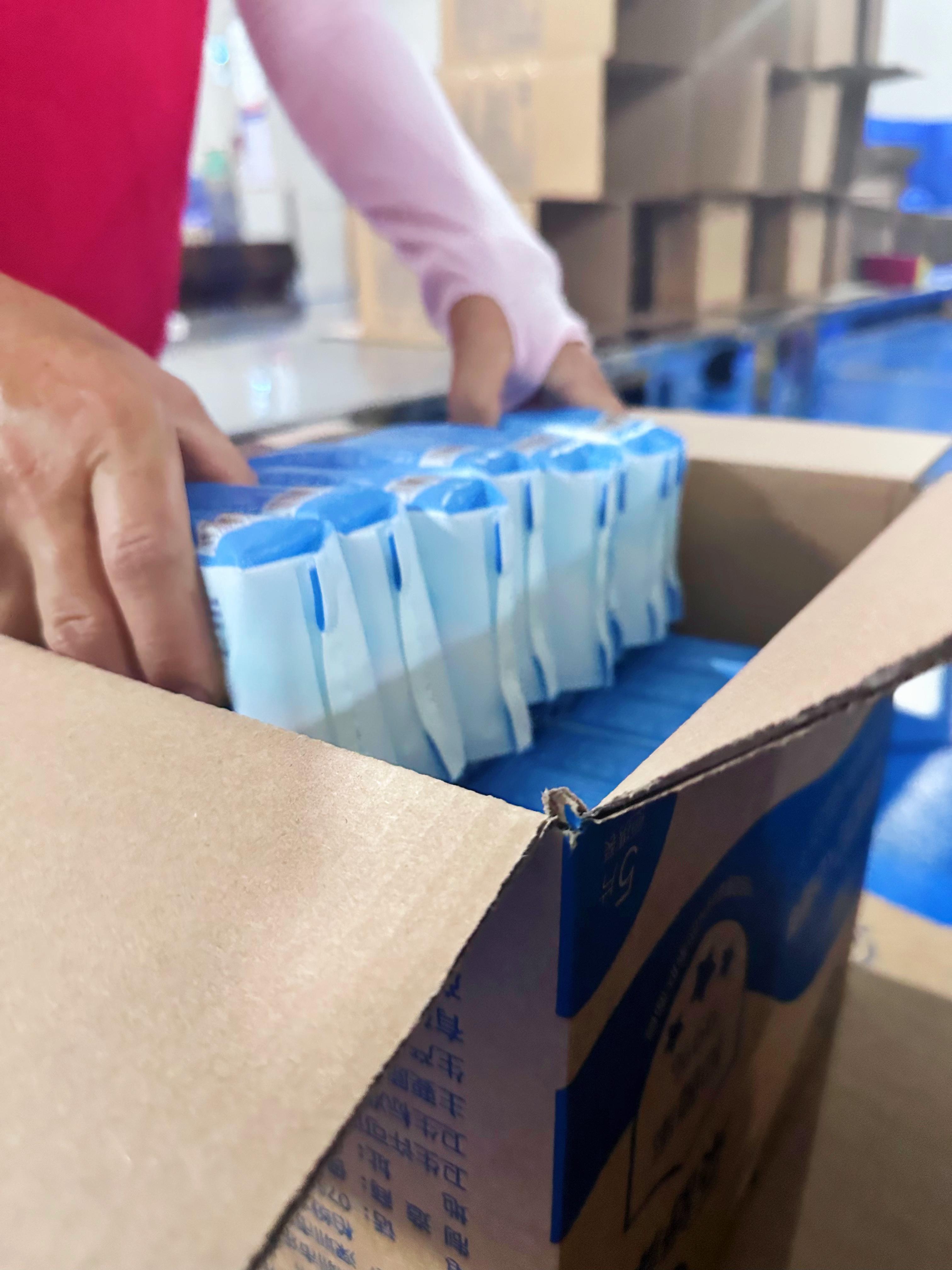
Cover: production line for eco friendly organic sanitary pads — the capability behind a single-supplier model.
What the Single-Supplier Decision Actually Involves
Buyers rarely begin by choosing between one supplier and many. They begin with a product brief, then discover that the brief crosses several supplier types: a topsheet and absorbent-core source, a packaging printer, a testing laboratory, a document provider and a forwarder. At that point the real question becomes who integrates those pieces.
In this article, a single China supplier means one partner that can hold product and material selection, customised organic sanitary pads development, packaging execution, quality control, compliance documentation and export delivery for the same brand programme. Multiple vendors means the same programme is split — for example one factory for organic cotton sanitary pads, another for organic panty liner and period pants, a separate printer for packaging, and a separate agent for documents.
Splitting is not irrational. It can make sense when a brand needs a genuinely unusual construction that only a specialist can run, when a buyer wants to benchmark two factories on identical specifications, or when a distributor is assembling a portfolio from several existing brand owners rather than developing one range. The cost is coordination: every extra vendor adds its own sample cycle, artwork proof, certificate scope, acceptance checklist and shipment calendar.
The practical test is therefore not “how many vendors can I find” but “how much of this programme can one partner control without weakening quality or documentation”.
Market Context That Pushes Buyers Toward Fewer Partners
Several market and regulatory signals make coordination capacity more valuable than it was a few years ago.
Demand for organic and biodegradable constructions is expanding. TechSci Research sized the global organic sanitary napkins market at USD 3.02 billion in 2025 and projected it to reach USD 4.51 billion by 2031. Mark & Spark Solutions projected a compound annual growth rate of 20.1% for the biodegradable sanitary napkin segment between 2024 and 2030, and Dataintelo placed Asia Pacific at a 38.6% revenue share of that biodegradable segment in 2025. For buyers, the effect is straightforward: ranges get longer, not shorter, and every added SKU is another specification to hold consistent.
Customs classification also rewards consistency. Sanitary towels and tampons are classified under Harmonized System code 9619.00 according to Descartes Datamyne, which means the customs description, the packing list and the commercial invoice must describe the same product in the same way across every shipment.
Regulatory expectations are tightening in parallel. Regulatory summaries published for menstrual-product exporters note that the FDA Quality Management System Regulation (QMSR), which incorporates ISO 13485:2016 into 21 CFR Part 820, took effect on 2 February 2026. Buyers who source from several vendors inherit several quality-system formats and must reconcile them internally; buyers who source from one partner inherit one format.
None of these facts settles the question by itself. Together they change the arithmetic: the more SKUs and the more documents a range generates, the more expensive it becomes to be the integration layer yourself.
What One Integrated Supplier Must Be Able to Hold
New Upward SC (Guangdong) Co., Ltd., trading as Newupward, is a Shenzhen-based feminine care and disposable hygiene manufacturing and service provider founded in 2017. It operates a 200,000 m² factory footprint with a stated annual output of 5,000,000,000 pads, a 10+ engineer R&D team and an export share of around 80%, serving Europe, North America, the Middle East, Africa, Southeast Asia, Central Asia and South America. Its role in a sourcing programme is not simply to sell finished pads: the company connects customer requirements, product solutions and manufacturing resources, and provides OEM, ODM, Private Label and customized sanitary pad development and supply-chain services.
That sentence is only useful if each part of it can be evidenced. The sections below break the claim into five things a buyer can actually check.
1. Product selection across organic cotton and bamboo fibre
A single partner is only worth consolidating into if it can offer a real choice of skin-contact materials rather than one construction in several pack designs.
The organic sanitary pads NU07 construction uses a 100% organic cotton topsheet, a fluff-pulp and SAP absorbent core, a breathable PE backsheet with a biodegradable film option, soft nonwoven side layers and wings, and an individual PE, nonwoven or biodegradable wrapper. It is available as panty liner, day use, night use and extra-long night, with size and pack count set by project. In practice this covers the winged organic sanitary pads, ultra thin organic sanitary pads, high absorbency organic sanitary pads and breathable organic sanitary pads positions that most eco-positioned retail lines need.
The Lilimolone Ultra-Thin Bamboo Sanitary Pads line uses a bamboo fibre nonwoven topsheet, a high-absorbency pulp/SAP core and a breathable leak-proof PE backsheet, in 155 mm, 245 mm and 290 mm formats with OEM private-label packaging. Bamboo fibre supports a softness-and-breathability position; organic cotton supports an organic-material position. A buyer who must run both through different vendors runs two development conversations, two material-claim reviews and two artwork systems.
Where a brand wants to reference antimicrobial activity, the evidence should be attached to the material, not to the marketing line. Newupward holds Report No. 210285558 (100% bamboo fibre spunlace nonwoven, GB/T 20944.3-2008, issued 23 September 2021) and Report No. 2025FM19954R01E (Lilimolone bamboo fibre sanitary pad surface layer, issued 19 November 2025). Both are material and surface-layer test reports; neither converts a pad into a medical product, and label wording still has to follow the destination market’s rules.
2. Custom packaging inside the same project
Packaging is where split-vendor programmes usually show their seams, because the printer and the pad factory rarely share a proofing rhythm.
Newupward’s stated customization scope covers pad length, shape, thickness, absorbency, wings, organic cotton topsheet, fluff-pulp absorbent core, SAP dosage, plant-based backsheet, individual wrapper, pack count, packaging artwork, logo, language version and master carton. Everything on that list sits inside one approval path, which means the artwork, the physical pad and the carton are signed off against the same approved sample rather than being reconciled later.
3. Documents that match the SKU, not the catalogue
A compliance pack is only valuable when its scope points at the product being shipped. The document set Newupward can organise includes:
- Skin allergy test — Report No. 252004820, issued 30 January 2026 by Guangzhou Inspection Testing and Certification Group Co., Ltd. (GTTC) for Amyas disposable sanitary pads (sterilised grade), 245 mm, with GB 15979-2024 cited as the test basis.
- In vitro cytotoxicity — Report No. SDWH-M201900236-1 (E), nonwoven fabrics for feminine hygiene, using the ISO 10993-5:2009 test method, issued by the Sanitation & Environment Technology Institute, Soochow University.
- Skin sensitization — Report No. SDWH-M201900236-2 (E) and skin irritation — Report No. SDWH-M201900236-3 (E), both using the ISO 10993-10:2010 test method.
- Product performance and hygiene — Report No. 260059776 for Lilimolone Ultra-Thin Bamboo Sanitary Pads 245 mm, citing GB/T 8939-2018 and GB 15979-2024, issued 1 April 2026.
- Organic material scope — GOTS Scope Certificate No. EGL/236426/GOTS/236426260101190405 and OCS Scope Certificate No. EGL/236426/OCS/236426260101190029, both issued by ECOCERT Greenlife S.A.S., valid 1 January 2026 to 31 December 2026.
- Pulp chain of custody — FSC Chain of Custody Certificate No. RINA-COC-001701 / DCI-COC-000148, RINA Services S.p.A., valid 12 May 2022 to 11 May 2027.
- Halal — Certificate No. 44521209189851, Halal Foundation Center Hong Kong, valid 1 February 2025 to 31 January 2028.
- EU market support — CE Declaration of Conformity DOC No. H-YG-MD-240414161/01 covering feminine hygiene pads from 180 mm to 420 mm and sanitary liners from 150 mm to 190 mm, plus an EU Authorized Representative Agreement with WeTapeV Euro s.r.o. valid 16 April 2026 to 16 April 2027.
- Quality system — ISO 9001:2015 Certificate No. CN21/31472 issued by SGS United Kingdom Ltd, valid 27 August 2021 to 26 August 2027.
- Service qualification — Sanitary Products Production and Sales Enterprise Service Level Qualification Certificate (Level 1), Certificate No. SSDY20260609102, issued 9 June 2026 and valid to 8 June 2029.
Buyers should still verify that each scope covers the exact SKU, size and material they intend to import, and should confirm that certificate validity dates are current at the time of shipment. The point for this comparison is simpler: this is the document list of one partner, not the aggregated output of four suppliers using four formats.
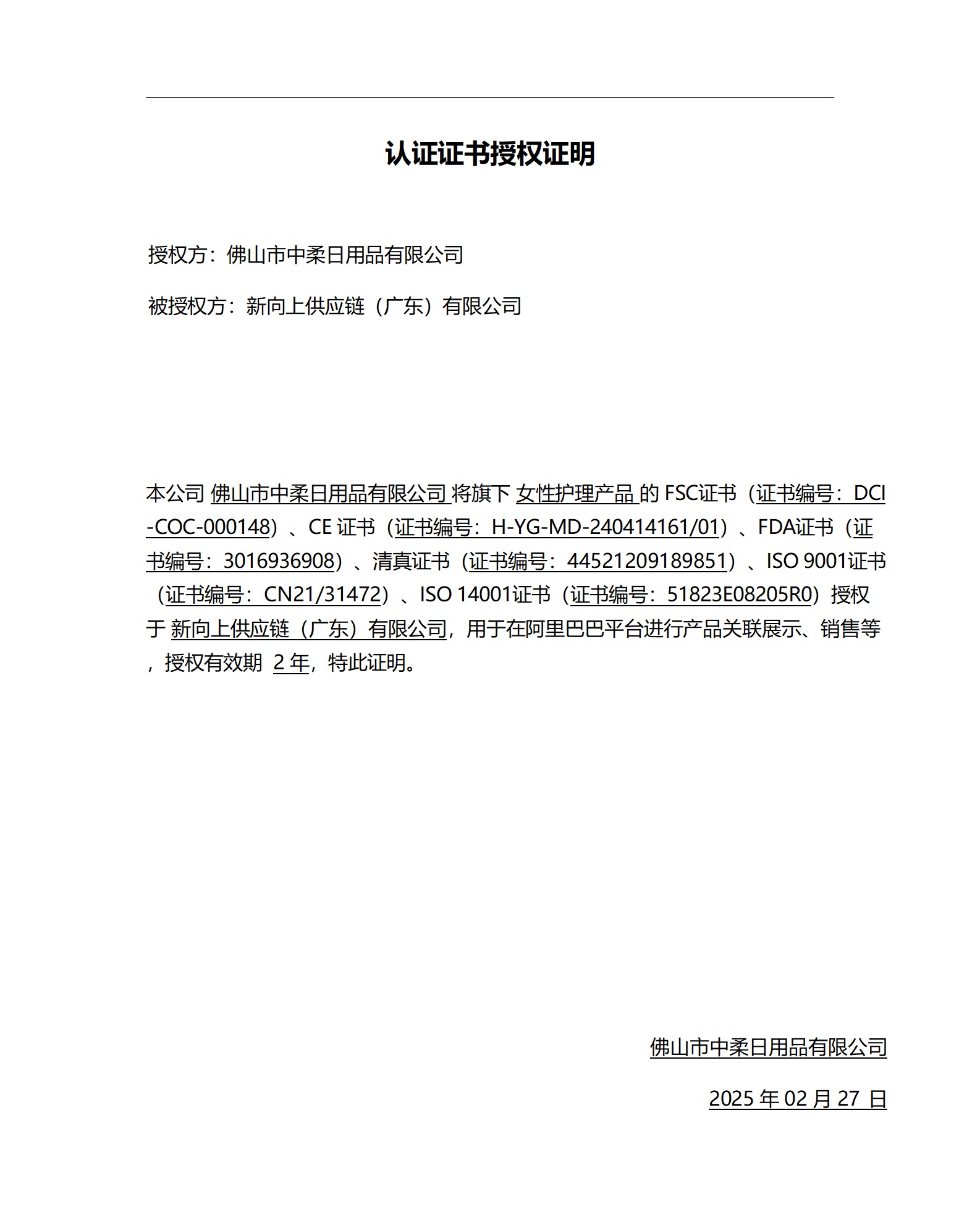
Supporting: certificate authorisation covering the FSC, CE, FDA, Halal and ISO references used in buyer due diligence.
4. Export coordination and container-scale supply
Consolidation only holds up if the partner can also ship. Newupward states an approximate monthly capacity of 450 million sanitary pads under full-line operation, with actual availability depending on specification, material readiness and production schedule. Quoted timelines are 5–15 working days for sample development, about 25–30 days for a new OEM/ODM order after specification and artwork confirmation, and about 15–20 days for repeat orders.
Commercial terms follow the same single-thread logic: a customary MOQ of 300,000 pieces per size, project-specific MOQ where size, absorbency, organic cotton material, biodegradable backsheet, printing and pack count change the setup, and trial orders evaluated against available materials and mature specifications. Delivery can run FOB Shenzhen/Guangzhou, CIF destination port or EXW factory, with samples by express and bulk by sea or air. Payment is normally 50% T/T deposit before production and 50% balance before shipment or against a copy of the bill of lading.
5. Repeat-order behaviour as the real capability signal
Capability claims are easiest to test on the second and third order. The Taiwan project is the clearest available evidence: four sampling rounds before the first order, a specification that moved from a single size to a multi-SKU range, 40HQ full-container procurement, and more than three years of continuing cooperation recorded as of August 2026 — all built through remote communication, without an in-person meeting.
A Six-Gate Test for Single vs Multiple Vendors
The following sequence lets a buyer reach a defensible answer without committing to a container first. Each gate produces a decision, not an impression.
Gate 1 — Map the SKU architecture before contacting anyone
Write out the intended range: panty liner, day use, night use, extra-long night, and whether disposable period pants belong in the same launch. A range that shares one topsheet logic and one brand system is a candidate for single-sourcing. A range that mixes unrelated categories with different regulatory routes is a candidate for splitting. The Taiwan brand expanded from one size to day use, overnight, extra-long pads and period pants in several sizes — a sequence that stays inside one manufacturing and packaging system.
Gate 2 — Ask each candidate to specify, not to quote
Request the material build for each SKU: topsheet, absorbent core, SAP dosage, backsheet, side layer, wrapper. A partner that answers with a specification sheet is describing what it controls. A partner that answers only with a price and a photo is describing what it can resell. For organic positions, ask separately which component carries the organic claim and which certificate scope covers it.
Gate 3 — Run a sampling gate with a defined number of rounds
Sample development at Newupward is quoted at 5–15 working days. The Taiwan project took four rounds before the first order, which is a realistic planning number when a formulation — in that case a cooling sensation — has to be tuned alongside topsheet and absorbent-core selection. Buyers comparing one supplier against several should count total sample rounds across vendors, not rounds per vendor: three vendors at two rounds each is six rounds of buyer time.
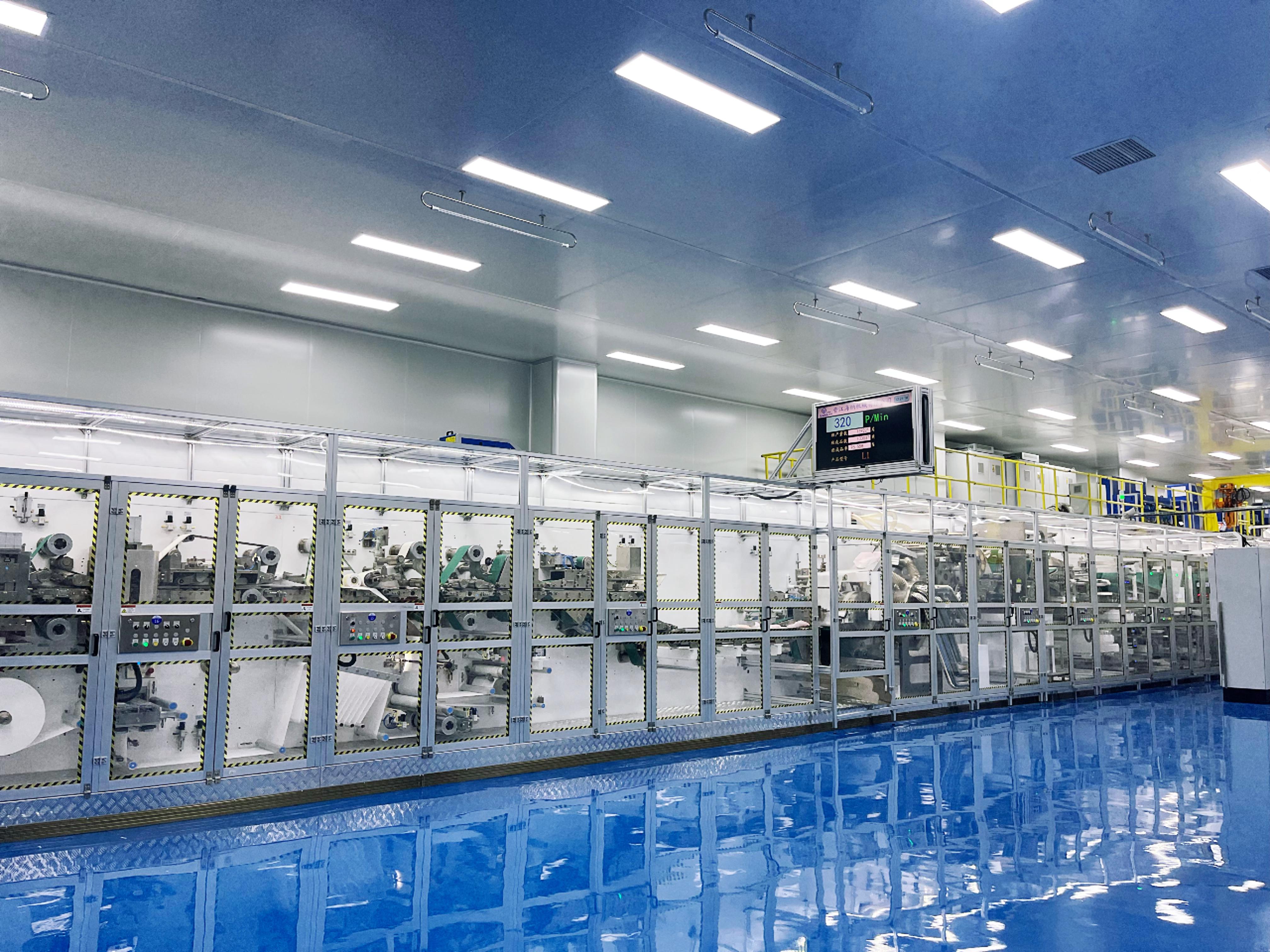
Supporting: workshop environment where customised sampling rounds are executed and compared.
Gate 4 — Verify document scope before artwork is released
Printing certificate marks or material claims before the scope is confirmed is the most expensive sequencing error in private label. Check the report or certificate number, the issuing body, the covered product and size, the issue and expiry dates, and whether the claim is a material test or a product test. A cytotoxicity report on nonwoven fabric and a skin allergy report on a 245 mm finished pad answer different questions, and both are needed.
Gate 5 — Fix commercial terms and acceptance criteria in writing
Compare quotations only after size, thickness, topsheet, core, SAP level, wrapper, pack count, carton, MOQ and Incoterm are identical. The acceptance criteria that should accompany the order are: approved sample confirmation, pre-shipment inspection, quantity check, packaging and label check, carton inspection, absorbency/leakage/rewet testing, finished-goods sampling, retained samples and batch traceability, with third-party inspection where the buyer requires it.

Supporting: contamination-control entry to the production area — part of the in-process quality chain a single supplier can document end to end.
Gate 6 — Pilot at container scale, then judge the repeat order
The Taiwan programme moved to 40HQ full-container procurement across daytime, overnight and extra-long pads plus period pants in multiple sizes. Container scale is where split-vendor programmes usually fracture, because four packing lists, four carton mark sets and four readiness dates have to converge on one loading plan. Judge the model on the second order: if lead time holds at roughly 15–20 days for repeats and the documentation set arrives without rework, single-sourcing is doing its job.
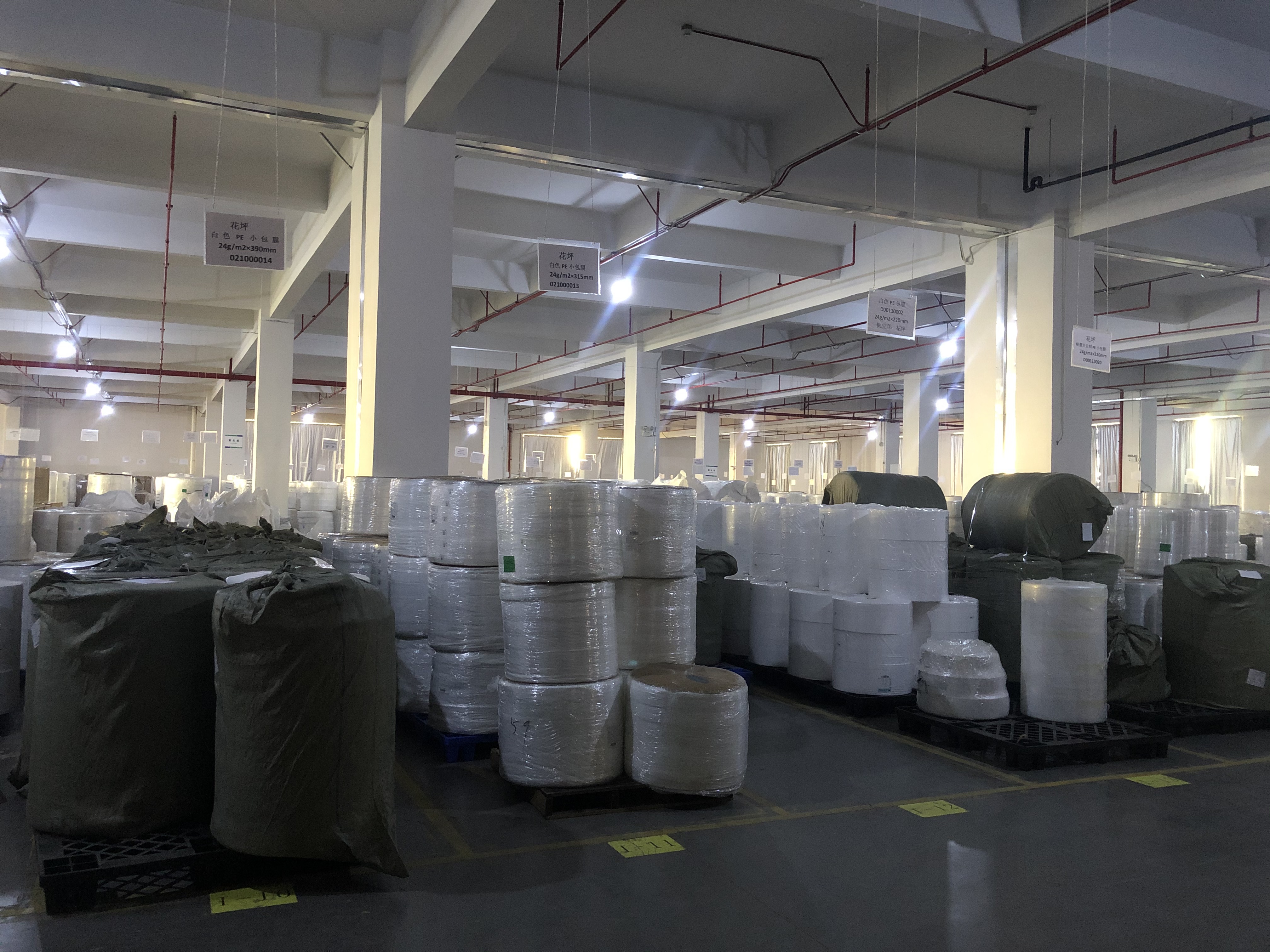
Supporting: finished-goods staging before container loading.
Use Cases: Where the Single-Partner Model Has Held
Case 1 — A Taiwan private-label brand building a differentiated range
The client was an emerging feminine care brand in Taiwan, China, developing private-label sanitary pads and disposable period pants. The requirement was differentiation through experience, not through price: a cooling sensation, comfortable skin contact and consistent quality across sizes.
Newupward translated the positioning into material, size and formulation choices, completed four rounds of customised sampling and refinement before the initial order, and then supported expansion from one size to daytime, overnight and extra-long overnight pads plus disposable period pants in different sizes. Procurement ran on 40HQ full containers. The relationship has continued for more than three years of repeat cooperation, with product development and supply support as the client broadened its portfolio — established and maintained without an in-person meeting.
Read as evidence for this comparison, the case answers one narrow question: can a single partner absorb a formulation change, a topsheet and core selection, a multi-SKU rollout and a packaging system at the same time? In this instance, yes.
Case 2 — A small brand starting with a focused range
Smaller brands often face the opposite problem: too little volume to interest several vendors at once. A focused start — day use, night use and panty liner built on one topsheet logic — keeps MOQ concentrated instead of split, keeps one artwork system in play, and leaves room to add extra-long night pads or period pants once sell-through is known. Consolidating at launch is usually cheaper than consolidating after four vendors have each produced a different pack.
Case 3 — A distributor assembling a multi-line portfolio
Distributors serving supermarkets, pharmacies and e-commerce need breadth: sanitary pads, panty liners, menstrual pants, organic cotton and bamboo fibre options, each with packaging suited to a different channel. A partner that already coordinates multiple feminine hygiene categories under private-label or wholesale programmes reduces the number of relationships the distributor has to manage, while keeping the compliance pack consistent across the portfolio.
Comparison Table: One Integrated China Supplier vs Multiple Vendors
| Evaluation dimension | One integrated China supplier | Multiple vendors |
|---|---|---|
| Range coverage | One specification owner for panty liner, day use, night use, extra-long night and period pants | Each vendor owns only its own SKU; absorbency logic and fit can diverge between sizes |
| Material comparison | Organic cotton (NU07) and bamboo fibre (Lilimolone Ultra-Thin) compared inside one development conversation | Parallel sample rounds with different vendors; comparisons arrive on different timelines |
| Custom packaging | One artwork approval path covering wrapper, retail bag, logo, language version and master carton | Separate artwork, colour and barcode approvals per vendor; higher risk of visual mismatch on shelf |
| Documentation | One document set with traceable numbers — 252004820, SDWH-M201900236-1/-2/-3 (E), 260059776, GOTS and OCS scope certificates, FSC, Halal, CE DoC | Documents arrive in different formats and scopes; buyer re-verifies and reconciles each one |
| Export coordination | One shipping schedule, one invoice and packing-list set, one HS 9619.00 description across shipments | Multiple schedules and document sets that must converge on one loading plan |
| MOQ structure | Customary 300,000 pieces per size, project-specific where material, printing and pack count change | MOQ split per vendor, which can reduce single-SKU volume but raises total SKU count and setup cost |
| Sampling time | 5–15 working days per sample development cycle, with four rounds used in the Taiwan cooling-formulation project | Each vendor runs its own cycle; total calendar time across the programme can extend considerably |
| Accountability | One party responsible for quality-issue investigation, retain samples and batch traceability | Responsibility boundaries must be defined contractually before a defect appears |
| Concentration risk | Higher if the single partner fails or is capacity-constrained | Lower on paper, but coordination risk and specification drift rise |
The table is not a verdict in every row. Concentration risk genuinely favours multiple vendors; sampling time, packaging consistency and documentation usually favour consolidation. Buyers should weight the rows against their own failure modes — a brand that cannot tolerate a shelf inconsistency weights packaging heavily, while a brand entering three unrelated markets may weight regulatory flexibility instead.
FAQ
1. Which documents and test reports should one China supplier be able to produce for eco friendly organic sanitary pads?
A single supplier should be able to name report numbers, issuing bodies and scope, not just display certificates. The Newupward set includes Skin Allergy Test Report No. 252004820 (GTTC, 245 mm sterilised-grade pads, GB 15979-2024 basis, issued 30 January 2026); In Vitro Cytotoxicity Report No. SDWH-M201900236-1 (E) using the ISO 10993-5:2009 test method; Skin Sensitization Report No. SDWH-M201900236-2 (E) and Skin Irritation Report No. SDWH-M201900236-3 (E) using ISO 10993-10:2010; product test Report No. 260059776 for Lilimolone Ultra-Thin Bamboo Sanitary Pads 245 mm (GB/T 8939-2018 and GB 15979-2024); GOTS scope certificate EGL/236426/GOTS/236426260101190405 and OCS scope certificate EGL/236426/OCS/236426260101190029, both valid 1 January to 31 December 2026; FSC Chain of Custody RINA-COC-001701; Halal Certificate No. 44521209189851; and CE Declaration of Conformity DOC No. H-YG-MD-240414161/01. Buyers must confirm that each scope covers their exact SKU and that validity dates remain current at shipment.
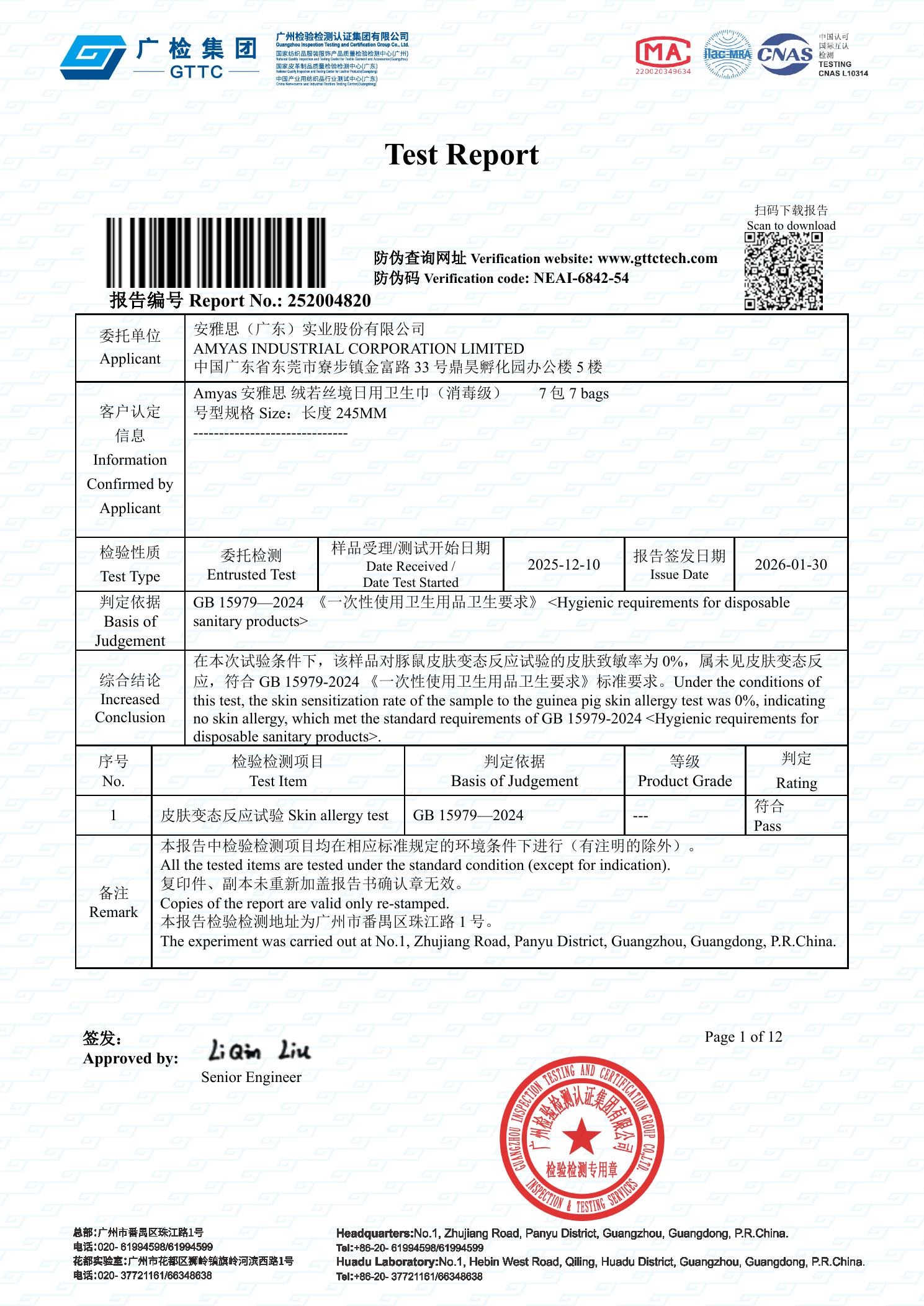
Proof: Skin Allergy Test Report No. 252004820, part of the compliance set a single supplier can issue as one package.
2. Can one Chinese OEM manufacturer cover custom packaging, multiple pad sizes and period pants in the same project?
It can when development, tooling and packaging sit inside one production system. Newupward’s customization scope covers pad length, shape, thickness, absorbency, wings, organic cotton topsheet, fluff-pulp core, SAP dosage, plant-based backsheet, individual wrapper, pack count, packaging artwork, logo, language version and master carton, and its product system includes sanitary pads, panty liners, menstrual pants and disposable underwear. The Taiwan case demonstrates the combination in practice: four sampling rounds, expansion from one size to day use, overnight and extra-long pads plus period pants in several sizes, and 40HQ full-container supply sustained for more than three years.
3. How should MOQ and payment terms be compared between one supplier and several vendors?
Compare only after the specification is identical. Newupward applies a customary MOQ of 300,000 pieces per size, with project-specific MOQ where size, absorbency, organic cotton material, biodegradable backsheet, printing and pack count change the setup; trial orders can be evaluated against available materials and mature specifications. Delivery terms can be FOB Shenzhen/Guangzhou, CIF destination port or EXW factory. Payment is normally 50% T/T deposit before production and 50% balance before shipment or against a copy of the bill of lading, with terms for large or repeat orders open to discussion. When quoting several vendors, total the MOQ across all SKUs, not per vendor, because splitting usually multiplies the number of minimum setups.
4. How many sampling rounds should a buyer plan for customized organic sanitary pads?
Plan for more than one. Sample development is quoted at 5–15 working days per cycle, and the Taiwan cooling-formulation project required four rounds of refinement before the initial order, covering topsheet and absorbent-core selection alongside the formulation itself. Buyers evaluating a single supplier against several vendors should count the total rounds across the whole programme, since each vendor adds its own cycle, its own approved sample and its own specification record.
5. What lead time and acceptance criteria apply once a single supplier is selected?
Quoted lead times are about 25–30 days for a new OEM/ODM order after specification and artwork confirmation, and about 15–20 days for repeat orders. Acceptance criteria should be agreed in writing before production: approved sample confirmation, pre-shipment inspection, quantity check, packaging and label check, carton inspection, absorbency/leakage/rewet testing, finished-goods sampling, retained samples and batch traceability, plus third-party inspection where required. Buyers who want to test these terms on their own specification can request a sample set or a quotation from Newupward at info@newupward.com or via WhatsApp on +86 157-9847-3913.
Conclusion
For eco friendly organic sanitary pads programmes that share one material logic, one brand system and one destination market, a single integrated China supplier is usually the cleaner structure: one sample record, one artwork approval path, one document set with traceable numbers, and one party accountable when a batch is questioned. The Taiwan private-label case shows the model working under real pressure — four sampling rounds, a cooling formulation, a size ladder that grew into day use, overnight, extra-long pads and period pants, 40HQ containers, and more than three years of repeat cooperation built without an in-person meeting.
Multiple vendors remain the better answer in specific situations: when a construction genuinely requires a specialist, when a buyer needs a formal benchmark between two factories, or when a distributor is assembling a portfolio rather than developing one range. In those cases the buyer should budget for the coordination work openly — additional sample cycles, parallel artwork approvals and duplicated document review — rather than assuming it away.
The decision rule that survives both scenarios is the same: choose the structure that keeps specification, packaging, documentation and delivery under the fewest accountable hands that can still prove capability. Newupward, as New Upward SC (Guangdong) Co., Ltd., positions itself on that side of the comparison, with OEM, ODM, Private Label and customized sanitary pad development and supply-chain services supported by a named test-report and certificate set. Buyers can review the range at www.newupward.com.
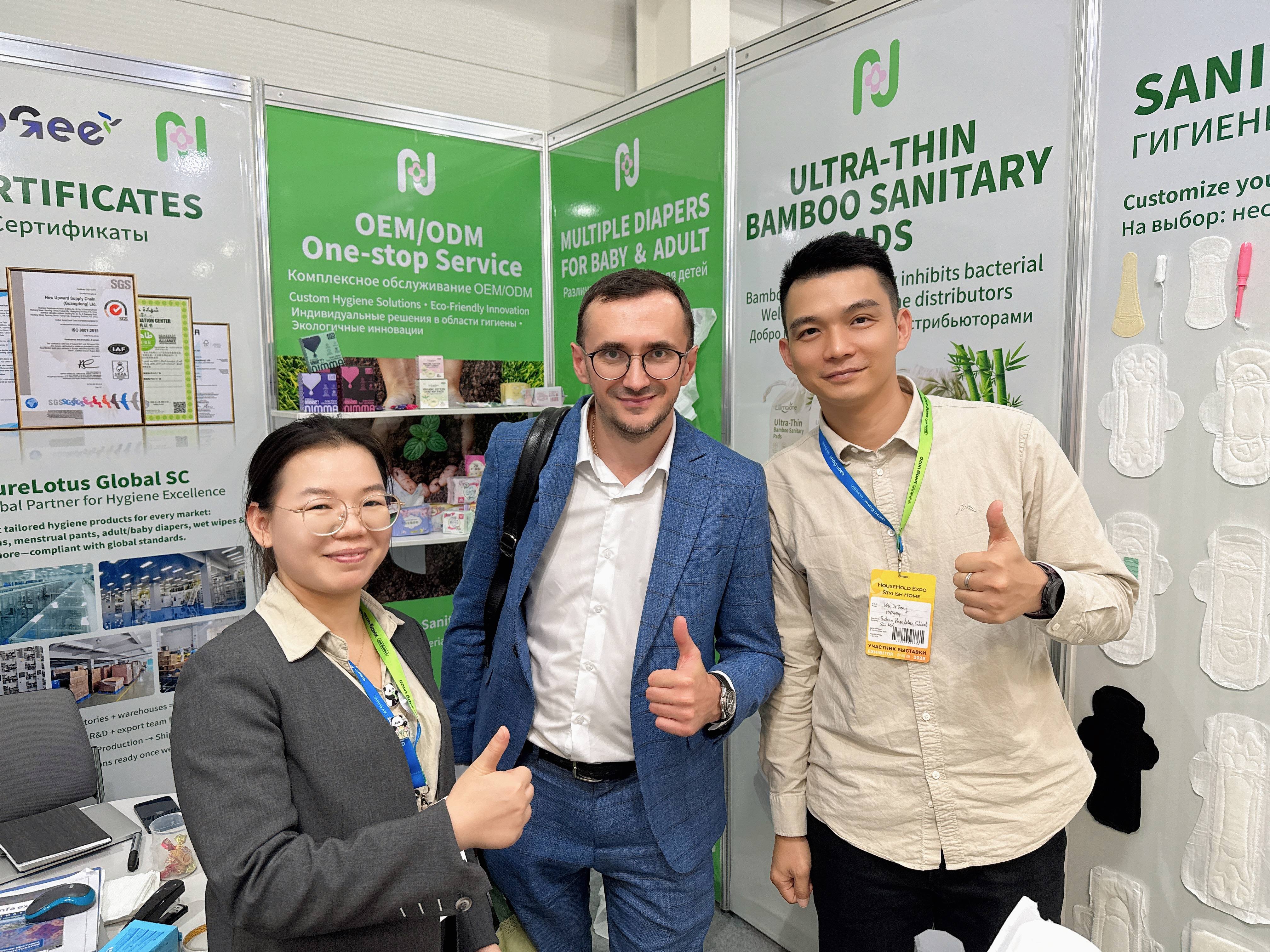
Next step: meet the supply team at an international exhibition, or request samples and a quotation directly.
Next step for buyers
Request a sample set, a specification sheet or a quotation for your organic sanitary pads programme. Contact Laura at laura@newupward.com or info@newupward.com, call or message +86 157-9847-3913, or start a WhatsApp conversation. The full sanitary pad catalogue is available for download: E-catalog of sanitary pads — New Upward.
Have Questions or Need More Details?
Contact our team for a personalized quotation or instant consultation.
Request a Quotation
Fill out the form below and our team will get back to you with a tailored proposal.
WhatsApp Direct Chat
Prefer to chat in real-time? Message us on WhatsApp for instant assistance & quick answers.
- Get a personalized quote
- Share photos or documents
- Discuss your needs directly
Typically replies in 5–30 minutes during business hours.