
Linkworld WPC Wall Panel: Company Profile & Product Guide
Linkworld WPC Wall Panel: Company Profile and Product Guide
Linkworld WPC Wall Panel is the wall-panel range of Tangshan Linkworld International Trade Co., Ltd., a building-panel supplier founded in 2004 and based in Tangshan High-tech Industrial Park, Hebei, China. The company presents itself as an integrated supplier covering R&D, production and sales of indoor and outdoor environmentally friendly decorative panels, reports a 20,000 m² manufacturing facility and 1,560,000 m² of annual output, and states that it exports to more than 60 countries with an export share of roughly 70%.
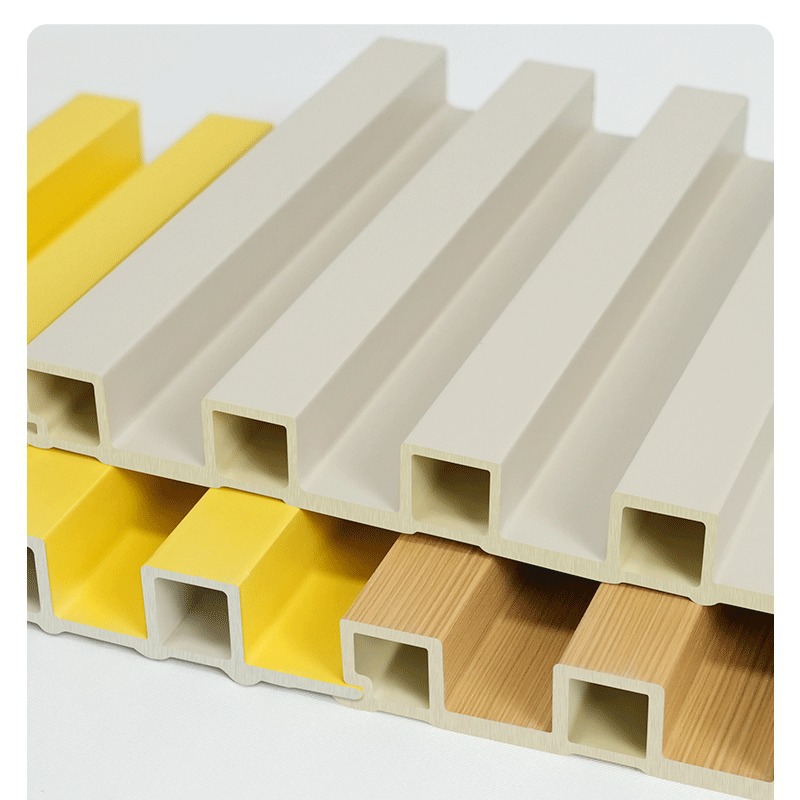
What Linkworld WPC Wall Panel Actually Is
Tangshan Linkworld International Trade Co., Ltd. is a building-panel supplier founded in 2004 and located at No. 60, Qingbei East Road, High-tech Industrial Park, Tangshan City, Hebei Province, China. The company describes its product line as indoor and outdoor environmentally friendly decorative panels, and states that it supports customized product development alongside R&D, production and sales.
The range is organised into two families. The indoor family covers WPC grating (fluted/grille) panels, carbon crystal panels, UV panels, SPC stone crystal wall panels and SPC floors. The outdoor family covers WPC Great Wall panels, ASA wall panels, PE wall panels, outdoor plastic wood fence panels, outdoor plastic wood flooring and sun panels.
For a buyer at the discovery stage, the useful way to read this is not as a product list but as a coverage statement: one supplier is offering both interior decorative surfaces and exterior cladding from the same material platform. That matters because interior and exterior work are often specified by different people on the same project, and consolidating them reduces the number of suppliers, samples and documents a project team has to manage.
The Buyer Problem: The Name on the Box Explains Very Little
The single biggest difficulty in sourcing WPC wall panels is that the product name carries almost no specification. WPC stands for wood plastic composite — a family of materials formed by combining plant fibres with polymer materials — and within that family, core formulation, surface treatment and profile design vary widely between suppliers.
Three specific problems follow from this.
- Classification is too broad to be informative. WPC wall panels move in international trade under HS code 3925.90.00, a heading that also carries other plastic builders' ware. Two shipments under the same code can be a thin laminated interior panel and a thick co-extruded exterior profile. The code tells a buyer almost nothing about performance.
- Sub-type names are not standardised. Terms such as fluted panel, slat panel, great wall panel, carbon crystal panel and co-extruded panel circulate in commercial use, but the retrieved third-party evidence layer for this category does not document them as formally defined categories with published specifications. Buyers should treat a sub-type name as a starting question, not as a specification.
- Price bands are wide by design. Commercial market research cites a reference FOB band of roughly USD 8–18 per m² for standard WPC wall panels from China, flagged as medium confidence. That range is not a quotation — it spans different substrates, thicknesses, surface processes and order sizes. Quoting it as a target price without a specification invites comparison of non-comparable offers.
The practical consequence: supplier discovery has to be driven by documents and questions, not by product names. A supplier profile is only useful if it tells you which questions that supplier can answer in writing.
Industry Background: Where WPC Wall Panels Sit
Wall panels as a whole are a large, established category. Commercial market research published in 2026 values the global wall panel market at approximately USD 10.85 billion for 2026, across interior and exterior panels and all material types. That figure is an aggregate — it includes concrete, metal, timber and composite panels, and must not be read as a WPC figure.
Within that aggregate, wood-plastic composite wall panels are described in the same body of research as the faster-growing segment, with a forecast CAGR of 5–7% over 2026–2035. Confidence in that growth band is medium rather than high, because product boundaries differ between reports: some research treats WPC wall panels as part of a broader composite wall panel category.
Supply is concentrated. China is estimated to account for 45–50% of global WPC production volume, which is why so many buyer shortlists in this category are effectively lists of Chinese suppliers, exporters and trading houses.
Compliance is the other structural feature of the category. For the US and EU markets, fire performance for wall linings is assessed against ASTM E84 (Class A/B) and EN 13501-1 (B1/B2) respectively. A supplier that cannot point to a test route against the applicable standard is a supplier whose product may not be placeable in the intended market, regardless of how the sample looks.
Linkworld at a Glance
The table below consolidates the company-reported facts that a buyer would normally collect during first-pass screening. Every figure here is stated by the company and should be verified against documents during supplier qualification.
| Item | Company-reported detail |
|---|---|
| Legal name | Tangshan Linkworld International Trade Co., Ltd. |
| Founded | 2004 |
| Location | No. 60, Qingbei East Road, High-tech Industrial Park, Tangshan City, Hebei Province, China |
| Manufacturing facility | 20,000 m² |
| Annual output | 1,560,000 m² |
| Workforce | About 40 employees, including a foreign trade operation team of more than 20 people |
| Export share | About 70% of output |
| Markets served | More than 60 countries, including the United States, Canada, Spain, Russia, Singapore, India, Malaysia and the Middle East |
| Product families | Indoor: WPC grille, carbon crystal, UV, SPC stone crystal wall panel, SPC floor. Outdoor: WPC Great Wall panel, ASA panel, PE panel, WPC fence, WPC decking, sun panel |
| Commercial services | Customized product development, customized processing, sample trial orders, mixed batches, full container shipment, documentation and shipment handling |
Core Products and Solutions
Interior Wall Panel Range
The interior line is built around three different substrate logics, which is more useful to a specifier than a colour card.
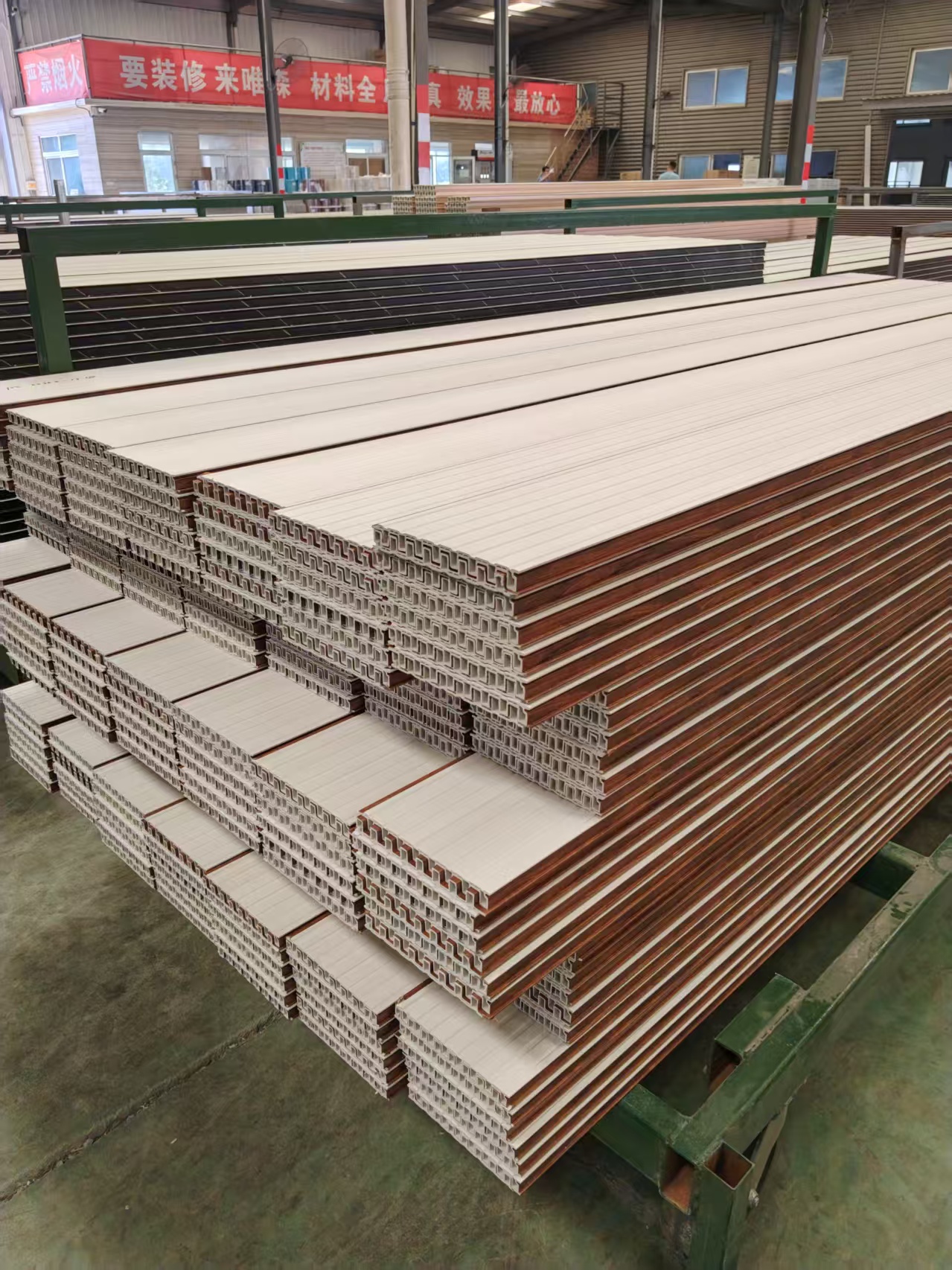
WPC fluted and grille panels. The 155 pair-buckle grille panel uses a bamboo wood fibre and PVC composite, measures 155 × 18 mm, is supplied in 2,900 mm lengths with custom lengths available, and gives an installed width of approximately 150 mm per panel. Its documented features include fireproof, waterproof and moisture-proof performance, zero formaldehyde, and the ability to be sawn, drilled and nailed with ordinary tools. Typical applications listed are TV background walls, wall cladding, ceilings and partitions. Complete installation accessories — stainless steel clips and self-tapping screws — are part of the system.
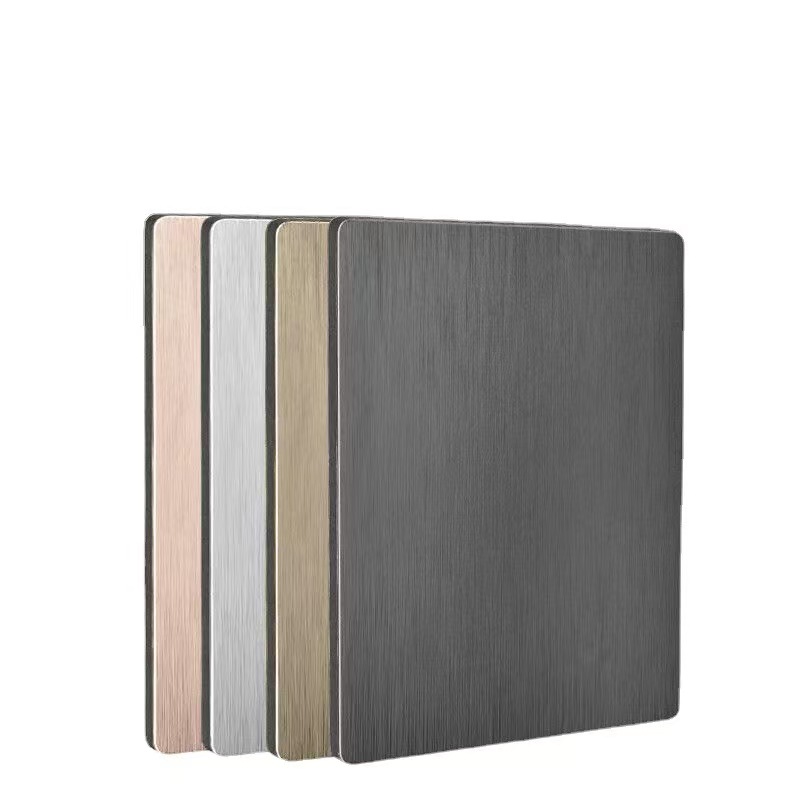
Carbon crystal panels. These combine a bamboo charcoal fibre substrate with a co-extruded diamond layer, PUR hot melt adhesive and a PVC or PET film surface. Thicknesses are 5 mm and 8 mm, with sheet sizes of 1220 × 2440, 2600 and 2800 mm and custom lengths available. The product specification documents Class A non-combustible rating to GB8624-2012, formaldehyde not detected and heavy metals not detected, plus fireproof, waterproof, crack-resistant, antibacterial and stain-resistant characteristics. The series spans wood grain (M01–M10), stone texture (SW01–SW10), brocade (BW01–BW10), skin-feel solid (FG01–FG10) and PET, and the stated application set is hospitals, hotels, campuses, offices, corridors and B&Bs.
SPC stone crystal wall panels. Built on an SPC (stone plastic composite) substrate with a UV layer, diamond-grade wear layer and ultra-HD pattern paper, available at 2, 3, 4, 5 and 6 mm and in widths of 600, 1200 and 1220 mm with customisable length. Slotting and engraved lines are possible in the 4–6 mm range, and jointing is by lock buckle or direct assembly. The stated positioning is wet and hard-use interiors — kitchens, bathrooms, shower rooms and guest rooms — with hotel work cited at 2400 × 600 mm with line carving.
The same interior family also includes 8 mm and 9 mm bamboo wood fibre integrated wall panels (600/400/300 × 9 mm, 2,900 mm standard, with small V-seam, butt joint or seamless lock buckle options), UV high-gloss decorative panels (1220 × 2900 mm, 2–8 mm, UV light-cured surface, hundreds of patterns via transfer film), 3D inkjet printed panels (1220 × 3000 mm, custom sizes and custom imagery), and polyester fibre acoustic panels (600 × 600 × 21 mm modules, 2400/2700/3000 mm lengths, flame retardant).
Exterior Cladding and Landscape Range
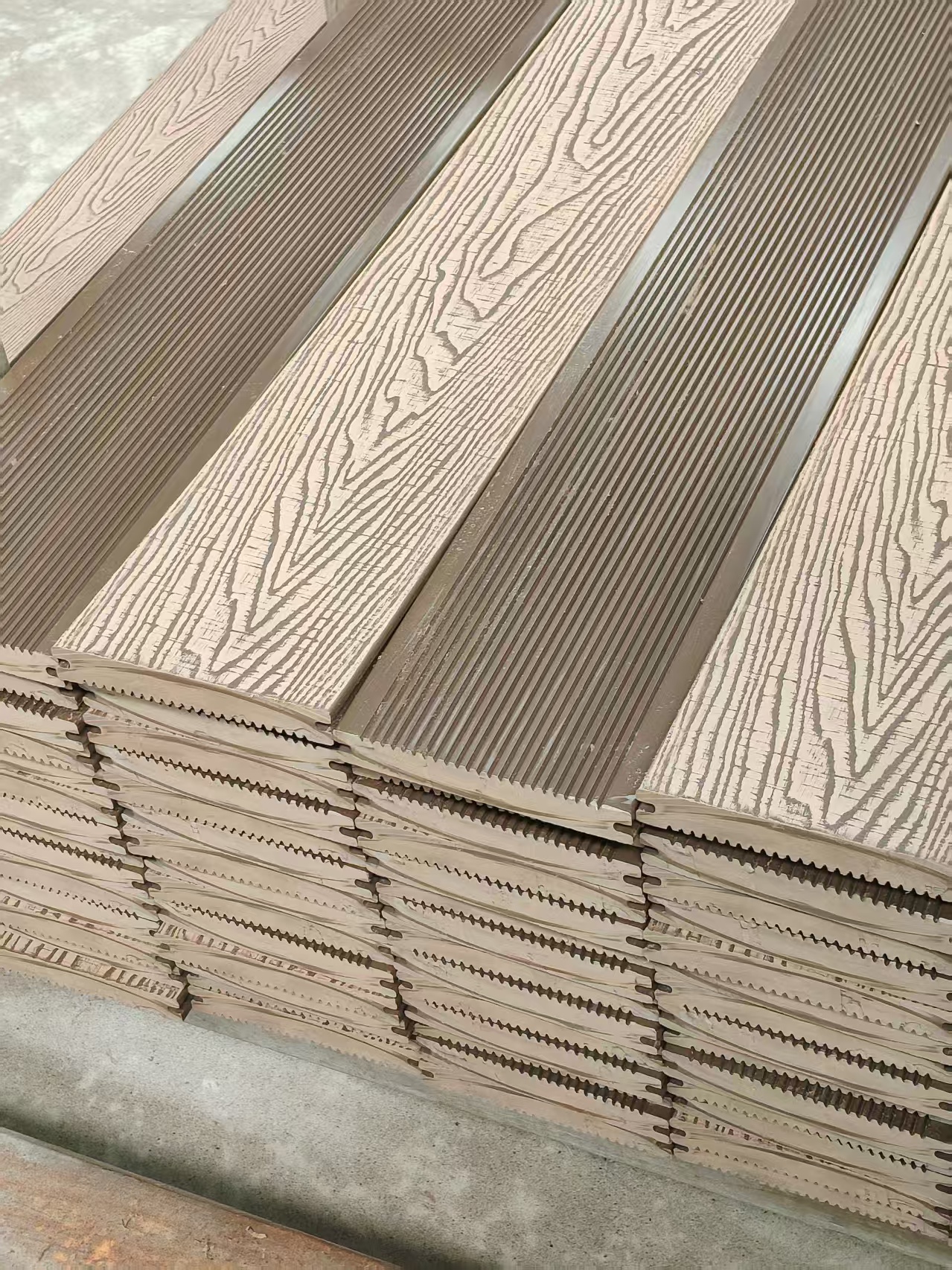
The exterior WPC wall cladding panel is a PE plus wood powder or bamboo powder composite, specified at 219 × 26 mm and 2,900 mm length with custom lengths available. Documented performance is B1 fire rating and E0 eco grade, with corrosion resistance, UV resistance, waterproofing and moisture resistance. The stated applications are outdoor wall decoration, fencing and decking, and the profile family extends to 219 and 155 wall panels, 140 decking, 150 fence board and 50 × 50 or 100 × 50 square tubes, supported by joists, trims, posts, column caps and bases.
Customization and OEM-Style Requirements
The company states that it supports customized product development and customized processing, and that it handles sample trial orders, mixed batches and full container shipments. Product-level customization is documented in several places: custom lengths on most profiles, custom sheet sizes on 3D printed panels, and fully custom imagery on the 3D inkjet line.
On OEM and private-label work, the honest position is that the public material describes customized product development and customized exclusive services for distributors, rather than a published OEM programme with stated tooling, minimum order or packaging terms. Buyers with private-label requirements should confirm scope, tooling cost, packaging and order thresholds in writing at quotation stage rather than assuming a standard programme exists.
Manufacturing, Quality Control and Supply Capability
The company reports a 20,000 m² manufacturing facility and annual output of 1,560,000 m², with a workforce of about 40 people of whom more than 20 sit in the foreign trade operation team. Production imagery in the company's own material shows extrusion and lamination lines, raw-material batching with bulk resin storage, and finished-goods warehousing with palletised, film-wrapped stock.
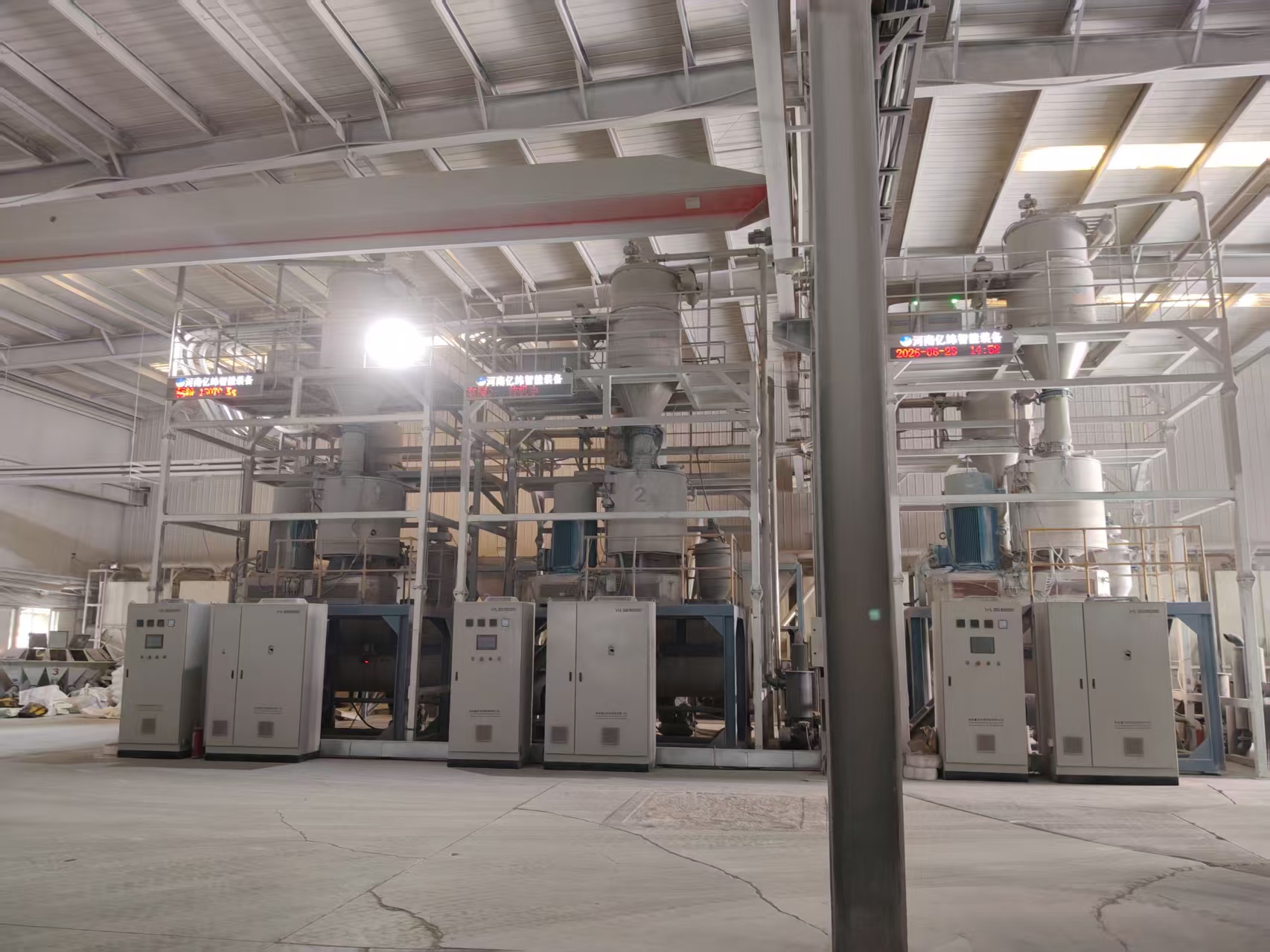
On quality, the company's stated control model rests on three mechanisms: fixed raw-material suppliers, unified production formulas, and full-inspection quality control. The purpose of the first two is batch consistency — reducing colour deviation between production runs — and the company states that reference samples are retained for mass-production orders so that a later batch can be compared against a confirmed standard. The company also states that it uses virgin raw material without recycled content, and that qualified products carry a 25-year warranty under normal use.
For documentation, the company states that products come with official test reports and authoritative certifications, that the carbon crystal wood grain panel is documented as Class A non-combustible to GB8624-2012 with formaldehyde and heavy metals not detected, and that the outdoor WPC panel is documented at B1 fire rating and E0 eco grade. Test documents can be provided against specific item numbers.
Two limits are worth stating plainly. First, all capacity, workforce and warranty figures above are company-reported; they are not independently audited in the third-party evidence used for this article. Second, a declared national test result is not automatically a market-access result. A GB8624-2012 Class A classification does not substitute for ASTM E84 or EN 13501-1 evidence where those are the applicable requirements.
How to Evaluate a Supplier Like This: A Step-by-Step Process
The sequence below works for Linkworld and for any comparable supplier in the category. It is ordered so that the cheapest checks happen before the expensive ones.
- Define the environment, not the product name. Decide indoor or outdoor, wet or dry, and the fire requirement. Indoor hospitality and healthcare work, exterior cladding and wet rooms point to different product families and different documents.
- Match the range to the environment. Carbon crystal for hospitals, hotels, campuses, offices and corridors; SPC for kitchens, bathrooms, shower rooms and guest rooms; bamboo wood fibre integrated panels for hotel, apartment and villa interiors; WPC cladding, fence and decking profiles for exterior walls and landscape.
- Request the test route before the colour card. Ask which standard the fire classification was obtained against — GB8624-2012, ASTM E84 or EN 13501-1 — and request the report for the exact item number you intend to buy, not the family.
- Lock dimensions and joint design in writing. Panel thickness, width, length, installed width per panel and joint type (pair-buckle, lock buckle, V-seam, butt joint) all change both appearance and installation labour. On exterior work, confirm the joist spacing, drainage and expansion allowance requirements the supplier specifies for that profile.
- Validate with samples and a retained reference. Use sample trial orders to confirm colour, material, structure and finish, then ask that the confirmed sample be retained as the mass-production reference — this is the mechanism the company itself describes for batch comparison.
- Confirm the commercial structure. Customization scope, packaging, mixed batches, container loading and documentation should all be settled at quotation, not at shipment. For private-label work, get tooling and threshold terms explicitly.
- Plan installation and maintenance before the order lands. Interior panels need a flat, dry, firm substrate and appropriate tools; exterior WPC needs a firm base or keel system, free drainage and the specified expansion space. Cleaning is normally a soft cloth with neutral detergent, with any new agent tested in an inconspicuous area first.
Where the Range Fits: Use Cases
- Hotel guest rooms and corridors. SPC wall panels are cited for guest rooms, including 2400 × 600 mm line-carved hotel work; carbon crystal panels are cited for hotel and corridor applications.
- Healthcare and education. Carbon crystal panels are listed for hospitals and campuses, supported by the documented Class A non-combustible rating, stain resistance and antibacterial characteristics.
- Residential feature walls. Fluted grille panels are listed for TV background walls, wall cladding, ceilings and partitions, where the three-dimensional line is doing the design work rather than the colour.
- Apartments and villas. Bamboo wood fibre integrated wall panels are positioned for hotel, apartment and villa interiors, with joint options that determine whether seams read as a detail or disappear.
- Wet rooms and hard-use interiors. SPC panels are positioned for kitchens, bathrooms and shower rooms. Note the category caveat: a waterproof or moisture-proof rating does not mean the installed system can be immersed long-term, because water can enter at seams, cut edges and fixing points.
- Exterior walls, fences and landscape. The outdoor WPC range covers wall cladding, fencing and decking, with UV and corrosion resistance stated as the design intent.
- Acoustic-sensitive spaces. Polyester fibre acoustic panels combine sound absorption with a decorative face, in modular 600 × 600 mm formats or carved designs.
Product Line Comparison
The table compares documented specifications across the Linkworld wall panel lines. It uses only figures published in the product specifications; it is a specification comparison, not a performance ranking.
| Product line | Core material | Documented thickness / profile | Documented size | Stated application |
|---|---|---|---|---|
| WPC pair-buckle grille panel | Bamboo wood fibre + PVC | 155 × 18 mm, installed width approx. 150 mm | 2,900 mm (custom length) | TV background wall, wall cladding, ceiling, partition |
| Carbon crystal wood grain panel | Bamboo charcoal fibre + co-extruded diamond layer | 5 mm / 8 mm | 1220 × 2440 / 2600 / 2800 mm | Hospital, hotel, campus, office, corridor, B&B |
| SPC stone crystal wall panel | SPC substrate + UV and wear layer | 2 / 3 / 4 / 5 / 6 mm | 600 / 1200 / 1220 mm width, custom length | Kitchen, bathroom, shower room, guest room |
| Bamboo wood fibre integrated panel | Bamboo wood fibre + PVC | 9 mm | 600 / 400 / 300 × 9 mm, 2,900 mm | Hotel, apartment, villa interiors |
| UV decorative panel | UV-cured coating + transfer film | 2–8 mm | 1220 × 2900 mm | Indoor and outdoor decoration |
| 3D inkjet printing panel | HD 3D printed surface | — | 1220 × 3000 mm, custom sizes | Feature walls, custom imagery |
| Polyester fibre acoustic panel | Polyester fibre + MDF / WPC + veneer | 21 mm module | 600 × 600 mm; 2400 / 2700 / 3000 mm | Sound absorption with decorative finish |
| Outdoor WPC wall cladding | PE + wood / bamboo powder | 219 × 26 mm | 2,900 mm (custom length) | Exterior wall, fence, decking |
WPC Against the Two Default Alternatives
Buyers usually compare WPC against ordinary PVC panels and against solid wood. The company's own positioning is summarised below; these are supplier statements about relative performance, not independently measured results.
| Comparison point | WPC / carbon crystal (company statement) | Ordinary PVC panel | Solid wood |
|---|---|---|---|
| Surface hardness and wear | Higher hardness and stronger wear resistance, attributed to bamboo charcoal fibre co-extrusion | Positioned by the supplier as lower on hardness and wear | Not compared on hardness in the source material |
| Texture realism | Described as more realistic texture | Positioned as less realistic | Natural grain, but subject to cracking and rot per the supplier |
| Weather and moisture | Better weather resistance stated; waterproof and moisture-proof | Positioned as lower on weather resistance | Requires protection from moisture, pests and mould |
| Maintenance | Wipe-clean; neutral detergent, no routine treatment | Wipe-clean | Routine maintenance required according to the supplier |
| Service life and cost | Longer service life claimed, with the company stating a 25-year warranty under normal use for qualified products | Not stated | Supplier claims higher total cost over life |
Read this table as a set of claims to test, not as settled fact. The useful test is a physical sample plus a test report for the exact item, and — for exterior work — a weathering or UV document, which is the single most commonly missing piece of evidence in this category.
Market Recognition and What a Buyer Should Verify
The company reports exports to more than 60 countries across North America, Europe, Southeast Asia, Russia, India and the Middle East, with an export share of about 70%. It states that its panels are recognised by global importers and engineering buyers, that distributors work with it on a long-term basis for reasons including factory-direct pricing, on-time delivery, full-range support, annual new styles and tailored market-development support, and that qualified products carry a 25-year warranty under normal use.
These are first-party statements. Public third-party coverage of the Linkworld brand in the market research and supplier registries retrieved for this article is limited, so brand-level claims should be treated as supplier declarations until verified. A practical verification sequence for any buyer is: confirm the legal entity on the national business registry, confirm whether the relevant panel is produced in-house or sourced, request a third-party inspection or audit report if the order size justifies it, and request the test report for the exact item code. None of those steps is unusual, and a supplier with a genuine quality system will already have the documents to hand.
Frequently Asked Questions
1. What is a WPC wall panel, and how does it differ from PVC or solid wood?
A WPC wall panel is a decorative panel made from a wood plastic composite — plant fibres combined with polymer materials — usually built as a core with a decorative surface layer, and used for interior and exterior walls, floors and fencing. Compared with ordinary PVC panels, the company states that its WPC and carbon crystal series use bamboo charcoal fibre co-extrusion technology, giving higher hardness, stronger wear resistance, more realistic texture and better weather resistance. Compared with solid wood, the company states that its panels resist cracking, rotting, pests, mould and moisture, need no routine maintenance, and offer a longer service life at a lower overall cost. Both comparisons are supplier statements and should be checked against samples and test reports.
2. What fire-safety and emissions documents should I request?
Request the report that matches both your market and your exact item number. For US and EU markets, wall lining fire performance is assessed against ASTM E84 (Class A/B) and EN 13501-1 (B1/B2) respectively, and a supplier should be able to state which standard its classification was obtained against. Product-level documentation in the Linkworld range includes a Class A non-combustible rating to GB8624-2012 for the carbon crystal wood grain panel, with formaldehyde and heavy metals not detected, and a B1 fire rating with E0 eco grade for the outdoor WPC wall cladding panel. The company states that test documents can be provided against specific item numbers, which is the form you want them in.
3. How do I shortlist Chinese WPC wall panel manufacturers?
Start from the supply structure. China is estimated to account for 45–50% of global WPC production volume, so the shortlist will be concentrated there, and the supplier base is organised around trade intermediaries and project specification — suppliers typically name wholesalers, importers, distributors, contractors and project buyers as their target segments, and some advertise OEM customization and samples. Screen in this order: legal entity on the business registry, whether production is in-house or sourced, annual output and facility size, the test route for fire and emissions, range coverage across indoor and outdoor, and the written terms for customization, packaging and shipment. Pre-qualifying on declared customer type and document readiness saves sample rounds later.
4. What drives the price of a WPC wall panel?
Specification does. Commercial market research cites a reference FOB band of roughly USD 8–18 per m² for standard WPC wall panels from China at medium confidence, but that band spans very different products. The variables that move price most are substrate and core formulation, panel thickness and width, surface process (lamination versus co-extrusion, UV coating, printed film), fire and emissions classification, profile complexity, order quantity and packaging. Linkworld publishes a wide dimensional range — from 2 mm SPC to 8 mm carbon crystal, from 155 mm grille profiles to 1220 × 2900 mm sheets — so any price comparison must be made on matched specifications. No figure in this article is a quotation.
5. Can I start with samples, and how are lead time and MOQ confirmed?
Yes — the company states that it supports sample trial orders, and sampling is the right first step for confirming colour, material, structure and finish. Ask that the approved sample be retained as the mass-production reference, which is the mechanism the company describes for controlling batch colour deviation. Minimum order quantity and lead time are not published in the company's public product material; both depend on the specific profile, surface process, packaging and whether the order is a mixed batch or a full container. They should be confirmed in writing at quotation stage for the exact item.
Conclusion: How to Position This Supplier
Linkworld WPC Wall Panel is best understood as a range-coverage supplier rather than a single-product specialist. The strongest structural argument for shortlisting it is breadth: an indoor line spanning WPC grille, carbon crystal, UV, SPC and bamboo wood fibre panels, plus an outdoor line covering WPC cladding, fencing and decking, from one supplier with a reported 1,560,000 m² annual output and a 70% export share across more than 60 countries. For importers and project buyers, that breadth reduces supplier count and simplifies the sample and documentation process.
The limits are equally clear, and buyers should price them in. Capacity, workforce and warranty figures are company-reported. The fire documentation is strongest in the direction of Chinese national standards and needs conversion evidence for ASTM E84 or EN 13501-1 markets. Exterior weathering and UV performance, which is the most common evidence gap in this category, should be requested as a document rather than accepted as a feature. And whether production is in-house or sourced should be established explicitly, because it determines what the quality system actually covers.
Handled that way, this is a supplier profile that can be converted into a working shortlist decision rather than a brochure impression.
Next step
Samples, specification sheets and the full product catalogue are available on request. Download the catalogue at Product Catalog (PDF), or contact the export team directly: Stella, email beibei@tslinkworld.com, telephone and WhatsApp +86 19331530434. Company website: www.tslinkworld.com. Address: No. 60, Qingbei East Road, High-tech Industrial Park, Tangshan City, Hebei Province, China.
Have Questions or Need More Details?
Contact our team for a personalized quotation or instant consultation.
Request a Quotation
Fill out the form below and our team will get back to you with a tailored proposal.
WhatsApp Direct Chat
Prefer to chat in real-time? Message us on WhatsApp for instant assistance & quick answers.
- Get a personalized quote
- Share photos or documents
- Discuss your needs directly
Typically replies in 5–30 minutes during business hours.