
WPC Exterior Wall Cladding: A Buyer's Guide to WPC Wall Panels
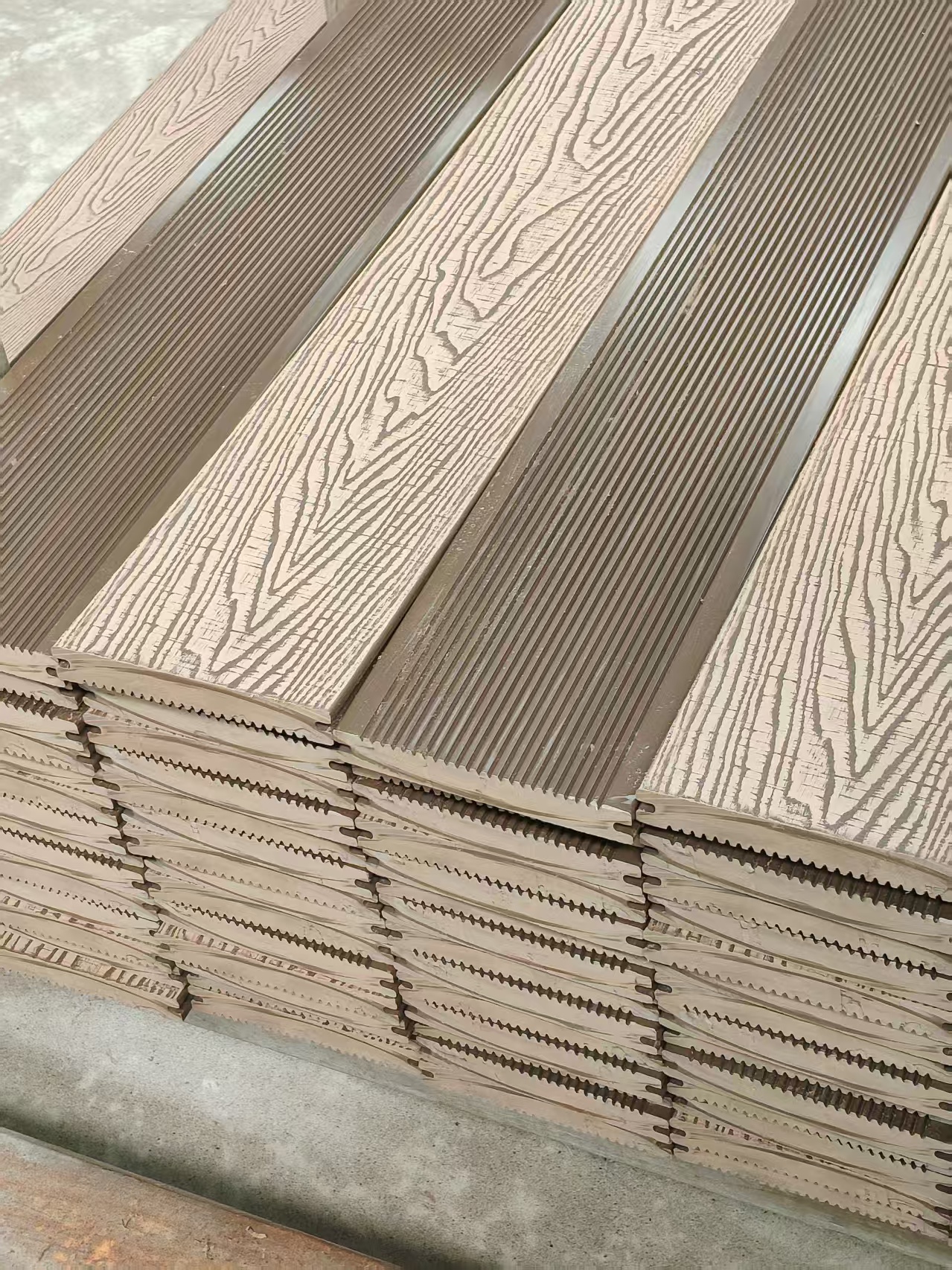
WPC exterior wall cladding from Linkworld WPC Wall Panel, produced from PE plus wood flour or bamboo powder.
WPC exterior wall cladding is an exterior wall finish made from wood-plastic composite: plant fibre combined with a plastic polymer and extruded into profiled cladding boards. Buyers specify it when a facade needs the visual warmth of timber but cannot absorb the maintenance cycle that solid timber demands — painting, oiling, rot repair and pest treatment.
This guide is written for importers, distributors, brand owners and project buyers who are at the stage of discovering what WPC wall panel systems actually are before they commit to a specification. It explains what the material is made of, which profile families exist under the WPC umbrella, how a cladding package is specified and installed step by step, where the panels are used, how the main wall panel families compare, and what to verify before an order is placed.
What Problem Does WPC Exterior Wall Cladding Solve?
Exterior facades have traditionally forced a trade-off. Solid timber gives a natural look but cracks, rots and needs regular maintenance. Painted render and concrete are stable but visually flat and prone to staining. Metal cladding performs well but reads as industrial on residential work.
Wood-plastic composite occupies the middle of that range. WPC combines plant fibre with polymer material to produce a stable board that keeps a wood-like texture while inheriting the weather resistance associated with plastics. In practice that means a facade element which is not expected to crack, rot, or attract termites, and which does not need a routine maintenance programme to stay serviceable.
The trade-off does not disappear — it moves. WPC cladding is a system, not a single board. Outdoor installation depends on a firm substrate or batten frame, unobstructed drainage, and a correctly sized expansion gap. Those are installation and specification responsibilities rather than material properties, and they are where most failures originate.
Buyer-relevant distinction: “waterproof” and “moisture-proof” describe the behaviour of the board under normal service conditions. They do not mean the panel can be permanently immersed in water. Moisture reaches a wall system through seams, cut edges, fixing holes and unsealed areas, so joint sealing and base-layer waterproofing still belong in the specification.
Industry Background: Where WPC Cladding Sits Today
WPC wall panel is a segment inside the much larger wall panels category, and the two numbers are frequently confused in supplier marketing.
A 2026 market forecast published by IndexBox puts the total global wall panels market at approximately USD 10.85 billion in 2026, projecting the WPC wall panel segment to grow at a compound annual growth rate of 5–7% over 2026–2035. The headline figure covers all wall panel materials — concrete, metal and composites together — not WPC alone. Buyers comparing market data should confirm which boundary a number is built on before using it in a business case.
On the supply side, the same forecast places China at 45–50% of global WPC production volume. That concentration matters practically: most international buyers will be sourcing from a Chinese manufacturing cluster, and the quality spread between suppliers is wide because interior decorative laminates and high-performance exterior cladding can leave the factory under the same trade classification.
For customs and trade purposes, WPC wall panels are commonly handled under HS code 3925.90.00. Because that heading also covers other plastic builders' ware, trade statistics built on it cannot be read as a WPC-only figure without bill-of-lading level analysis.
Market access and fire performance
Fire classification is usually the first compliance question on an exterior cladding project. Two reference frameworks dominate: ASTM E84 (Class A or Class B) for the United States, and EN 13501-1 (B1 or B2 classification) for the European Union. Both are mandatory-style requirements in their respective markets, and both should be documented by test report rather than by a supplier's verbal assurance.
Price reference
IndexBox reports a reference FOB price band of USD 8–18 per square metre for standard WPC wall panels from Chinese factories. The width of that band reflects specification variables — profile, wall thickness, surface treatment and whether the panel is a standard laminate or a higher-performance construction. It is a planning reference, not a quotation.
What Is WPC Exterior Wall Cladding Made Of?
Wood-plastic composite is formed by combining plant fibres with polymer material to create a stable panel. The fibre supplies the wood-like surface character and stiffness; the polymer binds it and carries the weather resistance.
Linkworld WPC Wall Panel's exterior cladding product is built on a PE (polyethylene) base compounded with wood flour or bamboo powder plant fibre. The core exterior specification is:
- Material: PE plus wood flour or bamboo powder
- Profile specification: 219 × 26 mm
- Length: 2900 mm standard, with custom length available
- Fire rating: B1
- Eco grade: E0
- Declared performance characteristics: corrosion resistant, UV resistant, waterproof, moisture-proof
- Declared applications: outdoor wall decoration, fence, decking
The exterior range is offered alongside matching accessories — joists, trims, posts, column caps and column bases — and across multiple profiles within the same material platform, including 219 and 155 wall panels, a 140 decking profile, a 150 fence board, and 50×50 and 100×50 square tubes.
Note on formulation: WPC is a material family, not a fixed recipe. The ratio of wood fibre to plastic, the additive package, the cross-sectional structure and the manufacturing process all affect how a given board performs. Fire resistance, load-bearing behaviour and UV performance should be verified against the specific model and its test documentation rather than inferred from the material name.
The WPC Wall Panel Families Behind an Exterior Project
An exterior cladding package rarely stands alone. Most projects pair an exterior skin with interior feature surfaces, and buyers increasingly want both from a single supplier to protect batch consistency and reduce logistics complexity.
WPC exterior wall cladding
The primary exterior element: a PE and wood/bamboo powder composite profile at 219 × 26 mm, supplied in 2900 mm lengths with custom length available, rated B1 and E0. This is the product specified for facades, boundary walls and open-air structures.
WPC Great Wall panel and the outdoor range
Linkworld WPC Wall Panel's outdoor product line comprises WPC Great Wall panels, ASA wall panels, PE wall panels, outdoor plastic wood fence panels, outdoor plastic wood flooring and sun panels. These are distinct products sharing a common material platform, which is why a single supplier relationship can often cover facade cladding, fencing, decking and landscape items at once.
WPC fluted and slat wall panel
The WPC grille panel is a three-dimensional decorative profile formed by combining multiple decorative strips — the fluted or slat format most often seen on feature walls. The 155 Pair Buckle Grille Panel is built from bamboo wood fibre plus PVC at 155 × 18 mm, 2900 mm length, with an installed width of approximately 150 mm per panel and an 18 / 10 / 18 mm groove cross-section. It is surfaced with PVC film in wood grain and solid colours, and is described for TV background walls, wall cladding, ceilings and partitions.
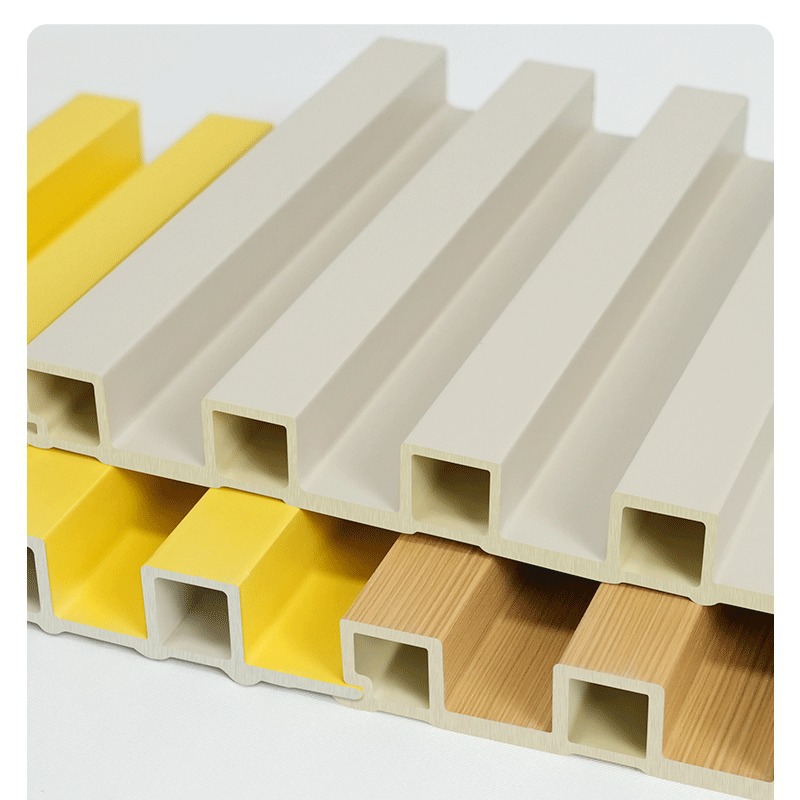
WPC grille panel profiles at 155 × 18 mm — the fluted or slat format used for feature walls, ceilings and partitions.
The visual effect is the point: strip-shaped arrangement creates contrast between light and dark and builds visual layers, and it works across modern, minimalist and wood-grain decorative schemes. Structural performance still depends on the specific model — bearing capacity, moisture resistance and fire resistance should be confirmed from the model's test data and the agreed installation method.
WPC interior wall panel: carbon crystal, SPC and UV
For the interior side of the same project, Linkworld WPC Wall Panel supplies carbon crystal panels, UV panels, SPC stone crystal wall panels and SPC floors, plus WPC grating panels.
- Wood Grain Carbon Crystal Wall Panel: bamboo charcoal fibre substrate with a co-extruded diamond layer, 5 mm or 8 mm thick, 1220 × 2440 / 2600 / 2800 mm with custom length, Class A non-combustible under GB8624-2012, formaldehyde and heavy metals not detected in testing. Series cover wood grain (M01–M10), stone texture (SW01–SW10), brocade (BW01–BW10), skin-feel solid (FG01–FG10) and PET.
- SPC Stone Plastic Composite Wall Panel: SPC substrate with a UV layer, diamond-grade wear-resistant layer and ultra-HD pattern paper, 2–6 mm thick, 600 / 1200 / 1220 mm wide with customisable length. Slotting and engraved lines are available at 4–6 mm. Specified for kitchens, bathrooms, shower rooms and guest rooms, including hotel work at 2400 × 600 mm with line carving.
- UV High-Gloss Decorative Panel: UV light-cured paint coating with polymer transfer film, 1220 × 2900 mm at 2–8 mm thickness, offering flexibility, chemical resistance and a long service life across hundreds of patterns including simulated stone.
The co-extruded construction used in the carbon crystal range is worth flagging for buyers comparing “co-extruded WPC wall panel” claims: the co-extruded diamond layer is a distinct process layer over the substrate, and its presence should be confirmed on the specific model rather than assumed across an entire catalogue.
Step-by-Step: How a WPC Cladding Project Is Specified and Installed
The sequence below applies to outdoor WPC wall panels. It is the stage where most quality outcomes are decided, because panel performance is only realised when the support system and movement allowances are correct.
Step 1 — Confirm the base and the drainage path. Check the strength of the construction base, the batten or keel layout, and the drainage conditions. Outdoor cladding needs water to leave the wall cavity rather than sit behind the panel.
Step 2 — Lock the board specification and accessories. Confirm profile, board dimensions, fixing accessories and installation direction before any cutting. For a wall panel the fixing method should only be determined after the product system and structure are confirmed — different product types are not interchangeable in how they are fixed.
Step 3 — Set keel spacing to the manufacturer's requirement. Determine the spacing and fixing positions of the keel according to the manufacturer's specification. Reducing keel spacing arbitrarily, or cancelling it, is not a permitted shortcut.
Step 4 — Install and reserve expansion space. Fit the board and leave the specified expansion gap. WPC products can change dimension with temperature and humidity; without enough expansion space, that movement converts into internal stress and shows up as arching, compression or damaged fixings. The correct gap depends on product specification and site conditions — it cannot be applied as one universal value.
Step 5 — Inspect before handover. Verify fixing firmness, joint quality, drainage function and overall flatness. Where outdoor decking carries load, check the product's load-bearing capacity and the support design rather than judging applicability from the material name.
For interior panels the preparation differs: the base layer must be flat, dry and firm; wall dimensions should be measured with door and window openings deducted; layout, joint positions and texture direction should be planned; and cutting tools selected to suit the material and thickness, with a trial cut before batch processing.
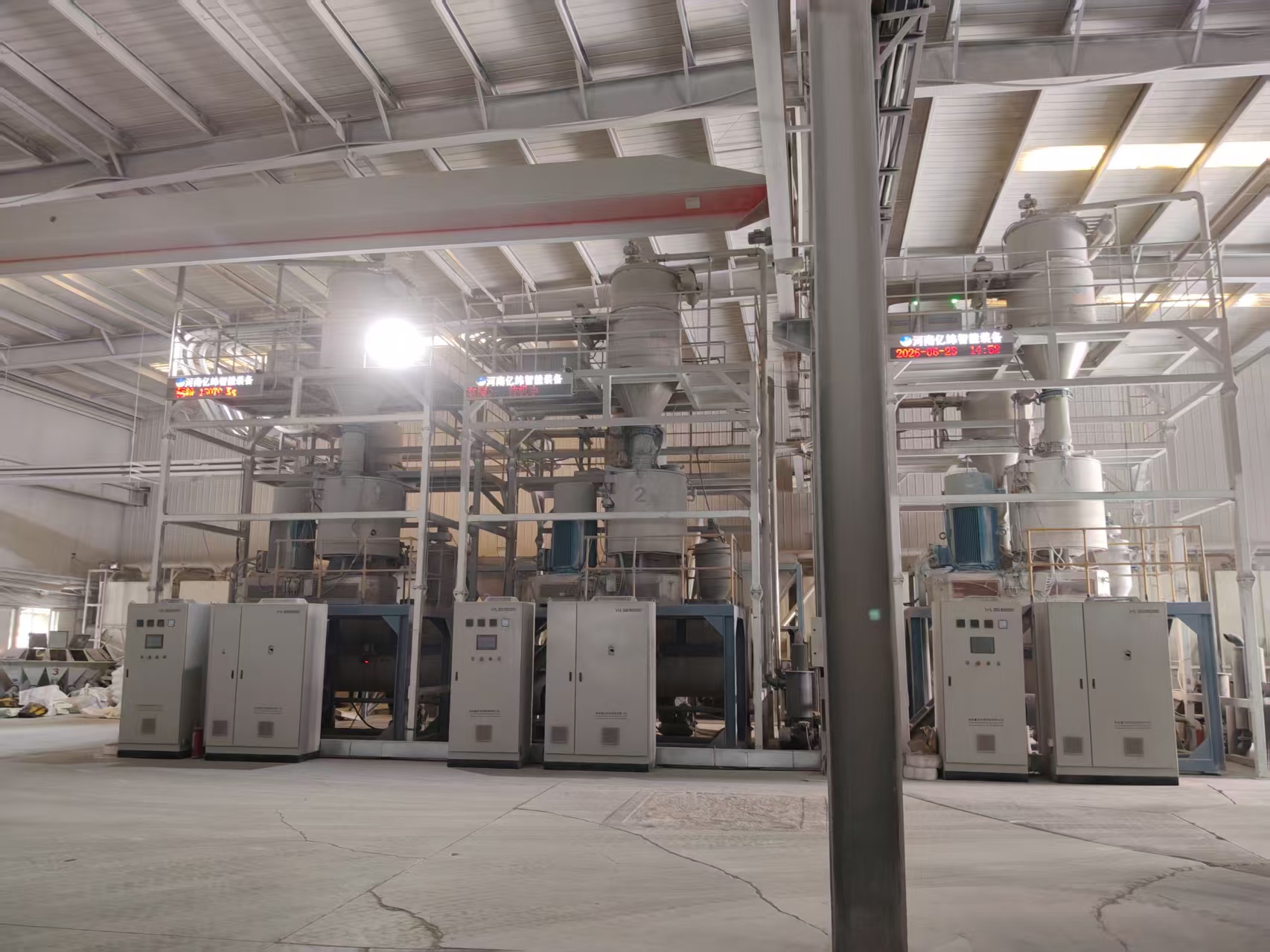
Extrusion and automatic batching equipment on the production floor, where wall panel profiles are extruded and laminated.
Where WPC Exterior Wall Cladding Is Used
Application scope follows the outdoor specification directly: outdoor wall decoration, fencing and decking. In practice the panels appear in residential exteriors, commercial building facades, boundary and privacy fencing, garden and landscape structures, balcony guardrails and outdoor leisure areas.
The interior side of the same catalogue covers residential decoration, hotels, offices, commercial spaces, hospitals, schools, corridors, campuses, guest houses and public building interiors — typically feature walls, wall cladding, ceilings and partitions.
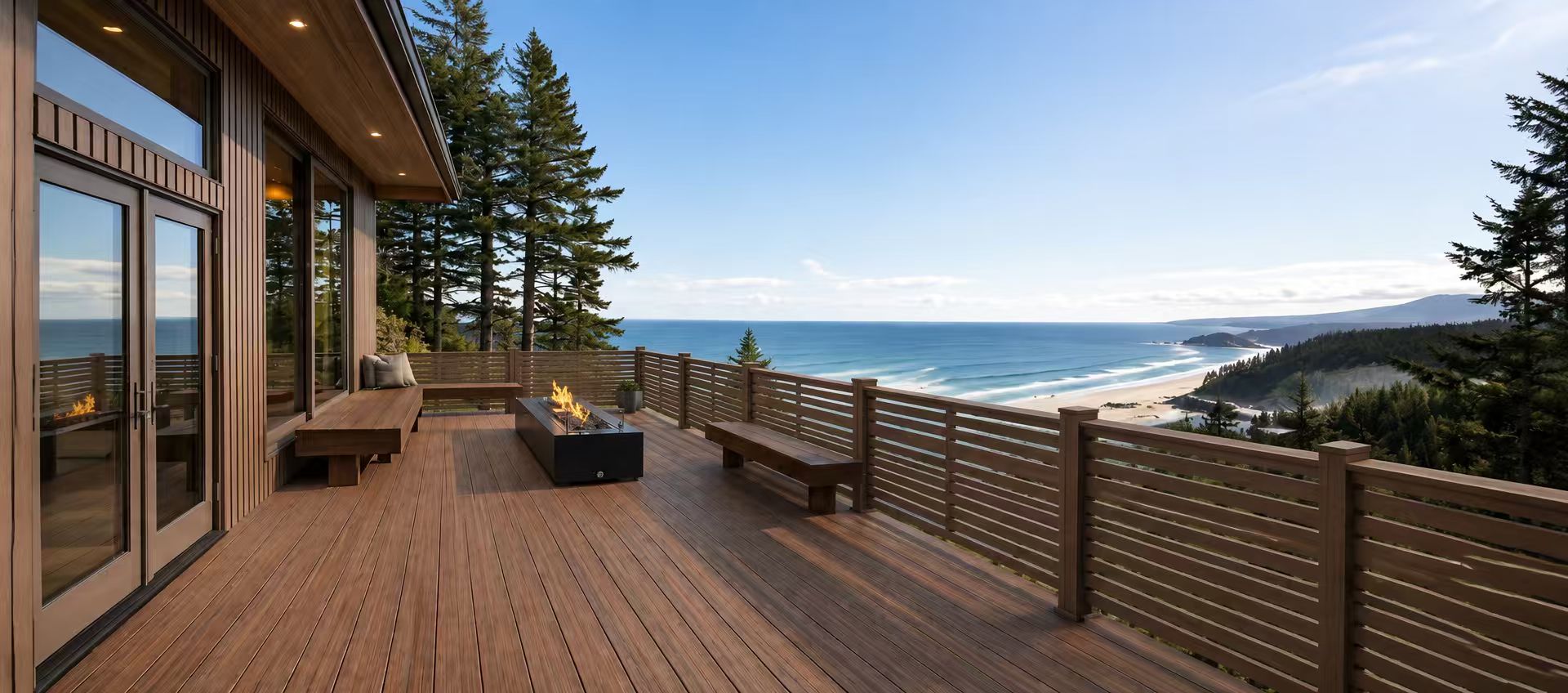
Exterior decking and railing built from the same WPC material platform used for exterior wall cladding.
How the Main Wall Panel Families Compare
The table below compares the panel families a project buyer is most likely to mix. Figures are the manufacturer's stated specifications for the named models; they are not a ranking, and a different model within the same family may carry different values.
| Panel family | Core material | Thickness / profile | Fire | Eco | Typical use |
|---|---|---|---|---|---|
| Outdoor WPC Wall Cladding Panel | PE + wood flour / bamboo powder | 219 × 26 mm; 2900 mm (custom length) | B1 | E0 | Outdoor walls, fence, decking |
| Wood Grain Carbon Crystal Wall Panel | Bamboo charcoal fibre + co-extruded diamond layer | 5 mm / 8 mm; 1220 × 2440–2800 mm | Class A non-combustible (GB8624-2012) | Formaldehyde and heavy metals not detected | Hospital, hotel, campus, office, corridor, B&B |
| SPC Stone Plastic Composite Wall Panel | SPC substrate + UV layer + wear layer | 2–6 mm; 600 / 1200 / 1220 mm wide | Not stated for this model | Not stated for this model | Kitchen, bathroom, shower room, guest room |
| Bamboo Wood Fiber Integrated Wall Panel | Bamboo wood fibre + PVC | 9 mm; 300 / 400 / 600 mm wide; 2900 mm | Fireproof (manufacturer statement) | Zero formaldehyde (manufacturer statement) | Hotel, apartment, villa interior walls |
| 155 Pair-Buckle Grille (fluted / slat) | Bamboo wood fibre + PVC | 155 × 18 mm; approx. 150 mm installed width | Fireproof (manufacturer statement) | Zero formaldehyde (manufacturer statement) | TV background wall, wall cladding, ceiling, partition |
| UV High-Gloss Decorative Panel | UV-cured coating + polymer transfer film | 2–8 mm; 1220 × 2900 mm | Not stated for this model | Not stated for this model | Indoor and outdoor decoration |
Two reading rules apply. First, a blank compliance cell means the manufacturer specification for that model does not state a value — it does not mean the panel fails the requirement, but it does mean documentation must be requested before the model is specified for a regulated facade. Second, waterproof and moisture-proof characteristics describe performance under normal service; they are not a licence for long-term immersion.
What to Verify Before Placing an Order
The commercial step from research to quotation is where buyers most often lose money. A practical verification list:
- Fire documentation against the destination market. Ask for a test report that maps to ASTM E84 or EN 13501-1, not a marketing line. Confirm that the report covers the exact model being quoted.
- Model-level specification, not catalogue-level. Confirm substrate, thickness, width, length tolerance and joint type for the specific SKU. Composition ratios and density are commonly unstated — request them in writing.
- System accessories. Joists, trims, posts, caps, clips and screws should be quoted with the panel. Installing an exterior system with mismatched or missing accessories undermines the panel performance regardless of board quality.
- Expansion and fixing guidance. Get the manufacturer's stated expansion allowance and keel spacing in writing. This is the single most useful document for the installer.
- Samples before commitment. Samples confirm colour, material, structure and quality requirements, and provide a physical reference for bulk production comparison.
- Batch consistency method. Ask how colour deviation between batches is controlled, and whether reference samples are retained for the mass-production order.
- Supply capacity. Match claimed annual output against your order volume and delivery schedule.
About Linkworld WPC Wall Panel
Linkworld WPC Wall Panel is the building-panel brand of Tangshan Linkworld International Trade Co., Ltd., a building-panel supplier founded in 2004 and located at No. 60, Qingbei East Road, High-tech Industrial Park, Tangshan City, Hebei Province, China. The company presents itself as an integrated building-panel supplier covering R&D, production and sales, and supports customised product development.
Its operating base covers a 20,000 m² manufacturing facility with a total workforce of about 40 employees and a foreign trade operation team of more than 20 people. Reported annual production capacity is 1,560,000 square metres, with an export ratio of around 70% across more than 60 countries, including the United States, Canada, Spain, Russia, Singapore, India, Malaysia and the Middle East.
The product line is positioned as indoor and outdoor environmentally friendly decorative panels. Indoor panel products include WPC grating panels, carbon crystal panels, UV panels, SPC stone crystal wall panels and SPC floors. Outdoor panel products include WPC Great Wall panels, ASA wall panels, PE wall panels, outdoor plastic wood fence panels, outdoor plastic wood flooring and sun panels. The company specialises in carbon crystal panels, PVC panels, WPC grilles and outdoor plastic wood panels.
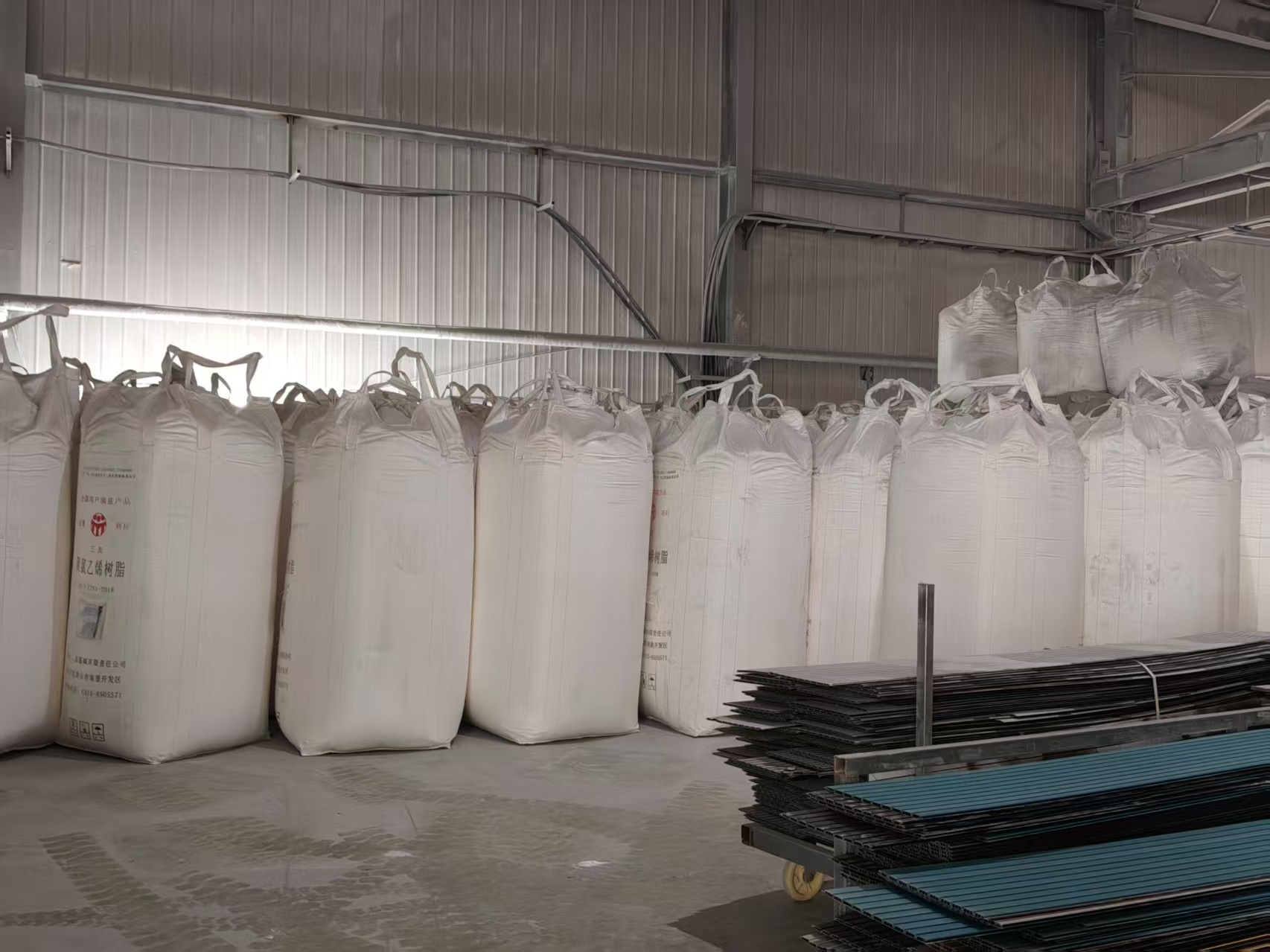
Raw material storage and batching area, where incoming resin is held before extrusion.
Frequently Asked Questions
Chinese WPC wall panel manufacturers: how should a buyer assess them?
Assess them on documented facts rather than category claims. China accounts for 45–50% of global WPC production volume, so the supply base is deep and the quality spread is wide. Ask for the model-level specification sheet, the fire test report that maps to your destination market (ASTM E84 for the US, EN 13501-1 for the EU), your named product's dimensional data, and the accessory list. Then check annual output against your order size and confirm whether customised product development is genuinely on offer. For reference, Linkworld WPC Wall Panel reports a 20,000 m² facility, 1,560,000 square metres of annual output, and an export footprint across more than 60 countries.
Can Chinese WPC wall panel manufacturers meet US or EU fire requirements?
Fire classification is a market-access requirement, and in the US and EU it is mandatory-style. The applicable reference frameworks are ASTM E84 (Class A or Class B) in the United States and EN 13501-1 (B1 or B2 classification) in the European Union. Compliance has to be established by a test report covering the exact model, so the practical question is not “can they” but “do they hold a report for this SKU”. Within Linkworld's range, the Outdoor WPC Wall Cladding Panel is rated B1 and the Wood Grain Carbon Crystal Wall Panel is Class A non-combustible under GB8624-2012 — note that GB8624-2012 is the Chinese standard, so confirm destination-market equivalence separately.
Can exterior WPC cladding be customised in size and surface?
Yes, within the limits of the product system. The Outdoor WPC Wall Cladding Panel runs at 219 × 26 mm with a 2900 mm standard length and custom length available, and Linkworld supports customised product development across its panel range. The broader catalogue shows the customisation range available on adjacent products: the carbon crystal panel offers 1220 × 2440 / 2600 / 2800 mm with custom length and five surface series, while the SPC wall panel offers 600 / 1200 / 1220 mm widths with customisable length and 4–6 mm slotting or engraved lines. Custom profile development and length changes should be confirmed against tooling and minimum order before quotation.
What does WPC exterior wall cladding cost per square metre?
IndexBox reports a reference FOB price band of USD 8–18 per square metre for standard WPC wall panels from Chinese factories in its 2026 forecast. The band is wide because the specification drives the price: profile geometry, wall thickness, surface treatment, and whether the panel is a standard construction or a higher-performance build all move the number. Treat the band as a budgeting reference and request model-specific quotations with a stated unit basis, MOQ, incoterm and packaging term before comparing suppliers. A published listing price without a unit basis is not comparable to an FOB quote.
Can I get samples before placing a bulk order?
Samples are the standard pre-order step in this category and are used to confirm colour, material, structure and quality requirements before bulk production. Linkworld supports sample trial orders alongside customised processing, mixed batches and full container shipments, and retains reference samples for mass-production orders so bulk output can be compared against the confirmed sample. Request the sample in the exact model you intend to order — a sample of a different profile or surface does not validate the specification you are buying. To start, contact the team with your application, dimensions and colour direction.
How much WPC wall panel can a supplier deliver at scale?
Capacity should be matched against your order pattern rather than judged in isolation. Linkworld WPC Wall Panel reports an annual production capacity of 1,560,000 square metres from a 20,000 m² facility, with an export ratio of about 70% across more than 60 countries. For project buyers, the more useful questions are whether the supplier can hold consistent batch colour across a phased delivery, whether outdoor and indoor lines can ship together to consolidate containers, and whether the same supplier relationship can cover cladding, fencing and decking from one material platform.
Conclusion
WPC exterior wall cladding is a system decision as much as a material decision. The board itself delivers a wood-like exterior surface with corrosion resistance, UV resistance, waterproof and moisture-proof behaviour, a B1 fire rating and E0 eco grade on the outdoor specification — but that performance only survives installation when the base is firm, drainage is unobstructed, keel spacing follows the manufacturer's requirement, and expansion space is correctly reserved.
For buyers in the research stage, the sequence that reduces risk is straightforward: lock the model-level specification, obtain the fire documentation that matches your destination market, confirm the accessory package, take a sample in the exact SKU, and check annual output against your delivery schedule. The market data supports steady demand — a WPC segment growing at 5–7% CAGR through 2035 inside a wall panels market forecast at USD 10.85 billion in 2026, with China supplying 45–50% of global production volume.
Next Step: Specifications, Samples and Quotation
Review the full indoor and outdoor panel range in the Linkworld WPC Wall Panel product catalogue, then send your application, dimensions and target market for a model-specific quotation and sample arrangement.
Download the Product Catalog (PDF) →
Website: www.tslinkworld.com
Contact: Stella | Email: beibei@tslinkworld.com | Tel / WhatsApp: +86 19331530434
Address: No. 60, Qingbei East Road, High-tech Industrial Park, Tangshan City, Hebei Province, China
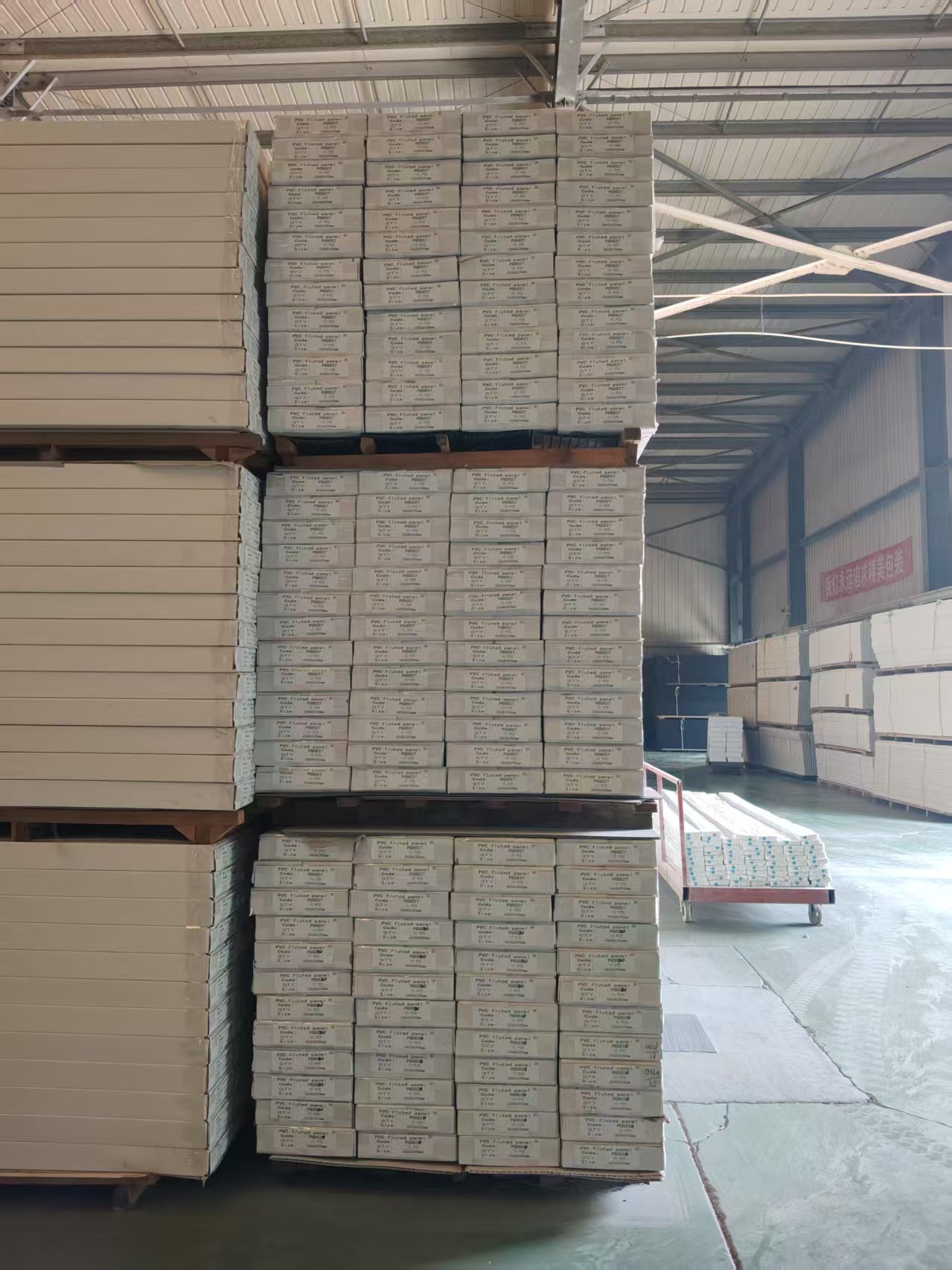
Packaged panels on pallets in the finished-goods warehouse ahead of export shipment.
Have Questions or Need More Details?
Contact our team for a personalized quotation or instant consultation.
Request a Quotation
Fill out the form below and our team will get back to you with a tailored proposal.
WhatsApp Direct Chat
Prefer to chat in real-time? Message us on WhatsApp for instant assistance & quick answers.
- Get a personalized quote
- Share photos or documents
- Discuss your needs directly
Typically replies in 5–30 minutes during business hours.