
WPC Fluted Wall Panel Guide: Types, Specs & Applications
WPC Fluted Wall Panel: A Buyer's Guide to Types, Specifications, and Applications
A WPC fluted wall panel is a decorative wall profile made from a wood-plastic composite core, shaped into repeated slats, and finished with a laminated surface film. It is specified for feature walls, wall cladding, partitions, ceilings and, in heavier exterior profiles, facades and fences. This guide explains how the panel is built, which variants share the same look, what to confirm before ordering, and which applications each type suits.
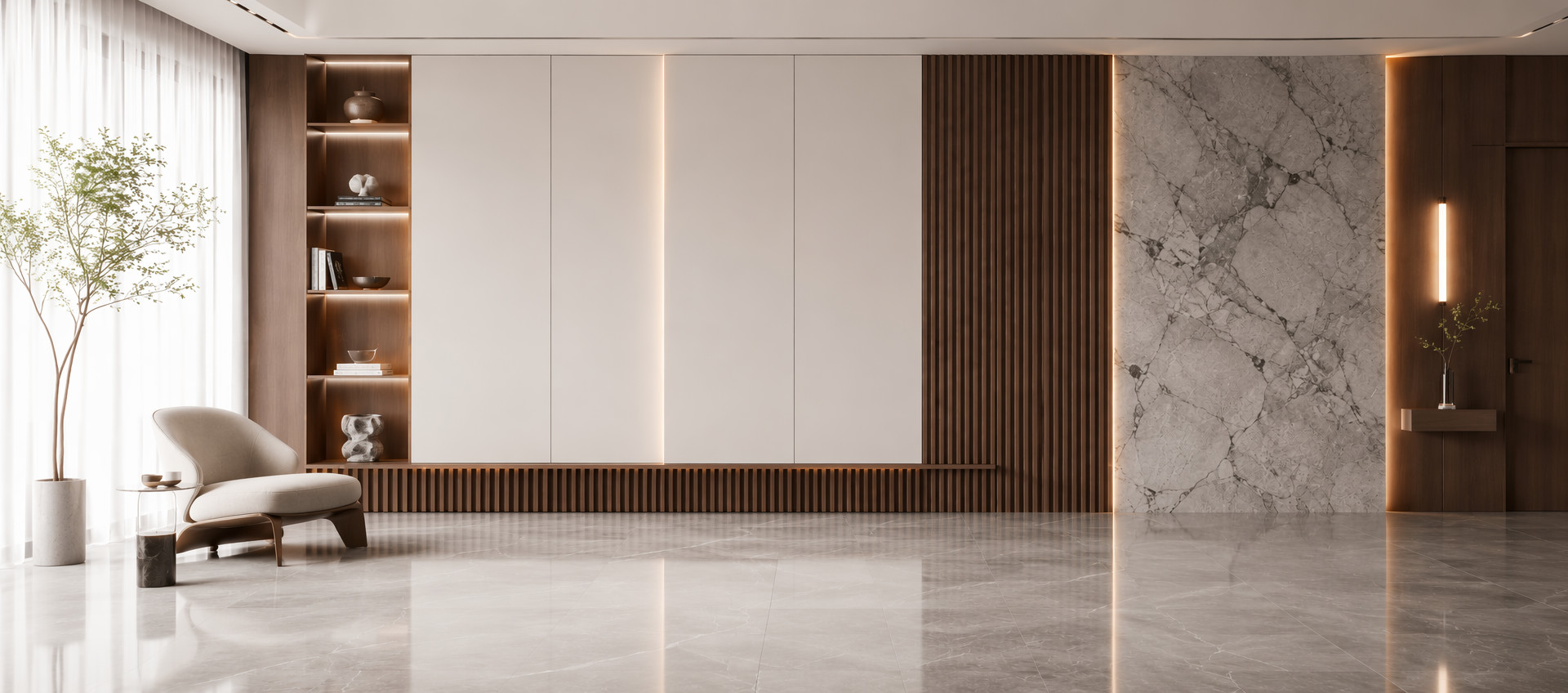
Problem definition: why fluted wall panels are harder to buy than they look
The same ribbed profile is sold under at least four names — WPC fluted panel, WPC grille, slat wall panel, and great wall panel — and the construction behind the appearance is not always the same. Buyers who compare on look and price alone usually end up comparing different products.
- Same appearance, different core. A fluted panel can be a hollow PVC profile, a bamboo-fibre and PVC composite, or a co-extruded board with a denser surface layer. Core formulation affects stiffness, weight, moisture behaviour and fire performance, so the material name alone does not define performance.
- Waterproof is a material property, not a system guarantee. Moisture enters through seams, cut edges, fixing holes and unsealed areas, so the water resistance of the board cannot represent the behaviour of the installed assembly. Wet-area use needs joint sealing, substrate preparation and drainage considered together.
- Compliance requirements change by market. Reaction-to-fire performance for wall linings is typically demonstrated against ASTM E84 (Class A or B) in the United States and EN 13501-1 (B1 or B2) in the European Union. A report issued against a different standard, or for a different model, does not transfer automatically.
- Quoted prices are often not comparable. Public B2B listings sometimes show a price with no stated unit basis, specification, MOQ or Incoterm, which makes them unusable as a benchmark. Only specification-linked FOB prices per square metre can be compared.
- Installation assumptions are rarely stated. Panel dimensions change with temperature and humidity, so expansion space, substrate flatness and fixing method must be decided before the material is ordered rather than on site.
Industry background: where WPC wall panels sit in the market
Wall panels as a whole are an established category. A 2026 IndexBox forecast places the global wall panels market at about USD 10.85 billion, and the WPC wall panel segment specifically is forecast to grow at roughly 5–7% per year between 2026 and 2035 — faster than the broader wall panel market. China accounts for an estimated 45–50% of global WPC production volume, which is why most export-facing buyers end up sourcing from Chinese factories and trading companies.
Two structural points matter for procurement. First, WPC wall panels are traded under HS code 3925.90.00, but that heading also covers other plastic builders' ware, so customs statistics cannot be read as a clean WPC wall panel figure without shipment-level analysis. Second, the interior and exterior split is a surface-and-formulation decision inside one material family rather than two separate industries: the same factories typically present interior decorative panels, exterior cladding, decking, fencing and landscape items from one WPC platform.
The supply base is organised around trade intermediaries and project specification. Suppliers in this category commonly name wholesalers, importers, distributors, contractors and project buyers as their target segments, and OEM or private-label customisation is routinely offered. A buyer's first screening decision is therefore usually not which panel to choose, but which supply model to work with — importer and distributor stock, project supply, or private label.
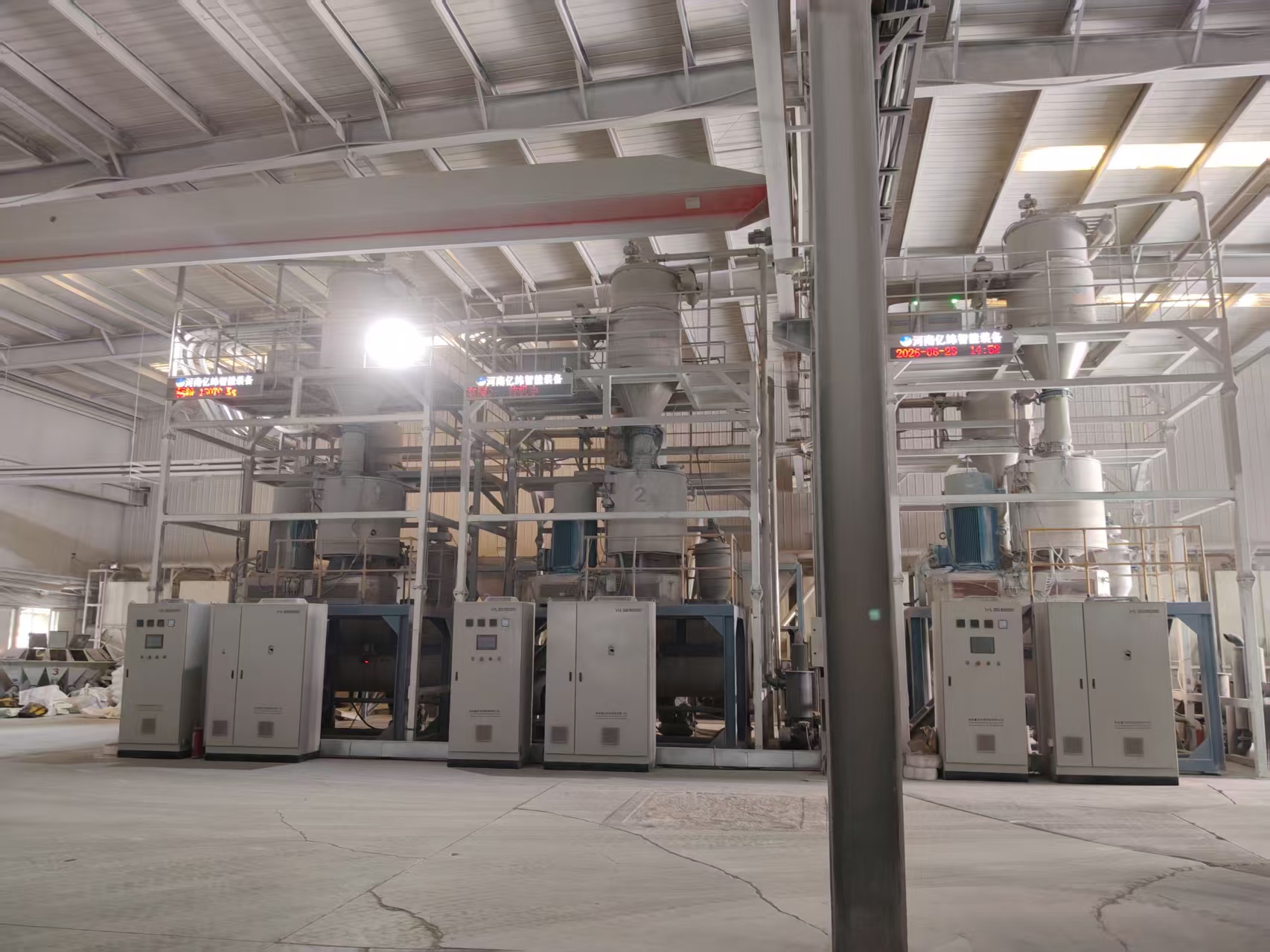
Detailed solution: construction, specifications and supply
How the panel is built
WPC — wood-plastic composite — is formed by combining plant fibres with polymer materials to create a stable panel that keeps a wood-like texture while gaining the moisture and weather behaviour of the plastic fraction. In a fluted wall panel, four elements determine the result:
- Core: bamboo or wood fibre blended with PVC. Density and the fibre-to-plastic ratio drive stiffness and screw-holding.
- Surface: a laminated PVC film in wood grain or solid colour; films differ in thickness and in how they are bonded.
- Profile and joint: slat depth, spacing and groove geometry plus the joint type — pair-buckle, tongue-and-groove, V-seam, butt joint or lock buckle — determine the shadow line and the installation speed.
- Accessories: stainless steel clips, self-tapping screws, trims and end profiles. Accessories are usually what decide whether a joint stays tight over time.
Linkworld WPC Wall Panel: supplier context
Linkworld WPC Wall Panel is the wall panel line of Tangshan Linkworld International Trade Co., Ltd., a building-panel supplier founded in 2004 and located in Tangshan High-tech Industrial Park, Hebei, China. The company presents itself as an integrated building-panel supplier covering R&D, production and sales, with support for customised product development. Its manufacturing facility covers 20,000 m², employs about 40 people and reports an annual output of 1,560,000 m²; the foreign trade team is more than 20 people, and the company reports an export ratio of about 70% across more than 60 countries, including the United States, Canada, Spain, Russia, Singapore, India, Malaysia and the Middle East.
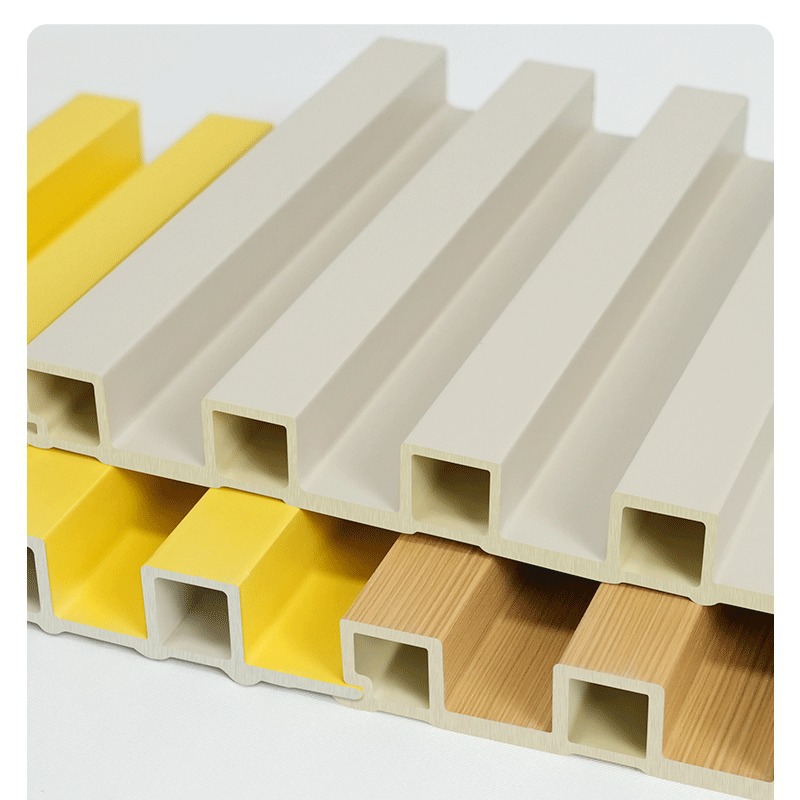
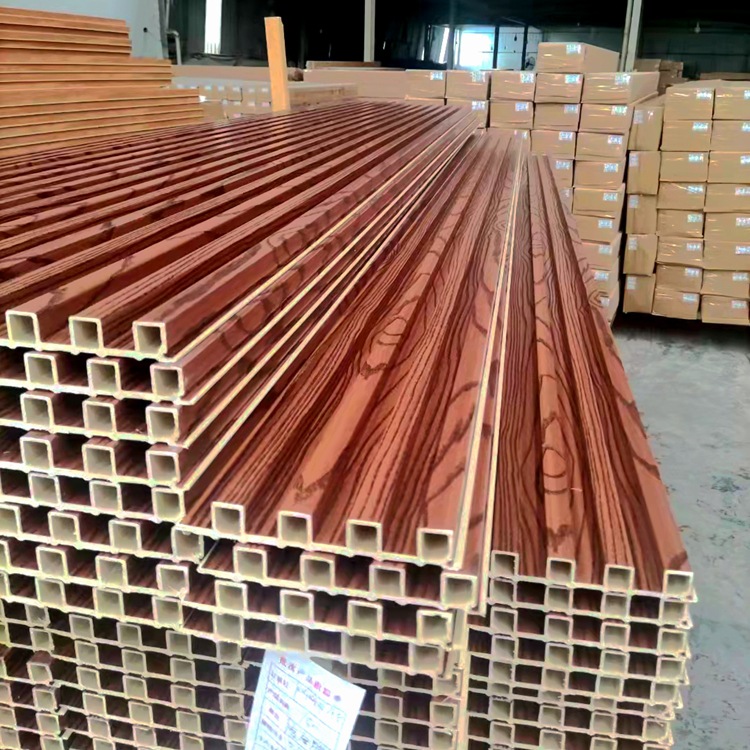
The fluted profile in the range: 155 Pair Buckle Grille Panel
- Material: bamboo wood fibre + PVC
- Specification: 155 × 18 mm; installed width approximately 150 mm per panel
- Length: 2900 mm, custom length available
- Cross-section: 18 mm / 10 mm / 18 mm groove profile
- Surface: PVC film in wood grain and solid colours
- Stated features: fireproof, waterproof, moisture-proof, zero formaldehyde, easy to saw, drill and nail with ordinary tools
- Applications: TV background wall, wall cladding, ceiling, partition
- Accessories: stainless steel clips, self-tapping screws
Adjacent panels that solve the same wall problem
Fluted profiles rarely cover a whole project. Linkworld's indoor range also includes carbon crystal panels, UV panels, SPC stone crystal wall panels, WPC grating panels and SPC floors; the outdoor range includes WPC Great Wall panels, ASA wall panels, PE wall panels, outdoor plastic wood fence panels, outdoor plastic wood flooring and sun panels. Carbon crystal panels, for example, are built on a bamboo charcoal fibre substrate with a co-extruded layer, are offered at 5 mm and 8 mm in 1220 × 2440 / 2600 / 2800 mm, and are stated as Class A non-combustible to GB8624-2012 with formaldehyde and heavy metals not detected in laboratory testing.
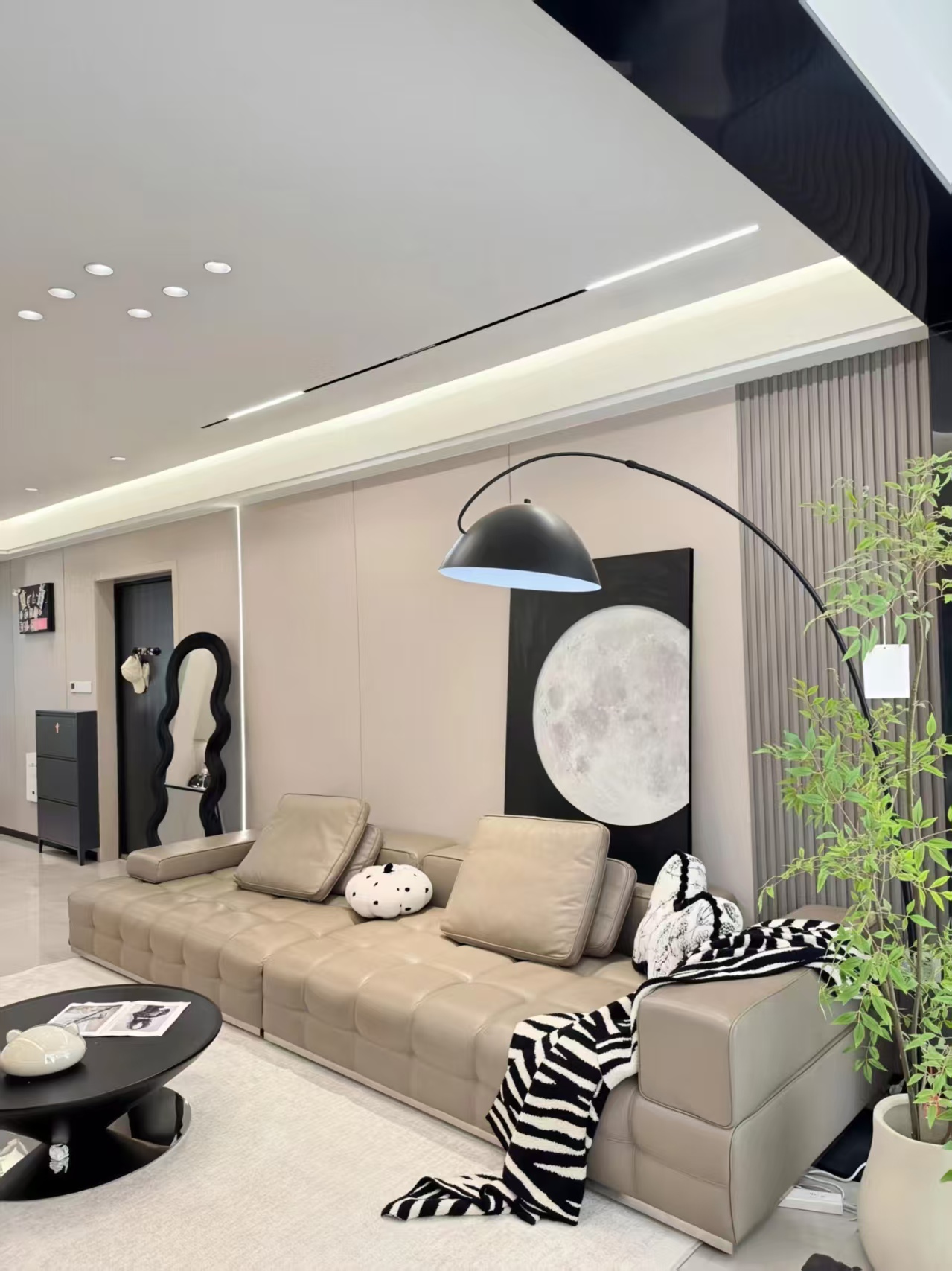
Step-by-step: how to specify and validate a fluted WPC panel
- Define the application and environment first. Interior feature wall, wet room or exterior facade? Specification should follow indoor or outdoor use, humidity, temperature, substrate and fire-safety requirements. Exterior work needs UV and weathering documentation, not just a material name.
- Fix the profile and dimensions. Agree slat width, depth, installed coverage (about 150 mm per panel on the 155 pair-buckle profile) and length. Standard length is 2900 mm with custom length available; confirm how cut edges and corners will be closed.
- Agree surface, colour and batch control. Wood grain and solid colours are available on the fluted line, and the wider interior range uses defined pattern series. Colour consistency across batches depends on raw-material and formula control, so ask how batch colour is managed and whether reference samples are retained.
- Verify compliance documents against the exact model. Request the test report that matches the model being quoted and the destination market: ASTM E84 or EN 13501-1 for the US and EU, GB8624-2012 where a Chinese classification is cited, and formaldehyde or heavy-metal results where indoor air quality matters. Outdoor cladding should carry its stated fire rating and eco grade, for example B1 and E0.
- Validate with samples before committing. Samples confirm colour, material, structure and quality requirements. Keep the approved sample as the reference for mass production and check the same features on delivery.
- Plan installation, cutting and maintenance. Check that the wall is flat, dry and firm; measure the area and deduct openings; plan joints and grain direction; trial-cut before batch cutting; then fix, trim and inspect. Reserve expansion space according to product specification and site conditions rather than a fixed value. For cleaning, use a soft cloth or sponge with water and a neutral detergent, test any agent in an inconspicuous area, and avoid strong acids, alkalis, wire wool and unverified solvents.
Use cases: where fluted WPC panels fit
Residential feature walls. Vertical slats behind a TV or along a corridor create depth without a full renovation; combined with flat panels they separate a feature zone from the surrounding wall.
Commercial and hospitality interiors. Hotels, offices, corridors and B&B projects use fluted profiles where speed of installation and repeatable appearance matter. Specifiers often pair a fluted section with carbon crystal or SPC panels on the same wall to control cost and maintenance.
Healthcare and education. Where a Class A non-combustible classification and low-emission documentation are required, the carbon crystal line is the relevant part of the range — with the caveat that the report must match the quoted model.
Wet and service areas. Kitchens, bathrooms and shower rooms are usually handled with SPC wall panels rather than a fluted profile, because the joint design and surface are easier to seal and clean.
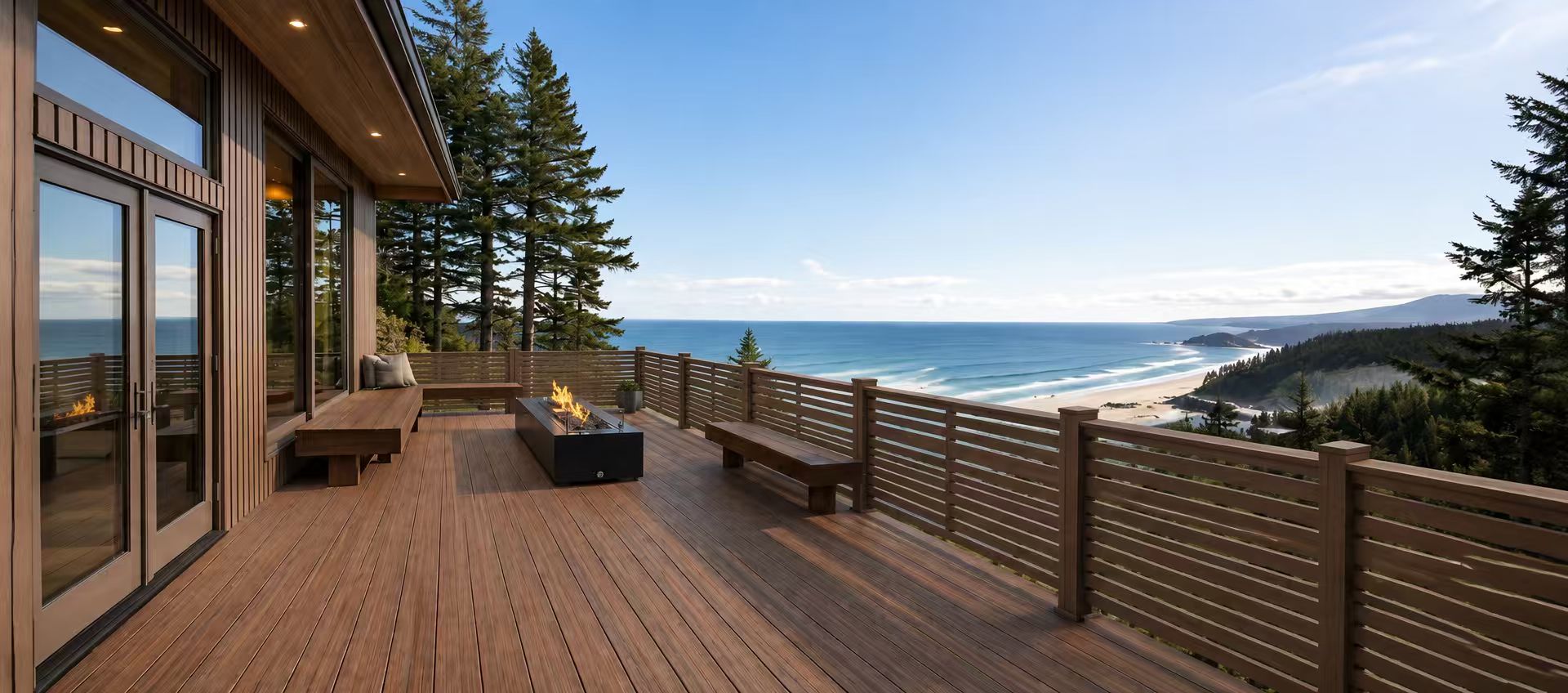
Exterior cladding and landscape. Outdoor WPC wall cladding is a different profile and formulation — PE with wood or bamboo powder, 219 × 26 mm, 2900 mm length, B1 fire rating and E0 eco grade, described as corrosion-resistant, UV-resistant, waterproof and moisture-proof, used for exterior walls, fences and decking with matching joists, trims, posts and column caps.
Comparison table: WPC fluted panels and related wall panel types
| Product | Core / material | Typical thickness and size | Stated features | Best-fit application |
|---|---|---|---|---|
| 155 Pair Buckle Grille Panel (fluted) | Bamboo wood fibre + PVC | 155 × 18 mm; 2900 mm length; installed width approx. 150 mm | Fireproof, waterproof, moisture-proof, zero formaldehyde; easy to saw, drill, nail | TV background wall, wall cladding, ceiling, partition |
| Outdoor WPC Wall Cladding | PE + wood powder / bamboo powder | 219 × 26 mm; 2900 mm length | B1 fire rating, E0 eco grade; corrosion-resistant, UV-resistant, waterproof | Exterior wall decoration, fence, decking |
| Carbon Crystal Panel – Wood Grain | Bamboo charcoal fibre + co-extruded diamond layer | 5 mm / 8 mm; 1220 × 2440 / 2600 / 2800 mm | Class A non-combustible (GB8624-2012); formaldehyde and heavy metals not detected | Hospital, hotel, campus, office, corridor, B&B |
| SPC Stone Plastic Composite Wall Panel | SPC substrate + pattern paper + wear layer + UV coating | 2–6 mm; 600 / 1200 / 1220 mm width | Scratch-resistant matte or gloss surface; lock buckle or direct assembly | Kitchen, bathroom, shower room, guest room |
| Bamboo Wood Fiber Integrated Wall Panel | Bamboo wood fibre + PVC | 9 mm; 600 / 400 / 300 mm width; 2900 mm length | Zero formaldehyde, fireproof, waterproof; V-seam, butt joint or lock buckle | Hotel, apartment, villa interior walls |
All values in this table are the manufacturer's published product data. Performance statements apply to the specific model listed and should be confirmed against the test report for the model being purchased.
On price, the verified reference for standard WPC wall panels from Chinese supply is an FOB range of roughly USD 8–18 per m², with the spread driven by thickness, surface process, profile complexity and order volume. Public marketplace listings cannot be used as a benchmark unless the unit basis, specification and trade term are stated.
FAQ
Wall linings sold into the United States are usually classified for surface burning characteristics under ASTM E84, where Class A is the most commonly requested result; the European equivalent is reaction-to-fire classification under EN 13501-1, where B1 or B2 is typically referenced. Indoor panels are also screened for formaldehyde and heavy-metal content. Documentation must match the exact model and destination market: Linkworld's outdoor WPC cladding is stated as B1 fire rating and E0 eco grade, and its wood-grain carbon crystal panel line is stated as Class A non-combustible to GB8624-2012 with formaldehyde and heavy metals not detected in laboratory testing. A report for a different model or a different standard does not transfer.
Within the Linkworld range, the 155 Pair Buckle Grille Panel is produced at 155 × 18 mm with an installed width of about 150 mm, a standard length of 2900 mm with custom length available, and a PVC film surface in wood grain and solid colours. The company states that it supports customised product development, and the wider interior range covers defined pattern series — for example six carbon crystal series with more than 60 samples. Customisation should be agreed against a physical sample, because colour, joint and surface are confirmed at sample stage rather than from a catalogue image.
Verified reference pricing for standard WPC wall panels from Chinese supply sits at roughly USD 8–18 per m² FOB, with the spread coming from thickness, surface process, profile complexity and order volume. A fluted or co-extruded profile sits above a flat panel of the same thickness because of tooling and material use, and mixed containers or project quantities change the effective unit price. Quotations should always state the unit basis, specification, MOQ and Incoterm; public marketplace prices shown without those details cannot be compared.
Yes. Samples can be provided to confirm colours, materials, structures and quality requirements. Because colour consistency depends on raw-material and formula control, Linkworld states that it uses fixed raw-material suppliers and unified formulas to reduce batch colour deviation, and retains reference samples for mass-production orders so delivered panels can be compared with the approved standard.
China accounts for an estimated 45–50% of global WPC production volume, and most suppliers in this category declare the same target segments: wholesalers, importers, distributors, contractors and project buyers. A practical shortlist screens four things — whether the supplier covers both interior and exterior WPC from one platform, whether OEM or private-label customisation is offered, what sample and batch-control process is used, and whether test documentation is issued for the exact model. Linkworld WPC Wall Panel, the line of Tangshan Linkworld International Trade Co., Ltd. (founded 2004, Tangshan, Hebei), reports a 20,000 m² facility, 1,560,000 m² annual output and exports to more than 60 countries; requesting the catalogue or a project-specific quotation is a fast way to test responsiveness on all four points.
Request samples, a quotation, or the product catalogue
Send the application, wall dimensions, preferred slat size and colour direction, and the destination market. Samples can be arranged to confirm colour, material and structure before a bulk order.
Catalogue: Product Catalog (PDF) | Website: www.tslinkworld.com | Email: linkworld@tslinkworld.com | WhatsApp / Tel: +86 19331530434
Conclusion
A WPC fluted wall panel is a simple product with a complicated buying decision behind it. The appearance can be produced from several different cores, the word waterproof describes a material rather than an installed system, and fire or emissions documentation is only valid for the exact model and market it was issued for. Buyers who define the application first, fix the profile and dimensions second, and validate documents and samples third avoid most of the rework that happens later.
For interior feature walls, a bamboo-fibre and PVC pair-buckle grille at 155 × 18 mm with 2900 mm standard length covers most requirements; for wet areas, SPC panels are the better fit; for facades and fences, exterior WPC cladding at 219 × 26 mm with a B1 rating and E0 grade is the relevant specification. Matching the profile to the environment, and the paperwork to the model, is what makes the finished wall last.
Have Questions or Need More Details?
Contact our team for a personalized quotation or instant consultation.
Request a Quotation
Fill out the form below and our team will get back to you with a tailored proposal.
WhatsApp Direct Chat
Prefer to chat in real-time? Message us on WhatsApp for instant assistance & quick answers.
- Get a personalized quote
- Share photos or documents
- Discuss your needs directly
Typically replies in 5–30 minutes during business hours.