
WPC Interior Wall Panel: A Practical Buyer's Guide
Construction & Decoration · Buyer Guide
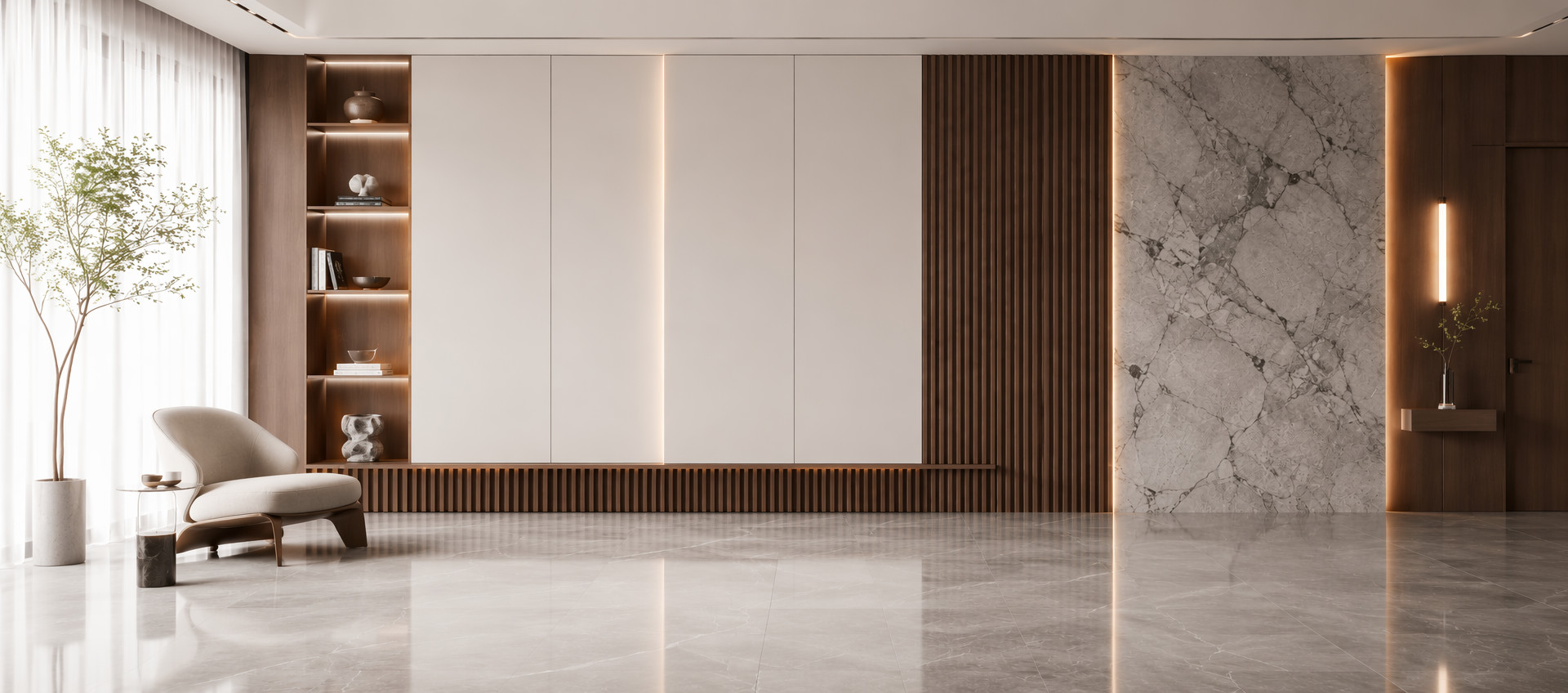
A fluted WPC interior wall panel used as a full-height feature wall, combined with flat panels and a stone-effect accent panel.
Short answer: a WPC interior wall panel is a decorative wall cladding profile made from a wood-plastic composite — plant fibre such as wood powder or bamboo powder blended with a plastic polymer — extruded into panels and finished with a decorative surface film. It is used for interior walls, feature walls, ceilings and partitions, and it combines a wood-like appearance with the moisture resistance of a plastic-based material.
Linkworld WPC Wall Panel is the WPC wall panel range supplied by Tangshan Linkworld International Trade Co., Ltd., a building-panel supplier founded in 2004 and based in Tangshan High-tech Industrial Park, Hebei, China. The company describes its product line as indoor and outdoor environmentally friendly decorative panels and exports to more than 60 countries, including the United States, Canada, Spain, Russia, Singapore, India and the Middle East.
This guide is written for importers, distributors, contractors and project buyers who are at the research stage. It explains what the product actually is, how the supply market is structured, which panel formats exist, what to verify in a specification, how installation works, and where WPC sits against adjacent panel types such as carbon crystal, SPC and ordinary PVC.
The Problem: Why WPC Interior Wall Panels Are Hard to Specify Well
Most problems with WPC interior wall panels are created before the order, not after installation. Three issues recur in buyer enquiries.
1. Product names outrun specifications. The terms WPC, PVC, carbon crystal, SPC and bamboo charcoal are used loosely and sometimes interchangeably. The real differences between these products lie in their specific formulations, substrate structures, thicknesses, surface coatings, physical properties and application positioning. Two panels sold under the same trade name can therefore behave very differently. The only reliable basis for comparison is the actual material composition, the technical parameters and the test report for the specific item.
2. Waterproof is read as waterproof forever. The moisture resistance of the material is not the same as the moisture performance of the installed system. Water can enter through seams, cut edges, fixing holes and unsealed areas, and the water absorption, dimensional stability and water resistance of different materials vary. A waterproof or moisture-proof wall panel should not be read as suitable for long-term immersion; suitability depends on the substrate, surface layer, seams, edge treatment, installation method and the testing the product has actually undergone.
3. Joints and expansion are treated as details. Wall panels and WPC profiles can change dimension with temperature and humidity. Without adequate expansion space, that movement converts into internal stress and shows up later as compression, arching, deformation or failed joints. Expansion allowance must be set against product data and site conditions, not copied from a different project or a different panel type.
A buyer who resolves these three points has effectively written the specification: item code and composition, dimensions and joint type, moisture and fire requirements for the actual room, and installation rules including expansion allowance.
Industry Background: Where WPC Interior Wall Panels Sit
The wall panel category is large, and the WPC segment is growing inside it. A 2026 market forecast places the global wall panels market at about USD 10.85 billion and projects the WPC wall panel segment to grow at roughly 5–7% CAGR over the 2026–2035 period. Those two figures should be read separately: the first covers all wall panel materials, the second covers only the WPC segment, so they cannot be combined into a single WPC market size.
Supply is concentrated. China is estimated to account for 45–50% of global WPC production volume, which is why most shortlists for this product end up being lists of Chinese manufacturers and Chinese trading companies.
Trade classification adds a practical caveat. WPC wall panels are commonly declared under HS 3925.90.00. The same heading also covers other plastic builders' ware, so customs statistics built on it cannot be read as WPC-only volumes; isolating WPC trade requires bill-of-lading level analysis.
The supplier base is organised around trade rather than consumer retail. Suppliers in this category typically name wholesalers, importers, distributors, contractors and project buyers as their target customers, and at least one supplier publicly lists OEM customisation and free samples as part of its offer. For a buyer this means two different supplier types compete for the same order: manufacturers running their own lines, and sourcing or trading companies that aggregate factories.
On price, published research for this category puts reference FOB pricing for standard WPC wall panels at roughly USD 8–18 per m², at medium confidence. That band spans genuine specification differences — thickness, width, surface process, joint design — and excludes tooling, packaging, freight and duties. It is a budgeting reference, not a quotation.
The Solution: WPC Interior Wall Panel Formats and Specifications
Linkworld WPC Wall Panel covers two interior WPC formats that carry most wall applications, alongside adjacent interior lines in carbon crystal, SPC and UV panels and a separate exterior WPC cladding range. Tangshan Linkworld International Trade Co., Ltd. operates a 20,000 m² manufacturing facility with an annual output of 1,560,000 square meters, a workforce of about 40 employees and a foreign trade operation team of more than 20 people.
Format 1: 155 Pair Buckle Grille Panel — the fluted and slat profile
The 155 Pair Buckle Grille Panel is the fluted format: a decorative grille panel made from a wood-plastic composite containing bamboo wood fibre and PVC. It measures 155 × 18 mm, has an installed width of approximately 150 mm and a standard length of 2900 mm, with custom lengths available. The cross-section carries an 18 mm / 10 mm / 18 mm groove profile, and the surface is finished with a PVC film in wood-grain and solid colours.
Listed performance for this profile is fireproof, waterproof, moisture-proof and eco-friendly with zero formaldehyde, and the panel is described as easy to saw, drill and nail with ordinary tools. Listed applications are wall cladding, ceiling and partition, with the TV background wall as the typical case; the product information does not specify exterior facade application. Matching stainless steel clips and self-tapping screws are supplied as installation accessories.
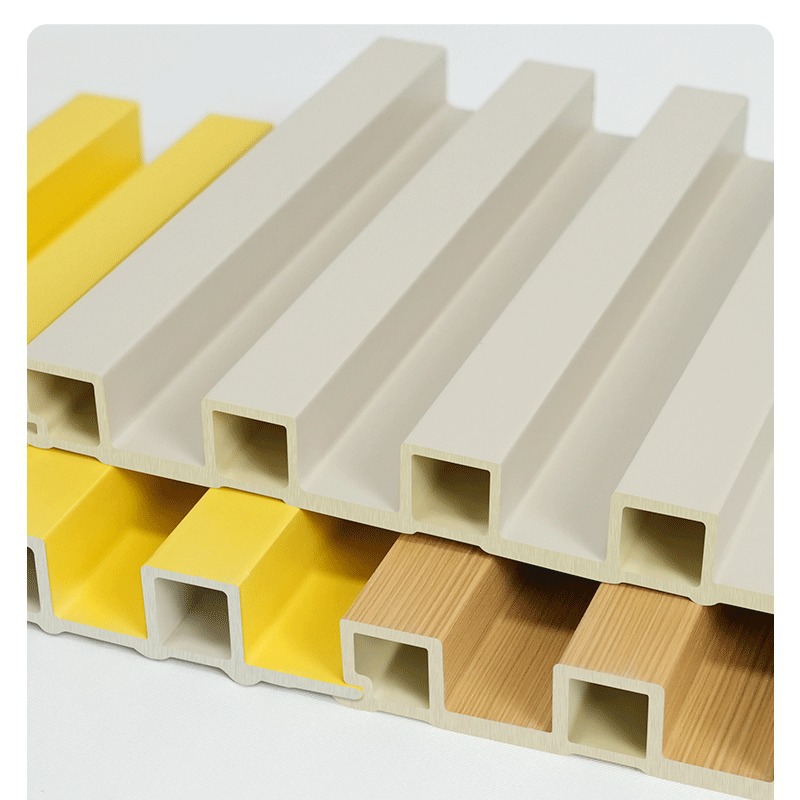
The 155 Pair Buckle Grille Panel: the WPC slat and fluted format used for feature walls, wall cladding, ceilings and partitions.
Format 2: Bamboo Wood Fiber Integrated Wall Panel 9 mm — the flat large-format panel
The 8mm/9mm Bamboo Wood Fiber Integrated Wall Panel is made of bamboo wood fibre and PVC, formed by high-temperature extrusion of the fibre raw material with PVC. The surface uses PVC film paper, with decorative options including PVC film paper, fabric and leather. Available widths are 600 mm, 400 mm and 300 mm at 9 mm thickness, with a standard length of 2900 mm and custom length available.
Joint options are a small V-seam, butt joint or seamless lock buckle, which is what allows the same panel family to be specified either as a visible linear joint design or as a cleaner flat wall. Listed features are zero formaldehyde, fireproof, waterproof, moisture-proof and strong plasticity, with hotel, apartment and villa interior walls named as the primary applications.
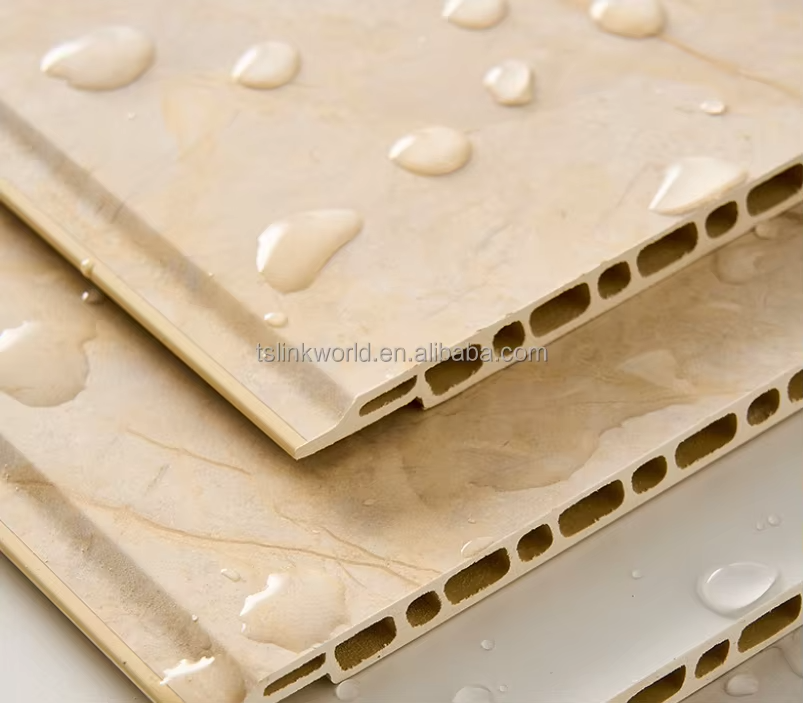
The 9 mm bamboo wood fibre integrated panel: a flat WPC interior wall panel for hotel, apartment and villa walls.
Adjacent interior lines: carbon crystal, SPC and UV panels
Linkworld's indoor range also includes carbon crystal panels, UV panels, SPC stone crystal wall panels and SPC floors, and the company states that its WPC and carbon crystal series are produced using bamboo charcoal fibre co-extrusion technology, which it says gives higher hardness, stronger wear resistance, more realistic texture and better weather resistance than ordinary PVC panels. Those comparative points are supplier statements and should be checked against the test documentation for the specific item.
For specification purposes the differences are concrete. The wood-grain carbon crystal panel uses a bamboo charcoal fibre substrate with a co-extruded diamond layer, is available at 5 mm and 8 mm in 1220 × 2440, 2600 or 2800 mm, is listed as Class A non-combustible to GB8624-2012, and is stated as formaldehyde not detected and heavy metals not detected. The SPC wall panel uses an SPC substrate with pattern paper, a diamond-grade wear-resistant layer and UV coating at 2–6 mm and 600, 1200 or 1220 mm width, and is positioned for kitchens, bathrooms, shower rooms and guest rooms.
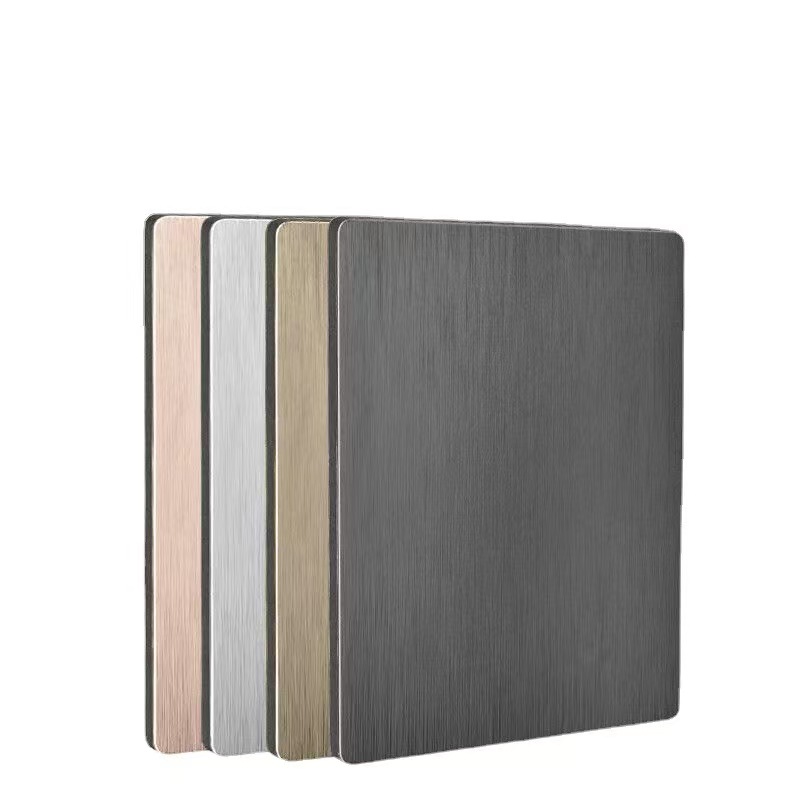
Wood-grain carbon crystal panel: an adjacent interior line with a co-extruded diamond layer and a Class A non-combustible listing.
Quality control, customisation and capacity
Batch consistency is the main technical objection in this category, and it is answered by process rather than by promise. Linkworld states that it uses 100% brand-new raw materials with no recycled content, that fixed raw-material suppliers and unified production formulas greatly reduce batch colour difference and keep performance consistent, and that reference samples are retained for mass-production orders so incoming goods can be compared against the confirmed standard. Qualified products are stated to carry a 25-year warranty under normal-use conditions.
Customisation runs through the product line: custom product development is supported, standard lengths of 2900 mm can be extended to order, and the 3D inkjet printing line supports custom patterns including marble, abstract art, natural scenery motifs and personal photographs on a 1220 × 3000 mm panel with custom sizing.
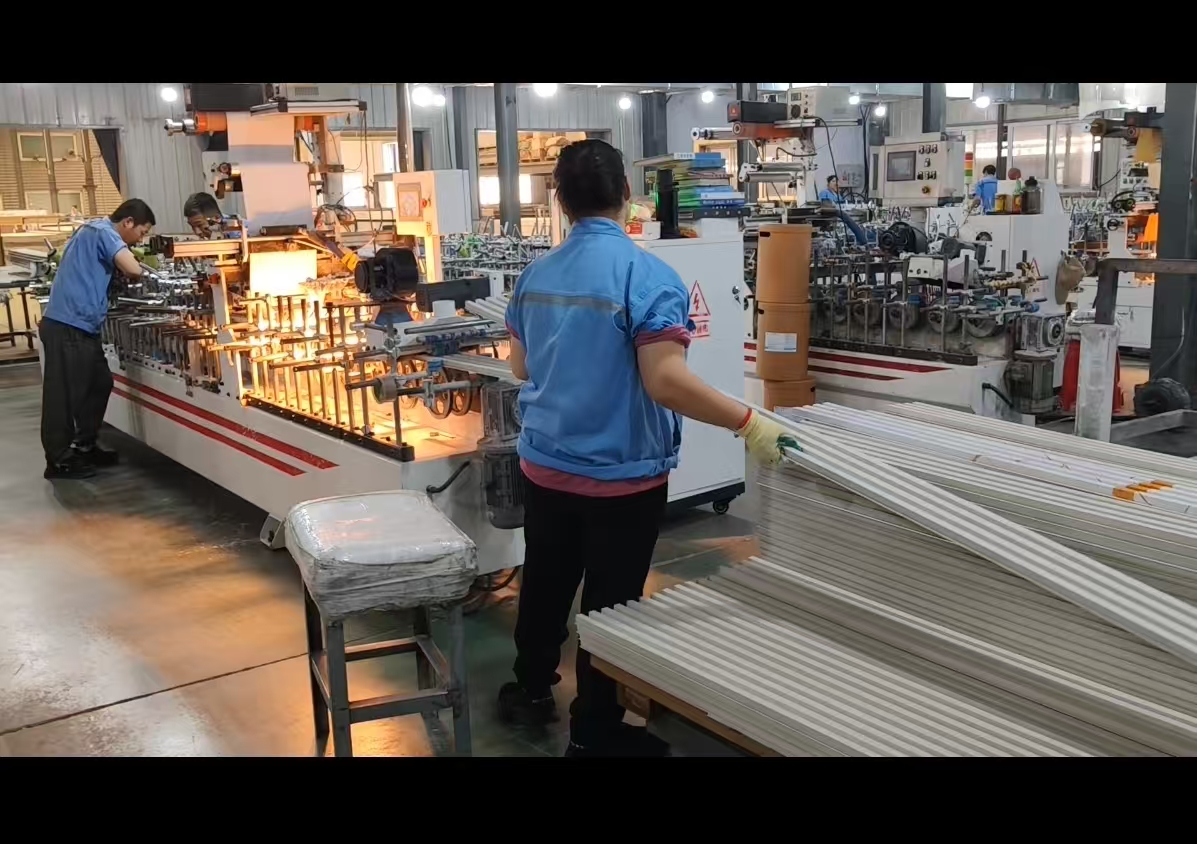
Extrusion and lamination line at the production facility, where panel profiles and surface films are combined.
Step-by-Step: Specifying and Installing a WPC Interior Wall Panel
- Define the application and the environment. Interior or exterior, dry or humid room, and the fire-safety requirement of the building type. Specification should depend on indoor or outdoor use, humidity, temperature, substrate and fire-safety requirements, and the finish, edge and packaging requirements for the destination market should be confirmed at the same time.
- Choose the panel format. Fluted grille profiles for feature walls, partitions and ceilings; flat integrated panels where a quieter surface is required. Choose by shape effect, colour, size and installation method, and apply the usage scenario, budget and installation environment as filters alongside waterproof performance, decorative effect, construction efficiency, service life and cost.
- Check the substrate. Before installation, verify that the wall is flat, dry and firm. An uneven base is one of the documented causes of visible joint gaps.
- Measure and plan the layout. Measure the wall length and height and deduct door and window areas. Confirm the actual panel size and effective coverage, then plan joints, texture direction and panel layout. Estimate cutting loss from the site conditions rather than applying a fixed percentage to every project.
- Confirm the accessory set. Stainless steel clips, self-tapping screws, decorative trim and corner closures should be ordered with the panels so the fixing method is not improvised on site.
- Cut safely and test first. Select the cutting tool by material and thickness, make a trial cut before batch processing, and check the cut edge quality. Wear goggles and protective gloves, and check tools and power supply before use.
- Fix and allow movement. Install and fix according to the product instructions, reserve the specified expansion space, and check joints and overall flatness as the work proceeds. Do not mix installation methods from different panel types.
- Finish, clean and maintain. Complete corner closing and clean the site. For daily maintenance, use a soft cloth or sponge with water and a suitable neutral detergent, then dry as required; test any cleaning agent in an inconspicuous area first and avoid strong acids, alkalis, solvents and steel wool.
Use Cases for WPC Interior Wall Panels
Residential feature walls
TV background walls and living-room accents are the clearest fit for the fluted profile: the strip arrangement creates contrast between light and dark and a visible depth layer, and it can be combined with flat panels and stone-effect boards in the same room. Because the grille is easy to saw, drill and nail, on-site adjustment around sockets and shelving is practical.
Hotels, apartments and B&B properties
Guest rooms, corridors and apartment interiors are named applications for the 9 mm integrated panel, where the seamless lock buckle option reduces visible joint lines and the panel is installed over a prepared substrate. Hospitality projects typically combine formats: flat panels on large wall areas and grille sections on headboard walls and corridor features.
Offices, retail and commercial interiors
Commercial buildings and public facilities are listed as applicable industries for the interior wall panel range. Reception walls, meeting rooms and retail fit-outs use WPC where a wood appearance is required without solid-wood maintenance, and where the surface must tolerate routine cleaning.
Healthcare, education and public buildings
Hospitals, clinics, campuses and similar buildings are named in the application scope for the interior panel lines, with carbon crystal panels listed specifically for hospital, campus, corridor and office use alongside the WPC formats. In these projects the specified performance — fire classification and emission data — matters more than the decorative pattern.
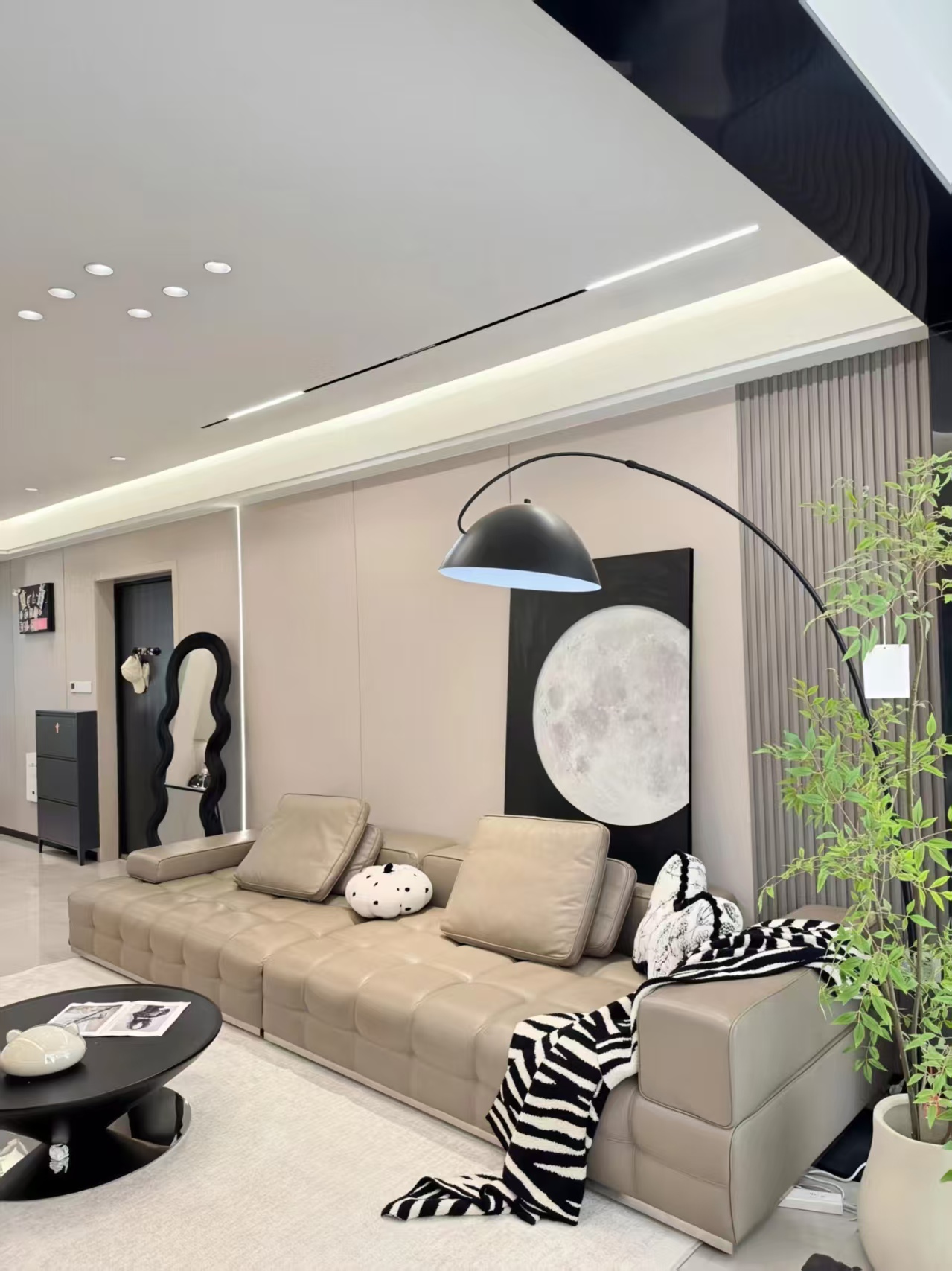
Flat interior wall panels across the main wall, with a fluted accent section used to define the seating zone.
Comparison Table: WPC Interior Wall Panel vs Adjacent Panel Types
The table below uses only the specifications and stated performance published for the Linkworld product lines. It is a format-selection aid, not a ranking: the correct panel depends on the room, the substrate and the required test documentation.
| Panel line | Core material | Size / thickness | Listed performance | Listed application |
|---|---|---|---|---|
| 155 Pair Buckle Grille Panel | Bamboo wood fibre + PVC | 155 × 18 mm; installed width ~150 mm; 2900 mm standard, custom available | Fireproof, waterproof, moisture-proof, zero formaldehyde; easy to saw, drill and nail | TV background wall, wall cladding, ceiling, partition |
| Bamboo Wood Fiber Integrated Wall Panel 9 mm | Bamboo wood fibre + PVC, high-temperature extrusion | 600 / 400 / 300 mm width × 9 mm; 2900 mm standard, custom available | Zero formaldehyde, fireproof, waterproof, moisture-proof; V-seam, butt joint or seamless lock buckle | Hotel, apartment and villa interior walls |
| Carbon Crystal Panel – Wood Grain | Bamboo charcoal fibre + co-extruded diamond layer | 5 mm / 8 mm; 1220 × 2440 / 2600 / 2800 mm | Class A non-combustible (GB8624-2012); formaldehyde not detected; heavy metals not detected | Hospital, hotel, campus, office, corridor, B&B |
| SPC Wall Panel | SPC substrate + pattern paper + diamond-grade wear layer + UV coating | 2 / 3 / 4 / 5 / 6 mm; 600 / 1200 / 1220 mm width | Waterproof and stable substrate; scratch-resistant matte or gloss UV surface | Kitchen, bathroom, shower room, guest room |
| Outdoor WPC Wall Cladding Panel | PE + wood powder or bamboo powder | 219 × 26 mm; 2900 mm standard, custom available | B1 fire rating; E0 eco grade; corrosion resistant, UV resistant, waterproof | Outdoor wall decoration, fence, decking |
The table also shows where specification errors happen: the interior grille and integrated panel are not the same construction as the exterior cladding panel, which uses a PE-based composite at 219 × 26 mm. Interior profiles should not be specified for facade use, and exterior profiles should not be substituted for interior wall lining without checking the interior requirements.
How to Shortlist Chinese WPC Wall Panel Manufacturers
Because Chinese producers account for an estimated 45–50% of global WPC production volume, the shortlist is long and price comparison alone will not separate it. Seven checks do most of the work:
- Published specification. Composition, dimensions, thickness, joint type and surface are stated before quotation, not after.
- Declared customer type. A supplier that serves wholesalers, importers, distributors, contractors and project buyers has already adapted packaging, documentation and MOQ to export trade.
- OEM and private-label capability. Relevant if the panel is sold under your own brand; ask what is customisable — length, colour, film, packaging, pattern.
- Sample policy. Samples should confirm colour, material, structure and quality requirements before volume commitment.
- Batch consistency method. Fixed raw-material suppliers, a unified formula and retained reference samples are the mechanism; ask which of these exists.
- Documents per item code. Test reports and certificates should be tied to the exact item, not to the product family name.
- Export record and warranty terms. Destination markets served, export share and the stated warranty conditions indicate how the supplier handles after-sales.
Next Step: Samples, Specification Sheet and Quotation
A quotation is only comparable when it references the same item code, thickness, surface and joint. The fastest route is to send the application, wall area, preferred format and destination market, then compare the returned sheet against the specification points in this guide.
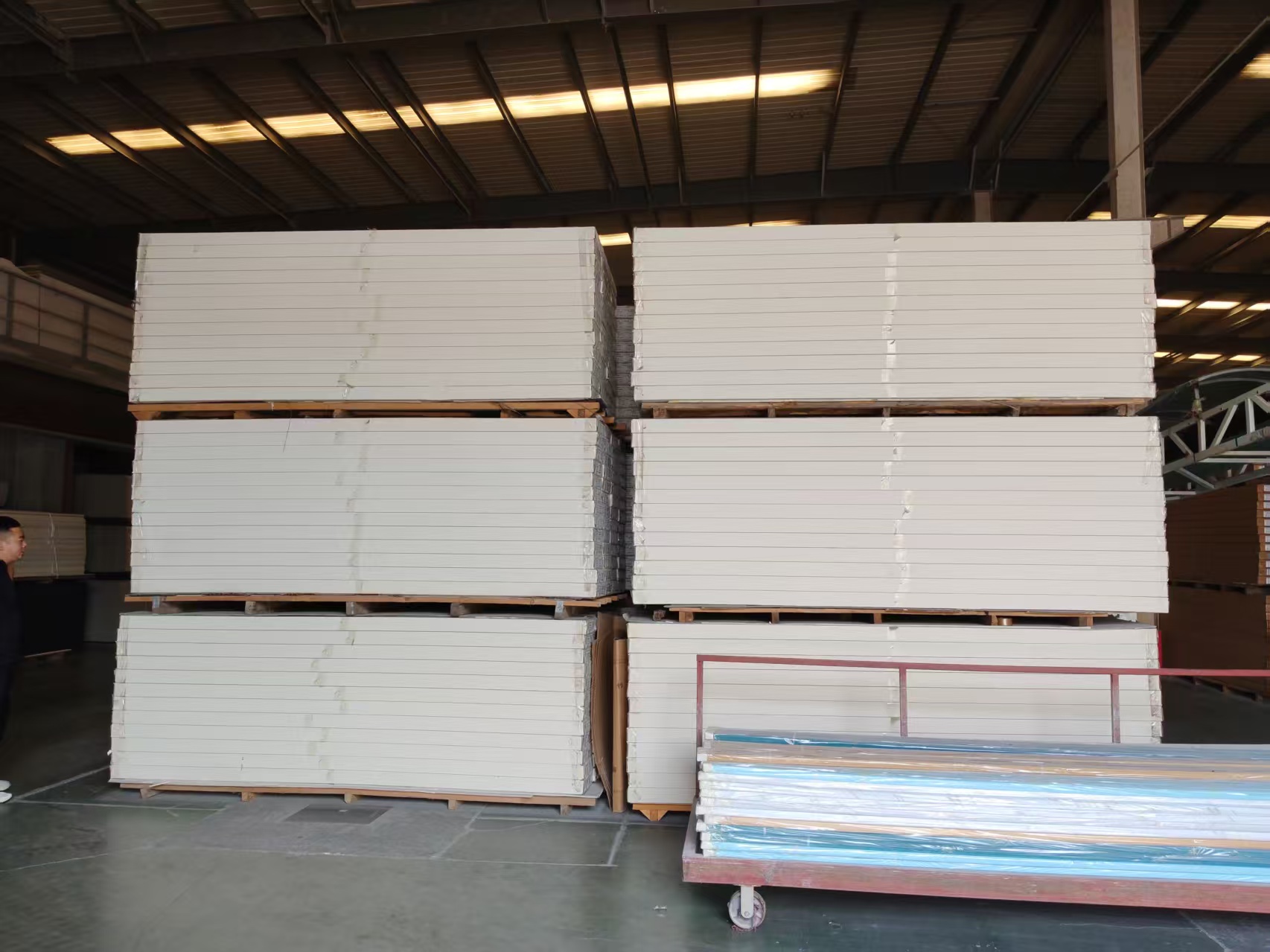
Finished panels packed and palletised before shipment, with protective film and batch identification.
Linkworld WPC Wall Panel — Tangshan Linkworld International Trade Co., Ltd.
Contact: Stella · Email: beibei@tslinkworld.com · Tel / WhatsApp: +86 19331530434
Address: No. 60, Qingbei East Road, High-tech Industrial Park, Tangshan City, Hebei Province, China · Website: www.tslinkworld.com
Product catalog (PDF, open access): download the Linkworld product catalog. Samples can be arranged to confirm colour, material, structure and quality requirements before a volume order.
FAQ
Which fire and emission standards should a WPC interior wall panel meet?
It depends on the destination market and the building type. For the US and EU markets, the fire-retardancy standards commonly required for wall panels are ASTM E84 (Class A or B) and EN 13501-1 (B1 or B2) respectively. For interior panels, formaldehyde and heavy-metal content are the other standard screens. Within the Linkworld range, the WPC grille and bamboo wood fibre integrated panels are described as zero formaldehyde, fireproof and waterproof, while the wood-grain carbon crystal panel is listed as Class A non-combustible to GB8624-2012 with formaldehyde and heavy metals not detected. Request the test report for the exact item code rather than the product family name.
How is a WPC interior wall panel different from carbon crystal, SPC and ordinary PVC panels?
The main differences among these products lie in their specific formulations, substrate structures, thicknesses, surface coatings, physical properties and application positioning — so quality should be judged from the material and the test data, not from the product name. Concretely: the WPC grille is a bamboo wood fibre and PVC composite at 155 × 18 mm; the WPC integrated panel is bamboo wood fibre and PVC at 9 mm in 600, 400 or 300 mm widths; the carbon crystal panel uses a bamboo charcoal fibre substrate with a co-extruded diamond layer at 5 mm or 8 mm; the SPC panel uses an SPC substrate with pattern paper, a diamond-grade wear layer and UV coating at 2–6 mm. Compare technical data sheets, test reports and installation requirements side by side.
What should I budget for WPC wall panels?
Published research for this category puts reference FOB pricing for standard WPC wall panels at roughly USD 8–18 per m², at medium confidence. That range spans real specification differences — thickness, width, surface process, joint design and whether the panel is co-extruded — and it excludes tooling, packaging, freight and import duties. Compare quotations per square metre at a stated thickness and surface rather than per piece, and treat the band as a budgeting reference, not a market price.
Can I request samples before placing an order?
Yes. Linkworld states that samples can be provided to confirm colours, materials, structures and quality requirements, and that reference samples are retained for mass-production orders so bulk goods can be compared against the confirmed standard. Ask for the sample to be labelled with item code, thickness, surface and joint type, so the later quotation and inspection refer to exactly the same specification.
Who are the Chinese WPC wall panel manufacturers, and how do I evaluate them?
China is estimated to account for 45–50% of global WPC production volume, so the candidate pool is large and mixes manufacturers with their own extrusion lines and sourcing or trading companies that aggregate factories. Evaluate in this order: whether a specification sheet is published before quotation; which buyer types the supplier declares — wholesalers, importers, distributors, contractors or project buyers; OEM and private-label ability; the sample policy; how batch consistency is controlled; which test documents can be supplied per item code; and the stated warranty and export record. For a specification-matched quotation on Linkworld WPC Wall Panel, send the item code, thickness, surface, quantity and destination port to beibei@tslinkworld.com or WhatsApp +86 19331530434, and download the product catalog for the full range list.
Conclusion
A WPC interior wall panel is a specification decision before it is a design decision. The material is a wood-plastic composite of plant fibre and polymer, the formats divide into fluted grille profiles and flat integrated panels, and the performance that matters — fire classification, emission data, moisture behaviour, joint design and expansion allowance — is documented per item code rather than per product name.
Linkworld WPC Wall Panel covers the 155 × 18 mm fluted grille and the 9 mm bamboo wood fibre integrated panel for interior walls, supported by adjacent carbon crystal, SPC and UV lines, a 20,000 m² facility with 1,560,000 square meters of annual output, and export experience across more than 60 countries. Buyers who compare suppliers on specification, samples, batch consistency and documentation — rather than on price per piece — are the ones who avoid the joint failures, colour mismatches and compliance surprises that define this category.
Have Questions or Need More Details?
Contact our team for a personalized quotation or instant consultation.
Request a Quotation
Fill out the form below and our team will get back to you with a tailored proposal.
WhatsApp Direct Chat
Prefer to chat in real-time? Message us on WhatsApp for instant assistance & quick answers.
- Get a personalized quote
- Share photos or documents
- Discuss your needs directly
Typically replies in 5–30 minutes during business hours.