
Cat7a vs Cat8 Ethernet Cable for Data-Center High-Speed Interconnection: A Buyer Comparison
For most data-center and enterprise interconnection projects, Cat7a F/FTP is the working cable and Cat8 F/FTP is a targeted exception. Cat7a is rated at 1000 MHz and supports stable 40 Gbps up to 50 m, plus 10 Gbps across a full 100 m channel. Cat8 doubles rated bandwidth to 2000 MHz and carries 25/40 Gbps — and 40–100 Gbps — inside a 30 m short-reach window, with stricter shielding and crosstalk control and a higher cost. The buying task is therefore not to pick the stronger category, but to match each link's length, port speed, channel components and flame/certification requirement.
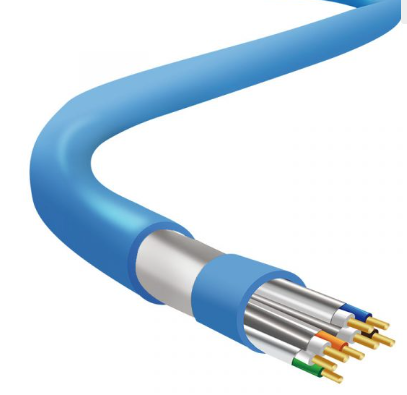
This comparison is written for network buyers and project engineers who are past the discovery stage and are preparing a specification, a tender document or a purchase order. It works through the application fit first — high-frequency data-center environments, 24/7 non-stop operation, the CMP flame rating required in air-handling spaces, and UL/ETL/CPR-certified supporting equipment such as core switches, patch panels and enterprise gateways — and only then compares the two cable categories. All product, certification and capacity figures below come from Linoya Electronic Technology Co., Ltd. documentation and case records.
The Real Buying Problem: Fit, Not Category Rank
Cat8 is not a drop-in upgrade for Cat7a, and treating it as one is the most expensive mistake in this category. Its documented advantage is concentrated in a 30 m short-reach window; running it across a 45 m in-row span does not extend that qualified reach, it only raises the bill of materials. Buyers who compare the two cables by bandwidth alone usually discover the mismatch at commissioning, when the channel test fails or the link negotiates below the expected rate.
Five specific failure patterns account for most of the rework in interconnection projects:
- Category chosen per building instead of per link. A hall contains 3 m cabinet-to-cabinet jumpers, 20–30 m rack-to-rack runs, and longer in-row spans that leave the Cat8 window entirely. One category cannot serve all three.
- Cable specified, channel ignored. A shielded cable terminated into an unmatched patch panel, or linked with lower-grade patch cords, does not form a channel of the same class.
- Distance budget exceeded. Twisted-pair Ethernet sets a 100 m maximum total channel length including patch cords; exceeding it causes signal attenuation and packet loss regardless of category.
- Flame rating treated as a formality. In North America, plenum air-handling space strictly requires CMP-rated cable; CM or CMG grades cannot satisfy plenum code.
- Certificate scope not matched to the model. Certification documents list the exact construction and, sometimes, the exact flame rating. A verification issued for one construction does not automatically cover a different shielding type or jacket.
Why Data-Center Interconnection Is a Different Buying Environment
Interconnection links inside a data center operate as fixed, passive, 24/7 high-load connections. The cable is the least serviceable layer in the stack: once the trays are closed and the cabinets are populated, a wrong category choice cannot be corrected by a firmware update. That single fact reshapes the buying criteria compared with office or commercial cabling.
Three environment factors dominate. First, density: high-frequency and high-density cabinet environments concentrate alien crosstalk risk, which is why both Cat7a and Cat8 use full shielding rather than unshielded construction. Second, duty cycle: documented deployment scenarios for these categories assume 24/7 high-load continuous operation, so stability records matter as much as peak bandwidth. Third, fire safety: cables run through return-air plenums, risers and public areas, which is why CMP, CMR or CM grading and EU CPR classification decide whether a shipment is accepted at all.
The active-equipment side of the environment has also shifted. 10G ports are now the baseline in enterprise and data-center access layers, while 25G, 40G and 100G appear at the top-of-rack and core, frequently through SFP modules, high-performance servers, storage arrays and enterprise gateways. Because those ports are mixed within the same hall, the cable specification has to be mixed too.
What Cat7a and Cat8 Actually Deliver
Cat7a F/FTP: 1000 MHz and the longer qualified reach
Cat7a delivers 1000 MHz bandwidth, stable 40 Gbps transmission up to 50 m, and 10 Gbps across a full 100 m channel with high-shielded construction. In Linoya case records, the CAT7A F/FTP build is documented with 22AWG heavy-gauge solid copper, full shielding, CMP flame rating, UL/ETL/CPR certification and optional LSZH jacket. Deployment records for this construction include premium data-center ultra-high-speed interconnection and heavy-EMI industrial ultra-high-speed links, at 305 m per carton and 6000 cartons per project, with a stated 25-year service duration and 99.999% network stability with minimal signal loss.
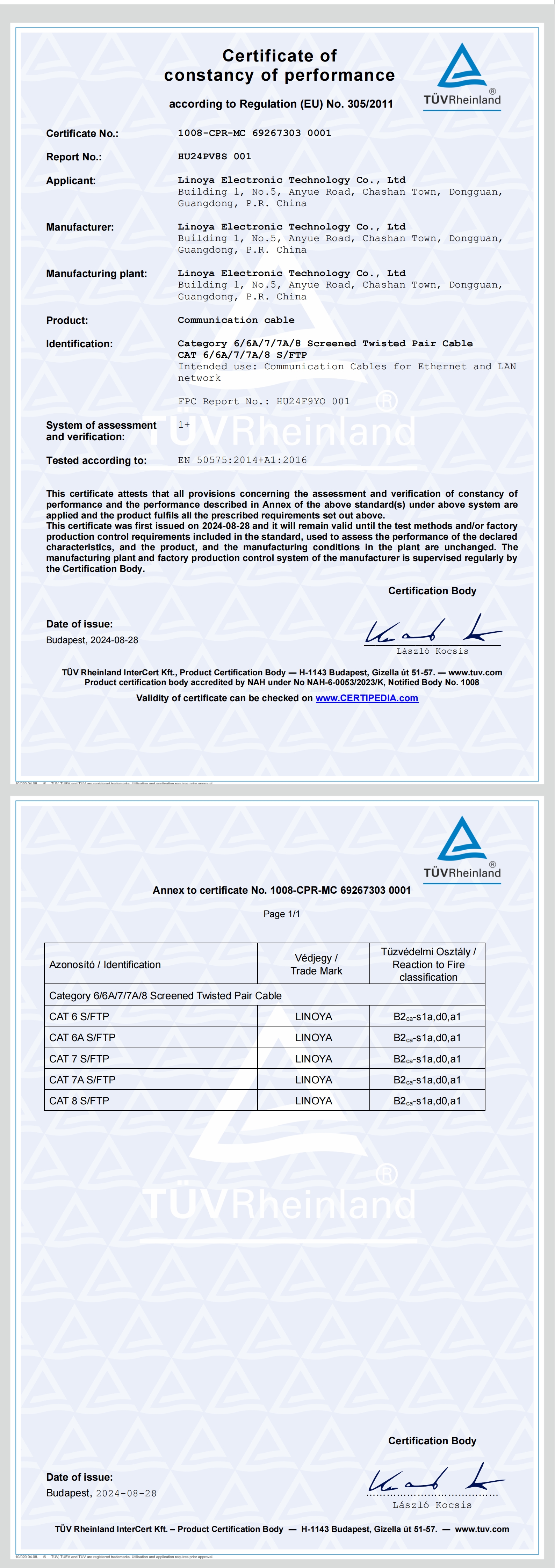
For European projects, the Cat7a F/FTP construction sits inside the CPR scope of report 801180-01/01 CLASS issued by Elektrotechnický zkušební ústav, s.p. (EZÚ, Notified Body 1014) to CSN EN 13501-6:2014 at class Dca-s1,d0,a2, and it is also within the CAT6/6A/7/7A/8 S/FTP scope of the B2ca certificate of constancy of performance. That dual documentation is what makes Cat7a practical for a building-wide EU data hall rather than a single short link.
Cat8 F/FTP: 2000 MHz inside a 30 m window
Cat8 reaches 2000 MHz bandwidth and supports 25/40 Gbps, and 40–100 Gbps transmission within 30 m, with stricter shielding and crosstalk control than Cat7a. The trade-off is explicit in the specification: higher cost and a limited transmission distance. Linoya case records for the CAT8 F/FTP build list 22AWG solid copper, full shielding, CMP flame rating, UL/ETL/CPR certification, LSZH jacket optional and a documented 30 m transmission distance, deployed in cabinet-to-cabinet and rack-internal short-reach links at 305 m per carton and 5000 cartons per project, with 99.998%–99.999% network stability and reliable 40G transmission.
Cat8 is therefore a precision tool. It exists for the dense, short, high-port-count segment where the active equipment genuinely runs 25G, 40G or 100G and the whole channel is built to the same class. Used there, it is the correct purchase. Used as a blanket specification across a hall, it is cost without benefit.
Matching the channel to the equipment at both ends
A cable category only exists inside a channel. Documented matched equipment for these deployments includes 10G and 40G switches, high-performance servers, storage arrays, patch panels, SFP modules, cable managers and enterprise gateways. Three matching rules follow:
- The port decides the category, not the catalogue. A 10G switch port cannot use Cat8's extra headroom; a 25G/40G/100G top-of-rack port cannot be served by an unmatched cable.
- Every passive component must be rated to the same class and properly grounded. Shielded constructions need correct grounding to deliver their anti-interference benefit; incorrect grounding introduces noise.
- The weakest component sets the channel. Patch panels, cords and connectors below the cable's class cap the whole link at their own rating.
A Seven-Step Link Audit Before You Order
- Map every link by length and target speed. Record cabinet-to-cabinet, rack-to-rack and in-row distances separately, and confirm the total channel stays within the 100 m limit including patch cords at both ends.
- Read the port inventory. Note where 10G ends and where 25G, 40G or 100G begins, including uplinks, storage arrays and enterprise gateway ports. Cable demand follows port capability.
- Assign the category per link. Cat8 for short-reach links inside 30 m carrying 25/40/100G; Cat7a for 40G up to 50 m, for 10G across the full 100 m channel, and for any run that leaves the Cat8 window.
- Match the passive channel. Specify patch panels, cords, outlets and connectors at the same class as the cable, and confirm the grounding scheme for shielded installation.
- Confirm the flame rating against the space. CMP where the run crosses a plenum air-handling space; CM/CMG cannot satisfy plenum code. For EU projects, confirm the CPR class the tender actually requires.
- Verify certificate scope against the exact model. Check that the certificate lists the construction and flame rating you are ordering — a Cat6A U/FTP ETL verification, for example, carries no flame rating marking, so it cannot be used to evidence a plenum claim.
- Lock the specification into the purchase order and validate on delivery. State conductor AWG, shielding type, jacket material and flame rating in the contract; enforce pre-shipment electrical testing and, where required, third-party inspection.
The commercial terms that usually accompany this audit are straightforward at Linoya: minimum order quantity of 305 m per carton at 100 cartons, standard lead time of 30 days, monthly capacity of 200,000 cartons, FOB or EXW delivery, acceptance based on pre-shipment test, and payment of 30% deposit with 70% balance before shipment.
Where Each Cable Fits in a Live Data Center
Cabinet-to-cabinet short reach. Links under 30 m between racks, where 25/40G or higher ports are in use, are the only place Cat8 F/FTP earns its premium. Documented deployments at 5000 cartons per project report 99.998%–99.999% network stability, full shielding for signal integrity and reliable 40G transmission.
Premium data-center and high-end enterprise interconnection. Where runs extend past 30 m, or where the mix is 10G and 40G rather than 100G, Cat7a F/FTP at 1000 MHz covers 40 Gbps to 50 m and 10 Gbps across 100 m. Documented projects report 99.999% stability with 22AWG heavy-gauge copper and minimal signal loss.
High-EMI and industrial-adjacent halls. Where motors, drives or heavy equipment share the building, full shielding and correct grounding matter more than the last increment of bandwidth. Cat7a F/FTP case records include heavy-EMI industrial ultra-high-speed links described as industrial grade with supreme anti-interference.
Mixed halls with legacy 10G switches. Buying Cat8 for ports that will never exceed 10G adds cost with no change in link behaviour. In these areas Cat7a — or a lower category where distance and speed allow — is the disciplined choice.
Cat7a vs Cat8: Verified Comparison
| Comparison point | Cat7a F/FTP | Cat8 F/FTP |
|---|---|---|
| Rated bandwidth | 1000 MHz | 2000 MHz |
| Documented speed and distance | Stable 40 Gbps up to 50 m; 10 Gbps across a full 100 m channel | 25/40 Gbps, and 40–100 Gbps within 30 m |
| Documented transmission distance (case records) | Up to 100 m channel for 10G | 30 m |
| Conductor (Linoya case records) | 22AWG heavy-gauge solid copper | 22AWG solid copper |
| Shielding | Full shielding | Full shielding with stricter crosstalk control |
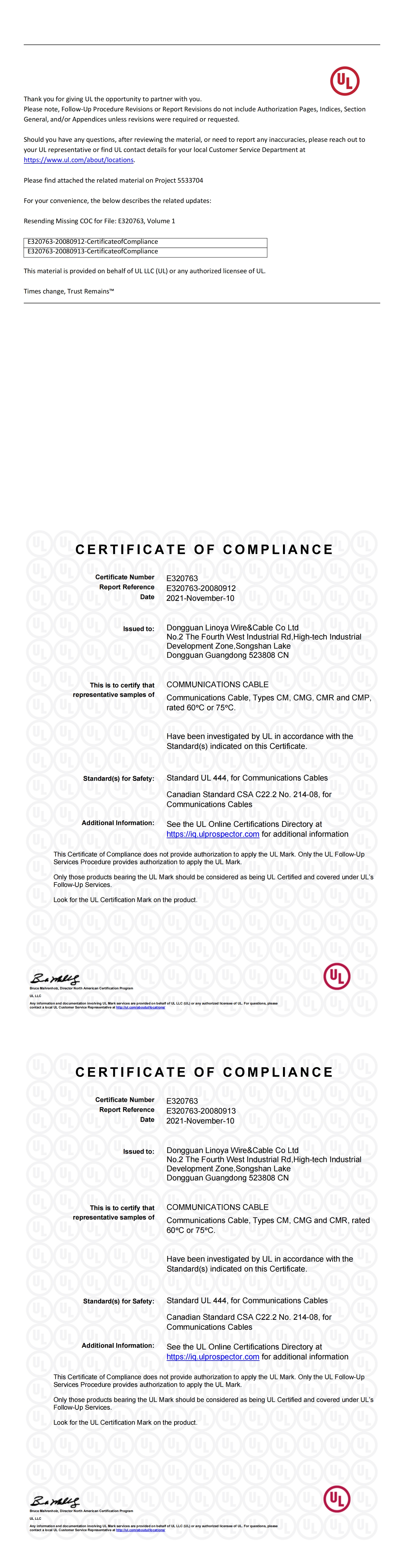
| Flame rating | CMP available; UL E320763 covers CM/CMG/CMR/CMP | CMP available; UL E320763 covers CM/CMG/CMR/CMP |
| EU CPR documentation | EZÚ 801180-01/01 CLASS, Dca-s1,d0,a2; within B2ca S/FTP certificate scope | Within B2ca-s1a,d0,a1 certificate scope, 1008-CPR-MC 69267303 0001 |
| Jacket options | LSZH jacket optional | LSZH jacket optional |
| Documented 24/7 stability (case records) | 99.999% | 99.998%–99.999% |
| Cost position | Lower than Cat8 | Higher cost per metre |
| Best-fit link type | Rack-to-rack and in-row runs at 10G/40G, including runs beyond 30 m | Dense cabinet-to-cabinet short reach at 25G/40G/100G |
| Link requirement | Specify | Verify before ordering |
|---|---|---|
| 10G across the full 100 m channel | Cat7a F/FTP | Channel length including patch cords; LSZH option if required |
| 40G at 30–50 m | Cat7a F/FTP | 40 Gbps support up to 50 m; grounding scheme for shielded build |
| 25/40/100G within 30 m | Cat8 F/FTP | Actual measured length; matched patch panel and cords |
| Plenum air-handling route | Either category, CMP version | UL E320763 scope and CMP marking on the delivered cable |
| EU public or tender project | Either category | CPR class in the tender matched to certificate scope and shielding type |
Both categories require correct grounding of the shield, termination at the same class, and a total channel within 100 m. Category alone does not create a compliant channel.
FAQ: Cat7a, Cat8 and Data-Center Interconnection Buying Questions
Do Cat7a and Cat8 data-center cables need CMP flame rating, and which certificates should I verify?
Flame rating follows the installation space, not the cable category. In North America, plenum air-handling spaces require CMP-rated cable, and CM or CMG grades cannot satisfy plenum code. Linoya UL Certificate of Compliance E320763 covers communications cable types CM, CMG, CMR and CMP rated 60 °C or 75 °C under UL 444 and CSA C22.2 No. 214-08. For EU projects, CPR performance is documented separately: certificate of constancy of performance 1008-CPR-MC 69267303 0001 from TÜV Rheinland InterCert Kft. (Notified Body 1008) covers CAT6/6A/7/7A/8 S/FTP LAN cables to EN 50575:2014+A1:2016 at class B2ca-s1a,d0,a1, while the Cat7a F/FTP construction is also covered by EZÚ report 801180-01/01 CLASS at Dca-s1,d0,a2. Verify that the certificate scope matches the exact model and shielding construction you order.
Can a supplier customize Cat7a or Cat8 cable — and OEM the Cat6a S/FTP range — for a private-label programme?
Linoya Electronic Technology Co., Ltd. runs OEM and customization programmes covering cable length, logo printing and packaging, with 305 m per carton and monthly capacity of 200,000 cartons. Customization only adds value when the construction stays inside the certificate scope, so specify conductor AWG, shielding type, jacket material and flame rating in the purchase order and match each one to the certification documents. The same OEM arrangements apply across the shielded range, including Cat6a S/FTP, which is useful when one project mixes 10G access links with 40G and 100G interconnection.
Do I need Cat8 on every link to avoid future bottlenecks?
No. Cat8's advantage sits inside a 30 m short-reach window, where 2000 MHz bandwidth supports 25/40 Gbps and 40–100 Gbps with stricter shielding and crosstalk control — at a higher cost. Cat7a provides 1000 MHz, stable 40 Gbps to 50 m and 10 Gbps across a full 100 m channel at a lower unit cost. Running Cat8 on longer in-row spans does not extend its qualified distance; it only raises project cost. Specify Cat7a for the general run and reserve Cat8 for short, dense cabinet-to-cabinet links driven by 25G/40G/100G ports.
What should a pre-order sample evaluation confirm?
Three things: that the sample construction matches the certificate scope, that the finished cable passes electrical performance testing, and that the delivered length fits the 100 m maximum channel limit including patch cords. Linoya applies 100% pre-shipment testing, full electrical performance tests and random sampling inspection, and accepts third-party inspection such as SGS or UL. Because the minimum order is 305 m per carton at 100 cartons, sample evaluation is normally handled as a carton-level trial before the bulk run, with conductor AWG checked against the contract clause.
What lead time, MOQ and commercial terms apply to a bulk Cat7a or Cat8 order?
Standard lead time is 30 days, with monthly capacity of 200,000 cartons of 305 m and a minimum order of 100 cartons. Delivery terms are FOB or EXW, acceptance is based on pre-shipment test, and payment terms are 30% deposit with 70% balance before shipment. After-sales support includes 24/7 online technical support, a one-year product warranty and free replacement of defective products.
Conclusion: Buy the Match, Not the Number
The decision rule is short. If a link runs beyond 30 m, or if the ports at both ends are 10G or 40G, Cat7a F/FTP is the specification that fits: 1000 MHz, 40 Gbps to 50 m, 10 Gbps across 100 m, full shielding, CMP available, and CPR coverage that a European tender will accept. If a link is a short, dense cabinet-to-cabinet run driven by 25G, 40G or 100G ports, Cat8 F/FTP with 2000 MHz is the correct tool — provided the patch panels, cords and connectors are built to the same class and the run genuinely stays inside the 30 m window.
What separates a smooth commissioning from a rework cycle is rarely the category printed on the reel. It is whether the flame rating matches the space, whether the certificate scope matches the exact construction, whether the passive channel matches the cable, and whether the delivered conductor matches the contract. Audit those four points link by link, and the Cat7a versus Cat8 question answers itself.
Next Step: Specification Review, Sample and Quotation
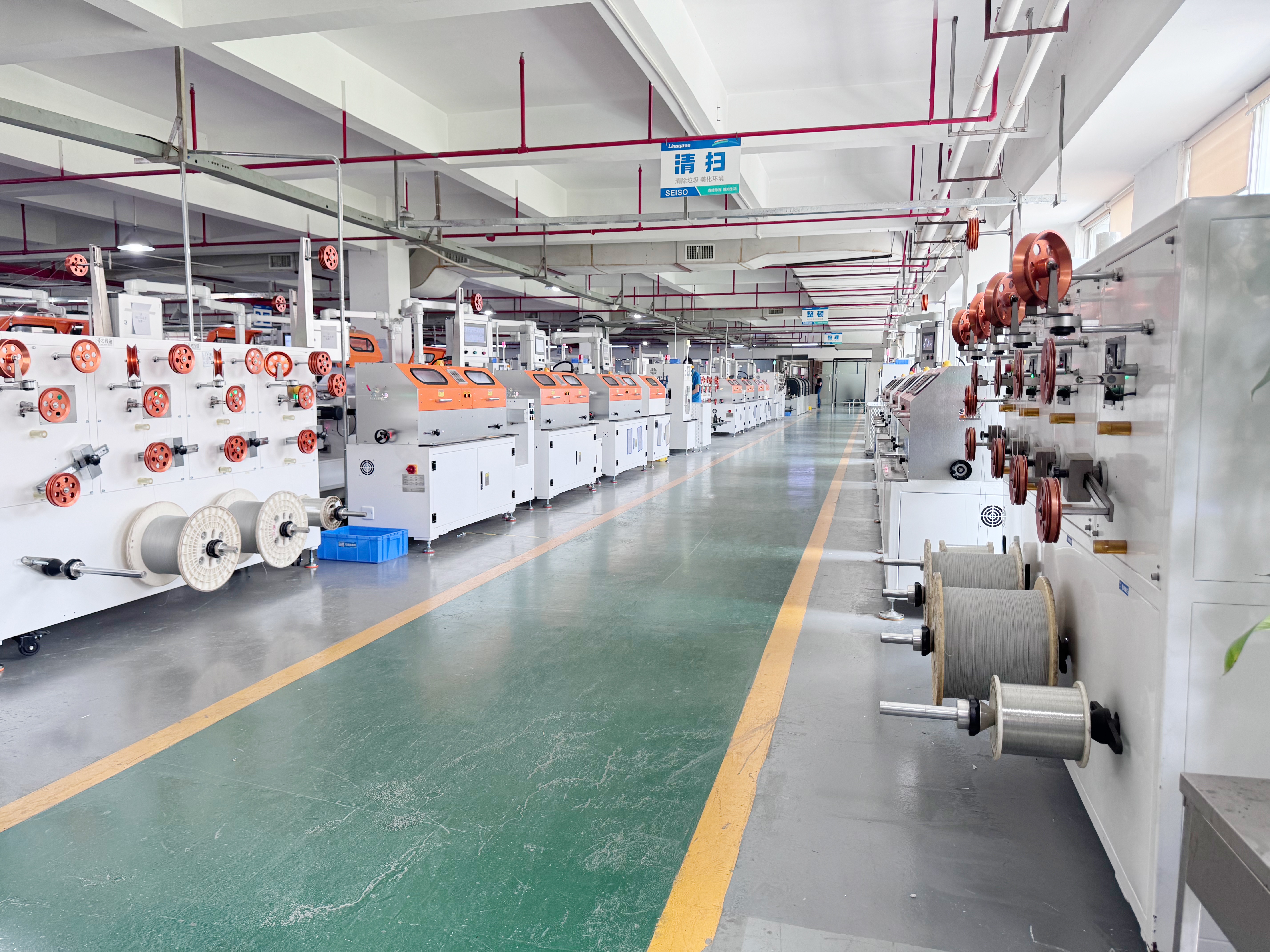
Send your link list — lengths, target speeds, flame rating and the CPR class your tender requires — and Linoya Electronic Technology Co., Ltd. will confirm which links should be Cat7a and which justify Cat8, then quote against verified certification scope.
Email: inquiry@linoya.com · Tel: +86-15602610696 · WhatsApp: +86-13038893260 · Website: www.linoya.com
Download the full product and certification catalogue: Linoya Electronic Technology Co., Ltd. Catalogue (PDF)
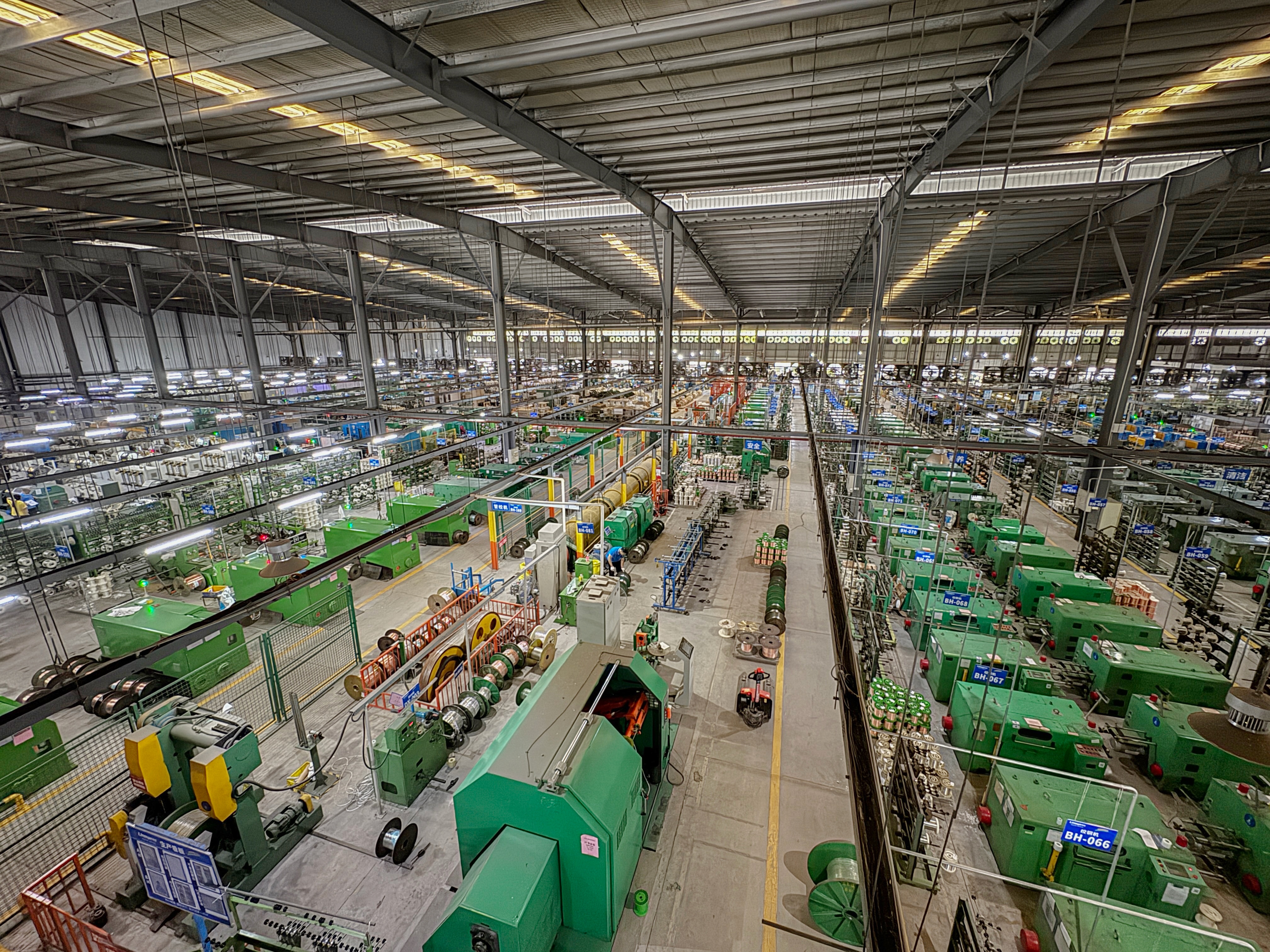
Linoya Electronic Technology Co., Ltd. was established in 1997 and manufactures cable and wire at a 60,000 m² facility in Dongguan, Guangdong Province, China, with 3000+ employees, 300+ engineers, 4,000,000 km annual output and exports to the EU and the Middle East. Address: No.2, The Fourth West Industrial Road, High-Tech Industrial Development Zone, Songshan Lake, Dongguan City, Guangdong Province, China.
Have Questions or Need More Details?
Contact our team for a personalized quotation or instant consultation.
Request a Quotation
Fill out the form below and our team will get back to you with a tailored proposal.
WhatsApp Direct Chat
Prefer to chat in real-time? Message us on WhatsApp for instant assistance & quick answers.
- Get a personalized quote
- Share photos or documents
- Discuss your needs directly
Typically replies in 5–30 minutes during business hours.