Direct-Burial vs Aerial Outdoor Waterproof Ethernet Cable: A Buyer's Comparison Guide
Short answer: choose a direct-burial construction when the cable runs underground, and an aerial construction when it hangs between supports — and if a route includes both, specify the harder section. The two structures are not interchangeable grades of the same product. Direct-burial outdoor cable is built around a double-jacket water-blocking structure for underground moisture resistance; aerial outdoor cable is built around tensile strength for hanging installation. Once the structure is fixed, the second decision is jacket material (PVC, PE-type thermoplastics such as TPE, TPU or XLPE, and LSZH), and the third is environment: UV exposure, plenum ceilings that require a CMP rating, and mechanical load.
This guide is written for importers, distributors and project buyers evaluating outdoor network infrastructure. It compares the two deployment structures side by side, shows where each one wins and where each one fails, and sets out what to put on a specification before an RFQ goes out. Linoya Electronic Technology Co., Ltd., a cable and wire manufacturer established in 1997 with production in Dongguan, China and Vietnam, makes network cables as well as outdoor waterproof cables and connectors; its published construction and certification information is used as the manufacturing reference throughout.
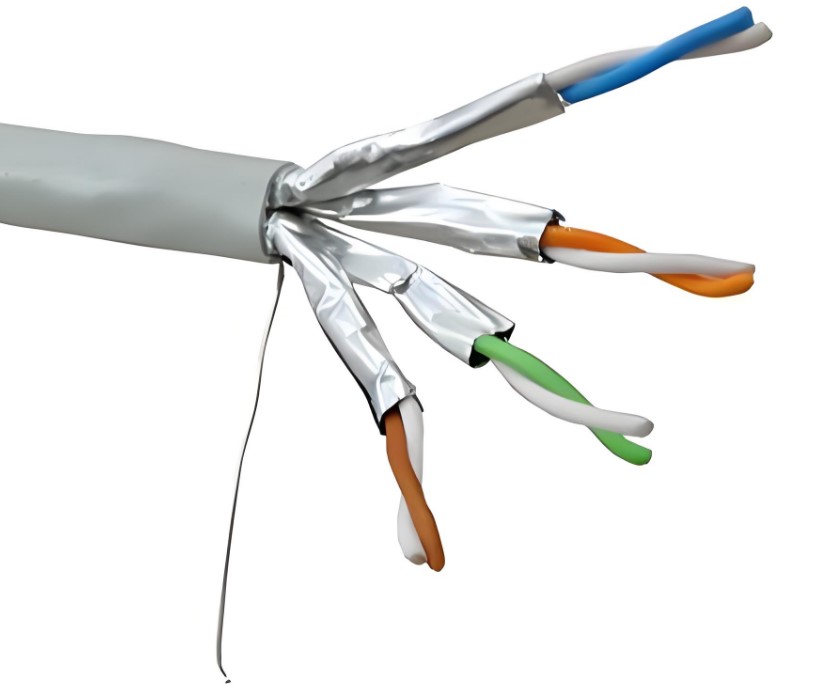
Shielded twisted-pair construction — the electrical layer that stays the same whether the cable is buried or suspended.
Problem Definition: Why Outdoor Cable Specifications Fail
Outdoor cable failures rarely start with the copper. They start with a specification that does not match the installation, and they show up in three predictable patterns.
- Indoor-grade cable installed outdoors. An indoor jacket is tuned for mechanical flexibility and flame performance, not for years of direct UV exposure or permanent soil contact.
- Direct-burial cable suspended in the air. An underground construction relies on its jacket and water-blocking layer to resist moisture. It usually carries little or no tensile member to absorb span tension and wind-induced vibration.
- Aerial cable buried in a trench. An aerial design spends its structure budget on tensile strength. Buried, that advantage disappears, and the construction may lack the longitudinal water blocking that continuous wet soil demands.
Both failures are slow. The jacket hardens and cracks, water migrates along the cable core, copper corrodes, and link stability or PoE delivery degrades a season or two after handover — at which point re-trenching or re-stringing costs far more than the cable ever did.
Industry Background: The Four Loads That Set the Specification
Five outdoor networking scenarios dominate demand: IP video surveillance, wireless base station backhaul, campus and industrial park backbones, building-to-building links, and industrial outdoor zones. All of them expose cable to some combination of four environmental loads.
- Water. Standing immersion in trenches and below the water table, intermittent contact from rain, ground splash and meltwater, and condensation.
- Solar radiation. Sustained UV exposure degrades unstabilised polymers, which shows up as jacket cracking, chalking and colour change.
- Mechanical load. Span tension, wind-induced vibration, ice loading, sag, pulling during installation and soil movement.
- Fire and code requirements. Where a cable enters a building, its position — not its outdoor climate — often dictates the required flame rating.
These four loads rarely appear at the same level on the same run. That asymmetry is the whole point of the direct-burial versus aerial comparison: each structure is optimised for a different subset of heavy load and accepts a weakness elsewhere.
On the manufacturing side, an outdoor cable is not one polymer decision but several. Linoya works with thermoplastic materials including PVC, CTPE, TPE, TPU, PUR, XLPE, XLPO, low-smoke zero-halogen (LSZH) and FPE — and which of these goes into the jacket is exactly where direct-burial and aerial constructions begin to diverge.
Detailed Solution: Two Structures, Two Jobs
Direct-Burial Construction: Double Jacket and Water Blocking
Direct-burial outdoor waterproof Ethernet cable uses a double-jacket, water-blocking structure. An inner water-blocking layer between the two jackets — typically water-swellable tape, yarns or gel — swells or forms a barrier when water reaches a damage point or a termination, stopping lengthwise migration inside the sheath system. The outer jacket is the surface that meets the soil: abrasion, stone impression, soil chemistry and permanent moisture.
The procurement consequence is straightforward. Underground, moisture is continuous and radial, so any water that enters the sheath system has to be stopped rather than drained. That same logic argues for ordering direct-burial cable in continuous route lengths with as few intermediate joints as possible, because every joint is the weakest water-block point on the run.
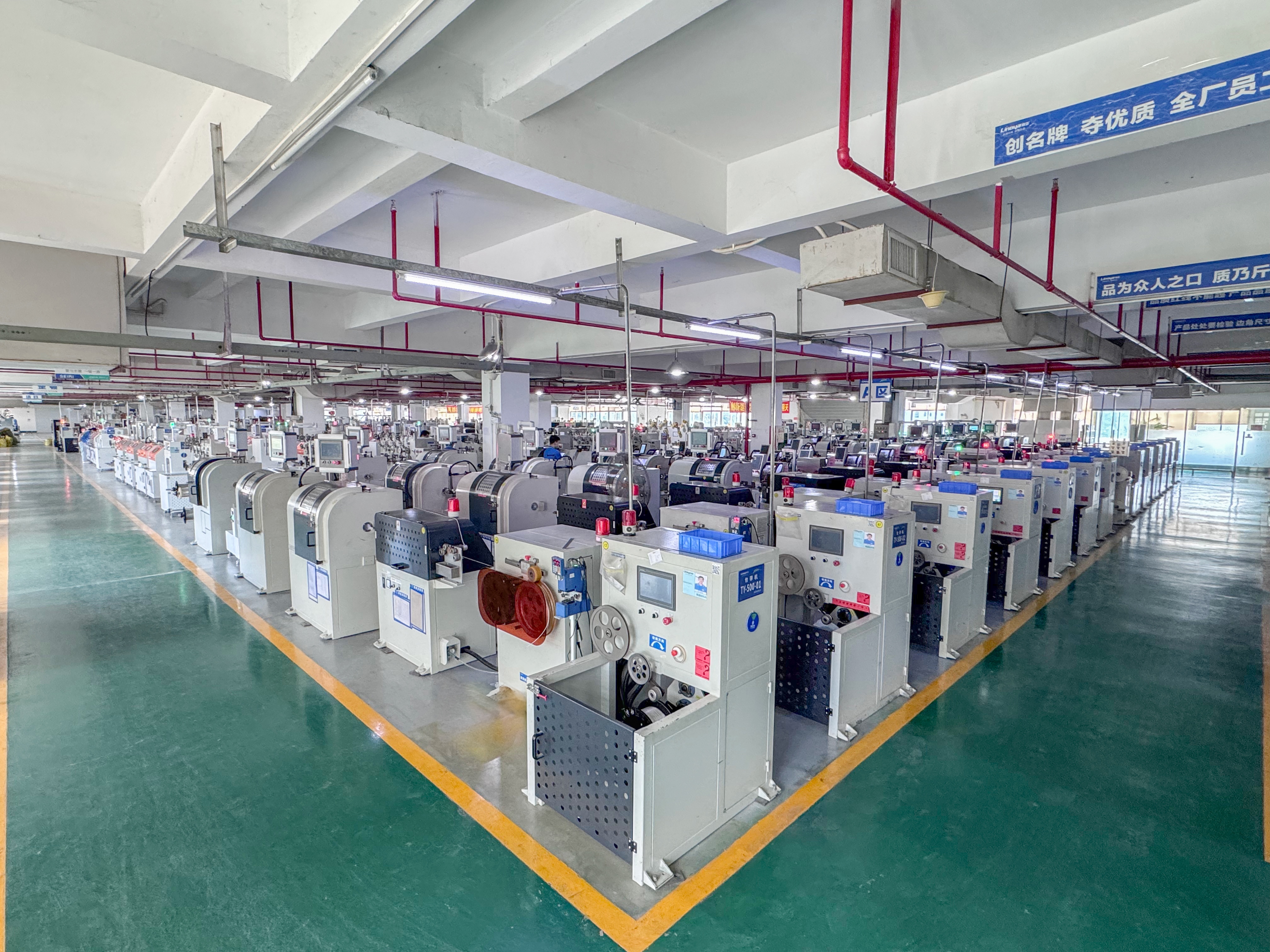
Overlapping tape layers are applied around the core on the production line — the construction step where water-blocking and shielding layers are built in before jacketing.
What the water-blocking layer actually does
Water blocking converts a flooding problem into a bounded one. Without a blocking layer, water entering at a factory end or a field termination travels along the core by capillary action and surface tension rather than pressure, reaching parts of the cable no one will ever open. With the blocking layer in place, that water stays near the entry point.
Shielding and fill in buried routes
Shield style — F/UTP, SF/UTP, F/FTP and similar designs — changes how moisture crosses the cable, because each foil or braid adds another interface. Shielding is justified by electromagnetic environment, not by soil conditions, and it does not replace water blocking. Treat them as two independent decisions, and state both on the drawing.
Aerial Construction: Built Around Tensile Strength
Aerial outdoor cable is designed to carry tensile load. Strength members run along the core — typically aramid yarns or other high-tenacity synthetic fibres, and in self-supporting designs a galvanised steel messenger formed integrally with the cable. The jacket then has to do two jobs at once: resist UV radiation and survive repeated flexing from wind vibration, thermal cycling and ice load.
The structural direction changes the procurement question. For a suspended installation, the buyer is not selecting a cable by conductor gauge but by span and support arrangement, the load the cable will carry, the sag it will be allowed, and the spacing of supports. A buried design with the correct gauge will elongate under load and distort the pair geometry that produces its electrical performance — and once the geometry is distorted, the performance claim on the datasheet no longer describes the installed cable.
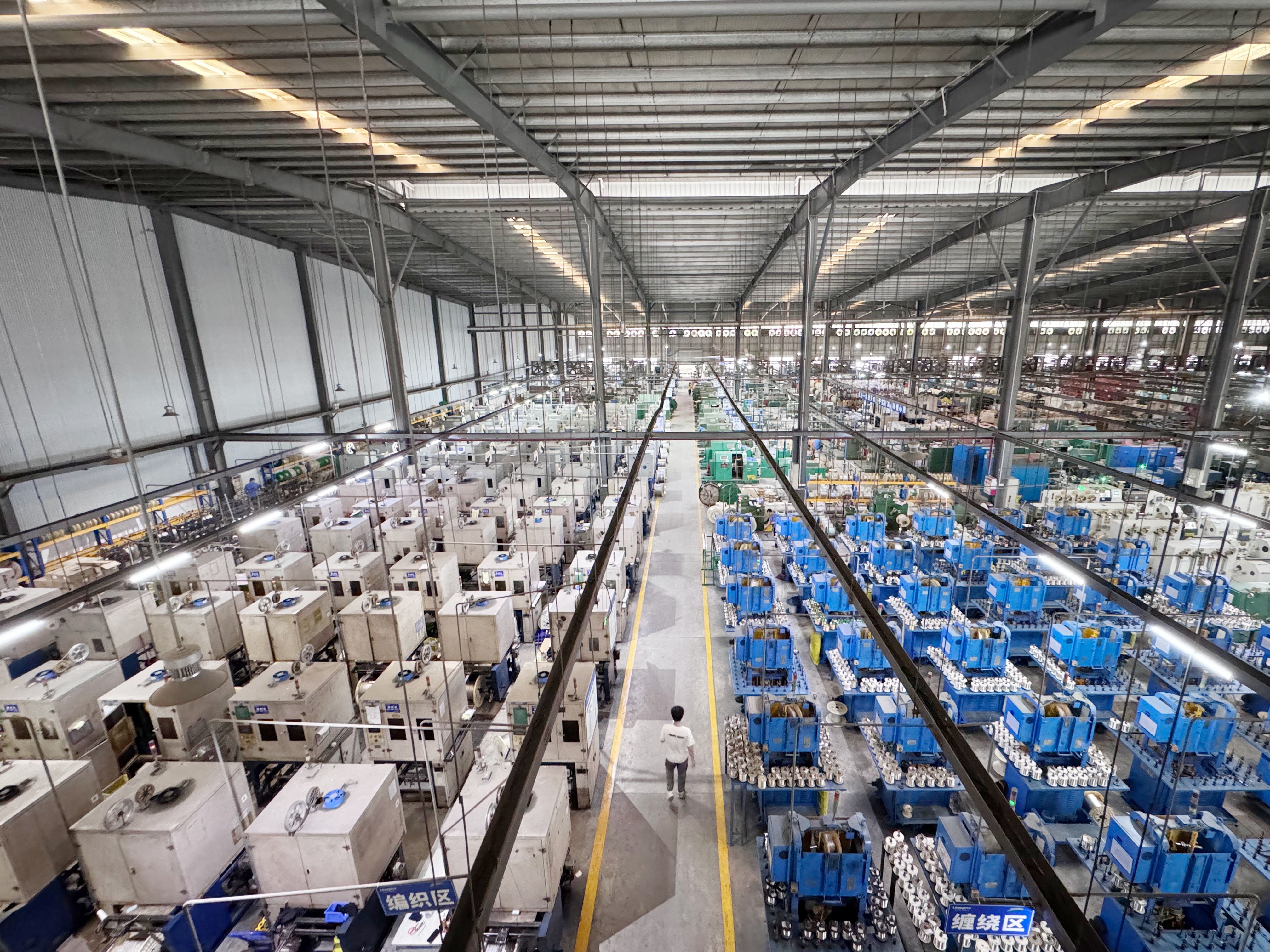
Braiding and strength-layer construction — the part of the build that distinguishes a suspended design from a buried one.
Two variables that decide an aerial run
Tension and UV are the deciding pair. Tension is set by span, sag and wind loading, and it determines whether a strength member is needed and how large it must be. UV exposure is set by how much of the run is in direct sun, and it determines whether the outer jacket has to be a UV-stabilised compound. Neither variable can be assessed from a product photograph; both need to be stated by the buyer in the route description.
Jacket Material: PVC, PE-Type Thermoplastics and LSZH
Jacket chemistry decides how long the cable lasts outdoors. Four families need to be separated, because they trade moisture resistance, UV stability and fire performance against each other.
PVC
PVC is flexible, flame retardant and inexpensive to process, which makes it a common choice indoors. Outdoors it requires UV stabilisation, and long-term direct soil contact is generally not its strongest application. On protected outdoor transitions and indoor terminations, PVC is often the reasonable option — it is the exposed and buried sections that need a harder look.
PE-type thermoplastics: TPE, TPU and XLPE
Polyethylene-based systems carry most outdoor structures. PE generally offers better moisture resistance and chemical resistance than PVC; crosslinking (XLPE) improves heat resistance and mechanical durability; TPU contributes abrasion resistance, which matters on exposed spans and on pulls through rocky trenches; TPE balances flexibility with low-temperature performance, which matters for buried runs in cold climates. These choices are not equivalent between the two structures: abrasion resistance is a span and trench-pull concern, while low-temperature flexibility is mainly a buried-route concern.
LSZH
LSZH is specified where smoke and acid gas emissions in a fire would threaten people and equipment: tunnels, stations, enclosed chambers and public buildings. Its advantage is a fire-scenario advantage, not an outdoor one. Before LSZH is used as an outer jacket on permanent UV exposure or continuous burial, confirm that the compound has been stabilised for that duty, because low-smoke formulations are not automatically equivalent to a PE jacket on mechanical toughness and UV performance.
Composite jackets
Mixed constructions are common: a PE or XLPE outer jacket for the environment, with an inner layer chosen for a fire or emission requirement, so the same cable satisfies both the outdoor and the building side of the route. The important discipline is to specify both layers on the drawing rather than writing "outdoor jacket" and leaving the rest to the supplier.
How Environment Shifts the Decision
UV exposure
UV exposure is set by where the cable is installed, not by a catalogue claim. Cable inside conduit, in a dense bundle or in permanent shade carries a far lower UV burden than cable on an exposed pole-to-pole span or a facade run. The useful buyer habit is to mark the exposed sections on the route drawing and specify a UV-resistant jacket only for those sections. Linoya's published selection guidance recommends UV-resistant and water-blocking jackets for long outdoor or underground runs, which is the right baseline for a mixed route.
Plenum ceilings and CMP
CMP is the most stringent flame rating in UL 444 for communications cable. It is an indoor rating, and aerial cable frequently has to meet it because an aerial route often enters a building through a plenum ceiling, a soffit or a riser. The practical reading: the outdoor section is governed by UV and moisture requirements, the indoor section is governed by flame requirements, and the transition point is where a single product rating no longer covers the whole run. Linoya holds UL Certificate of Compliance E320763 covering communications cable types CM, CMG, CMR and CMP, rated 60℃ or 75℃, under UL 444 and CSA C22.2 No. 214-08 — when specifying a cable that crosses from outside into a plenum space, verify that the certificate lists the specific construction.
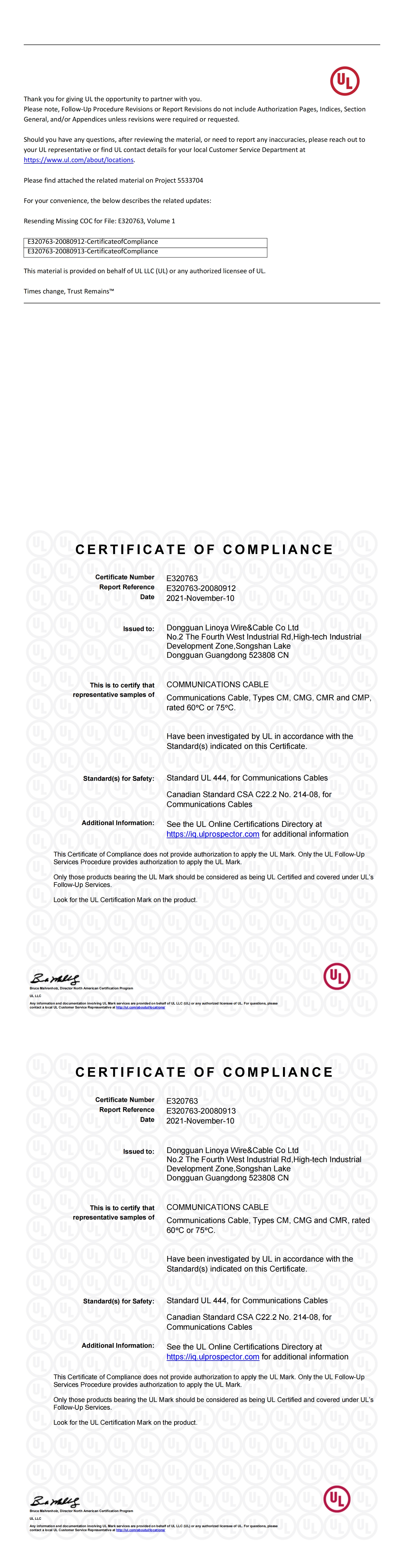
UL Certificate of Compliance E320763 — the flame-rating scope that matters when a route enters a plenum ceiling.
Step-by-Step Breakdown: A Seven-Step Selection Process
- Map the route before choosing the cable. Mark every section as buried, suspended or inside a building. If more than one section type appears, specify a mixed route and identify the transition points explicitly.
- Define the moisture load. Permanent immersion, intermittent contact or condensation. Permanent immersion drives water-blocked constructions; intermittent contact drives a robust outer jacket and sound waterproof terminations.
- Define the UV load. Direct, indirect or shaded. Only the direct sections need a UV-resistant outer jacket, but those sections need to be identified on the drawing rather than assumed.
- Define the fire requirement inside the building. If the route passes a plenum, a riser or a public area, establish the required rating (CM, CMG, CMR or CMP), the governing standard and the local compliance mark for the destination market.
- Fix the electrical target. Category, AWG, shielding and PoE budget. For reference, Linoya's CAT5E U/UTP uses 24AWG solid bare copper at 1 Gbps; CAT6 U/UTP is offered in 24AWG or 23AWG with 10 Gbps over 55 m; CAT6A constructions use 23AWG solid bare copper with 10 Gbps over 100 m.
- Require written test and certificate evidence. 100% pre-shipment testing, third-party inspection (SGS/UL), and — for EU-bound projects — a declaration of performance that matches the model being purchased.
- Lock the commercial terms last. Reel or carton length, packaging, printing, MOQ and delivery. Settling these before the drawing is frozen prevents the two most common post-order disputes.
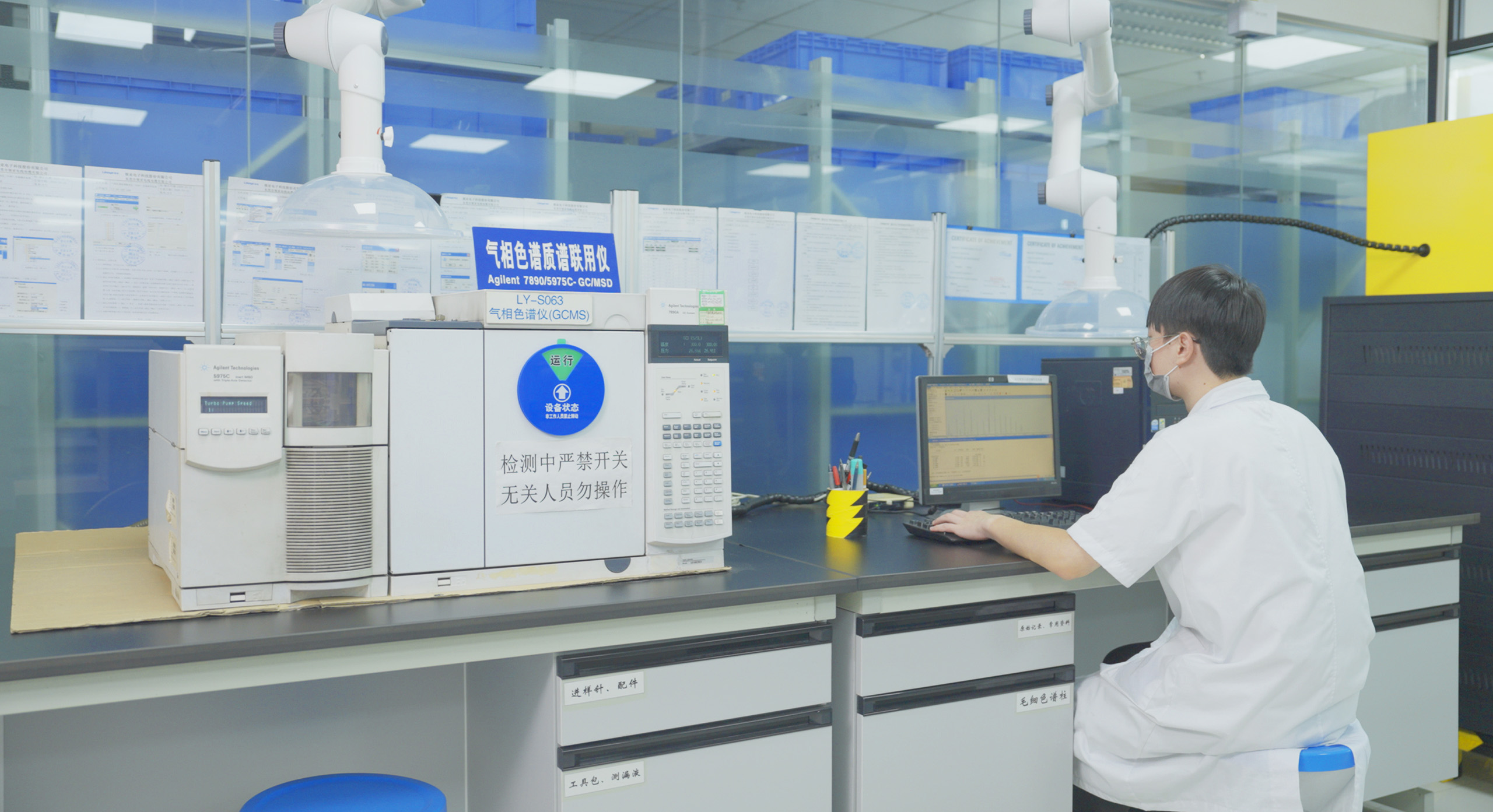
Finished-cable verification — electrical performance testing before shipment.
Use Cases: Mapping Scenarios to Structures
Application keywords usually describe a scenario, not a structure, which is where buyers commonly get stuck. The mapping below resolves the common cases.
Outdoor surveillance waterproof Ethernet cable
Two different runs hide inside this one phrase. A camera on a pole or under an eave, with a short cross-span, is usually an aerial or conduit installation. A camera at distance, fed along a trench, is a direct-burial installation. What matters is fixing both endpoints in the same specification: a watertight termination at each end, and a UV-resistant jacket on whatever section is exposed.
Outdoor base station waterproof Ethernet cable
This is an aerial case. The dominant loads are tension, wind-induced vibration and sustained UV; the strength member and the UV-stabilised jacket matter more than any single electrical parameter. Tower and pole work also means installers will bend the cable to get it into position, so minimum bend radius and flexibility belong in the specification alongside the electrical requirements.
Campus, trench and duct backbones
Direct burial. A trench is full of water, stone and soil chemistry — three loads that all point at a double-jacket water-blocked structure. Order continuous route lengths to minimise intermediate joints.
Building-to-building links
This is the mixed case: direct burial or aerial outdoors, and a building interior that may require CMP and other flame requirements. It is also the most frequently mis-specified type of run, because the outdoor half and the indoor half tend to be specified by different people.
Industrial outdoor areas and yards
Usually a combination. Cable between fixed structures at height is aerial; cable to remote equipment along the yard perimeter is buried. Shielding and PoE budget become significant here because industrial environments and high-power devices sit on the same run.
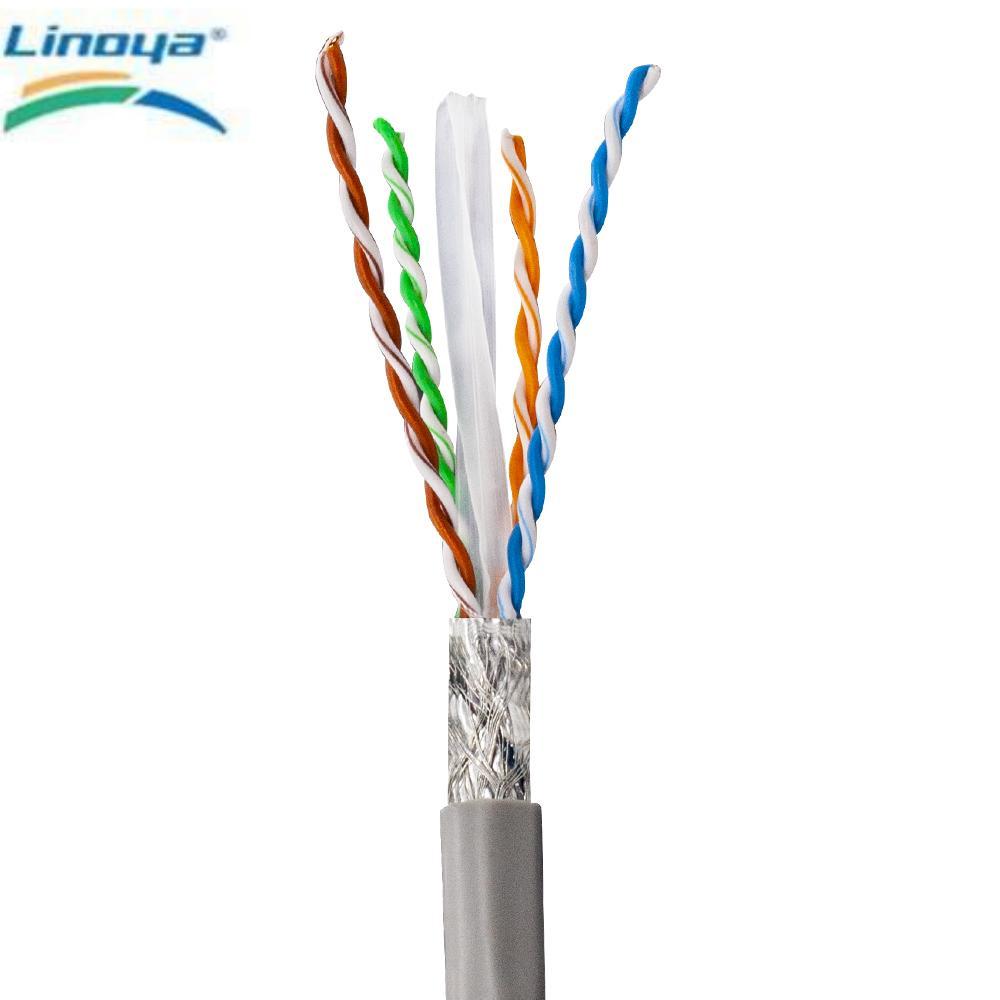
Shielded construction for surveillance and industrial runs where electromagnetic interference is present alongside outdoor exposure.
Comparison Table: Direct-Burial vs Aerial Outdoor Waterproof Ethernet Cable
| Decision factor | Direct-burial structure | Aerial structure |
|---|---|---|
| Primary load path | Soil and backfill | Span tension between supports |
| Core function | Double-jacket water blocking for underground moisture | Tensile member for hanging installation |
| Moisture exposure | Continuous and radial, often immersion | Intermittent — rainfall, splash and condensation |
| UV exposure | Exposed ends and draw points only | Full run, sustained |
| Mechanical load | Crush, abrasion, soil movement | Tension, wind vibration, ice load, sag |
| Typical outer jacket | PE-type thermoplastic, XLPE or composite | UV-stabilised PE, TPU or composite |
| Where CMP matters | Termination points and building entry | Plenum ceilings, soffits and riser entries |
| Typical failure mode | Jacket cracking; water ingress after a jacket nick | UV ageing; pair geometry distortion under tension |
| Maintenance access | Low — repair means re-excavation | High — accessible and visually inspectable |
| Documentation priority | Water-blocking construction; CPR fire class where applicable | Strength member and UV performance; UL flame rating at the building entry |
Table: direct-burial and aerial outdoor waterproof Ethernet cable structures compared on the dimensions buyers actually decide on.
OEM and Customization: Turning the Specification into an Order
Once the structure is settled, the remaining work is manufacturing and commercial terms. Linoya operates on an OEM and customization model covering cable length, logo printing and packaging. The standard carton configuration is 305 m per carton, the minimum order quantity is 100 cartons, and the standard lead time is 30 days.
Those figures matter when the RFQ is being drafted. A 305 m carton means a 1,000 m run does not divide neatly into cartons — it corresponds to four cartons with the remainder, and a 100-carton MOQ decides whether a short or irregular run can realistically be built to custom length or should revert to a standard reel length. A 30-day standard lead time should be scheduled against the installation window before the drawing is frozen, not afterwards.
Production support behind those terms includes a monthly capacity of 200,000 cartons, 100% pre-shipment testing, third-party inspection (SGS/UL), random sampling inspection and full electrical performance testing. Export markets include the EU, the US, the Middle East, Southeast Asia, Australia, South Korea and Japan. After-sales support covers 24/7 online technical support, a 1-year product warranty, free replacement for defective products and online after-sales consultation.
One commercial detail is worth flagging: custom lengths and custom packaging change the carton footprint and the shipping volume, which feeds back into unit cost. For projects with many short and irregular runs, standard 305 m cartons terminated on site are often the cheaper path than chasing a custom length for every segment.
FAQ
1. Does a direct-burial outdoor Ethernet cable need CE or CPR certification for the EU?
For cable installed in construction works in the EU, the CPR reaction-to-fire class normally applies, and the required class varies by location. Linoya holds a Certificate of Constancy of Performance from TÜV Rheinland InterCert (Notified Body 1008), certificate 1008-CPR-MC 69267303 0001, covering B2ca-s1a,d0,a1 for CAT6, CAT6A, CAT7, CAT7A and CAT8 S/FTP communication/LAN cables under EN 50575:2014+A1:2016. Additional Eca and Dca-s1,d0,a2 classification reports cover a number of CAT5E, CAT6, CAT6A and CAT7 constructions. Each certificate applies only to the cable types it lists, so match the model on the drawing to the model on the certificate before ordering.
2. Can a manufacturer provide custom lengths, logo printing and packaging on outdoor Ethernet cable?
Yes — under its OEM and customization model, Linoya supports custom cable length, logo printing and packaging. Custom work runs alongside the standard carton basis of 305 m per carton, with a minimum order quantity of 100 cartons.
3. What does outdoor waterproof Ethernet cable cost per 305 m?
Commercial research describing the category places bulk Cat6 UTP outdoor PE-jacket 23AWG cable in the region of USD 47.00 to USD 50.00 per 1,000 ft (305 m) roll. Treat that as a directional benchmark rather than a quotation. The real figure is driven by structure more than by category: a double-jacket water-blocked construction, a tensile member, a TPU or LSZH jacket and custom lengths all sit above a plain PE-jacketed benchmark. Quote against a drawing rather than comparing a per-metre average.
4. Can a batch be validated before placing a large order?
Validation of a finished batch happens at the end of the production line, not in a warehouse. Linoya's practice is 100% pre-shipment testing, third-party inspection (SGS/UL), random sampling inspection and full electrical performance testing, backed by a 1-year product warranty and free replacement for defective products. In practice the strongest pre-order validation is to obtain a reference sample reel for electrical measurement and a certificate copy for model matching, and to complete both before the purchase order is issued.
5. What are the MOQ and standard lead time?
The minimum order quantity is 100 cartons at 305 m per carton, and the standard lead time is 30 days. Monthly capacity is 200,000 cartons. If a project has a fixed installation window, put the lead time on the schedule at the point where the specification is written — that is the only moment it can still influence the result. To start, contact the Linoya team at inquiry@linoya.com for a quote or product catalogue matched to this comparison.
Conclusion
The choice between direct-burial and aerial outdoor waterproof Ethernet cable comes down to one question on the route drawing: is the heavy load moisture or tension? A buried route answers with a double-jacket water-blocking structure. A suspended route answers with a tensile member and a UV-stabilised jacket. A mixed route needs both, with the transition points written down.
After the structure is fixed, the jacket chemistry (PVC, a PE-type thermoplastic such as TPE, TPU or XLPE, or LSZH) and the environment — direct UV exposure and the plenum flame rating at the building entry — complete the specification. Getting those three items onto the drawing removes most of the field failures that outdoor links experience in year one and year two.
Linoya Electronic Technology Co., Ltd. has manufactured cable and wire since 1997, including network cables and outdoor waterproof cables and connectors, with production in Dongguan and Vietnam and export markets across the EU, the US, the Middle East, Southeast Asia, Australia, South Korea and Japan. For a structural recommendation or a custom-length requirement, contact the team directly.
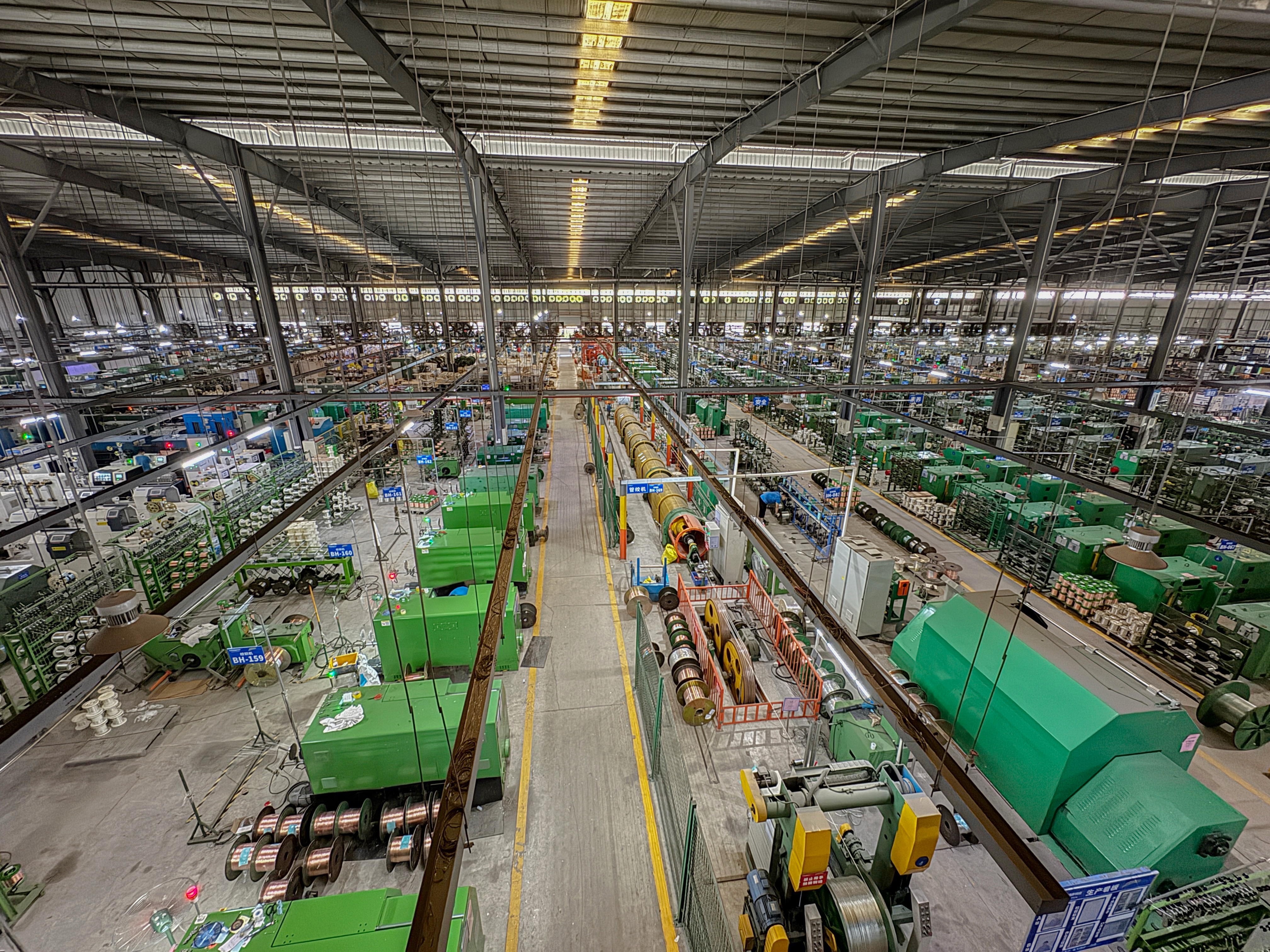
Conductor preparation on the production line — where the electrical build begins, whichever outdoor structure is specified.
Next step
Send a route description and the Linoya team will recommend the construction for the buried and suspended sections separately, including jacket chemistry and the certificate documentation each market requires.
Email: inquiry@linoya.com · Tel: +86-15602610696 · WhatsApp: +86-13038893260
Website: www.linoya.com · Blog: blog.linoya.com
Address: No.2, The Fourth West Industrial Road, High-Tech Industrial Development Zone, Songshan Lake, Dongguan City, Guangdong Province, China
Download the catalogue: LINOYA ELECTRONIC TECHNOLOGY CO., LTD. (PDF)
Have Questions or Need More Details?
Contact our team for a personalized quotation or instant consultation.
Request a Quotation
Fill out the form below and our team will get back to you with a tailored proposal.
WhatsApp Direct Chat
Prefer to chat in real-time? Message us on WhatsApp for instant assistance & quick answers.
- Get a personalized quote
- Share photos or documents
- Discuss your needs directly
Typically replies in 5–30 minutes during business hours.