
Ethernet Cable Buying Guide: Cat5e, Cat6, Cat6a, Cat7 & Cat8 Explained
Ethernet Cable Buying Guide: Cat5e to Cat8 Explained
How to select the right bulk Ethernet cable for your network project — comparing shielded types, fire ratings, AWG, and category performance.
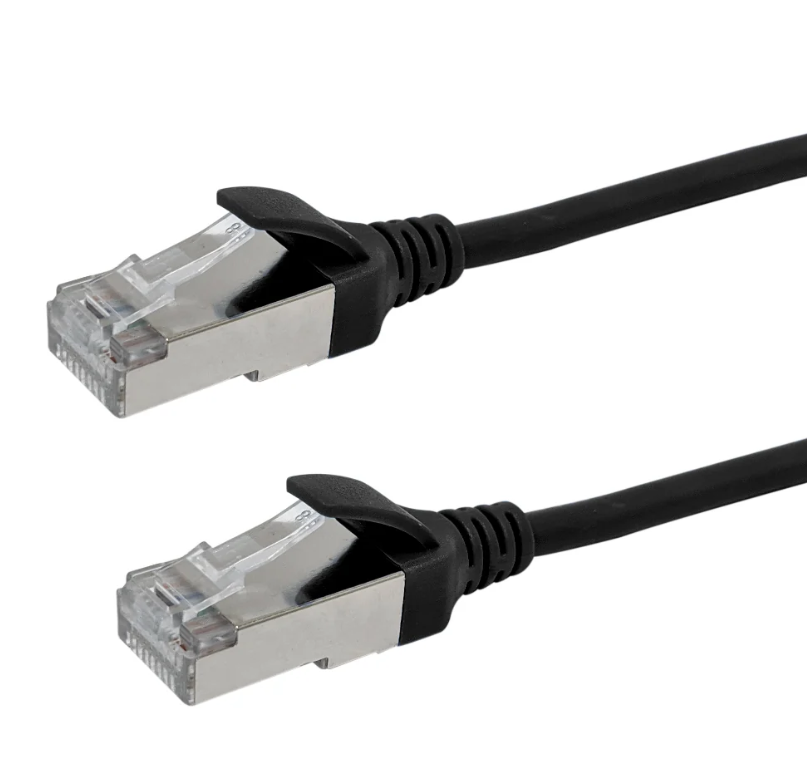
Shielded Ethernet cables such as CAT8 F/FTP use full foil shielding for high-frequency signal integrity.
The Problem: Choosing the Wrong Ethernet Cable Can Break Your Network
Ethernet cable selection is not just about picking a cable with the highest number. A mismatch between cable category, shielding structure, conductor gauge, flame rating, and installation environment can cause packet loss, slow throughput, unstable PoE power delivery, and project acceptance failure. For distributors, contractors, and enterprises sourcing bulk Ethernet cable, the cost of re-cabling a building or data center is far higher than the saving from choosing the wrong cable upfront.
This guide explains what Ethernet cable specifications mean and how to match them to your project requirements — covering Cat5e, Cat6, Cat6a, Cat7, and Cat8 in UTP, FTP, and SF/UTP shielded structures, in both PVC and LSZH jacket options.
What Is an Ethernet Cable?
An Ethernet cable, also known as a network cable or LAN cable, is a twisted-pair copper cable used to connect devices within a local area network (LAN). It carries data and, in Power over Ethernet (PoE) deployments, electrical power to devices such as IP cameras, wireless access points, and switches. Ethernet cables are classified into categories (Cat5e, Cat6, Cat6a, Cat7, Cat8) based on their bandwidth and transmission performance, and are governed by standards including ANSI/TIA-568-C.2 and the newer TIA-568.2-E.
Most structured cabling projects use solid bare copper conductors in 305-meter bulk reels. Linoya Electronic Technology Co., Ltd., a manufacturer established in 1997 in Dongguan, China, supplies full-category Ethernet cables from Cat5e to Cat8 with a factory area of 60,000 m² and an annual production capacity of 4,000,000 kilometers.
Industry Background: What Is Driving Ethernet Cable Demand?
Global Ethernet cable demand continues to grow along with data center expansion, cloud computing, IP surveillance, smart buildings, and industrial IoT networks. The global Ethernet cable market was valued at USD 38.55 billion in 2025 and is expected to approach USD 70.02 billion by 2032, with a CAGR of 8.9% from 2026 to 2032, according to Maximize Market Research.
Two standards developments are shaping procurement decisions:
- ANSI/TIA-568.2-E, released in October 2024, replaced TIA-568.2-D and added DC resistance unbalance (DCRU) specifications for Cat5e, Cat6, and Cat6a — tightening quality requirements for permanent links.
- EU CPR (Construction Products Regulation) requires Ethernet cables installed in European construction to carry a declared reaction-to-fire class (e.g., Eca, Dca, B2ca) based on testing under EN 50575. Cable labels must match the certified fire class.
For buyers, the practical implication is that choosing certified, standards-compliant cable from a traceable manufacturer is no longer optional — it determines whether the product can legally enter a project.
Ethernet Cable Categories: Performance Levels Explained
Cat5e Ethernet Cable — Gigabit Baseline
Cat5e (Category 5 enhanced) supports up to 1 Gbps bandwidth at 100 meters with a 100 MHz rating. It remains a cost-effective choice for residential networks, IP surveillance systems, general office LANs, and SMB environments. In PoE applications, Cat5e supports standard PoE and PoE+. Linoya’s Cat5e series includes U/UTP, F/UTP, and SF/UTP shielded structures with 24AWG solid bare copper conductors, UL/ETL certification, and CM/CMG flame ratings.
Cat6 Ethernet Cable — Short-Reach 10Gbps Option
Cat6 cable offers 250 MHz bandwidth and supports 10Gbps only up to 55 meters — beyond that distance it is specified for 1Gbps. Many Cat6 constructions use a central cross-separator to reduce crosstalk. Cat6 products from Linoya are available in 24AWG or 23AWG solid copper, in U/UTP, F/UTP, and SF/UTP types, with CMR flame rating and UL/ETL certification. Cat6 dominated the global Ethernet cable assembly market in 2025 with a 32.5% share, reflecting its popularity in commercial building and enterprise deployments.
Cat6a Ethernet Cable — Full-Distance 10Gbps
Cat6a doubles the bandwidth to 500 MHz and supports stable 10Gbps across the full 100-meter channel. It also passes strict alien-crosstalk (AXT) tests, making it suitable for dense cable bundles in data centers, enterprise networks, server rooms, and high-EMI commercial environments. Linoya’s Cat6a portfolio covers U/UTP, U/FTP, SF/UTP, and F/FTP configurations with 23AWG solid bare copper, CMP flame ratings, and UL/ETL/CPR certifications. For projects targeting 10Gbps building backbone, Cat6a U/FTP with individual pair foil shielding eliminates internal crosstalk and provides stable high-frequency performance.
Cat7 & Cat7a — Shielded Solutions for 40G+ High-Speed Links
Cat7 S/FTP cable provides 600 MHz bandwidth and supports 40Gbps up to 50 meters with full pair foil shielding. Cat7a extends bandwidth to 1000 MHz, offering larger signal headroom, stable 40Gbps transmission, and better alien-crosstalk resistance for premium data centers and ultra-high-speed enterprise networks. Linoya manufactures Cat7 F/FTP with a 23AWG solid copper conductor (40Gbps at 50m) and Cat7a F/FTP with a thicker 22AWG conductor (100Gbps at 15m). Both are designed for high-EMI industrial environments, data center short links, and long-distance shielded building cabling.
Cat8 — Data-Center-Grade Short-Reach Interconnect
Cat8 Ethernet cable reaches 2000 MHz bandwidth and supports 25G/40G transmission at up to 30 meters. It is engineered specifically for short rack-to-rack and switch-to-server interconnects inside data centers. Linoya’s CAT8 F/FTP uses 22AWG solid bare copper with overall plus pair full foil shielding, rated at 40Gbps at 30 meters, with CMP flame rating and UL/ETL/CPR certifications. Because of its limited distance, Cat8 is a complement to — not a replacement for — Cat6a horizontal cabling.
Shielding Types: UTP, FTP, SF/UTP — Which Structure Do You Need?
Shielding protects Ethernet signals from electromagnetic interference (EMI). The right shielding depends on the installation environment and the proximity of power cables, motors, and radio-frequency sources.
| Shielding Type | Construction | Best For | Considerations |
|---|---|---|---|
| U/UTP | No metallic shielding | Offices, homes, low-EMI environments, cost-sensitive projects | Lowest cost; basic anti-interference performance |
| F/UTP | Overall foil shield | Commercial buildings, offices with moderate EMI, surveillance systems | Good general-purpose shielded choice for mixed environments |
| U/FTP | Individual pair foil shield | 10G link channel, crosstalk-critical links, enterprise data center applications | Protects pairs while maintaining smaller outer diameter |
| SF/UTP or S/FTP | Overall screen + foil | Industrial automation, high-EMI environments, high-speed network backbone links | Excellent shielding, but installation needs proper grounding |
| F/FTP | Overall + pair foil | High-speed data center links, 40G+ transmission, maximum-signal-integrity environments | Strongest protection; largest diameter; all Linoya Cat6a F/FTP through Cat8 F/FTP use overall + pair foil structure |
UTP cable is usually adequate for standard office and residential use where electromagnetic noise is limited. FTP or SF/UTP is recommended in industrial workshops, production floors, buildings with heavy electrical equipment, and any site where data runs near motors, motors drivers, or power lines. A general rule: shielded cable protects high-frequency signal integrity, but shielded systems must be correctly grounded. Improper grounding can degrade performance instead of improving it.
Jacket & Flame Rating: PVC vs LSZH
The outer jacket determines where a cable can legally run and how it behaves in a fire. Two different jacket families matter:
PVC Jacket
PVC is flexible, durable, and low-cost. However, PVC releases toxic hydrogen halide gas and dense smoke when it burns. Ordinary PVC cable with CM/CMR/CMG rating is used in general indoor applications where local code permits.
LSZH (Low-Smoke Zero-Halogen)
LSZH emits little smoke and no corrosive halogen gas when exposed to fire, reducing injury risk and protecting electronics from corrosive damage. LSZH is required for public buildings — hospitals, hotels, schools, subway stations — and for EU projects specifying CPR fire classes such as Dca or B2ca. Linoya offers Cat6a and Cat7 LSZH cables with CPR Dca-s1,d0,a2 ratings certified through EZÚ, an EU-notified body.
PVC jacket cable cannot achieve higher CPR fire-performance classes such as Dca-s1,d0,a2. If a tender specifies Dca or B2ca, the cable must be manufactured with an LSZH outer sheath and certified accordingly.
Solid or Stranded, and Why AWG Matters
Solid conductors, made of a single piece of copper, are specified for fixed building infrastructure wiring and horizontal cabling. They offer lower DC resistance, stable long-distance transmission performance, and reliable termination into IDC punch-down blocks. Stranded conductors use multiple thin copper wires, which makes the cable flexible for patch cords and frequent plug-and-play movement. Stranded cable is not intended for permanent long-run building cabling.
AWG (American Wire Gauge) indicates the copper conductor diameter. Lower AWG means thicker copper and lower electrical resistance. In Linoya’s product line: Cat5e uses 24AWG, Cat6 uses 24AWG or 23AWG, Cat6a uses 23AWG, Cat7 uses 23AWG, and Cat7a and Cat8 use 22AWG solid conductors. For very long channel distances and high-power PoE++ loads, thicker-gauge cable reduces signal attenuation and power loss.
Solid Bare Copper vs CCA
Buyers sourcing from international markets may be offered copper-clad aluminum (CCA) cable at a lower price. CCA uses an aluminum core coated with a thin copper layer. It has higher DC resistance, weaker signal transmission, and poorer PoE power delivery than pure copper; it is also more vulnerable to oxidation over time. Each model in Linoya’s Cat5e-Cat8 Ethernet portfolio uses solid bare-copper conductors for commercial-grade reliability.
Step-by-Step: How to Select the Right Ethernet Cable for a Project
- Define the application environment. Is the cable going inside an office, industrial plant, outdoor area, data center, or buried underground?
- Determine the required network speed. Choose the category by the maximum required speed: 1Gbps → Cat5e; 10Gbps at up to 55m → Cat6; 10Gbps at up to 100m → Cat6a; 40Gbps short distance → Cat7 or Cat8; 100Gbps very short links → Cat7a.
- Assess EMI / noise environment. High electromagnetic interference requires shielded cable (FUTP/FTP/SFTP). In low-interference environments, U/UTP is an efficient use of budget.
- Check local regulations and fire rating. For North America, verify UL Mark or ETL verification meets CM/CMR/CMP as required by the space. For EU projects, verify the CPR class (Eca/Dca/B2ca) matches the tender and uses an LSZH sheath when specified.
- Confirm build type and conductor grade. Spec solid bare copper conductors for fixed runs, and stranded patch cords for flex applications.
- Verify certifications for the specific model. Check that the certification scope covers your exact cable construction and that the certification validity is current.
- Order in bulk reels. Standard horizontal distribution comes on 305-meter pull boxes or reels, reducing field splices for long systems.
Common Use Cases
Data Center Cabinet-to-Cabinet Links
High-density data center environments require reliable short-range interconnection with high signal integrity. Linoya CAT8 F/FTP Ethernet cable with 22AWG solid bare copper supports 40Gbps at 30-meter links, with overall and pair foil shielding to maintain signal performance under dense EMI exposure. CMP flame rating and UL/ETL/CPR certification support deployment in plenum spaces.
Industrial High-EMI Environments
In industrial workshops where motors, drives, and high-voltage lines create electromagnetic noise, Linoya Cat6a SF/UTP or Cat6a F/FTP shielded cable sustains 10Gbps at full 100-meter channels with top-tier anti-interference — these products also offer LSZH jackets for public-adjacent industrial spaces.
Office / Building Horizontal Cabling
Most commercial buildings need low-EMI-friendly 10G-ready infrastructure. Cat6a U/UTP provides a balance of performance and cost for a 10G enterprise network over full 100m, while Cat6 U/UTP suits standard Gigabit and short-range 10G office LANs. These cables use 23AWG solid copper for stable signal and PoE++ support.
Security Camera & IP Surveillance
IP surveillance systems demand support for PoE power over long distances. Cat5e U/UTP is a cost-effective video cable for 1Gbps PoE; Cat5e F/UTP if the run is near interference sources. Where high-power pan-tilt-zoom cameras need PoE++ and longer 10G-capable links, Cat6a with 23AWG solid copper reduces voltage drop across the route.
Ethernet Cable Comparison at a Glance
| Category | Bandwidth | Data Rate | Transmission Distance | Conductor (Linoya) | Typical Environments |
|---|---|---|---|---|---|
| Cat5e U/UTP | 100 MHz | 1 Gbps | 100 m | 24AWG solid bare copper | Office, residential, IP camera, SMB |
| Cat5e F/UTP | 100 MHz | 1 Gbps | 100 m | 24AWG solid bare copper | Security camera, small commercial EMI |
| Cat5e SF/UTP | 100 MHz | 1 Gbps | 100 m | 24AWG solid bare copper | Industrial edge, high-noise office, building structured cabling |
| Cat6 U/UTP | 250 MHz | 10 Gbps | Up to 55 m | 24AWG / 23AWG solid | Office 10G short links, surveillance, SMB |
| Cat6 F/UTP | 250 MHz | 10 Gbps | Up to 55 m | 24AWG / 23AWG solid | Office with EMI, commercial building, CCTV |
| Cat6 SF/UTP | 250 MHz | 10 Gbps | Up to 55 m | 24AWG / 23AWG solid | Industrial automation, high-EMI commercial, enterprise LAN |
| Cat6a U/UTP | 500 MHz | 10 Gbps | 100 m | 23AWG solid bare copper | Data center, office 10G full-channel, enterprise |
| Cat6a U/FTP | 500 MHz | 10 Gbps | 100 m | 23AWG solid bare copper | Enterprise data center, high-performance 10G network, core backbone |
| Cat6a SF/UTP | 500 MHz | 10 Gbps | 100 m | 23AWG solid bare copper | Data center, enterprise network, high-EMI commercial |
| Cat6a F/FTP | 500 MHz | 10 Gbps | 100 m | 23AWG solid bare copper | Heavy-EMI industrial, data center, public infrastructure |
| Cat7 F/FTP | 600 MHz | 40 Gbps | 50 m | 23AWG solid bare copper | High-EMI industrial, data center, high-performance network |
| Cat7a F/FTP | 1000 MHz | 100 Gbps | 15 m | 22AWG solid bare copper | Premium data center, ultra-high-speed short links |
| Cat8 F/FTP | 2000 MHz | 40 Gbps | 30 m | 22AWG solid bare copper | Data center switch-to-server, cloud provider infrastructure |
Note on conductors & jacket. All Linoya Ethernet cables shown above use solid bare copper conductors with LDPE insulation. Jacket options are PVC or LSZH. Certification status differs by model family and market: Cat5e models are UL/ETL certified with CM/CMG ratings; Cat6 models are UL/ETL certified with CMR rating; Cat6a and above support CMP-rated options and UL/ETL/CPR certification. Confirm your model against certification documents before ordering.
FAQ
1. Do Ethernet cables for North American plenum spaces need CMP flame rating?
In North America, plenum air-handling spaces above drop ceilings or below raised floors require CMP-rated cable (plenum grade). CM or CMR ratings do not satisfy plenum code requirements. Verify the flame rating against the space classification before purchasing. Linoya Cat6a and Cat7 cables are available with CMP flame rating for such installations.
2. What certification should Ethernet cables have for North American market?
Cables for the US/Canada market should carry a valid UL Mark or ETL Verified certification and comply with ANSI/TIA-568 performance standards. Always request the UL file number or ETL verification report from the supplier and check scope of certification covers the exact model. Linoya maintains an active UL file, number E320763, for communications LAN cables.
3. Should I buy LSZH or PVC Ethernet cable for a public building project?
Public buildings such as hospitals, hotels, and subway stations typically require low-smoke zero-halogen (LSZH) cable for fire safety. PVC-jacket cable cannot achieve certain CPR fire classes such as Dca-s1,d0,a2. LSZH cable uses special polymer material that produces low smoke and no halogen gas when burned. It costs more than PVC, and is less flexible to handle, but is required where fire-safety codes or project tenders involve occupied public structures. Linoya supplies LSZH-jacketed Cat5e–Cat8 cables with CPR ratings suitable for European public building use.
4. Can I get custom private-label Ethernet cables for my brand?
Yes. When sourcing Ethernet cable for private labeling, choose a manufacturer that can perform formal certification transfer, keep consistent product quality, and provide export documentation. Linoya offers compliant OEM private-label service, including certification transfer arrangement for distribution customers. Contact sales to confirm your certificate scope requirements.
5. How do I request samples for an Ethernet cable project?
To save wrong-decision risk in bulk procurement, request a sample reel and confirm the measurement of the cable before mass volume. Check the cable jacket printing, outer diameter, and construction against the supplier datasheet, and run a channel test. Linoya can arrange samples for evaluation — you can request a quotation or sample by emailing inquiry@linoya.com.
Conclusion: Match the Cable Category to the Application — Never Buy Category Alone
Choosing Ethernet cable is a layered decision. Category number defines frequency and data-rate performance. Shielding type determines immunity to external electromagnetic noise. Conductor type and AWG affect long-term link stability and PoE capacity. Flame rating is set by the space the cable runs through. And certification is the legal entry ticket for the market you are supplying.
A Cat6a U/FTP vertical backbone cable is not automatically better than Cat6 U/UTP in an SMB office — it depends on the application. Use the comparison table and the seven-step selection method in this guide as a practical framework for procurement decisions.
For specifiers and distributors who need full-category Ethernet cabling with consistent quality across projects, Linoya Electronic Technology Co., Ltd supplies Cat5e to Cat8 in UTP to F/FTP shielding structures, with solid bare copper conductors, PVC/LSZH jackets, UL/ETL/CPR certification, and global project support.
Need to verify Ethernet cable specifications and certification for your project?
Contact Linoya to request samples, get a quotation, or speak with an engineer about cable selection.
Email: inquiry@linoya.com | WhatsApp: +86-13038893260
Have Questions or Need More Details?
Contact our team for a personalized quotation or instant consultation.
Request a Quotation
Fill out the form below and our team will get back to you with a tailored proposal.
WhatsApp Direct Chat
Prefer to chat in real-time? Message us on WhatsApp for instant assistance & quick answers.
- Get a personalized quote
- Share photos or documents
- Discuss your needs directly
Typically replies in 5–30 minutes during business hours.