Outdoor Waterproof Ethernet Cable for Industrial Automation: Scenario Fit Guide
The correct outdoor waterproof Ethernet cable for an industrial-automation project is decided by the physical link, not by the product name. A fixed horizontal run, a direct-burial crossing, an aerial span and a PoE++ backbone each fail for a different reason, so each one needs a different construction and a different piece of evidence at acceptance.
This guide maps four outdoor link scenarios to cable construction, then to the market gate — UL/ETL for North America, CPR-CE and LSZH for EU public buildings — and finally to pre-shipment acceptance and order planning. Linoya Electronic Technology Co., Ltd. is a cable and wire manufacturer established in 1997, headquartered in Dongguan, China, whose range includes network cables, high-speed data transmission cables, and outdoor waterproof cables and connectors; the company reports a 30% export share, concentrated in the EU and the Middle East.
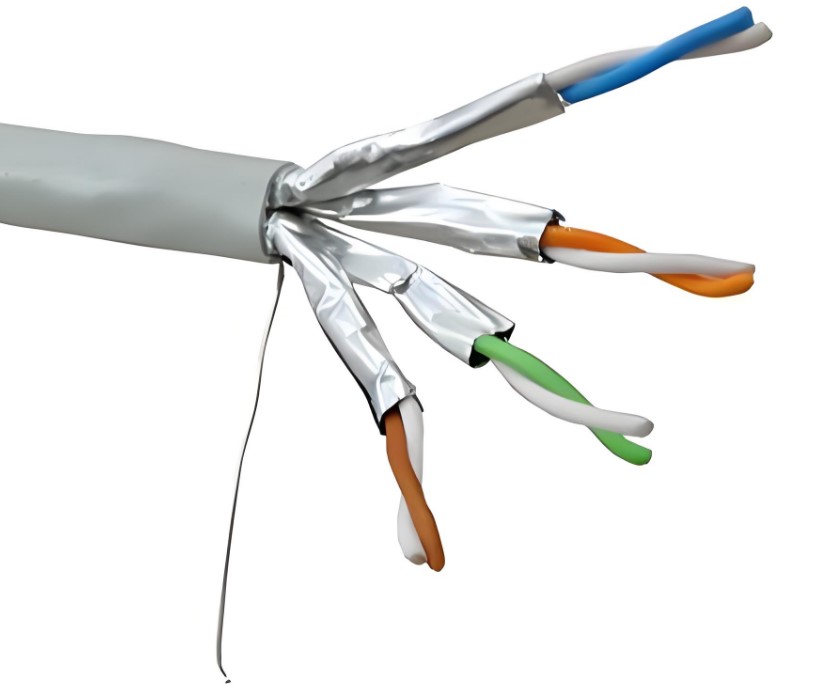
Cat6A U/FTP cable from Linoya's network cable range — the grade used where full-channel 10G and PoE++ headroom are required.
Problem Definition: "Outdoor Waterproof" Is a Claim, Not a Specification
Two cables marketed as outdoor waterproof can behave very differently after three years in a cable tray, a trench or on a pole. The word describes an intent, while the failure mechanism is always physical. In industrial-automation projects, six mechanisms account for most outdoor link failures.
- Water ingress. Common indoor Ethernet cable cannot be buried directly underground; water, humidity and soil corrosion will make it fail. A project needs direct-burial rated cable with a water-resistant jacket, a properly dug trench that avoids sharp rock, ideally a protective conduit, and fully sealed joints.
- UV degradation. A jacket without UV resistance embrittles and cracks on exposed runs, which then admits water and creates an earth path for interference.
- Mechanical load on spans. An aerial run carries its own weight plus wind and vibration; without a tensile element and strain relief at each support, the conductor and jacket fatigue.
- Crosstalk and external EMI. Crosstalk is electromagnetic signal leakage between adjacent twisted pairs inside the cable; excessive crosstalk produces packet loss, slow speed or an unstable link. Near drives, welding equipment and servo cabling, external noise is added on top.
- PoE++ heat. PoE++ delivers up to 90 W over the cable, and that energy has to dissipate through the jacket and the bundle.
- Channel length. Twisted-pair Ethernet is limited to 100 m total channel length, patch cords included; beyond that, attenuation and packet loss appear and a repeater or switch is required rather than a longer single run.
The practical consequence is that a specification saying only "outdoor waterproof Cat6" leaves both the installer and the incoming inspector without a testable requirement. A usable specification names the scenario, the construction, the category and the compliance document.
Industry Background: Why Outdoor Links Are Now Part of the Automation Network
Industrial-automation architecture has moved toward IP-based field networks, and that shift puts Ethernet cable outdoors. Perimeter cameras, outdoor access points, remote I/O cabinets, small cells and yard sensors are powered and addressed over the same twisted pair, so the cable is no longer an indoor patch item but a permanent outdoor asset.
The wider market reflects that direction. One 2026 forecast publication projects the global Ethernet cable market to reach approximately USD 70.02 billion by 2032 (Market Reports World, cited as a forecast rather than a measured value); the sub-segment for outdoor and waterproof constructions is not broken out in the available figures, so project planning should rely on link-level requirements rather than on category-level forecasts.
Two compliance regions dominate the purchasing decision. In North America, UL or ETL listing is the expected evidence, and the file status matters as much as the number: an expired file creates tender and customs risk, so the buyer should confirm on the certification body's official directory that the file is active and covers the exact model. Linoya's UL listing for appliance wiring material components is filed under UL file E315619 (UL758, UL1581), and its communication-LAN-cable file is referenced as E320763 — buyers should confirm which file covers the model being purchased.
In the EU, construction products for public buildings fall under CPR, and a laboratory test report alone cannot substitute for a formal CPR-CE certificate issued by an EU Notified Body for customs and tender purposes. Genuine LSZH cable should additionally carry a CPR fire-class certificate and a material report for low-smoke zero-halogen performance, rather than a supplier description. Note that PE is widely used for outdoor jackets because of its moisture and UV behaviour, while LSZH compounds are specified where smoke and halogen content matter — the two pull in different directions, so the fire classification of the exact jacket compound must appear in the certificate scope.
Customs classification is a separate planning item that catches first-time buyers. Insulated conductors not fitted with connectors fall under HS 854449, while the same conductors fitted with connectors fall under HS 854442; China trade statistics use 8544422100 for cables with connectors at or below 80 V. Bulk 305 m reels and terminated patch cords therefore do not automatically share a declaration, and the classification should be confirmed against the national tariff schedule before the shipment is booked.
On the supply side, Linoya Electronic Technology Co., Ltd. operates three self-owned industrial parks — Shenzhen Linoya Technology Park, Dongguan Songshan Lake Linoya Industrial Park and Dongguan Chashan Linoya Industrial Park — together with the subsidiary brand Dongguan Recheer Electric Wire & Cable Co., Ltd. and a production base in Vietnam. The company reports 60,000 m² of factory space, 3,000+ employees, 300+ R&D engineers, over 100 production lines and an annual output of 4,000,000 km of cable, and states annual sales exceeding USD 420 million. It produces thermoplastic polymer compounds in-house, including PVC, CTPE, TPE, TPU, PUR, XLPE, XLPO, LSZH and FPE, which is relevant here because jacket and insulation compound choice is the variable that separates an indoor cable from an outdoor one.
Scenario Fit: Four Link Types and the Construction Each One Requires
1. Fixed building horizontal cabling with solid conductor
This is the most common industrial case: a permanent run from a telecom room or cabinet to an outdoor camera, access point or field enclosure, fixed in tray, conduit or on the building envelope. Because the cable is never flexed after installation, a solid bare copper conductor is the correct choice — it holds its geometry, keeps attenuation stable and terminates reliably on a patch panel. Linoya states that at least some of its cable families use solid bare copper conductors, and its Cat5e construction is documented as 24AWG twisted pairs with PVC or LSZH jackets, tested at 350 MHz against TIA568C.2 and ISO11801.
Where the run leaves the building envelope, the jacket — not the conductor — becomes the weak point, so the specification should require a UV-resistant outdoor jacket for any exposed length, even if the majority of the route is indoors. The cable category is then set by the speed and power budget, not by habit: Cat5e for 1000BASE-T, Cat6 for gigabit with short-range 10G headroom, Cat6a for full-channel 10G.
2. Direct-burial crossings with double-jacket water-blocking construction
Road crossings, yard links and inter-building runs frequently go underground, and this is where generic outdoor cable is most often misapplied. The requirement is a direct-burial rated construction: a two-layer jacket with a water-blocking element between the layers, a UV-resistant outer jacket for the exposed tails, and sealed joints at every transition. Trench depth and a sand or conduit bed protect the sheath from sharp rock, and the joint is the single most likely entry point for moisture.
Linoya's published buying guidance recommends UV-resistant and water-blocking jackets for long outdoor or underground runs, and states that ordinary indoor cable cannot be buried directly. A specification that only says "outdoor" without "direct burial" gives the installer no basis for rejecting an unsuitable reel.
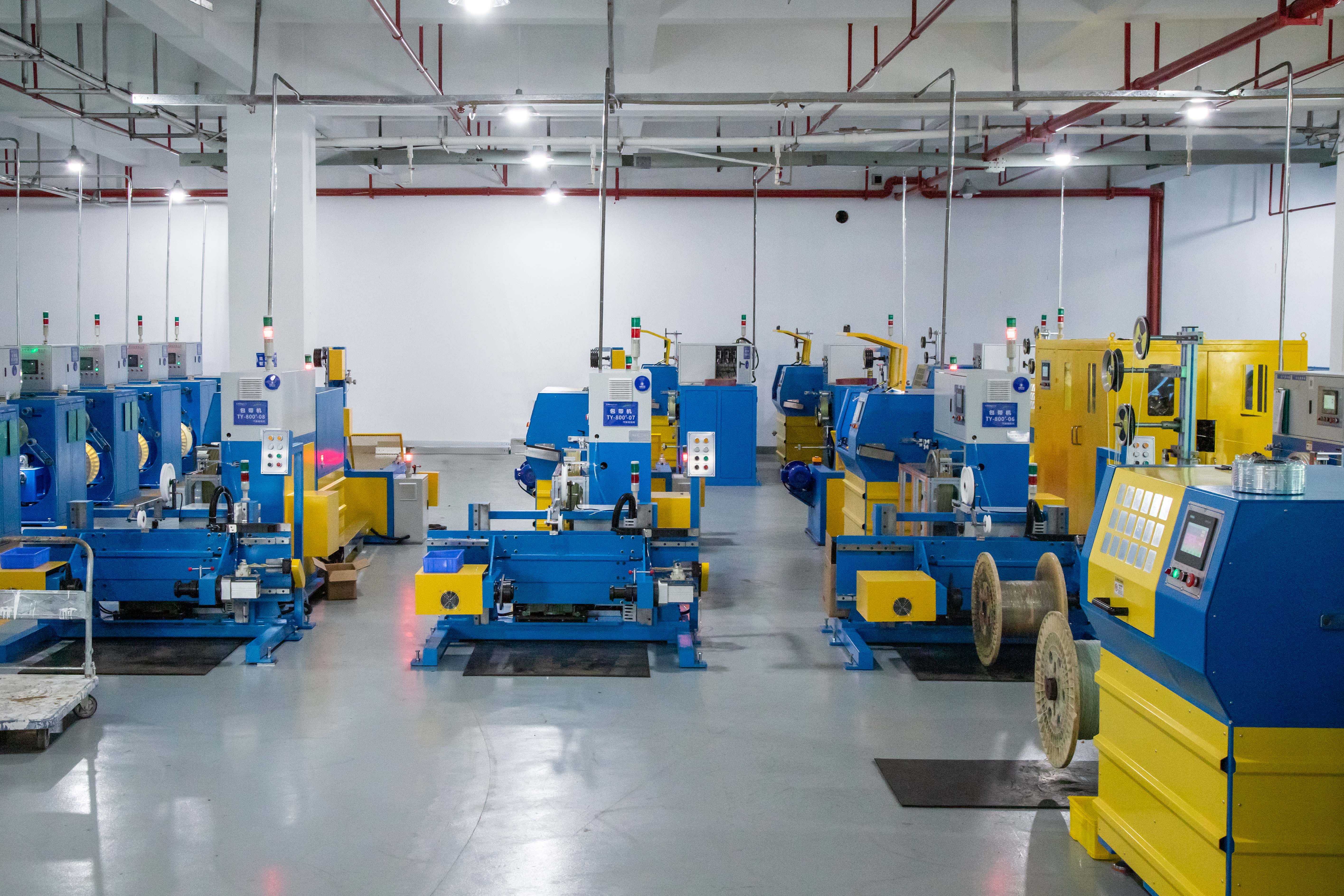
Tape wrapping station on the production line: binder and barrier tapes are applied over the core before the jacket is extruded.
3. Aerial hanging with tensile-strength design
An aerial span between poles, masts or building edges loads the cable in tension, and the load is dynamic — wind, vibration and thermal expansion all cycle through the same conductor. Two things must be specified. First, a construction that carries the span: either a separate messenger wire to which the cable is lashed, or a cable with a rated tensile element. Second, strain relief at each support so the load is not transferred into the termination.
Because tensile ratings are model-specific, the requirement should be written as a stated value in the RFQ and matched against the datasheet, together with the maximum support spacing the manufacturer allows. A UV-resistant jacket is mandatory on every aerial span, and the shield, if present, should be bonded at defined points rather than floating. Where the route is exposed to lightning-prone terrain, surge protection is a system property — a bonded drain wire plus surge protective devices at the building entry — and the model-level surge claim should be requested with its test method, not accepted as a marketing phrase.
4. PoE++ and high-speed runs: Cat6a, and where Cat7a fits
Once a single cable powers a pan-tilt-zoom camera, an outdoor access point or a 5G small cell, power and data share the same four pairs and both budgets tighten. Cat6a is the grade that carries the verified full-channel figures in Linoya's documentation: 10 Gbps over 100 m, PoE++ up to 90 W, and 23AWG solid copper conductors. Cat6 remains a valid choice for gigabit links, but its 10G reach is 55 m, and Cat5e stops at 1000BASE-T.
Cat7a and Cat8 appear in the same portfolio with different conductor, shielding and bandwidth configurations, which is a genuine option for high-interference outdoor backbones — but the performance figures must be read from the model datasheet rather than assumed from the category name. Two further checks decide whether the PoE++ design survives: the 100 m limit applies to the whole channel including patch cords, and heat dissipation depends on bundle density and conduit fill, so the jacket and insulation temperature rating should be confirmed for the installed condition.
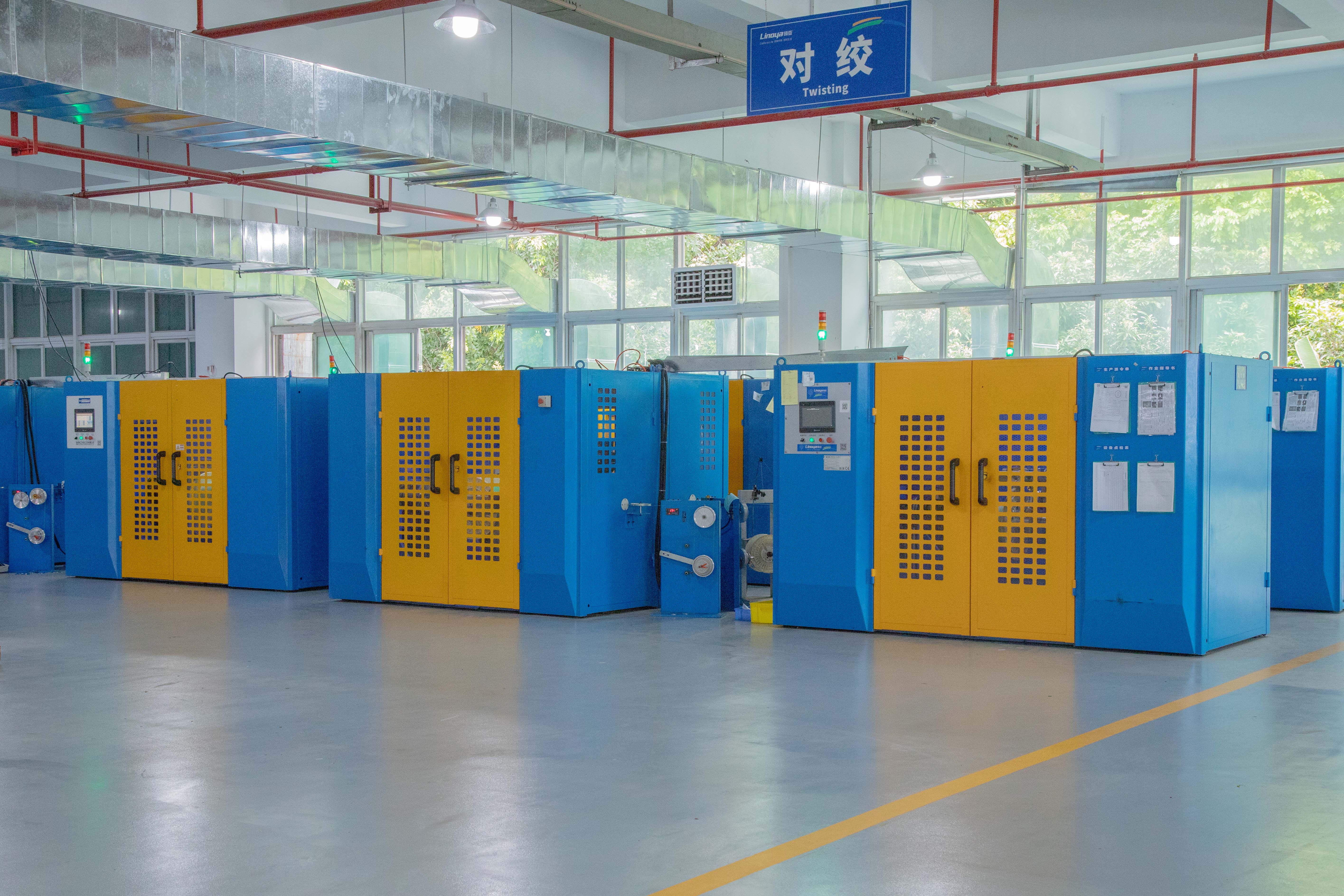
Pair twisting station: twist geometry is the first control on crosstalk between the four pairs.
5. High-interference industrial routing: shielding and grounding
Inside an automation cell, cable often runs beside drives, inverters and welding leads. An overall foil or braid shield with a drain wire, bonded at the panel entry, is the standard countermeasure; an unshielded construction in that route is a cost decision that shows up later as packet loss. Linoya's portfolio includes shielded configurations across Cat5e to Cat8, and its published guidance states that optimized twist-pair structure is used to control crosstalk. The installation rule is simple and frequently missed: a shield that is not bonded at both designated ends behaves like an antenna rather than a barrier.
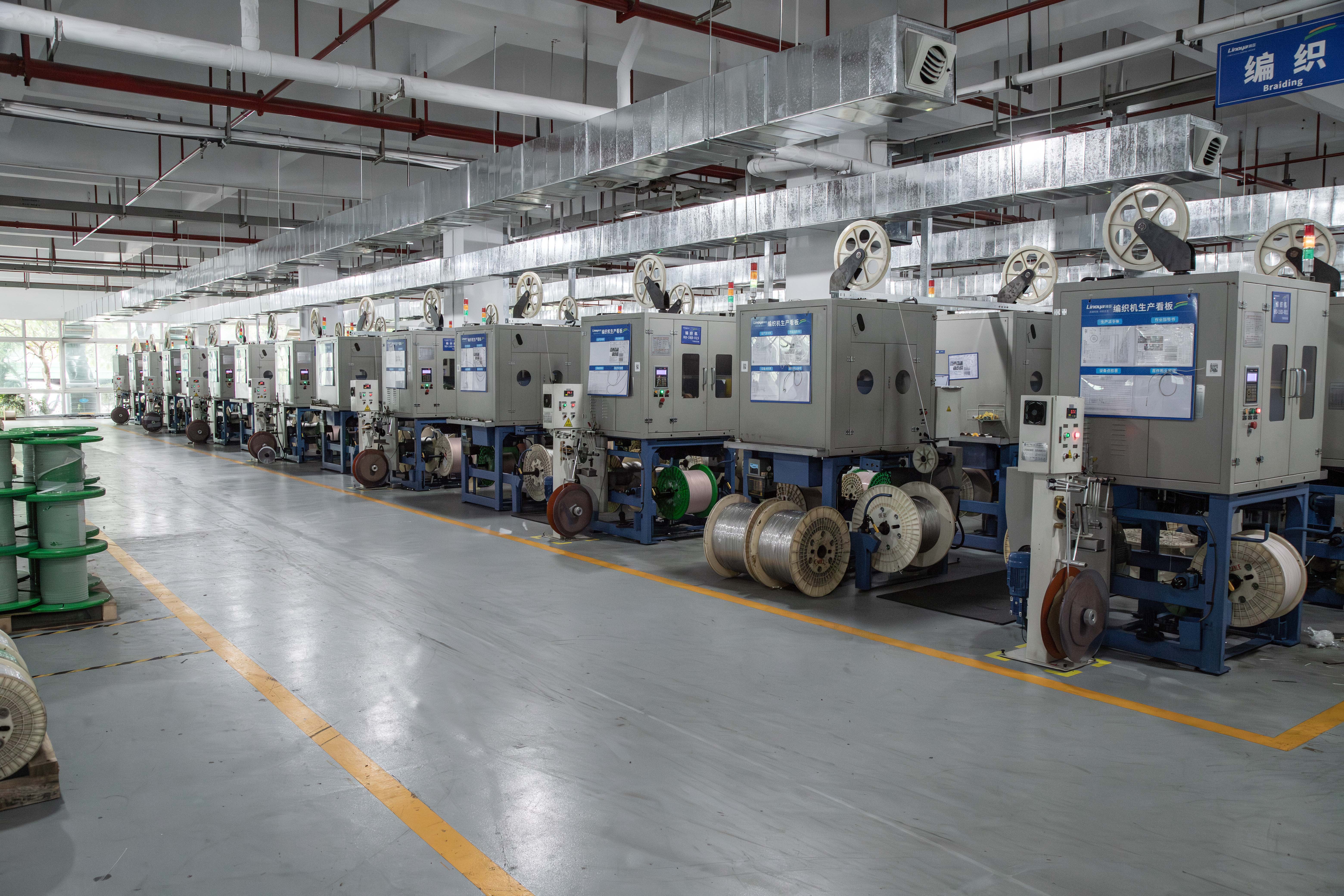
Braiding station on the cable line, where a metallic braid can be applied over the shielding system.
Step-by-Step: Specifying and Accepting an Outdoor Cable Order
The sequence below converts a scenario decision into a purchase order that can be inspected. Each step produces a document, and the documents are what a third-party auditor will ask for.
- Map every outdoor link to one of the four scenarios. Walk the route and record length, exposure, burial depth, span length and adjacent power cabling. Any link longer than 100 m must be split with an active device, not solved with a longer reel.
- Set the speed and PoE budget per link. Record the required rate and the powered-device wattage. A PoE++ device on a Cat5e run is a design error discovered at commissioning, not at delivery.
- Write the construction clause. State conductor type (solid bare copper), AWG, category, shield type, jacket compound (PE for exposed outdoor routes, LSZH where fire class governs), water-blocking requirement for burial, and the tensile requirement for spans.
- Set the market compliance gate. For North America, require UL or ETL listing with the file number and confirm its active status on the official directory. For EU public buildings, require a formal CPR-CE certificate from an authorized Notified Body — Linoya's certificates are issued by bodies such as TÜV and EZÚ — and verify the serial number and model scope on the issuing body's website. A self-made document is not evidence.
- Qualify the sample before the volume order. Verify conductor AWG against the contract, because AWG directly affects insertion loss; check jacket marking and print legend, run continuity and link tests, and confirm the CPR fire class and material report where LSZH is specified.
- Define pre-shipment acceptance. Agree the inspection items in advance: length and reel count, jacket print, visual sheath defects, electrical performance records, and the certification dossier. Linoya states that all finished cables pass factory-level electrical performance testing before delivery, and that factory-tested cable still requires an on-site re-check after construction.
- Plan MOQ, packing and origin. A 100-carton order of 305 m reels equals 30,500 m of cable, so confirm whether the MOQ applies per model or per construction, how reels are palletised, and which production base ships the order. Linoya operates in China and Vietnam, and customs records show the Vietnam entity exporting USD 11.78 million between August 2025 and July 2026 — relevant when a project needs an alternative origin for tariff or lead-time reasons.
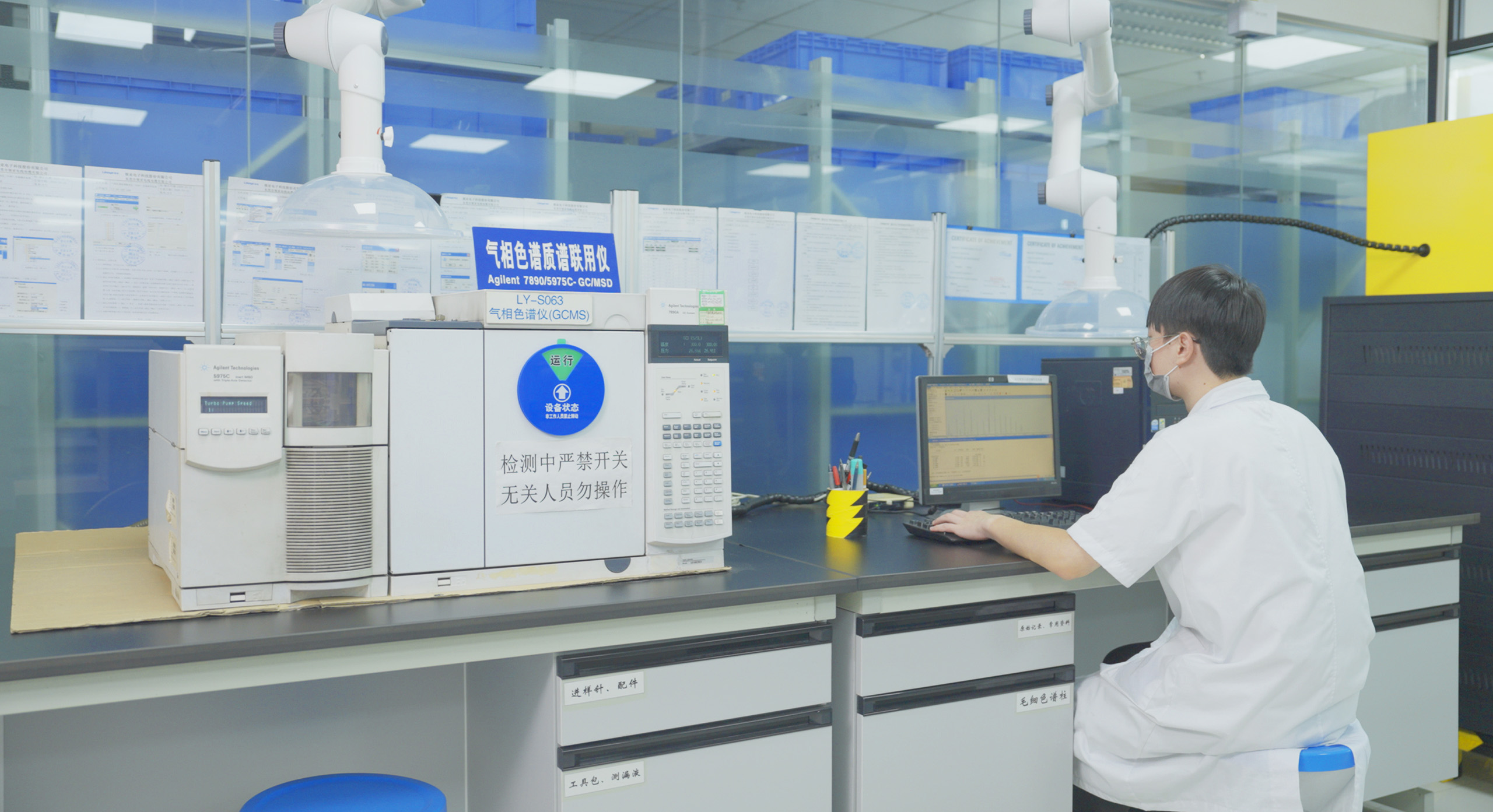
In-house laboratory testing: factory electrical performance records form part of the pre-shipment acceptance dossier.
Use Cases: Mapping Project Types to Selection
Outdoor surveillance perimeter
An outdoor surveillance waterproof Ethernet cable runs from a hardened switch to poles, gates and fence-line cameras, often with PoE++ for heaters and pan-tilt motors. Fixed poles use solid conductor Cat6a; buried approaches to gate houses use direct-burial construction with sealed joints; any span between poles needs a tensile-rated design. The practical check is the wattage at the far end plus the 100 m channel limit, because camera runs are frequently longer than the site drawing suggests.
Outdoor base station and wireless backhaul
An outdoor base station waterproof Ethernet cable powers and connects radios mounted on masts or rooftops. Here the dominant loads are UV, wind-driven rain and vibration, and the dominant electrical risk is surge at the mast entry. Specify a UV-resistant jacket, a bonded shield, strain relief at the mast, and surge protective devices at the equipment entry; request the model-level surge and tensile data rather than accepting a general outdoor claim.
Industrial automation cell and outdoor skid
Machine cells, skids and remote I/O cabinets combine high EMI with washdown and weather exposure. Solid bare copper with an overall shield, bonded at the panel entry, is the baseline; where the cable leaves the enclosure, the jacket must be UV-resistant and, if buried between skids, direct-burial rated. Cable routing inside the cell should be separated from drive cabling, since shielding reduces coupling but does not eliminate it.
Public infrastructure and building perimeter
Airports, stations, campuses and public buildings add a fire-safety gate to the weather requirement. There, LSZH constructions with a CPR fire classification and a Notified Body certificate take priority, and the certificate scope must match the model and the declared fire class. PE-jacketed outdoor cable and LSZH cable are not interchangeable in that context, which is why jacket choice is a compliance decision before it is a technical one.
Comparison Table: Scenario Fit at a Glance
The table condenses the four scenarios into the construction decisions that must appear in a purchase specification, and the evidence that must exist before the reel is accepted.
| Link scenario | Jacket and water management | Conductor and shield | Category guidance | Evidence to collect |
|---|---|---|---|---|
| Fixed horizontal cabling (indoor, on-building) | UV-resistant outdoor jacket on exposed lengths; sealed entries | Solid bare copper; shield only where EMI exists | Cat5e for 1G, Cat6 for 1G with headroom, Cat6a for 10G | Datasheet AWG and category test; jacket print legend |
| Direct-burial crossing | Direct-burial rated, two-layer jacket with water-blocking layer; sealed joints; sand or conduit bed | Solid bare copper; shield optional | Cat5e, Cat6 or Cat6a depending on rate and PoE budget | Written direct-burial rating; joint sealing method; burial installation instruction |
| Aerial span | UV-resistant jacket; drain wire bonded at defined points | Solid copper; rated tensile element or messenger wire | Cat6 or Cat6a | Model tensile rating and maximum support spacing; strain-relief method |
| PoE++ / high-speed run | Jacket and insulation temperature rating suitable for the bundle and conduit fill | 23AWG solid copper; shield where EMI is present | Cat6a for 10G at 100 m and PoE++ up to 90 W; Cat6 limited to 55 m for 10G | PoE++ claim in the datasheet; total channel length including patch cords |
| High-interference industrial route | UV-resistant jacket where exposed; correct glanding | Overall foil or braid shield with drain wire, bonded at panel entry | Cat6a or Cat7a, per datasheet figures | Shield type, grounding instruction, crosstalk test data |
| EU public building | LSZH compound with declared CPR fire class | Solid bare copper; shield as required | Set by the project specification | Formal CPR-CE certificate from an authorized Notified Body; material report for LSZH performance |
| Category | Verified performance in Linoya documentation | Power | Practical role outdoors |
|---|---|---|---|
| Cat5e | 1000BASE-T; 24AWG twisted pairs; PVC or LSZH jacket; tested at 350 MHz to TIA568C.2 and ISO11801 (company-reported) | PoE / PoE+ | Gigabit camera and access-point drops with modest power |
| Cat6 | 250 MHz bandwidth; 1 Gbps to 100 m; 10 Gbps to 55 m | PoE / PoE+ | Gigabit links with short-range 10G headroom |
| Cat6a | 10 Gbps to 100 m; 23AWG solid copper; specified as stable for PoE++ | PoE++ up to 90 W | Perimeter cameras, outdoor APs, small cells, backbone segments |
| Cat7a | Portfolio option with different conductor, shielding and bandwidth configuration; model datasheet governs | Per datasheet | High-interference outdoor backbone where a shielded construction is required |
Figures are drawn from Linoya product documentation and published selection guidance; confirm the model datasheet and certificate scope before ordering.
Frequently Asked Questions
Is a laboratory test report enough to prove CPR-CE compliance for an EU public-building project?
No. A laboratory test report alone cannot substitute for a formal CPR-CE certificate issued by an EU Notified Body for customs and tender purposes. Three checks settle the question: confirm the issuing institution is an authorized Notified Body, verify the certificate serial number on that body's official website, and confirm that the certificate scope covers the exact model and fire class being supplied. Linoya provides official CPR-CE certificates together with the related test reports, with certificates issued by authorized Notified Bodies such as TÜV and EZÚ.
Chinese outdoor waterproof Ethernet cable manufacturers versus local suppliers — what should the comparison actually measure?
Compare on five dimensions rather than on country of origin. First, certification coverage and validity for the destination market: UL or ETL file status for North America, CPR-CE for the EU. Second, construction control: solid bare copper, contracted AWG, jacket compound, and water blocking where the route is buried. Third, documentation for tender or third-party audit, including original certification dossiers and batch traceability. Fourth, order mechanics: MOQ, reel length, packing and delivery schedule. Fifth, landed cost including freight, duty under the correct HS code, and incoming inspection. Local distributors typically shorten replenishment and simplify returns, while direct import shifts document verification and incoming inspection to the buyer — so the comparison is really about which party performs those checks. A manufacturer with an export programme is structured to supply them: Linoya, established in 1997, reports 60,000 m² of factory space, 3,000+ employees, 300+ R&D engineers, over 100 production lines and 4,000,000 km of annual output, with 30% of sales exported, mainly to the EU and the Middle East, and states that it can provide full CPR-CE, UL and ETL documentation for third-party audit requirements.
Can Cat6a carry PoE++ across a full 100 m outdoor link?
Yes, within the documented limits. Linoya specifies its Cat6A U/UTP cable as stable for PoE++ support with 23AWG solid copper conductors, at 10 Gbps over 100 m, and PoE++ is documented at up to 90 W. Two conditions still apply: the 100 m figure is the total channel including patch cords, and heat dissipation depends on bundle density and conduit fill, so the temperature rating of the jacket and insulation should be checked against the installed condition. Cat6 reaches 10 Gbps only to 55 m, which is the usual reason a PoE++ camera link underperforms after installation.
What bulk price and order quantity should a project plan for?
As an indicative benchmark, outdoor waterproof Cat6 cable in UTP construction with a PE jacket and 23AWG conductors is typically quoted at USD 47.00 to USD 50.00 per 305 m (1000 ft) roll for bulk orders; that figure excludes freight, duty, connectors, termination labour and testing. On quantity, an order planned at 100 cartons of 305 m equals 30,500 m of cable, so the purchase specification should state whether the MOQ applies per model or per construction, and how reels are palletised for container loading. Certification scope, jacket compound and shielding level are the variables most likely to move the quoted price.
How should pre-shipment acceptance and delivery planning work at 100-carton volume?
Fix the acceptance items in the contract before production: conductor AWG and its datasheet marking, jacket print legend, length and reel count, sheath appearance, electrical performance records, and the certification dossier matched to the model. Sample verification comes first — AWG and continuity testing on an incoming reel — followed by batch consistency review across production lots. Linoya states that all finished cables pass factory-level electrical performance testing before delivery and that factory testing does not replace the on-site re-check after construction. For delivery planning, confirm the shipping origin, since Linoya operates both in China and through a Vietnam production base. To move from specification to a verified reel, request a sample and a quotation covering construction, category, certification and packing — the company brochure with the full product range is available for download.
Next Step: Match the Cable to the Link, Then Verify It
Send the link scenario, channel length, PoE budget, destination market and required certification to Linoya Electronic Technology Co., Ltd. and request a sample reel plus a quotation for the construction that fits.
Email: inquiry@linoya.com | Tel: +86-15602610696 | WhatsApp: +86 13038893260 | Website: www.linoya.com
Product catalogue: Linoya Electronic Technology Co., Ltd. brochure (PDF)
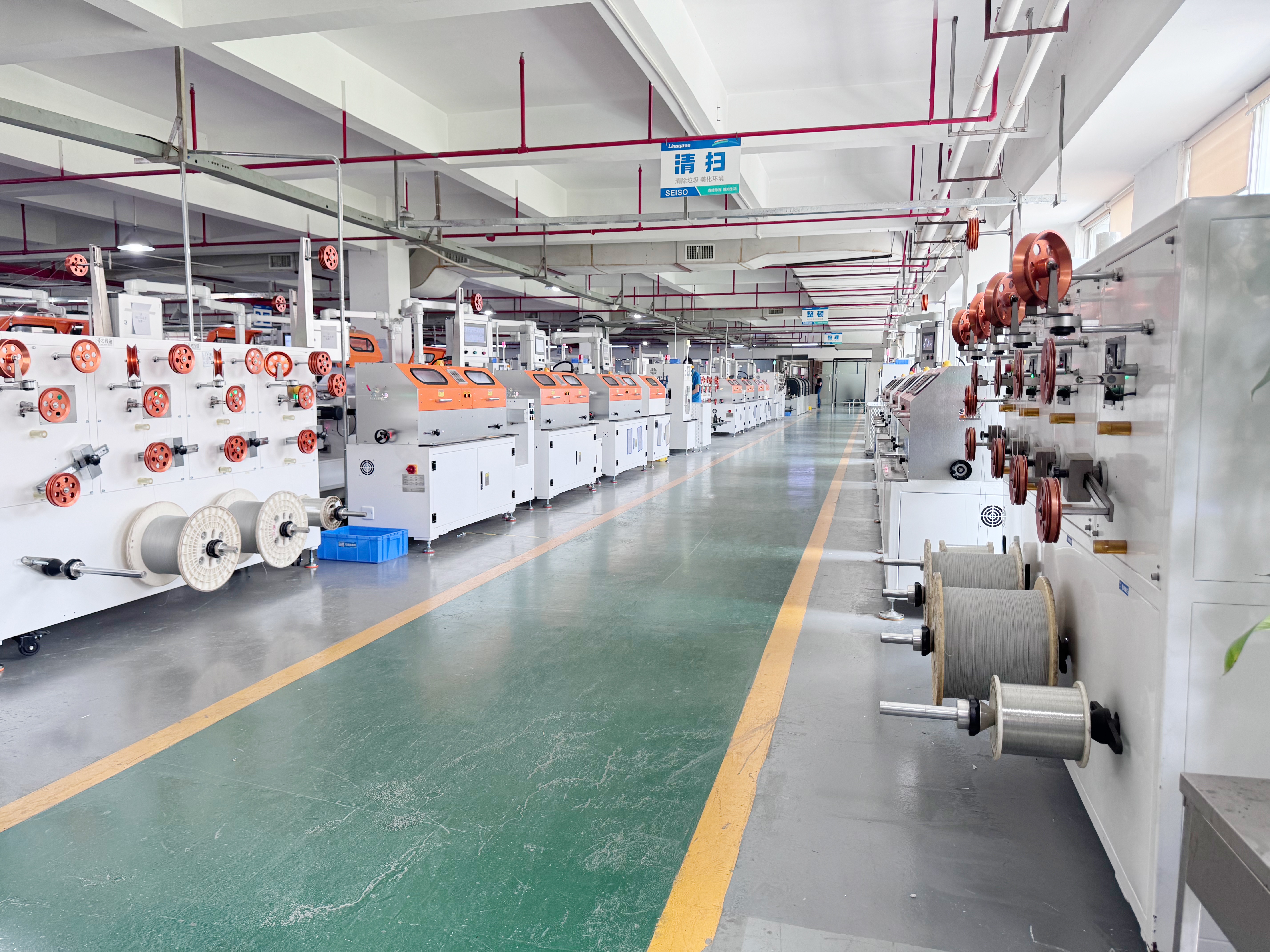
Linoya production site in Dongguan, China — one of three self-owned industrial parks supporting cable output of 4,000,000 km per year.
Conclusion
Outdoor waterproof Ethernet cable selection for industrial automation is a scenario-matching exercise. Solid bare copper in a UV-resistant jacket suits fixed horizontal cabling; a direct-burial rated, two-layer jacket with water blocking suits crossings; a tensile-rated construction with strain relief suits aerial spans; and Cat6a — 10 Gbps at 100 m with PoE++ up to 90 W and 23AWG solid copper — suits PoE++ and high-speed runs, with Cat7a reserved for cases where the model datasheet supports the requirement. Around those technical choices sit two gates that decide whether the project passes inspection: UL or ETL file status for North America, and a formal CPR-CE certificate from an authorized Notified Body plus genuine LSZH evidence for EU public buildings. Acceptance closes the loop: contracted AWG, sample verification, batch consistency and pre-shipment records, planned against a realistic MOQ such as 100 cartons of 305 m. Get those four decisions right and the cable stops being a line item and becomes a predictable part of the network.
Have Questions or Need More Details?
Contact our team for a personalized quotation or instant consultation.
Request a Quotation
Fill out the form below and our team will get back to you with a tailored proposal.
WhatsApp Direct Chat
Prefer to chat in real-time? Message us on WhatsApp for instant assistance & quick answers.
- Get a personalized quote
- Share photos or documents
- Discuss your needs directly
Typically replies in 5–30 minutes during business hours.