
Cat7a vs Cat8 Ethernet Cable: Head-to-Head for Data Center High-Speed Interconnection
Data center interconnect is a distance problem before it is a category problem. Cat7a is a 1000 MHz shielded construction positioned for stable 40 Gbps links up to 50 metres. Cat8 is a 2000 MHz construction with stricter shielding and crosstalk control that supports short-reach 25G–100G links inside a 30-metre envelope, at a higher cost. In a dense cabinet row, Cat8 is usually the right answer. Across an aisle or along a longer cable path, Cat7a is the only one of the two that reaches.
The rest of the decision is compliance and channel discipline: whether the cable route passes through a plenum air-handling space that requires a CMP flame rating, whether the project sits under the EU CPR regime where the fire class must be documented by an EU Notified Body, and whether the certification in the supplier file actually covers the exact model being ordered. This guide compares Cat7a and Cat8 head-to-head across bandwidth, shielding, conductor construction, flame rating and certification coverage, then sets out a step-by-step qualification sequence for data center procurement teams.
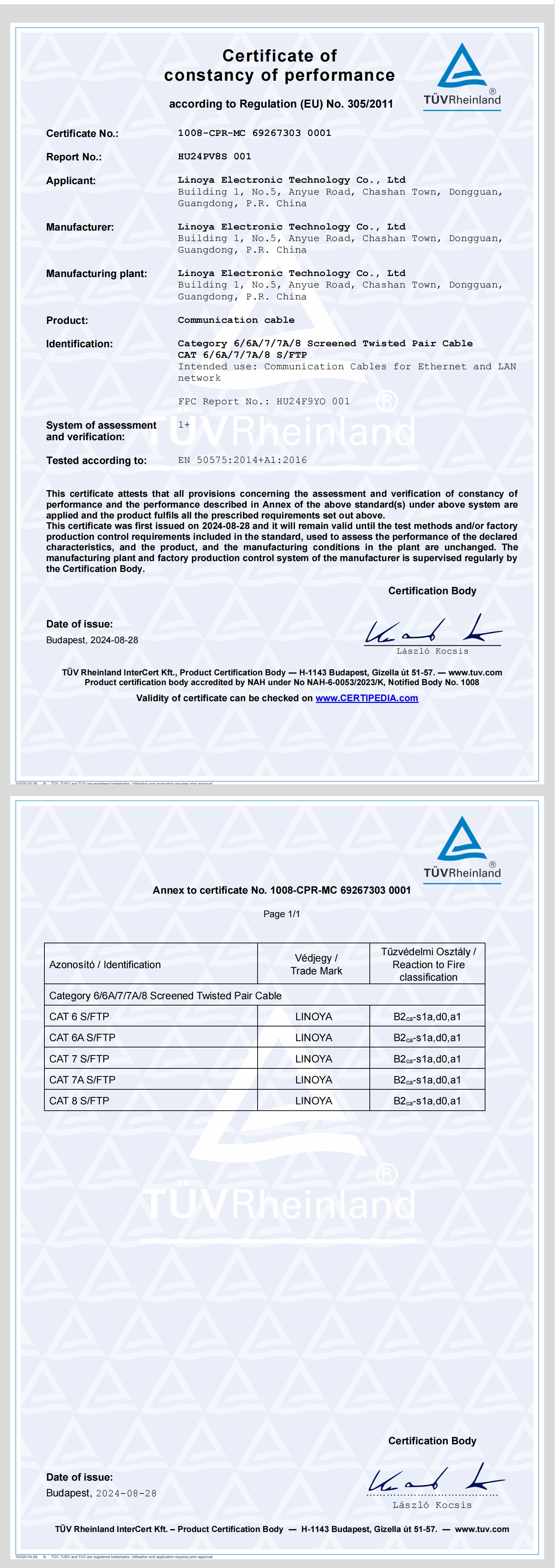
Linoya CPR Certificate of Constancy of Performance (System 1+), issued by TUV Rheinland InterCert Kft. (Notified Body 1008) under EN 50575:2014+A1:2016, covers B2ca-s1a,d0,a1 for CAT6/6A/7/7A/8 S/FTP communication and LAN cables, including the Cat7A and Cat8 constructions compared here.
Problem definition: why the Cat7a vs Cat8 decision goes wrong in practice
Three mistakes account for most Cat7a and Cat8 interconnect failures in data center projects.
Category escalation. Specifying the highest available category on every link looks like future-proofing, but Cat8 is a 30-metre class. A link that physically exceeds that distance cannot deliver the same performance regardless of what is printed on the jacket, so escalation creates a gap that only appears at acceptance testing, or forces an expensive redesign late in the build.
Shielding without grounding discipline. Both categories are fully shielded constructions using overall plus pair foil, and shielded cable requires correct grounding. Improper grounding introduces extra noise rather than removing it. Density is what separates a cable that passes a bench test from one that holds alien crosstalk margins inside a 48-port row.
Treating the cable as the whole channel. A link is cable, plus connectors, plus patch panel, plus the active port, which may be an enterprise gateway, a core switch or a server NIC. Cable certification covers the cable only. That distinction has practical consequences because scope varies between documents: Linoya Category 6A 4-pair 23 AWG U/FTP horizontal solid cable is ETL Verified with no flame rating marked in that verification, so it cannot be assumed into a plenum pathway on the strength of that document alone.
A fourth risk sits on the label. If the fire class printed on the jacket or drum label does not match the original CPR test report, the shipment can be recalled or fined by EU market surveillance and project acceptance can fail. Cross-checking the label against the Notified Body report is a procurement step, not a formality.
Industry background: a small, high-value slice of a large cable market
The global Ethernet cable market was valued at USD 38.55 Billion in 2025, and market research forecasts revenue of nearly USD 70.02 Billion by 2032, a CAGR of 8.9% from 2026 to 2032 (Maximize Market Research). Within that market, the Cat6 segment dominated 2025 with a 32.5% share (Dataintelo), which is a reminder that Cat7a and Cat8 are selected for specific high-frequency, short-reach roles rather than for general horizontal cabling.
Two standards movements frame current selection work. ANSI/TIA-568.2-E was released in October 2024, replacing ANSI/TIA-568.2-D and introducing DC resistance unbalance (DCRU) specifications for Cat5e, Cat6 and Cat6A, tightening the electrical balance requirements component suppliers must control. On the European side, CPR (Construction Products Regulation) classes under EN 50575 define reaction-to-fire performance, and the B2ca class is a genuinely demanding threshold: flame spread (FS) of 1.5 m or less, total heat release (THR) of 15 MJ or less, and peak heat release rate of 30 kW or less.
Trade classification also shapes the landed cost of a rollout. Bulk Ethernet cable on a reel without connectors is classified under HS code 8544.49, while patch cables with connectors rated at 80 V or less fall under HS 8544.42. The U.S. MFN duty rate for HS 8544.42.90 is 2.6%, while the EU MFN rate is 0%.
Cat7a vs Cat8 head-to-head: five criteria that decide the link
1. Bandwidth and usable reach
Bandwidth determines what is possible; reach determines what is practical. Cat7a delivers 1000 MHz and is positioned for stable 40 Gbps transmission up to 50 metres. Cat8 reaches 2000 MHz and supports 25G to 100G short-reach transmission within 30 metres, with stricter shielding and crosstalk control. Linoya model-level data follows the same logic: CAT7A F/FTP is specified at 100 Gbps at 15 m as an ultra-short-reach link, while CAT8 F/FTP is specified at 40 Gbps at 30 m.
The practical rule is to map real path lengths before comparing categories. If any segment exceeds 30 metres, Cat8 is eliminated for that segment. If the segment sits inside 15 metres and the port supports the rate, Cat7a can carry an extremely high data rate. Distance, not category prestige, decides.
2. Shielding, crosstalk and grounding in dense bundles
Both Linoya constructions use an overall plus pair full foil shield in the F/FTP format, and both are quoted with a CMP flame rating. The difference is margin. The Cat8 2000 MHz class is defined with stricter shielding and crosstalk control, which is what makes it viable in the densest cabinet and patch-field environments. Both categories still require correct shield grounding, because a shielded system installed without proper grounding performs worse than an unshielded one: the shield becomes a noise path instead of a barrier.
3. Conductor and jacket construction
Both models use 22 AWG solid bare copper conductors with LDPE insulation and are available with PVC or LSZH jackets. The 22 AWG heavy gauge is not cosmetic. Lower DC resistance means less attenuation and better power delivery over distance, and it is the construction that suits permanent infrastructure rather than patch-only duty.
4. Flame rating and certification: CMP, UL/ETL and CPR
This is where Cat7a versus Cat8 stops being a performance comparison and becomes a documentation comparison. In North America, plenum air-handling spaces require CMP-rated cable, and CM or CMG grades cannot satisfy plenum code. Linoya holds UL Certificate of Compliance file E320763, issued by UL LLC under Standard UL 444 and Canadian Standard CSA C22.2 No. 214-08, covering communications cable types CM, CMG, CMR and CMP rated 60 °C or 75 °C. The related product list for that file includes CAT6 SF/UTP, CAT6A U/UTP and CAT6A F/FTP. ETL Verified certificates issued by Intertek cover further models, including Category 5e and Category 6 horizontal solid constructions tested to ANSI/TIA-568 series standards.
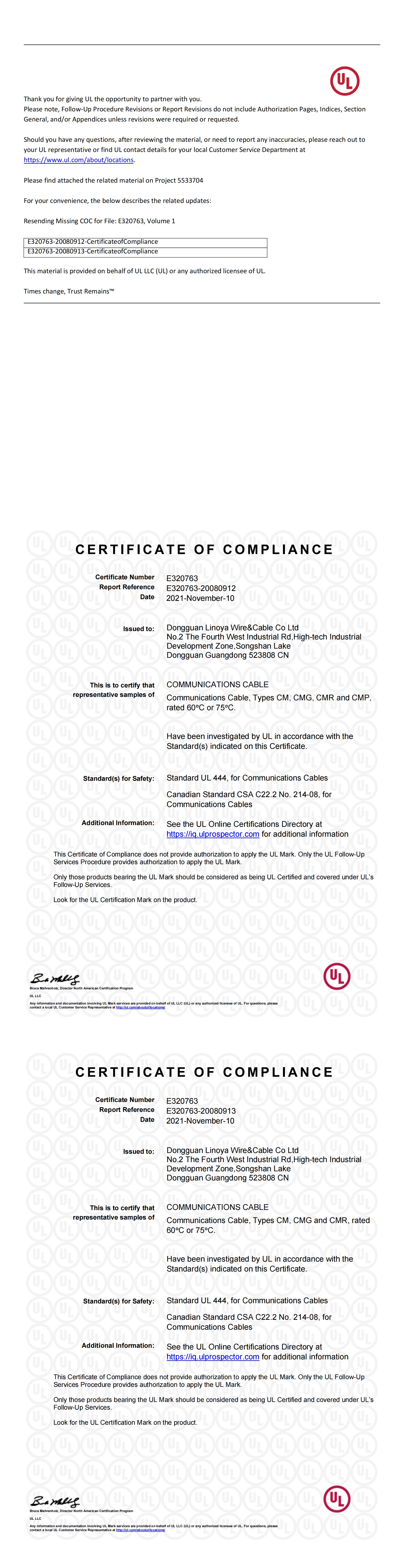
UL Certificate of Compliance file E320763 covers Linoya communications cable types CM, CMG, CMR and CMP rated 60 °C or 75 °C under UL 444 and CSA C22.2 No. 214-08.
In the European Union, cables placed on the market must have CPR performance declared through an EU Notified Body. Linoya Certificate of Constancy of Performance (System 1+) 1008-CPR-MC 69267303 0001 was issued on 28 August 2024 by TUV Rheinland InterCert Kft. (Notified Body 1008) under EN 50575:2014+A1:2016, with scope B2ca-s1a,d0,a1 for CAT6/6A/7/7A/8 S/FTP communication and LAN cables. A separate EZU classification report (Notified Body 1014, reference 801180-01/01 CLASS, standard CSN EN 13501-6:2014) records Dca-s1,d0,a2 for CAT7 F/FTP and CAT7A F/FTP constructions, and VDE reports (Notified Body 0366) record Eca classifications across several Cat5e and Cat6 variants.

EZU classification report 801180-01/01 CLASS records CPR Dca-s1,d0,a2 for CAT7 F/FTP and CAT7A F/FTP LAN cable constructions.
5. The rest of the channel: patch panel, enterprise gateway and cabinet density
An interconnect is only as good as its weakest certified element. When a Cat7a or Cat8 run terminates at an enterprise gateway, core switch or server NIC, the port, transceiver and patch panel each carry their own rating and their own documentation. The cable UL, ETL or CPR certificate says nothing about the gateway port capability: the achieved rate is set by the endpoint rated output and by whether the connecting hardware matches the category.
In Linoya documented enterprise data center scenario for CAT6A U/FTP, a 10G server-room deployment, the matched equipment list includes core switch, router, server farm, data center equipment and enterprise gateway. The same discipline applies one class higher. An enterprise gateway feeding a Cat8 row must be specified for the target 25G or 40G rate, and the patch field must match the shielded category, otherwise the link is limited by hardware rather than by cable.
Density closes the loop. The Cat8 30-metre envelope frequently means more aggregation points per aisle, more patch hardware and more careful cable management, while Cat7a longer reach can reduce the number of active aggregation points across medium-distance runs. That trade-off, not the price per drum, is the core of the total cost comparison.
Step-by-step: qualifying a Cat7a or Cat8 interconnect for a data center project
- Map true link lengths. Measure the physical route including slack, tray path and vertical runs. Flag every segment over 30 metres, which is outside the Cat8 stated limit, and every segment between 30 and 50 metres, which sits inside the Cat7a 40G envelope.
- Fix the per-link data rate. Separate rack-internal links from aisle and cross-aisle runs, and record the target rate for each: 10G, 25G, 40G, or ultra-short-reach 100G. Model-level capability matters here: Linoya CAT7A F/FTP is specified at 100 Gbps at 15 m and CAT8 F/FTP at 40 Gbps at 30 m.
- Set the compliance regime. In North America, confirm whether the route passes through a plenum air-handling space that requires CMP. In the EU, identify the CPR class the tender or specification requires, whether Eca, Dca or B2ca, and treat it as a pass or fail gate rather than a preference.
- Select the construction. Choose full shielding with overall plus pair foil and 22 AWG solid bare copper for permanent high-frequency infrastructure, and choose an LSZH jacket wherever the required fire class or the building type demands low-smoke zero-halogen performance.
- Verify certification at model level. Check the certificate number, the Notified Body (TUV Rheinland InterCert 1008, EZU 1014 or VDE 0366 for EU CPR documents), the tested construction, the referenced standard and the validity period. Confirm that the label matches the report.
- Confirm supply capability and schedule. Match supplier numbers to the project window. For Linoya, the minimum order is 305 m per carton with a 100-carton minimum, typical production lead time is 30 days, and monthly capacity is 200,000 cartons. Quality control includes 100% pre-shipment testing, third-party inspection (SGS/UL), random sampling and full electrical performance testing. OEM customization covers cable length, logo printing and packaging for buyers selling under their own brand.
- Re-test on site after installation. Factory testing does not replace field acceptance. Use a cable tester for continuity and wiring sequence, check the RJ45 link status on the connected device, and run an actual throughput test. Most data center link failures trace back to termination quality rather than to the cable itself.
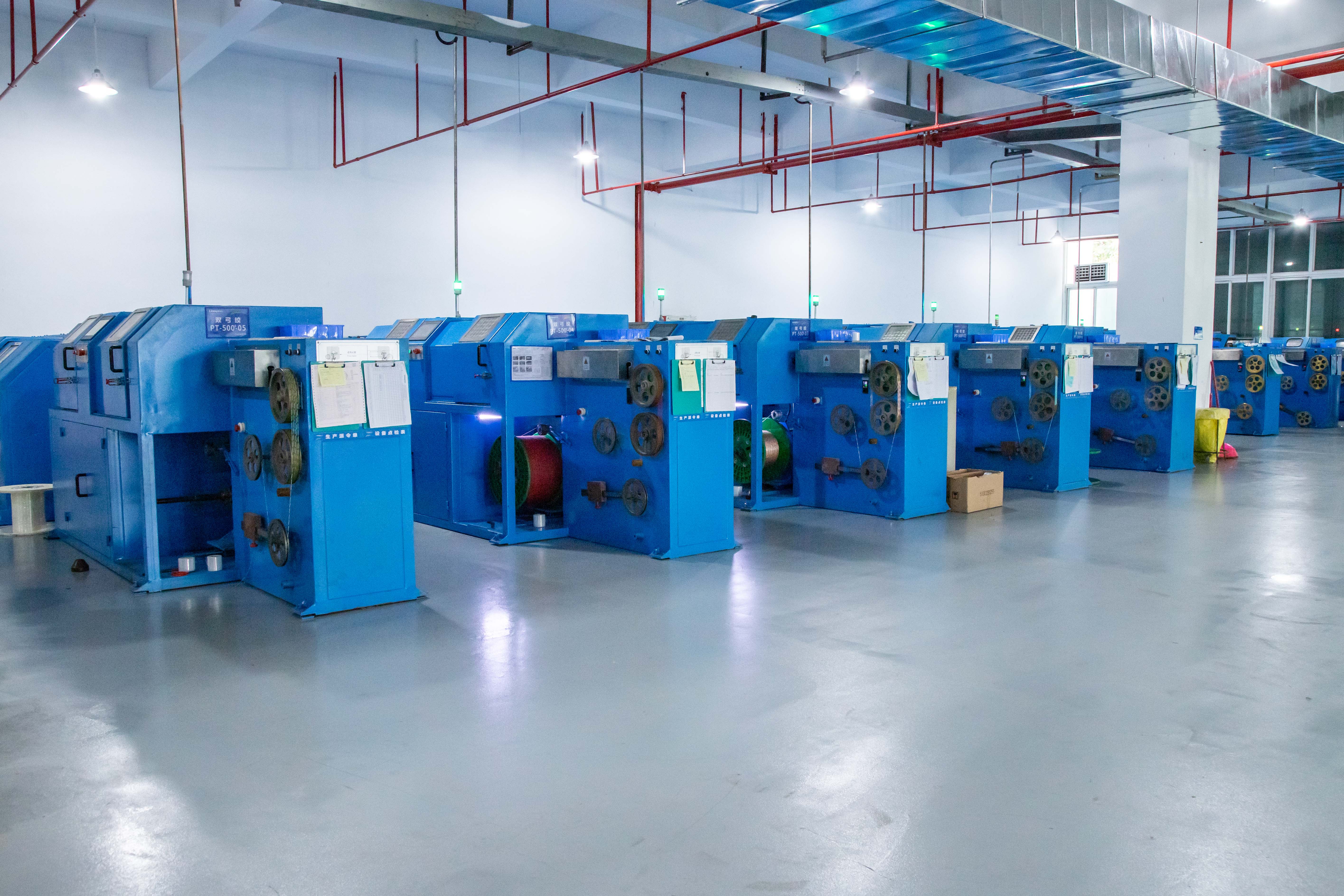
22 AWG solid bare copper conductor production on a double-bow type stranding machine, the conductor construction used in both CAT7A F/FTP and CAT8 F/FTP models.
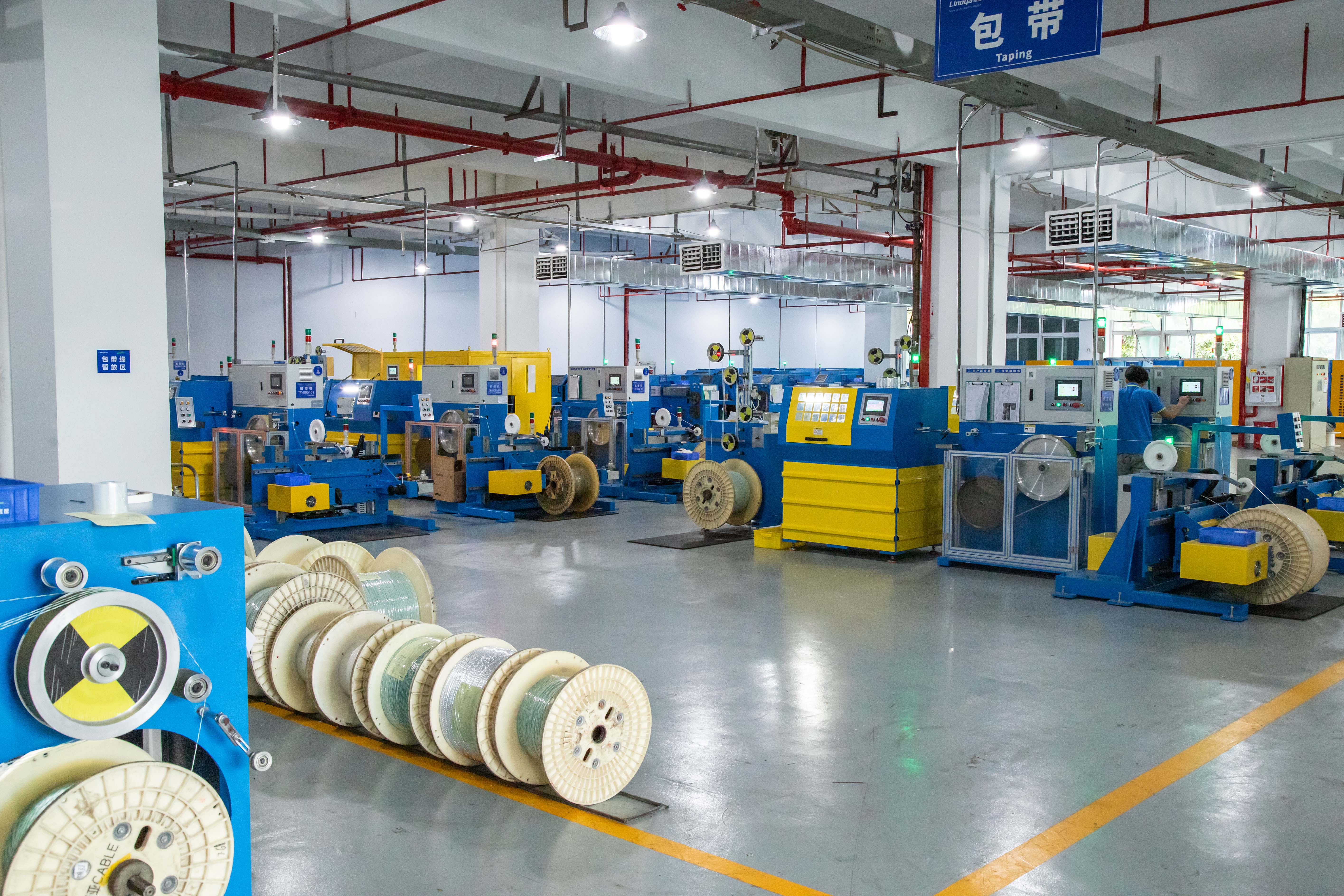
Foil taping and shielding application are in-line process steps; every finished length is then covered by 100% pre-shipment electrical performance testing.
Use cases: where each category wins
High-density cabinet-to-cabinet interconnect within 30 m, Cat8 F/FTP. A high-performance data center operator building short-reach interconnection between high-density server cabinets deployed 5,000 cartons of 305 m. The reported outcome was 99.998% network stability with full shielding for signal integrity and reliable 40G transmission, using 22 AWG solid copper with CMP flame rating, UL/ETL/CPR certification and an optional LSZH jacket.
Server rack internal wiring and cabinet-to-cabinet short reach, Cat8 F/FTP. A data center operator and server room integrator deployed 5,000 cartons for cabinet-to-cabinet short-reach interconnection and rack internal wiring, reporting 99.999% network stability and stable 40G short-range transmission at a 30-metre transmission distance with 22 AWG heavy-gauge conductors.
Premium data center ultra-high-speed interconnection, Cat7A F/FTP. A premium data center operator and high-end enterprise IT team deployed 6,000 cartons for ultra-high-speed interconnection and 100G enterprise network construction, reporting 99.999% network stability, stable 100G transmission and minimal signal loss with 22 AWG heavy-gauge copper, CMP flame rating and UL/ETL/CPR certification.
Heavy-EMI industrial and premium data center short-reach links, Cat7A F/FTP. A heavy industry integrator and premium data center project deployed 5,000 cartons in a heavy-EMI, ultra-high-speed environment, reporting 99.998% network stability, strong anti-interference performance and stable 100G transmission in an extreme environment using a full shielding structure, 22 AWG solid copper and industrial-grade construction with CMP flame rating and CPR certification.
Across all four profiles the pattern is consistent. Cat8 carries the shortest and densest links; Cat7a covers the medium-reach and high-interference roles. Mixed deployments, with Cat8 inside the row and Cat7a on the longer or noisier paths, are a normal and defensible design outcome.
Comparison table: Cat7a vs Cat8 for data center high-speed interconnection
| Decision factor | Cat7a (Linoya CAT7A F/FTP) | Cat8 (Linoya CAT8 F/FTP) |
|---|---|---|
| Frequency class | 1000 MHz | 2000 MHz |
| Stated transmission capability | 100 Gbps at 15 m (model specification); stable 40 Gbps up to 50 m in the 1000 MHz class | 40 Gbps at 30 m (model specification); 25G to 100G short reach within 30 m |
| Shielding | Overall plus pair full foil shield (F/FTP) | Overall plus pair full foil shield (F/FTP) with stricter shielding and crosstalk control |
| Conductor | 22 AWG solid bare copper | 22 AWG solid bare copper |
| Insulation and jacket options | LDPE insulation; PVC or LSZH jacket | LDPE insulation; PVC or LSZH jacket |
| Quoted flame rating | CMP | CMP |
| Certification status (Linoya) | UL/ETL/CPR certified at model level; EU CPR B2ca-s1a,d0,a1 (TUV Rheinland InterCert, NB 1008) covers CAT6/6A/7/7A/8 S/FTP | UL/ETL/CPR certified at model level; same EU CPR B2ca scope, with exact Cat8 model confirmation required |
| Grounding requirement | Correct shield grounding required | Correct shield grounding required |
| Relative cost | Lower of the two | Higher, driven by the higher frequency class and stricter shielding and crosstalk control |
| Best-fit link | Medium-distance 40G interconnect up to 50 m; high-EMI routes; ultra-short-reach 100G links at 15 m | Rack-to-rack and cabinet-to-cabinet links within 30 m; high-density rows |
Supporting compliance documents referenced in this comparison, as recorded in Linoya certification file:
| Document | Issuer / Notified Body | Standard and scope | Related products |
|---|---|---|---|
| UL Certificate of Compliance E320763 | UL LLC | UL 444; CSA C22.2 No. 214-08; types CM, CMG, CMR, CMP rated 60 °C or 75 °C | CAT6 SF/UTP, CAT6A U/UTP, CAT6A F/FTP |
| CPR Certificate of Constancy of Performance 1008-CPR-MC 69267303 0001 (28 August 2024) | TUV Rheinland InterCert Kft., NB 1008 | EN 50575:2014+A1:2016; B2ca-s1a,d0,a1 | CAT6/6A/7/7A/8 S/FTP communication and LAN cables |
| CPR classification report 801180-01/01 CLASS | EZU, NB 1014 | CSN EN 13501-6:2014; Dca-s1,d0,a2 | CAT7 F/FTP, CAT7A F/FTP |
| CPR classification report 801180-01/02 CLASS | EZU, NB 1014 | CSN EN 13501-6:2014; TIA/EIA 568-C.2; Dca-s1a,d0,a2 | CAT6A U/FTP |
| ETL Verified 103161791CRT-002c | Intertek / ETL | ANSI/TIA-568.2-D; Category 6, 4-pair, 23 AWG, UTP, CM, horizontal solid | CAT6 U/UTP (part number Linoya198) |
| ETL Verified 102500029CRT-002 | Intertek / ETL | ISO/IEC 11801-1; Category 6A, 4-pair, 23 AWG, U/FTP, horizontal solid; no flame rating marked | CAT6A U/FTP |
FAQ: Cat7a vs Cat8 for data center interconnect
1. What flame rating and certification do Cat7a and Cat8 cables need for a data center?
2. Who can manufacture OEM Cat6a S/FTP through Cat8 S/FTP cable to our specification?
3. What drives the budget difference between a Cat7a and a Cat8 rollout?
4. How do we validate a Cat7a or Cat8 cable before committing to a full rollout?
5. What are the MOQ, lead time and delivery terms for a Cat7a or Cat8 order?
Conclusion: choose by length and compliance, then confirm the certificate
The Cat7a versus Cat8 decision resolves in a fixed order. Map the real link lengths first: links inside 30 metres and inside dense cabinet rows belong on Cat8 F/FTP at 2000 MHz, while links between 30 and 50 metres, high-EMI routes and ultra-short-reach 100G runs belong on Cat7a F/FTP at 1000 MHz. Then apply the compliance filter: CMP for North American plenum pathways, and the CPR class named in the specification for EU projects, with B2ca-s1a,d0,a1 documented for Linoya CAT6/6A/7/7A/8 S/FTP constructions. Finally, verify the exact model against the certificate scope, including the not-always-obvious detail of whether the document carries a flame rating at all.
Mixed designs are usually the honest answer: Cat8 where density and speed dominate, Cat7a where reach and interference resistance dominate. Both are 22 AWG solid copper, fully shielded, CMP-rated and covered by UL, ETL and CPR documentation, so the comparison is about fitting the link rather than about which category is intrinsically superior.
Next step: sample, datasheet or quote
Linoya Electronic Technology Co., Ltd. manufactures Cat5e to Cat8 Ethernet cable, including CAT7A F/FTP and CAT8 F/FTP full-shielded constructions with 22 AWG solid bare copper, CMP flame rating and UL/ETL/CPR documentation, plus OEM customization of cable length, logo printing and packaging.
Send your link lengths, target data rate and required flame rating to inquiry@linoya.com, contact Raylene Lu at +86-15602610696 or WhatsApp +86-13038893260, and Linoya can confirm model availability, sample arrangements and lead time. The full product and certification overview is available in the Linoya Electronic Technology catalogue (PDF) or at linoya.com.
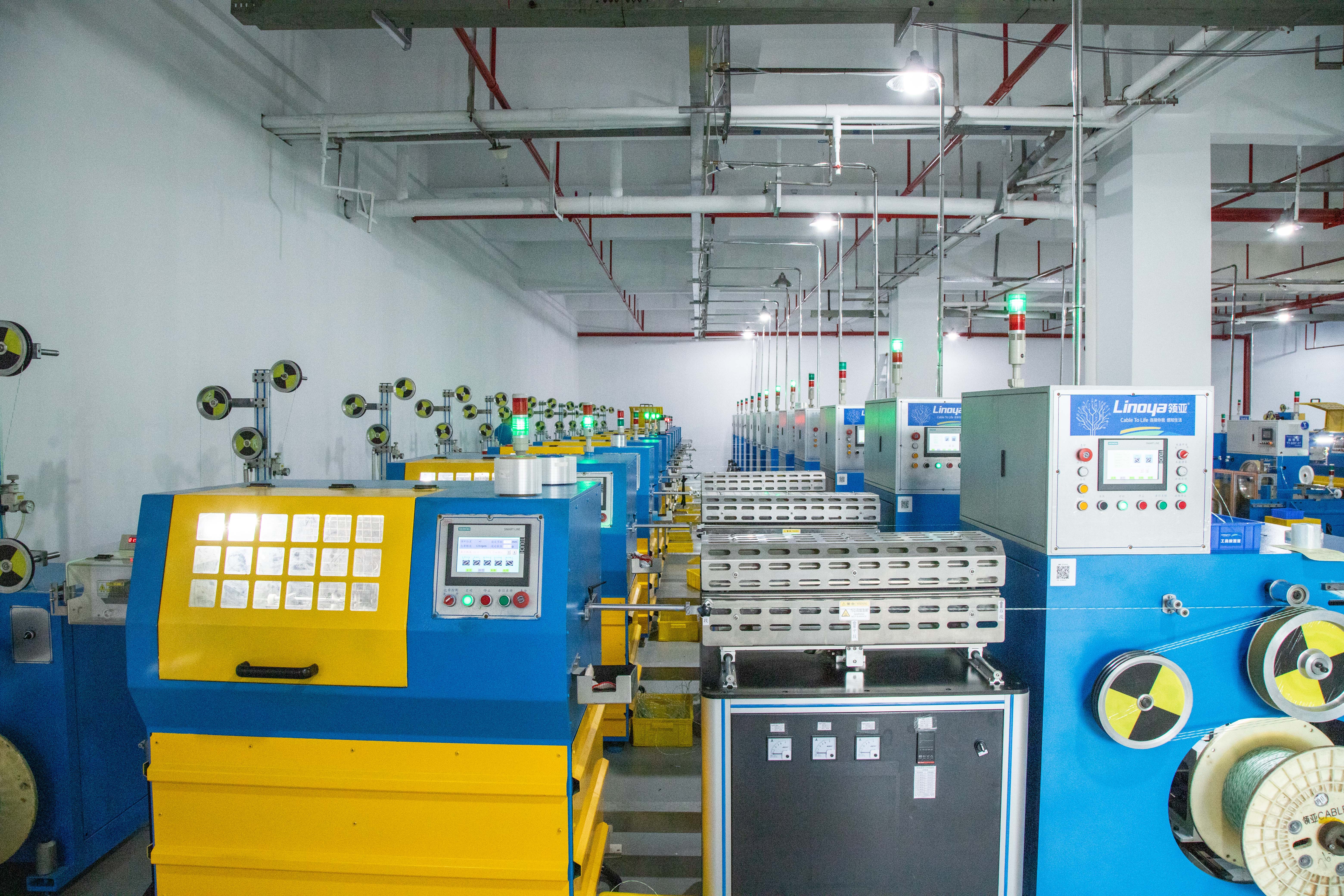
Production capacity of 200,000 cartons per month supports bulk Cat7a and Cat8 orders, with 100% pre-shipment electrical performance testing.
Address: No.2, The Fourth West Industrial Road, High-Tech Industrial Development Zone, Songshan Lake, Dongguan City, Guangdong Province, China.
Have Questions or Need More Details?
Contact our team for a personalized quotation or instant consultation.
Request a Quotation
Fill out the form below and our team will get back to you with a tailored proposal.
WhatsApp Direct Chat
Prefer to chat in real-time? Message us on WhatsApp for instant assistance & quick answers.
- Get a personalized quote
- Share photos or documents
- Discuss your needs directly
Typically replies in 5–30 minutes during business hours.