
Top 7 Ethernet Cable Picks for Data Center and High-EMI Commercial Networks in 2026
A data center link that negotiates 10G and then drops packets under load, a plenum run that cannot pass a fire inspection, a shielded cable installed with no grounding plan — these are specification failures, not purchasing failures. Cabling decisions for data center and high-EMI commercial projects are made against three hard conditions: a defined transmission speed over a defined distance, shielding that protects signal integrity along an electrically noisy route, and flame ratings plus third-party certification that hold up in a compliance review.
This guide ranks seven Ethernet cable configurations by how closely their published specifications match those conditions for 2026 projects. The seven picks are models from the Ethernet cable range of Linoya Electronic Technology Co., Ltd., a cable and wire manufacturer established in 1997 that integrates R&D, manufacturing and sales across intelligent transmission, smart power and new materials. Each entry states the shield construction, conductor, rated bandwidth at distance, flame rating and certification status, then adds the environment where it fits and the limitation that rules it out elsewhere.
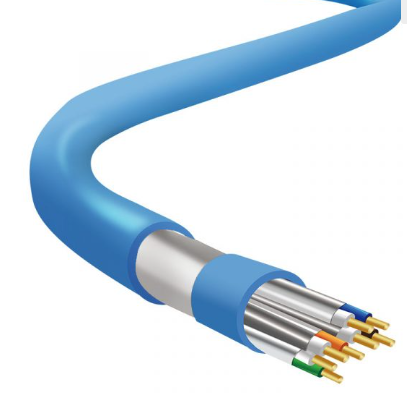
Quick answer — the seven picks at a glance:
- CAT8 F/FTP — 40Gbps at 30 m, overall + pair full foil shield, CMP, UL/ETL/CPR. Fit: data center cabinet-to-cabinet and top-of-rack links.
- CAT7A F/FTP — 100Gbps at 15 m, overall + pair full foil shield, CMP, UL/ETL/CPR. Fit: premium data center and heavy-EMI ultra-high-speed links.
- CAT7 F/FTP — 40Gbps at 50 m, overall + pair full foil shield, CMP, UL/ETL/CPR. Fit: high-EMI industrial and data center backbone.
- CAT6A F/FTP — 10Gbps at 100 m, overall + pair full foil shield, CMP, UL/ETL/CPR. Fit: heavy-EMI industrial and public infrastructure 10G.
- CAT6A SF/UTP — 10Gbps at 100 m, screen + foil overall shield, CMP, UL/ETL/CPR. Fit: high-EMI commercial buildings and enterprise core links.
- CAT6A U/FTP — 10Gbps at 100 m, individual pair foil shield, CMP, UL/ETL/CPR. Fit: enterprise data center and server rooms with low-crosstalk requirements.
- CAT6A U/UTP — 10Gbps at 100 m, unshielded, CMP, UL/ETL/CPR. Fit: cost-controlled 10G where EMI is managed by pathway design.
Problem Definition: Where Data Center and High-EMI Cabling Actually Fails
Most Ethernet failures in demanding buildings trace back to four specification gaps, and each gap maps to a different cable property.
1. Electromagnetic interference and crosstalk. Crosstalk is signal interference where electrical signals leak between adjacent twisted-wire pairs inside the cable, which can cause packet loss, slow speeds or unstable network connections. In high-EMI commercial buildings and industrial sites, interference also arrives from outside the cable — motors, variable-frequency drives, power feeders and dense rack bundles. Field symptoms reported in cabling troubleshooting include no link light, frequent disconnection, random packet loss, unstable PoE power supply, and a link that negotiates 10/100Mbps instead of the expected gigabit speed.
2. Distance-versus-speed mismatch. Category ratings are distance-dependent. In the Linoya range, Cat6 supports 10Gbps at 55 m and 10G performance is not guaranteed beyond 55 m, while Cat6a, Cat7, Cat7A and Cat8 extend the working envelope further. A cable that is correct for a 40 m desk run can be the wrong specification for a 90 m backbone riser.
3. Fire rating and installation space. Plenum air-handling spaces, riser shafts and general horizontal runs are governed by different flame ratings. In this range, CMP-rated cables are designated for plenum installations, CMR-rated Cat6 constructions serve riser and general commercial routing, and Cat5e constructions carry CM/CMG flame ratings.
4. Standards and termination quality. The ANSI/TIA-568.2-E standard was released in October 2024, replacing ANSI/TIA-568.2-D, and introduced DCRU (DC resistance unbalance) specifications for Cat5e, Cat6 and Cat6A. On the component side, low-grade RJ45 connectors cannot support the high-frequency performance of Cat6/Cat6a cable, and untwisted pairs left too long at the termination create a bottleneck regardless of how good the reel is.
Industry Background: What Is Driving Demand in 2026
Two forces are pushing specification decisions toward shielded, certified cable: continued bandwidth growth in data centers, and tightening fire-safety regulation in construction markets.
- The global Ethernet cable market was valued at USD 38.55 billion in 2025, according to Maximize Market Research, and the same source projects revenue of nearly USD 70.02 billion by 2032, a CAGR of 8.9% from 2026 to 2032.
- Dataintelo reports that the Cat6 segment dominated the Ethernet cable market in 2025 with a 32.5% share, which is consistent with what most enterprise 10G deployments still specify for short-to-medium runs.
- In the European Union, cable placed on the market as a construction product is classified under CPR (EN 50575). The B2ca class represents high fire performance with strict thresholds: FS ≤ 1.5 m, THR ≤ 15 MJ, and peak HRR ≤ 30 kW.
- For procurement planning, Ethernet patch cables with connectors fall under HS code 8544.42, while bulk cable on a reel without connectors falls under HS code 8544.49. The US MFN duty rate for HS 8544.42.90 is 2.6%, while the EU MFN rate is 0%.
Read together, these signals explain why 2026 project specifications increasingly ask for documented shielding architecture, a named flame rating, and certification that can be checked on paper before the first reel is shipped.
Source note: market size, CAGR and category share figures come from commercial research reports (Maximize Market Research; Dataintelo) and are cited as reported. Fire-performance thresholds come from the EU CPR framework as published by industry sources. Standards, tariff and HS classification references come from TIA and customs classification sources. Verify current versions before writing them into a project specification.
How the Seven Picks Were Ranked
Ranking cable configurations is only useful if the ranking criteria are visible. These seven criteria were applied in order, with the first two weighted most heavily because they eliminate options fastest.
- Shield construction versus EMI severity — unshielded, overall foil, screen plus foil, pair foil, or full overall-plus-pair foil.
- Rated bandwidth at distance — 1Gbps, 10Gbps at 55 m, 10Gbps at 100 m, 40Gbps at 50 m, 40Gbps at 30 m, or 100Gbps at 15 m.
- Conductor and gauge — solid bare copper construction, in 23AWG or 22AWG depending on the model.
- Flame rating — CMP for plenum spaces, CMR for riser and general commercial routing, CM/CMG for lighter-duty runs.
- Certification and standards — UL and ETL certification, CPR certification for EU projects, and conformity with TIA/EIA-568-C.2.
- Supporting equipment compatibility — interoperability with industrial switches, patch panels, servers and workstations used along the same link.
- Jacket availability — PVC or LSZH, where low-smoke zero-halogen routing is required.
Neutrality note: this ranking compares cable configurations, not companies. The same seven criteria can be applied to any supplier's datasheet, and the order will change as soon as distances, EMI levels or fire-rating requirements change. Treat the list as a decision framework, then verify the actual specification against the project drawings.
The Top 7 Ethernet Cable Picks for 2026
1. CAT8 F/FTP — best fit for data center cabinet-to-cabinet links up to 30 m
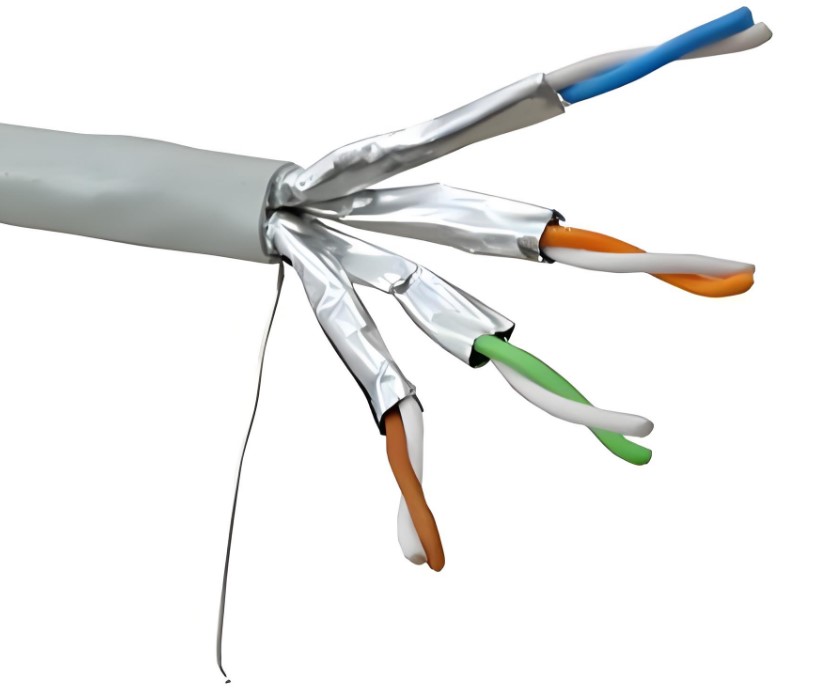
The highest-ranked pick for dense indoor data center work is a CAT8 F/FTP full shielded Ethernet cable. It uses 22AWG solid bare copper conductors, LDPE insulation and a PVC or LSZH jacket, with an overall plus pair full foil shield.
- Rated bandwidth: 40Gbps at 30 m.
- Compliance: TIA/EIA-568-C.2, CMP flame rating, UL, ETL and CPR certified.
- Designed environment: data center cabinet-to-cabinet and server cabinet internal connections, operated 24/7.
- Matched equipment: data center switches, servers, storage devices, high-speed interconnect equipment and cable managers.
- Limitation: the 30 m rated distance restricts it to short-reach in-row and top-of-rack links. It is not a substitute for a longer backbone run.
2. CAT7A F/FTP — best fit for heavy-EMI and premium data center links up to 15 m
Where the highest short-reach rate is required inside a noise-heavy facility, CAT7A F/FTP is the pick. It carries 22AWG solid bare copper conductors with overall plus pair full foil shielding, and it is positioned as a heavy-duty industrial-grade construction.
- Rated bandwidth: 100Gbps at 15 m.
- Compliance: TIA/EIA-568-C.2, CMP flame rating, UL, ETL and CPR certified.
- Designed environment: heavy-EMI industrial areas, premium data centers and ultra-high-speed links.
- Matched equipment: industrial high-speed switches, high-precision control equipment and industrial automation systems.
- Limitation: the 15 m rated distance makes it a specialized interconnect, not a general distribution cable.
3. CAT7 F/FTP — best fit for 40G high-EMI industrial and data center backbone up to 50 m
The middle ground between ultra-short-reach 100G and full-distance 10G is CAT7 F/FTP: 23AWG solid copper, overall plus pair full foil shielding, and a 40Gbps rating at 50 m. Its published product positioning also covers PoE++ performance and an LSZH jacket option for low-smoke routing.
- Rated bandwidth: 40Gbps at 50 m.
- Compliance: TIA/EIA-568-C.2, CMP flame rating, UL, ETL and CPR certified.
- Designed environment: high-EMI industrial sites, data centers and high-performance networking, running 24/7.
- Matched equipment: industrial gigabit switches, PLCs, industrial robots, control systems and sensor networks.
- Limitation: 50 m is a real ceiling. If the route is longer, step to a Cat6a construction rated for 100 m.
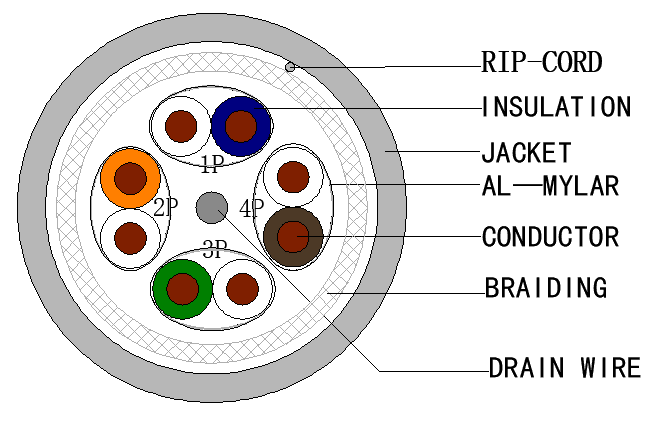
4. CAT6A F/FTP — best fit for full-distance 10G in heavy-EMI industrial and public infrastructure
When the requirement is 10Gbps across a full 100 m channel inside a hostile electrical environment, CAT6A F/FTP is the most conservative choice in the list. It combines 23AWG solid copper conductors with an overall plus pair full foil shield.
- Rated bandwidth: 10Gbps at 100 m.
- Compliance: TIA/EIA-568-C.2, CMP flame rating, UL, ETL and CPR certified.
- Designed environment: heavy-EMI industrial plants, data centers and public infrastructure, with an LSZH jacket option.
- Matched equipment: industrial switches, PLCs, industrial control equipment, sensors, gateways and HMIs.
- Limitation: full shielding adds diameter and stiffness compared with unshielded Cat6a. Confirm conduit fill, bend radius and patch-panel clearance before ordering.
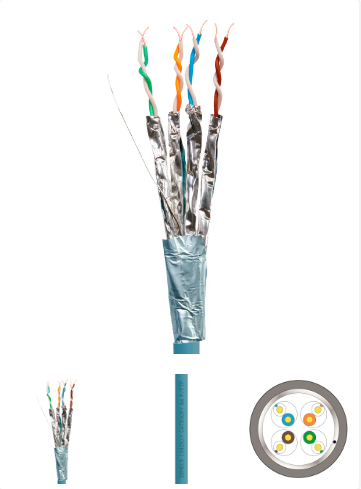
5. CAT6A SF/UTP — best fit for high-EMI commercial buildings and enterprise core links
For commercial buildings where the noise source is real but the route is long, CAT6A SF/UTP delivers 10Gbps at 100 m using a screen plus foil overall shield over 23AWG solid copper conductors. It is positioned specifically for high-EMI commercial environments inside enterprise networks.
- Rated bandwidth: 10Gbps at 100 m.
- Compliance: TIA/EIA-568-C.2, CMP flame rating, UL, ETL and CPR certified.
- Designed environment: high-density data centers, enterprise core networks and high-EMI commercial buildings, 24/7 operation.
- Matched equipment: data center switches, servers, routers, firewalls, patch cords and cable management systems.
- Selection rule: screen-plus-foil shielding addresses external interference across the whole cable. Where pair-to-pair isolation inside a dense bundle is the dominant concern, the next pick is the better fit.
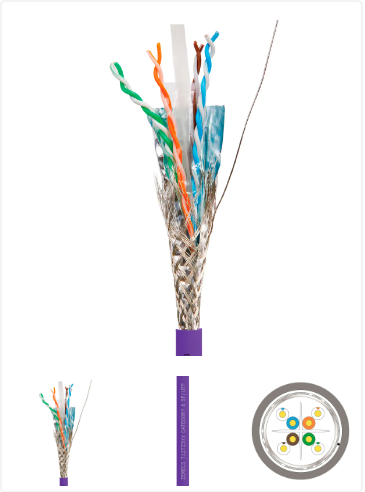
6. CAT6A U/FTP — best fit for enterprise data center and server room crosstalk control
CAT6A U/FTP uses individual pair foil shielding rather than an overall screen. That construction is aimed at eliminating crosstalk between pairs inside the cable — the failure mode that appears first in dense, high-frequency rack environments.
- Rated bandwidth: 10Gbps at 100 m.
- Compliance: TIA/EIA-568-C.2, CMP flame rating, UL, ETL and CPR certified.
- Designed environment: enterprise data centers, server rooms and high-performance 10G networking.
- Matched equipment: core switches, routers, server farms, data center equipment and enterprise gateways.
- Selection rule: pair-level foil targets internal crosstalk. Where the dominant risk is external EMI rather than internal crosstalk, choose an overall-shielded construction such as F/FTP or SF/UTP instead.
7. CAT6A U/UTP — best fit for cost-controlled 10G where EMI is managed by pathway design
Not every 100 m 10G run needs a shield. CAT6A U/UTP is an unshielded 23AWG solid copper construction rated 10Gbps at 100 m, and it is positioned as a cost-effective 10G solution with low signal attenuation for data center, commercial office and enterprise networking.
- Rated bandwidth: 10Gbps at 100 m.
- Compliance: TIA/EIA-568-C.2, CMP flame rating, UL, ETL and CPR certified.
- Designed environment: data center rack interconnection, commercial offices and 10G enterprise networking, running 24/7.
- Matched equipment: 10G switches, servers, NAS/SAN storage, patch panels and SFP modules.
- Limitation: with no shield, performance depends on separation from power feeders, motors and drives, plus disciplined pathway and bundle design. In an electrically noisy route, drop this option rather than trying to compensate with installation practice.
Also worth keeping in the catalog — supporting options outside the top seven
Two project types fall just outside the top seven but still show up in data center and commercial renovation scopes:
- CAT6 SF/UTP and CAT6 F/UTP — screen-plus-foil and overall-foil Cat6 constructions rated 10Gbps at 55 m with a CMR flame rating and UL/ETL certification. These suit moderate-EMI commercial buildings, industrial edge cabinets and surveillance backbones where 55 m is sufficient.
- CAT6 U/UTP and the Cat5e family (U/UTP, F/UTP, SF/UTP) — Cat6 U/UTP offers dual 24AWG/23AWG options with stable PoE++ support, while Cat5e constructions deliver 1Gbps with CM/CMG flame ratings for retrofits, surveillance and structured cabling where gigabit is the target.
Step-by-Step: Applying This List to a Real Project
The ranking above is a menu, not an instruction. Convert it into a bill of materials with the following sequence.
- Map every link by distance and target speed. Write down the required speed at the required length for each route. A 30 m rack link and a 95 m riser are two different specifications, and mixing them is the most common source of over-specification or under-specification.
- Classify the EMI environment in each zone. Separate normal office space from areas near motors, drives, power feeders or heavy machinery. Shielded configurations belong in the noisy zones; unshielded configurations belong where the route is controlled.
- Fix the flame rating before the category. Match CMP for plenum air-handling spaces, CMR for riser and general commercial routing, and CM/CMG for lighter-duty runs. For EU construction projects, confirm the CPR classification as well.
- Check the whole equipment chain. Verify compatibility with the industrial switches, patch panels, servers and workstations on the same link. Cable category means nothing if the connectors and patch panels cannot carry the same frequency.
- Confirm conductor and jacket. The picks above use solid bare copper conductors with LDPE insulation and a PVC or LSZH jacket. Where low-smoke zero-halogen routing is required, specify the LSZH jacket option.
- Validate with samples and field testing. Test continuity and wiring sequence with a cable tester, check the RJ45 link indicator on the connected equipment, and run a throughput test against the expected rate. Factory electrical performance testing before delivery is a starting point, not a substitute for on-site verification after construction.
- Plan the supply for a multi-phase rollout. Renovation and data center projects usually install in stages. Confirm that the selected construction, jacket and flame rating remain consistent across every delivery batch, because mixed batches are a common cause of field failures.
Use Cases: Matching the Pick to the Environment
- Data center cabinet-to-cabinet 40G links (up to 30 m): CAT8 F/FTP, paired with data center switches, servers, storage devices and cable managers. Short-reach, high-density, 24/7 continuous operation.
- Heavy-EMI industrial automation backbone: CAT7A F/FTP for 15 m ultra-high-speed segments, or CAT7 F/FTP for 50 m 40G runs, connected to industrial high-speed switches, PLCs, robots, control systems and sensor networks.
- Enterprise 10G server room and core network renovation: CAT6A U/FTP where crosstalk control is the priority, or CAT6A SF/UTP where external interference dominates, terminated through core switches, routers, server farms and gateways.
- High-EMI commercial building and surveillance cabling: CAT6 SF/UTP or CAT6 F/UTP for 10Gbps at 55 m with a CMR flame rating, feeding building network switches, patch panels, workstations and building automation systems.
- Cost-controlled 10G in managed pathways: CAT6A U/UTP across a full 100 m channel where the route is separated from noise sources and the project needs the lowest-cost 10G option that still carries CMP rating and UL/ETL/CPR certification.
Comparison Table: The Top 7 Picks Side by Side
| Rank | Model | Shield construction | Conductor | Rated bandwidth | Flame rating & certification | Primary fit |
|---|---|---|---|---|---|---|
| 1 | CAT8 F/FTP | Overall + pair full foil | 22AWG solid bare copper | 40Gbps @ 30 m | CMP; UL, ETL, CPR | Data center cabinet-to-cabinet and top-of-rack links |
| 2 | CAT7A F/FTP | Overall + pair full foil | 22AWG solid bare copper | 100Gbps @ 15 m | CMP; UL, ETL, CPR | Premium data center and heavy-EMI ultra-high-speed links |
| 3 | CAT7 F/FTP | Overall + pair full foil | 23AWG solid bare copper | 40Gbps @ 50 m | CMP; UL, ETL, CPR | High-EMI industrial and data center backbone |
| 4 | CAT6A F/FTP | Overall + pair full foil | 23AWG solid bare copper | 10Gbps @ 100 m | CMP; UL, ETL, CPR | Heavy-EMI industrial and public infrastructure 10G |
| 5 | CAT6A SF/UTP | Screen + foil overall | 23AWG solid bare copper | 10Gbps @ 100 m | CMP; UL, ETL, CPR | High-EMI commercial buildings and enterprise core links |
| 6 | CAT6A U/FTP | Individual pair foil | 23AWG solid bare copper | 10Gbps @ 100 m | CMP; UL, ETL, CPR | Enterprise data center and server room crosstalk control |
| 7 | CAT6A U/UTP | Unshielded | 23AWG solid bare copper | 10Gbps @ 100 m | CMP; UL, ETL, CPR | Cost-controlled 10G with managed EMI pathways |
All seven constructions share the same base material set — solid bare copper conductor, LDPE insulation, and a PVC or LSZH jacket — and all comply with TIA/EIA-568-C.2. The differences that matter are shield architecture, conductor gauge and rated bandwidth at distance.
FAQ: Compliance, Capability, Budget, Samples and Supply
Which certifications and standards should a data center or high-EMI commercial Ethernet cable carry?
A specification for these environments should name four things: a recognized product certification such as UL and ETL; category compliance with TIA/EIA-568-C.2; a flame rating matched to the installation space — CMP for plenum, CMR for riser, CM/CMG for general-purpose routing; and, for construction products placed on the EU market, a CPR classification under EN 50575. Two current references are worth checking: the ANSI/TIA-568.2-E standard was released in October 2024, replacing ANSI/TIA-568.2-D, and it introduced DCRU (DC resistance unbalance) specifications for Cat5e, Cat6 and Cat6A; and the EU CPR B2ca class is defined by strict thresholds of FS ≤ 1.5 m, THR ≤ 15 MJ and peak HRR ≤ 30 kW. Cables in the Linoya shielded range — Cat6A, Cat7, Cat7A and Cat8 — are UL, ETL and CPR certified, comply with TIA/EIA-568-C.2, and carry a CMP flame rating.
Can a shielded Cat6A or Cat7 cable really hold stable 10Gbps over 100 m in a high-EMI building?
Yes, within the published distance limits. Cat6A shielded and unshielded constructions in this range are rated 10Gbps at 100 m, which is the standard channel length for a permanent link. Above that speed tier, the rated distance shortens: Cat7 is rated 40Gbps at 50 m, Cat7A is rated 100Gbps at 15 m, and Cat8 is rated 40Gbps at 30 m. Shield architecture decides how much interference the link can tolerate along the way — full overall-plus-pair foil for the noisiest routes, pair foil where internal crosstalk is the main risk, and no shield where the pathway is controlled. When a link silently negotiates 10/100Mbps instead of gigabit, or shows random packet loss and unstable PoE power, interference, termination quality or cable grade is usually the cause.
How do I choose between Cat5e, Cat6 and Cat6a when the budget is constrained?
Choose by required speed, required distance and expected service life rather than by price alone. Cat5e supports 1Gbps and suits gigabit LANs, PoE surveillance cameras and general office wiring at low procurement cost, but it does not support 10Gbps or high-power PoE++ devices. Cat6 supports 10Gbps at 55 m and fits cost-controlled short-range 10G and standard gigabit networks with upgrade headroom, but 10G performance cannot be guaranteed beyond 55 m. Cat6a supports full-channel 10Gbps at 100 m, handles dense cable bundles, PoE++ up to 90W and long-term permanent building cabling, at the cost of a larger cable diameter and a higher overall project cost. For data center and high-EMI projects, that trade-off usually favors Cat6a or above.
Can I validate a cable before committing to a bulk order?
Yes, and validation should happen at two levels. On a sample, test continuity and wiring sequence with a cable tester, confirm the LED sequence shows no open circuit, short circuit or mis-wiring, connect the cable between a workstation and a switch to check the RJ45 link indicator, and run a throughput test to confirm the actual rate against the expected rate. Finished cables from Linoya Electronic Technology Co., Ltd. pass factory-level electrical performance testing before delivery, but on-site re-checking after construction is still required because termination quality and pathway conditions are created on site. Sample and specification review can be arranged through the Linoya sales contact before a bulk commitment.
What supports supply continuity for large or multi-phase cabling projects?
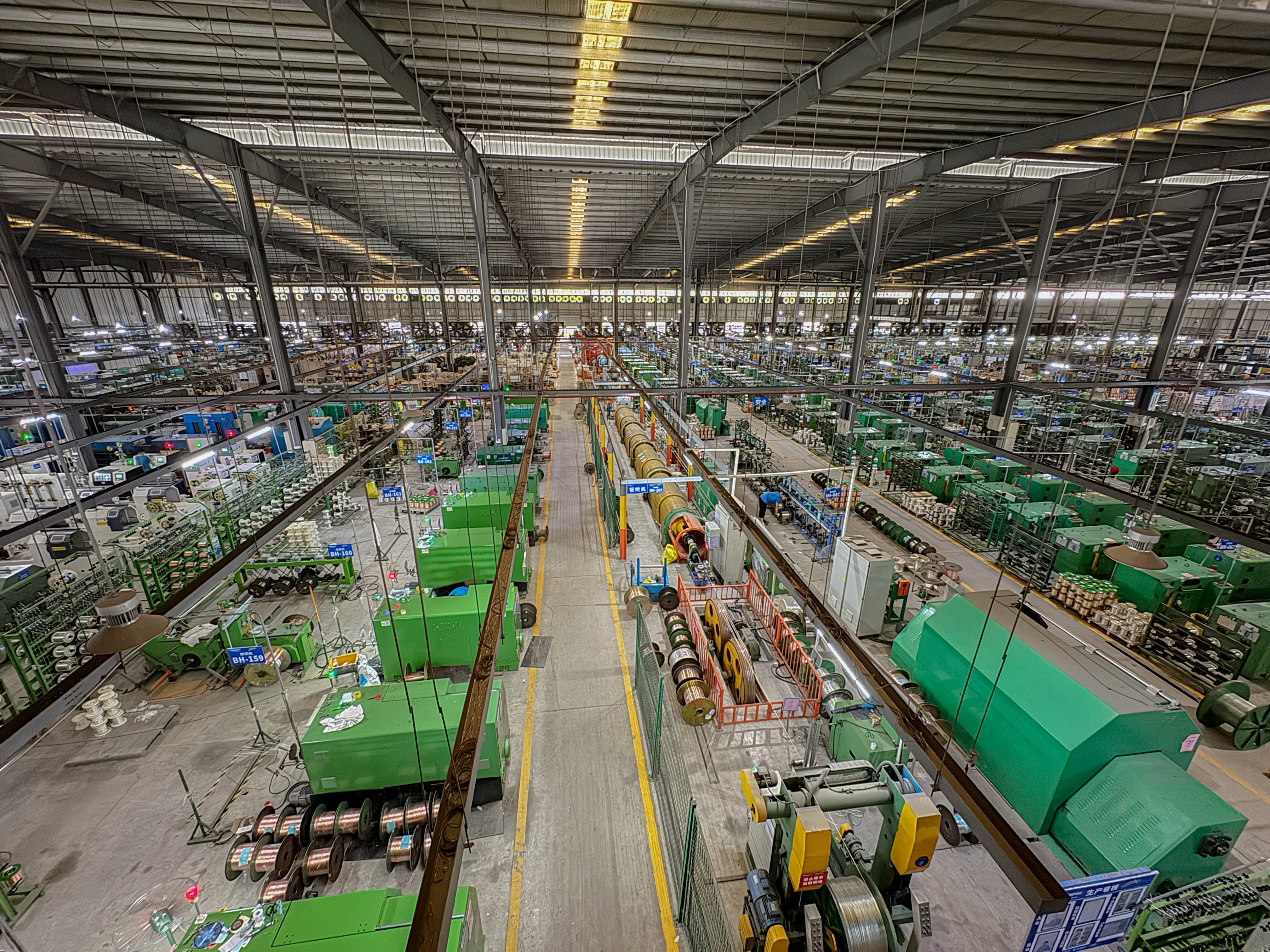
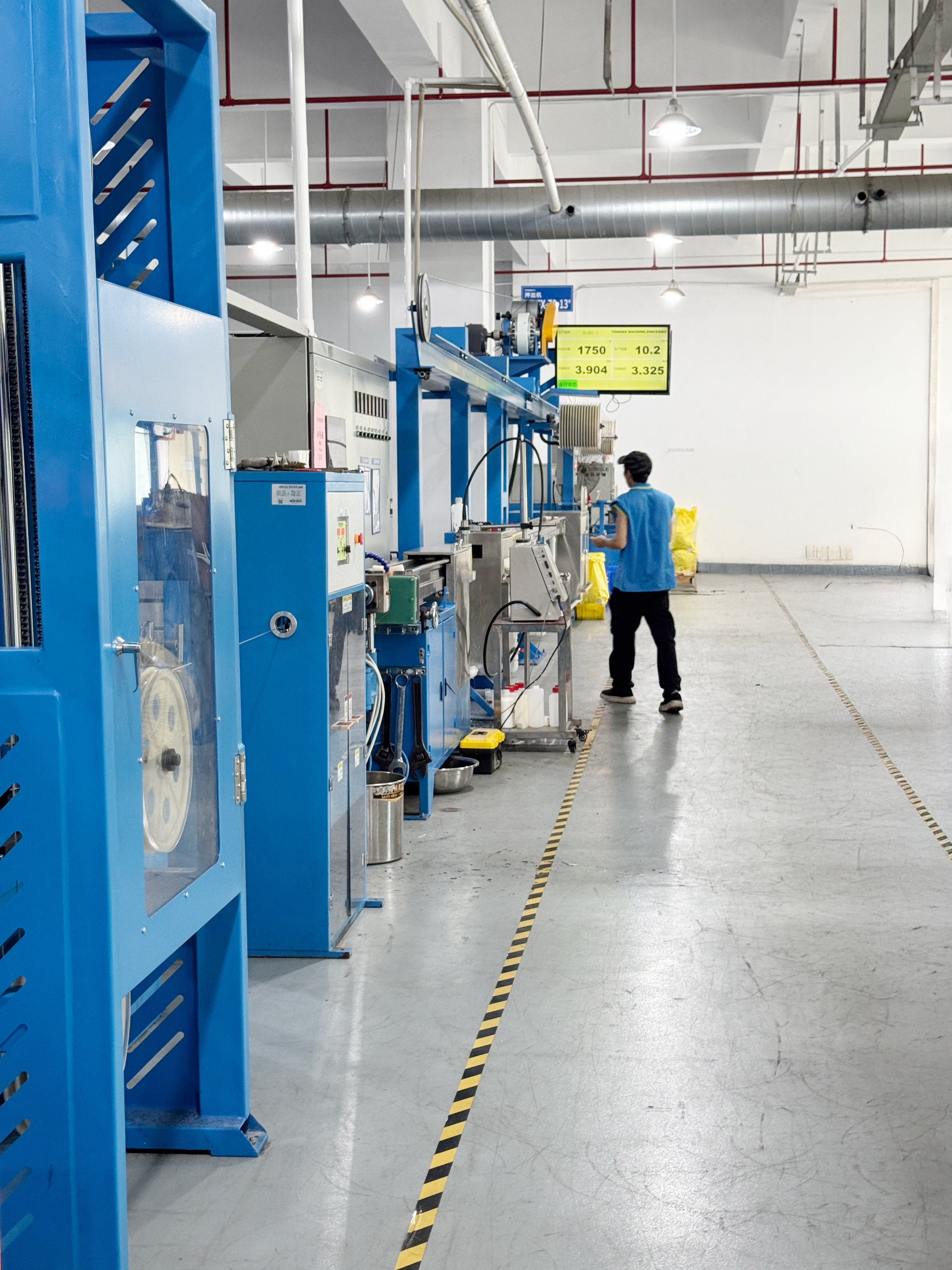
Supply continuity depends on manufacturing capacity and on consistent construction across batches. Linoya Electronic Technology Co., Ltd. was established in 1997 and operates three self-owned industrial parks — Shenzhen Linoya Technology Park, Dongguan Songshan Lake Linoya Industrial Park and Dongguan Chashan Linoya Industrial Park — plus one production base in Vietnam, with more than 100 production lines, manufacturing areas of 60,000 m², over 3,000 employees, more than 300 engineers and an annual output of 4,000,000 kilometers. The company reports annual sales exceeding USD 420 million and exports to the EU and the Middle East, with an export ratio of 30%. For projects that install in phases, confirm that shield construction, conductor gauge and flame rating stay identical across every delivery batch — and request a schedule and quantity confirmation for the full rollout rather than ordering phase by phase.
Conclusion
For 2026 data center and high-EMI commercial projects, the selection logic is narrow and testable: match rated bandwidth to real distance, match shield architecture to the actual interference profile, and match the flame rating to the installation space. The seven configurations above rank in that order — Cat8 and Cat7A for short-reach 40G and 100G inside the rack, Cat7 for 40G at 50 m, the Cat6A family for full-distance 10G in heavy-EMI industrial, commercial and server room environments, and unshielded Cat6a where the pathway does the shielding work.
Use the comparison table as a specification checklist, not as a shopping list. The same criteria — shielding, distance, conductor, flame rating, certification, equipment compatibility and jacket — will rank any supplier's datasheet, and the ranking should change as soon as a project's distances or EMI conditions change.
Next step: specification review, samples and project quotation
If your project involves data center interconnects, high-EMI commercial buildings or core network renovation, the fastest path from this list to a bill of materials is a specification review against your link schedule.
Catalog Download the full product documentation: Linoya Electronic Technology Co., Ltd. company and product catalog (PDF)
Website www.linoya.com
Contact Raylene Lu — Email: inquiry@linoya.com — Tel: +86-15602610696 — WhatsApp: +86-13038893260
Address: No.2, The Fourth West Industrial Road, High-Tech Industrial Development Zone, Songshan Lake, Dongguan City, Guangdong Province, China.
Have Questions or Need More Details?
Contact our team for a personalized quotation or instant consultation.
Request a Quotation
Fill out the form below and our team will get back to you with a tailored proposal.
WhatsApp Direct Chat
Prefer to chat in real-time? Message us on WhatsApp for instant assistance & quick answers.
- Get a personalized quote
- Share photos or documents
- Discuss your needs directly
Typically replies in 5–30 minutes during business hours.