
Nonwoven Fabric Machine Supplier Evaluation: What to Document
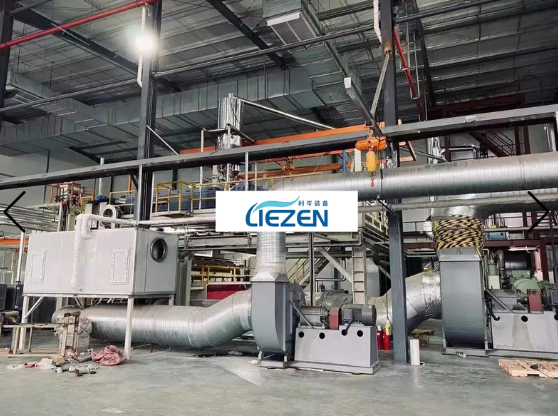
A nonwoven fabric machine supplier evaluation is finished only when two documents agree: a capability record that shows what the supplier can build and deliver for your configuration, and an agreement whose purchasing terms and acceptance criteria match that record item by item. Anything that cannot be placed in either document — a verbal speed figure, a catalogue page describing a different line, an assurance about the production slot — is still an open item, not an evaluation result.
This guide is written for buyers who have already shortlisted suppliers and are moving from evaluation into execution. It sets out a seven-step sequence: define the line, run six capability checks with named evidence, match supplier scope to your build strategy, convert the answers into purchasing terms, write testable acceptance criteria, secure delivery commitments, and record every item in one file. Lizen Machinery Co., Ltd, a nonwoven machinery manufacturer based in Changzhou, Jiangsu, China, is used as the worked example because its supplied documentation covers configuration, capacity, lead time, quality control and after-sales in enough detail to show what a complete record looks like.
Why a capability claim is not yet an evaluation result
Three gaps cause most supplier-evaluation failures, and none of them is about machine technology. The first is category-level language: a supplier says it builds SMS or spunmelt lines, which is true of a wide range of widths, layer counts and speed bases, and tells the buyer almost nothing about the exact line being quoted. The second is document drift: the RFQ, the quotation and the meeting minutes each contain a different version of the specification, and the version that survives is the one easiest to satisfy during commissioning. The third is treating delivery as a logistics task rather than a production commitment, so nobody asks where the order sits in the supplier's build schedule.
Purchasing terms describe what you agreed to buy. Acceptance criteria describe how you will prove you received it. Capability checks describe why you believe the supplier can do either. When those three statements sit in one record with a named evidence item behind each one, the evaluation has a defensible output; when they sit in three places, the buyer is negotiating at sign-off with whatever the supplier chooses to remember.
What the market context does and does not tell you
Commercial research published in 2026 estimates that spunbond technology accounts for roughly 40% of the nonwoven machinery market by technology type, ahead of needlepunch, meltblown and spunlace. That figure describes a machinery category, not the capability of any company on your shortlist, and it should never be used to rank individual suppliers. Its practical use in an evaluation file is narrower: it explains why most shortlisted offers will be spunbond-derived configurations, and why the comparison questions you prepare should centre on layer structure, width and bonding rather than on process family alone.
Supplier scope is also not uniform, and this affects evaluation more than market share does. Reifenhäuser Reicofil, Oerlikon and ANDRITZ publicly present complete spunmelt or nonwoven production line portfolios, while Hills Inc and Nordson publicly present component-level scope such as spin packs, die heads and meltblown systems, according to each company's own published product description. Lizen positions itself as a full-line builder for PP spunbond, meltblown, SMS, SMMS, SSMS, SMMSS, PET and bi-component machines. Placing a turnkey line builder and a component supplier on the same scoring sheet produces a false ranking before a single technical question is asked, so scope has to be settled first.
Step 1: Define the line before you define the questions
The evaluation record should open with a locked line definition, because every later capability check is measured against it. A workable definition covers the process family (Single S, SS, SSS, meltblown, SMS, SMMS, SSMS, SMMSS, PET or bi-component), effective width in millimetres, layer count, target basis weight range, polymer, and the output basis you will hold the supplier to — kilograms per hour or metres per minute, with the conditions attached to that figure.
Lizen publishes an effective width of 1600–3200 mm and a production speed below 250 m/min for its SW-SS PP spunbond nonwoven machine. Read that the way an evaluator should: the width is a range, so the width you need must be confirmed as an offered configuration rather than assumed, and the speed is stated as a maximum, so it must be tied to a polymer, a basis weight and a width before it can be compared with any other offer. A speed number without that basis is not comparable evidence, whichever supplier presents it.
Add two fields that buyers often leave out until too late: the inline testing and quality-control requirement, and the product you intend to sell. Hygienic, medical, automotive and agricultural end uses load different demands onto the same line, and your acceptance samples have to come from the product you actually plan to produce.
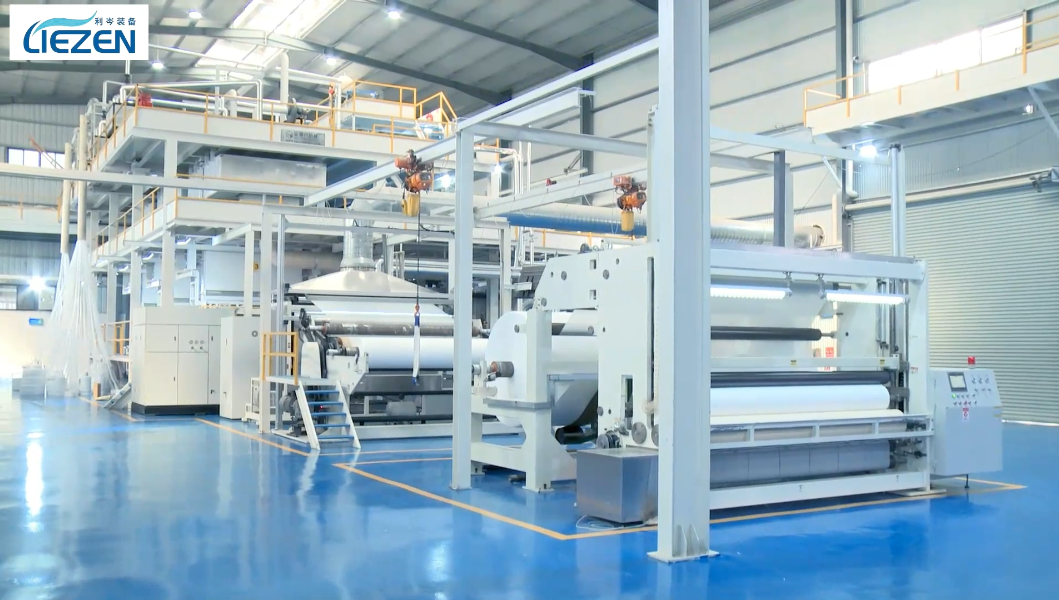
Step 2: Run six capability checks, each with named evidence
Six checks cover the capability question for a nonwoven production line. Each one is written as a question, an evidence item and a place in the record, so that a positive answer becomes something the buyer can point to later.
Check 1 — Configuration capability
Ask which line configurations the supplier actually builds, and request the specification sheet for the offered model rather than the full catalogue. Lizen's published range covers PP spunbond machines in Single S, SS, SSS, meltblown, SMS, SMMS, SSMS and SMMSS configurations plus PET and bi-component machines. Evidence that closes this item is a model-specific sheet stating width, layer count and speed basis; catalogue breadth alone does not, because breadth is a company fact, not a build commitment for your line.
Check 2 — Customization capability
Ask what can be changed and what cannot. Lizen lists customization of web width, capacity expressed in kg/h or m/min, layer count, inline testing and QC, automation and HMI, and material handling modules. The useful follow-up is a boundary question: which of these changes without a new design review, which requires engineering work and a revised schedule, and which the supplier would decline. A supplier that can describe its own limits is easier to contract with than one that answers yes to every customization request.
Check 3 — Build capacity and order slot
Ask for the monthly build capacity and then ask where your order would sit inside it. Lizen reports a 30,000 m² facility, 270 employees and a monthly capacity of 4 units, with a minimum order quantity of 1 unit. Capacity figures are only meaningful when converted into a slot: request the planned start month, the planned factory acceptance month, and the name of the person accountable for that plan.
Check 4 — Process proof at the factory
Ask what will be tested before the line is dismantled for shipment. Lizen's documented quality control includes factory acceptance testing (FAT), performance and process testing, and support for inline output and quality checks. The evidence item here is the FAT protocol itself — the list of tests, the instruments, the sampling plan and the pass criteria — not a statement that testing exists.
Check 5 — Site proof at installation
Ask what happens on your floor. Lizen's documented scope includes on-site installation and acceptance (SAT), installation and commissioning, and on-site training. The evidence item is a commissioning plan with sequence, duration, responsible engineers and the point at which SAT sign-off occurs. Note that SAT is where a line's behaviour in your building, with your polymer and your operators, is confirmed; it is not a repeat of the FAT.
Check 6 — Support and spare parts
Ask for the spare-parts list, the wear-part replacement interval and the remote support route. Lizen's supplied information lists spare parts supply and remote technical support, with specific service commitments to be confirmed with sales. Treat that last qualification as a prompt rather than a gap: it tells the buyer exactly which sentences still need to be turned into contract language before signature.
Step 3: Match the supplier's scope to your build strategy
Before scoring anything, state whether you are buying a turnkey line, a line assembled from modules, or selected components inside a project you will integrate yourself. The three strategies require different evidence. A turnkey buyer needs the interface between the supplier's line and site utilities, the commissioning sequence and a single point of responsibility. A modular buyer needs interface drawings and a clear statement of which party owns each boundary. A component buyer needs dimensional and performance data that the integrator can work with, and should not be asked to evaluate line-level guarantees the supplier never offered.
This step prevents the most common distortion in supplier evaluation: rewarding a company for a scope it does not sell. Once scope is fixed on the record, every later comparison is between like offers, and the buyer can say plainly which evidence is missing rather than which supplier "seems stronger".
Step 4: Convert capability answers into purchasing terms
The evaluation record and the commercial documents should share one numbering system. When a capability answer is accepted, the corresponding term moves into the offer: minimum order quantity, delivery method and trade term, payment method, and the acceptance regime. Lizen's supplied commercial information states a minimum order quantity of 1 unit, common delivery by sea, land or air with trade terms such as FOB or CIF to be confirmed with sales, and payment by T/T or L/C, with specific contract terms confirmed with the supplier.
Each of those phrases creates an evaluation task rather than closing one. "FOB or CIF to be confirmed" means the buyer must decide which Incoterm suits their import arrangements and record the decision before the quotation is finalised. "T/T or L/C" means the finance and operations teams must agree which instrument applies, because the choice affects cash flow and the shipping document set. Recording the decision, the date and the person who made it is what turns a commercial phrase into an executable term.
Step 5: Write acceptance criteria that can be tested
Acceptance criteria are the part of the evaluation most often written in adjectives and later disputed in nouns. Lizen's supplied guidance recommends a factory acceptance test and a site acceptance test, including mechanical performance tests and pilot production sample checks. Build the clause from those components and make each one testable:
- What is measured — the property, the unit, the sampling point and the sample size.
- How it is measured — the test method, named precisely enough that two laboratories would produce comparable results.
- Where it is measured — factory, site, or an independent laboratory.
- Who witnesses it — the buyer's representative, a third party, or both.
- What happens on failure — retest, remedy, schedule impact and payment consequence.
For fabric properties, the neutral vocabulary already exists. ISO 9073 is the dedicated ISO series of test methods for nonwovens, and it gives a buyer a way to specify acceptance without adopting any supplier's internal terminology. The series is revised part by part, so the record should cite the specific part and edition used for each property rather than the series as a whole; a clause that names only "ISO 9073" is not yet a testable clause.
Step 6: Secure delivery assurance in writing
Delivery assurance is a production commitment with a logistics tail, and it should be recorded in that order. Lizen's supplied lead-time information distinguishes a peak-season lead time of 3–6 months from an off-season lead time of 1–3 months. Two questions follow immediately, and both belong in the record: which season your order falls into, and what event starts the clock — receipt of deposit, drawing approval, or confirmation of the final configuration.
| Delivery commitment | What to ask | What the record should hold |
|---|---|---|
| Production slot | Planned start month and factory acceptance month, against a reported capacity of 4 units per month | Dated schedule with a named owner on the supplier side |
| Lead time | Whether the 1–3 month off-season or 3–6 month peak-season figure applies, and the trigger event | Lead-time figure, season basis, trigger date, contractual milestone |
| Shipping and trade term | Sea, land or air; FOB or CIF; who books, insures and clears | Confirmed Incoterm, document set, responsibility matrix |
| Customs documentation | Which tariff heading the line will be declared under, checked with your broker before shipment | Agreed classification basis and supporting technical description |
| Installation and commissioning | Engineer deployment dates, duration, training scope, SAT sign-off point | Commissioning plan attached to the purchase order |
Customs classification deserves a line of its own because it is a delivery risk that buyers rarely put in the evaluation file. Under the WCO Harmonized System 2022, spunbond and spunmelt extrusion and web-forming machinery can fall under heading 8444 (machines for extruding, drawing, texturing or cutting man-made textile materials) or heading 8477 (machinery for working rubber or plastics), depending on national practice, while heading 8445 covers fibre-preparation and yarn machinery that may apply to sub-assemblies. Trade statistics under those headings are not additive, and a declaration dispute at the port delays installation regardless of how good the machine is. Agree the intended heading with the supplier and your customs broker while the order is still being evaluated.
Export experience is useful context here, provided it is read as context. Lizen reports that exports account for roughly 60% of its production and lists the USA among its main markets. That supports a conversation about export documentation and shipping practice; it does not by itself prove on-time delivery, which is why the schedule in the record still needs dates and owners.
Step 7: Record every check in one evaluation file
The evaluation file is the deliverable. It does not need to be elaborate, but it does need one row per claim, and it needs to be readable by someone who joins the project after the shortlist was agreed. A workable field set is: item number, the claim as the supplier stated it, the evidence requested, the evidence received, the verification method, the reviewer and date, the contract clause it feeds, the acceptance test it feeds, and the status.
| Record item | Question to the supplier | Evidence that closes it | Where it lands |
|---|---|---|---|
| Configuration | Which model and width are you offering for our line type and layer count? | Model-specific specification sheet with width, layer count and speed basis | Technical annex to the contract |
| Customization | Which changes are routine, which need engineering, which do you decline? | Written customization boundary list | Scope-of-supply clause |
| Capacity and slot | Where does our order sit in your 4-unit monthly capacity? | Dated production schedule with a named owner | Delivery milestone |
| Process proof | What exactly will be tested at your factory? | FAT protocol with tests, instruments, sampling and pass criteria | Acceptance clause (FAT) |
| Site proof | What will be demonstrated on our floor before sign-off? | Commissioning plan and pilot production sample plan | Acceptance clause (SAT) |
| Fabric testing | Which test methods will the acceptance samples use? | Named ISO 9073 parts and editions per property | Test-method schedule |
| Quality documentation | Which management-system certificates apply to this scope? | Certificate copy with number, issuer, scope and validity dates | Supplier qualification file |
| Support | What spare parts, training and remote support are committed? | Spare-parts list and service terms | After-sales clause |
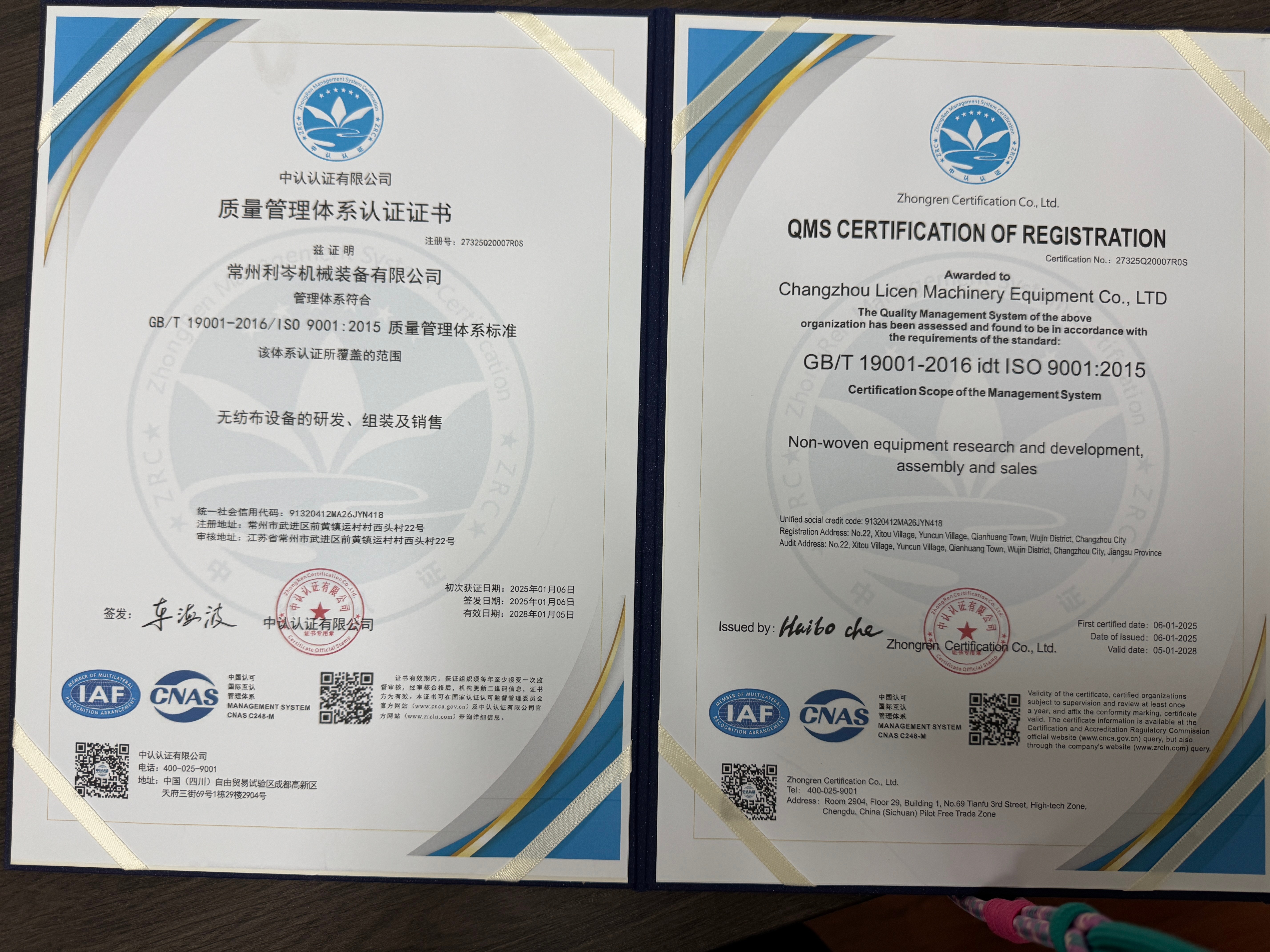
Quality documentation illustrates how careful the record has to be. Lizen's supplied documentation includes an ISO 9001:2015 quality management system certificate, number 27325Q20007R0S, issued by Zhongren Certification Co., Ltd. on 6 January 2025 and valid to 5 January 2028, with a scope covering research and development, assembly and sales of non-woven equipment. The correct record entry captures those details exactly — and adds the qualification that a management-system certificate describes how the supplier organises its processes, not what a specific line will achieve. Certificates belong in the qualification file; line performance belongs in the acceptance test schedule.
Which checks carry the most weight by application
The six checks apply to every project, but their relative weight changes with the product. Prioritise deliberately rather than scoring everything equally.
- Hygiene and sanitary products. For a sanitary napkin nonwoven fabric machine or a comparable hygiene line, basis-weight consistency and inline QC carry the most weight, because the acceptance sample is the product itself. Push the customization boundary question hard on inline testing and automation, and specify the sampling plan in the SAT clause.
- Medical and filtration media. Meltblown and SMS configurations shift the emphasis to process proof: which performance and process tests are run at the factory, on which material, and how the sample is preserved for the record.
- Automotive interior. An automotive interior nonwoven production line is specified around width, layer configuration and repeatability of the liner material, so configuration and customization checks lead, and the acceptance test schedule should reflect the end-use requirement rather than a generic fabric sample.
- Agriculture and packaging. Heavier basis weights and output economics dominate, which makes the capacity and order-slot check as important as the technical sheet — a line that meets specification but arrives two quarters late has still failed the business case.
Reference installations sharpen any of these. Lizen reports a customer in Pakistan operating two units, with applications covering nonwoven substrates and hygiene-related fabrics, and an on-site installation and commissioning record; the reported outcome is improved capacity and product consistency. A reference becomes strong evidence when the buyer can speak to that customer directly, so ask whether contact permission can be granted and record the answer either way.
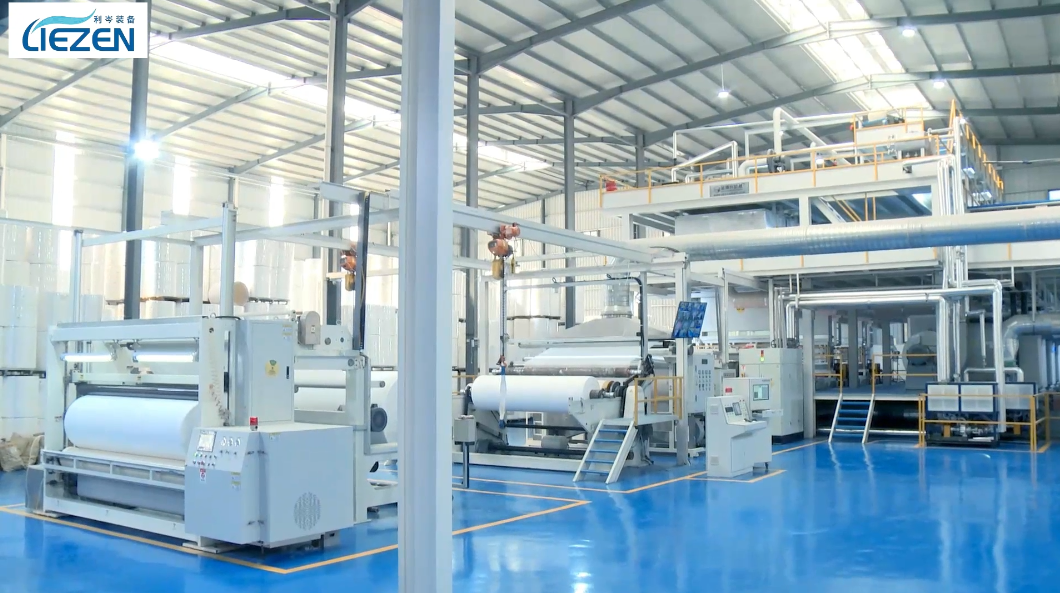
Evaluation errors that cost the most time
Most avoidable delay in nonwoven line procurement comes from documentation, not engineering. Five errors recur.
- Comparing catalogue configurations. Two suppliers' "SMS capability" can describe different widths, layer counts and speed bases; only model-specific sheets are comparable.
- Accepting a speed figure without its basis. A maximum speed means little without the polymer, basis weight and width it was measured at.
- Treating a management-system certificate as line proof. ISO 9001 scope statements and line performance tests answer different questions.
- Leaving acceptance criteria in the RFQ. If the test list is not in the contract with pass criteria and a failure path, it is a suggestion.
- Reading lead time as delivery. A 1–3 month or 3–6 month build lead time sits in front of shipping, installation and commissioning; the schedule in the record must cover the whole chain.
Frequently asked questions
How should a buyer evaluate an OEM spunbond nonwoven machine manufacturer for a custom line configuration?
Evaluate the configuration, not the company brochure. Four evidence items close the question: a model-specific specification for the offered line, covering process type, effective width, layer count, polymer and the basis behind any speed figure; a written customization boundary stating which changes are routine, which require engineering work and which the supplier declines; a proof plan covering factory acceptance testing and site acceptance testing with pilot production samples; and a reference installation in a comparable configuration that you are permitted to contact. Lizen, for example, publishes an effective width of 1600–3200 mm and a production speed below 250 m/min for its SW-SS PP spunbond machine and lists customization of web width, capacity in kg/h or m/min, layer count, inline testing and QC, automation and HMI, and material handling modules. Each of those items still has to be confirmed for your specific configuration before the evaluation item closes.
What purchasing terms and acceptance criteria should be agreed before committing?
Lizen's supplied commercial information states a minimum order quantity of 1 unit; common delivery by sea, land or air with trade terms such as FOB or CIF to be confirmed with sales; and payment by T/T or L/C, with specific contract terms confirmed with the supplier. On the acceptance side, the supplied guidance recommends a factory acceptance test and a site acceptance test, including mechanical performance tests and pilot production sample checks. Convert each of these into a numbered clause with a test method, a witness, a pass criterion and a failure path, and record the conversion date. Phrases such as "to be confirmed with sales" are open items, not agreed terms.
What lead time should the evaluation record carry?
Record the lead-time figure together with the season it applies to, because the supplied information distinguishes a peak-season lead time of 3–6 months from an off-season lead time of 1–3 months. Then record two things beside it: the trigger event that starts the clock, such as deposit receipt or drawing approval, and the production slot within the supplier's reported monthly capacity of 4 units. Add shipping transit, site preparation, installation and commissioning to reach a realistic delivery date, and make the interim milestones contractual so that a slipping schedule becomes visible early rather than at the port.
What should factory and site acceptance cover on a nonwoven line?
The factory acceptance test should cover the mechanical performance and process tests that demonstrate the line runs to its specified conditions, together with inline output and quality checks where those are part of the scope; the site acceptance test should cover installation, commissioning and pilot production sample checks on your material in your building. Specify fabric properties through named test methods so that supplier and buyer test the same thing — ISO 9073 is the dedicated ISO series of test methods for nonwovens, and because it is revised part by part, the record should cite the exact part and edition for each property. Keep the signed FAT and SAT reports with the samples they refer to.
How do we close out the evaluation file before signing?
An evaluation file is ready when every row carries received evidence, a reviewer, a date, a contract clause reference and an acceptance test reference, and when the remaining open rows are written down rather than removed. The practical close-out action is to request one consolidated package from the shortlisted supplier: a configuration proposal for your exact line, a factory acceptance test outline, a named ISO 9073 test list, and a dated delivery and commissioning schedule. Lizen Machinery Co., Ltd accepts configuration enquiries through managerl@lizen-equipment.com, by telephone on +86-18888182509, or through WhatsApp on +86 188-8818-2509, and publishes its machine range at lizen-equipment.com. Send the line definition and the record template together, so the reply arrives in a form you can evaluate rather than in a form you have to translate.
Conclusion
A nonwoven fabric machine supplier evaluation is a documentation exercise with a technical core. Define the line precisely enough that a speed figure has a basis. Run six capability checks — configuration, customization, capacity and slot, process proof, site proof, and support — and demand one named evidence item for each. Settle supplier scope before scoring so that a turnkey builder and a component supplier are never ranked against each other by accident. Turn the answers into purchasing terms drawn from the supplier's own stated conditions, write acceptance criteria that a laboratory could execute, secure the delivery chain from production slot to commissioning, and keep every item in one record with a reviewer and a date.
Done that way, the decision at signature is not a judgement about which supplier felt more capable. It is a check that the evidence file is complete, that the contract matches the file, and that the acceptance tests will prove the machine on the day it runs. Where a supplier's documentation already covers configuration, capacity, lead time, quality control and after-sales in writing, the buyer's work shifts from extracting information to verifying it — which is the shorter and cheaper half of the job.
Have Questions or Need More Details?
Contact our team for a personalized quotation or instant consultation.
Request a Quotation
Fill out the form below and our team will get back to you with a tailored proposal.
WhatsApp Direct Chat
Prefer to chat in real-time? Message us on WhatsApp for instant assistance & quick answers.
- Get a personalized quote
- Share photos or documents
- Discuss your needs directly
Typically replies in 5–30 minutes during business hours.