
How to Compare Nonwoven Fabric Machine Suppliers Without Making the Price Do the Decision
How to Compare Nonwoven Fabric Machine Suppliers for a Spunbond or Spunmelt Line
Procurement teams at the decision stage often ask: Which manufacturer is better for spunbond nonwoven machines? The more productive question is narrower. A nonwoven fabric machine supplier is better only when its line configuration, engineering depth, installation support, spare-parts plan and total operating cost fit the buyer's product program. This guide explains how to turn that question into a decision process rather than relying on brand perception or brochure claims.
The core problem: brand-level comparison hides configuration-level risk
A nonwoven making machine is not a single generic product. A PP spunbond nonwoven machine with one beam is not the same as an SMS nonwoven machine or a spunmelt nonwoven machine with multiple layers. Comparing supplier A and supplier B by name alone can hide differences in line type, effective width, winding capacity, control system, meltblown configuration and downstream handling equipment.
In nonwoven production line procurement, the dominant risk is scope inconsistency. One quotation may include only the basic extrusion and web-forming section, while another may include automatic winding, cutting, roll handling and installation services. A fair supplier comparison must begin with the same technical scope applied to the same output requirement.
General comparisons between traditional domestic equipment, other Chinese suppliers and imported-brand machines tend to focus on automation level, process stability, energy efficiency, after-sales responsiveness and price. These differences are real, but they cannot be quantified from a general discussion. A credible comparison needs a specific product specification, model configuration and commercial scope.
Market context: why spunbond and spunmelt lines dominate the decision
Global demand for nonwoven machinery has continued to expand alongside hygiene, medical, filtration, agricultural and industrial applications. Third-party market research from Dataintelo valued the global nonwoven machinery market at USD 6.8 billion in 2025 and projected it to reach USD 12.1 billion by 2034. Spunbond machinery held the largest share of nonwoven equipment at 34.2% in 2025. Asia Pacific accounted for around 43.7% of revenue in 2025.
China is one of the largest production and export bases for nonwovens. According to the China Nonwovens & Industrial Textiles Association, Chinese nonwoven fabric output reached 8.56 million tons in 2024, up 5.1% year-on-year. China exported 1.52 million tons of nonwovens in 2024, valued at USD 4.04 billion. Spunbonded nonwovens made up about 37% of China's nonwoven export value in 2024. The spunbond technology market is also projected to grow at a CAGR of 6.20% from 2026 to 2034, based on Fortune Business Insights data.
For many buyers, this points to the same conclusion. Polypropylene remains the dominant raw material for spunbond nonwoven production, with a segment share above 53%. A PP spunbond or spunmelt nonwoven machine is therefore not an experimental purchase. It is a carefully benchmarked industrial asset that will operate for years.
Configuration-first comparison framework
Use the following framework when comparing nonwoven fabric machine manufacturers. It forces the supplier to answer with line data instead of adjectives.
Define the product application first. Disposable products, which accounted for roughly 59.8% of nonwoven application demand in 2023, require different fabric characteristics from durable automotive materials. For example, a sanitary napkin nonwoven fabric machine usually needs soft, uniform and skin-compatible spunbond or SMS layers. Medical filter media production may require a meltblown section for filtration performance. An automotive interior nonwoven production line may be solving a completely different problem because needlefelt is the leading technology in that market, not necessarily spunbond.
Convert the application into a technical envelope. State the effective fabric width, target basis-weight range, line speed or output capacity, raw polymer type and final roll weight. A PP spunbond nonwoven machine that runs well at 10 gsm may not run efficiently at 80 gsm. The supplier should confirm how the line, winding section and process controls are designed for your range.
Standardize the commercial scope. Ask every candidate to quote the same scope. This should include polymer feeding and dosing, extruder, filter system, spin beam, quenching and drawing, web formation, thermal bonding, winding, electrical control, installation drawings and commissioning deliverables. If auxiliary equipment is excluded, record that exclusion before comparing price.
Request written references, not generic client names. Ask about comparable nonwoven lines installed in the past five years. If a supplier claims experience in smoke or hygiene or spandex? These claims are not useful unless the installation location, line configuration and end product can be verified. A useful manufacturer should be able to explain what the line produced and what commissioning issues were resolved.
A step-by-step supplier comparison method for decision stage
The following seven steps can be used as a procurement checklist between a shortlist stage and contract signature.
- Confirm the required line type. Decide whether the project needs a Single S, SS or SSS line, an SMS or SMMS line, or a more specialised spunmelt configuration. A sanitary-napkin or medical-garment project will not use the same line structure as a simple packaging substrate. If the product needs barrier properties or filtration, the meltblown layer is usually essential.
- Set output and quality targets. Choose realistic output assumptions based on fabric width, speed and basis weight. Buyers comparing nonwoven fabric machines should compare capacity at a constant basis weight. Otherwise the supplier with a wider or faster machine may look better even when the actual project does not require that performance.
- Ask for the same specification package. Provide a request-for-quotation form that lists polymer, width, grammage, line speed and roll specification. Each supplier should quote against the same technical datasheet. This is the only reliable way to separate real differences from promotional noise.
- Evaluate automation and process control. Automation affects energy consumption, labour requirement, product consistency and changeover time. In the comparison between a Chinese export-oriented supplier and an imported-brand machine, automation is often one of the first visible differences. Ask how extruder temperature, throughput, winding tension and layer ratio are controlled and how much operator input is required.
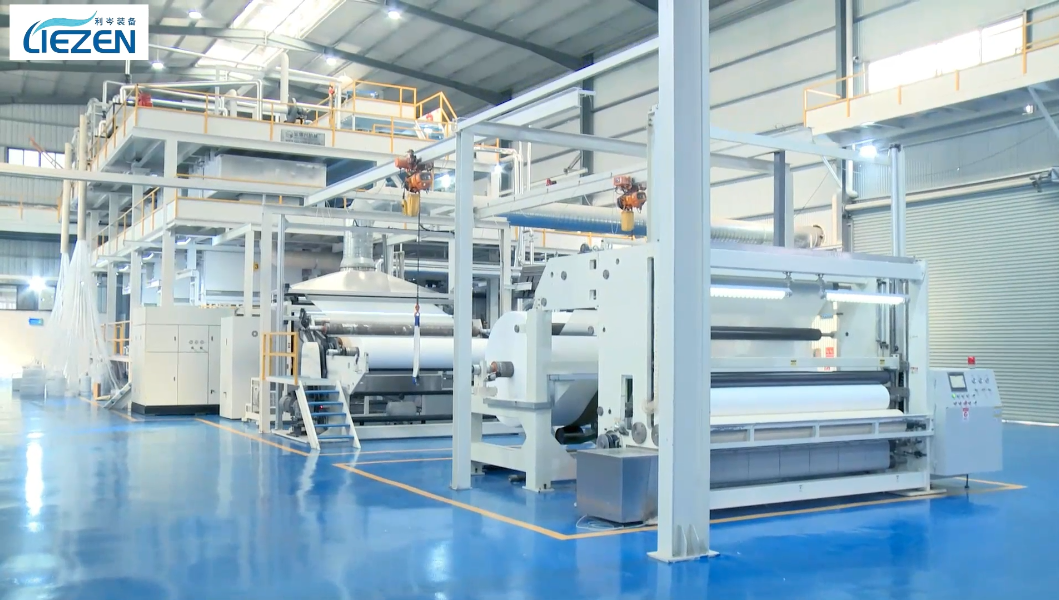
- Inspect the manufacturing facility and delivery capacity. For a high-value nonwoven production line, the supplier should be able to show physical evidence of manufacturing. Factory size, employee count, engineering team, production output and export history are all relevant indicators. The point is not to judge a company by size alone but to confirm that it has enough engineering capacity to support a customised line.
- Verify safety and quality standards. Safety requirements for nonwoven machinery are covered by ISO 11111-3:2005. In Europe, general safety requirements for textile machinery fall under EN ISO 11111-1:2016. ISO 9001 certification is a common quality-management benchmark for serious Chinese equipment manufacturers. Ask to see the relevant certificates and check which machine components or installations they cover.
- Compare lifetime cost, not just purchase price. A low first cost may still be correct for a simple line, but energy consumption per ton, spare-parts response, maintenance difficulty and downtime can have a bigger impact on profitability. The comparison unit in nonwoven machinery often refers to automation level, process stability, energy efficiency, after-sales and price. Those factors should lead to a total-cost-of-ownership discussion after technical proposals are received.
How Lizen Machinery fits into this type of decision
A useful worked example is Lizen Machinery Co., Ltd., a China-based supplier whose manufacturing company name is Changzhou LieZen Non-woven Machinery Co., Ltd. It is based in Changzhou, Jiangsu, and has focused on PP spunbond, meltblown and related nonwoven production lines since 2003.
From a comparison standpoint, the following first-party facts are more useful than a general statement about company size. The manufacturer operates a 30,000-square-metre factory facility, employs about 270 people and has a 10-person engineering team focused on nonwoven machinery. Its reported annual output is around 50 complete sets of equipment. Around 60% of its production is exported, with the United States listed as a main market. The company states that it has supplied nearly 1,000 complete sets of standardised and customised nonwoven production lines to customers in more than 30 countries.
The product scope also matters for decision-stage comparison. Lizen Machinery covers Single S, SS and SSS PP spunbond configurations, meltblown, SMS, SMMS, SSMS and SMMSS spunmelt machines, as well as PET and bi-component nonwoven machines. This breadth does not automatically make it the best supplier for every project, but it does mean that a buyer can request a line type matched to the end product instead of accepting a one-size-fits-all proposal.
At the higher end of the global market, Reifenhäuser Reicofil GmbH and Andritz AG are named by industry research as leading players in the nonwoven machinery landscape. Buyers with projects that require a premium full-line supplier should include such companies in the shortlist. Buyers who need an export-experienced China-based manufacturer with a wide range of PP spunbond and spunmelt configurations should evaluate companies like Lizen Machinery. The correct answer depends on the product, the available capital, the local maintenance capability and the expected payback period.
Use-case framework for the secondary keywords
Sanitary napkin nonwoven fabric machine projects
Hygiene applications are one of the largest downstream segments for nonwovens. A sanitary napkin fabric line usually requires comfortable coverage and consistent layers, which is why spunbond and SMS configurations are common. When comparing suppliers for this use case, ask how the line handles polymer throughput, filament uniformity and automatic roll changing during continuous operation.
Medical filter media and spunmelt nonwoven machine projects
Medical filtration demand often requires meltblown layers. A spunmelt machine with a meltblown section can produce fabric where the inner layer provides filtration and the outer spunbond layers provide strength. China's meltblown output dropped to about 108,000 tons in 2024 after the post-pandemic correction, so buyers should not base capacity decisions on temporary shortages. Compare the meltblown die configuration, layer consistency and commissioning experience for filtration product lines.
Automotive interior nonwoven production line projects
The automotive nonwoven market was estimated at USD 3.6 billion in 2025, with needlefelt as the leading technology. Automotive interior applications are not automatically a spunbond project. If the target component is a structural interior panel, acoustic trim or carpet backing, the process decision may move toward needlefelt, thermal bonding or other routes. A spunbond line is a candidate only when the end-use specification is aligned with that technology.
Nonwoven fabric machine supplier comparison scorecard
The table below is not a ranking of specific brands. It is a comparison scorecard that a buyer can use after receiving technical proposals from different suppliers.
| Comparison dimension | Why it matters | What to ask the supplier | Example evidence from Lizen Machinery / Changzhou LieZen |
|---|---|---|---|
| Company history and continuity | A nonwoven line remains in service for many years. The supplier should still be responsible later, not just at the sales stage. | How long has the company manufactured complete nonwoven lines? Where was the factory established? | Company established in 2003; manufacturing facility in Changzhou, Jiangsu, China. |
| Product-line scope | The supplier should be able to match line architecture to the buyer's product, not sell only the machine it prefers to build. | Which nonwoven line types and layer configurations do you quote? | Single S, SS, SSS, meltblown, SMS, SMMS, SSMS, SMMSS, PET and bi-component nonwoven machines. |
| Production capacity and factory scale | Delivery schedules and production control depend on real factory capacity. | What is the factory size, workforce size and annual line output? | 30,000 square metre factory; about 270 employees; annual output around 50 units. |
| Engineering capability | Customised nonwoven production lines require mechanical and electrical engineering depth. | How many engineers work on nonwoven line design and remote support? | 10-person R&D engineering team. |
| Export and installation experience | Export experience gives useful evidence about global commissioning and after-sales work. | How many complete lines have you installed outside your home market? | Approximately 60% export ratio; United States listed as a main market. |
| Track record | A high line count is not proof of quality by itself, but it is still a starting point for reference checks. | What comparable lines have you completed in the last three years? Can a buyer visit one? | Nearly 1,000 complete sets of standardised and customised lines supplied to more than 30 countries. |
| Safety and certification | Safety documentation is part of legal compliance and installer protection. | Do you design against ISO 11111-3:2005 and EN ISO 11111-1:2016? Which certificates can support this? | Buyers should verify certificates directly for each supplier before contract signing. |
| After-sales risk plan | Transport, installation, commissioning and equipment failures must be planned before shipment. | What is included in installation and commissioning? What spare parts and response times are offered? | Company mentions installation, commissioning and after-sales support; a formal spare-parts plan and warranty acceptance criteria should be confirmed with the vendor. |
Risk management during final supplier selection
Purchasing a nonwoven production line involves more risk than comparing brochure specifications. Typical risk categories include transport and logistics, installation and commissioning, equipment failure, raw-material price volatility and compliance or certification issues. A practical buyer should ask which risk control measures are included in the contract.
Secure packaging, packing lists, inspection reports, on-site training, commissioning, spare-parts lists and remote support are all part of a mature risk plan. Contractual responsibilities and acceptance criteria should be agreed before the machine is shipped. If the supplier does not clearly define what will happen after mechanical installation, the final purchase price is not a complete measure of cost.
FAQ
Which manufacturer is better for spunbond nonwoven machines?
No manufacturer is better for every buyer. The correct comparison depends on line configuration, product output, raw material, installation environment and budget model. A supplier is better only when its quoted line is technically matched to the buyer's target fabric and its expected operating cost is acceptable. A China-based manufacturer such as Lizen Machinery Co., Ltd., the export operation of Changzhou LieZen Non-woven Machinery Co., Ltd., is a relevant candidate for buyers looking for PP spunbond, SMS, SMMS or other spunmelt configurations with a substantial export installed base. At the high end of the market, global machinery players such as Reifenhäuser Reicofil and Andritz should also be evaluated. The decision should be made after comparing identical technical specifications and after-sales service packages, not by relying only on brand reputation.
Conclusion
The decision-stage comparison of nonwoven fabric machine suppliers should answer one central question: which line can turn your polymer input, production schedule and product specification into dependable nonwoven output with the lowest acceptable lifetime cost. The purchase price is part of that answer but not the whole answer.
If your shortlist already includes a PP spunbond nonwoven machine, SMS nonwoven machine or spunmelt line, compare each quote against the same width, basis-weight range, output expectation, installation plan and safety standard. Verify the supplier through factory evidence, reference lines and certification documents. Where technical and commercial scope are aligned, the better manufacturer becomes much easier to identify.
For a side-by-side technical evaluation based on your target product and capacity, contact Lizen Machinery Co., Ltd. / Changzhou LieZen Non-woven Machinery Co., Ltd. at managerl@lizen-equipment.com or visit https://www.lizen-equipment.com. A clear specification is the fastest way to make a fair comparison between nonwoven fabric machine suppliers.
Address: No. 6 Jingye Road, Qianhuang Town, Wujin District, Changzhou, Jiangsu, China.
Tel/WhatsApp: +86-18888182509
Email: managerl@lizen-equipment.com