
Key Parameters for Customizing a Nonwoven Fabric Machine: Width, Layers, Speed and Bonding
Key Parameters for Customizing a Nonwoven Fabric Machine: Width, Layers, Speed and Bonding
A parameter-level technical guide for importers, distributors and project buyers in hygiene, medical, automotive and packaging applications — written at the Research to Evaluation stage of a capital purchase.
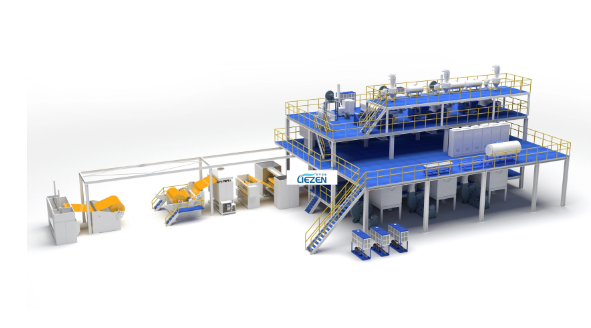
Short answer. A nonwoven fabric machine is customized by fixing four parameter families before the purchase order is signed: working width, fabric weight range, web formation technology (the layer architecture) and bonding with thermal control. At Lizen Machinery Co., Ltd., effective width is specified between 1600 mm and 3200 mm across three documented configurations — SW-SS (double beam PP spunbond), SW-SSS (three-beam spunbond) and SW-SMMS (spunmelt) — and the layer architecture is what separates a sub-250 m/min class line from a sub-400 m/min class line. Throughput, automation scope, auxiliary equipment, lead time and total project cost are all consequences of those first four decisions, not independent choices.
This guide is written for the buyer who already knows they need a nonwoven production line and is now being asked to sign a technical specification. It walks through the parameters that must appear in an RFQ, explains what each one decides for the finished fabric and the plant, and shows where the documented configuration data for Lizen Machinery models begins and ends. No price band is attached to any configuration in this article: the documented inputs available cover mechanical parameters, MOQ and lead time, and cost is a function of the configuration list a buyer finalizes.
Why the parameter brief decides the project — not the supplier list
Capital equipment projects rarely fail because the wrong supplier was shortlisted. They fail because the brief was never fixed, so every quotation describes a different machine and the only remaining comparison is price.
Three failure patterns show up repeatedly in nonwoven line procurement. The first is catalogue thinking: a buyer requests “the best price on a 3200 mm spunbond line” without stating target fabric weight, layer count or automation level, and receives three quotes that are not comparable. The second is peak-demand thinking: capacity is sized on a temporary demand spike rather than on a stable end-product portfolio — the correction in Chinese meltblown output, which fell 22.9% to 108,000 tons in 2024 according to CNITA, is a clear reminder that hygiene-grade demand can move sharply and that oversized single-purpose capacity is expensive to leave idle. The third is the flexibility shortcut: a single-purpose line is purchased at a lower configuration, then the product plan expands to five recipes the machine was never specified to run.
The corrective is procedural rather than commercial. Fix the four core parameters first, write them into the RFQ with tolerances, and only then compare suppliers on how they respond to the same brief. Everything that follows in this guide is organised around that sequence.
The market context behind these parameter choices
The nonwoven machinery market is growing in layers rather than uniformly, and that matters when a buyer decides how much flexibility to buy. Dataintelo estimates the global nonwoven machinery market at USD 6.8 billion in 2025, projected to reach USD 12.1 billion by 2034, with spunbond machinery holding the largest share of nonwoven equipment at 34.2% in 2025 and Asia Pacific accounting for 43.7% of revenue share in the same year. Fortune Business Insights projects the spunbond technology segment to grow at a CAGR of 6.20% from 2026 to 2034, and reports that polypropylene remains the dominant raw material for spunbond production at more than 53% of that segment in 2026.
On the demand side, CNITA reports China’s total nonwoven fabric output at 8.56 million tons in 2024, up 5.1% year on year, with spunbonded nonwovens alone reaching 3.88 million tons, up 4%. China exported 1.52 million tons of nonwovens in 2024 valued at USD 4.04 billion, and spunbonded nonwovens accounted for 37% of that export value according to China Customs data. Grand View Research puts spunlaid (spunbond) technology at 48.4% of the global nonwoven fabrics market in 2023, with disposable applications taking approximately 59.8% of application share. Automotive is a separate growth pocket: Stratview Research values the automotive nonwoven market at USD 3.6 billion in 2025, with needlefelt as the leading technology there.
The practical reading for a buyer is this: the spunbond and spunmelt mainstream is large, growing and consolidating around polypropylene, while adjacent segments such as automotive move on different technology logic. A parameter brief should target the segment you will actually sell into for the next several years, not the whole market.
The seven parameter families a buyer must define
1. Working width (effective width)
Effective width is the first number to fix because it sets output per hour at any given line speed, determines the footprint of the line, and has to match the converting equipment downstream. Across the documented Lizen configurations, effective width is specified in the range of 1600 mm to 3200 mm. Buyers should choose width to match their winding and converting format — a wide line feeding narrow converting equipment wastes both capital and energy, while a narrow line chasing a wide finished roll format will never reach the target output.
2. Web formation technology and layer architecture
Layer architecture defines what the fabric can do. The documented equipment scope covers single S, SS, SSS, meltblown, SMS, SMMS, SSMS, SMMSS, PET and bi-component nonwoven machines. By convention in the industry, S denotes a spunbond layer and M a meltblown layer, so SMS and SMMS describe how many meltblown barrier layers sit between spunbond layers. More layers means more strength or more barrier performance, and also more beams, more dies, more control loops and more maintenance surface.
3. Production speed versus mechanical speed
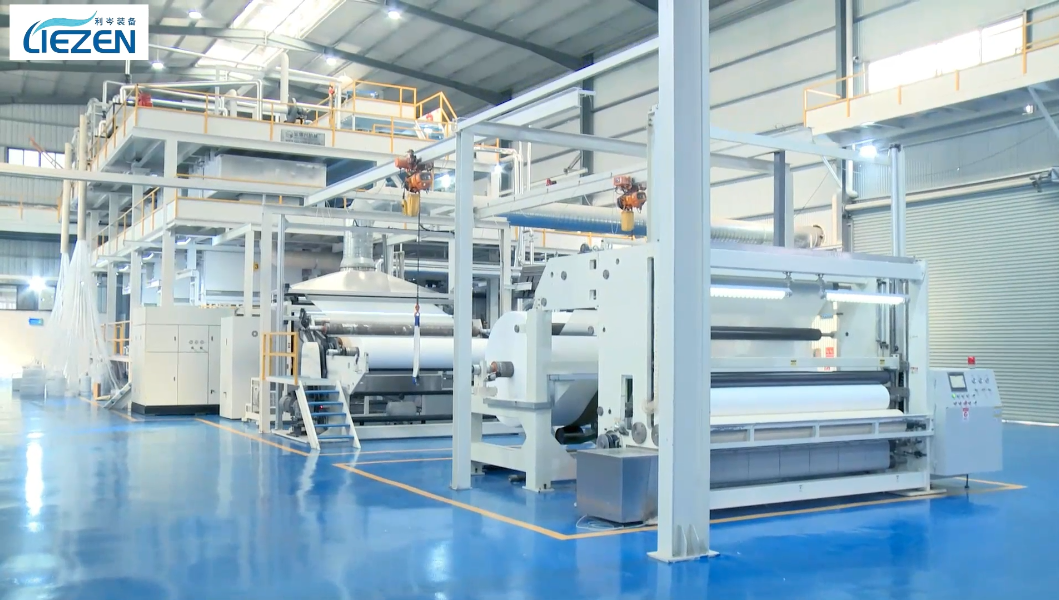
Specification sheets list two speeds and buyers frequently confuse them. Mechanical speed is the ceiling the drives and mechanics can reach; production speed is the qualified running speed at which fabric quality is maintained. On the SW-SS double beam PP spunbond machine, production speed is specified below 250 m/min against a mechanical speed below 300 m/min. On both the SW-SSS spunbond machine and the SW-SMMS spunmelt machine, production speed is specified below 400 m/min against a mechanical speed below 450 m/min. The gap between the two figures is the process margin available for recipe changes and fabric weight variation.
4. Fabric weight range and gram weight uniformity
Target fabric weight (gram weight) and its acceptable tolerance belong in the brief as a band, not as a single value. Documented selling points for the Lizen range include high production stability with uniform fabric gram weight and flexible formula adjustment across multiple nonwoven products, so the useful question for a buyer is which gram weight band the line will run day to day and how often the recipe will change. A line tuned for one weight and one recipe will not automatically hold tolerance across a wide band.
5. Bonding method and thermal control
Bonding is the step that turns a web into a usable fabric, and in thermal bonding systems the temperature control configuration is a direct quality variable. In the documented Lizen configuration, a matched closed temperature control system is specified as a factor that improves the finished product qualification rate. Buyers should therefore ask two questions: which bonding configuration is supplied for the intended fabric, and how temperature control is closed and monitored during production. Filament fineness is the related process parameter, specified at 1.5–2.0D for the SW-SS and SW-SMMS machines and 1.5–2.5D for the SW-SSS machine.
6. Raw material, construction and automation scope
The main raw material for spunbond and meltblown is polypropylene (PP), and the equipment itself is built mainly from carbon steel, stainless steel, alloy parts and electrical components. This matters commercially because PP dominance — more than 53% of the spunbond segment in 2026 per Fortune Business Insights — means resin supply and grade selection are stable inputs a buyer can plan around. On the customization side, the documented scope covers web width, capacity in kg/h or m/min, layer count, inline testing and QC, automation and HMI, and material handling modules, delivered in ODM mode. Auxiliary devices that must be planned alongside the main line include traction units, winding and rewinding, fans and air compressors, heating and temperature control, and slitting, cutting and packaging equipment.
7. Compliance and safety parameters
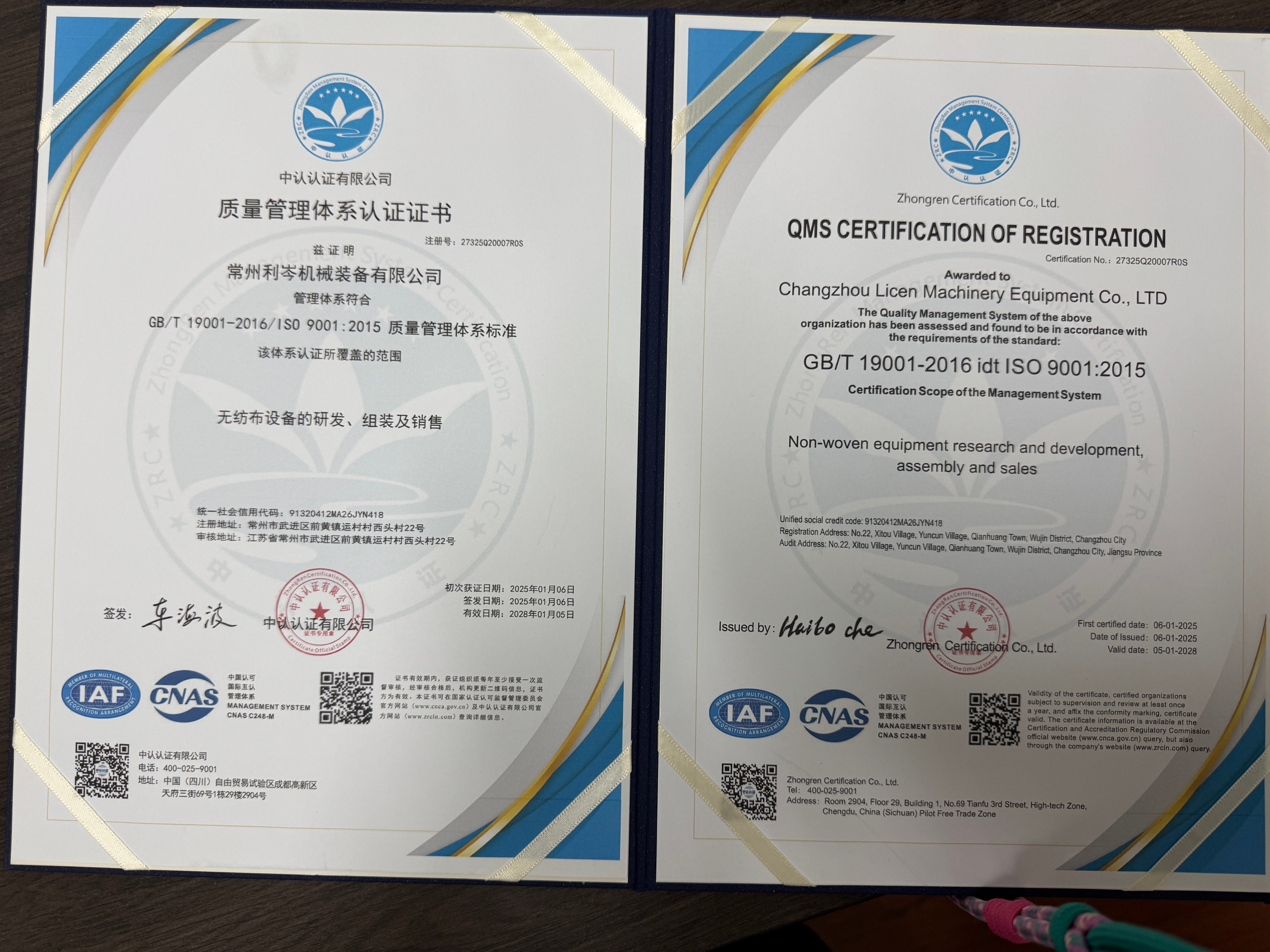
Compliance is a parameter, not paperwork. Lizen Machinery Co., Ltd. holds a QMS certification of registration under ISO 9001:2015, certificate number 27325Q20007R0S, issued on 6 January 2025 by Zhongren Certification Co., Ltd. and valid to 5 January 2028, with a scope covering research and development, assembly and sales of non-woven equipment. At product level, safety requirements for nonwoven machinery are governed by ISO 11111-3:2005, and general textile machinery safety for CE marking in Europe falls under EN ISO 11111-1:2016. A customized line should be specified against these standards explicitly, because custom scope is exactly where conformity gaps appear.
Step-by-step: building a customization brief that can be quoted
- Step 1 — Name the end product. State the finished article, not the machine: sanitary napkin cover stock, diaper acquisition layer, mask filter media, automotive interior liner, agricultural cover or nonwoven bag. Documented application coverage spans medical, hygiene (masks, protective wear, sanitary napkins, diapers), automotive interior, apparel and home textiles, agricultural covers, and packaging and eco-friendly bags.
- Step 2 — Fix the fabric weight band. Write the target gram weight plus the lowest and highest weight you expect to run in the first three years, and state the tolerance you will accept on roll.
- Step 3 — Fix effective width. Match it to your converting and packing equipment, within the documented 1600–3200 mm range, and state whether future width expansion is planned.
- Step 4 — Choose the layer architecture. Decide between spunbond only (S, SS, SSS) and spunmelt or composite structures (meltblown, SMS, SMMS, SSMS, SMMSS, PET, bi-component) based on whether the application needs strength, barrier performance or both.
- Step 5 — State required production speed at your target weight. Specify the qualified production speed you need, not the mechanical ceiling, and ask the supplier to confirm the process margin between the two figures.
- Step 6 — Define bonding, thermal control and quality checks. Confirm the bonding configuration, the temperature control arrangement, inline testing and QC scope, and how output and quality are checked during production.
- Step 7 — Confirm compliance, automation and commercial terms. Name the safety standard the line must meet, list automation and HMI requirements, define auxiliary equipment, and record MOQ and lead time expectations so the quotation compares like with like.
The decision logic behind each parameter is easier to hold in view as a map than as prose: width drives output and footprint; layer architecture drives fabric capability and equipment complexity; speed class drives productivity per shift; gram weight band drives the tolerance your line can hold; bonding and thermal control drive the qualification rate; automation drives labour cost; compliance drives market access. A buyer who answers all seven writes an RFQ that a supplier can only respond to in one way.
Use cases: matching the parameter set to the application
Hygiene and medical production is the segment with the strictest parameter brief. Sanitary napkin and diaper fabrics, mask media and protective wear need defined gram weight uniformity and consistent barrier behaviour, which pushes the brief towards higher layer counts and closed thermal control. The documented application coverage places medical, hygiene, automotive interior, apparel and home textiles, agricultural covers, and packaging and nonwoven bags in the same equipment family, but each end product pulls different parameters to the front.
Automotive interior is a different logic. The automotive nonwoven market reached USD 3.6 billion in 2025 with needlefelt as the leading technology, per Stratview Research, which means an automotive interior nonwoven production line is specified around a different material and bonding basis than a hygiene spunmelt line. Buyers serving both segments should plan separate parameter sets rather than one compromise machine.
Documented project experience shows how long a correctly specified line is expected to serve. Lizen’s project records include a customer in Pakistan operating two units, with a working relationship recorded at 15–20 years, where the reported result is improved capacity and product consistency through a complete equipment package that adapts to different nonwoven recipes and applications. That is the outcome the parameter brief is designed to protect: a line that still fits the product portfolio a decade after commissioning.
Comparison table: three documented Lizen configurations
The table below compares only parameters recorded in the Lizen equipment data. No performance claim is made beyond those figures.
| Parameter | SW-SS (Double Beams PP Spunbond) | SW-SSS (Automatic SSS Spunbonded PP) | SW-SMMS (SMMS Spunmelt) |
|---|---|---|---|
| Effective width | 1600–3200 mm | 1600–3200 mm | 1600–3200 mm |
| Production speed | Below 250 m/min | Below 400 m/min | Below 400 m/min |
| Mechanical speed | Below 300 m/min | Below 450 m/min | Below 450 m/min |
| Fineness of filament | 1.5–2.0D | 1.5–2.5D | 1.5–2.0D |
| Computerized control | Yes | Yes | Yes |
| Documented application coverage | Medical, hygiene (masks, protective wear, sanitary napkins, diapers), automotive interior, apparel and home textiles, agricultural covers, packaging and eco-friendly bags | ||
| Common selling points | High production stability and uniform fabric gram weight; flexible formula adjustment for multiple nonwoven products; modular structure for maintenance; high automation reducing manual labour cost; matched closed temperature control system improving finished product qualification rate | ||
Read the table as a sequence of trade-offs rather than a ranking. The SW-SS double beam spunbond configuration is specified at a lower speed class, while the SW-SSS and SW-SMMS configurations are specified at the higher class with a wider fineness band on the SSS machine. Which one belongs in a plant depends on the fabric the plant must sell, not on which row looks stronger.
Who supplies this customization scope
Lizen Machinery Co., Ltd. (Changzhou LieZen Non-woven Machinery Co., Ltd.) is a nonwoven machinery manufacturer founded in 2003, operating a 30,000 m² factory with 270 employees, 10 R&D engineers and annual output of 50 units. Its main product is the single S PP spunbond nonwoven machine, with a documented configuration range covering Single S, SS, SSS, meltblown, SMS, SMMS, SSMS, SMMSS, PET and bi-component machines. The company reports a 60% export ratio, with the USA among its main markets, and states that it has supplied close to 1,000 complete standardized and customized nonwoven production lines across 30 countries. Full configuration information is available at lizen-equipment.com.
FAQ: customizing a nonwoven fabric machine
Which certifications and safety standards should a customized nonwoven fabric machine meet?
Two compliance layers matter. The first is the manufacturer’s quality management system: Lizen Machinery Co., Ltd. holds an ISO 9001:2015 QMS certification of registration, certificate number 27325Q20007R0S, issued on 6 January 2025 by Zhongren Certification Co., Ltd. and valid until 5 January 2028, with a scope covering research and development, assembly and sales of non-woven equipment. The second is machinery safety at product level: safety requirements for nonwoven machinery are governed by ISO 11111-3:2005, while general safety requirements for textile machinery, including nonwoven lines, fall under EN ISO 11111-1:2016 for CE marking compliance in Europe. A custom specification should name the standard the line must satisfy and the standard the acceptance test will reference.
What can actually be customized on a nonwoven fabric machine?
The documented customization scope covers web width, capacity expressed in kg/h or m/min, layer count, inline testing and QC, automation and HMI, and material handling modules, delivered in ODM mode. Effective width for the documented Lizen configurations is specified between 1600 mm and 3200 mm, and the equipment range covers single S, SS, SSS, meltblown, SMS, SMMS, SSMS, SMMSS, PET and bi-component machines. Special requirements that can be supported include different widths, layer counts, electrostatic treatment, flame-retardant options and medical-grade clean standards. What is not customizable is the physics of the process: fabric weight tolerance, layer count and bonding behaviour remain linked, so each additional customization should be tied to a defined end product.
What drives the cost of a customized nonwoven production line?
Cost follows the configuration list, not a catalogue figure. The documented inputs available for the Lizen range cover mechanical and process parameters, MOQ and lead time rather than a published price band, so a budget should be built from the variables a buyer fixes: effective width within the 1600–3200 mm range, layer architecture and layer count, required production speed class, automation and HMI level, inline testing and QC scope, material handling modules, and the auxiliary equipment package including traction units, winding and rewinding, fans and air compressors, heating and temperature control, and slitting, cutting and packaging. The most reliable cost control is to specify only the flexibility the product portfolio genuinely requires.
How is a customized line validated before shipment and after installation?
Documented quality control runs in three stages. Factory acceptance testing (FAT) is performed before shipment, followed by performance and process testing, and then on-site installation and acceptance (SAT) at the buyer’s plant. Inline output and quality checks can also be supported during production, which is the practical way to confirm that fabric gram weight uniformity, filament fineness and bonding control behave as specified on the buyer’s own resin and recipe. Buyers should write the acceptance criteria — target gram weight band, width and speed at that weight — into the contract before FAT, because that is the point at which the parameter brief becomes measurable.
What lead time and order quantity should be planned?
For the documented Lizen configuration, MOQ is 1 unit and monthly capacity is 4 units. Lead time is stated as 3–6 months during peak season and 1–3 months off season, and the company provides installation and commissioning, on-site training, spare parts supply and remote technical support after delivery, with specific service commitments confirmed at sales stage. Because the lead time difference between peak and off-season is significant, the practical move is to finalize the parameter brief early and send the defined specification — target fabric, gram weight band, width, layer architecture, speed class and compliance requirement — for a project-specific quotation. You can send it to managerl@lizen-equipment.com or via WhatsApp on +86 188-8818-2509, and the same parameters can be reviewed against the full configuration range at lizen-equipment.com.
Conclusion
Customizing a nonwoven fabric machine is a specification exercise before it is a purchasing exercise. Four decisions carry most of the weight: working width within the documented 1600–3200 mm range, fabric weight range with a stated tolerance, web formation technology and layer architecture from single S through SS, SSS, meltblown, SMS, SMMS, SSMS, SMMSS, PET and bi-component, and bonding with a matched closed temperature control system that protects the qualification rate. Throughput class, fineness, automation, auxiliary equipment, compliance under ISO 9001:2015, ISO 11111-3:2005 and EN ISO 11111-1:2016, MOQ, and the 3–6 month peak-season lead time all follow from that brief.
The payoff is not only a better quotation comparison today. It is a line that still matches the product portfolio a decade after commissioning — which is what the documented project record of two units with 15–20 years of relationship describes. Write the parameters down first; the machine follows.
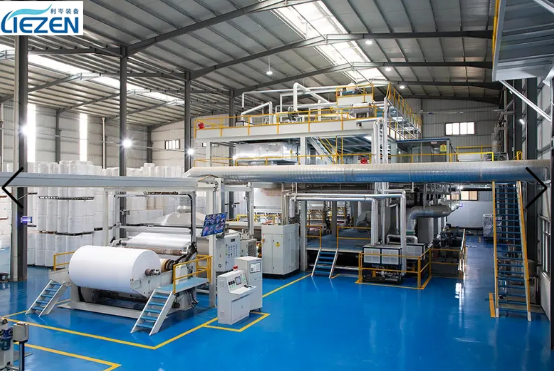
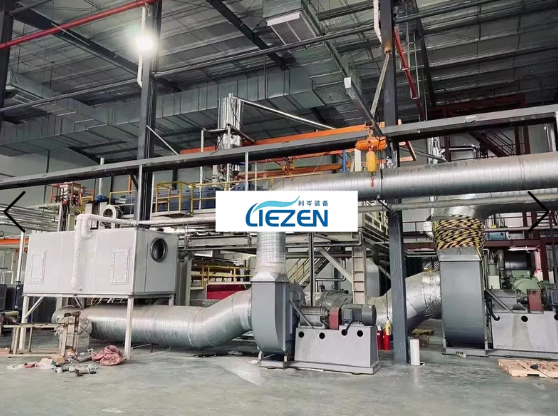
Actual machine view — review of a configured nonwoven fabric machine before shipment.
Next step: turn your parameter list into a project quotation
Send your target fabric type, gram weight band, effective width, layer architecture, required production speed and compliance standard. The Lizen team will respond with a configuration that matches the brief rather than a generic offer.
Email: managerl@lizen-equipment.com | WhatsApp: +86 188-8818-2509 | Web: lizen-equipment.com