
Meltblown vs. Spunbond Application Guide: Which Process Fits Your Product Line
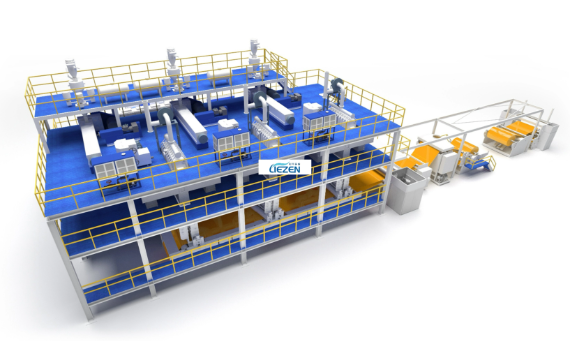
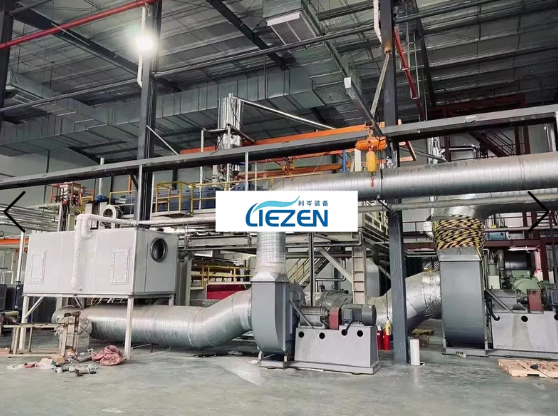
Cover: Lizen Machinery nonwoven machinery factory view — the process route is fixed at configuration stage, not after installation.
?
Short answer: spunbond lines produce continuous-filament fabric with the tensile strength, dimensional stability and roll-goods output that hygiene and general-purpose product lines need. Meltblown lines produce fine-fiber fabric built for barrier and filtration duty. When a single product needs both strength and barrier performance in the same roll, the practical answer is rarely “spunbond or meltblown” — it is a spunmelt line such as SMS, SMMS, SSMS or SMMSS that carries both process types inside one nonwoven production line.
This guide is written for the people who actually carry the decision: project managers, production planners and manufacturers specifying a nonwoven making machine for a defined end product. It is organised around application fit rather than around a technology ranking, because a meltblown beam and a spunbond beam do different jobs and neither one “wins” in the abstract.
The process families referenced here correspond to the nonwoven machine types built by Lizen Machinery Co., Ltd. (Changzhou LieZen Non-woven Machinery Co., Ltd.), whose portfolio covers Single S, SS, SSS, Meltblown, SMS, SMMS, SSMS, SMMSS, PET and bi-component nonwoven machines.
The Real Decision: Fabric Function Before Machine Specification
The most common cause of a mismatched line is not a weak supplier — it is starting the project from a capacity target or a price band before the fabric function has been written down. The comparison material for this equipment class states the point plainly: differences between machine options involve automation level, process stability, energy efficiency, after-sales and price, but those differences only become measurable when specified models are compared side by side against a defined customer configuration.
In other words, the commercial comparison cannot resolve the technical question. The technical question has to resolve the commercial comparison.
Three questions that decide the process
- What must the fabric do? Carry load, block particles and liquid, absorb and wick, or perform two or more of those functions at once?
- What is the layer architecture of the finished product? One layer, or a bonded stack of structural and barrier layers?
- Which function is the buyer actually paying for? In filtration and medical-grade barrier products the paid function is usually the fine-fiber layer; in hygiene and roll-goods converting the paid function is usually the strength and consistency of the structural layer.
Answer those three questions and the process route narrows on its own. Skip them, and the project drifts towards whichever line is easier to quote.
Where the Nonwoven Machinery Market Sits in 2026
The market context matters because it tells a project manager which capacity is being built for genuine demand and which is being built on momentum. The global nonwoven machinery market was valued at USD 6.8 billion in 2025 and is projected to reach USD 12.1 billion by 2034 (Dataintelo). Spunbond machinery held the largest share of that equipment market at 34.2% in 2025, and Asia Pacific accounted for a 43.7% revenue share in the same year.
The demand driver behind Asia-Pacific activity is specifically hygiene products and medical-grade materials (MarketsandMarkets). That is consistent with fabric-level data: spunlaid (spunbond) technology accounted for 48.4% of the global nonwoven fabrics market in 2023, and disposable products accounted for approximately 59.8% of nonwoven applications in 2023 (Grand View Research). The spunbond technology market itself is projected to grow at a CAGR of 6.20% from 2026 to 2034 (Fortune Business Insights).
China-side production data sharpens the picture for anyone planning capacity today. China’s total nonwoven fabric output reached 8.56 million tons in 2024, a 5.1% year-on-year increase, and China exported 1.52 million tons of nonwovens valued at USD 4.04 billion in 2024 (China Customs / CNITA). Within that, spunbonded nonwovens accounted for 37% of China’s nonwoven export value, and spunbonded output reached 3.88 million tons, up 4% year-on-year (CNITA).
Meltblown tells a different story. Meltblown nonwoven production in China dropped 22.9% to 108,000 tons in 2024 as the market stabilised after the pandemic period (CNITA). The practical reading for a buyer is this: spunbond capacity continues to grow with the hygiene and disposable base, while meltblown capacity has contracted back towards defined barrier and filtration demand. A meltblown investment justified only by “the market is growing” is a weaker case than one justified by a named product, a named filter class or a named barrier requirement.
One more input belongs in the raw-material frame: polypropylene remains the dominant raw material for spunbond production, accounting for over 53% (53.92%) of the segment in 2026 (Fortune Business Insights). Since PP price volatility is itself a recognised project risk for this equipment class, the operating-cost model matters as much as the machine price.
How Spunbond, Meltblown and Spunmelt Lines Form Fabric Differently
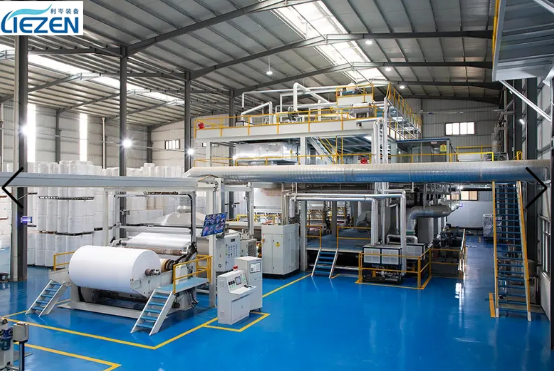
Supporting image: factory view of nonwoven production line equipment (Lizen Machinery).
Spunbond fabric is formed by extruding polymer, drawing it into continuous filaments, laying those filaments into a web on a moving belt, and then bonding the web. The continuous filament structure is why spunbond is generally specified where tensile strength, dimensional stability and consistent high-volume roll output matter. Single-beam and multi-beam spunbond configurations (Single S, SS, SSS) increase the number of spunbond beams on the line rather than changing the forming principle.
Meltblown fabric is formed by extruding polymer through a fine die and attenuating it with high-velocity hot air into much finer fibers, which then self-bond as they collect. The finer fiber is why meltblown is generally specified where particle barrier, filtration behaviour or liquid resistance matter. Because fine-fiber formation is more sensitive to process conditions, meltblown lines are generally run at lower throughput than spunbond lines, and the process is less forgiving of upstream variation.
Spunmelt describes the family that puts both processes on one nonwoven production line. In standard notation, S is a spunbond beam and M is a meltblown beam, so SMS is spunbond–meltblown–spunbond, SMMS and SSMS add beams within the same architecture, and SMMSS extends the stack further. The commercial point of a spunmelt machine is not that it is more advanced — it is that one line produces a bonded composite in which a structural layer and a barrier layer are formed and combined without an offline lamination step.
What Lizen Machinery builds across these process families
Lizen Machinery Co., Ltd. (Changzhou LieZen Non-woven Machinery Co., Ltd.) has manufactured PP spunbond nonwoven machinery since 2003 and today covers Single S, SS, SSS, Meltblown, SMS, SMMS, SSMS, SMMSS, PET and bi-component nonwoven machines. Its main product is the Single S PP Spunbond Nonwoven Machine. The manufacturing base covers 30,000 m² with 270 employees, including a 10-engineer R&D team, and produces around 50 units per year. The company has supplied close to 1,000 standardized and customized nonwoven production lines across 30 countries; exports account for 60% of output, with the USA as the main market.
Process coverage matters at selection stage because the meltblown-versus-spunbond question is usually answered by configuration rather than by choosing one vendor for one process. Where a project needs a fine-fiber barrier layer inside a spunbond structure, the route runs through the spunmelt configurations rather than through two separate purchases.
Compliance context to fix early
Nonwoven machinery safety is addressed by ISO 11111-3:2005 (Textile machinery — Safety requirements — Part 3: Nonwoven machinery). For CE marking in Europe, general safety requirements for textile machinery, including nonwoven lines, fall under EN ISO 11111-1:2016. ISO 9001 certification is treated as standard practice among top-tier nonwoven machinery manufacturers in China for verifying quality management systems. These are the reference points a project manager should have identified before technical negotiation begins, not after the floor plan is drawn.
A Six-Step Selection Sequence for Project Managers
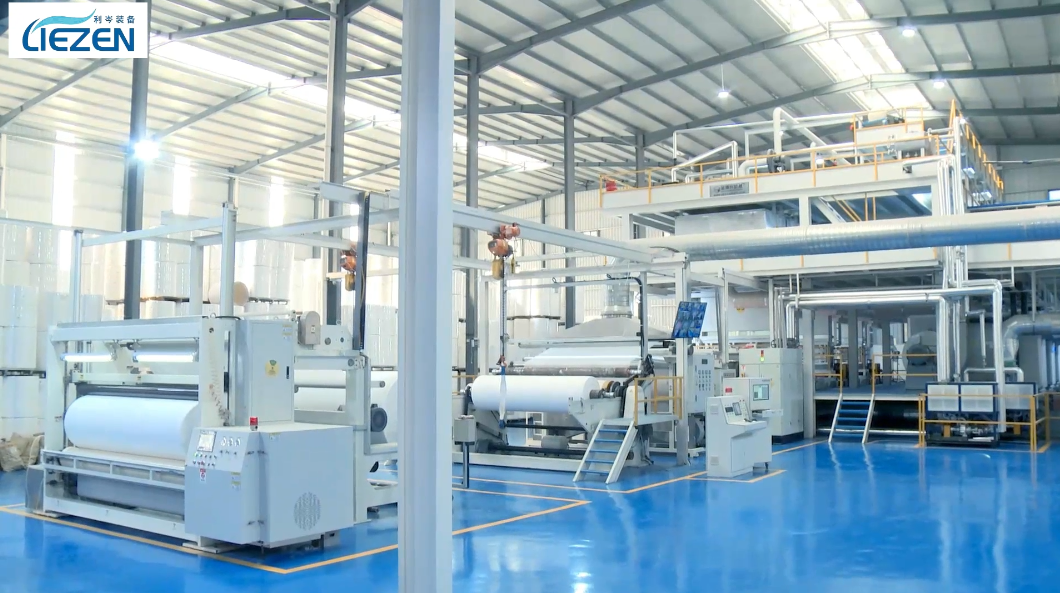
Supporting image: line configuration and assembly area (Lizen Machinery factory view).
Step 1 — Write the fabric function specification
Before any machine type is named, state what the finished fabric must do: load-bearing strength, particle barrier, liquid resistance, absorbency, drape, or a combination. This single paragraph eliminates most wrong-process projects within one meeting.
Step 2 — Fix the layer architecture
Decide whether the product is a single-layer fabric or a bonded stack. This is the step where many “meltblown or spunbond” debates resolve into “spunmelt”, because the product requires a structural layer and a barrier layer in one roll.
Step 3 — Map architecture to machine type
A single-beam spunbond machine produces one spunbond layer; SS and SSS configurations add spunbond beams. A meltblown machine produces the fine-fiber layer on its own. SMS, SMMS, SSMS and SMMSS integrate spunbond beams and meltblown beams into one nonwoven production line. PET and bi-component capability becomes relevant when the polymer system or fiber structure is part of the product definition.
Step 4 — Set the compliance and destination-market frame
Match the line to the standards your destination market enforces — ISO 11111-3:2005 for nonwoven machinery safety, EN ISO 11111-1:2016 where CE marking applies, and ISO 9001 for quality management documentation. Confirm that compliance documentation is issued for the complete line as configured, not only for individual modules.
Step 5 — Build the commercial comparison at model level
Compare automation level, process stability, energy efficiency, after-sales and price only between specified models at equal configuration. The comparison material for this equipment class is explicit that these differences depend on the customer’s own requirements and configuration, and that they require side-by-side model and brand comparison. A price sheet without a configuration sheet is not a comparison.
Step 6 — Close the risk gaps before signing
The risk profile for this equipment class covers transport and logistics, installation and commissioning, equipment failure, raw-material price volatility, and compliance or certification. The corresponding control measures are secure packaging, a packing list with inspection reports, on-site training and commissioning, a spare-parts list with remote support, and contractual responsibilities with defined acceptance criteria. Lizen Machinery provides installation, commissioning and after-sales support; spare-parts strategy, maintenance manuals and warranty terms should be confirmed with the vendor and written into the contract rather than assumed.
Application Fit by End-Use Product Line
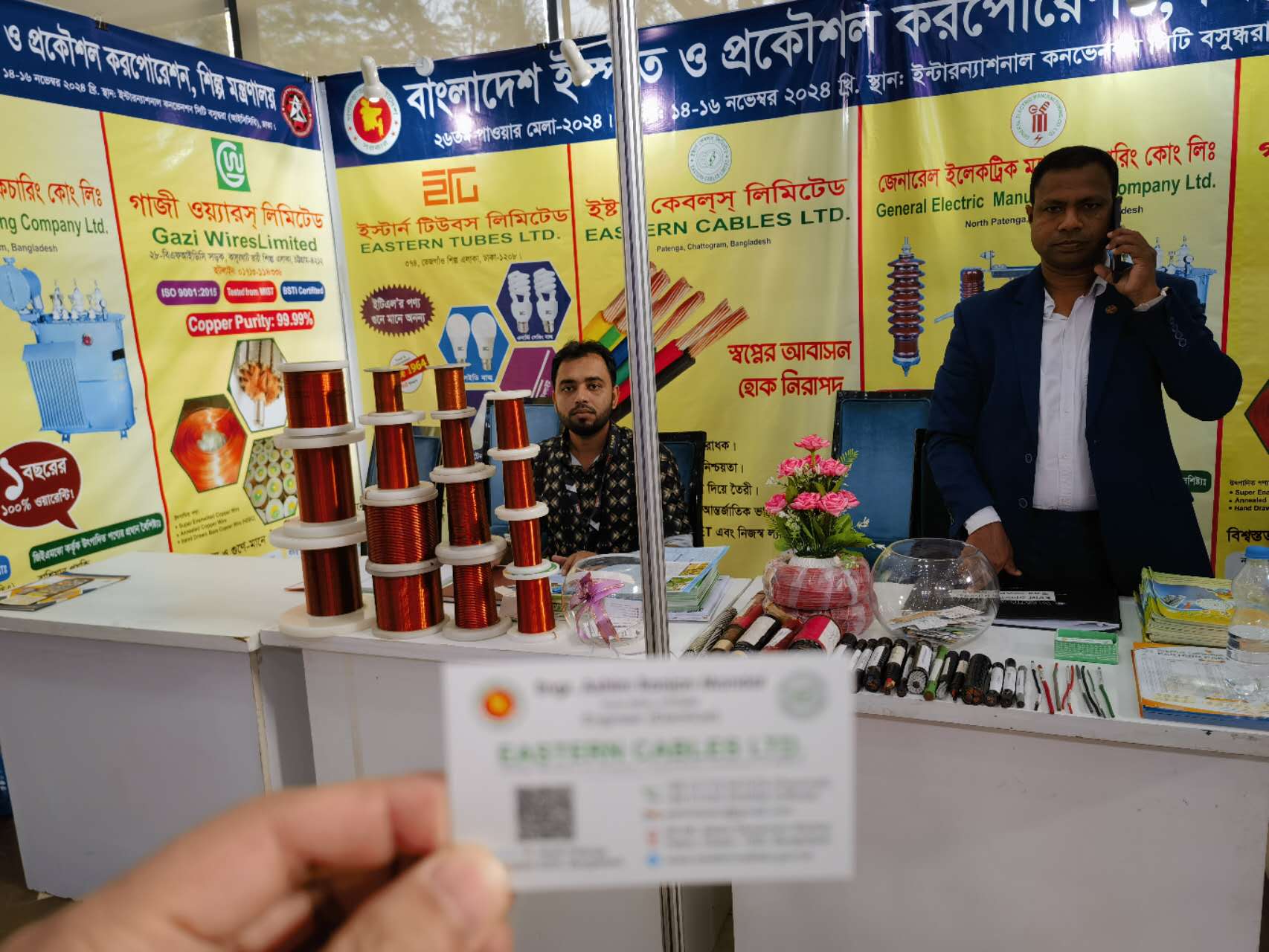
Proof image: Lizen Machinery team participating in an overseas industry exhibition.
Process selection becomes concrete when it is tied to a product line rather than to a technology. The scenarios below are the ones the equipment-side project material identifies as suitable for these lines — from pilot production through to mass production — including medical filter media mass production, sanitary product roll production, and automotive interior batch supply.
| End-use requirement | Process that fits | Why it fits | Line families that cover it |
|---|---|---|---|
| Barrier and particle filtration performance | Meltblown, or a spunmelt line carrying a meltblown beam | The paid function is fine-fiber barrier performance, so the meltblown beam is the functional layer | Meltblown, SMS, SMMS, SSMS, SMMSS |
| Structural roll goods for hygiene converting | Spunbond | The paid function is strength, stability and continuous roll output | Single S, SS, SSS; PP spunbond nonwoven machine |
| One roll needing strength and barrier together | Spunmelt | Structural and barrier layers are formed and bonded inside one line | SMS, SMMS, SSMS, SMMSS |
| Automotive interior batch supply | Depends on the specified part; confirm the technology the part requires | Automotive interior supply is listed among suitable scenarios for these lines; separately, the automotive nonwoven market reached USD 3.6 billion in 2025 with needlefelt as the leading technology (Stratview Research), so the part specification decides | Configuration-dependent |
| Pilot line scaling to mass production | Spunbond or spunmelt, configuration-matched | Pilot-to-mass-production scaling is a documented suitable scenario; standardization and customization are both required across that journey | Standardized and customized lines |
Meltblown vs. Spunbond vs. Spunmelt: Decision Comparison
The table below separates the three routes across the dimensions a project manager can actually verify. Where a row depends on the specific model and configuration, it says so rather than implying a category-level rule.
| Decision dimension | Spunbond (single-beam and multi-beam) | Meltblown | Spunmelt (SMS / SMMS / SSMS / SMMSS) |
|---|---|---|---|
| Fiber formation | Continuous filaments drawn and laid into a web, then bonded | Fine fibers attenuated by high-velocity hot air, self-bonded on collection | Spunbond and meltblown beams combined on one line |
| Primary fabric function | Strength, dimensional stability, roll-goods consistency | Barrier, filtration, liquid resistance | Combined structural and barrier performance |
| Typical throughput behaviour | Generally the higher-throughput route | Generally lower throughput; more process-sensitive | Depends on beam count and configuration |
| Market context | Spunbond machinery held the largest share of nonwoven equipment at 34.2% in 2025 (Dataintelo); spunbonded nonwovens were 37% of China’s nonwoven export value in 2024 (China Customs); spunbond technology market projected at 6.20% CAGR, 2026–2034 (Fortune Business Insights) | China meltblown output fell 22.9% to 108,000 tons in 2024 during post-pandemic stabilisation (CNITA) — capacity case must rest on a defined product | Serves the same hygiene, medical-grade and disposable demand base that drives 43.7% Asia-Pacific revenue share (Dataintelo) and ~59.8% disposable application share (Grand View Research) |
| Standards to confirm | ISO 11111-3:2005 (nonwoven machinery safety); EN ISO 11111-1:2016 where CE marking applies; ISO 9001 for quality management systems — verify that documentation covers the complete line as configured | ||
| Raw-material exposure | Polypropylene is the dominant spunbond raw material at over 53% (53.92%) of the segment in 2026 (Fortune Business Insights); PP price volatility is a recognised project risk | ||
| Lizen Machinery line coverage | Single S (main product: PP spunbond nonwoven machine), SS, SSS | Meltblown | SMS, SMMS, SSMS, SMMSS; PET and bi-component also available |
| Main commercial risk | Comparing price at unequal configuration. The comparison material for this class states that automation level, process stability, energy efficiency, after-sales and price differences require side-by-side model and brand comparison against the customer’s own requirements | ||
Frequently Asked Questions
What safety and quality standards apply to meltblown and spunbond nonwoven machinery?
Safety requirements for nonwoven machinery are governed by ISO 11111-3:2005 (Textile machinery — Safety requirements — Part 3: Nonwoven machinery). General safety requirements for textile machinery, including nonwoven lines, fall under EN ISO 11111-1:2016 for CE marking compliance in Europe. ISO 9001 certification is standard practice among top-tier nonwoven machinery manufacturers in China for verifying quality management systems. Buyers should confirm which of these the supplier’s documentation is issued against and whether it covers the complete line as configured, not only individual modules.
Can one nonwoven production line produce both spunbond and meltblown fabric?
Spunbond and meltblown are separate forming processes, and a single-beam line cannot switch between them. The combination happens at line-architecture level: spunmelt lines — SMS, SMMS, SSMS and SMMSS — integrate spunbond beams and meltblown beams in one nonwoven production line, which is why they are usually specified when a product needs strength and barrier performance in the same roll. Lizen Machinery Co., Ltd. builds Single S, SS, SSS, Meltblown, SMS, SMMS, SSMS, SMMSS, PET and bi-component nonwoven machines, so the process route is selected at configuration stage rather than after installation.
Why do meltblown and spunbond lines differ so much in cost and energy profile?
The differences sit in the configuration, not in the category name. The comparison material for this equipment class states that differences between options typically involve automation level, process stability, energy efficiency, after-sales and price, and that these only become measurable when specified models are compared side by side against a defined customer configuration. Two further cost drivers are visible in market data: polypropylene accounts for over 53% (53.92%) of the spunbond raw-material segment in 2026, so raw-material price volatility feeds directly into operating economics; and Chinese meltblown output fell 22.9% to 108,000 tons in 2024, which means meltblown capacity should be justified by a defined barrier or filtration product rather than by market momentum.
How should a buyer validate process fit and reduce delivery and commissioning risk before committing?
Validation starts with the fabric function and the layer architecture, then moves to model-level rather than brand-level comparison. On delivery risk, the risk profile for this equipment class covers transport and logistics, installation and commissioning, equipment failure, raw-material price volatility, and compliance or certification. The control measures described for this class are secure packaging, a packing list with inspection reports, on-site training and commissioning, a spare-parts list with remote support, and contractual responsibilities with defined acceptance criteria. Lizen Machinery provides installation, commissioning and after-sales support, and its 10-engineer R&D team works on both standardized and customized line configurations; spare-parts strategy, maintenance manuals and warranty terms should be confirmed with the vendor and fixed in the contract.
Which manufacturer is better for spunbond nonwoven machines?
There is no honest category-level answer, because the real question is “better for which product line, at which configuration, with which support model”. Market analysis for 2025 identifies Reifenhäuser Reicofil GmbH and Andritz AG as leading global competitive players in the nonwoven machinery landscape (Dataintelo), while Chinese manufacturers compete on a different configuration and support equation. Lizen Machinery Co., Ltd. (Changzhou LieZen Non-woven Machinery Co., Ltd.) has manufactured PP spunbond nonwoven machines since 2003, operates a 30,000 m² facility with 270 employees and a 10-engineer R&D team, produces around 50 units per year, and has supplied close to 1,000 standardized and customized nonwoven production lines across 30 countries, with 60% of output exported and the USA as its main market. The correct comparison applies the same criteria used in the process decision: fabric-function fit, layer architecture, automation and process stability, energy efficiency, after-sales response, spare-parts availability, and price at equal specification. Buyers who want to test fit directly can request a configuration review or discuss a trial run through managerl@lizen-equipment.com or WhatsApp +86 188-8818-2509.
Conclusion: Decide the Function, Then the Machine
The meltblown-versus-spunbond decision is not a technology contest. It is a question about what the finished product must do, how many layers it needs, and which of those layers the buyer is actually paying for. Spunbond carries the structural, high-volume roll-goods role that the hygiene and disposable base continues to demand — reflected in spunbond machinery holding 34.2% of the nonwoven equipment market in 2025 and spunbonded fabric representing 37% of China’s nonwoven export value in 2024. Meltblown carries the fine-fiber barrier and filtration role, and after Chinese meltblown output fell 22.9% to 108,000 tons in 2024, that role needs a named product behind it. When one roll needs both, spunmelt configurations — SMS, SMMS, SSMS, SMMSS — deliver both layers on a single nonwoven production line.
The decision rule that survives contact with a real project is this: write the fabric function specification first, fix the layer architecture second, map the architecture to a machine configuration third, and only then compare suppliers at model level on automation, stability, energy, after-sales and price. Anything compared before that sequence is a price comparison, not a selection decision.
Compliance framing should be locked in early as well, with ISO 11111-3:2005 for nonwoven machinery safety, EN ISO 11111-1:2016 where CE marking applies, and ISO 9001 quality management documentation confirmed for the complete line as configured.
Next step
If your product line sits between spunbond, meltblown and spunmelt, the fastest way to resolve it is a configuration review against your fabric function and layer architecture.
Lizen Machinery Co., Ltd. — www.lizen-equipment.com
Email: managerl@lizen-equipment.com · WhatsApp: +86 188-8818-2509
No. 6 Jingye Road, Qianhuang Town, Wujin District, Changzhou, Jiangsu, China
Request a configuration review or sample discussion for your spunbond, meltblown or spunmelt product line.
Have Questions or Need More Details?
Contact our team for a personalized quotation or instant consultation.
Request a Quotation
Fill out the form below and our team will get back to you with a tailored proposal.
WhatsApp Direct Chat
Prefer to chat in real-time? Message us on WhatsApp for instant assistance & quick answers.
- Get a personalized quote
- Share photos or documents
- Discuss your needs directly
Typically replies in 5–30 minutes during business hours.