Nonwoven Fabric Machine Guide: Spunbond vs Meltblown vs SMS
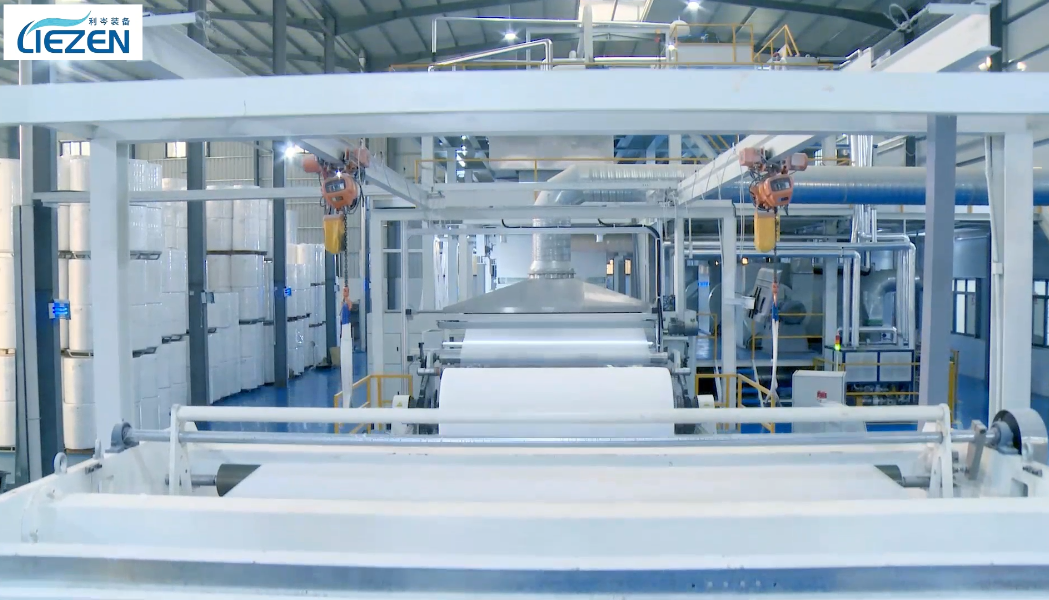
Nonwoven Fabric Machine Guide: Spunbond vs Meltblown vs SMS
Spunbond, meltblown and SMS lines all convert polypropylene granules into nonwoven fabric, but they do not produce the same fabric, and they are not interchangeable. Spunbond delivers strength, breathability and volume. Meltblown delivers very fine fibres and barrier performance. SMS — a spunmelt configuration — delivers both on one roll. Choosing a nonwoven fabric machine therefore begins with the finished product, not with the machine's maximum rating.
This guide is written for buyers in the research stage: importers, hygiene and medical converters, automotive interior suppliers, brand owners and procurement teams comparing nonwoven production line options before they shortlist suppliers. It sets out how the three configurations differ structurally, which criteria separate them in practice, how to match a line to a target application step by step, and where each type fits.
Problem Definition: Why "Nonwoven Fabric Machine" Is Not One Machine
Most early research begins with one search phrase — nonwoven fabric machine, nonwoven making machine or nonwoven production line — and quickly meets a wall of letter combinations: S, SS, SSS, M, SMS, SMMS, SSMS, SMMSS. These letters are not marketing labels. They describe how many spunbond (S) and meltblown (M) beams are stacked in one continuous line, and the stack determines what the finished fabric can do.
The practical difficulty is that a quotation for an "SMS line" and a quotation for an "SSS line" can look comparable on working width and speed while producing fabrics that serve entirely different customers. Because nonwoven machinery is configured around the end product, two lines with the same footprint may not be substitutes for one another at all.
Three questions sit underneath almost every early-stage comparison, and each one eliminates at least one configuration:
- What must the fabric do? Carry load and breathe, block particles and liquids, or both at once?
- How many functional layers does the product need? A single-layer base fabric and a three-layer barrier composite are different production problems.
- How much flexibility will the line need over its service life? A line purchased for one product and a line expected to cover a product family require different levels of customisation.
Short answer: specify spunbond when you need strength, breathability and output volume; specify meltblown when you need fine fibres for filtration or barrier layers; specify SMS or another spunmelt configuration when a single roll must combine spunbond strength with meltblown barrier performance. Nonwoven line naming such as Single S, SS, SSS, SMS, SMMS, SSMS and SMMSS simply records how those beams are stacked.
What Each Line Actually Produces
Spunbond Lines (S, SS, SSS)
Spunbond lines extrude continuous filaments, draw them, lay them into a web and bond that web, most commonly through hot calendering. The result is a fabric with good tensile strength, good dimensional stability and high productivity, which is why spunbond is the backbone technology of the nonwoven industry. Spunlaid (spunbond) technology accounted for 48.4% of the global nonwoven fabrics market share in 2023, according to Grand View Research.
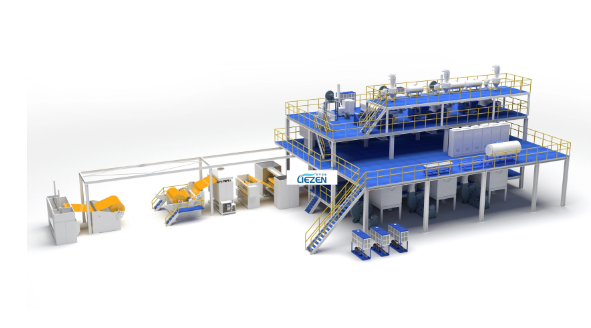
Layer count is simultaneously a capacity decision and a property decision. A single-beam line produces a lighter, simpler web; SS and SSS configurations add beams to raise output and improve web uniformity. Within the Lizen Machinery range, PP spunbond machines are built with effective widths from 1600 mm to 3200 mm. The SW-SS double-beam configuration runs at production speeds below 250 m/min with filament fineness between 1.5D and 2.0D, while the SW-SSS triple-beam configuration extends production speed to below 400 m/min with filament fineness between 1.5D and 2.5D.
Meltblown Lines (M)
Meltblown lines use high-velocity hot air to attenuate the polymer stream into very fine fibres that form a self-bonded web. Because those fibres are much finer than spunbond filaments, meltblown fabric delivers high filtration efficiency and strong barrier performance — the reason it dominates filtration media and protective material construction.
The trade-off is mechanical. A stand-alone meltblown web is weaker and often needs support from another layer, which is why meltblown is frequently deployed as a functional layer inside a composite rather than as the only layer in a product. Market behaviour reflects that specialist role: China's meltblown nonwoven production fell 22.9% to 108,000 tons in 2024 as pandemic-era filtration demand normalised, according to CNITA. By comparison, China's spunbonded nonwoven output reached 3.88 million tons in the same year, up 4% year on year.
SMS and Other Spunmelt Configurations
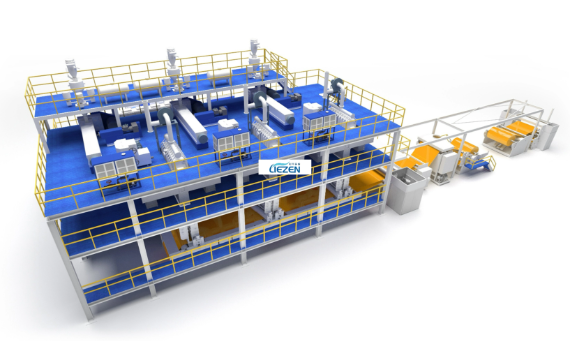
SMS is a spunmelt configuration in which a meltblown layer is sandwiched between two spunbond layers inside one continuous process. The outer spunbond layers supply strength and abrasion resistance; the inner meltblown layer supplies barrier and filtration performance. Because the layers are formed and bonded inline, SMS fabric holds composite properties without a separate lamination step — a structural advantage that also removes a downstream process from the plant.
The same logic extends to SMMS, SSMS and SMMSS, which add beams for higher barrier, higher output, or both. Lizen Machinery builds the SW-SMMS spunmelt configuration with an effective width of 1600–3200 mm, production speed below 400 m/min, mechanical speed below 450 m/min and filament fineness of 1.5–2.0D.
Industry Background: Why Buyers Are Comparing These Lines Now
The comparison is not theoretical. The global nonwoven machinery market was valued at USD 6.8 billion in 2025 and is projected to reach USD 12.1 billion by 2034, according to Dataintelo, and Spunbond technology is projected to grow at a CAGR of 6.20% from 2026 to 2034, according to Fortune Business Insights. Within the equipment market, spunbond machinery held the largest share of nonwoven equipment at 34.2% in 2025, also reported by Dataintelo.
Demand is concentrated in Asia Pacific, which dominated the nonwoven machinery market with a 43.7% revenue share in 2025. MarketsandMarkets attributes that position to increasing demand for hygiene products and medical-grade materials. China alone produced 8.56 million tons of nonwoven fabric in 2024, a 5.1% year-on-year increase, and exported 1.52 million tons valued at USD 4.04 billion, according to China Customs and CNITA. Spunbonded nonwovens accounted for 37% of that export value.
Two structural signals matter for machine selection. First, disposable products dominate nonwoven applications with approximately 59.8% share in 2023 (Grand View Research), which keeps demand concentrated on high-throughput spunbond and spunmelt lines rather than on specialist low-volume configurations. Second, the automotive nonwoven market reached USD 3.6 billion in 2025, with needlefelt as the leading technology in that segment (Stratview Research); PP-based spunbond and spunmelt lines serve the automotive interior applications where web-based materials are required. Polypropylene remains the dominant raw material for spunbond nonwoven production, accounting for over 53% of the segment in 2026 (Fortune Business Insights), which means a buyer's raw material strategy is usually already decided before the machine comparison begins.
Comparing the Three Lines: Six Decision Criteria
The following criteria are the ones that change a purchasing decision. They are presented as a decision framework rather than a performance ranking, because none of the three configurations is universally superior — each is optimised for a different fabric outcome.
1. Web Structure and Layer Count
Spunbond produces a filament web from one or more spunbond beams. Meltblown produces a fine-fibre web from a single meltblown process. SMS and its variants produce a layered web in which spunbond and meltblown beams alternate in a defined sequence. Layer count defines the ceiling on composite performance: you cannot create a barrier function by running a spunbond-only line faster, and you cannot create spunbond-level tensile strength on a stand-alone meltblown line.
2. Filament and Fibre Fineness
Fineness is expressed in denier (D) for spunbond filaments and is a direct lever on softness, coverage and filtration behaviour. A finer filament generally means softer hand, better coverage and lower stiffness; a coarser filament generally means higher strength and more stable web formation at speed. In the Lizen range, spunbond configurations are built to 1.5–2.5D depending on model, and the spunmelt SW-SMMS configuration is built to 1.5–2.0D. Buyers should specify the fineness target together with the fabric gram weight target, since the two interact.
3. Bonding Method
Spunbond webs are typically consolidated by thermal calender bonding, which fixes strength and surface character. Meltblown webs are largely self-bonded during fibre attenuation, with bonding control coming from the die and air system. Spunmelt configurations bond all layers inline in one pass, which is what allows an SMS fabric to behave as a single material rather than three loosely related layers. The bonding method determines whether the finished fabric feels like a base material, a filter medium, or a composite barrier fabric.
4. Line Speed and Mechanical Speed
Production speed and mechanical speed are separate figures, and buyers should compare both. Production speed describes the line running at a stable commercial output; mechanical speed describes the machine's design ceiling. A configuration quoted at a high mechanical speed but a lower production speed is not underperforming — it is being quoted honestly. For reference within the Lizen range, the SW-SS spunbond configuration is rated at production speed below 250 m/min with mechanical speed below 300 m/min, while the SW-SSS spunbond and SW-SMMS spunmelt configurations are rated at production speed below 400 m/min with mechanical speed below 450 m/min.
5. Raw Material Compatibility
Polypropylene (PP) is the main raw material for both spunbond and meltblown production, and the equipment itself is typically built from carbon steel, stainless steel, alloy parts and electrical components. Where a buyer intends to run multiple polymers or bi-component structures, raw material compatibility has to be confirmed against the extruder, die and temperature control design before commitment — this is a configuration question, not an after-purchase upgrade.
6. Flexibility, Changeover and Customisation
Flexibility is the least visible cost item and one of the most consequential. A line designed for one product family may be efficient but rigid; a line designed for a product range needs adjustable layer count, width and thermal profiles. Customisation in this category commonly covers different working widths, layer counts, electrostatic treatment, flame-retardant options and medical-grade clean standards, along with matched auxiliary equipment such as traction units, winding and rewinding, fans and air compressors, heating and temperature control, and slitting, cutting and packaging equipment.
Side-by-Side Comparison Table
The table below compares the three configurations qualitatively. It deliberately avoids cross-type numeric claims, because performance figures belong to a specific line configuration and a specific fabric target, not to a machine category.
| Comparison Criterion | Spunbond (S / SS / SSS) | Meltblown (M) | SMS / Spunmelt (SMS, SMMS, SSMS, SMMSS) |
|---|---|---|---|
| Web structure | Continuous filament web from one or more spunbond beams | Fine-fibre self-bonded web from a meltblown process | Meltblown layer bonded between spunbond layers inline |
| Filament / fibre character | Continuous filaments; Lizen range builds to 1.5–2.5D depending on model | Very fine fibres; fineness driven by die and hot-air control | Spunbond outer layers with a fine-fibre core; SW-SMMS builds to 1.5–2.0D |
| Bonding method | Thermal calender bonding as the standard route | Self-bonding during fibre attenuation, with process control on die and air | Inline bonding across all layers in one continuous pass |
| Primary fabric strength | Strong, dimensionally stable, abrasion resistant | Lower as a stand-alone web; normally supported by another layer | Combines spunbond strength with meltblown barrier in one roll |
| Barrier / filtration behaviour | Breathable with limited barrier function | High filtration efficiency and strong barrier performance | Barrier performance retained from the meltblown core layer |
| Line complexity | Lower to medium, rising from S to SSS | Medium; sensitive to die and hot-air system control | Higher; multi-beam and multi-process integration |
| Raw material | Polypropylene (PP), the dominant spunbond material | Polypropylene (PP) | Polypropylene (PP) |
| Typical production role | High-volume base fabric | Functional filtration or barrier layer | Composite fabric for barrier-critical end products |
| Typical application fit | Hygiene topsheet and backsheet, agricultural covers, packaging and bags, apparel and home textiles | Filtration media, absorbent and barrier layers | Medical gowns and drapes, masks and protective wear, premium hygiene products |
| Customisation demand | Moderate — width, layer count, gram weight range | High — fibre fineness and air-system behaviour | High — layer sequence, width, layer count and thermal profile |
Step-by-Step: Matching a Line to Your Target Application
The following sequence reflects the order in which the decisions actually constrain each other. Working through it in this order prevents the most common research-stage error: selecting a line speed first and then trying to find a product that justifies it.
- Start from the finished product. Name the specific product you intend to sell — for example a sanitary napkin topsheet, a medical drape, a filtration medium or an agricultural cover. Product category determines whether barrier performance is required at all, which is the first filter between spunbond and spunmelt.
- Fix the fabric gram weight and property targets. Gram weight, softness, tensile strength and elongation targets translate directly into filament fineness and bonding parameters. Without these targets, a supplier can only quote a generic configuration.
- Decide where barrier performance comes from. If the product needs a barrier, decide whether it will come from a meltblown layer inside the line (SMS or a wider spunmelt stack) or from a separate downstream process. Inline composite construction removes a process step but raises line complexity and cost.
- Confirm raw material compatibility. PP is the base material for spunbond and meltblown production. If alternative polymers or bi-component structures are planned, confirm extruder, die and temperature control compatibility as part of the specification, not as a later modification.
- Set the output requirement and check it against line speed. Convert your commercial output target into a required production speed at your target gram weight and working width. Then compare the quoted production speed — not the mechanical speed — against that requirement. Working widths across the Lizen range are built from 1600 mm to 3200 mm, which gives buyers room to scale output through width as well as speed.
- Map the auxiliary and downstream equipment. A production line is more than the forming section. Traction units, winding and rewinding, fans and air compressors, heating and temperature control, and slitting, cutting and packaging equipment all affect achievable output and fabric handling quality. Confirm what is included in the scope and what is not.
- Validate with a sample before locking the configuration. Sample or trial-stage validation is the point at which a proposed layer structure is tested against the real product requirement. This step protects both sides: it confirms the configuration before capital commitment and gives the manufacturer a concrete target rather than a specification sheet.
Use Cases: Which Line Fits Which Product
Hygiene and Sanitary Products
Disposable hygiene applications — sanitary napkins, diapers, masks, protective wear — are the largest demand block in the nonwoven market, with disposable products holding approximately 59.8% of application share in 2023 (Grand View Research). Spunbond and spunmelt lines serve this segment because they can produce the base fabrics, topsheets, backsheets and barrier layers that these products are built from at commercial volume. For a sanitary napkin or diaper converter, the choice usually sits between an SSS-type spunbond line for base fabric volume and an SMS-type spunmelt line where barrier performance is also required.
Medical and Protective Materials
Medical gowns, drapes, masks and protective wear depend on the combination of strength and barrier performance that spunmelt construction provides, which is why SMS and wider spunmelt stacks are common in this segment. Buyers in this category often add custom requirements such as medical-grade clean standards, electrostatic treatment and flame-retardant options — all of which belong in the original configuration discussion rather than in a later retrofit.
Automotive Interior
The automotive nonwoven market reached USD 3.6 billion in 2025, with needlefelt as the leading technology in that segment (Stratview Research). PP-based spunbond and spunmelt lines cover the automotive interior applications where web-based PP materials are used, and these projects typically involve dedicated line configurations rather than standard hygiene configurations. Buyers in this category should specify the interior component and its performance requirement, since automotive procurement usually involves qualification cycles that a generic configuration cannot satisfy.
Packaging, Bags and Agricultural Covers
Nonwoven bags, packaging materials and agricultural covers typically require strength, breathability and cost efficiency rather than barrier performance. This is spunbond territory — single-beam and multi-beam spunbond configurations produce the base fabric at the volume these applications need, and the absence of a meltblown layer keeps line complexity and operating cost lower.
How Lizen Machinery Builds These Lines
Lizen Machinery Co., Ltd. is a nonwoven machinery manufacturer based in Changzhou, Jiangsu, China, founded in 2003. The company operates a 30,000 m² factory with 270 employees, including an R&D team of 10 engineers, and produces approximately 50 units per year. Exports account for 60% of its output, with the United States as its main market. Across almost 20 years of operation, the company reports having supplied almost 1,000 complete sets of standardised and customised nonwoven production lines in 30 countries.
The product scope covers PP spunbond nonwoven fabric machines in Single S, SS, SSS, meltblown, SMS, SMMS, SSMS and SMMSS configurations, along with PET and bi-component nonwoven machines. Supply models range from single-machine supply and turnkey production line delivery to process modification and upgrade projects, and lines can be specified for continuous or semi-continuous operation with different levels of automation and online monitoring.
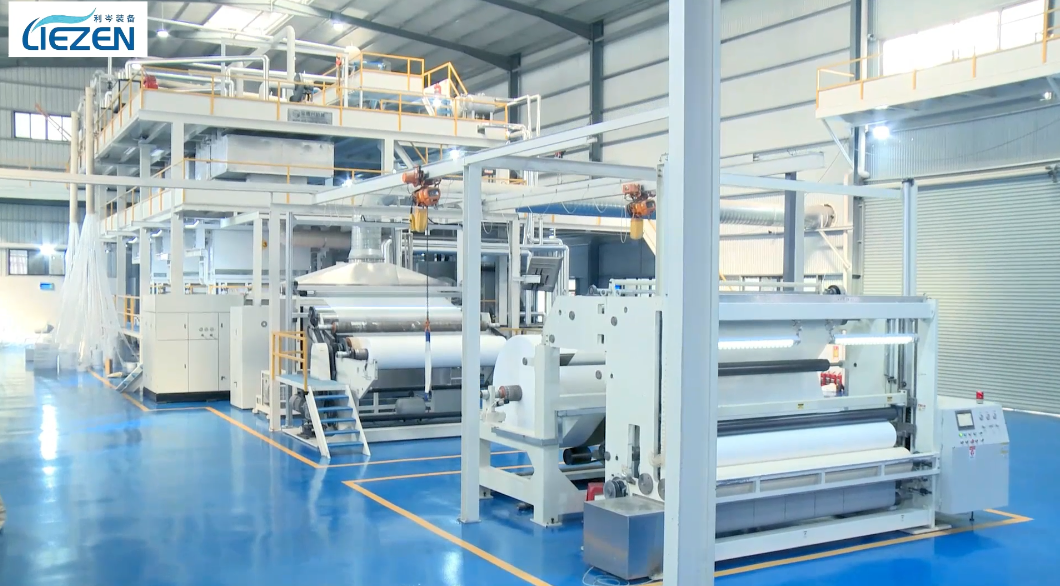
Four design priorities sit behind these configurations: high production stability with uniform fabric gram weight; flexible formula adjustment so one line can cover multiple nonwoven products; a modular structure that simplifies maintenance; and high automation that reduces manual labour cost. A matched closed temperature control system is used to improve the finished product qualification rate — a detail worth verifying on any line, because gram weight uniformity and temperature stability are the two variables that most often separate a smooth commissioning from a long one.
Representative configurations in the current range are summarised below. All listed models are computerised and supplied through factory outlet.
| Configuration | Model | Effective Width | Production Speed | Mechanical Speed | Fineness of Filament |
|---|---|---|---|---|---|
| Double-beam PP spunbond | SW-SS | 1600–3200 mm | <250 m/min | <300 m/min | 1.5–2.0D |
| Triple-beam spunbond | SW-SSS | 1600–3200 mm | <400 m/min | <450 m/min | 1.5–2.5D |
| Spunmelt composite | SW-SMMS | 1600–3200 mm | <400 m/min | <450 m/min | 1.5–2.0D |
Comparing these three rows illustrates the decision logic in this article. The double-beam spunbond line targets base fabric volume at a moderate speed band with a narrower fineness window. The triple-beam spunbond line raises speed and widens the fineness window, which supports a broader product range within spunbond. The spunmelt composite keeps a narrow fineness window but adds layer structure, which is what buyers pay for when barrier performance is the requirement.
Frequently Asked Questions
What does a nonwoven fabric machine manufacturer actually supply?
A nonwoven fabric machine manufacturer supplies the core equipment that converts polymer granules into nonwoven fabric, and typically the complete line around it. The scope normally covers the extrusion and spinning section, the web-forming and bonding section, and the matched auxiliary equipment — traction units, winding or rewinding, fans and air compressors, heating and temperature control, and slitting, cutting and packaging equipment. Supply models range from single-machine supply and turnkey production line delivery to process modification and upgrade projects. Lizen Machinery Co., Ltd., based in Changzhou, Jiangsu, China, builds PP spunbond and spunmelt lines in Single S, SS, SSS, meltblown, SMS, SMMS, SSMS and SMMSS configurations, alongside PET and bi-component nonwoven machines.
Which configuration should a first-time buyer choose?
There is no universal default, because the answer follows the finished product. Spunbond is usually the starting point when the target is a high-volume base fabric such as hygiene topsheet or backsheet, agricultural cover, nonwoven bag or packaging material, because the process is simpler and the web is strong and breathable. A meltblown layer is added when filtration or barrier performance is required. SMS or a wider spunmelt stack is chosen when one fabric must combine strength and barrier in a single roll, as in medical gowns, drapes and masks. Deciding from the product specification first, rather than from the machine rating, is what keeps the choice defensible.
What raw material do spunbond, meltblown and SMS lines use?
Polypropylene (PP) is the main raw material for both spunbond and meltblown production, and PP remains the dominant material for spunbond nonwovens, accounting for over 53% of the segment in 2026, according to Fortune Business Insights. The equipment itself is typically built from carbon steel, stainless steel, alloy parts and electrical components. Buyers planning multi-polymer or bi-component production should confirm polymer compatibility against the extruder, die and temperature control design as part of the original specification rather than as a later upgrade.
Which specification figures should I compare between quotations?
Four figures do most of the work: effective width, filament fineness in denier, production speed and mechanical speed. Effective width sets the output ceiling at a given speed. Filament fineness sets the softness, coverage and strength balance. Production speed describes stable commercial output, while mechanical speed describes the design ceiling — a quotation that separates the two is more informative than one that lists only the higher number. Within the Lizen range, for example, the SW-SS spunbond configuration is quoted at production speed below 250 m/min and mechanical speed below 300 m/min, while SW-SSS and SW-SMMS are quoted at production speed below 400 m/min and mechanical speed below 450 m/min, all at effective widths from 1600 mm to 3200 mm.
What safety and quality standards apply to nonwoven machinery?
Safety requirements for nonwoven machinery are governed by ISO 11111-3:2005, Textile machinery — Safety requirements — Part 3: Nonwoven machinery, published by the International Organization for Standardization. In Europe, EN ISO 11111-1:2016 sets general safety requirements for textile machinery for CE marking compliance, published by the European Committee for Standardization. On the quality-management side, ISO 9001 certification is commonly used across the industry to verify quality management systems. Buyers should ask for the specific standard reference and the scope it applies to, rather than accepting a certificate name alone.
How do I request a sample or a quotation for a specific configuration?
Because line configuration follows the target fabric, the most useful first step is to send the intended end product, target gram weight, expected output and preferred working width, together with any layer-structure requirement. With those inputs, a manufacturer can propose a matching layer count and fineness window, and confirm what can be validated at sample or trial stage before capital commitment. Lizen Machinery can be reached through www.lizen-equipment.com or by email at managerl@lizen-equipment.com.
Conclusion: Decide From the Fabric, Not the Machine Type
Spunbond, meltblown and SMS lines are not three grades of the same product. They are three production logics that end in different fabrics. Spunbond lines convert PP into strong, breathable, high-volume base fabrics. Meltblown lines convert PP into fine-fibre webs with filtration and barrier performance, usually as a functional layer inside a composite. Spunmelt configurations such as SMS and SMMS combine both into one inline process, which is why they command a higher configuration complexity — and why they are the right answer only when the product genuinely needs strength and barrier in the same roll.
The decision framework reduces to four checks: define the finished product, fix the gram weight and property targets, decide where barrier performance comes from, and verify that the quoted production speed and effective width match the output plan. Everything else — layer count, fineness window, bonding method, auxiliary equipment and customisation — follows from those four answers.
Next Step: Match a Line to Your Product
Send your target end product, gram weight, expected output and preferred working width. Lizen Machinery will map it to a spunbond, meltblown or spunmelt configuration and confirm what can be validated at sample stage.
Website: www.lizen-equipment.com
Email: managerl@lizen-equipment.com
Tel / WhatsApp: +86-18888182509
Address: No. 6 Jingye Road, Qianhuang Town, Wujin District, Changzhou, Jiangsu, China